MAJOR ENVIRONMENTAL ISSUES IN
INDIA
Sanika Shah
60878
ECONOMIC DEVELOPMENT CAUSES
ENVIRONMENTAL ISSUES IN INDIA
Uncontrolled growth of
urbanization
Industrialization
Expansion- intensification of
agriculture
The destruction of forests-
deforestation
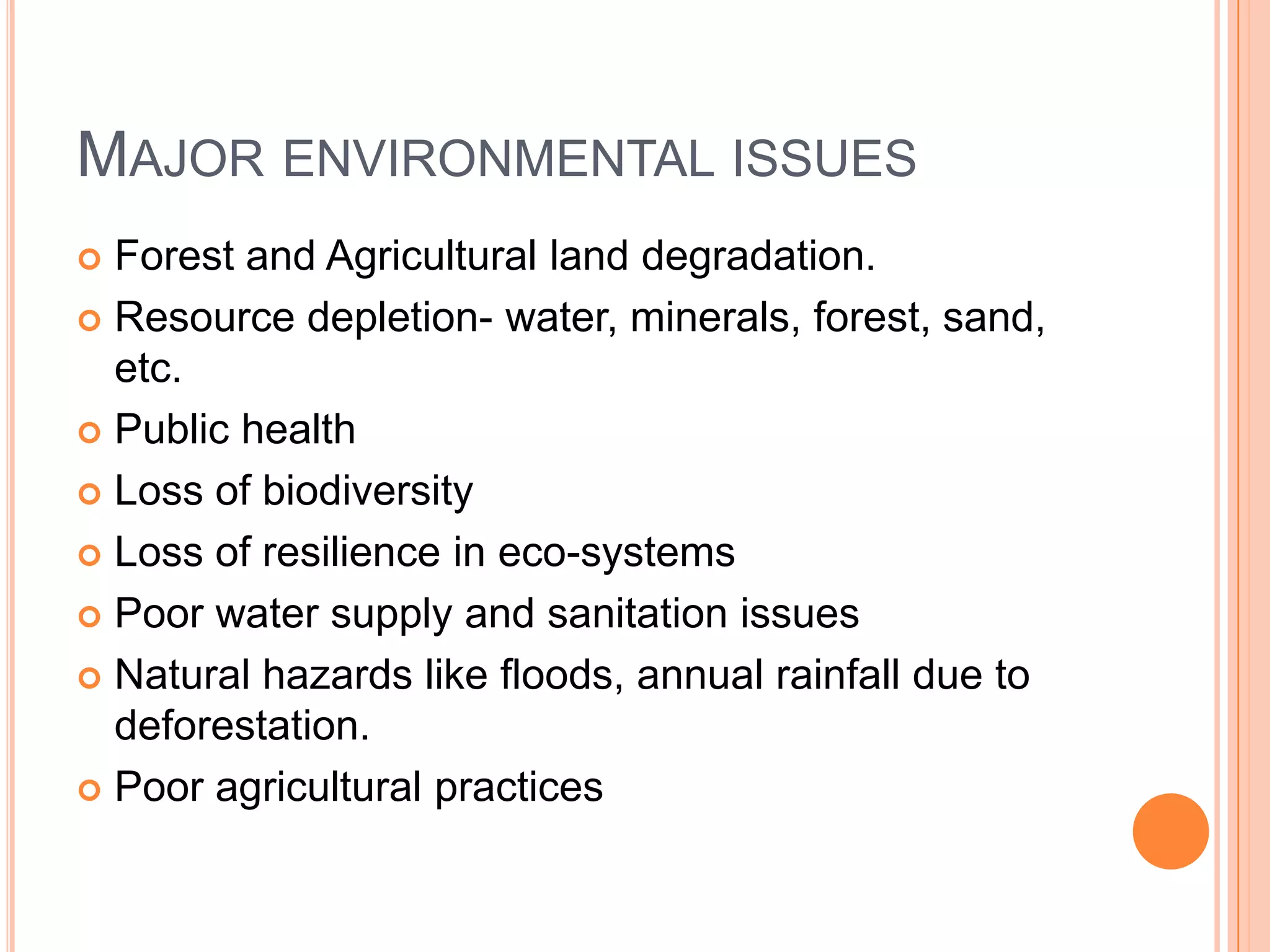
MAJOR ENVIRONMENTAL ISSUES
 Forest and Agricultural land degradation.
 Resource depletion- water, minerals, forest, sand,
etc.
 Public health
 Loss of biodiversity
 Loss of resilience in eco-systems
 Poor water supply and sanitation issues
 Natural hazards like floods, annual rainfall due to
deforestation.
 Poor agricultural practices
CONT’D
 Civil conflicts involving natural resources---
coal, forest land for cultivation.
 Increasing pollution have led to an increase in air
pollution, shifting precipitation patterns and
declining intervals of drought recurrence
 Resource misdistribution.
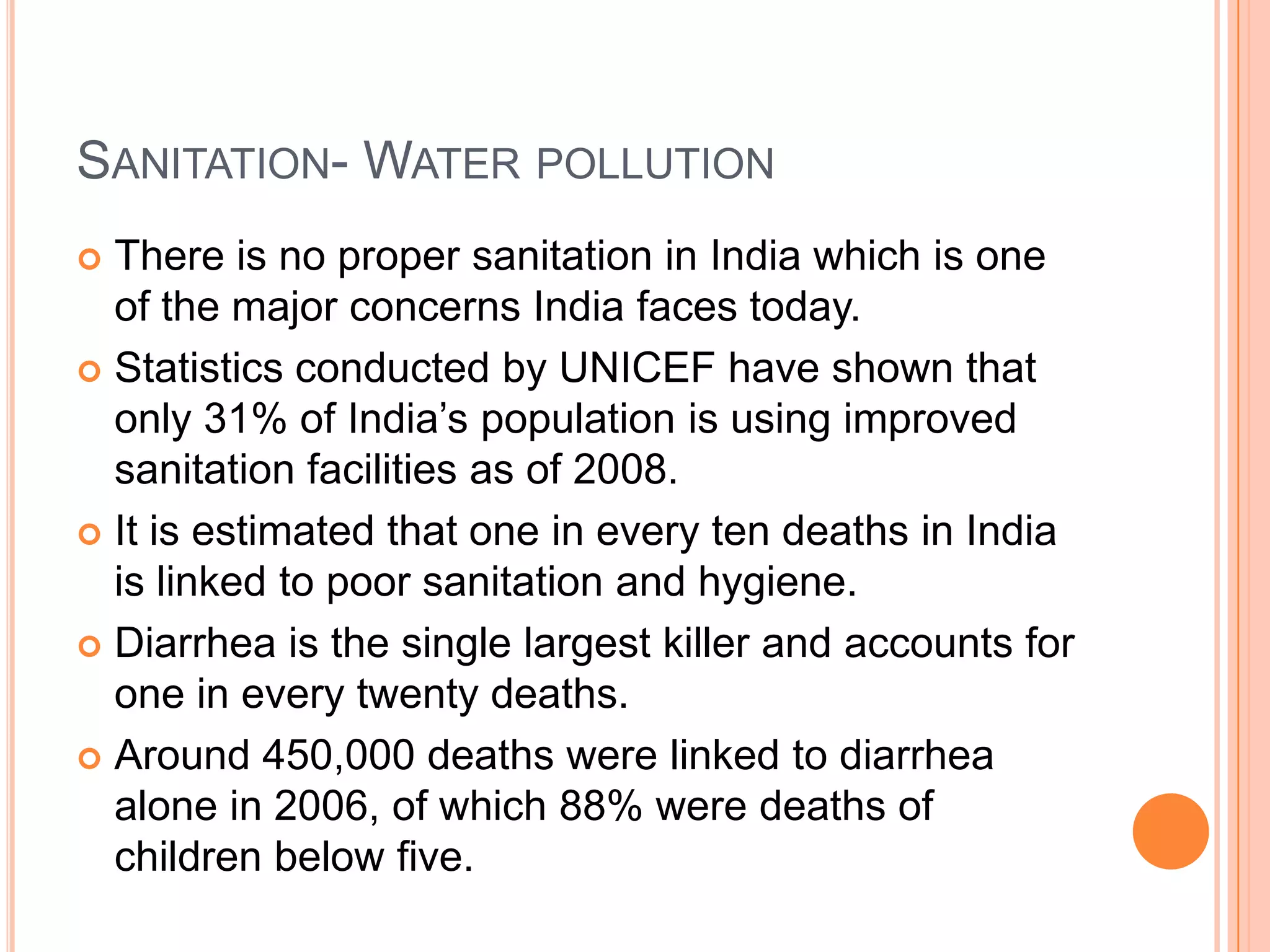
SANITATION- WATER POLLUTION
 There is no proper sanitation in India which is one
of the major concerns India faces today.
 Statistics conducted by UNICEF have shown that
only 31% of India’s population is using improved
sanitation facilities as of 2008.
 It is estimated that one in every ten deaths in India
is linked to poor sanitation and hygiene.
 Diarrhea is the single largest killer and accounts for
one in every twenty deaths.
 Around 450,000 deaths were linked to diarrhea
alone in 2006, of which 88% were deaths of
children below five.
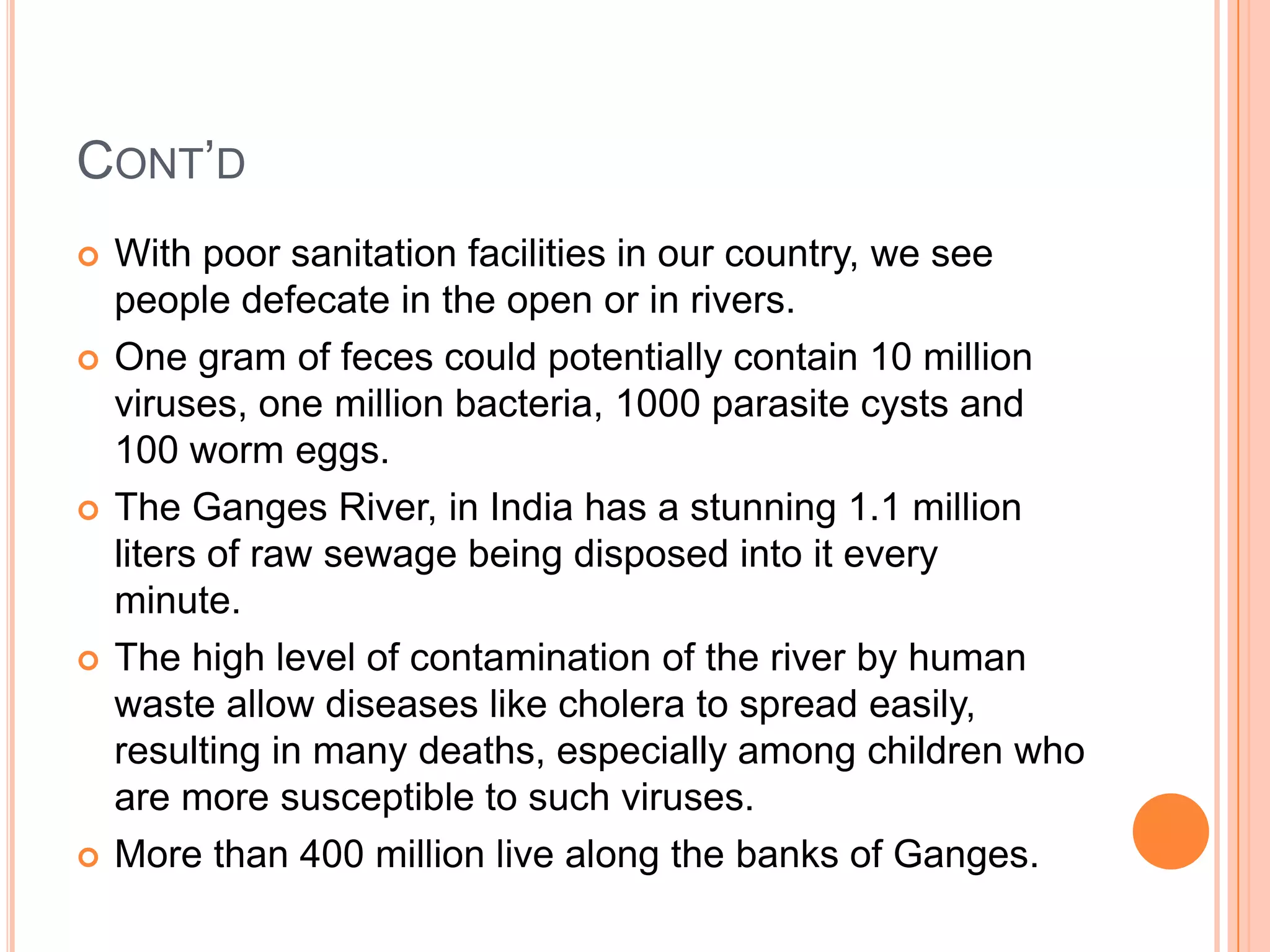
CONT’D
 With poor sanitation facilities in our country, we see
people defecate in the open or in rivers.
 One gram of feces could potentially contain 10 million
viruses, one million bacteria, 1000 parasite cysts and
100 worm eggs.
 The Ganges River, in India has a stunning 1.1 million
liters of raw sewage being disposed into it every
minute.
 The high level of contamination of the river by human
waste allow diseases like cholera to spread easily,
resulting in many deaths, especially among children who
are more susceptible to such viruses.
 More than 400 million live along the banks of Ganges.
DEFORESTATION
 Began in the 19th century with the arrival of British
colonialism
 Railroads and roadways built by the British
exacerbated the situation
 Population explosion-Large areas of forests have
been cleaned for agriculture, factories, road and rail
tracks, industries, mining and quarrying have
seriously affected the forest.
 Fires-Forest fires destroy trees, seeds and the
animal life.
 Pests-Many kinds of insect pests destroy forests
by eating the shoots and spreading diseases.
CONT’D
 Grazing and gnawing mammals-These animal
seat, trample the young plants, and damage their
trunks and roots.
 Weather-Storm and snow damage the forests.
These natural forces are beyond human power to
control.
 Dams-Barriers constructed across rivers to prevent
floods submerge and kill large tracts of forests.
 Jhuming (Shifting cultivation)-In certain parts of
India, forests are burnt and the ash is mixed with
the soil and the land used for cultivation.
EFFECTS OF DEFORESTATION
 Rainforest microbes are extremely efficient at breaking
down and recycling waste organic matter - the leaf litter
and layers of detritus on the ground. As a result, almost
no nutrients reach the forest soil and it is consequently
poor.
 Removal of the trees allows the soil to dry out and the
little humus that exists to deteriorate. This causes the
rainforest microbes to die and the soil becomes largely
inert, biologically.
 The degraded soil is also prone to erosion by wind and
when land floods, it can be washed away.
 Because of the resulting poor soil conditions, sustained
farming after clearance is difficult and people regularly
move on, looking for more fertile soil.
 Causes loss in biodiversity
POPULATION AND ECONOMIC GROWTH
 These are contributing to many serious
environmental calamities in India.
 Heavy pressure on land
 Land degradation
 Habitat destruction
 Changing consumption pattern has led to rising
demand for energy
 The final outcome of this are air pollution, global
warming, climate change, depletion of natural
resources, water scarcity and water pollution.
AIR POLLUTION
 Indian cities are polluted by vehicle and industrial
emissions
 Road dust due to vehicles also contributing up to
33% of air pollution
 In cities like Bangalore around 50% of children
suffer from asthma
 One of the biggest causes of air pollution in India is
from the Transport system
 Excessive air pollution was causing the white
marble of the Taj Mahal was turning yellow
 The air pollution in the big cities is rising to such an
extent that it is now 2.3 times higher than the
amount recommended by WHO
LAND POLLUTION
 Although the British started deforestation in India,
the pressures to modernize since the partition of
1947 have only increased the rates of
deforestation, which causes soil erosion which
leads to Land Pollution
 Land pollution in India is due to pesticides and
fertilizers as well as soil errosion
 In March 2009, the issue of Uranium poising in
Punjab came into light, caused by flyash ponds of
thermal power stations, which reportedly lead to
severe birth defects in children in the Faridkot and
Bhatinda districts of Punjab
CONSERVATION
 Forest cover
 Scrub cover, to maintain healthy soil
 Sustainable development – A certain proximity of
land can produce only a limited amount of
resources to sustain only a limited amount of
people
 Growing trees
 More dustbins in all public places
 Encourage a cleaner city is a better city to live in
 The End

Major environmental issues in india

  • 1.
    MAJOR ENVIRONMENTAL ISSUESIN INDIA Sanika Shah 60878
  • 2.
    ECONOMIC DEVELOPMENT CAUSES ENVIRONMENTALISSUES IN INDIA Uncontrolled growth of urbanization Industrialization Expansion- intensification of agriculture The destruction of forests- deforestation
  • 3.
    MAJOR ENVIRONMENTAL ISSUES Forest and Agricultural land degradation.  Resource depletion- water, minerals, forest, sand, etc.  Public health  Loss of biodiversity  Loss of resilience in eco-systems  Poor water supply and sanitation issues  Natural hazards like floods, annual rainfall due to deforestation.  Poor agricultural practices
  • 4.
    CONT’D  Civil conflictsinvolving natural resources--- coal, forest land for cultivation.  Increasing pollution have led to an increase in air pollution, shifting precipitation patterns and declining intervals of drought recurrence  Resource misdistribution.
  • 5.
    SANITATION- WATER POLLUTION There is no proper sanitation in India which is one of the major concerns India faces today.  Statistics conducted by UNICEF have shown that only 31% of India’s population is using improved sanitation facilities as of 2008.  It is estimated that one in every ten deaths in India is linked to poor sanitation and hygiene.  Diarrhea is the single largest killer and accounts for one in every twenty deaths.  Around 450,000 deaths were linked to diarrhea alone in 2006, of which 88% were deaths of children below five.
  • 6.
    CONT’D  With poorsanitation facilities in our country, we see people defecate in the open or in rivers.  One gram of feces could potentially contain 10 million viruses, one million bacteria, 1000 parasite cysts and 100 worm eggs.  The Ganges River, in India has a stunning 1.1 million liters of raw sewage being disposed into it every minute.  The high level of contamination of the river by human waste allow diseases like cholera to spread easily, resulting in many deaths, especially among children who are more susceptible to such viruses.  More than 400 million live along the banks of Ganges.
  • 8.
    DEFORESTATION  Began inthe 19th century with the arrival of British colonialism  Railroads and roadways built by the British exacerbated the situation  Population explosion-Large areas of forests have been cleaned for agriculture, factories, road and rail tracks, industries, mining and quarrying have seriously affected the forest.  Fires-Forest fires destroy trees, seeds and the animal life.  Pests-Many kinds of insect pests destroy forests by eating the shoots and spreading diseases.
  • 9.
    CONT’D  Grazing andgnawing mammals-These animal seat, trample the young plants, and damage their trunks and roots.  Weather-Storm and snow damage the forests. These natural forces are beyond human power to control.  Dams-Barriers constructed across rivers to prevent floods submerge and kill large tracts of forests.  Jhuming (Shifting cultivation)-In certain parts of India, forests are burnt and the ash is mixed with the soil and the land used for cultivation.
  • 10.
    EFFECTS OF DEFORESTATION Rainforest microbes are extremely efficient at breaking down and recycling waste organic matter - the leaf litter and layers of detritus on the ground. As a result, almost no nutrients reach the forest soil and it is consequently poor.  Removal of the trees allows the soil to dry out and the little humus that exists to deteriorate. This causes the rainforest microbes to die and the soil becomes largely inert, biologically.  The degraded soil is also prone to erosion by wind and when land floods, it can be washed away.  Because of the resulting poor soil conditions, sustained farming after clearance is difficult and people regularly move on, looking for more fertile soil.  Causes loss in biodiversity
  • 11.
    POPULATION AND ECONOMICGROWTH  These are contributing to many serious environmental calamities in India.  Heavy pressure on land  Land degradation  Habitat destruction  Changing consumption pattern has led to rising demand for energy  The final outcome of this are air pollution, global warming, climate change, depletion of natural resources, water scarcity and water pollution.
  • 12.
    AIR POLLUTION  Indiancities are polluted by vehicle and industrial emissions  Road dust due to vehicles also contributing up to 33% of air pollution  In cities like Bangalore around 50% of children suffer from asthma  One of the biggest causes of air pollution in India is from the Transport system  Excessive air pollution was causing the white marble of the Taj Mahal was turning yellow  The air pollution in the big cities is rising to such an extent that it is now 2.3 times higher than the amount recommended by WHO
  • 14.
    LAND POLLUTION  Althoughthe British started deforestation in India, the pressures to modernize since the partition of 1947 have only increased the rates of deforestation, which causes soil erosion which leads to Land Pollution  Land pollution in India is due to pesticides and fertilizers as well as soil errosion  In March 2009, the issue of Uranium poising in Punjab came into light, caused by flyash ponds of thermal power stations, which reportedly lead to severe birth defects in children in the Faridkot and Bhatinda districts of Punjab
  • 16.
    CONSERVATION  Forest cover Scrub cover, to maintain healthy soil  Sustainable development – A certain proximity of land can produce only a limited amount of resources to sustain only a limited amount of people  Growing trees  More dustbins in all public places  Encourage a cleaner city is a better city to live in
  • 17.