Gamificationsolving the engagement
problem?
Sebastian Deterding (@dingstweets)
Games & Play in Communication
14 April 2016, ITU Copenhagen
c b
Does
gamification
solve our
engagement
problemS?
Simple answer
MU
http://www.flickr.com/photos/ewanrayment/1250158647
Slightly more
complicated answer
<1>
gamification?
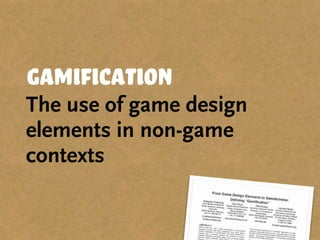
Gamification
The use of game design
elements in non-game
contexts
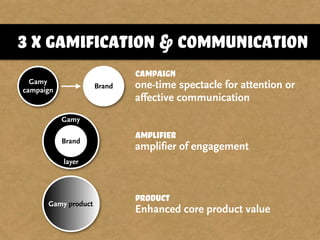
3 x Gamification & COMMUNICATION
Gamy
campaign
Brand
Brand
Gamy
Gamy product
Campaign
one-time spectacle for attention or
affective communication
AMPLIFIER
amplifier of engagement
Product
Enhanced core product value
layer
Campaign1
Amplifier2
Product3
<2>
engagement
problems?
Buy!
from one-time transaction …
Upload!
Comment!
Tag!
Digg!
Forward!
Invite!
Bookmark!
Retweet!
Share!
Add friend!
Design!
Mark as Spam!
Like!
Answer!
Vote!
Register Now!
Subscribe!
to sustained inter-action
a
threefold
shift
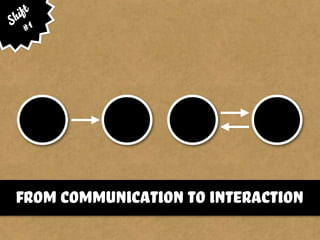
From communication to interaction
Shift
#1
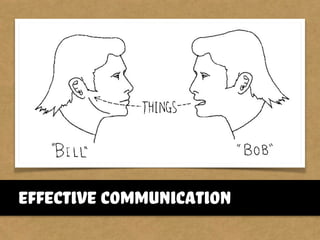
Effective communication
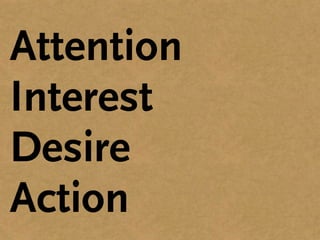
A
I
D
A
Attention
Interest
Desire
Action
Attention
Interest
Desire
What we
excel at
Where we
can learnAction
Attention, Interest, Desire ...
Finding
Deciding
Acting
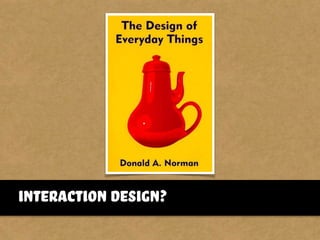
Interaction design?
A
B
from usability …
Shift
#2
… to motivation
loyalty programs?
From extrinsic to intrinsic
Shift
#3
http://www.flickr.com/photos/diego_rivera/4261964210
extrinsic motivation
intrinsic motivation
http://www.flickr.com/photos/areyoumyrik/308908967
what intrinsic motivation
drives the most
passionate customers?
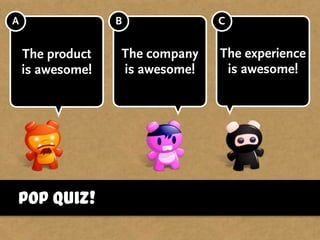
Pop Quiz!
The product
is awesome!
The company
is awesome!
The experience
is awesome!
A B C
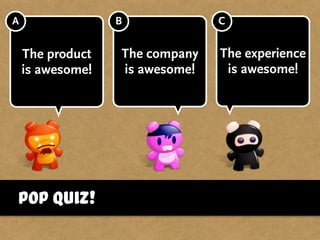
Pop Quiz!
The product
is awesome!
The company
is awesome!
The experience
is awesome!
A B C
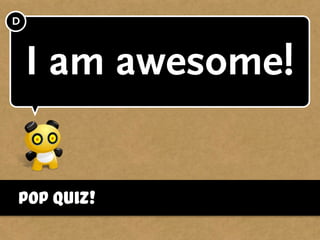
Pop Quiz!
I am awesome!
D
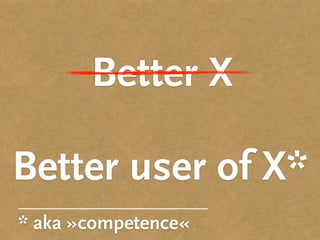
Better X

Better user of X*
* aka »competence«
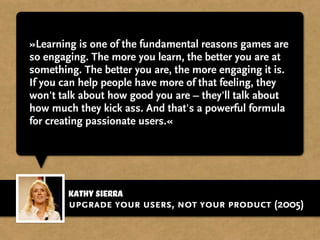
»Learning is one of the fundamental reasons games are
so engaging. The more you learn, the better you are at
something. The better you are, the more engaging it is.
If you can help people have more of that feeling, they
won't talk about how good you are – they'll talk about
how much they kick ass. And that's a powerful formula
for creating passionate users.«
Kathy Sierra
upgrade your users, not your product (2005)
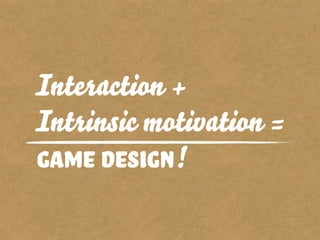
Game design!
Interaction +
Intrinsic motivation =
Raph Koster
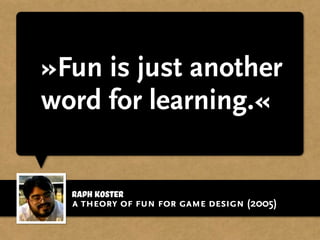
»Fun is just another
word for learning.«
a theory of fun for game design (2005)
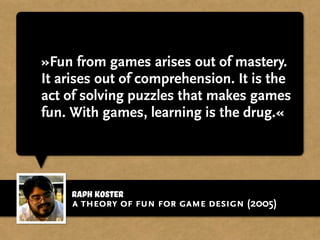
»Fun from games arises out of mastery.
It arises out of comprehension. It is the
act of solving puzzles that makes games
fun. With games, learning is the drug.«
Raph Koster
a theory of fun for game design (2005)
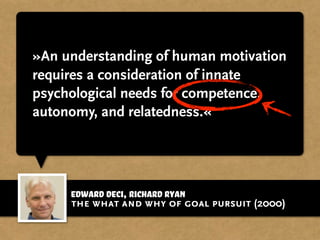
Edward Deci, Richard Ryan
»An understanding of human motivation
requires a consideration of innate
psychological needs for competence,
autonomy, and relatedness.«
the what and why of goal pursuit (2000)
<3>
how?
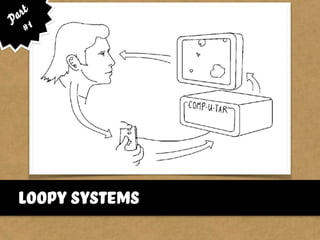
loopy systems
Part
#1
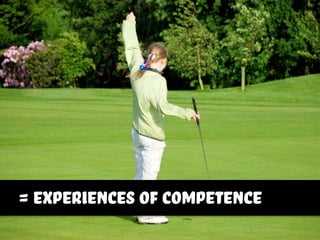
goals …
+ RULES ...
= interesting challenges
+ Feedback ...
http://www.flickr.com/photos/bodgerbrooks/1315419080
= experiences of competence
feedback without challenge
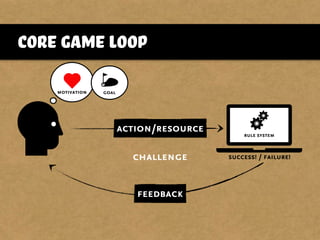
core game loop
motivation
rule system
goal
success! / failure!
action/resource
feedback
challenge
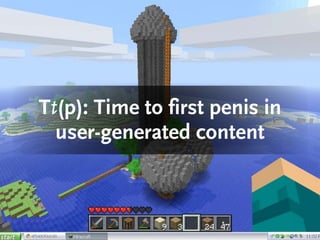
Tt(p): Time to first penis in
user-generated content
tools & license for expression
https://www.flickr.com/photos/benimoto/2084853203
real experience design™
Part
#2
the inherent-additive model of experience
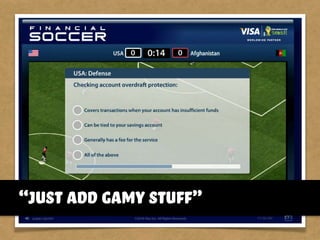
“just add gamy stuff”
a
resounding
failure …
http://www.flickr.com/photos/8147452@N05/2913356030/sizes/o/
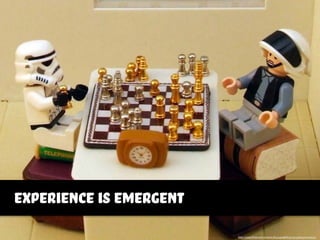
experience is emergent
the systemic-emergent model of experience
https://www.flickr.com/photos/benimoto/2084853203
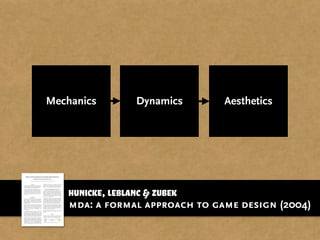
AestheticsMechanics Dynamics
Hunicke, LeBlanc & Zubek
mda: a formal approach to game design (2004)
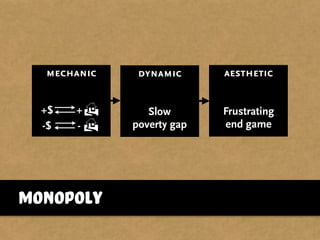
Monopoly
aesthetic
Frustrating
end game
mechanic dynamic
Slow
poverty gap
+$ !+
-$ !-
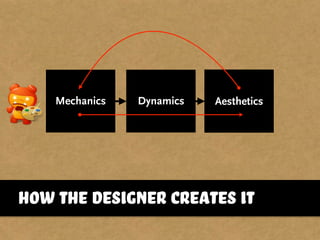
AestheticsMechanics Dynamics
How the designer creates it
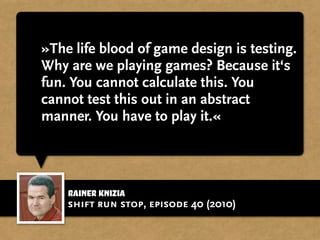
Rainer Knizia
»The life blood of game design is testing.
Why are we playing games? Because it‘s
fun. You cannot calculate this. You
cannot test this out in an abstract
manner. You have to play it.«
shift run stop, episode 40 (2010)
<4>
to conclude
Does
gamification
solve our
engagement
problemS?
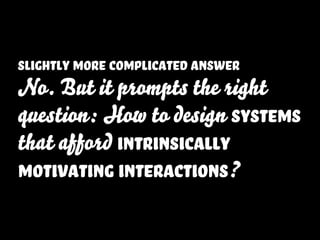
Slightly more complicated answer
No. But it prompts the right
question: How to design systems
that afford intrinsically
motivating interactions?
sebastian@codingconduct.cc
@dingstweets
codingconduct.cc
thank you.

Gamification: Solving the Engagement Problem in Communication?