un-boring
meetings
Sebastian Deterding (@dingstweets)
Alibis for Interaction
November 11, 2016
c b
chapter 1
Introduction
are meetings
boring?
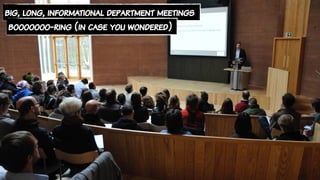
big, long, informational department meetings
booooooo-ring (in case you wondered)
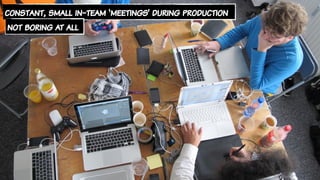
constant, small in-team ‘meetings’ during production
not boring at all
when
are meetings
boring?
Meetings are boring when
we don’t give or receive
something we find relevant.
observation
so how do we cut
straight to the
relevant bits?
we can’t.
teaser
the problem is not
how we do meetings.
it’s that we do them.
teaser
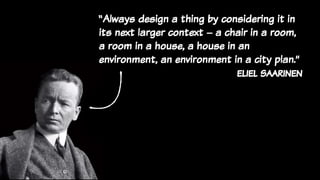
“Always design a thing by considering it in
its next larger context – a chair in a room,
a room in a house, a house in an
environment, an environment in a city plan.”
eliel saarinen
there are organisational
contexts that make
meetings both (1)
unavoidably boring and (2)
unavoidable.
teaser
how do we redesign
organisational contexts to
avoid doing (unavoidably
boring) meetings?
the real question
but first, some hygiene
meeting design does matter*
* Links at the end
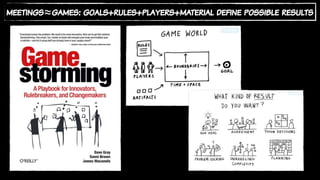
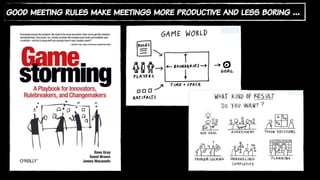
meetings≈games: goals+rules+players+material define possible results
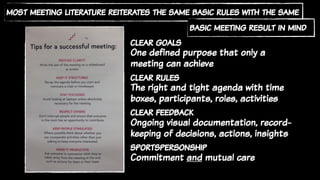
most meeting literature reiterates the same basic rules with the same
clear goals
One defined purpose that only a
meeting can achieve
clear rules
The right and tight agenda with time
boxes, participants, roles, activities
clear feedback
Ongoing visual documentation, record-
keeping of decisions, actions, insights
sportspersonship
Commitment and mutual care
basic meeting result in mind
chapter 2
Shared ground, or:
Why meetings
must be boring
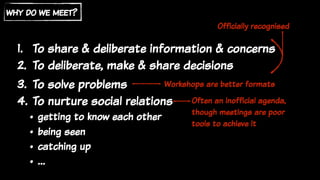
1. To share & deliberate information & concerns
2. To deliberate, make & share decisions
why do we meet?
3. To solve problems
4. To nurture social relations
• getting to know each other
• being seen
• catching up
• …
Officially recognised
Workshops are better formats
Often an inofficial agenda,
though meetings are poor
tools to achieve it
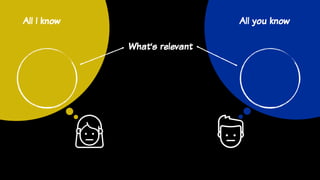
All I know All you know
What’s relevant
What I know
is relevant
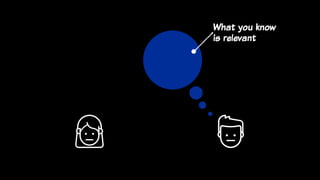
What you know
is relevant
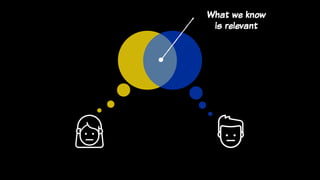
What we know
is relevant
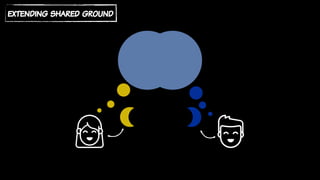
extending shared ground
?
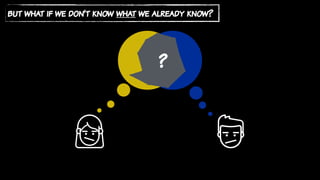
but what if we don’t know what we already know?
?
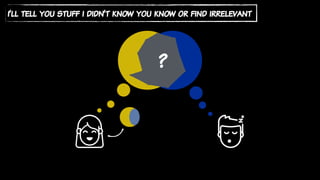
i’ll tell you stuff i didn’t know you know or find irrelevant
?
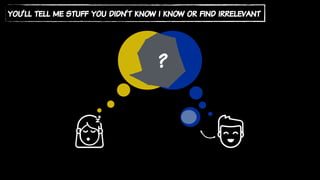
you’ll tell me stuff you didn’t know i know or find irrelevant
?
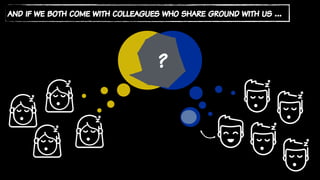
and if we both come with colleagues who share ground with us …
“Some of you will already be
familiar with this, but …”
“This may not be relevant to
everyone here, but …”
common give-aways
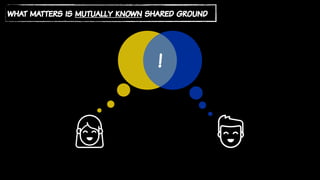
what matters is mutually known shared ground
!
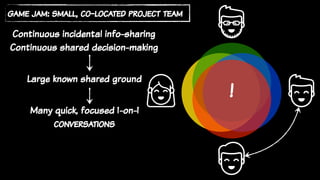
game jam: small, co-located project team
Continuous incidental info-sharing
Continuous shared decision-making
Many quick, focused 1-on-1
conversations
Large known shared ground
!
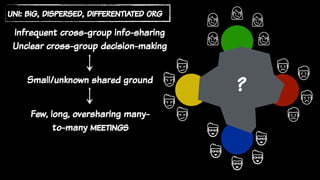
uni: big, dispersed, differentiated org
Infrequent cross-group info-sharing
Unclear cross-group decision-making
Few, long, oversharing many-
to-many meetings
?Small/unknown shared ground
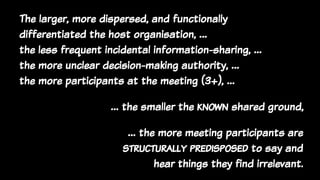
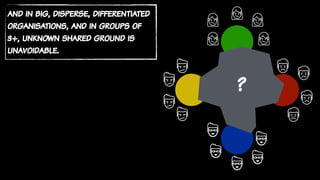
The larger, more dispersed, and functionally
differentiated the host organisation, …
the less frequent incidental information-sharing, …
the more unclear decision-making authority, …
the more participants at the meeting (3+), …
… the more meeting participants are
structurally predisposed to say and
hear things they find irrelevant.
… the smaller the known shared ground,
chapter 3
Accountability, or:
Why we still meet
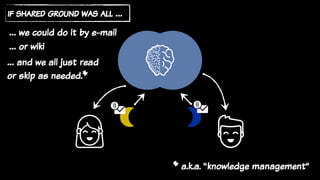
if shared ground was all …
… we could do it by e-mail
… or wiki
… and we all just read
or skip as needed.*
* a.k.a. “knowledge management”
and then …
“Sorry, I didn’t see that e-mail,
maybe it landed in my spam folder/
you know my inbox/…”
accountability in real life: legal serving
accountability in real life: witnesses and signatures
accountability in digital life: read receipt
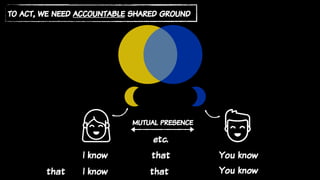
to act, we need accountable shared ground
mutual presence
I know You knowthat
You know
that
I know that
etc.
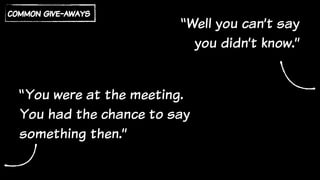
“Well you can’t say
you didn’t know.”
“You were at the meeting.
You had the chance to say
something then.”
common give-aways
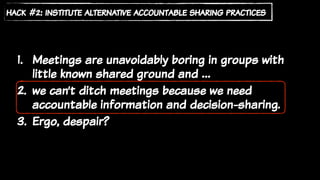
1. Meetings are unavoidably boring in groups with
little known shared ground and …
2. we can’t ditch meetings because we need
accountable information and decision-sharing.
3. Ergo, despair?
what we learned so far
chapter 4
Advanced meeting
avoidance
1. Meetings are unavoidably boring in groups with
little known shared ground and …
2. we can’t ditch meetings because we need
accountable information and decision-sharing.
3. Ergo, despair?
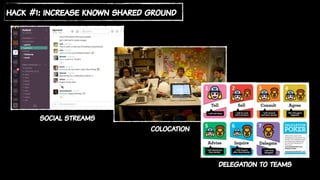
hack #1: increase known shared ground
social streams
colocation
delegation to teams
1. Meetings are unavoidably boring in groups with
little known shared ground and …
2. we can’t ditch meetings because we need
accountable information and decision-sharing.
3. Ergo, despair?
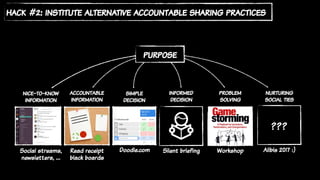
hack #2: institute alternative accountable sharing practices
purpose
Social streams,
newsletters, …
nice-to-know
information
accountable
information
Read receipt
black boards
simple
decision
Doodle.com
informed
decision
Silent briefing
problem
solving
nurturing
social ties
Workshop Alibis 2017 :)
???
chapter 5
Summary
good meeting rules make meetings more productive and less boring …
?
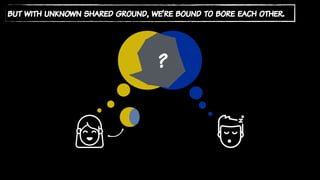
but with unknown shared ground, we’re bound to bore each other.
and in big, disperse, differentiated
organisations, and in groups of
3+, unknown shared ground is
unavoidable.
?
we stick to meetings because they are our default for producing
accountability in organisations
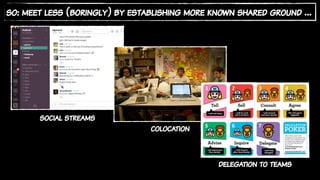
so: meet less (boringly) by establishing more known shared ground …
social streams
colocation
delegation to teams
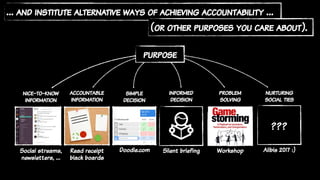
… and institute alternative ways of achieving accountability …
purpose
Social streams,
newsletters, …
nice-to-know
information
accountable
information
Read receipt
black boards
simple
decision
Doodle.com
informed
decision
Silent briefing
problem
solving
nurturing
social ties
Workshop Alibis 2017 :)
???
(or other purposes you care about).
sebastian@codingconduct.cc
@dingstweets
codingconduct.cc
thank you.

Un-Boring Meetings

  • 1.
  • 2.
  • 3.
  • 4.
    big, long, informationaldepartment meetings booooooo-ring (in case you wondered)
  • 5.
    constant, small in-team‘meetings’ during production not boring at all
  • 6.
  • 7.
    Meetings are boringwhen we don’t give or receive something we find relevant. observation
  • 8.
    so how dowe cut straight to the relevant bits?
  • 9.
  • 10.
    the problem isnot how we do meetings. it’s that we do them. teaser
  • 11.
    “Always design athing by considering it in its next larger context – a chair in a room, a room in a house, a house in an environment, an environment in a city plan.” eliel saarinen
  • 12.
    there are organisational contextsthat make meetings both (1) unavoidably boring and (2) unavoidable. teaser
  • 13.
    how do weredesign organisational contexts to avoid doing (unavoidably boring) meetings? the real question
  • 14.
  • 15.
    meeting design doesmatter* * Links at the end
  • 16.
  • 17.
    most meeting literaturereiterates the same basic rules with the same clear goals One defined purpose that only a meeting can achieve clear rules The right and tight agenda with time boxes, participants, roles, activities clear feedback Ongoing visual documentation, record- keeping of decisions, actions, insights sportspersonship Commitment and mutual care basic meeting result in mind
  • 18.
    chapter 2 Shared ground,or: Why meetings must be boring
  • 19.
    1. To share& deliberate information & concerns 2. To deliberate, make & share decisions why do we meet? 3. To solve problems 4. To nurture social relations • getting to know each other • being seen • catching up • … Officially recognised Workshops are better formats Often an inofficial agenda, though meetings are poor tools to achieve it
  • 20.
    All I knowAll you know What’s relevant
  • 21.
  • 22.
  • 23.
  • 24.
  • 25.
    ? but what ifwe don’t know what we already know?
  • 26.
    ? i’ll tell youstuff i didn’t know you know or find irrelevant
  • 27.
    ? you’ll tell mestuff you didn’t know i know or find irrelevant
  • 28.
    ? and if weboth come with colleagues who share ground with us …
  • 29.
    “Some of youwill already be familiar with this, but …” “This may not be relevant to everyone here, but …” common give-aways
  • 30.
    what matters ismutually known shared ground !
  • 31.
    game jam: small,co-located project team Continuous incidental info-sharing Continuous shared decision-making Many quick, focused 1-on-1 conversations Large known shared ground !
  • 32.
    uni: big, dispersed,differentiated org Infrequent cross-group info-sharing Unclear cross-group decision-making Few, long, oversharing many- to-many meetings ?Small/unknown shared ground
  • 33.
    The larger, moredispersed, and functionally differentiated the host organisation, … the less frequent incidental information-sharing, … the more unclear decision-making authority, … the more participants at the meeting (3+), … … the more meeting participants are structurally predisposed to say and hear things they find irrelevant. … the smaller the known shared ground,
  • 34.
  • 35.
    if shared groundwas all … … we could do it by e-mail … or wiki … and we all just read or skip as needed.* * a.k.a. “knowledge management”
  • 36.
  • 37.
    “Sorry, I didn’tsee that e-mail, maybe it landed in my spam folder/ you know my inbox/…”
  • 38.
    accountability in reallife: legal serving
  • 39.
    accountability in reallife: witnesses and signatures
  • 40.
    accountability in digitallife: read receipt
  • 41.
    to act, weneed accountable shared ground mutual presence I know You knowthat You know that I know that etc.
  • 42.
    “Well you can’tsay you didn’t know.” “You were at the meeting. You had the chance to say something then.” common give-aways
  • 43.
    1. Meetings areunavoidably boring in groups with little known shared ground and … 2. we can’t ditch meetings because we need accountable information and decision-sharing. 3. Ergo, despair? what we learned so far
  • 44.
  • 45.
    1. Meetings areunavoidably boring in groups with little known shared ground and … 2. we can’t ditch meetings because we need accountable information and decision-sharing. 3. Ergo, despair? hack #1: increase known shared ground
  • 46.
    hack #1: increaseknown shared ground social streams colocation delegation to teams
  • 47.
    1. Meetings areunavoidably boring in groups with little known shared ground and … 2. we can’t ditch meetings because we need accountable information and decision-sharing. 3. Ergo, despair? hack #2: institute alternative accountable sharing practices
  • 48.
    hack #2: institutealternative accountable sharing practices purpose Social streams, newsletters, … nice-to-know information accountable information Read receipt black boards simple decision Doodle.com informed decision Silent briefing problem solving nurturing social ties Workshop Alibis 2017 :) ???
  • 49.
  • 50.
    good meeting rulesmake meetings more productive and less boring …
  • 51.
    ? but with unknownshared ground, we’re bound to bore each other.
  • 52.
    and in big,disperse, differentiated organisations, and in groups of 3+, unknown shared ground is unavoidable. ?
  • 53.
    we stick tomeetings because they are our default for producing accountability in organisations
  • 54.
    so: meet less(boringly) by establishing more known shared ground … social streams colocation delegation to teams
  • 55.
    … and institutealternative ways of achieving accountability … purpose Social streams, newsletters, … nice-to-know information accountable information Read receipt black boards simple decision Doodle.com informed decision Silent briefing problem solving nurturing social ties Workshop Alibis 2017 :) ??? (or other purposes you care about).
  • 56.