blind spots
in persuasive design
Sebastian Deterding (@dingstweets)
Northeastern University
January 30, 2015
c b
task here:
use social influence
to motivate cycling
in boston,MA
<1/3>
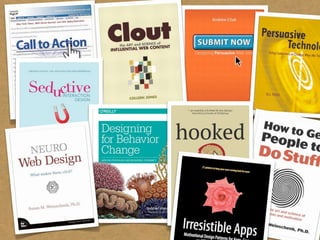
tool before
target
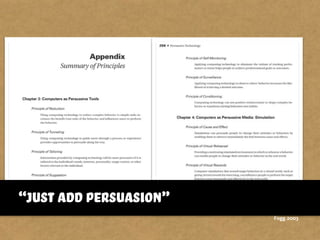
Fogg 2003
“just add persuasion”
“just add tag clouds”
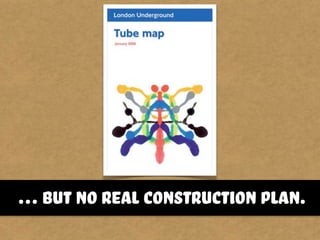
We have tool sets ...
…but no real construction plan.
what we warn all clients of:
»A solution in search
of a problem«
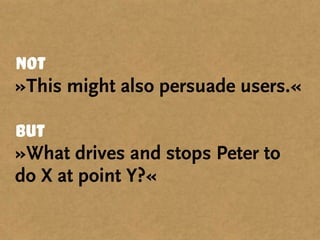
Not
»This might also persuade users.«
But
»What drives and stops Peter to
do X at point Y?«
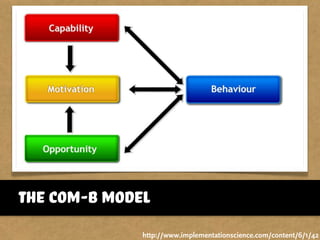
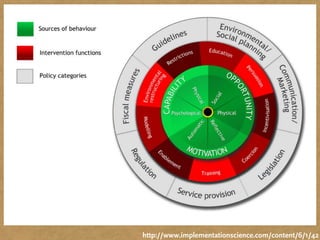
http://www.implementationscience.com/content/6/1/42
the com-b model
http://www.implementationscience.com/content/6/1/42
so: what to do?
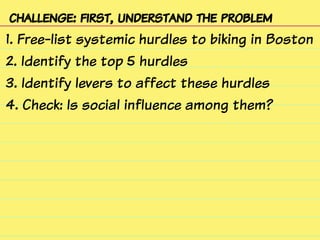
challenge: first, understand the problem
1. Free-list systemic hurdles to biking in Boston
2. Identify the top 5 hurdles
3. Identify levers to affect these hurdles
4. Check: Is social influence among them?
<2/3>
wider
contexts
Paul Watzlawick et al.
»These are two types of change: one that
occurs within a given system which itself
remains unchanged, and one whose
occurrence changes the system itself…
Second-order change is thus change of
change.«
change (1974: 10)
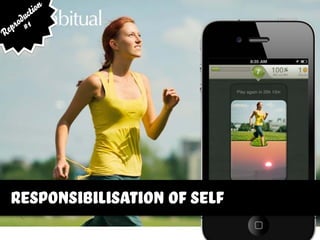
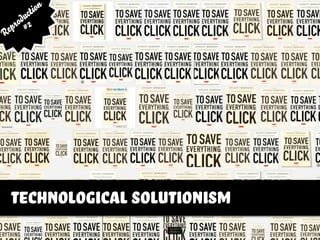
Implicit theory of social changeresponsibilisation of self
Reproduction
#1
Implicit theory of social changetechnological solutionism
Reproduction
#2
When discipline is reinforced,
revolution cannot fail!
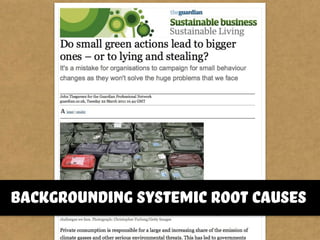
http://www.guardian.co.uk/sustainable-
business/small-painless-behaviour-change
backgrounding systemic root causes
so: what to do?
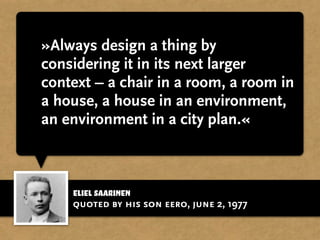
»Always design a thing by
considering it in its next larger
context – a chair in a room, a room in
a house, a house in an environment,
an environment in a city plan.«
quoted by his son eero, june 2, 1977
eliel saarinen
what are systemic,
social contexts of
cycling in Boston?
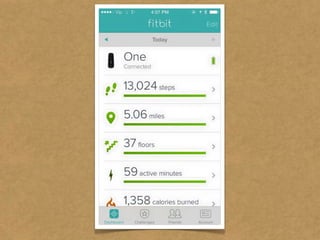
a friend in
rochester,NY
same friend in
Dubrovnik,CR
A sudden boost in
motivation?
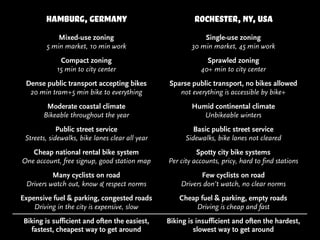
hamburg,germany rochester,ny,usa
Mixed-use zoning
5 min market, 10 min work
Single-use zoning
30 min market, 45 min work
Compact zoning
15 min to city center
Sprawled zoning
40+ min to city center
Dense public transport accepting bikes
20 min tram+5 min bike to everything
Sparse public transport, no bikes allowed
not everything is accessible by bike+
Moderate coastal climate
Bikeable throughout the year
Humid continental climate
Unbikeable winters
Public street service
Streets, sidewalks, bike lanes clear all year
Basic public street service
Sidewalks, bike lanes not cleared
Cheap national rental bike system
One account, free signup, good station map
Spotty city bike systems
Per city accounts, pricy, hard to find stations
Many cyclists on road
Drivers watch out, know & respect norms
Few cyclists on road
Drivers don’t watch, no clear norms
Expensive fuel & parking, congested roads
Driving in the city is expensive, slow
Cheap fuel & parking, empty roads
Driving is cheap and fast
Biking is sufficient and often the easiest,
fastest, cheapest way to get around
Biking is insufficient and often the hardest,
slowest way to get around
challenge: strike at the roots
1. Identify systemic reasons making biking hard,
slow, ineffective, costly
2. Identify positive feedback loops to affect
social change around these reasons
3. Ideate potential micro-ecosystems where
biking is the easiest, cheapest way to move
around
<3/3>
autonomy &
reactance
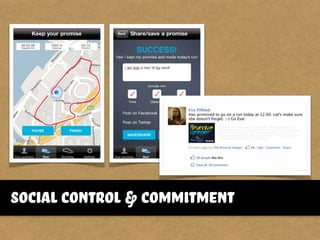
social control & commitment
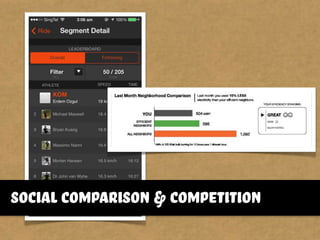
social comparison & competition
coercive,
creepy,and
context-blind
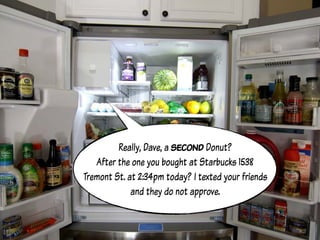
Really, Dave, a second Donut?
After the one you bought at Starbucks 1538
Tremont St. at 2:34pm today? I texted your friends
and they do not approve.
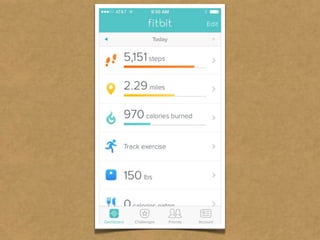
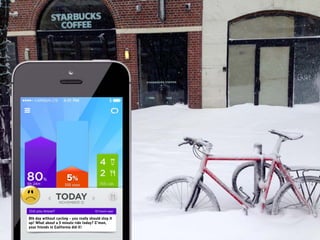
5%
500 steps
8th day without cycling – you really should step it
up! What about a 5 minute ride today? C’mon,
your friends in California did it!
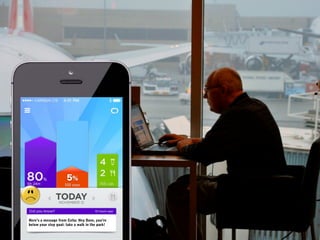
5%
500 steps
Here’s a message from Celia: Hey Dave, you’re
below your step goal: take a walk in the park!
Lopez 2011
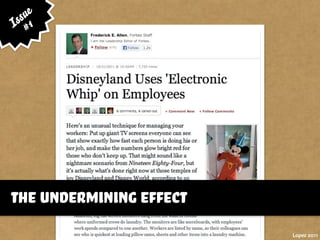
the undermining effect
Issue
#1
Edward Deci,Richard Ryan
»An understanding of human motivation
requires a consideration of innate
psychological needs for competence,
autonomy, and relatedness.«
the what and why of goal pursuits (2000)
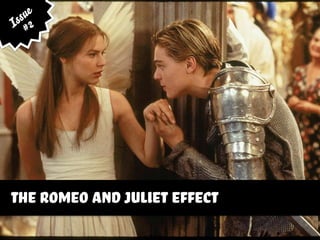
the romeo and juliet effect
Issue
#2
johnmarshall reeve
»When children do precisely what they were told not
to do … or when the targets of propaganda do the
opposite of the source’s intention, each performs a
counter maneuver aimed at reestablishing a
threatened freedom. The term reactance refers to the
psychological and behavioral attempt at
reestablishong (“reacting” against) a threatened or
eliminated freedom.«
understanding motivation (2014: 297)
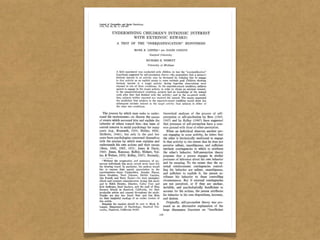
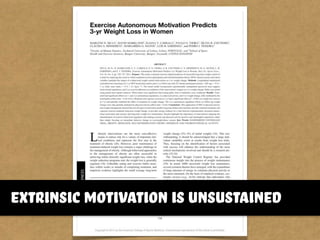
extrinsic motivation is unsustained
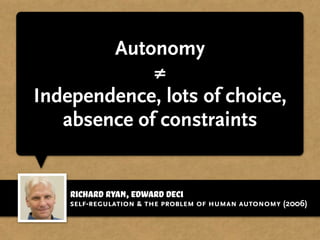
Richard Ryan,Edward Deci
Autonomy
≠
Independence, lots of choice,
absence of constraints
self-regulation & the problem of human autonomy (2006)
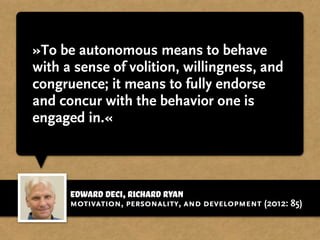
Edward Deci,Richard Ryan
»To be autonomous means to behave
with a sense of volition, willingness, and
congruence; it means to fully endorse
and concur with the behavior one is
engaged in.«
motivation, personality, and development (2012: 85)
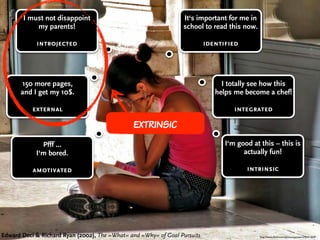
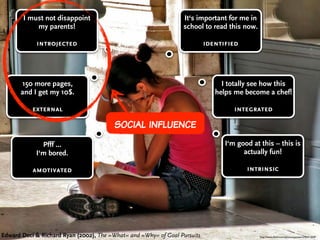
Edward Deci & Richard Ryan: The »What« and »Why« of Gaol Pursuits (2002)
150 more pages,
and I get my 10$.
external
I must not disappoint
my parents!
introjected
Pfff …
I‘m bored.
amotivated
I‘m good at this – this is
actually fun!
intrinsic
It‘s important for me in
school to read this now.
identified
I totally see how this
helps me become a chef!
integrated
http://www.flickr.com/photos/pensiero/95412049Edward Deci & Richard Ryan (2002), The »What« and »Why« of Goal Pursuits
extrinsic
Edward Deci & Richard Ryan: The »What« and »Why« of Gaol Pursuits (2002)
150 more pages,
and I get my 10$.
external
I must not disappoint
my parents!
introjected
Pfff …
I‘m bored.
amotivated
I‘m good at this – this is
actually fun!
intrinsic
It‘s important for me in
school to read this now.
identified
I totally see how this
helps me become a chef!
integrated
http://www.flickr.com/photos/pensiero/95412049Edward Deci & Richard Ryan (2002), The »What« and »Why« of Goal Pursuits
social influence
so: what to do?
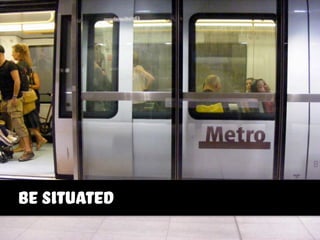
Be situated
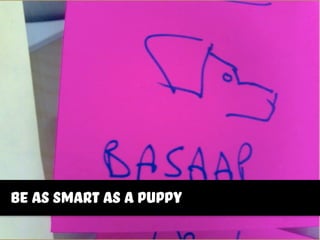
be as smart as a puppy
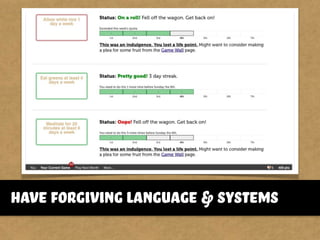
have forgiving language & systems
http://designinghappiness.wordpress.com/
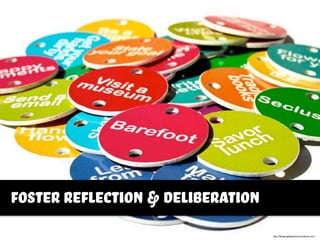
foster reflection & deliberation
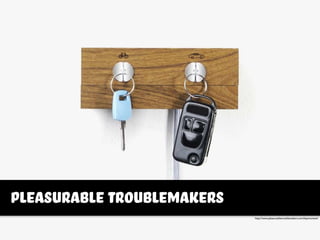
pleasurable troublemakers
http://www.pleasurabletroublemakers.com/keymoment/
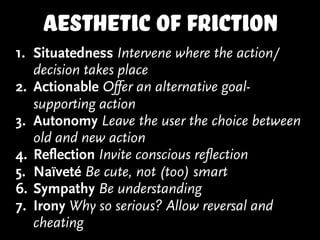
aesthetic of friction
1. Situatedness Intervene where the action/
decision takes place
2. Actionable Offer an alternative goal-
supporting action
3. Autonomy Leave the user the choice between
old and new action
4. Reflection Invite conscious reflection
5. Naïveté Be cute, not (too) smart
6. Sympathy Be understanding
7. Irony Why so serious? Allow reversal and
cheating
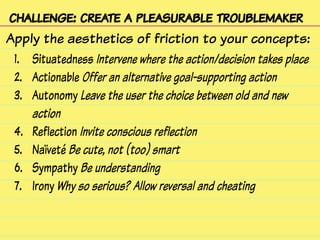
challenge: create a pleasurable troublemaker
Apply the aesthetics of friction to your concepts:
1. Situatedness Intervene where the action/decision takes place
2. Actionable Offer an alternative goal-supporting action
3. Autonomy Leave the user the choice between old and new
action
4. Reflection Invite conscious reflection
5. Naïveté Be cute, not (too) smart
6. Sympathy Be understanding
7. Irony Why so serious? Allow reversal and cheating
sebastian@codingconduct.cc
@dingstweets
codingconduct.cc
Thank You.

Blind Spots in Persuasive Design

  • 1.
    blind spots in persuasivedesign Sebastian Deterding (@dingstweets) Northeastern University January 30, 2015 c b
  • 2.
    task here: use socialinfluence to motivate cycling in boston,MA
  • 3.
  • 5.
    Fogg 2003 “just addpersuasion”
  • 6.
    “just add tagclouds”
  • 7.
    We have toolsets ...
  • 8.
    …but no realconstruction plan.
  • 9.
    what we warnall clients of: »A solution in search of a problem«
  • 10.
    Not »This might alsopersuade users.« But »What drives and stops Peter to do X at point Y?«
  • 11.
  • 12.
  • 13.
  • 14.
    challenge: first, understandthe problem 1. Free-list systemic hurdles to biking in Boston 2. Identify the top 5 hurdles 3. Identify levers to affect these hurdles 4. Check: Is social influence among them?
  • 15.
  • 16.
    Paul Watzlawick etal. »These are two types of change: one that occurs within a given system which itself remains unchanged, and one whose occurrence changes the system itself… Second-order change is thus change of change.« change (1974: 10)
  • 17.
    Implicit theory ofsocial changeresponsibilisation of self Reproduction #1
  • 18.
    Implicit theory ofsocial changetechnological solutionism Reproduction #2
  • 19.
    When discipline isreinforced, revolution cannot fail!
  • 20.
  • 21.
  • 22.
    »Always design athing by considering it in its next larger context – a chair in a room, a room in a house, a house in an environment, an environment in a city plan.« quoted by his son eero, june 2, 1977 eliel saarinen
  • 23.
    what are systemic, socialcontexts of cycling in Boston?
  • 24.
  • 26.
  • 28.
    A sudden boostin motivation?
  • 29.
    hamburg,germany rochester,ny,usa Mixed-use zoning 5min market, 10 min work Single-use zoning 30 min market, 45 min work Compact zoning 15 min to city center Sprawled zoning 40+ min to city center Dense public transport accepting bikes 20 min tram+5 min bike to everything Sparse public transport, no bikes allowed not everything is accessible by bike+ Moderate coastal climate Bikeable throughout the year Humid continental climate Unbikeable winters Public street service Streets, sidewalks, bike lanes clear all year Basic public street service Sidewalks, bike lanes not cleared Cheap national rental bike system One account, free signup, good station map Spotty city bike systems Per city accounts, pricy, hard to find stations Many cyclists on road Drivers watch out, know & respect norms Few cyclists on road Drivers don’t watch, no clear norms Expensive fuel & parking, congested roads Driving in the city is expensive, slow Cheap fuel & parking, empty roads Driving is cheap and fast Biking is sufficient and often the easiest, fastest, cheapest way to get around Biking is insufficient and often the hardest, slowest way to get around
  • 30.
    challenge: strike atthe roots 1. Identify systemic reasons making biking hard, slow, ineffective, costly 2. Identify positive feedback loops to affect social change around these reasons 3. Ideate potential micro-ecosystems where biking is the easiest, cheapest way to move around
  • 31.
  • 32.
    social control &commitment
  • 33.
  • 34.
  • 35.
    Really, Dave, asecond Donut? After the one you bought at Starbucks 1538 Tremont St. at 2:34pm today? I texted your friends and they do not approve.
  • 36.
    5% 500 steps 8th daywithout cycling – you really should step it up! What about a 5 minute ride today? C’mon, your friends in California did it!
  • 37.
    5% 500 steps Here’s amessage from Celia: Hey Dave, you’re below your step goal: take a walk in the park!
  • 38.
  • 40.
    Edward Deci,Richard Ryan »Anunderstanding of human motivation requires a consideration of innate psychological needs for competence, autonomy, and relatedness.« the what and why of goal pursuits (2000)
  • 41.
    the romeo andjuliet effect Issue #2
  • 42.
    johnmarshall reeve »When childrendo precisely what they were told not to do … or when the targets of propaganda do the opposite of the source’s intention, each performs a counter maneuver aimed at reestablishing a threatened freedom. The term reactance refers to the psychological and behavioral attempt at reestablishong (“reacting” against) a threatened or eliminated freedom.« understanding motivation (2014: 297)
  • 43.
  • 44.
    Richard Ryan,Edward Deci Autonomy ≠ Independence,lots of choice, absence of constraints self-regulation & the problem of human autonomy (2006)
  • 45.
    Edward Deci,Richard Ryan »Tobe autonomous means to behave with a sense of volition, willingness, and congruence; it means to fully endorse and concur with the behavior one is engaged in.« motivation, personality, and development (2012: 85)
  • 46.
    Edward Deci &Richard Ryan: The »What« and »Why« of Gaol Pursuits (2002) 150 more pages, and I get my 10$. external I must not disappoint my parents! introjected Pfff … I‘m bored. amotivated I‘m good at this – this is actually fun! intrinsic It‘s important for me in school to read this now. identified I totally see how this helps me become a chef! integrated http://www.flickr.com/photos/pensiero/95412049Edward Deci & Richard Ryan (2002), The »What« and »Why« of Goal Pursuits extrinsic
  • 47.
    Edward Deci &Richard Ryan: The »What« and »Why« of Gaol Pursuits (2002) 150 more pages, and I get my 10$. external I must not disappoint my parents! introjected Pfff … I‘m bored. amotivated I‘m good at this – this is actually fun! intrinsic It‘s important for me in school to read this now. identified I totally see how this helps me become a chef! integrated http://www.flickr.com/photos/pensiero/95412049Edward Deci & Richard Ryan (2002), The »What« and »Why« of Goal Pursuits social influence
  • 48.
  • 49.
  • 50.
    be as smartas a puppy
  • 51.
  • 52.
  • 53.
  • 54.
    aesthetic of friction 1.Situatedness Intervene where the action/ decision takes place 2. Actionable Offer an alternative goal- supporting action 3. Autonomy Leave the user the choice between old and new action 4. Reflection Invite conscious reflection 5. Naïveté Be cute, not (too) smart 6. Sympathy Be understanding 7. Irony Why so serious? Allow reversal and cheating
  • 55.
    challenge: create apleasurable troublemaker Apply the aesthetics of friction to your concepts: 1. Situatedness Intervene where the action/decision takes place 2. Actionable Offer an alternative goal-supporting action 3. Autonomy Leave the user the choice between old and new action 4. Reflection Invite conscious reflection 5. Naïveté Be cute, not (too) smart 6. Sympathy Be understanding 7. Irony Why so serious? Allow reversal and cheating
  • 56.