Enhancing Learning through Technology Web 2.0 Tools 4 Effective Teaching/Learning ExperienceVPMP Polytechnic Institute, Gandhinagar, Gujarat (India)12/19/20091Dr. Dilip Barad: dilipbarad@gmail.com: Bhavnagar University
The movement in this workshop is from theosisto praxis . . .Best results are generated at the end of the day, only if best ideas  are generated at the beginning of the day.12/19/20092Dr. Dilip Barad: dilipbarad@gmail.com: Bhavnagar University
Questions…What is web 2.0 tools?What to ‘enhance’?What is ‘teaching-learning experience’?How to use tools?How to enhance teaching learning experience?WHY ???12/19/20093Dr. Dilip Barad: dilipbarad@gmail.com: Bhavnagar University
I. Why? Learning StylesNo two individuals are similar, neither in their teaching nor in the learning styles. Each and every class is unanimously a class of mixed- ability. The IQ test of the class (or for that matter any such tests) may display common ability among the class/group but psychologically all have different abilities in their learning.12/19/20094Dr. Dilip Barad: dilipbarad@gmail.com: Bhavnagar University
The ‘Psychological Types’ as described by C. G. Jung and Myers-Briggs Type indicator - which divides personality types along four dimensions: introvert-extrovert, sensing-intuitive, thinking-feeling, and perceiving-judging. (Jung, 1921 & Myers, 1998) 12/19/20095Dr. Dilip Barad: dilipbarad@gmail.com: Bhavnagar University
As and when the ‘Personality type theory’ is applied to the educational phenomenon, it has substantiated the existence of a variety of learning styles (and complementary teaching styles).12/19/20096Dr. Dilip Barad: dilipbarad@gmail.com: Bhavnagar University
No single learning style is appropriate for everyone.While some students assimilate visual information best, others prefer auditory information. While some students prefer information to be structured as facts about things, others prefer a structure based on relationships among things. While some students prefer starting with first principles and using deductive reasoning, others prefer starting with examples and using inductive approaches. (Sivilloti and Pike, 2007). 12/19/20097Dr. Dilip Barad: dilipbarad@gmail.com: Bhavnagar University
Three types of learners:From the perspective of personality type theory, the edu-researchers have identified three main types of learners, viz. visual, auditory and tactile / kinesthetic. 12/19/20098Dr. Dilip Barad: dilipbarad@gmail.com: Bhavnagar University
Learning StylesA. Visual (65%):B. Auditory (30%)C. Kinesthetic / tactile learner (5%) 12/19/20099Dr. Dilip Barad: dilipbarad@gmail.com: Bhavnagar University
II. WHY? Technology???B’coz change is the species of life…Every new age has its own problems and has to solve them …The journey – from the symbolic language of pre-historical man to the symbolic language of e-Modern teacher…Advancement form Oral – Spoken word to written word… writing is also a technique…Four major advances in pedagogy…12/19/200910Dr. Dilip Barad: dilipbarad@gmail.com: Bhavnagar University
The BlackboardThe inventor or introducer of the blackboard deserves to be ranked among the best contributors to learning and science, if not among the great benefactors of mankind.Josiah Bumstead -1841.From Wayne’s introduction to the WikiEducator Project. http://www.wikieducator.org/User:Pschlicht12/19/200911Dr. Dilip Barad: dilipbarad@gmail.com: Bhavnagar University
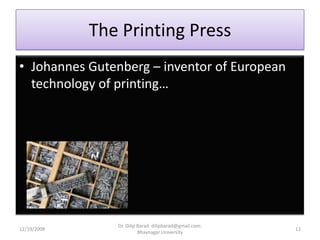
The Printing PressJohannes Gutenberg – inventor of European technology of printing…12/19/200912Dr. Dilip Barad: dilipbarad@gmail.com: Bhavnagar University
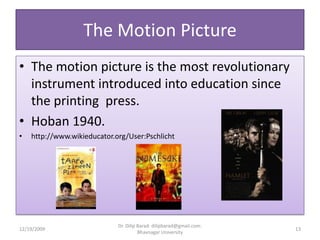
The Motion PictureThe motion picture is the most revolutionary instrument introduced into education since the printing  press.Hoban 1940.http://www.wikieducator.org/User:Pschlicht12/19/200913Dr. Dilip Barad: dilipbarad@gmail.com: Bhavnagar University
TelevisionIt now seems clear, however, that television offers the greatest opportunity for the advancement of education since the introduction of printing by movable type.Stoddard 1957.http://www.wikieducator.org/User:Pschlicht12/19/200914Dr. Dilip Barad: dilipbarad@gmail.com: Bhavnagar University
Computers and InternetThe impact of computers on society, and hence on education, has been compared to that of movable type and the printing press since Gutenberg.Caffrey and Mossman 1967http://www.wikieducator.org/User:Pschlicht12/19/200915Dr. Dilip Barad: dilipbarad@gmail.com: Bhavnagar University
How well are we doing, given all these technological innovations in education?Even today, the number of kids not goingto school is larger than kids going to the schools…CAN WE MAKE ANY DIFFERENCE???12/19/200916Dr. Dilip Barad: dilipbarad@gmail.com: Bhavnagar University
III. WHY? Research on pedagogyMin Liu, Zena Moore, Leah Graham, Shinwoong Lee – A Look at the Research on Computer-based Technology Use in Second Language Learning – Review of Literature 1990-2000.21 Journals and 246 ArticlesTwo Research in USA and UKTwo research in Gujarat – Kadi Uni.12/19/200917Dr. Dilip Barad: dilipbarad@gmail.com: Bhavnagar University
Research in UK UniversitiesGoodwyn, A., et al., 1997. The future curriculum in English and IT: how teachers and student teachers view the relationship. Journal of Information Technology for Teacher Education, 6(3), pp. 227-240.A study of student teachers of English from three universities in England to establish what their attitudes were towards ICT and to identify key influences on their practice and their thinking. The study suggests that these students have a broader view of literacy than is currently predominant in schools and this view positively embraces the role of ICT in literacy.Findings suggest that this cohort of newly qualified English teachers have a positive and committed attitude towards the use of ICT in the current and future literacy curriculum. (UK)12/19/200918Dr. Dilip Barad: dilipbarad@gmail.com: Bhavnagar University
Research in AmericaKarchmer, R., 2001. The journey ahead: thirteen teachers report how the internet influences literacy and literacy instruction in their K-12 classrooms. Reading Research Quarterly, 36 (4),pp. 442-466.This report explores ICT-literate primary and secondary teachers' perceptions of how the internet has or has not changed the way they taught reading and writing in their classrooms.Findings indicated that the teachers viewed the internet's influence on reading and writing as an extension of traditional literacy skills but had difficulties finding internet materials written for a range of reading levels. Teachers were teaching skills of evaluating internet materials in more depth and at a much earlier stage. (USA)12/19/200919Dr. Dilip Barad: dilipbarad@gmail.com: Bhavnagar University
Research in Gujarat – Kadi UniversityIMPACT OF CALL MATERIALS IN TEACHING ENGLISH GRAMMAR AT HIGH SECONDARY LEVEL – Mehul RanaExperiments with some ICT tools to enhance communication skill among undergraduate students of Business Administration – Jitendra Vaghela12/19/200920Dr. Dilip Barad: dilipbarad@gmail.com: Bhavnagar University
Findings:The results asserted that the possibilities of computer technology as a tool could include increasing language learners’Self-esteemVocational preparednessLanguage proficiencyOverall academic skills12/19/200921Dr. Dilip Barad: dilipbarad@gmail.com: Bhavnagar University
Answers to WHY?1. Learning Styles2. Technological advancements3. Pedagogical researchMost importantly: GER – 9% of Gujarat; 11% India…If we want it to be @ 25% - imagine how many colleges, universities, teachers, support staff will be required..!!..!!12/19/200922Dr. Dilip Barad: dilipbarad@gmail.com: Bhavnagar University
Benefits of ICT in TELLMemoryUnderstandingCognition of ideaDissemination of learningDelivery of contentAffects larger group of students‘collaborativeness’-------------- infinity ……………..12/19/200923Dr. Dilip Barad: dilipbarad@gmail.com: Bhavnagar University
Just as…… the secret of wisdom is hidden in philosophy…. That of human actions in History…. That of Art in Criticism…Similarly, modern educational pedagogy is in practical usage of Web 2.0 Tools…12/19/200924Dr. Dilip Barad: dilipbarad@gmail.com: Bhavnagar University
Let us now list some of the web 2.0 tolls useful in enhancing L-S-R-W SkillsGenre of Tools:Blog – text/audio/videoe-GroupsDiscussion ForumsWikisSocial networkingLMS/CMS12/19/200925Dr. Dilip Barad: dilipbarad@gmail.com: Bhavnagar University
Tools for specific purposeWeb 2.0 Tools for TeacherRef: NikPeechy’s Blog10 Web tools for English teacher12/19/200926Dr. Dilip Barad: dilipbarad@gmail.com: Bhavnagar University
1.Tokbox:a synchronous and asynchronous video conferencing and communication tool.www.tokbox.com 12/19/200927Dr. Dilip Barad: dilipbarad@gmail.com: Bhavnagar University
2. a tool for the creation of web based audio discussion threadswww.voxpop.com12/19/200928Dr. Dilip Barad: dilipbarad@gmail.com: Bhavnagar University
3. the web based pronunciation dictionary, works and what it can offer teachers and learners.www.forvo.com12/19/200929Dr. Dilip Barad: dilipbarad@gmail.com: Bhavnagar University
4. a tool for the creation of web based dictation activitieswww.listen-and-write.com12/19/200930Dr. Dilip Barad: dilipbarad@gmail.com: Bhavnagar University
5. the web based video activity creation tool www.eslvideo.com12/19/200931Dr. Dilip Barad: dilipbarad@gmail.com: Bhavnagar University
6. a web based tool for creating online presentationswww.280slides.com12/19/200932Dr. Dilip Barad: dilipbarad@gmail.com: Bhavnagar University
7. a very simple tool for creating animated movieshttp://www.dfilm.com/live/moviemaker.html12/19/200933Dr. Dilip Barad: dilipbarad@gmail.com: Bhavnagar University
8. A web based 'sticky notes' notice-boardwww.wallwisher.com12/19/200934Dr. Dilip Barad: dilipbarad@gmail.com: Bhavnagar University
9. A web based tool for creating graphic representation of texts based on word frequencywww.wordle.net12/19/200935Dr. Dilip Barad: dilipbarad@gmail.com: Bhavnagar University
10.A simple tool for keeping a web based journalwww.penzu.com12/19/200936Dr. Dilip Barad: dilipbarad@gmail.com: Bhavnagar University
Online examples…Audacity for e-Content- Listening and Speaking skillsGroups – for discussion – writing skillsSocial networking site: orkut – comments on images – testimonials – scraps…Blog: http://b4t.blogspot.com – Story WritingVideo blogging… How to?Wikieducator – online content updating…Moodle for evaluation ---Analysis of evaluation --- Surveygizmo for survey/feedback ---12/19/200937Dr. Dilip Barad: dilipbarad@gmail.com: Bhavnagar University

Enhancing Learning Through Technology

  • 1.
    Enhancing Learning throughTechnology Web 2.0 Tools 4 Effective Teaching/Learning ExperienceVPMP Polytechnic Institute, Gandhinagar, Gujarat (India)12/19/20091Dr. Dilip Barad: dilipbarad@gmail.com: Bhavnagar University
  • 2.
    The movement inthis workshop is from theosisto praxis . . .Best results are generated at the end of the day, only if best ideas are generated at the beginning of the day.12/19/20092Dr. Dilip Barad: dilipbarad@gmail.com: Bhavnagar University
  • 3.
    Questions…What is web2.0 tools?What to ‘enhance’?What is ‘teaching-learning experience’?How to use tools?How to enhance teaching learning experience?WHY ???12/19/20093Dr. Dilip Barad: dilipbarad@gmail.com: Bhavnagar University
  • 4.
    I. Why? LearningStylesNo two individuals are similar, neither in their teaching nor in the learning styles. Each and every class is unanimously a class of mixed- ability. The IQ test of the class (or for that matter any such tests) may display common ability among the class/group but psychologically all have different abilities in their learning.12/19/20094Dr. Dilip Barad: dilipbarad@gmail.com: Bhavnagar University
  • 5.
    The ‘Psychological Types’as described by C. G. Jung and Myers-Briggs Type indicator - which divides personality types along four dimensions: introvert-extrovert, sensing-intuitive, thinking-feeling, and perceiving-judging. (Jung, 1921 & Myers, 1998) 12/19/20095Dr. Dilip Barad: dilipbarad@gmail.com: Bhavnagar University
  • 6.
    As and whenthe ‘Personality type theory’ is applied to the educational phenomenon, it has substantiated the existence of a variety of learning styles (and complementary teaching styles).12/19/20096Dr. Dilip Barad: dilipbarad@gmail.com: Bhavnagar University
  • 7.
    No single learningstyle is appropriate for everyone.While some students assimilate visual information best, others prefer auditory information. While some students prefer information to be structured as facts about things, others prefer a structure based on relationships among things. While some students prefer starting with first principles and using deductive reasoning, others prefer starting with examples and using inductive approaches. (Sivilloti and Pike, 2007). 12/19/20097Dr. Dilip Barad: dilipbarad@gmail.com: Bhavnagar University
  • 8.
    Three types oflearners:From the perspective of personality type theory, the edu-researchers have identified three main types of learners, viz. visual, auditory and tactile / kinesthetic. 12/19/20098Dr. Dilip Barad: dilipbarad@gmail.com: Bhavnagar University
  • 9.
    Learning StylesA. Visual(65%):B. Auditory (30%)C. Kinesthetic / tactile learner (5%) 12/19/20099Dr. Dilip Barad: dilipbarad@gmail.com: Bhavnagar University
  • 10.
    II. WHY? Technology???B’cozchange is the species of life…Every new age has its own problems and has to solve them …The journey – from the symbolic language of pre-historical man to the symbolic language of e-Modern teacher…Advancement form Oral – Spoken word to written word… writing is also a technique…Four major advances in pedagogy…12/19/200910Dr. Dilip Barad: dilipbarad@gmail.com: Bhavnagar University
  • 11.
    The BlackboardThe inventoror introducer of the blackboard deserves to be ranked among the best contributors to learning and science, if not among the great benefactors of mankind.Josiah Bumstead -1841.From Wayne’s introduction to the WikiEducator Project. http://www.wikieducator.org/User:Pschlicht12/19/200911Dr. Dilip Barad: dilipbarad@gmail.com: Bhavnagar University
  • 12.
    The Printing PressJohannesGutenberg – inventor of European technology of printing…12/19/200912Dr. Dilip Barad: dilipbarad@gmail.com: Bhavnagar University
  • 13.
    The Motion PictureThemotion picture is the most revolutionary instrument introduced into education since the printing press.Hoban 1940.http://www.wikieducator.org/User:Pschlicht12/19/200913Dr. Dilip Barad: dilipbarad@gmail.com: Bhavnagar University
  • 14.
    TelevisionIt now seemsclear, however, that television offers the greatest opportunity for the advancement of education since the introduction of printing by movable type.Stoddard 1957.http://www.wikieducator.org/User:Pschlicht12/19/200914Dr. Dilip Barad: dilipbarad@gmail.com: Bhavnagar University
  • 15.
    Computers and InternetTheimpact of computers on society, and hence on education, has been compared to that of movable type and the printing press since Gutenberg.Caffrey and Mossman 1967http://www.wikieducator.org/User:Pschlicht12/19/200915Dr. Dilip Barad: dilipbarad@gmail.com: Bhavnagar University
  • 16.
    How well arewe doing, given all these technological innovations in education?Even today, the number of kids not goingto school is larger than kids going to the schools…CAN WE MAKE ANY DIFFERENCE???12/19/200916Dr. Dilip Barad: dilipbarad@gmail.com: Bhavnagar University
  • 17.
    III. WHY? Researchon pedagogyMin Liu, Zena Moore, Leah Graham, Shinwoong Lee – A Look at the Research on Computer-based Technology Use in Second Language Learning – Review of Literature 1990-2000.21 Journals and 246 ArticlesTwo Research in USA and UKTwo research in Gujarat – Kadi Uni.12/19/200917Dr. Dilip Barad: dilipbarad@gmail.com: Bhavnagar University
  • 18.
    Research in UKUniversitiesGoodwyn, A., et al., 1997. The future curriculum in English and IT: how teachers and student teachers view the relationship. Journal of Information Technology for Teacher Education, 6(3), pp. 227-240.A study of student teachers of English from three universities in England to establish what their attitudes were towards ICT and to identify key influences on their practice and their thinking. The study suggests that these students have a broader view of literacy than is currently predominant in schools and this view positively embraces the role of ICT in literacy.Findings suggest that this cohort of newly qualified English teachers have a positive and committed attitude towards the use of ICT in the current and future literacy curriculum. (UK)12/19/200918Dr. Dilip Barad: dilipbarad@gmail.com: Bhavnagar University
  • 19.
    Research in AmericaKarchmer,R., 2001. The journey ahead: thirteen teachers report how the internet influences literacy and literacy instruction in their K-12 classrooms. Reading Research Quarterly, 36 (4),pp. 442-466.This report explores ICT-literate primary and secondary teachers' perceptions of how the internet has or has not changed the way they taught reading and writing in their classrooms.Findings indicated that the teachers viewed the internet's influence on reading and writing as an extension of traditional literacy skills but had difficulties finding internet materials written for a range of reading levels. Teachers were teaching skills of evaluating internet materials in more depth and at a much earlier stage. (USA)12/19/200919Dr. Dilip Barad: dilipbarad@gmail.com: Bhavnagar University
  • 20.
    Research in Gujarat– Kadi UniversityIMPACT OF CALL MATERIALS IN TEACHING ENGLISH GRAMMAR AT HIGH SECONDARY LEVEL – Mehul RanaExperiments with some ICT tools to enhance communication skill among undergraduate students of Business Administration – Jitendra Vaghela12/19/200920Dr. Dilip Barad: dilipbarad@gmail.com: Bhavnagar University
  • 21.
    Findings:The results assertedthat the possibilities of computer technology as a tool could include increasing language learners’Self-esteemVocational preparednessLanguage proficiencyOverall academic skills12/19/200921Dr. Dilip Barad: dilipbarad@gmail.com: Bhavnagar University
  • 22.
    Answers to WHY?1.Learning Styles2. Technological advancements3. Pedagogical researchMost importantly: GER – 9% of Gujarat; 11% India…If we want it to be @ 25% - imagine how many colleges, universities, teachers, support staff will be required..!!..!!12/19/200922Dr. Dilip Barad: dilipbarad@gmail.com: Bhavnagar University
  • 23.
    Benefits of ICTin TELLMemoryUnderstandingCognition of ideaDissemination of learningDelivery of contentAffects larger group of students‘collaborativeness’-------------- infinity ……………..12/19/200923Dr. Dilip Barad: dilipbarad@gmail.com: Bhavnagar University
  • 24.
    Just as…… thesecret of wisdom is hidden in philosophy…. That of human actions in History…. That of Art in Criticism…Similarly, modern educational pedagogy is in practical usage of Web 2.0 Tools…12/19/200924Dr. Dilip Barad: dilipbarad@gmail.com: Bhavnagar University
  • 25.
    Let us nowlist some of the web 2.0 tolls useful in enhancing L-S-R-W SkillsGenre of Tools:Blog – text/audio/videoe-GroupsDiscussion ForumsWikisSocial networkingLMS/CMS12/19/200925Dr. Dilip Barad: dilipbarad@gmail.com: Bhavnagar University
  • 26.
    Tools for specificpurposeWeb 2.0 Tools for TeacherRef: NikPeechy’s Blog10 Web tools for English teacher12/19/200926Dr. Dilip Barad: dilipbarad@gmail.com: Bhavnagar University
  • 27.
    1.Tokbox:a synchronous andasynchronous video conferencing and communication tool.www.tokbox.com 12/19/200927Dr. Dilip Barad: dilipbarad@gmail.com: Bhavnagar University
  • 28.
    2. a toolfor the creation of web based audio discussion threadswww.voxpop.com12/19/200928Dr. Dilip Barad: dilipbarad@gmail.com: Bhavnagar University
  • 29.
    3. the webbased pronunciation dictionary, works and what it can offer teachers and learners.www.forvo.com12/19/200929Dr. Dilip Barad: dilipbarad@gmail.com: Bhavnagar University
  • 30.
    4. a toolfor the creation of web based dictation activitieswww.listen-and-write.com12/19/200930Dr. Dilip Barad: dilipbarad@gmail.com: Bhavnagar University
  • 31.
    5. the webbased video activity creation tool www.eslvideo.com12/19/200931Dr. Dilip Barad: dilipbarad@gmail.com: Bhavnagar University
  • 32.
    6. a webbased tool for creating online presentationswww.280slides.com12/19/200932Dr. Dilip Barad: dilipbarad@gmail.com: Bhavnagar University
  • 33.
    7. a verysimple tool for creating animated movieshttp://www.dfilm.com/live/moviemaker.html12/19/200933Dr. Dilip Barad: dilipbarad@gmail.com: Bhavnagar University
  • 34.
    8. A webbased 'sticky notes' notice-boardwww.wallwisher.com12/19/200934Dr. Dilip Barad: dilipbarad@gmail.com: Bhavnagar University
  • 35.
    9. A webbased tool for creating graphic representation of texts based on word frequencywww.wordle.net12/19/200935Dr. Dilip Barad: dilipbarad@gmail.com: Bhavnagar University
  • 36.
    10.A simple toolfor keeping a web based journalwww.penzu.com12/19/200936Dr. Dilip Barad: dilipbarad@gmail.com: Bhavnagar University
  • 37.
    Online examples…Audacity fore-Content- Listening and Speaking skillsGroups – for discussion – writing skillsSocial networking site: orkut – comments on images – testimonials – scraps…Blog: http://b4t.blogspot.com – Story WritingVideo blogging… How to?Wikieducator – online content updating…Moodle for evaluation ---Analysis of evaluation --- Surveygizmo for survey/feedback ---12/19/200937Dr. Dilip Barad: dilipbarad@gmail.com: Bhavnagar University