Ummmm….. Teacher, What is
   an Encyclopedia?
     Strategies for developing
   authentic research reports for
   Elementary Students with the
     Integration of Technology
Research Without Copying
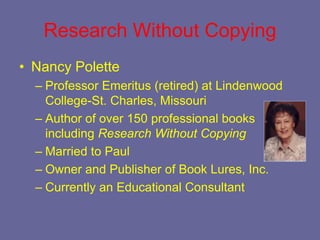
• Nancy Polette
  – Professor Emeritus (retired) at Lindenwood
    College-St. Charles, Missouri
  – Author of over 150 professional books
    including Research Without Copying
  – Married to Paul
  – Owner and Publisher of Book Lures, Inc.
  – Currently an Educational Consultant
Goals for Research
• Have Students Think critically about what
  is read and/or heard by seeking facts that
  support information
• Allow students to use information in a
  variety of ways instead of copying
  information
• Have students use various avenues of
  technology for effective research
The rewards of Integrating
 Technology into the classroom
 for English and Language Arts

• Gives motivational, individual instruction and/or
  practice in individual reading and writing skills
• Supports the reflection and frequent modification
  called for in process writing
• Supports all stages of the writing process:
  planning, drafting, revising and editing, and
  publishing.
Technology Integration Strategies
 • Language Skills Development
    – Teaching decoding skills
        »   Digitized speech support
        »   Interactive websites, games
        »   Videos
        »   Ebooks
    – Developing other reading skills
        » Software-based and online systems
        » Reference resources
        » Electronic devices
    – Creating everyday teacher activities
        » Spreadsheets
        » Electronic presentations
        » Using word processors
Technology Integration Strategies
• Literacy Development
  – Networked literacy projects
  – Activities with interactive storybooks, Ebooks,
    and talking books
  – Uses of tracking systems
  – Connections to online reading materials to
    engage students
  – Writing in blogs
  – Motivating writing with video projects
  – Threaded discussions at a distance
Technology Integration Strategies
• The Process Approach to writing
  – Prewriting
     • Electronic outlining
     • Concept mapping software
  – Drafting
     • Word processing program
     • Electronic note cards
  – Revising and editing
     •   Projection of the students typed draft on a screen
     •   Easier using a computer
     •   Word process capabilities
     •   Spell and grammar checkers
     •   Student interaction
     •   Group assignments
Technology Integration Strategies
              cont.
• The Process Approach to writing cont.
  – Publishing
    • Traditional (paper) publishing
         Desktop publishing programs
         Word processing software
    • Electronic publishing
         Share writing n electronic forms (i.e. EBooks, websites,
          multimedia slide shows, and news broadcasts)
         Students can publish their work
         Email and website projects
         Electronic penpal
         ePALS
Ummm… Teacher what’s an
        Encyclopedia
• Copied directly from Mrs. Polette
• Written Reports are usually copied
  information-thus becoming a true false
  paper
  – Martin Luther King, Jr. Paper
• Standard research papers encourage
  copying and data dumping from websites
• Wikipedia causes the traditional
  encyclopedia to become obsolete
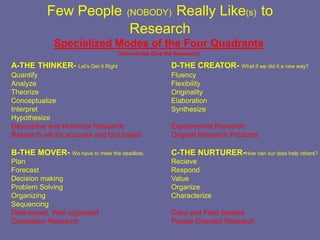
Few People                         Really Like(s) to
                                       (NOBODY)

                                        Research
             Specialized Modes of the Four Quadrants
                                    (Sorry-Gotta Give the Research)

A-THE THINKER- Let’s Get it Right                       D-THE CREATOR- What if we did it a new way?
Quantify                                                Fluency
Analyze                                                 Flexibility
Theorize                                                Originality
Conceptualize                                           Elaboration
Interpret                                               Synthesize
Hypothesize
Descriptive and Historical Research                     Experimental Research
Research will be accurate and fact based                Original Research Products

B-THE MOVER- We have to meet the deadline.              C-THE NURTURER-How can our data help others?
Plan                                                    Recieve
Forecast                                                Respond
Decision making                                         Value
Problem Solving                                         Organize
Organizing                                              Characterize
Sequencing
Data-based, Well organized                              Case and Field Studies
Correlation Research                                    People Oriented Research
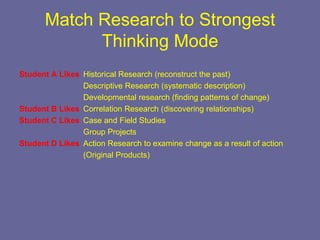
Match Research to Strongest
            Thinking Mode
Student A Likes Historical Research (reconstruct the past)
                Descriptive Research (systematic description)
                Developmental research (finding patterns of change)
Student B Likes Correlation Research (discovering relationships)
Student C Likes Case and Field Studies
                Group Projects
Student D Likes Action Research to examine change as a result of action
                (Original Products)
Resources
• K-5th Grade Products for Differentiation in the classroom-
  www.pieces of learning.com
   – Rubrics accompanies each product
• Research Reports to knock your teacher’s socks off-by
  Nancy Polette
• Research Without Copying-by Nancy Polette
• Research Without Copying for Primary Grades-by Nancy
  Polette
• Internet resources to motivate student reading
• Concept mapping software to help students plan their
  writing
REMEMBER MLK,JR?
• AVOID THIS:
    • Topic: Famous Black/African American
    • Assignment: One page report on a person

    What Students WILL DO:
     Copy pages from an online article about his/her
     subject

    Thinking Level: KNOWLEDGE
Examples
• Packet-Types of Research

• If you CHANGE the research Product you
  also CHANGE the thinking and research
  Processes the student used to develop the
  product.
TRY THIS
• Topic: Famous Black/African American
• Assignment: A narrative poem about an
  important incident in the life of a Famous African
  American
• What the student will do:
  –   Locate and Analyze Information
  –   Choose and important incident
  –   Verify Information
  –   Write a poem incorporating the most important data
• Thinking Level: Comprehension, Application,
  Analysis, Synthesis, Evaluation
When the Product is Changed
so that Students Have to Use
  Information in New Ways,
       Copying STOPS.
Issues and Problems
• Expanding the                • Exploring New
  Definition of Literacy         Instructional Practices
   – Incorporate electronic      – Knowledge of
     forms of                      hardware (e.g.,
     communication                 computers, televisions,
   – Shift our conception to       VCRs, scanners,
     new literacies                camcorders, digital
                                   cameras)
                                 – Learning to create and
                                   present multimedia
                                   products
Issues and Problems cont.
• Making Decisions      • Critical Social
  About Keyboarding       Learning
  Instruction             Environments
  – Qwerty keyboard        – Technology helps
  – Proper usage of a        students become
    keyboard               – Networked
                             technologies allowed
                             world wide
                             communication
                           – Technology
                             interactions provide
                             multicultural benefit
Issues and Problems cont.
• Working with Diverse       • Motivating Students
  Learners                     – Educators are using
  – Appropriate use of           interactive and visual
    technology (e.g. ,           qualities of software
    books on CD, tapes,          and websites to
    online, and software         increase motivation
  – Internet resources for     – A variety of technology
    non readers                  has increased the
                                 students willingness to
                                 write
                               – Computer based
                                 tracking systems (i.e.
                                 Accelerated Reader)
Issues and Problems cont.
• Teachers’ Growth as Literacy Professionals
  – Teachers who are skilled in the effective use of
    technology for teaching and learning,
  – A literacy curriculum that integrates the new literacies
    of technology into instructional programs,
  – Instruction that develops the critical literacies
    essential to effective information use,
  – Assessment practices in literacy that include reading
    and writing technology tools,
  – Opportunities to learn safe and responsible use of
    information and communication technologies, and
  – Equal access to technology
Research Activities
• Largely teacher selected
   – Best if hands on observational experiences
• Students learn about and relate information by
  interacting with materials
• If possible use independent learning centers in
  elementary
• Using instructional websites, social networking
• Using proofing and editing software
Models
• Upper Elementary
  – Review packet-Evaluation-packet
• Lower Elementary Ideas
  – Review Packet
Develop Good Research Skills
    Ask Good Questions
Benefits
•   Students gain knowledge and have fun
•   Students proud of product
•   Class is truly interested in product
•   Teacher not bored
•   Fosters Creativity
Websites
• www.duab.qsnhjz.co.cc
• www.palmbeach.k12.fl.us/learning_tools/students/el
  ementary.htm
• www.lps.lexingtonma.org/Libdept/elem.html
• www.lauriefowler.com/esheet.html
• www.cccoe.k12.ca.us/bats/research/research.htm
• www.mzpf.xalgjo.co.cc
• www.connect.spps.org/Elementary_Research_Tech
  niques2.html
Thank You

Technology Integration

  • 1.
    Ummmm….. Teacher, Whatis an Encyclopedia? Strategies for developing authentic research reports for Elementary Students with the Integration of Technology
  • 2.
    Research Without Copying •Nancy Polette – Professor Emeritus (retired) at Lindenwood College-St. Charles, Missouri – Author of over 150 professional books including Research Without Copying – Married to Paul – Owner and Publisher of Book Lures, Inc. – Currently an Educational Consultant
  • 3.
    Goals for Research •Have Students Think critically about what is read and/or heard by seeking facts that support information • Allow students to use information in a variety of ways instead of copying information • Have students use various avenues of technology for effective research
  • 4.
    The rewards ofIntegrating Technology into the classroom for English and Language Arts • Gives motivational, individual instruction and/or practice in individual reading and writing skills • Supports the reflection and frequent modification called for in process writing • Supports all stages of the writing process: planning, drafting, revising and editing, and publishing.
  • 5.
    Technology Integration Strategies • Language Skills Development – Teaching decoding skills » Digitized speech support » Interactive websites, games » Videos » Ebooks – Developing other reading skills » Software-based and online systems » Reference resources » Electronic devices – Creating everyday teacher activities » Spreadsheets » Electronic presentations » Using word processors
  • 6.
    Technology Integration Strategies •Literacy Development – Networked literacy projects – Activities with interactive storybooks, Ebooks, and talking books – Uses of tracking systems – Connections to online reading materials to engage students – Writing in blogs – Motivating writing with video projects – Threaded discussions at a distance
  • 7.
    Technology Integration Strategies •The Process Approach to writing – Prewriting • Electronic outlining • Concept mapping software – Drafting • Word processing program • Electronic note cards – Revising and editing • Projection of the students typed draft on a screen • Easier using a computer • Word process capabilities • Spell and grammar checkers • Student interaction • Group assignments
  • 8.
    Technology Integration Strategies cont. • The Process Approach to writing cont. – Publishing • Traditional (paper) publishing  Desktop publishing programs  Word processing software • Electronic publishing  Share writing n electronic forms (i.e. EBooks, websites, multimedia slide shows, and news broadcasts)  Students can publish their work  Email and website projects  Electronic penpal  ePALS
  • 9.
    Ummm… Teacher what’san Encyclopedia • Copied directly from Mrs. Polette • Written Reports are usually copied information-thus becoming a true false paper – Martin Luther King, Jr. Paper • Standard research papers encourage copying and data dumping from websites • Wikipedia causes the traditional encyclopedia to become obsolete
  • 10.
    Few People Really Like(s) to (NOBODY) Research Specialized Modes of the Four Quadrants (Sorry-Gotta Give the Research) A-THE THINKER- Let’s Get it Right D-THE CREATOR- What if we did it a new way? Quantify Fluency Analyze Flexibility Theorize Originality Conceptualize Elaboration Interpret Synthesize Hypothesize Descriptive and Historical Research Experimental Research Research will be accurate and fact based Original Research Products B-THE MOVER- We have to meet the deadline. C-THE NURTURER-How can our data help others? Plan Recieve Forecast Respond Decision making Value Problem Solving Organize Organizing Characterize Sequencing Data-based, Well organized Case and Field Studies Correlation Research People Oriented Research
  • 11.
    Match Research toStrongest Thinking Mode Student A Likes Historical Research (reconstruct the past) Descriptive Research (systematic description) Developmental research (finding patterns of change) Student B Likes Correlation Research (discovering relationships) Student C Likes Case and Field Studies Group Projects Student D Likes Action Research to examine change as a result of action (Original Products)
  • 12.
    Resources • K-5th GradeProducts for Differentiation in the classroom- www.pieces of learning.com – Rubrics accompanies each product • Research Reports to knock your teacher’s socks off-by Nancy Polette • Research Without Copying-by Nancy Polette • Research Without Copying for Primary Grades-by Nancy Polette • Internet resources to motivate student reading • Concept mapping software to help students plan their writing
  • 13.
    REMEMBER MLK,JR? • AVOIDTHIS: • Topic: Famous Black/African American • Assignment: One page report on a person What Students WILL DO: Copy pages from an online article about his/her subject Thinking Level: KNOWLEDGE
  • 14.
    Examples • Packet-Types ofResearch • If you CHANGE the research Product you also CHANGE the thinking and research Processes the student used to develop the product.
  • 15.
    TRY THIS • Topic:Famous Black/African American • Assignment: A narrative poem about an important incident in the life of a Famous African American • What the student will do: – Locate and Analyze Information – Choose and important incident – Verify Information – Write a poem incorporating the most important data • Thinking Level: Comprehension, Application, Analysis, Synthesis, Evaluation
  • 16.
    When the Productis Changed so that Students Have to Use Information in New Ways, Copying STOPS.
  • 17.
    Issues and Problems •Expanding the • Exploring New Definition of Literacy Instructional Practices – Incorporate electronic – Knowledge of forms of hardware (e.g., communication computers, televisions, – Shift our conception to VCRs, scanners, new literacies camcorders, digital cameras) – Learning to create and present multimedia products
  • 18.
    Issues and Problemscont. • Making Decisions • Critical Social About Keyboarding Learning Instruction Environments – Qwerty keyboard – Technology helps – Proper usage of a students become keyboard – Networked technologies allowed world wide communication – Technology interactions provide multicultural benefit
  • 19.
    Issues and Problemscont. • Working with Diverse • Motivating Students Learners – Educators are using – Appropriate use of interactive and visual technology (e.g. , qualities of software books on CD, tapes, and websites to online, and software increase motivation – Internet resources for – A variety of technology non readers has increased the students willingness to write – Computer based tracking systems (i.e. Accelerated Reader)
  • 20.
    Issues and Problemscont. • Teachers’ Growth as Literacy Professionals – Teachers who are skilled in the effective use of technology for teaching and learning, – A literacy curriculum that integrates the new literacies of technology into instructional programs, – Instruction that develops the critical literacies essential to effective information use, – Assessment practices in literacy that include reading and writing technology tools, – Opportunities to learn safe and responsible use of information and communication technologies, and – Equal access to technology
  • 21.
    Research Activities • Largelyteacher selected – Best if hands on observational experiences • Students learn about and relate information by interacting with materials • If possible use independent learning centers in elementary • Using instructional websites, social networking • Using proofing and editing software
  • 22.
    Models • Upper Elementary – Review packet-Evaluation-packet • Lower Elementary Ideas – Review Packet
  • 23.
    Develop Good ResearchSkills Ask Good Questions
  • 24.
    Benefits • Students gain knowledge and have fun • Students proud of product • Class is truly interested in product • Teacher not bored • Fosters Creativity
  • 25.
    Websites • www.duab.qsnhjz.co.cc • www.palmbeach.k12.fl.us/learning_tools/students/el ementary.htm • www.lps.lexingtonma.org/Libdept/elem.html • www.lauriefowler.com/esheet.html • www.cccoe.k12.ca.us/bats/research/research.htm • www.mzpf.xalgjo.co.cc • www.connect.spps.org/Elementary_Research_Tech niques2.html
  • 26.