Computer technology to help teachers and benefit students Learner- centred environment
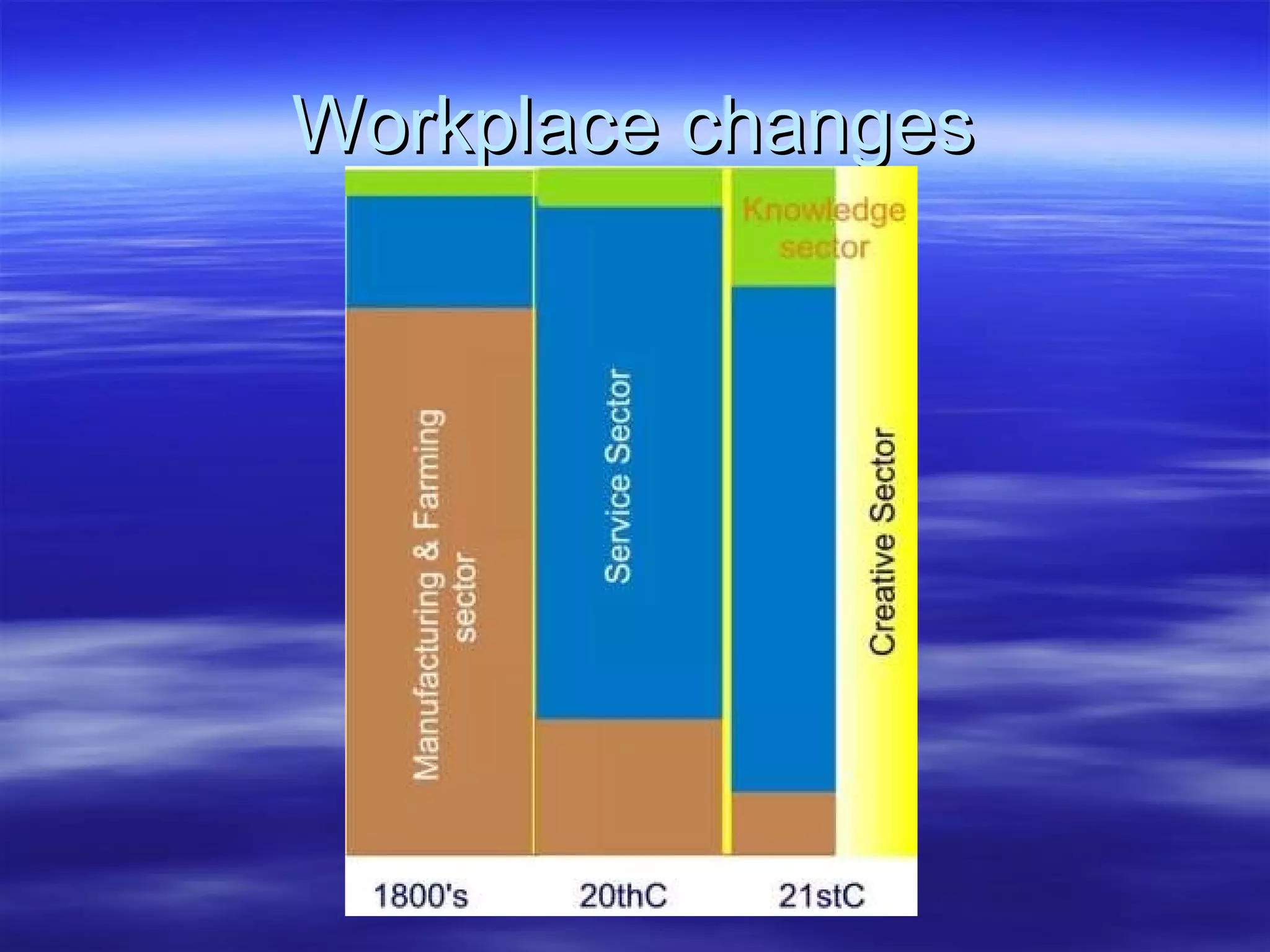
Workplace changes
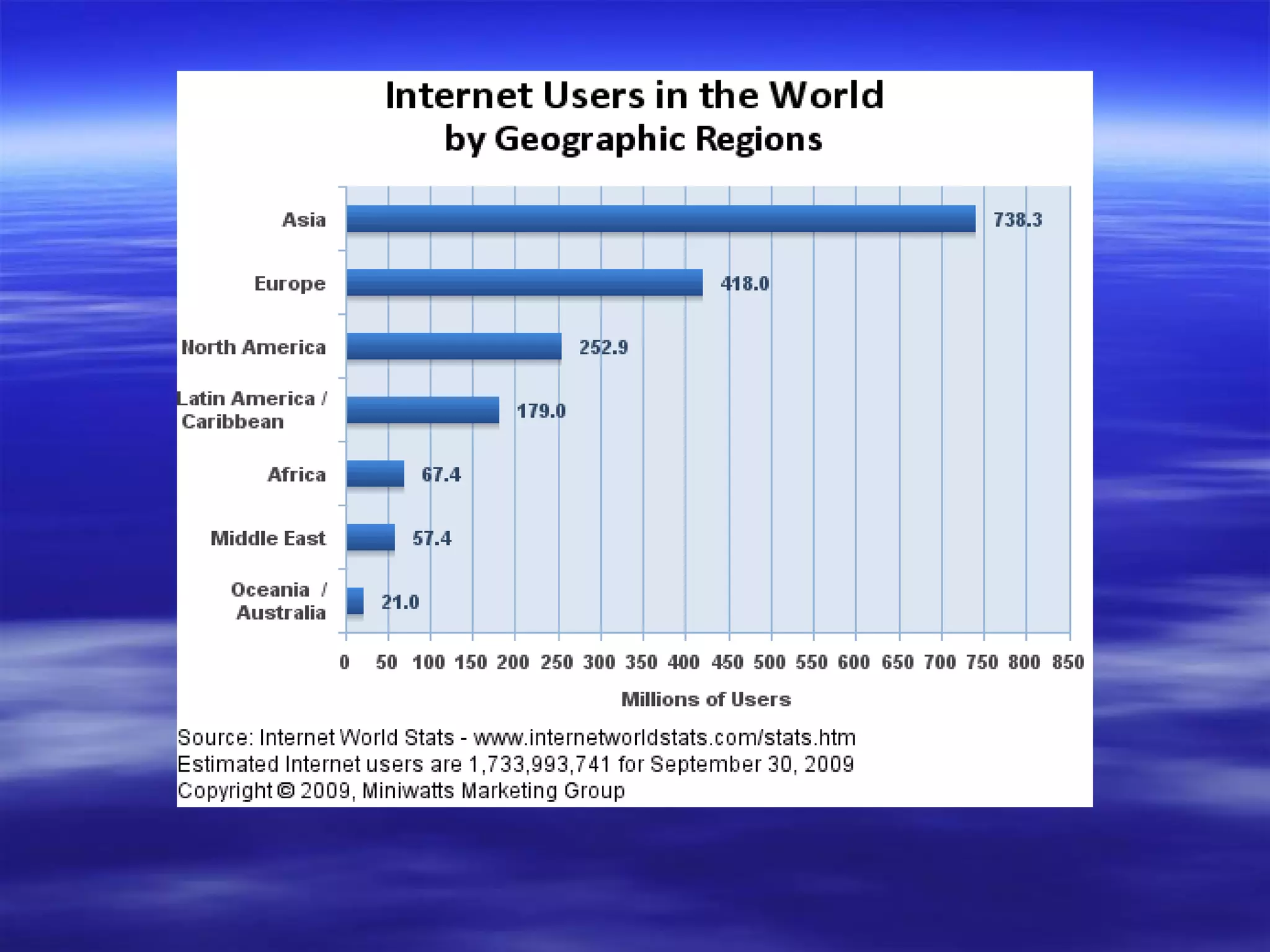
Things to know There is no doubt that things are changing in the modern classroom as teachers find more ways to leverage technology for learning. As the Internet grows at exponential rates, its associated technologies provide  a toolbox of educational and informational resources  for enhancing teaching and learning in the classroom and at home.
 
Student-centred  The information resources and processing features of the Internet have great potential for creating active,  student-centered  learning environments. In student-centered classrooms the goal of education is to  create independent, autonomous learners  who assume the responsibility for their own learning  (Weimer, 2002). In student-centered classrooms teachers, students, and instructional resources assume roles that are fundamentally different from those in teacher-directed classrooms.
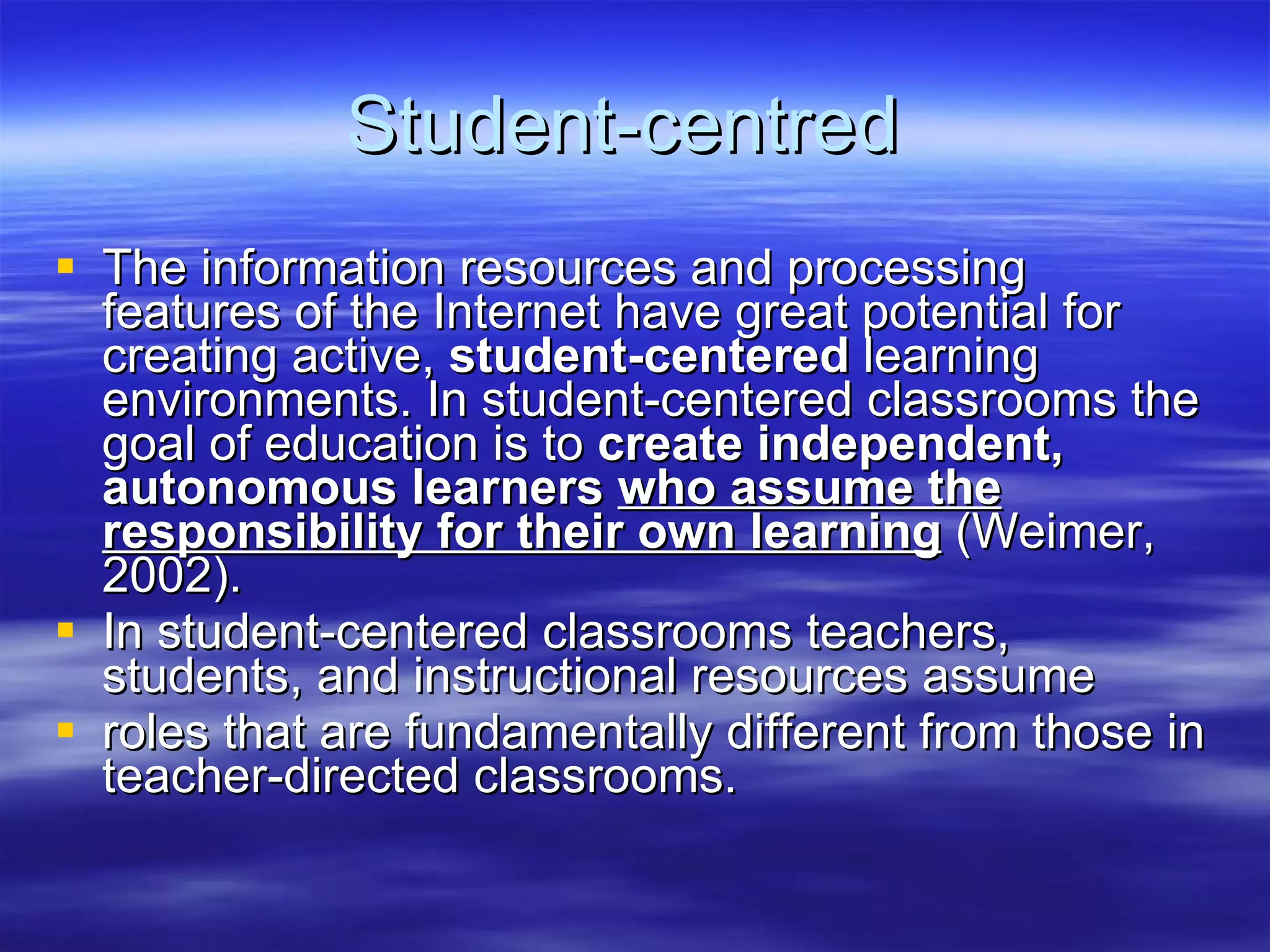
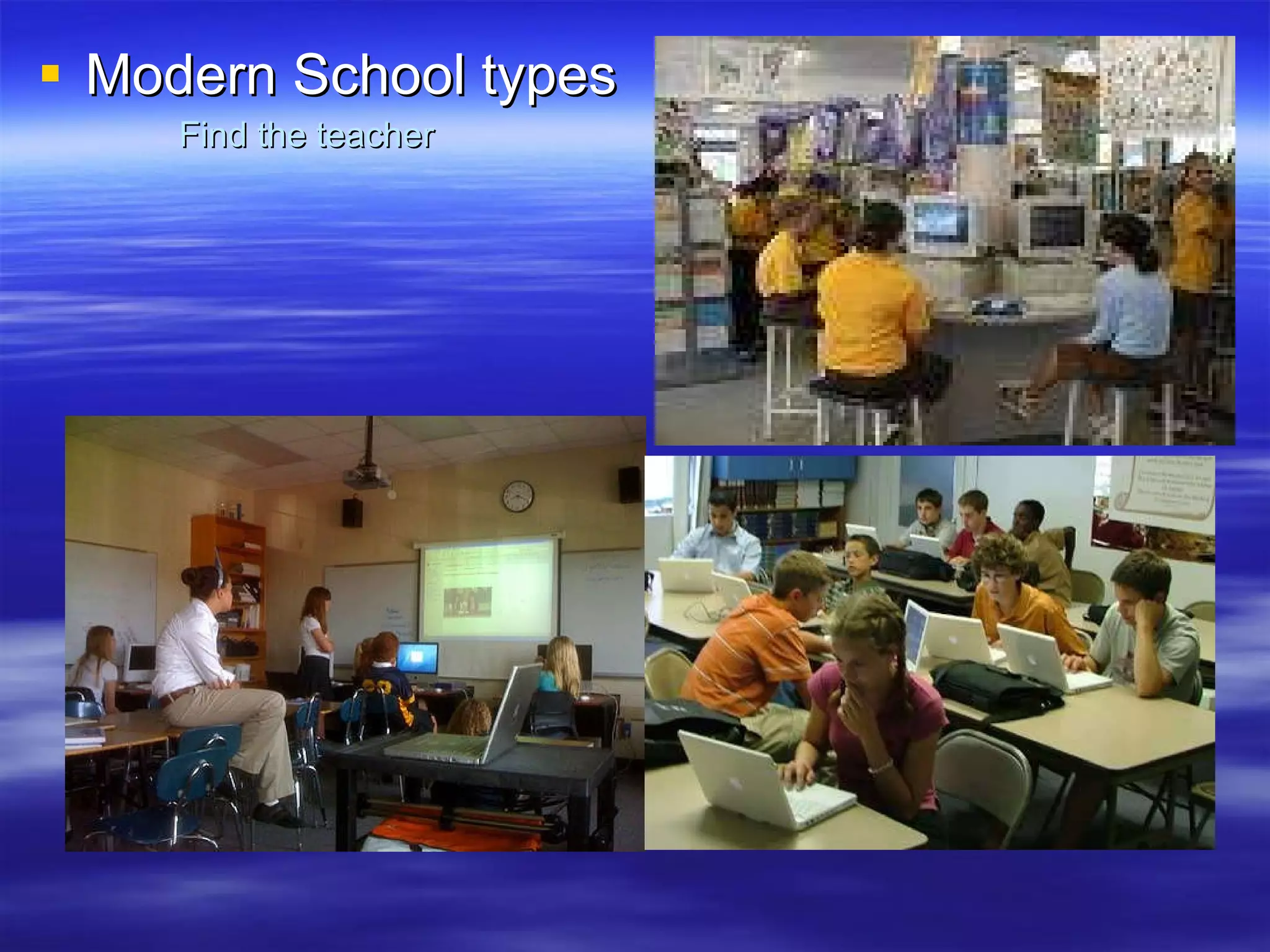
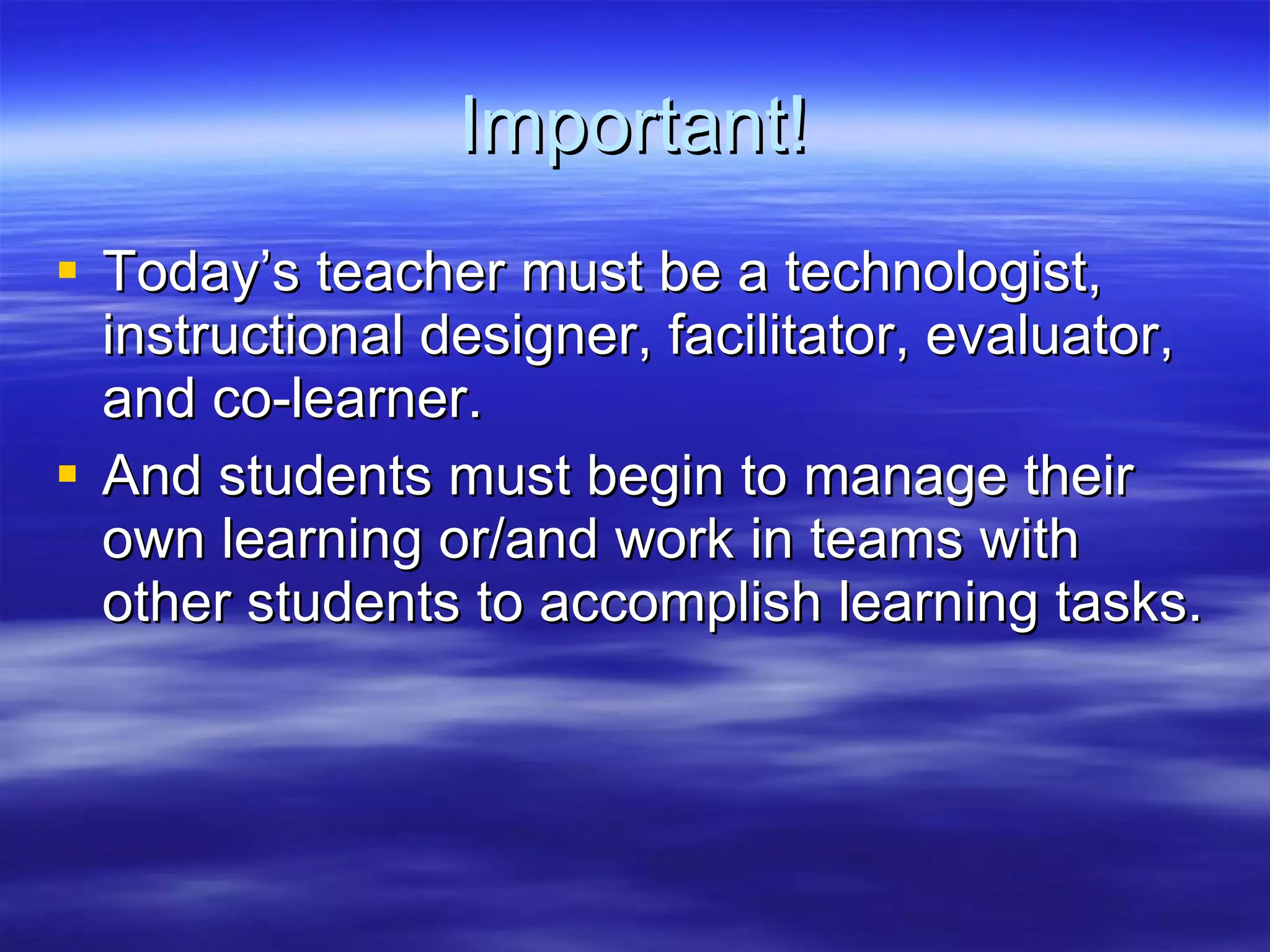
Find the teacher Modern School types
Important! Today’s teacher must be a technologist, instructional designer, facilitator, evaluator, and co-learner. And students must begin to manage their own learning or/and work in teams with other students to accomplish learning tasks.
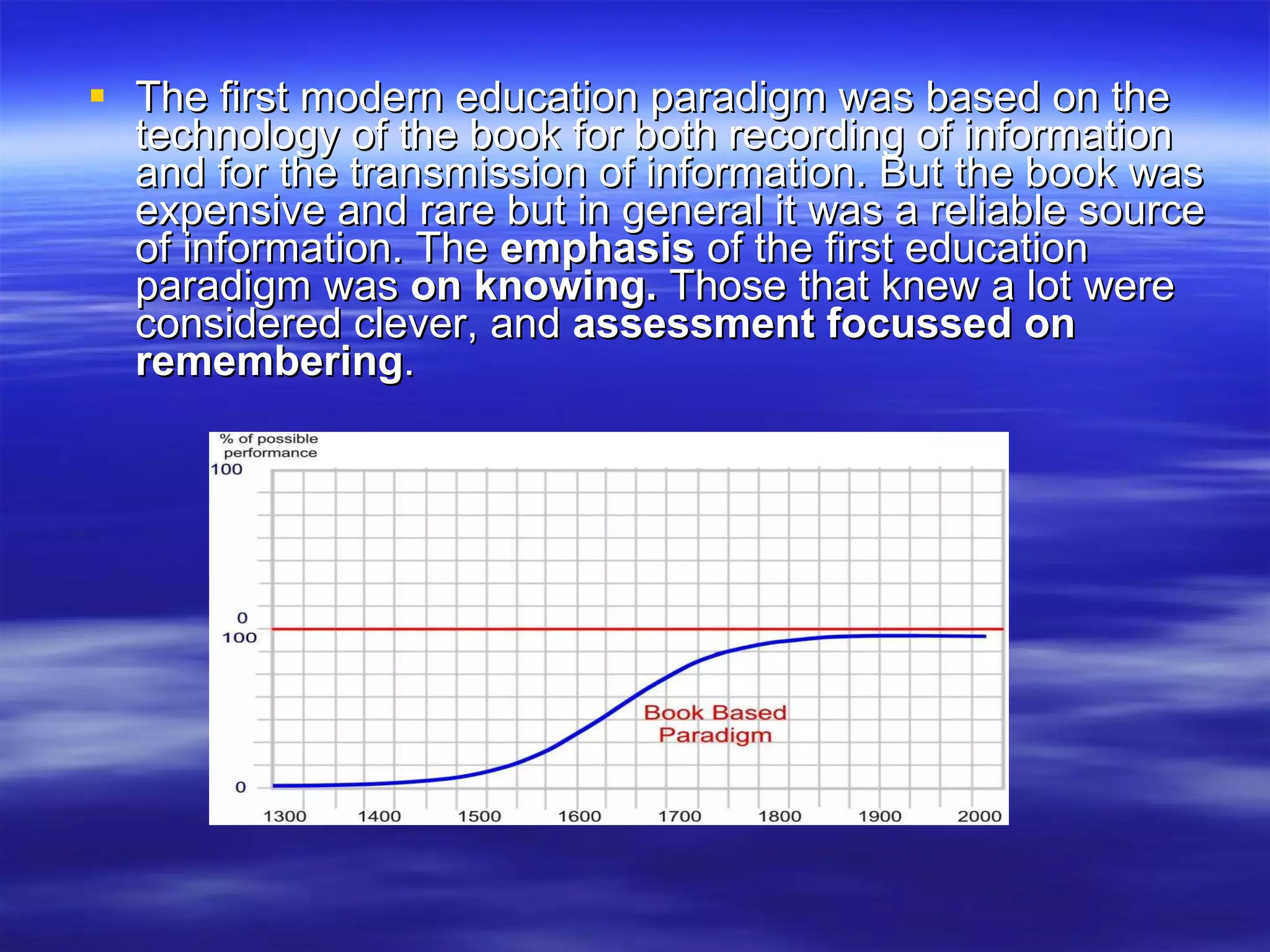
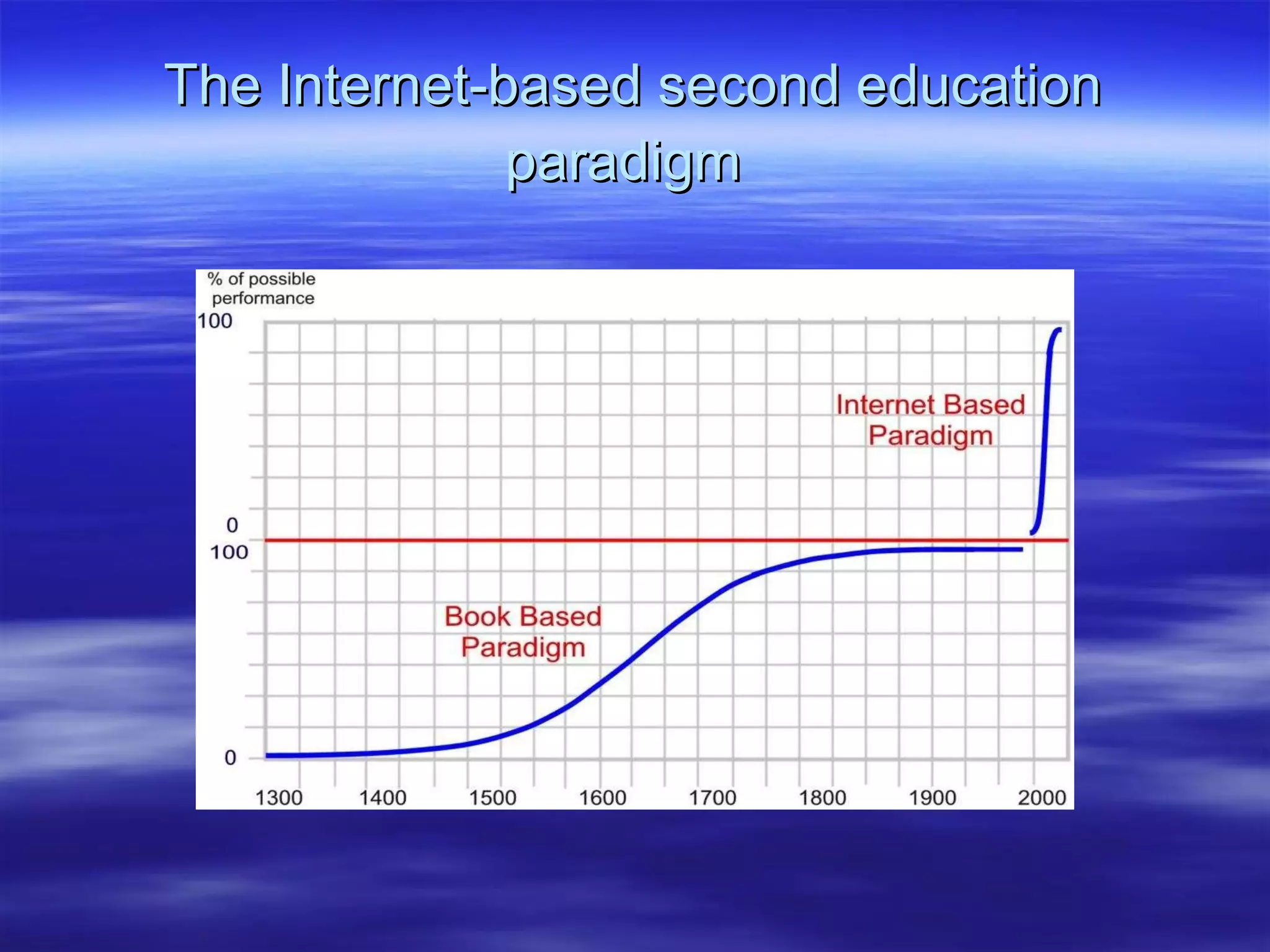
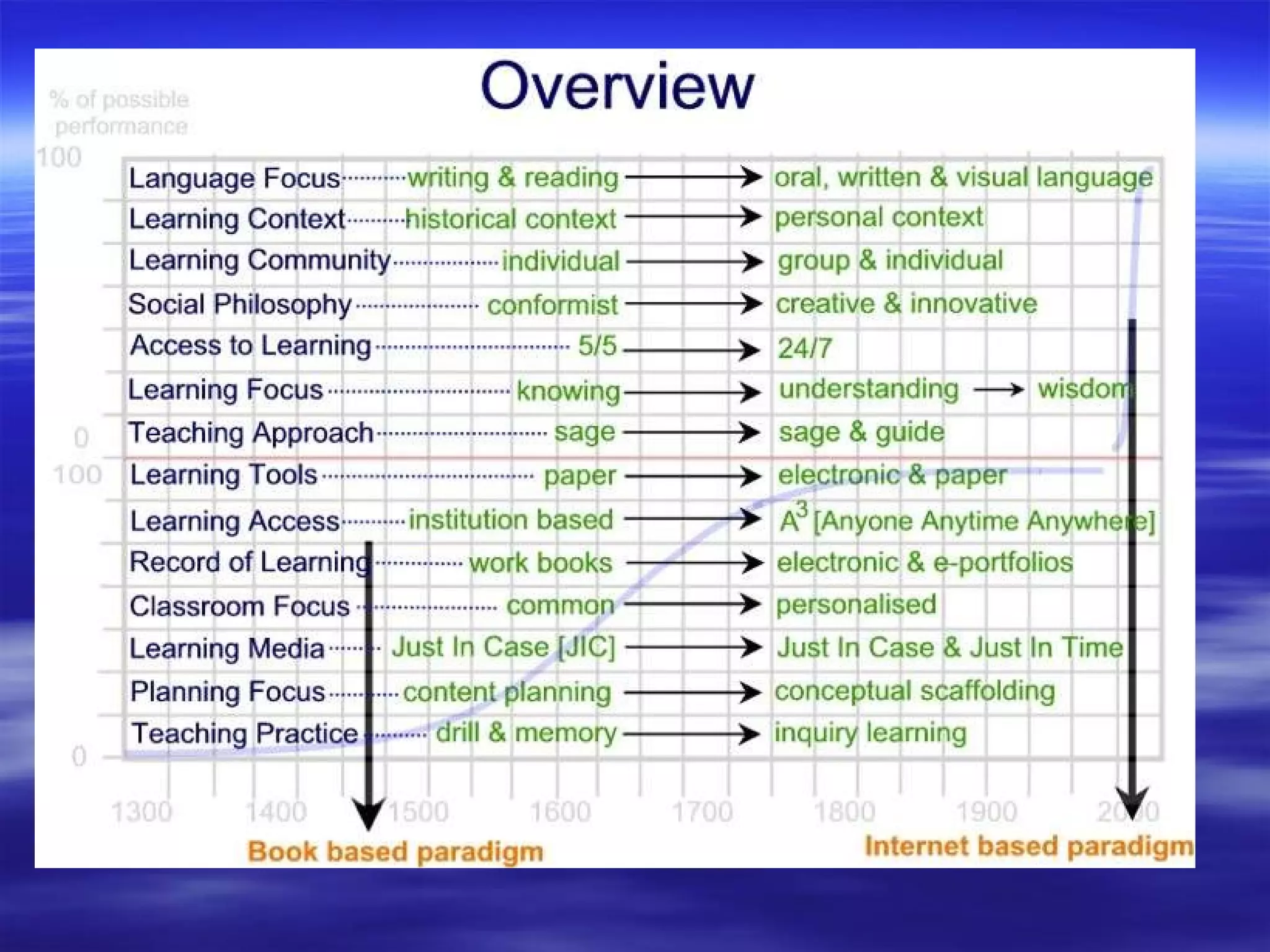
The first modern education paradigm was based on the technology of the book for both recording of information and for the transmission of information. But the book was expensive and rare but in general it was a reliable source of information. The  emphasis  of the first education paradigm was  on knowing.  Those that knew a lot were considered clever, and  assessment focussed on remembering .
The Internet-based second education paradigm
The Internet paradigm became a practical reality in terms of cost and access. In the second education paradigm information and communication systems are overwhelming in quantity presented in a multitude of media formats of a very high quality increasingly reliable
 
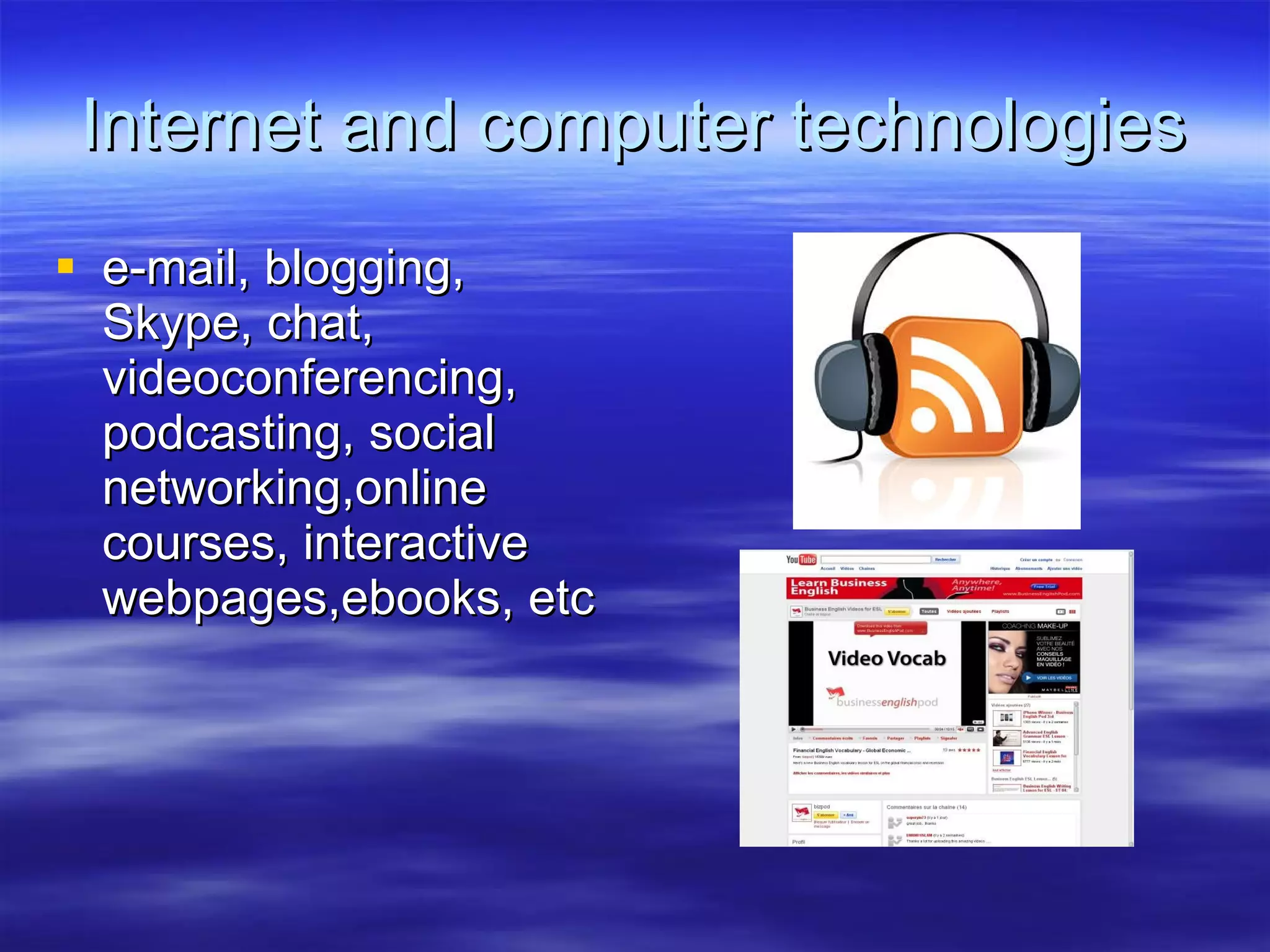
Internet and computer technologies e-mail, blogging, Skype, chat, videoconferencing, podcasting, social networking,online courses, interactive webpages,ebooks, etc
Blended teaching The concept behind the  blended teaching  method is that language learning can be greatly enhanced by an effective  combination of face-to-face teaching and online support materials . It is this blended learning solution that makes the method unique. It ensures that students enjoy the best of both worlds: they continue to receive face-to-face tuition and contact with their teachers whilst remaining free to study online within a controlled learning environment.
Critical Questions How can technology help you personalize learning? How can technology engage multiple intelligences? How can technology bridge the classroom and home learning environment? How can technology assist the unique learner? How can technology be used to simultaneously deepen student understanding and accelerate student achievement standards?
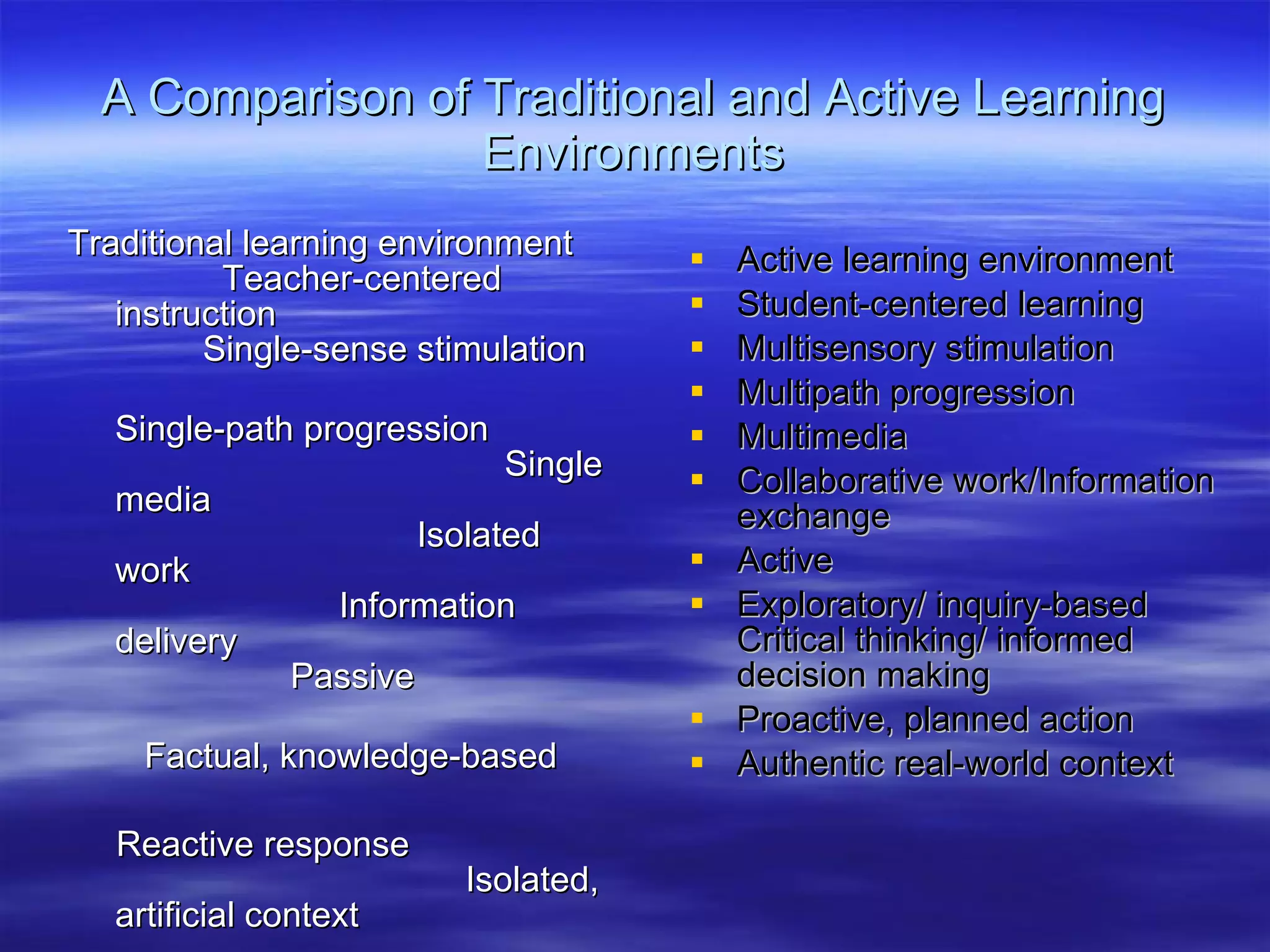
A Comparison of Traditional and Active Learning Environments Traditional learning environment  Teacher-centered instruction  Single-sense stimulation  Single-path progression  Single media  Isolated work  Information delivery  Passive  Factual, knowledge-based  Reactive response  Isolated, artificial context  Active learning environment Student-centered learning Multisensory stimulation Multipath progression Multimedia Collaborative work/Information exchange Active Exploratory/ inquiry-based Critical thinking/ informed decision making Proactive, planned action Authentic real-world context
Web-Enhanced Learning Versus Web-Based Instruction There are two primary educational models for using the Internet and the World Wide Web for teaching and learning: Web-based instruction and Web-enhanced learning. The main distinction between them is that  Web-based instruction  uses the Web and Internet technologies as the primary delivery   medium, whereas  Web-enhanced learning  uses the technologies, tools, and resources of the Internet and the World Wide Web to support teaching and learning in the classroom .
Web-Based Instruction Web-based instruction is also called  Web-based training, Web-based learning, or simply e-learning.  Web-based instruction is a form of distance learning that delivers instruction to the learner through a computer, using standard Internet technologies, especially  the World Wide Web  (Rosenberg, 2001). Online courses delivered through the Internet are examples of Web-based instruction.
Web-Enhanced Learning Web-enhanced learning is a classroom-based educational approach that allows students to  use Internet technologies, especially the Web, to access information  and human resources purposefully and intentionally in ways that are conducive to learning (Grabowski, Koszalka, & McCarthy, 2000).   Web-enhanced learning has the potential to provide  multiple learning contexts for both student learners and teacher learners . Web-enhanced learning can promote independent learning as well as facilitate collaborative communities of learners.   Web-enhanced learning depends on the features of Internet technologies, such as asynchronous communication, and information access and searching. These features offer teachers powerful tools for more efficient and flexible instruction and, hopefully, more effective learning (Collis, 1997).Web-enhanced learning can work well even in classrooms that do not have a computer for each student.
Your ideas In what  ways and means can you use Web and computers in homework tasks? A. Grammar B. Vocabulary C. Listening and Speaking D. Reading E. Writing
My ideas Grammmar E-grammar practice books Grammar Time, Round Up, and all time favourite-- Azar Book Series with Power Point Grammar presentations, Tests  etc. You name it, I have them. YouTube.com and slideshare.net files Software. Virtual Repetitor, interactive “Oxford Living Grammar”series. Online practice http://www.e-grammar.org/ You can practise all the grammatical structures with  free tests  - gap-filling, matching or multiple choice tests.  Software Irregular verbs trainer
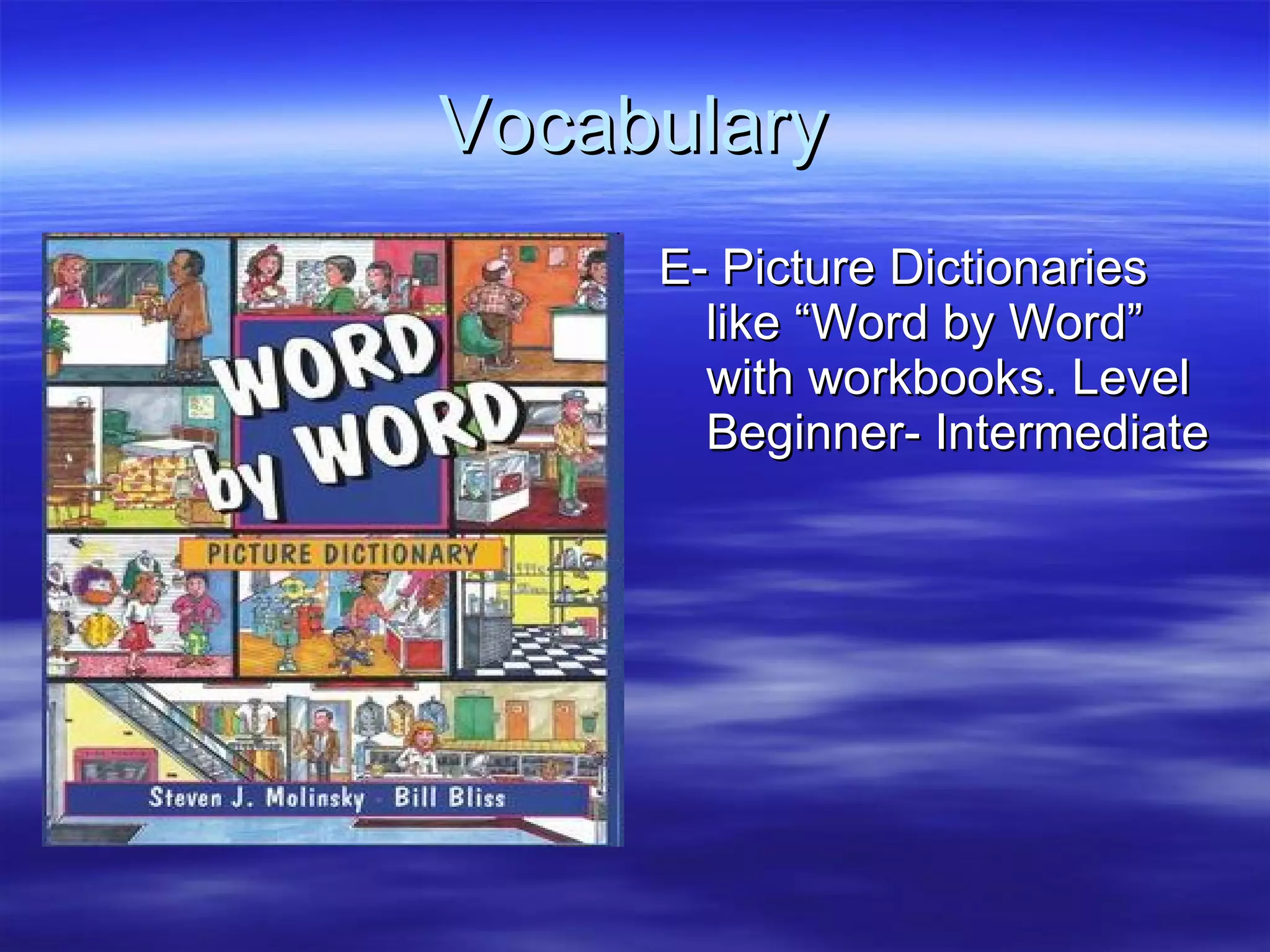
Vocabulary E- Picture Dictionaries like “Word by Word” with workbooks. Level Beginner- Intermediate
Vocabulary http:// www.youtube.com / video files  http://www.slideshare.net/ Power  Point Presentations E-Books  “ Target Vocabulary” series Software  Collins CobuildAdvanced Dictionary
Listening and Speaking Online listening Audio/Video podcasts http://www.bbc.co.uk/podcasts/ www.breakingnewsenglish.com http://australianetwork.com/learningenglish/vodcast.htm Software and digital interactive programmes E-Books ‘ESL Teacher's Conversation Pack”
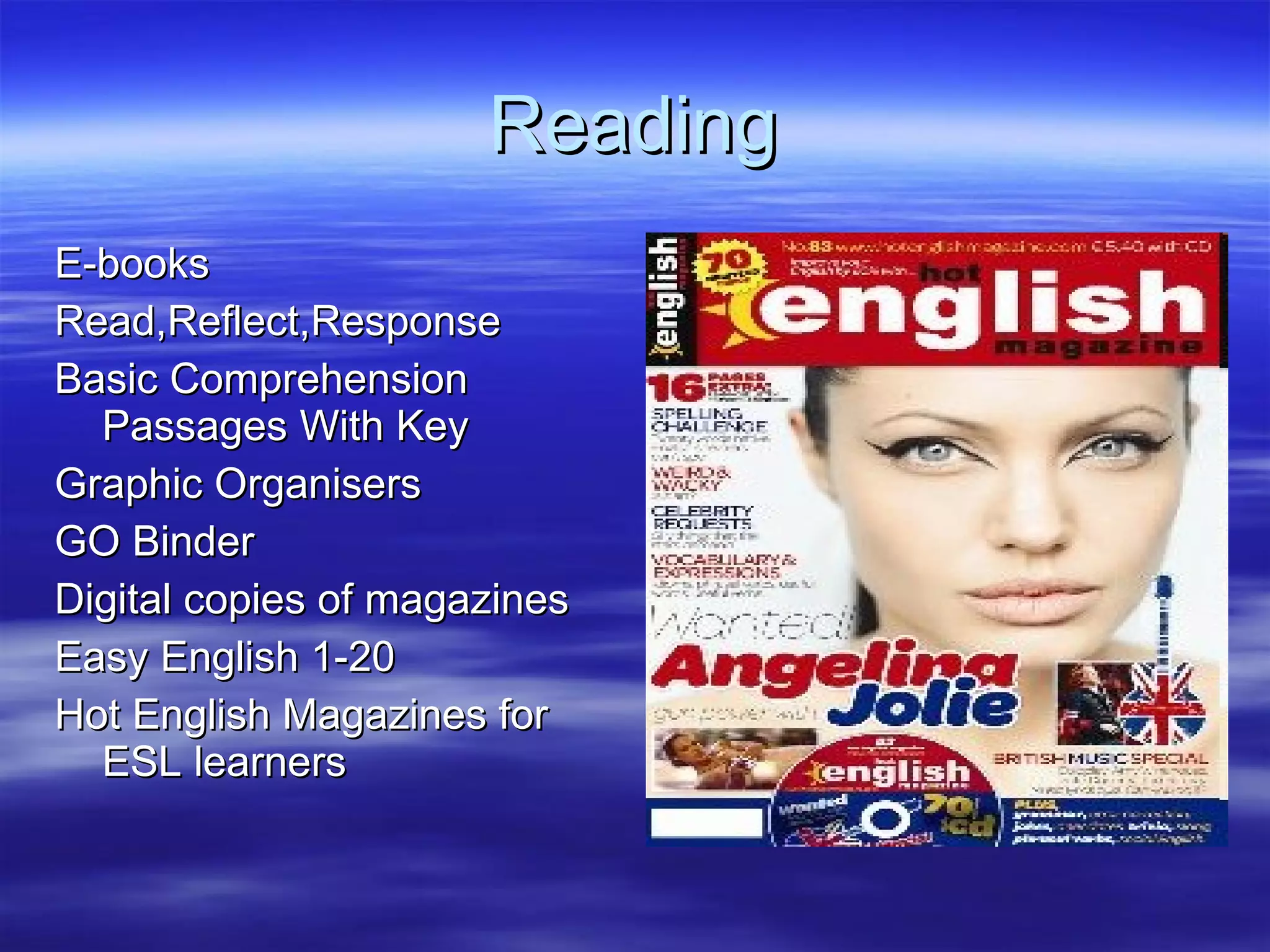
Reading E-books Read,Reflect,Response Basic Comprehension Passages With Key Graphic Organisers GO Binder Digital copies of magazines Easy English 1-20 Hot English Magazines for ESL learners
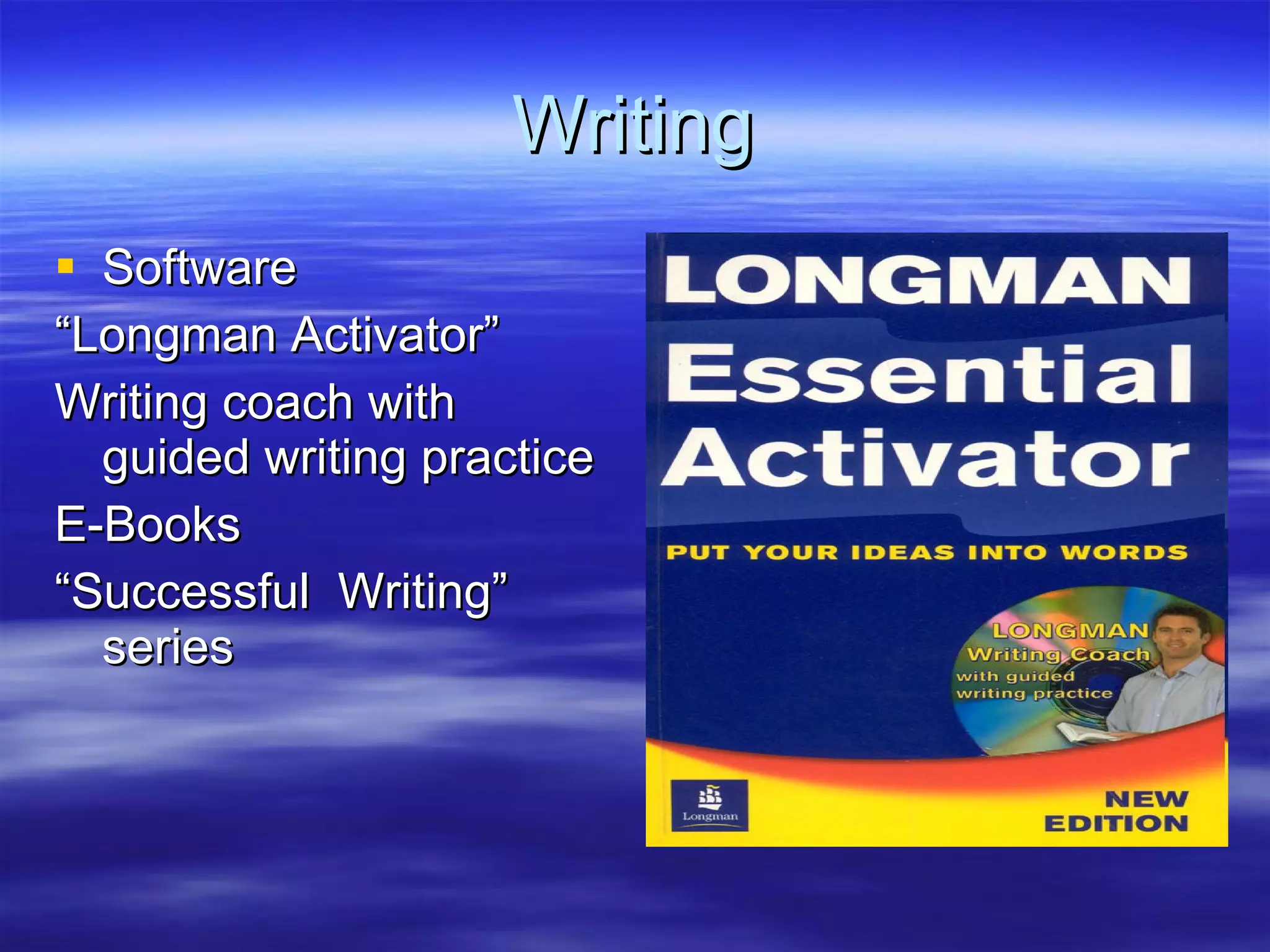
Writing Software “ Longman Activator” Writing coach with guided writing practice E-Books “ Successful  Writing” series
What does this mean for schools Multi-“text” approach to learning Increased student collaboration-in new paradigms Instant feedback and remediation Assessment becomes an ongoing and frequent activity Exploration, interactive, and inquiry-based learning take center stage Learning takes place in real-world context Learning takes place outside classroom New methods of delivering instruction
What does this mean to teachers ? Keeping up with students Learning new strategies to keep students engaged Developing the vision to see the potential Keeping the eye on students’ achievements Developing appropriate forms of assessment for technology supported learning Maintaining the home/school connection Making your life easy!
Barriers to implementation Costs to keep up and current Skepticism regarding benefits of technology for learning and achievement Security concerns Teacher skills to integrate technology seamlessly into the learning environment Teacher v student skills Existing paradigms – e-books v print eDependence
Be Creative Upload the burden

Compuet Technology to help teachers and benefit students

  • 1.
    Computer technology tohelp teachers and benefit students Learner- centred environment
  • 2.
  • 3.
    Things to knowThere is no doubt that things are changing in the modern classroom as teachers find more ways to leverage technology for learning. As the Internet grows at exponential rates, its associated technologies provide a toolbox of educational and informational resources for enhancing teaching and learning in the classroom and at home.
  • 4.
  • 5.
    Student-centred Theinformation resources and processing features of the Internet have great potential for creating active, student-centered learning environments. In student-centered classrooms the goal of education is to create independent, autonomous learners who assume the responsibility for their own learning (Weimer, 2002). In student-centered classrooms teachers, students, and instructional resources assume roles that are fundamentally different from those in teacher-directed classrooms.
  • 6.
    Find the teacherModern School types
  • 7.
    Important! Today’s teachermust be a technologist, instructional designer, facilitator, evaluator, and co-learner. And students must begin to manage their own learning or/and work in teams with other students to accomplish learning tasks.
  • 8.
    The first moderneducation paradigm was based on the technology of the book for both recording of information and for the transmission of information. But the book was expensive and rare but in general it was a reliable source of information. The emphasis of the first education paradigm was on knowing. Those that knew a lot were considered clever, and assessment focussed on remembering .
  • 9.
    The Internet-based secondeducation paradigm
  • 10.
    The Internet paradigmbecame a practical reality in terms of cost and access. In the second education paradigm information and communication systems are overwhelming in quantity presented in a multitude of media formats of a very high quality increasingly reliable
  • 11.
  • 12.
    Internet and computertechnologies e-mail, blogging, Skype, chat, videoconferencing, podcasting, social networking,online courses, interactive webpages,ebooks, etc
  • 13.
    Blended teaching Theconcept behind the blended teaching method is that language learning can be greatly enhanced by an effective combination of face-to-face teaching and online support materials . It is this blended learning solution that makes the method unique. It ensures that students enjoy the best of both worlds: they continue to receive face-to-face tuition and contact with their teachers whilst remaining free to study online within a controlled learning environment.
  • 14.
    Critical Questions Howcan technology help you personalize learning? How can technology engage multiple intelligences? How can technology bridge the classroom and home learning environment? How can technology assist the unique learner? How can technology be used to simultaneously deepen student understanding and accelerate student achievement standards?
  • 15.
    A Comparison ofTraditional and Active Learning Environments Traditional learning environment Teacher-centered instruction Single-sense stimulation Single-path progression Single media Isolated work Information delivery Passive Factual, knowledge-based Reactive response Isolated, artificial context Active learning environment Student-centered learning Multisensory stimulation Multipath progression Multimedia Collaborative work/Information exchange Active Exploratory/ inquiry-based Critical thinking/ informed decision making Proactive, planned action Authentic real-world context
  • 16.
    Web-Enhanced Learning VersusWeb-Based Instruction There are two primary educational models for using the Internet and the World Wide Web for teaching and learning: Web-based instruction and Web-enhanced learning. The main distinction between them is that Web-based instruction uses the Web and Internet technologies as the primary delivery medium, whereas Web-enhanced learning uses the technologies, tools, and resources of the Internet and the World Wide Web to support teaching and learning in the classroom .
  • 17.
    Web-Based Instruction Web-basedinstruction is also called Web-based training, Web-based learning, or simply e-learning. Web-based instruction is a form of distance learning that delivers instruction to the learner through a computer, using standard Internet technologies, especially the World Wide Web (Rosenberg, 2001). Online courses delivered through the Internet are examples of Web-based instruction.
  • 18.
    Web-Enhanced Learning Web-enhancedlearning is a classroom-based educational approach that allows students to use Internet technologies, especially the Web, to access information and human resources purposefully and intentionally in ways that are conducive to learning (Grabowski, Koszalka, & McCarthy, 2000). Web-enhanced learning has the potential to provide multiple learning contexts for both student learners and teacher learners . Web-enhanced learning can promote independent learning as well as facilitate collaborative communities of learners. Web-enhanced learning depends on the features of Internet technologies, such as asynchronous communication, and information access and searching. These features offer teachers powerful tools for more efficient and flexible instruction and, hopefully, more effective learning (Collis, 1997).Web-enhanced learning can work well even in classrooms that do not have a computer for each student.
  • 19.
    Your ideas Inwhat ways and means can you use Web and computers in homework tasks? A. Grammar B. Vocabulary C. Listening and Speaking D. Reading E. Writing
  • 20.
    My ideas GrammmarE-grammar practice books Grammar Time, Round Up, and all time favourite-- Azar Book Series with Power Point Grammar presentations, Tests etc. You name it, I have them. YouTube.com and slideshare.net files Software. Virtual Repetitor, interactive “Oxford Living Grammar”series. Online practice http://www.e-grammar.org/ You can practise all the grammatical structures with free tests - gap-filling, matching or multiple choice tests. Software Irregular verbs trainer
  • 21.
    Vocabulary E- PictureDictionaries like “Word by Word” with workbooks. Level Beginner- Intermediate
  • 22.
    Vocabulary http:// www.youtube.com/ video files http://www.slideshare.net/ Power Point Presentations E-Books “ Target Vocabulary” series Software Collins CobuildAdvanced Dictionary
  • 23.
    Listening and SpeakingOnline listening Audio/Video podcasts http://www.bbc.co.uk/podcasts/ www.breakingnewsenglish.com http://australianetwork.com/learningenglish/vodcast.htm Software and digital interactive programmes E-Books ‘ESL Teacher's Conversation Pack”
  • 24.
    Reading E-books Read,Reflect,ResponseBasic Comprehension Passages With Key Graphic Organisers GO Binder Digital copies of magazines Easy English 1-20 Hot English Magazines for ESL learners
  • 25.
    Writing Software “Longman Activator” Writing coach with guided writing practice E-Books “ Successful Writing” series
  • 26.
    What does thismean for schools Multi-“text” approach to learning Increased student collaboration-in new paradigms Instant feedback and remediation Assessment becomes an ongoing and frequent activity Exploration, interactive, and inquiry-based learning take center stage Learning takes place in real-world context Learning takes place outside classroom New methods of delivering instruction
  • 27.
    What does thismean to teachers ? Keeping up with students Learning new strategies to keep students engaged Developing the vision to see the potential Keeping the eye on students’ achievements Developing appropriate forms of assessment for technology supported learning Maintaining the home/school connection Making your life easy!
  • 28.
    Barriers to implementationCosts to keep up and current Skepticism regarding benefits of technology for learning and achievement Security concerns Teacher skills to integrate technology seamlessly into the learning environment Teacher v student skills Existing paradigms – e-books v print eDependence
  • 29.