Organisation of Libraries

        Industry View
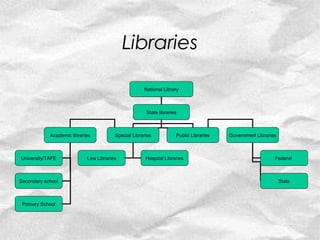
Libraries

                                                     National Library


                                                      State libraries


            Academic libraries          Special Libraries           Public Libraries   Government Libraries


University/TAFE             Law Libraries             Hospital Libraries                                  Federal


Secondary school                                                                                              State


 Primary School
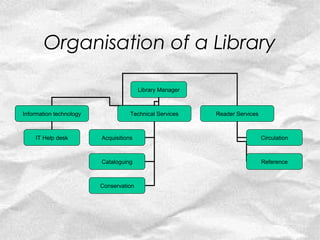
Organisation of a Library

                                        Library Manager


Information technology              Technical Services    Reader Services


    IT Help desk         Acquisitions                                       Circulation


                         Cataloguing                                        Reference


                         Conservation
National Library of Australia (NLA)
            Objectives
   To ensure that a comprehensive record
   of Australian history and endeavour,
   and a selected record of the world's
   knowledge, is collected, cared for and
   accessible
   To meet the needs of our users for rapid
   and streamlined access to collections
   To foster understanding and enjoyment
   of the National Library and its vital role
   in Australia's cultural, intellectual and
   social life
   To advance the development and
   understanding of libraries
State Libraries
State libraries have major responsibilities
for the collection development and
preservation of the State’s heritage. A
large amount of material held by the
State Libraries and the National Library
is acquired under legal deposit
    “The law which obliges publishers to
    deposit copies of their publications in
    libraries in the country in which they are
    published, including the National Library
    and other libraries designated in the Act”
    (Mortimer 2001, p.104)
State Library of Victoria
The State Library of Victoria will enrich
the cultural, educational, social and
economic life of all Victorians by:
    collecting, preserving and making
    available their documentary and
    published heritage
    providing access to the world’s
    information
    developing the state network of
    information resources and libraries
    promoting the culture and heritage of
    the state
Public Libraries
Public libraries are also called local or
municipal libraries. They are funded partly by
municipal councils and partly from State
revenue, and are free and open to all
members of the public, who can borrow items
after registering as a borrower. Your municipal
library may belong to a regional library -
     “A public library serving a district, usually
     across local government boundaries”
     (Mortimer 2001, p. 149).
The Regional Library, or the Head Office,
performs administrative functions for the
branch libraries, such as staffing, finances,
purchasing and processing items.
Public Libraries
Location

Population

Availability of specialist staff

Availability of funding

Availability of technology.
Academic Libraries

The aim of academic libraries is to
support the programs carried out in
the parent institution
   “A library serving the information
   needs of the students and staff of a
   university or similar institution”
   (Mortimer 2001, p. 5)..
Academic Libraries
The focus is on teaching the students
how to find their own information.
Materials in demand and on students’
reading lists are kept in a reserve
collection –
    “Also closed reserve, open reserve,
    restricted loan, short loan. A collection of
    material in high demand, usually in a
    teaching institution, whose access is
    controlled and whose loan periods are
    shorter than normal library loans”
    (Mortimer 2001, p.151).
School Libraries
School libraries have three main
aims in collection development. 
   the material must support the
   students’ studies to enable them to
   carry out study and research.
    the material collected must be
   very up to date to allow teachers
   to support the school curriculum
    the library must also choose
   materials that will encourage
   reading.
Special Libraries
Special libraries include
government and non-government
sector libraries; business, industry,
hospital and law libraries as well as
libraries which deal specifically
with special client groups such as
the Royal Society for the Blind.
   “A library focussing on a
   specialised subject area. Usually
   maintained by a corporation,
   association or government
   agency” (Mortimer 2001, p.163).

Organisation of Libraries

  • 1.
  • 2.
    Libraries National Library State libraries Academic libraries Special Libraries Public Libraries Government Libraries University/TAFE Law Libraries Hospital Libraries Federal Secondary school State Primary School
  • 3.
    Organisation of aLibrary Library Manager Information technology Technical Services Reader Services IT Help desk Acquisitions Circulation Cataloguing Reference Conservation
  • 4.
    National Library ofAustralia (NLA) Objectives To ensure that a comprehensive record of Australian history and endeavour, and a selected record of the world's knowledge, is collected, cared for and accessible To meet the needs of our users for rapid and streamlined access to collections To foster understanding and enjoyment of the National Library and its vital role in Australia's cultural, intellectual and social life To advance the development and understanding of libraries
  • 5.
    State Libraries State librarieshave major responsibilities for the collection development and preservation of the State’s heritage. A large amount of material held by the State Libraries and the National Library is acquired under legal deposit “The law which obliges publishers to deposit copies of their publications in libraries in the country in which they are published, including the National Library and other libraries designated in the Act” (Mortimer 2001, p.104)
  • 6.
    State Library ofVictoria The State Library of Victoria will enrich the cultural, educational, social and economic life of all Victorians by: collecting, preserving and making available their documentary and published heritage providing access to the world’s information developing the state network of information resources and libraries promoting the culture and heritage of the state
  • 7.
    Public Libraries Public librariesare also called local or municipal libraries. They are funded partly by municipal councils and partly from State revenue, and are free and open to all members of the public, who can borrow items after registering as a borrower. Your municipal library may belong to a regional library - “A public library serving a district, usually across local government boundaries” (Mortimer 2001, p. 149). The Regional Library, or the Head Office, performs administrative functions for the branch libraries, such as staffing, finances, purchasing and processing items.
  • 8.
    Public Libraries Location Population Availability ofspecialist staff Availability of funding Availability of technology.
  • 9.
    Academic Libraries The aimof academic libraries is to support the programs carried out in the parent institution “A library serving the information needs of the students and staff of a university or similar institution” (Mortimer 2001, p. 5)..
  • 10.
    Academic Libraries The focusis on teaching the students how to find their own information. Materials in demand and on students’ reading lists are kept in a reserve collection – “Also closed reserve, open reserve, restricted loan, short loan. A collection of material in high demand, usually in a teaching institution, whose access is controlled and whose loan periods are shorter than normal library loans” (Mortimer 2001, p.151).
  • 11.
    School Libraries School librarieshave three main aims in collection development. the material must support the students’ studies to enable them to carry out study and research. the material collected must be very up to date to allow teachers to support the school curriculum the library must also choose materials that will encourage reading.
  • 12.
    Special Libraries Special librariesinclude government and non-government sector libraries; business, industry, hospital and law libraries as well as libraries which deal specifically with special client groups such as the Royal Society for the Blind. “A library focussing on a specialised subject area. Usually maintained by a corporation, association or government agency” (Mortimer 2001, p.163).

Editor's Notes

  • #5 Objective 1 To ensure that a comprehensive record of Australian history and endeavour, and a selected record of the world's knowledge, is collected, cared for and accessible, we will: collect Australian print and electronic publications and materials such as archives and manuscripts, pictures, maps, music and oral histories collect selected overseas publications in print form and provide electronic access to other sources of information in order to extend the range of overseas resources available for use cooperate with other libraries, cultural institutions and creators of information to ensure a wide and culturally diverse range of material is available to the Australian community store and house the collections in environmental conditions that will ensure their longevity, and plan for future collection growth implement additional preservation strategies for the collections, including Australian information in electronic form, to enable their ongoing use. Objective 2 To meet the needs of our users for rapid and streamlined access to collections, we will: catalogue the Library's collections and make the records available online provide a more specific level of access to some collections, including hose in electronic form, by indexing or providing guides to them improve the Library's services and facilities for readers by redesigning reading rooms digitise selected materials from the Library's collections and assist users to access and explore, via the Internet, each type of collection material restructure the web site so that its services better meet the needs of particular customer groups develop innovative and collaborative reference services using Internet technologies develop and improve free web-based discovery services, including services which integrate access to the collections of collaborating Australian institutions facilitate the access of individual users to the collections of Australian libraries through Kinetica, regardless of their location or library affiliation collaborate with other libraries to extend and transform the nation's interlibrary loan services to support direct requests by users and to provide more timely access to documents. Objective 3 To foster understanding and enjoyment of the National Library and its vital role in Australia's cultural, intellectual and social life, we will: promote the Library's wide range of collections and services, and the relevance of these collections to Australia's culturally diverse communities share and make available the Library's collections through publishing and exhibition programs that selectively interpret and highlight these collections engage with the public through events and education programs aimed at stimulating discussion and ideas pursue relevant and clearly targeted collaborative opportunities and partnerships within the cultural arena and the broader community, including Friends, sponsorship and donor programs improve the Library's services and facilities for visitors by redesigning visitor areas. Objective 4 To advance the development and understanding of libraries, we will: promote the importance of libraries to an open, democratic society work collaboratively with libraries and other institutions to develop a national agenda for action, including policies and practices to enhance the performance of Australian libraries undertake an advocacy role on behalf of Australian libraries to help governments and other stakeholders understand and value the importance of library services contribute to the development of international standards and emerging technologies to enhance services offered by Australian libraries play an active and influential role in international library developments through collaborating with national and other libraries contribute to the development of national libraries in the Southeast Asian and Pacific regions through support in the form of library materials, training and staff development.
  • #8 The range of services and materials offered by a municipal library is as diverse as the population it serves. A good local library will reflect the needs of the local community. For example, if there is a large ethnic community you would expect to find some material in foreign languages. If the community has a significantly young population there may be a strong focus on library activities such as story telling sessions and school holiday programs. Many public libraries also have services that cater for the elderly members of the community such as large print books or a home delivery service for the housebound. The subject coverage of a public library’s collection is broad. There is usually a strong local history collection, including back runs of the local newspaper. The fiction collection will include Mills & Boon light romances as well as the latest best seller, whilst the non fiction will cover all subject areas enabling students to complete assignments, individuals to explore unfamiliar subjects, and adults and children to learn more about crafts, hobbies and other interests.
  • #9 Location rural or urbanaffluent or low socio-economic area Populations taticrising number of elderly growing younger population diverse ethnic groups Availability of specialist staff staff with suitable community languages specialist children’s staff specialist staff to service other user groups Availability of funding sometimes affected by attitude and political expertise of local government elected officials Availability of technology libraries may experience difficulty in meeting the demand for information owing to restricted budgets that impact on the capacity to purchase equipment and associated resources ie. licencing costs
  • #10 The collections are up to date and include a large journal collection, to provide more current information and supplement that held in the book collection. Increasingly academic libraries provide journal collections electronically. The material is on several levels, with introductory materials for undergraduate study as well as highly complex information for those doing post graduate work. Unlike public libraries there is little, if any, light reading material. The library budget is used to purchase items directly relevant to the teaching and research programs. The services provided are very different to those provided in school libraries. At the beginning of the academic year, library staff will run information literacy programs to ensure all students know how to use the library. Staff will explain how to use the catalogue, how to borrow items, and show where special collections are stored, how to use reference materials and how to access the electronic journal databases. In addition internet search skills are increasingly taught to assist students in finding their way through the mass of information and provide them with skills to check that the information they have located is authoritative. Correct citation of information sources is extremely important whether the material be from a text, electronic based or another format such as a video.
  • #11 The collections are up to date and include a large journal collection, to provide more current information and supplement that held in the book collection. Increasingly academic libraries provide journal collections electronically. The material is on several levels, with introductory materials for undergraduate study as well as highly complex information for those doing post graduate work. Unlike public libraries there is little, if any, light reading material. The library budget is used to purchase items directly relevant to the teaching and research programs. The services provided are very different to those provided in school libraries. At the beginning of the academic year, library staff will run information literacy programs to ensure all students know how to use the library. Staff will explain how to use the catalogue, how to borrow items, and show where special collections are stored, how to use reference materials and how to access the electronic journal databases. In addition internet search skills are increasingly taught to assist students in finding their way through the mass of information and provide them with skills to check that the information they have located is authoritative. Correct citation of information sources is extremely important whether the material be from a text, electronic based or another format such as a video.
  • #12 School librarians and library technicians provide a range of services to staff and children. Often library technicians will be asked to find material on subjects such as the solar system, IVF programs, the Victorian gold rushes or women mathematicians, and deliver a box of relevant materials to a classroom teacher. Technicians may also be involved in reading programs aimed at increasing a child’s interest in reading. A program such as the MS Read-a-thon encourages reading whilst raising money for medical research. School library staff also teach children how to use a library and its resources. The children learn how to use a catalogue, how materials are arranged on the shelves, and how to use encyclopaedias and other reference works to answer questions. Generally computer terminals with access to the internet are located in the school library.
  • #13 To give you an idea of the broad range of special libraries, the following selection has been taken from the Directory of Special Libraries in Australia : High Court of Australia Library, ACT Blacktown Hospital Medical Library, Blacktown, NSW Kevin J Curtin & Partners (Architects) Pty. Ltd., Northbridge, NSW. Douglas Heck & Burrell (Chartered Accountants) Brisbane, Queensland. Sugar Research Limited, Mackay, Queensland. Australian Film Institute, Melbourne, Victoria. R & I Bank of Western Australia Ltd., Perth, Western Australia. The collections in a special library are very limited in subject coverage, with the material being on the area of expertise of the organisation. Most special library collections concentrate on current up to date material, with much of the information stored in newspapers, specialised journals or on computer databases. The general public does not have direct access to special libraries. In school, municipal and academic libraries the users are required to find the material they need - with a little bit of help from library staff. In a special library the situation is reversed. Research engineers, doctors, lawyers and civic planners often need information very quickly. In a special library it is the job of the library staff to find the information for the user. Staff are often working under deadlines as the user wants the information ‘yesterday’.