Future of Libraries
Presentation
David Brown
General Manager – Victoria / Head of National Operations
2015
2030+
The role of the modern library
► There is a need to identify the objectives of a public library.
If this is not done, they will decline.
► Case studies: best practice libraries
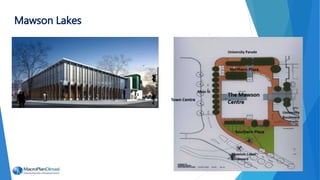
► Mawson Lakes
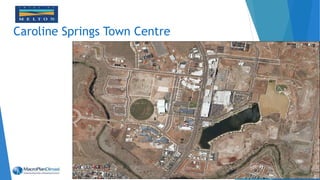
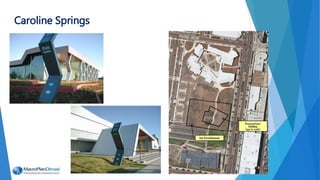
► Caroline Springs
► Evolution, focus, role – at a point in time
What is a library?
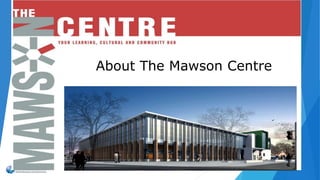
About The Mawson Centre
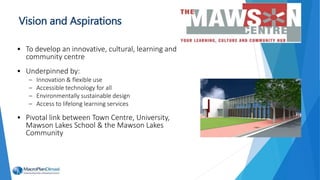
Vision and Aspirations
• To develop an innovative, cultural, learning and
community centre
• Underpinned by:
– Innovation & flexible use
– Accessible technology for all
– Environmentally sustainable design
– Access to lifelong learning services
• Pivotal link between Town Centre, University,
Mawson Lakes School & the Mawson Lakes
Community
Mawson Lakes
Caroline Springs Town Centre
Caroline Springs
► Libraries are changing from “static places of consumption and acquisition”
to places of “building, inventing and doing”.
– Metropolitan Library of New York, From Hacks to Stacks: Makerspaces and Librarybox
► Library spaces are transitioning away from the traditional “repository” or
warehousing of print materials, and towards broader education, innovation
and research.
Changing role of libraries
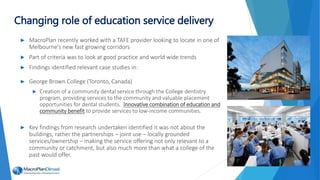
► MacroPlan recently worked with a TAFE provider looking to locate in one of
Melbourne’s new fast growing corridors
► Part of criteria was to look at good practice and world wide trends
► Findings identified relevant case studies in:
► George Brown College (Toronto, Canada)
► Creation of a community dental service through the College dentistry
program, providing services to the community and valuable placement
opportunities for dental students. Innovative combination of education and
community benefit to provide services to low-income communities.
► Key findings from research undertaken identified it was not about the
buildings, rather the partnerships – joint use – locally grounded
services/ownership – making the service offering not only relevant to a
community or catchment, but also much more than what a college of the
past would offer.
Changing role of education service delivery
State of Australian Libraries
► National and State Libraries Australasia publishes data on annual Australian public
library statistics, with the most recent publication being the 2013-2014 report
► In Australia from 2013-2014, there were:
► 1,530 public library service points, with 1,455 fixed point libraries and 75
mobile libraries
►This equates to one library for every 15,000 people
► Over 171 million items lent to 8.6 million members
► 112 million customer visits annually
►More than 9 million per month
► Total expenditure on libraries exceeded $1.04 billion in 2013-2014
State of Australian Libraries
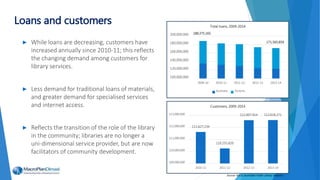
► While loans are decreasing, customers have
increased annually since 2010-11; this reflects
the changing demand among customers for
library services.
► Less demand for traditional loans of materials,
and greater demand for specialised services
and internet access.
► Reflects the transition of the role of the library
in the community; libraries are no longer a
uni-dimensional service provider, but are now
facilitators of community development.
Loans and customers
100,000,000
120,000,000
140,000,000
160,000,000
180,000,000
200,000,000
2009-10 2010-11 2011-12 2012-13 2013-14
Total loans, 2009-2014
Australia Victoria
Source: NSLA, Australian Public Library Statistics
111,627,234
110,255,820
112,607,914 112,618,271
109,000,000
110,000,000
111,000,000
112,000,000
113,000,000
2010-11 2011-12 2012-13 2013-14
Customers, 2009-2014
171,565,859
188,375,165
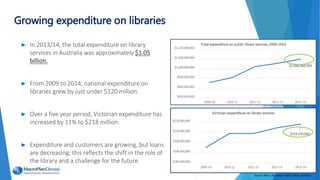
► In 2013/14, the total expenditure on library
services in Australia was approximately $1.05
billion.
► From 2009 to 2014, national expenditure on
libraries grew by just under $120 million.
► Over a five year period, Victorian expenditure has
increased by 11% to $218 million.
► Expenditure and customers are growing, but loans
are decreasing; this reflects the shift in the role of
the library and a challenge for the future.
Growing expenditure on libraries
$1,048,960,000
$850,000,000
$900,000,000
$950,000,000
$1,000,000,000
$1,050,000,000
$1,100,000,000
2009-10 2010-11 2011-12 2012-13 2013-14
Total expenditure on public library services, 2009-2014
$218,130,000
$180,000,000
$190,000,000
$200,000,000
$210,000,000
$220,000,000
2009-10 2010-11 2011-12 2012-13 2013-14
Victorian expenditure on library services
Source: NSLA, Australian Public Library Statistics
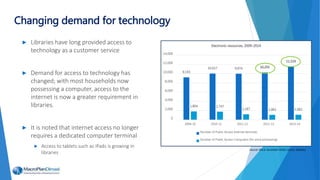
► Libraries have long provided access to
technology as a customer service
► Demand for access to technology has
changed; with most households now
possessing a computer, access to the
internet is now a greater requirement in
libraries.
► It is noted that internet access no longer
requires a dedicated computer terminal
► Access to tablets such as iPads is growing in
libraries
Changing demand for technology
9,193
10,017 9,974 10,255
11,519
1,804 1,747
1,187 1,062 1,082
0
2,000
4,000
6,000
8,000
10,000
12,000
14,000
2009-10 2010-11 2011-12 2012-13 2013-14
Electronic resources, 2009-2014
Number of Public Access Internet terminals
Number of Public Access Computers (for word processing)
Source: NSLA, Australian Public Library Statistics
► Australia-wide, customer numbers have grown by 991,037 from
2010/11 to 2013/14. Demand for library services is growing
slowly, but not in the traditional manner.
► Loans are decreasing, while the availability of internet-connected
devices in libraries is growing. This reflects a transition towards
facilitating access to knowledge; rather than directly providing
knowledge.
► The role of the library is changing: libraries are no longer a
repository of information, they are a conduit to information,
innovation and community development.
What does this mean?
How do we use libraries?
► Different demographic groups approach the broad variety of
public spaces available in libraries differently:
► For younger people (15-25), libraries offer quiet learning spaces with access
to materials that are not readily available. They complement facilities
available at schools and universities.
► For younger children, libraries are increasingly offering entertainment
options. This is not just limited to print materials such as books or
magazines, but also games, film or television and other interactive media.
This reflects changing attitudes towards the delivery of knowledge and
information.
► Mothers Groups – children story time and / or social Mum’s clubs
► Retirees/ RDO’s – The reading room, classes.
How do we use library spaces
The future of libraries
► An emerging trend in Australian libraries is the embracing of ‘creative spaces’.
► Reflects the principles of “self-directed learning, knowledge sharing and
community building” – (PLVN, Creative Spaces (2014))
► These can be diverse, such as “hackerspaces” with an emphasis on IT
innovation and discovery or hands-on, physical skills such as workshops
(wood work, machining, etc)
►Libraries have the capacity to be a bridge between different stages of
formal learning and the community; they can play a key role in
innovation
►The Mawson Lakes Library is situated to act as a bridge between the
University of South Australia campus and the Mawson Lakes town
centre. It is a conduit for people flowing between the two spaces,
and has become an integral part of the community and urban form.
Enabling creative spaces
► Many successful new libraries are co-located with other
community services to form a part of a cohesive, cooperative
community hub.
► Examples include the Hume Global Learning Centre in
Craigieburn and the Caroline Springs Civic Centre/Library
► This recognises that a library has the capacity to be so much more
than just a repository or warehouse of information and
knowledge; libraries can significantly contribute to the
communities that they service through promoting social inclusion,
providing entertainment and supporting skills development and
transition.
Cooperative & collaborative community spaces
Current Demand – Key Questions:
► Is it possible to attract demand from current market gaps? Is it necessary?
► What additional market penetration can be achieved in existing demand segments?
► Can job mobility be tapped?
► Are there emerging niche demand markets? Are they worthwhile in terms of size?
► Can library services ‘severance’ past age 18 be addressed?
► Why do some library services perform better?
Questions for now
Future Demand – Key Questions:
► Is the demand based on current services and current market penetration sufficient
to maintain the saliency of libraries?
► If not what is the marketing target/effort?
► Will future demand morph into demand for new services in which public libraries
may have to invest?
► How will the process of innovation occur?
► How can marketing or market reposition support innovation process?
Questions for the future
Thank You
24
David Brown
Head of National Operations
General Manager - Victoria
E: brown@macroplan.com.au
M: 0420 534 573
Level 4
356 Collins Street
Melbourne VIC 3000
T 03 9600 0500

Behaviour Based Marketing

  • 1.
    Future of Libraries Presentation DavidBrown General Manager – Victoria / Head of National Operations 2015 2030+
  • 2.
    The role ofthe modern library
  • 3.
    ► There isa need to identify the objectives of a public library. If this is not done, they will decline. ► Case studies: best practice libraries ► Mawson Lakes ► Caroline Springs ► Evolution, focus, role – at a point in time What is a library?
  • 4.
  • 5.
    Vision and Aspirations •To develop an innovative, cultural, learning and community centre • Underpinned by: – Innovation & flexible use – Accessible technology for all – Environmentally sustainable design – Access to lifelong learning services • Pivotal link between Town Centre, University, Mawson Lakes School & the Mawson Lakes Community
  • 6.
  • 7.
  • 8.
  • 9.
    ► Libraries arechanging from “static places of consumption and acquisition” to places of “building, inventing and doing”. – Metropolitan Library of New York, From Hacks to Stacks: Makerspaces and Librarybox ► Library spaces are transitioning away from the traditional “repository” or warehousing of print materials, and towards broader education, innovation and research. Changing role of libraries
  • 10.
    ► MacroPlan recentlyworked with a TAFE provider looking to locate in one of Melbourne’s new fast growing corridors ► Part of criteria was to look at good practice and world wide trends ► Findings identified relevant case studies in: ► George Brown College (Toronto, Canada) ► Creation of a community dental service through the College dentistry program, providing services to the community and valuable placement opportunities for dental students. Innovative combination of education and community benefit to provide services to low-income communities. ► Key findings from research undertaken identified it was not about the buildings, rather the partnerships – joint use – locally grounded services/ownership – making the service offering not only relevant to a community or catchment, but also much more than what a college of the past would offer. Changing role of education service delivery
  • 11.
  • 12.
    ► National andState Libraries Australasia publishes data on annual Australian public library statistics, with the most recent publication being the 2013-2014 report ► In Australia from 2013-2014, there were: ► 1,530 public library service points, with 1,455 fixed point libraries and 75 mobile libraries ►This equates to one library for every 15,000 people ► Over 171 million items lent to 8.6 million members ► 112 million customer visits annually ►More than 9 million per month ► Total expenditure on libraries exceeded $1.04 billion in 2013-2014 State of Australian Libraries
  • 13.
    ► While loansare decreasing, customers have increased annually since 2010-11; this reflects the changing demand among customers for library services. ► Less demand for traditional loans of materials, and greater demand for specialised services and internet access. ► Reflects the transition of the role of the library in the community; libraries are no longer a uni-dimensional service provider, but are now facilitators of community development. Loans and customers 100,000,000 120,000,000 140,000,000 160,000,000 180,000,000 200,000,000 2009-10 2010-11 2011-12 2012-13 2013-14 Total loans, 2009-2014 Australia Victoria Source: NSLA, Australian Public Library Statistics 111,627,234 110,255,820 112,607,914 112,618,271 109,000,000 110,000,000 111,000,000 112,000,000 113,000,000 2010-11 2011-12 2012-13 2013-14 Customers, 2009-2014 171,565,859 188,375,165
  • 14.
    ► In 2013/14,the total expenditure on library services in Australia was approximately $1.05 billion. ► From 2009 to 2014, national expenditure on libraries grew by just under $120 million. ► Over a five year period, Victorian expenditure has increased by 11% to $218 million. ► Expenditure and customers are growing, but loans are decreasing; this reflects the shift in the role of the library and a challenge for the future. Growing expenditure on libraries $1,048,960,000 $850,000,000 $900,000,000 $950,000,000 $1,000,000,000 $1,050,000,000 $1,100,000,000 2009-10 2010-11 2011-12 2012-13 2013-14 Total expenditure on public library services, 2009-2014 $218,130,000 $180,000,000 $190,000,000 $200,000,000 $210,000,000 $220,000,000 2009-10 2010-11 2011-12 2012-13 2013-14 Victorian expenditure on library services Source: NSLA, Australian Public Library Statistics
  • 15.
    ► Libraries havelong provided access to technology as a customer service ► Demand for access to technology has changed; with most households now possessing a computer, access to the internet is now a greater requirement in libraries. ► It is noted that internet access no longer requires a dedicated computer terminal ► Access to tablets such as iPads is growing in libraries Changing demand for technology 9,193 10,017 9,974 10,255 11,519 1,804 1,747 1,187 1,062 1,082 0 2,000 4,000 6,000 8,000 10,000 12,000 14,000 2009-10 2010-11 2011-12 2012-13 2013-14 Electronic resources, 2009-2014 Number of Public Access Internet terminals Number of Public Access Computers (for word processing) Source: NSLA, Australian Public Library Statistics
  • 16.
    ► Australia-wide, customernumbers have grown by 991,037 from 2010/11 to 2013/14. Demand for library services is growing slowly, but not in the traditional manner. ► Loans are decreasing, while the availability of internet-connected devices in libraries is growing. This reflects a transition towards facilitating access to knowledge; rather than directly providing knowledge. ► The role of the library is changing: libraries are no longer a repository of information, they are a conduit to information, innovation and community development. What does this mean?
  • 17.
    How do weuse libraries?
  • 18.
    ► Different demographicgroups approach the broad variety of public spaces available in libraries differently: ► For younger people (15-25), libraries offer quiet learning spaces with access to materials that are not readily available. They complement facilities available at schools and universities. ► For younger children, libraries are increasingly offering entertainment options. This is not just limited to print materials such as books or magazines, but also games, film or television and other interactive media. This reflects changing attitudes towards the delivery of knowledge and information. ► Mothers Groups – children story time and / or social Mum’s clubs ► Retirees/ RDO’s – The reading room, classes. How do we use library spaces
  • 19.
    The future oflibraries
  • 20.
    ► An emergingtrend in Australian libraries is the embracing of ‘creative spaces’. ► Reflects the principles of “self-directed learning, knowledge sharing and community building” – (PLVN, Creative Spaces (2014)) ► These can be diverse, such as “hackerspaces” with an emphasis on IT innovation and discovery or hands-on, physical skills such as workshops (wood work, machining, etc) ►Libraries have the capacity to be a bridge between different stages of formal learning and the community; they can play a key role in innovation ►The Mawson Lakes Library is situated to act as a bridge between the University of South Australia campus and the Mawson Lakes town centre. It is a conduit for people flowing between the two spaces, and has become an integral part of the community and urban form. Enabling creative spaces
  • 21.
    ► Many successfulnew libraries are co-located with other community services to form a part of a cohesive, cooperative community hub. ► Examples include the Hume Global Learning Centre in Craigieburn and the Caroline Springs Civic Centre/Library ► This recognises that a library has the capacity to be so much more than just a repository or warehouse of information and knowledge; libraries can significantly contribute to the communities that they service through promoting social inclusion, providing entertainment and supporting skills development and transition. Cooperative & collaborative community spaces
  • 22.
    Current Demand –Key Questions: ► Is it possible to attract demand from current market gaps? Is it necessary? ► What additional market penetration can be achieved in existing demand segments? ► Can job mobility be tapped? ► Are there emerging niche demand markets? Are they worthwhile in terms of size? ► Can library services ‘severance’ past age 18 be addressed? ► Why do some library services perform better? Questions for now
  • 23.
    Future Demand –Key Questions: ► Is the demand based on current services and current market penetration sufficient to maintain the saliency of libraries? ► If not what is the marketing target/effort? ► Will future demand morph into demand for new services in which public libraries may have to invest? ► How will the process of innovation occur? ► How can marketing or market reposition support innovation process? Questions for the future
  • 24.
    Thank You 24 David Brown Headof National Operations General Manager - Victoria E: brown@macroplan.com.au M: 0420 534 573 Level 4 356 Collins Street Melbourne VIC 3000 T 03 9600 0500