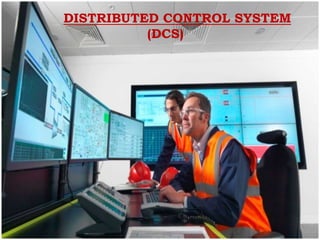
DISTRIBUTED CONTROL SYSTEM
(DCS)
AUTOMATION
 Automation is basically a delegation of human control
functions to control technical equipments.
 Automation can also be defined as “ a technique that makes
use of the control system and information technologies to
reduce the need for human work in the production of goods
and services.
 Even it can be explained as “automation= auto + mation
(motion)”
where auto stands for self and mation (motion) stands
for movement
DCS
DCS- DISTRIBUTED CONTROL SYSTEM
Abbreviation of DCS itself contains the meaning of this system.
Distributed - all the control elements are spread throughout the
plant and not centralized.
Control - to supervise and govern the operations .
So all together DCS can be explained as ,” the system that is used to
supervise and control the whole plant in which all the control
elements are distributed throughout the system”.
STATIONS
There are totally three important stations present in
DCS.
1. Engineering Station (ES)
2. Operator Station (OS)
3. Automation Station (AS)
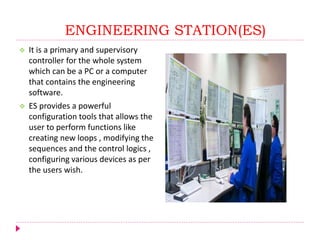
ENGINEERING STATION(ES)
 It is a primary and supervisory
controller for the whole system
which can be a PC or a computer
that contains the engineering
software.
 ES provides a powerful
configuration tools that allows the
user to perform functions like
creating new loops , modifying the
sequences and the control logics ,
configuring various devices as per
the users wish.
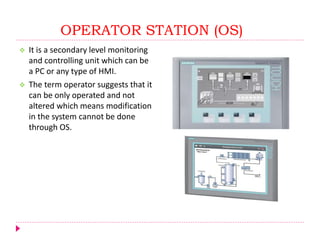
OPERATOR STATION (OS)
 It is a secondary level monitoring
and controlling unit which can be
a PC or any type of HMI.
 The term operator suggests that it
can be only operated and not
altered which means modification
in the system cannot be done
through OS.
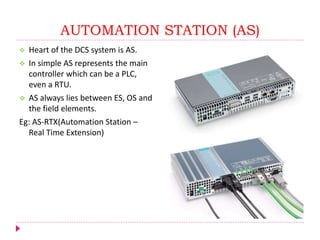
AUTOMATION STATION (AS)
 Heart of the DCS system is AS.
 In simple AS represents the main
controller which can be a PLC,
even a RTU.
 AS always lies between ES, OS and
the field elements.
Eg: AS-RTX(Automation Station –
Real Time Extension)
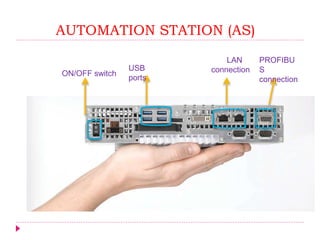
AUTOMATION STATION (AS)
LAN
connectionON/OFF switch
USB
ports
PROFIBU
S
connection
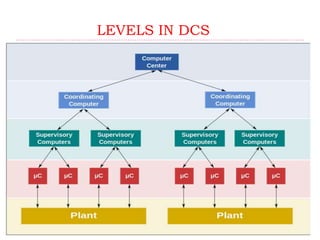
LEVELS IN DCS
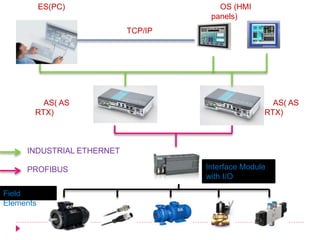
INDUSTRIAL ETHERNET
PROFIBUS
ES(PC) OS (HMI
panels)
AS( AS
RTX)
Interface Module
with I/O
Field
Elements
TCP/IP
AS( AS
RTX)
SIMATIC PCS7
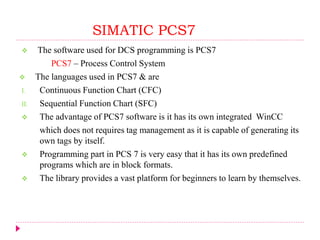
 The software used for DCS programming is PCS7
PCS7 – Process Control System
 The languages used in PCS7 & are
I. Continuous Function Chart (CFC)
II. Sequential Function Chart (SFC)
 The advantage of PCS7 software is it has its own integrated WinCC
which does not requires tag management as it is capable of generating its
own tags by itself.
 Programming part in PCS 7 is very easy that it has its own predefined
programs which are in block formats.
 The library provides a vast platform for beginners to learn by themselves.
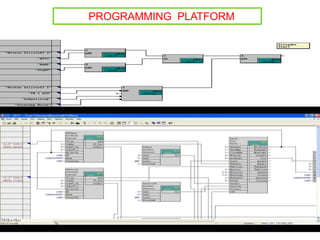
PROGRAMMING PLATFORM
SCADA Screen in PCS7
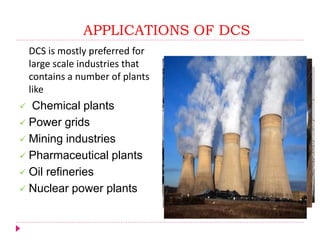
APPLICATIONS OF DCS
DCS is mostly preferred for
large scale industries that
contains a number of plants
like
 Chemical plants
 Power grids
 Mining industries
 Pharmaceutical plants
 Oil refineries
 Nuclear power plants
DCS an overview

DCS an overview

  • 1.
  • 2.
    AUTOMATION  Automation isbasically a delegation of human control functions to control technical equipments.  Automation can also be defined as “ a technique that makes use of the control system and information technologies to reduce the need for human work in the production of goods and services.  Even it can be explained as “automation= auto + mation (motion)” where auto stands for self and mation (motion) stands for movement
  • 3.
    DCS DCS- DISTRIBUTED CONTROLSYSTEM Abbreviation of DCS itself contains the meaning of this system. Distributed - all the control elements are spread throughout the plant and not centralized. Control - to supervise and govern the operations . So all together DCS can be explained as ,” the system that is used to supervise and control the whole plant in which all the control elements are distributed throughout the system”.
  • 4.
    STATIONS There are totallythree important stations present in DCS. 1. Engineering Station (ES) 2. Operator Station (OS) 3. Automation Station (AS)
  • 5.
    ENGINEERING STATION(ES)  Itis a primary and supervisory controller for the whole system which can be a PC or a computer that contains the engineering software.  ES provides a powerful configuration tools that allows the user to perform functions like creating new loops , modifying the sequences and the control logics , configuring various devices as per the users wish.
  • 6.
    OPERATOR STATION (OS) It is a secondary level monitoring and controlling unit which can be a PC or any type of HMI.  The term operator suggests that it can be only operated and not altered which means modification in the system cannot be done through OS.
  • 7.
    AUTOMATION STATION (AS) Heart of the DCS system is AS.  In simple AS represents the main controller which can be a PLC, even a RTU.  AS always lies between ES, OS and the field elements. Eg: AS-RTX(Automation Station – Real Time Extension)
  • 8.
    AUTOMATION STATION (AS) LAN connectionON/OFFswitch USB ports PROFIBU S connection
  • 9.
  • 10.
    INDUSTRIAL ETHERNET PROFIBUS ES(PC) OS(HMI panels) AS( AS RTX) Interface Module with I/O Field Elements TCP/IP AS( AS RTX)
  • 11.
    SIMATIC PCS7  Thesoftware used for DCS programming is PCS7 PCS7 – Process Control System  The languages used in PCS7 & are I. Continuous Function Chart (CFC) II. Sequential Function Chart (SFC)  The advantage of PCS7 software is it has its own integrated WinCC which does not requires tag management as it is capable of generating its own tags by itself.  Programming part in PCS 7 is very easy that it has its own predefined programs which are in block formats.  The library provides a vast platform for beginners to learn by themselves.
  • 12.
  • 13.
  • 14.
    APPLICATIONS OF DCS DCSis mostly preferred for large scale industries that contains a number of plants like  Chemical plants  Power grids  Mining industries  Pharmaceutical plants  Oil refineries  Nuclear power plants