Overview
Industrial Automation
rtPAC Systems
Process Control
 Basic Process Control Concept
 A measurement of the state or condition of a process
 A controller calculating an action based on this measured value against
a pre-set value [set point]
 An output signal resulting from the controller calculation which is used
to manipulate the process action through some form of actuators.
 The process itself reacting to this signal, and changing its state or
condition.
Advanced Control Systems
 Objective: Process control
information system Automating
the Plant Operations
 In producing the required output
of the product with minimal
quality variation
 Optimal consumption of raw
material and energy
 Maximum efficiency
 Improved Productivity
 Efficient Monitoring and Control
 Scalable and Robust
 Types of Automation Systems
 Programmable Logic
Controller [PLC],
 Distributed Control System
[DCS] and
 PC Based Control System
Sensors &
SCU
Control
Valve
Control
Station
PLC [or]
DCS [or]
PC Based
ADC
DAC
AA
Process
Controlled VariableMeasured Variable
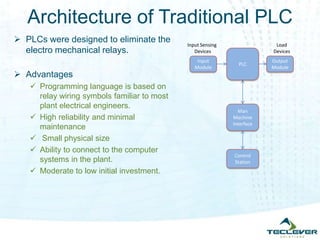
Architecture of Traditional PLC
 PLCs were designed to eliminate the
electro mechanical relays.
 Advantages
 Programming language is based on
relay wiring symbols familiar to most
plant electrical engineers.
 High reliability and minimal
maintenance
 Small physical size
 Ability to connect to the computer
systems in the plant.
 Moderate to low initial investment.
Input
Module
Output
Module
Man
Machine
Interface
Control
Station
Load
Devices
PLC
Input Sensing
Devices
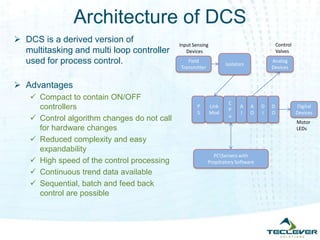
Architecture of DCS
 DCS is a derived version of
multitasking and multi loop controller
used for process control.
 Advantages
 Compact to contain ON/OFF
controllers
 Control algorithm changes do not call
for hardware changes
 Reduced complexity and easy
expandability
 High speed of the control processing
 Continuous trend data available
 Sequential, batch and feed back
control are possible
Field
Transmitter
Analog
Devices
P
S
PCServers with
Propitiatory Software
Control
Valves
Isolators
Input Sensing
Devices
Link
Mod
C
P
u
A
I
A
O
D
I
D
O
Digital
Devices
Motor
LEDs
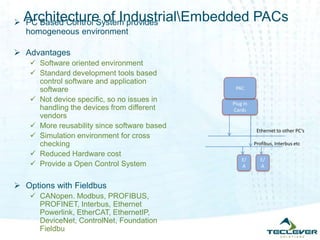
Architecture of IndustrialEmbedded PACs
Plug In
Cards
PAC
E/
A
E/
A
Ethernet to other PC’s
Profibus, Interbus etc
 PC Based Control System provides
homogeneous environment
 Advantages
 Software oriented environment
 Standard development tools based
control software and application
software
 Not device specific, so no issues in
handling the devices from different
vendors
 More reusability since software based
 Simulation environment for cross
checking
 Reduced Hardware cost
 Provide a Open Control System
 Options with Fieldbus
 CANopen. Modbus, PROFIBUS,
PROFINET, Interbus, Ethernet
Powerlink, EtherCAT, EthernetIP,
DeviceNet, ControlNet, Foundation
Fieldbu
TECLEVER’s offerings
 PC Based Control System Framework
 Features
 X86 Based system with Medium to High processing power based on
requirement
 Real time Linux based environment for Hard Real time application
 Developed mostly with FOSS components
 Easy integration with any OPC based SCADA packages
 Custom Web based control for non critical process monitoring
 Standardized driver modules for various Data acquisition cards. [Possible
to have different vendor cPCI/PXI cards]
 Possible to have both Data acquisition and control in a single controller.
 Possible to configure a High reliable redundant system
 Standard Software oriented environment for SCADA and User control
program
 Developed a User Control program framework where support for traditional
Ladder or FBD based development is enabled
User Control Program
 Development environment is based on Open Source Framework for
writing control program
 Compliance to IEC 61131, PLCOpen and CanOpen standards
 Any existing application compliance to this can be easily ported to our
development environment.
 Supports programming in LD/FBD/ST/IL/SFC
 Compiles ST/IL/SFC code into ANSI-C code.
 All POU parameters and variables are accessible through nested C structs
 Able to generate application code for different RTOS/Linux environments
 Enabled to work on a single Configuration file across controller/ Monitoring
software and Use Control program development. So seamless integration
of User control program into system control application
Controller/Data Acquisition Module Standard driver support for DAQ cards in Hard Real Time OS
 Any cPCI or PXI based card will be supported for the control
requirement
 So no vender specific looking is required
 Control System configuration thru configuration file, enables to use the
same application across different control requirement
 Diagnostic information for monitoring purpose
 Failure handling for any application problem thru a text based script
 Distributed engineering unit conversion to avoid load at monitoring
server
 Configurable mode to send RAW value to monitoring station for
calibration
Controller/Data Acquisition Module
 Optional redundancy management for any single point of failure
 Possible to have multiple thread User control program
 Standard ethernet based communication to and from DAQ system and
server.
 High speed operational cycle [Possible to have as small as 10msec]
 Able to handle very large number of channel systems
SCADA Server/ Operator Station
 Supports any standard OPC communication supported SCADA
packages
 Optional Web Based Monitoring system for monitoring
 SCADA System configuration thru configuration file
 SNMP based Network Diagnostic information for monitoring purpose
 Offline GUI for any specific reporting requirements
 Support for 10msec data logging
 Redundancy management at OPC communication and Application
server levels
Case Study
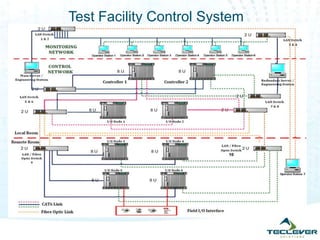
Test Facility Control System
Project Description
 The objective of this project is to design, develop and install a PC based
control system.
 A PXI/cPCI based control system with SCADA running in PC and Server in
distributed configuration is proposed for designing the control system.
 The control system acquires the data from field control elements then
processes the data in real time and generates output. The normal cycle
time of the system is 10msec.
 The acquired data and generated output are used for online monitoring
and controlling the test system. The data is logged at both the server and
controller for offline analysis.
 Data exchange between all the subsystems is through Dual redundant
Ethernet.
 Redundancy management at controller, server for fail-safe mode of
operation

Industrial Automation rtPAC System

  • 1.
  • 2.
    Process Control  BasicProcess Control Concept  A measurement of the state or condition of a process  A controller calculating an action based on this measured value against a pre-set value [set point]  An output signal resulting from the controller calculation which is used to manipulate the process action through some form of actuators.  The process itself reacting to this signal, and changing its state or condition.
  • 3.
    Advanced Control Systems Objective: Process control information system Automating the Plant Operations  In producing the required output of the product with minimal quality variation  Optimal consumption of raw material and energy  Maximum efficiency  Improved Productivity  Efficient Monitoring and Control  Scalable and Robust  Types of Automation Systems  Programmable Logic Controller [PLC],  Distributed Control System [DCS] and  PC Based Control System Sensors & SCU Control Valve Control Station PLC [or] DCS [or] PC Based ADC DAC AA Process Controlled VariableMeasured Variable
  • 4.
    Architecture of TraditionalPLC  PLCs were designed to eliminate the electro mechanical relays.  Advantages  Programming language is based on relay wiring symbols familiar to most plant electrical engineers.  High reliability and minimal maintenance  Small physical size  Ability to connect to the computer systems in the plant.  Moderate to low initial investment. Input Module Output Module Man Machine Interface Control Station Load Devices PLC Input Sensing Devices
  • 5.
    Architecture of DCS DCS is a derived version of multitasking and multi loop controller used for process control.  Advantages  Compact to contain ON/OFF controllers  Control algorithm changes do not call for hardware changes  Reduced complexity and easy expandability  High speed of the control processing  Continuous trend data available  Sequential, batch and feed back control are possible Field Transmitter Analog Devices P S PCServers with Propitiatory Software Control Valves Isolators Input Sensing Devices Link Mod C P u A I A O D I D O Digital Devices Motor LEDs
  • 6.
    Architecture of IndustrialEmbeddedPACs Plug In Cards PAC E/ A E/ A Ethernet to other PC’s Profibus, Interbus etc  PC Based Control System provides homogeneous environment  Advantages  Software oriented environment  Standard development tools based control software and application software  Not device specific, so no issues in handling the devices from different vendors  More reusability since software based  Simulation environment for cross checking  Reduced Hardware cost  Provide a Open Control System  Options with Fieldbus  CANopen. Modbus, PROFIBUS, PROFINET, Interbus, Ethernet Powerlink, EtherCAT, EthernetIP, DeviceNet, ControlNet, Foundation Fieldbu
  • 7.
    TECLEVER’s offerings  PCBased Control System Framework  Features  X86 Based system with Medium to High processing power based on requirement  Real time Linux based environment for Hard Real time application  Developed mostly with FOSS components  Easy integration with any OPC based SCADA packages  Custom Web based control for non critical process monitoring  Standardized driver modules for various Data acquisition cards. [Possible to have different vendor cPCI/PXI cards]  Possible to have both Data acquisition and control in a single controller.  Possible to configure a High reliable redundant system  Standard Software oriented environment for SCADA and User control program  Developed a User Control program framework where support for traditional Ladder or FBD based development is enabled
  • 8.
    User Control Program Development environment is based on Open Source Framework for writing control program  Compliance to IEC 61131, PLCOpen and CanOpen standards  Any existing application compliance to this can be easily ported to our development environment.  Supports programming in LD/FBD/ST/IL/SFC  Compiles ST/IL/SFC code into ANSI-C code.  All POU parameters and variables are accessible through nested C structs  Able to generate application code for different RTOS/Linux environments  Enabled to work on a single Configuration file across controller/ Monitoring software and Use Control program development. So seamless integration of User control program into system control application
  • 9.
    Controller/Data Acquisition ModuleStandard driver support for DAQ cards in Hard Real Time OS  Any cPCI or PXI based card will be supported for the control requirement  So no vender specific looking is required  Control System configuration thru configuration file, enables to use the same application across different control requirement  Diagnostic information for monitoring purpose  Failure handling for any application problem thru a text based script  Distributed engineering unit conversion to avoid load at monitoring server  Configurable mode to send RAW value to monitoring station for calibration
  • 10.
    Controller/Data Acquisition Module Optional redundancy management for any single point of failure  Possible to have multiple thread User control program  Standard ethernet based communication to and from DAQ system and server.  High speed operational cycle [Possible to have as small as 10msec]  Able to handle very large number of channel systems
  • 11.
    SCADA Server/ OperatorStation  Supports any standard OPC communication supported SCADA packages  Optional Web Based Monitoring system for monitoring  SCADA System configuration thru configuration file  SNMP based Network Diagnostic information for monitoring purpose  Offline GUI for any specific reporting requirements  Support for 10msec data logging  Redundancy management at OPC communication and Application server levels
  • 12.
  • 13.
  • 14.
    Project Description  Theobjective of this project is to design, develop and install a PC based control system.  A PXI/cPCI based control system with SCADA running in PC and Server in distributed configuration is proposed for designing the control system.  The control system acquires the data from field control elements then processes the data in real time and generates output. The normal cycle time of the system is 10msec.  The acquired data and generated output are used for online monitoring and controlling the test system. The data is logged at both the server and controller for offline analysis.  Data exchange between all the subsystems is through Dual redundant Ethernet.  Redundancy management at controller, server for fail-safe mode of operation

Editor's Notes

  • #3 Prior to the PLC, every hard-wired panel was just a collection of basic components and a host of wires. 
  • #4 Prior to the PLC, every hard-wired panel was just a collection of basic components and a host of wires. 
  • #5 It's not quite that simple. Changing the workings of a PLC is often a long and difficult task in which not only a few rung have to be changed, but more often a lot of rungs. These rungs have a tendency to influence each other, so you have to look out for these effects too. A big advantage in this is that you can make changes off-line, whereas rewiring is always online. Think at what this means for you production line.With PLCs, whether by accident (AB does not store rung comments with the program) or design (OEM lock) the designer of the machine can effectively seal you out of the process. You could have the best electrician in the world, but if the ladder code is not accessible, he is faced with a "black box" that he can do little more than guess at. He might be able to look at peripheral sensors and other equipment and sensors and guess at what he thinks should be happening, but he will have no clue as to what is really going on.When something goes wrong, all they can do is call out the PLC OEM tech or your SI and shell out the bucks.Ladder logic is an analog of relay logic, but statement list is a far cry from relay logic, symbolically. The learning curve on PLC's is longer than relay logic. You need to know everything you know for relay logic in ADDITION to whatever you need to know about PLC's.One last disadvantage is the lack of support for legacy PLC's. Think about converting programs in 20+ years because the old PLC is no longer made, and the code is no longer usable in its present form. I've not yet encountered this with PLC's, but I've gotten it with enough other (computers, drives, etc) equipment.http://www.plctalk.net/qanda/showthread.php?t=11438 2-B ? ----+----] [----+------------( )---- | | | | | 2-B |+----] / [----+
  • #7 High Availability , Reliability, Scalability ISA S84 standard: http://www.triconex.com/NR/rdonlyres/6155344E-58C4-4852-B420-D72CCC327C92/0/PCSTechnicalPaperANSIISAS8401HowThisStandardWillAf fectYourBusiness.pdfTMR control system: http://www.triconex.com/us/eng/triconexProducts/tricon/default.htmhttp://www.plctalk.net/qanda/archive/index.php/t-13453.html
  • #13 Prior to the PLC, every hard-wired panel was just a collection of basic components and a host of wires.