Carson Wang (Intel), Yuanjian Li (Baidu)
Spark SQL Adaptive Execution Unleashes
The Power of Cluster in Large Scale
#Exp5SAIS
Agenda
• Challenges in Using Spark SQL
• Adaptive Execution Introduction
• Adaptive Execution in Baidu
2#Exp5SAIS
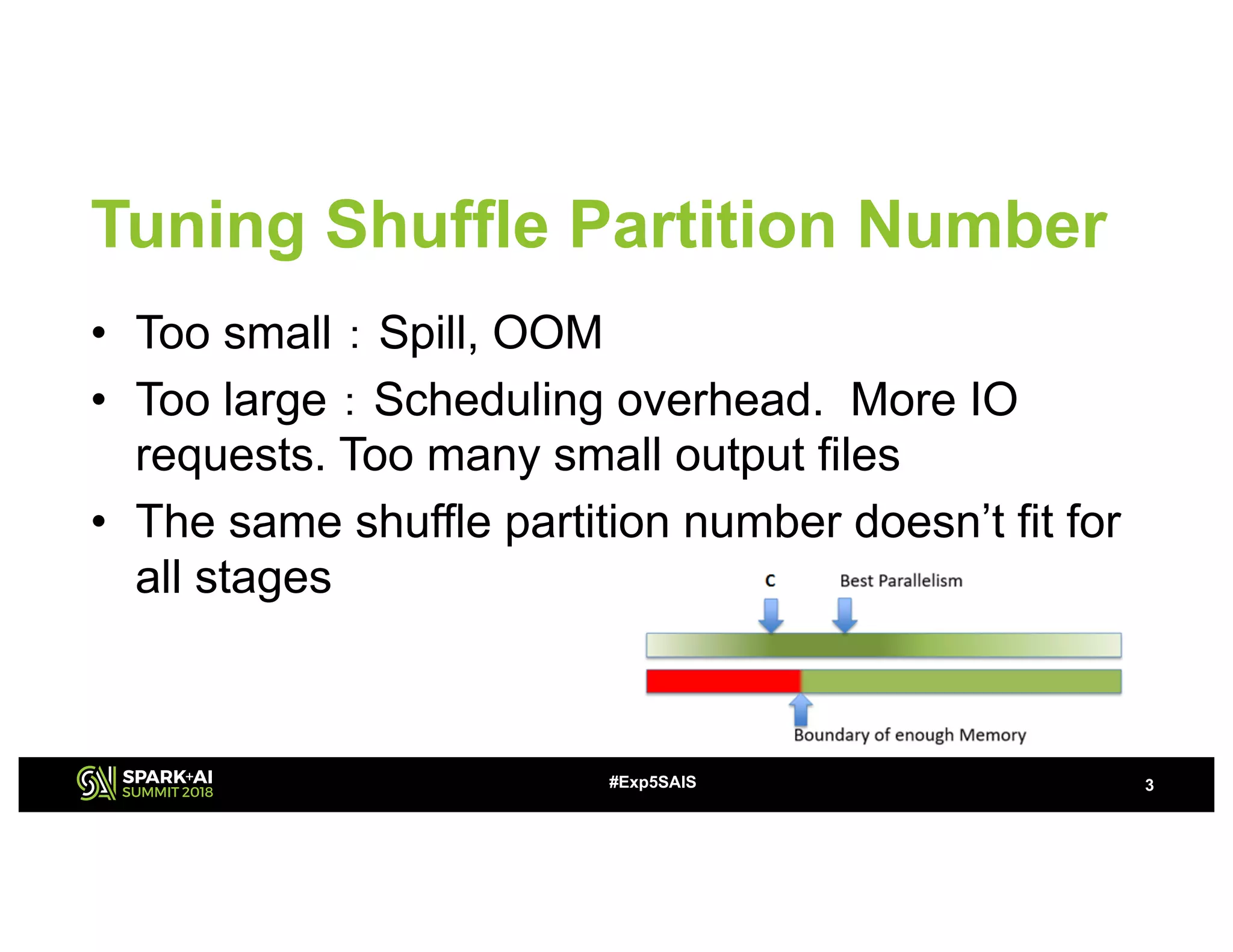
Tuning Shuffle Partition Number
• Too small Spill, OOM
• Too large Scheduling overhead. More IO
requests. Too many small output files
• The same shuffle partition number doesn’t fit for
all stages
3#Exp5SAIS
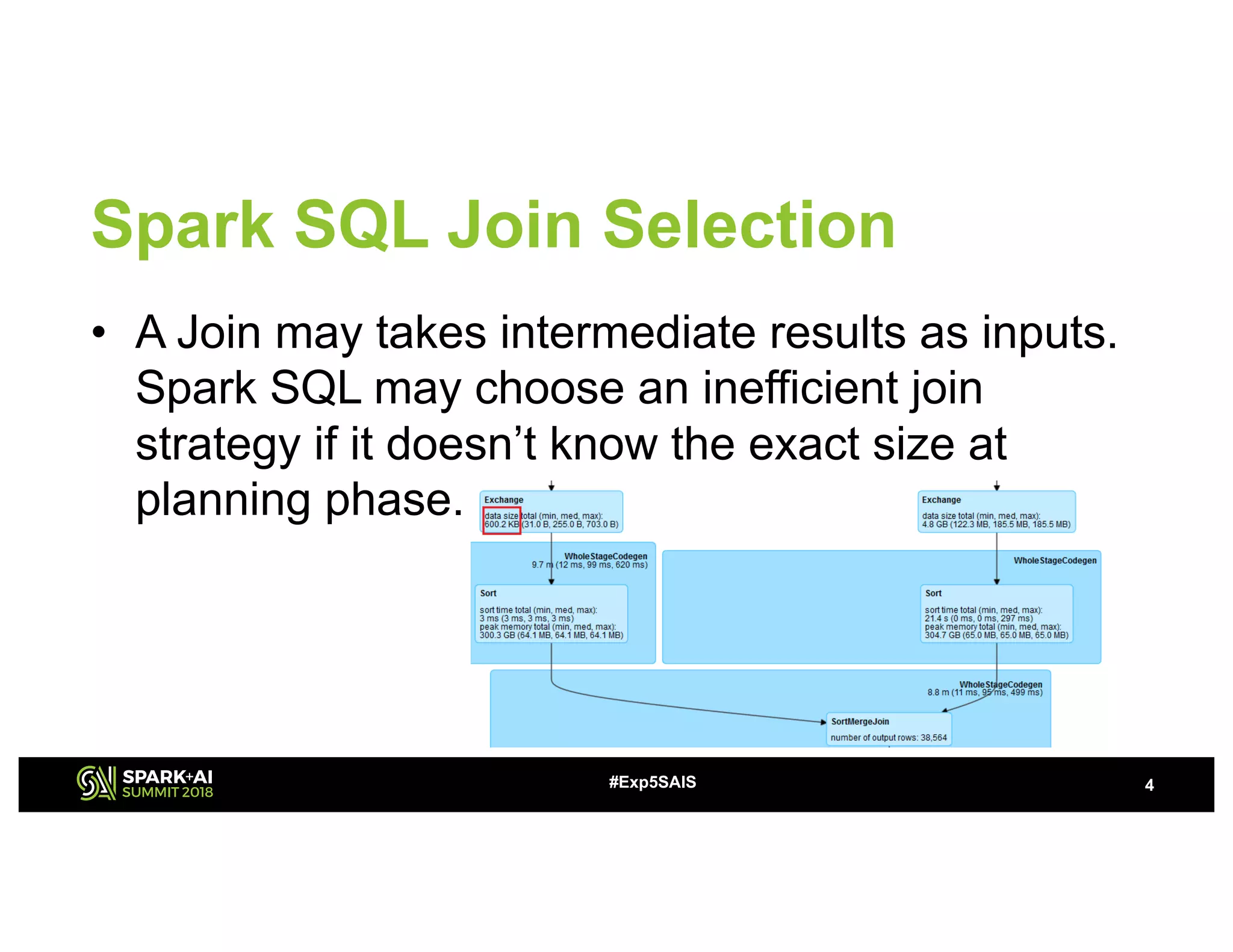
Spark SQL Join Selection
• A Join may takes intermediate results as inputs.
Spark SQL may choose an inefficient join
strategy if it doesn’t know the exact size at
planning phase.
4#Exp5SAIS
Data Skew in Join
• Data in some partitions are extremely larger
than other partitions. Data skew is a common
source of slowness for shuffle joins.
• Common ways to solve data skew
– Increase shuffle partition number
– Increase BroadcastJoin threashold
– Add prefix to the skewed keys
5#Exp5SAIS
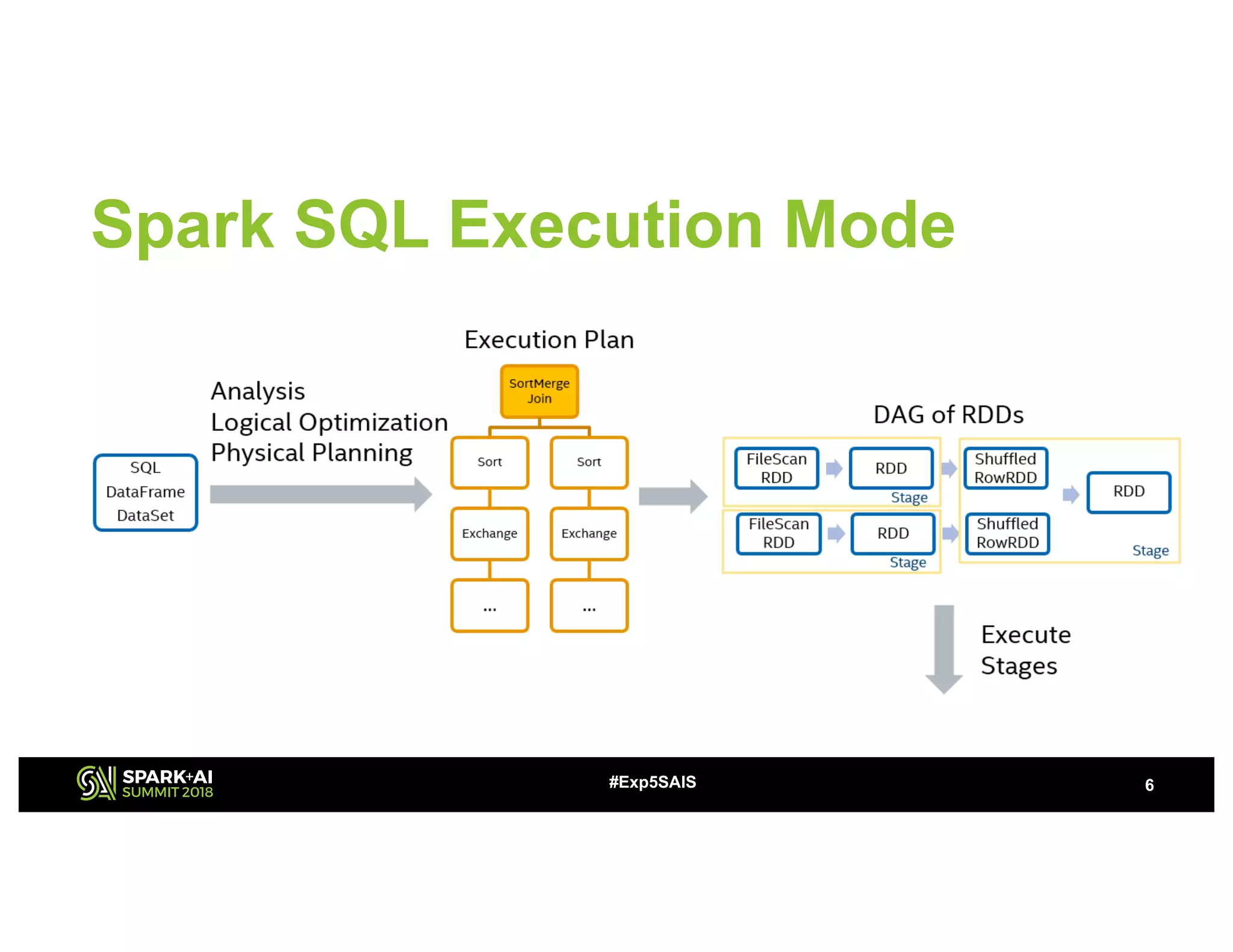
Spark SQL Execution Mode
6#Exp5SAIS
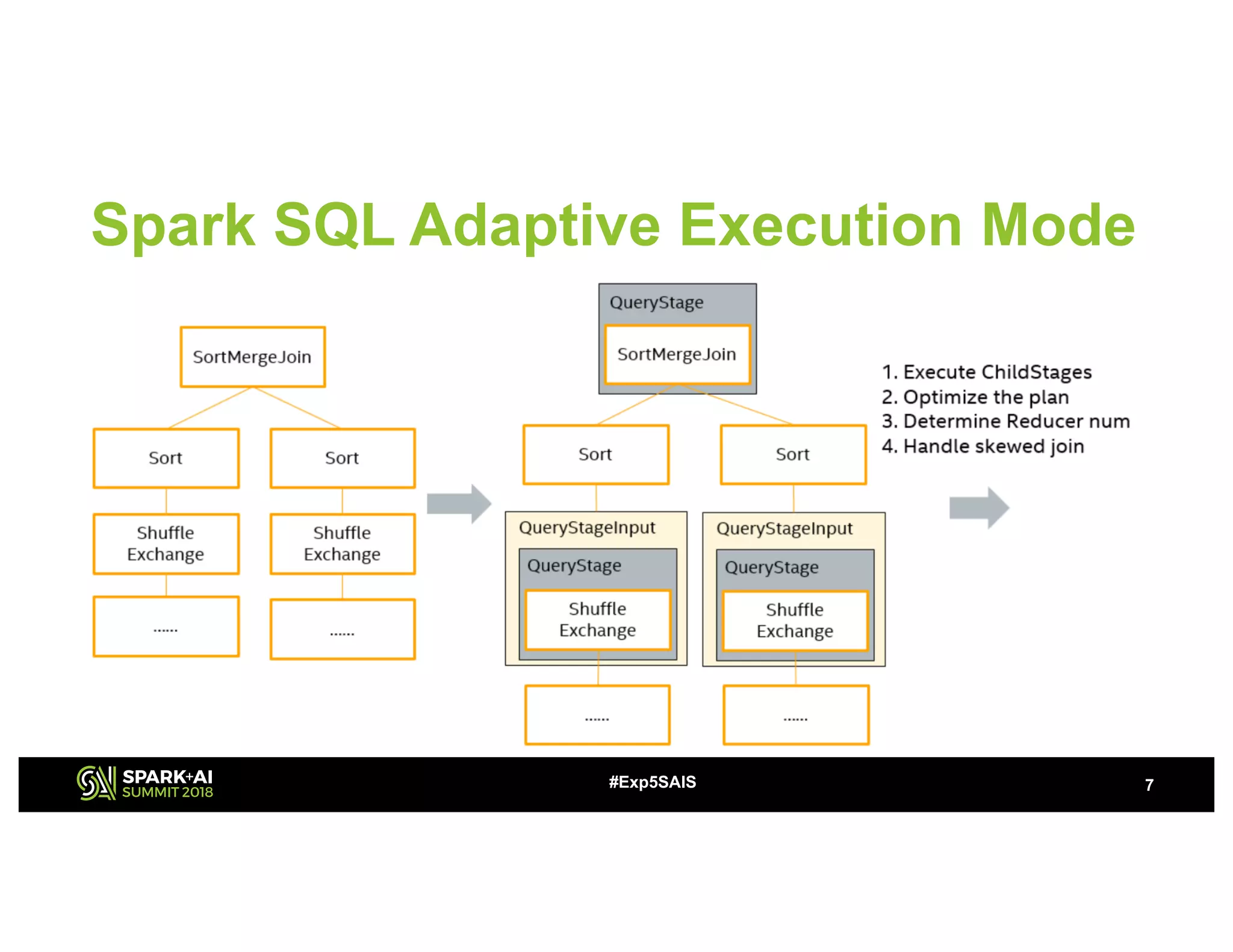
Spark SQL Adaptive Execution Mode
7#Exp5SAIS
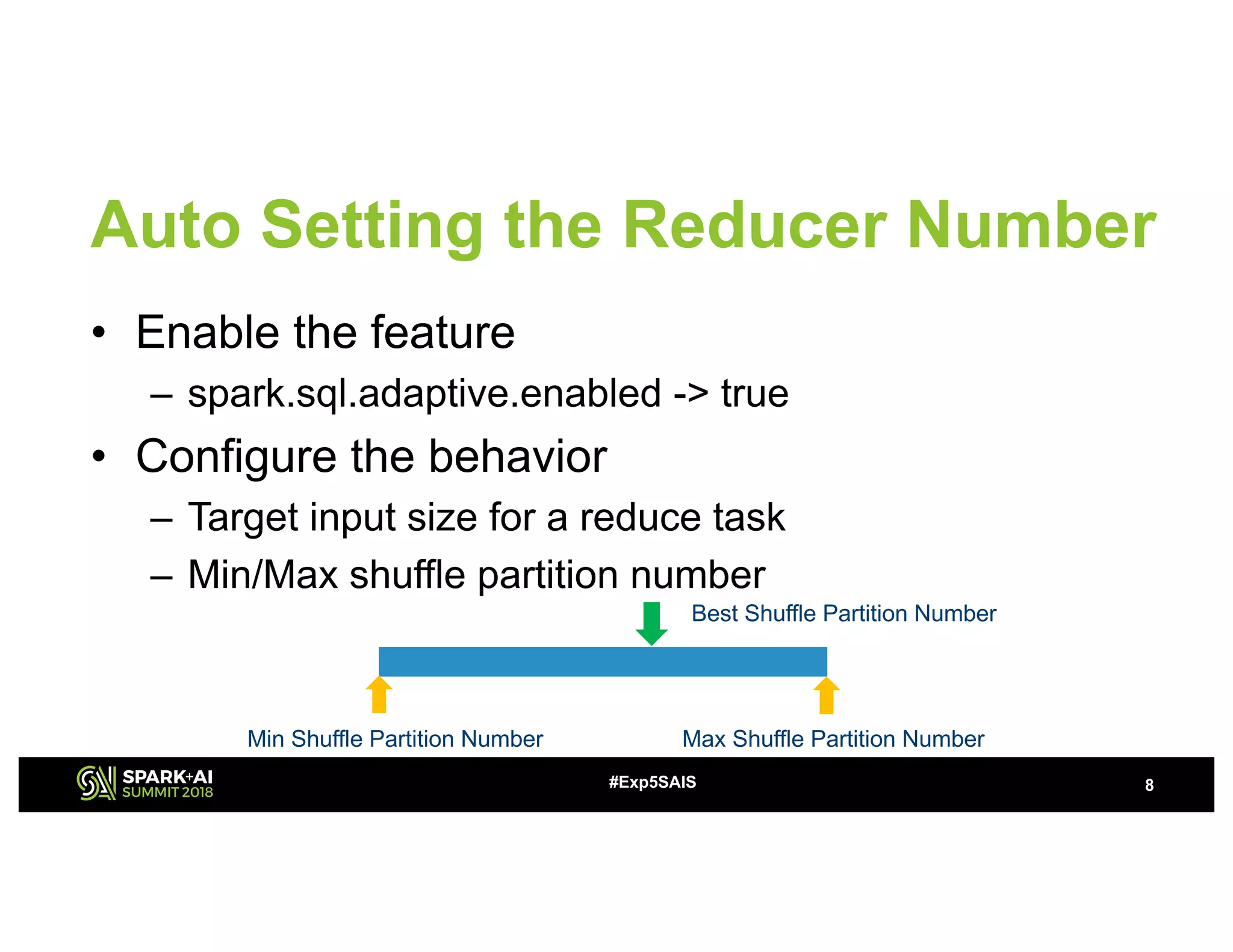
Auto Setting the Reducer Number
• Enable the feature
– spark.sql.adaptive.enabled -> true
• Configure the behavior
– Target input size for a reduce task
– Min/Max shuffle partition number
8#Exp5SAIS
Min Shuffle Partition Number Max Shuffle Partition Number
Best Shuffle Partition Number
Auto Setting the Reducer Number
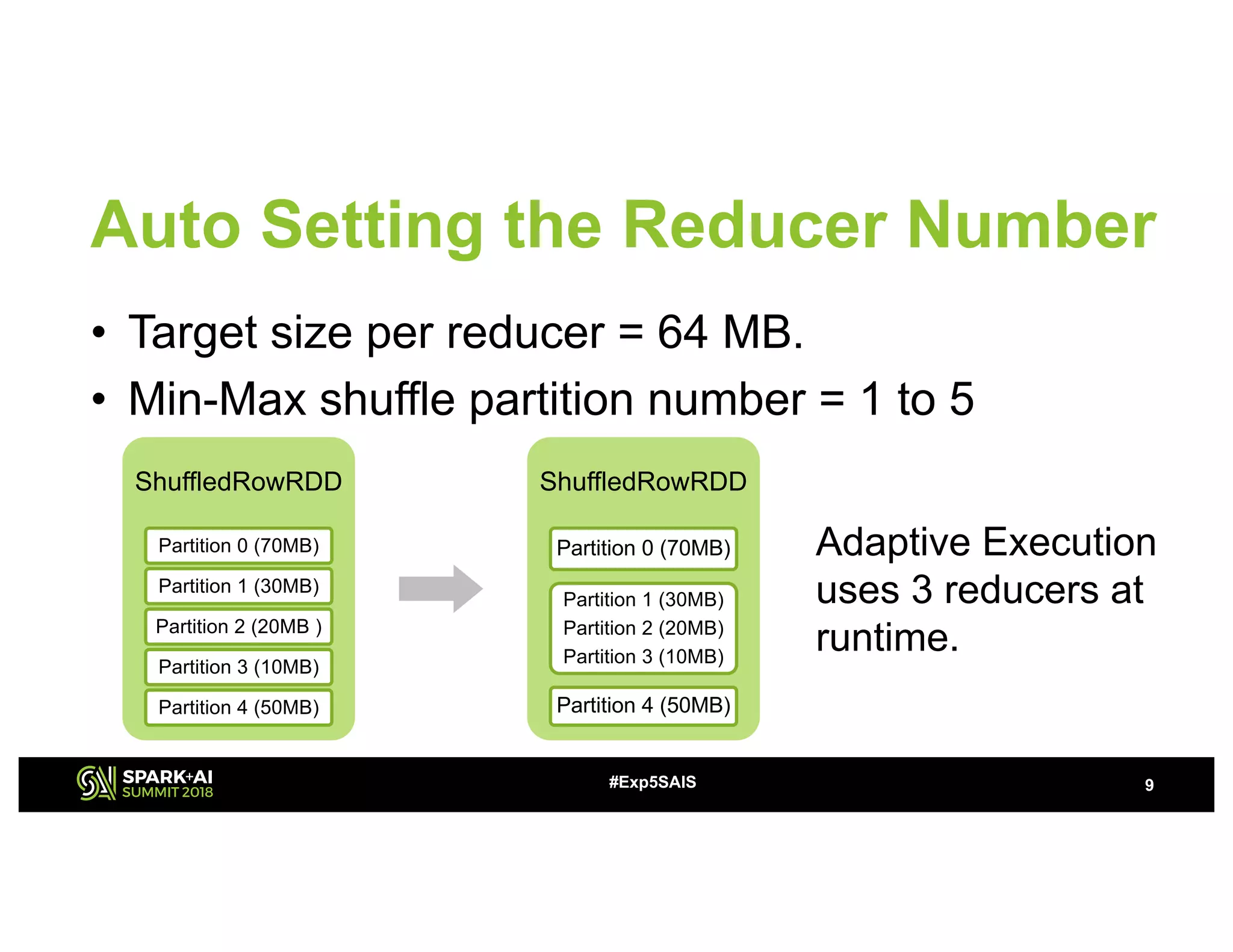
• Target size per reducer = 64 MB.
• Min-Max shuffle partition number = 1 to 5
9#Exp5SAIS
ShuffledRowRDD
Partition 0 (70MB)
Partition 1 (30MB)
Partition 2 (20MB )
Partition 3 (10MB)
Partition 4 (50MB)
ShuffledRowRDD
Partition 0 (70MB)
Partition 1 (30MB)
Partition 2 (20MB)
Partition 3 (10MB)
Partition 4 (50MB)
Adaptive Execution
uses 3 reducers at
runtime.
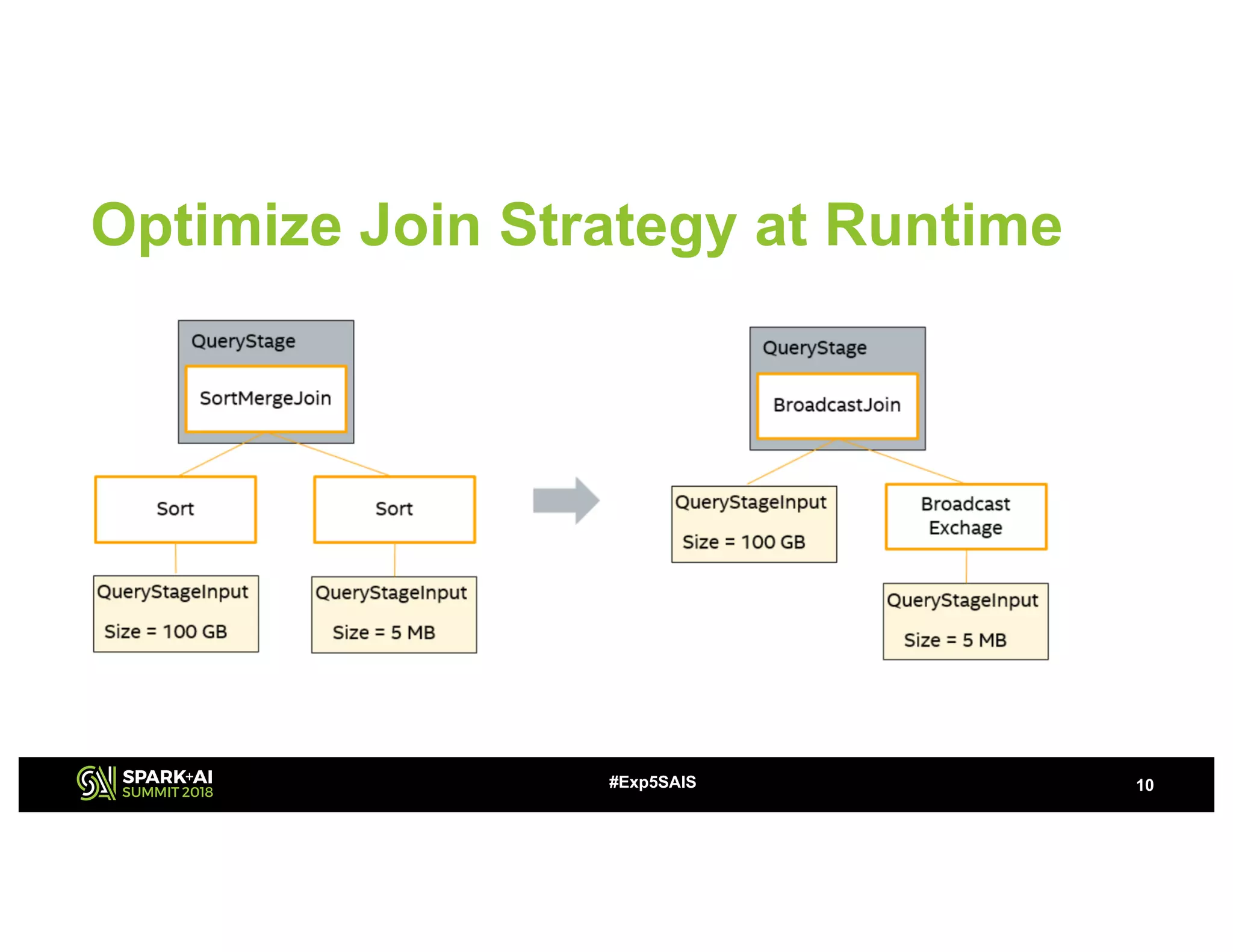
Optimize Join Strategy at Runtime
10#Exp5SAIS
Optimize Join Strategy at Runtime
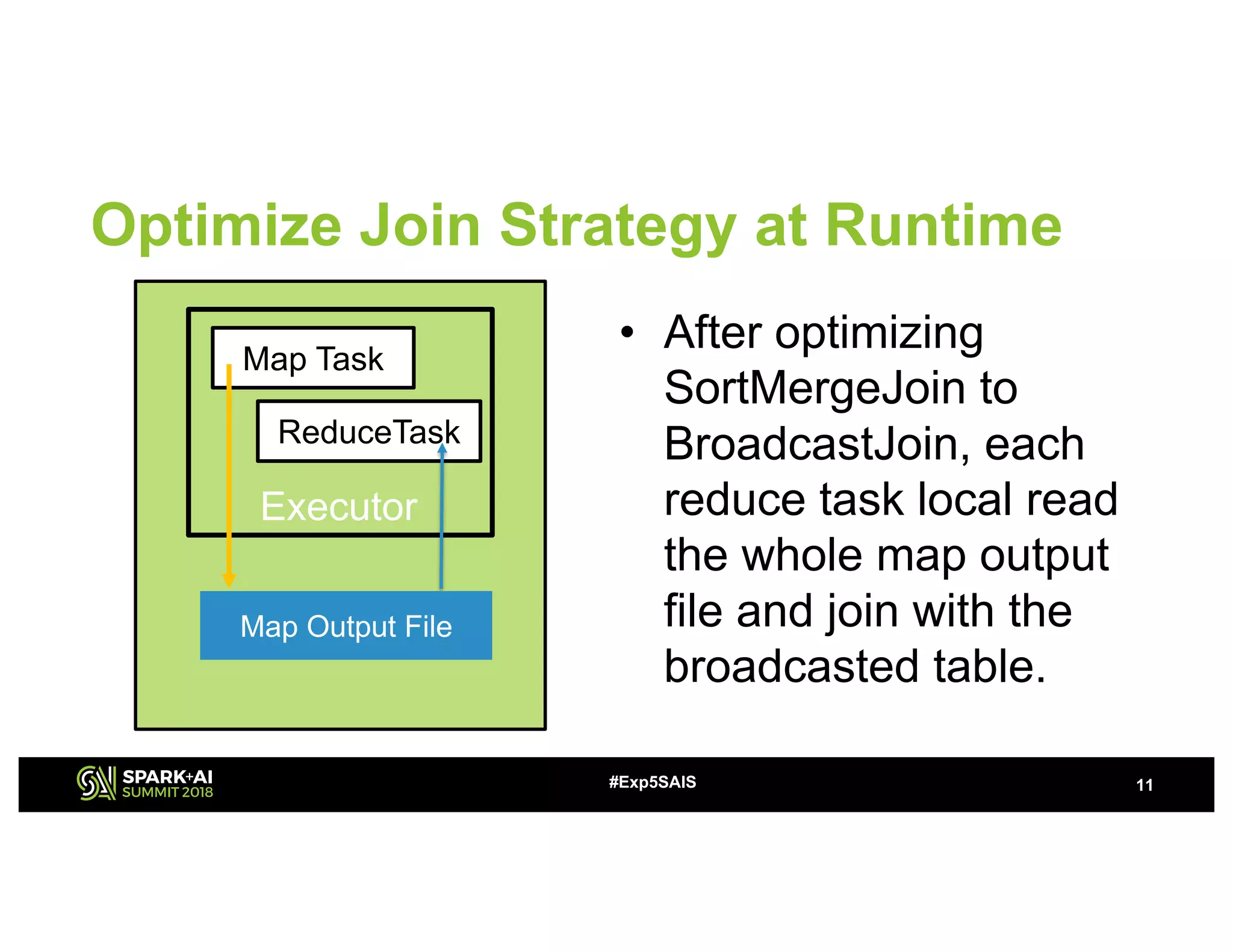
• After optimizing
SortMergeJoin to
BroadcastJoin, each
reduce task local read
the whole map output
file and join with the
broadcasted table.
11#Exp5SAIS
Map Task
Executor
ReduceTask
Map Output File
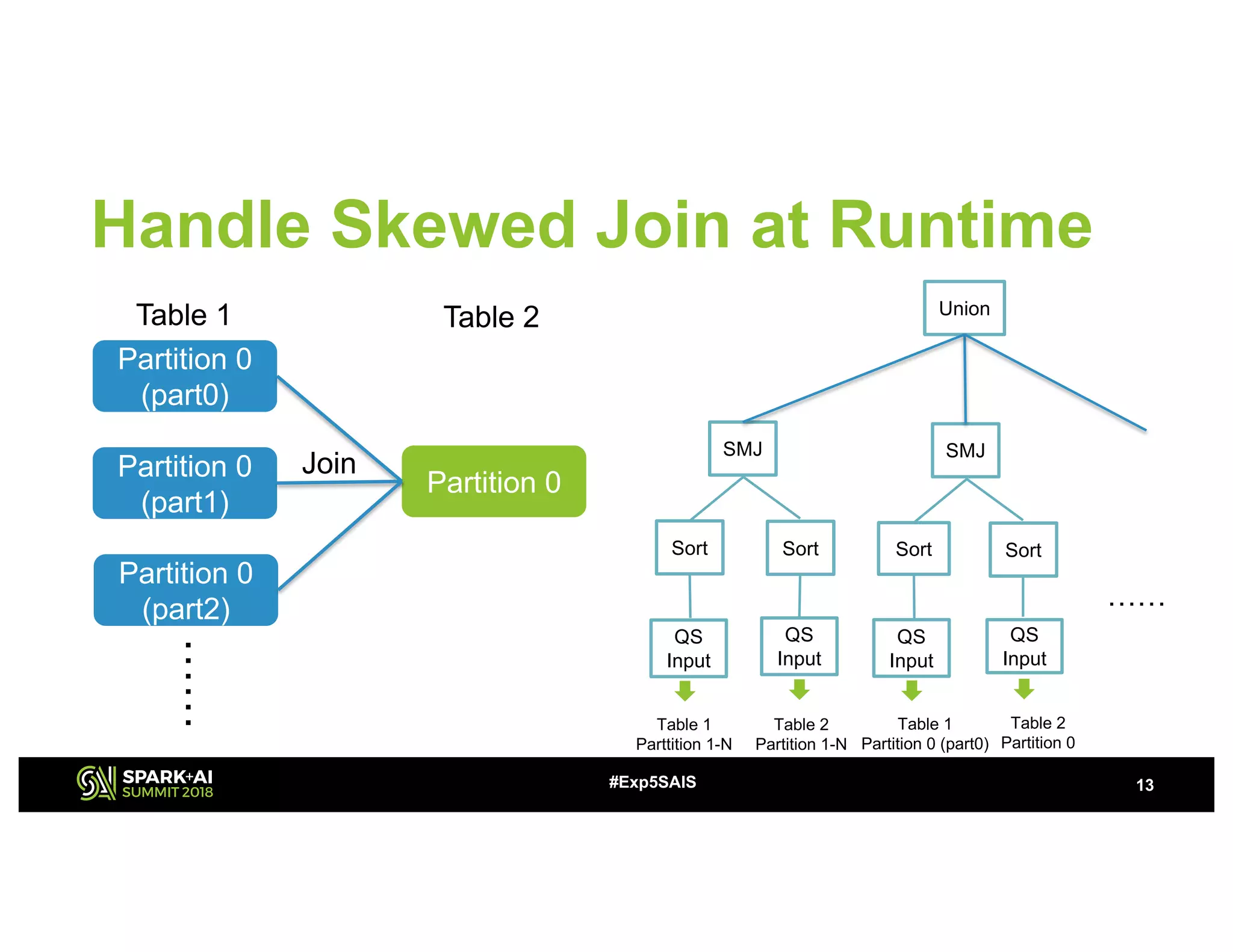
Handle Skewed Join at Runtime
• spark.sql.adaptive.skewedJoin.enabled -> true
• A partition is thought as skewed if its data size or
row count is N times larger than the median, and
also larger than a pre-defined threshold.
12#Exp5SAIS
Handle Skewed Join at Runtime
13#Exp5SAIS
……
Partition 0
(part0)
Partition 0
(part1)
Partition 0
(part2)
Partition 0
Table 1 Table 2
Join
Sort Sort
SMJ
Sort
QS
Input
QS
Input
Sort
SMJ
Union
……
QS
Input
QS
Input
Table 1
Partition 0 (part0)
Table 2
Partition 0
Table 1
Parttition 1-N
Table 2
Partition 1-N
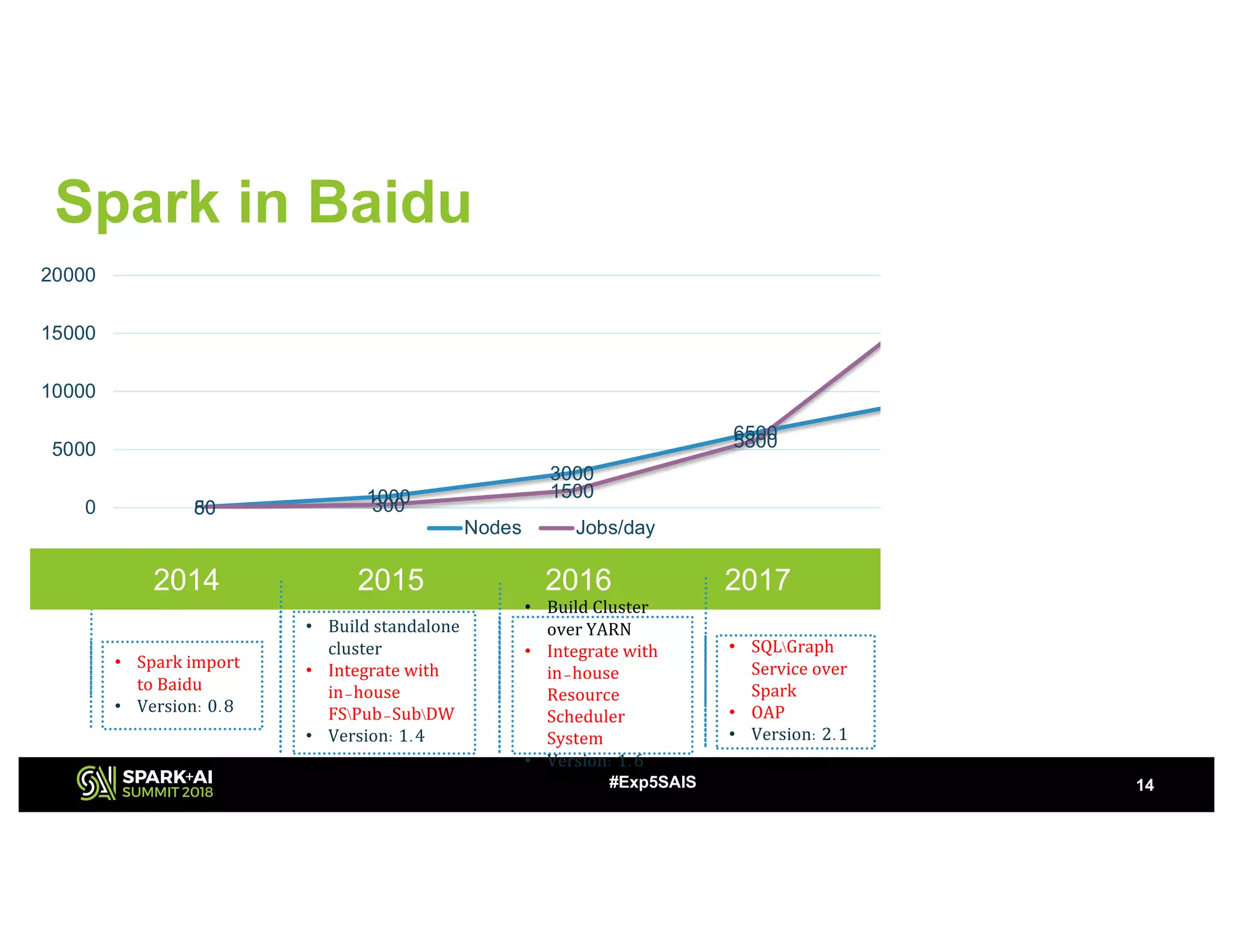
Spark in Baidu
14#Exp5SAIS
• Spark import
to Baidu
• Version: 0.8
80
1000
3000
6500
9500
50 300
1500
5800
18000
0
5000
10000
15000
20000
Nodes Jobs/day
2014 2015 2016 2017 2018
• Build standalone
cluster
• Integrate with
in-house
FSPub-SubDW
• Version: 1.4
• Build Cluster
over YARN
• Integrate with
in-house
Resource
Scheduler
System
• Version: 1.6
• SQLGraph
Service over
Spark
• OAP
• Version: 2.1
• Structure
Streaming
• Spark Adaptive
Execution
• Hadoop to Spark
• Version: 2.2
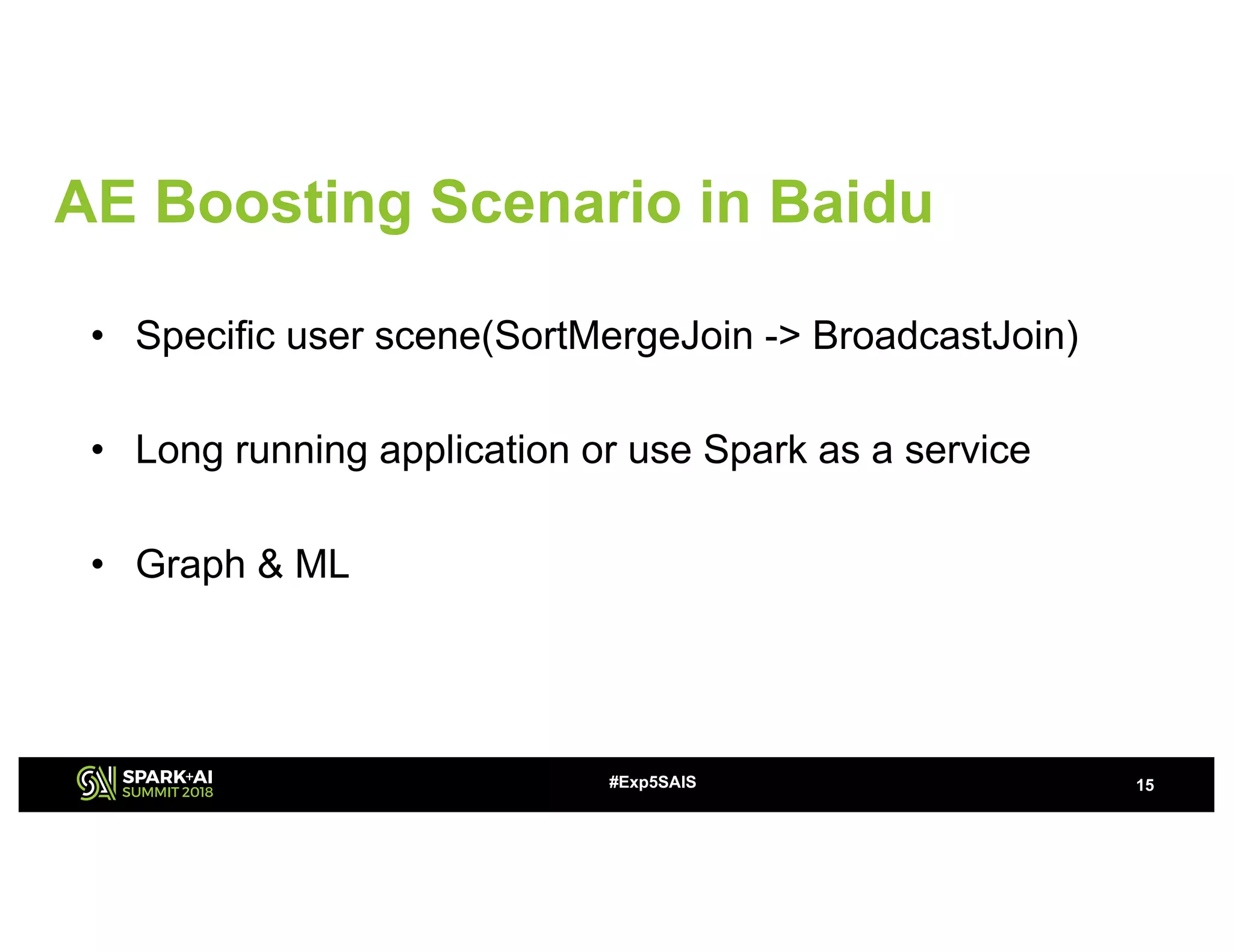
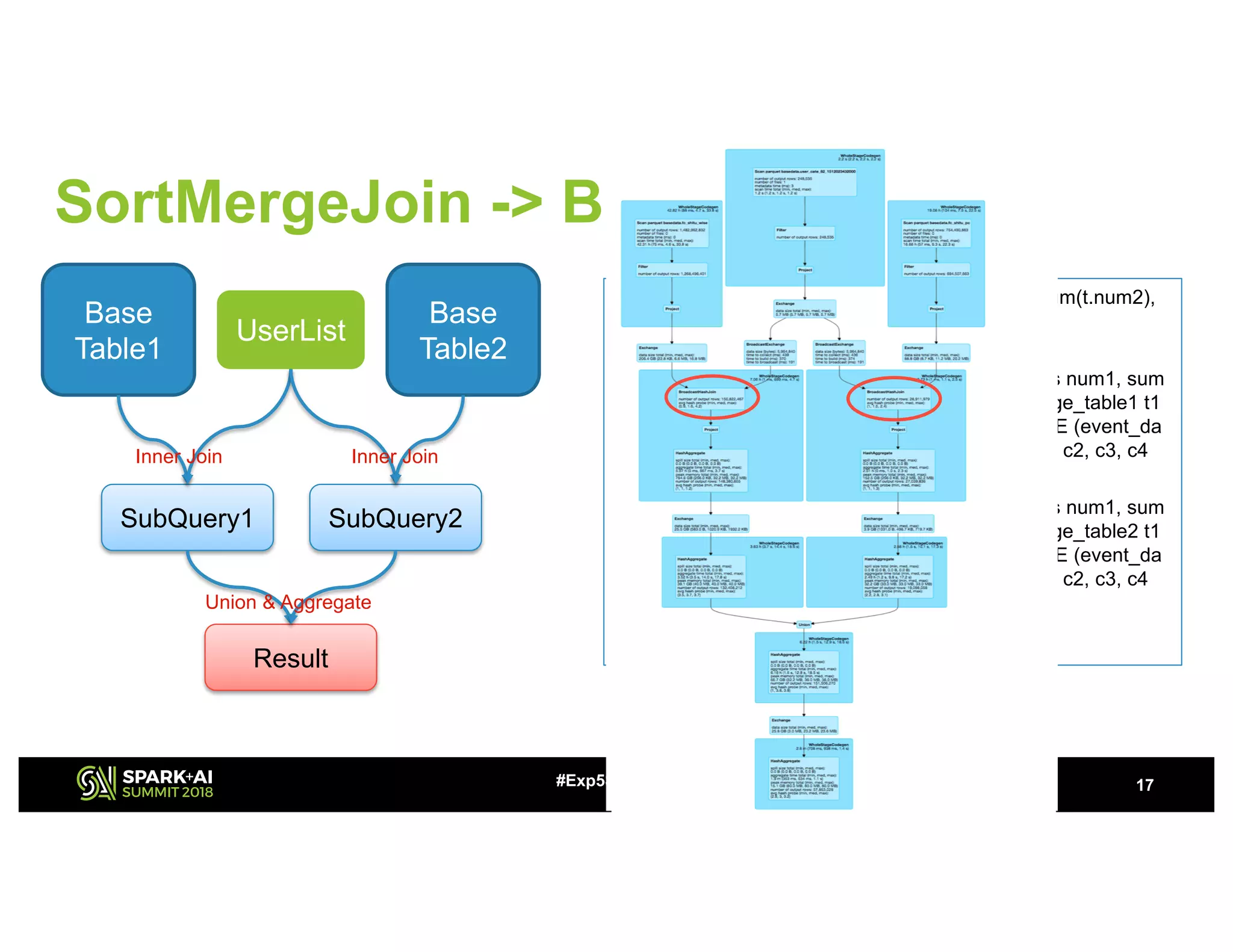
• Specific user scene(SortMergeJoin -> BroadcastJoin)
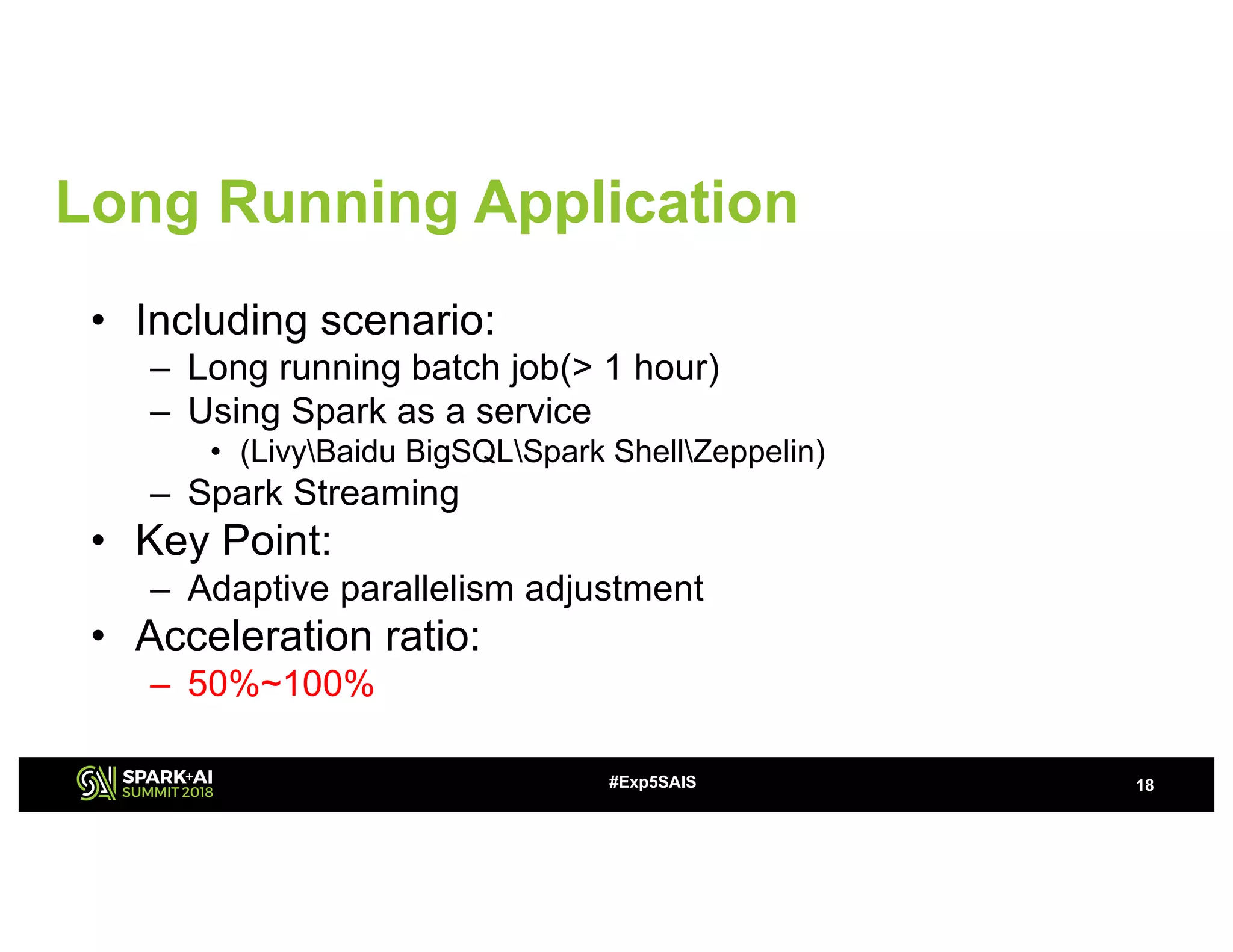
• Long running application or use Spark as a service
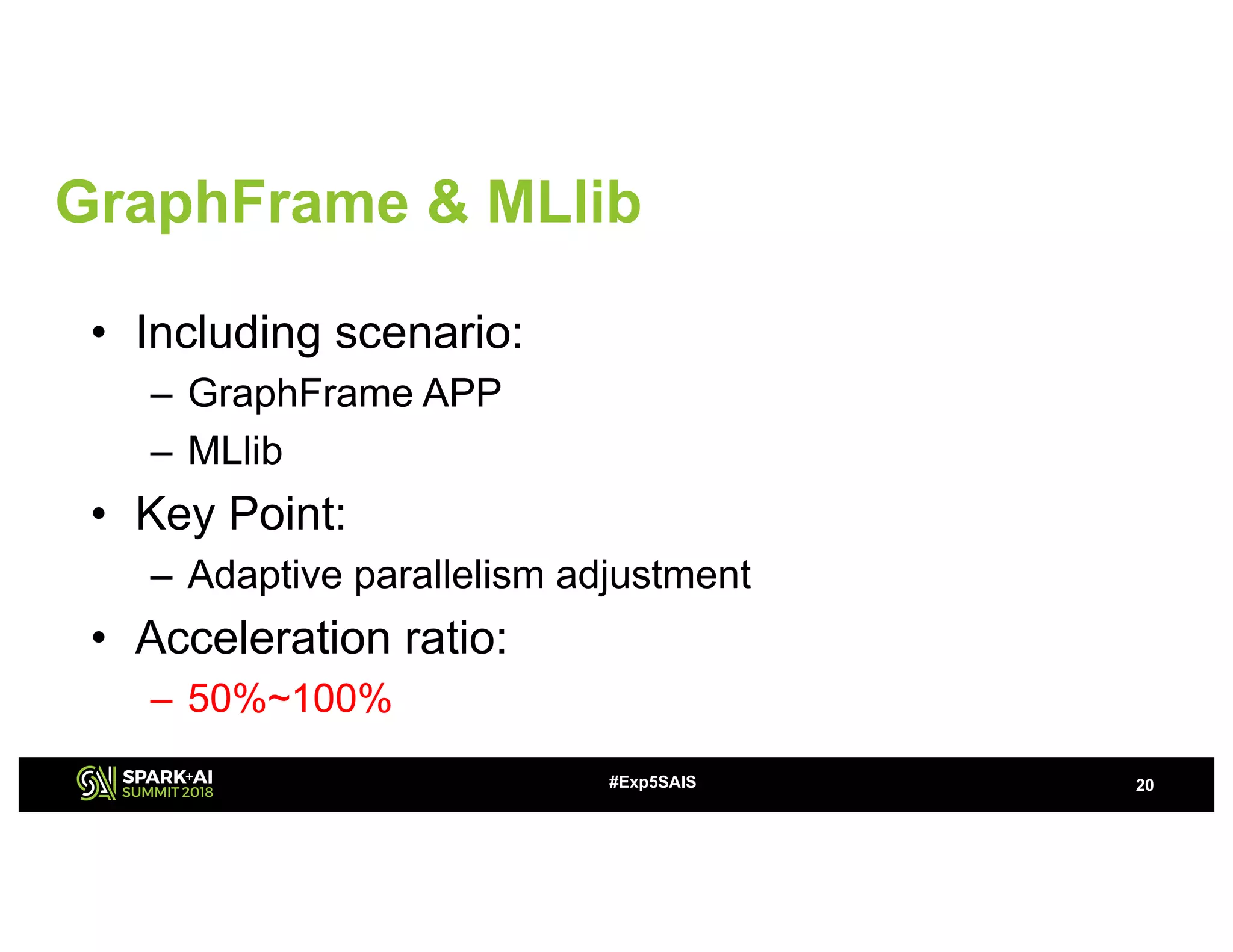
• Graph & ML
15#Exp5SAIS
AE Boosting Scenario in Baidu
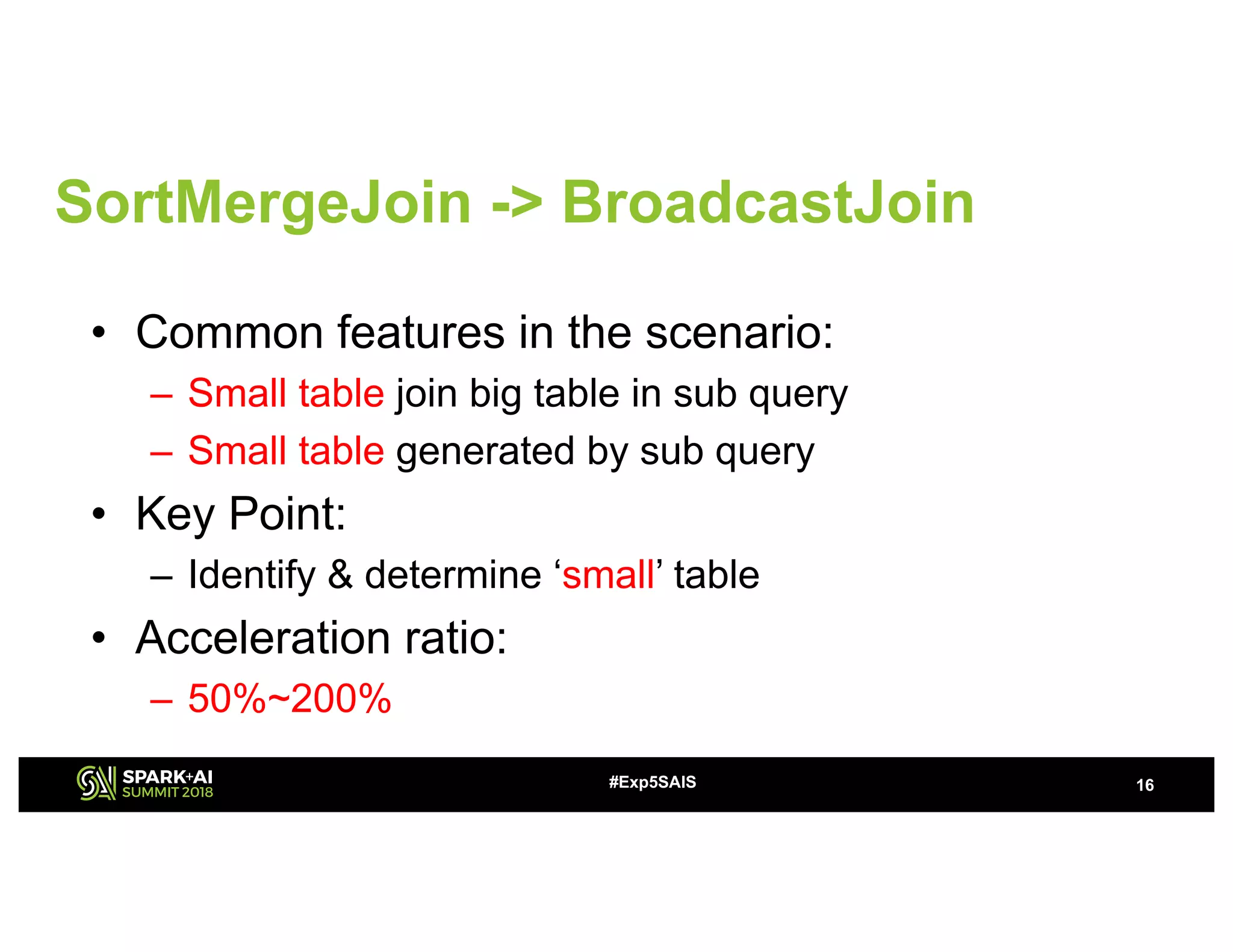
• Common features in the scenario:
– Small table join big table in sub query
– Small table generated by sub query
• Key Point:
– Identify & determine ‘small’ table
• Acceleration ratio:
– 50%~200%
16
SortMergeJoin -> BroadcastJoin
#Exp5SAIS
SELECT t.c1, t.id, t.c2, t.c3, t.c4, sum(t.num1), sum(t.num2),
sum(t.num3) FROM
(
SELECT c1, t1.id as id, c2, c3, c4, sum(num1s) as num1, sum
(num2) as num2, sum(num3) as num3 FROM huge_table1 t1
INNER JOIN user_list t2 ON (t1.id = t2.id) WHERE (event_da
y=20171107) and flag != 'true' group by c1, t1.id, c2, c3, c4
UNION ALL
SELECT c1, t1.id as id, c2, c3, c4, sum(num1s) as num1, sum
(num2) as num2, sum(num3) as num3 FROM huge_table2 t1
INNER JOIN user_list t2 ON (t1.id = t2.id) WHERE (event_da
y=20171107) and flag != 'true' group by c1, t1.id, c2, c3, c4
) t
GROUP BY t.c1, t.id, t.c2, t.c3, c4
17#Exp5SAIS
SortMergeJoin -> BroadcastJoin
UserList
Base
Table1
Base
Table2
SubQuery1 SubQuery2
Inner Join Inner Join
Result
Union & Aggregate
#Exp5SAIS
18
Long Running Application
• Including scenario:
– Long running batch job(> 1 hour)
– Using Spark as a service
• (LivyBaidu BigSQLSpark ShellZeppelin)
– Spark Streaming
• Key Point:
– Adaptive parallelism adjustment
• Acceleration ratio:
– 50%~100%
#Exp5SAIS
19
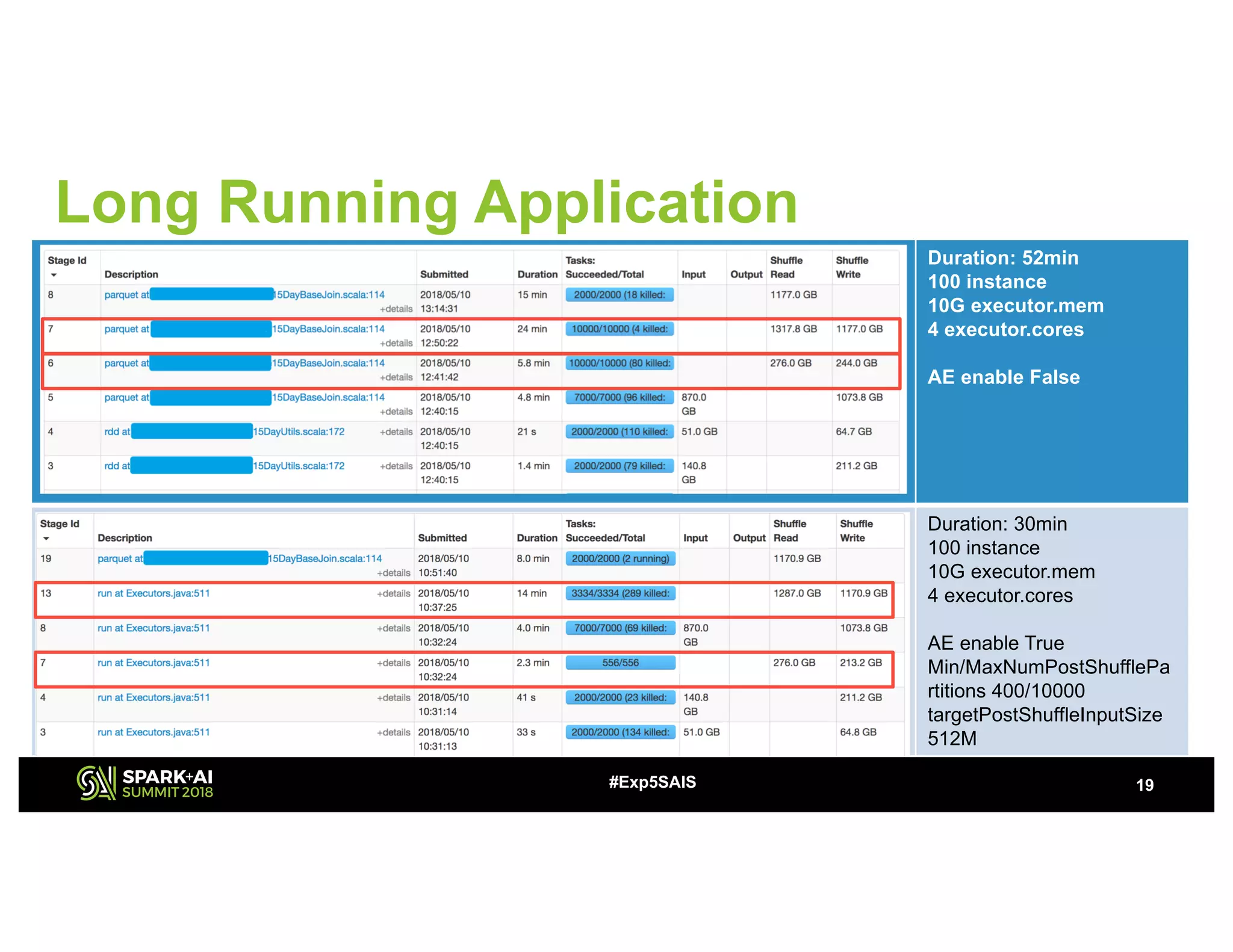
Long Running Application
Duration: 52min
100 instance
10G executor.mem
4 executor.cores
AE enable False
Duration: 30min
100 instance
10G executor.mem
4 executor.cores
AE enable True
Min/MaxNumPostShufflePa
rtitions 400/10000
targetPostShuffleInputSize
512M
#Exp5SAIS
20
GraphFrame & MLlib
• Including scenario:
– GraphFrame APP
– MLlib
• Key Point:
– Adaptive parallelism adjustment
• Acceleration ratio:
– 50%~100%
#Exp5SAIS
21
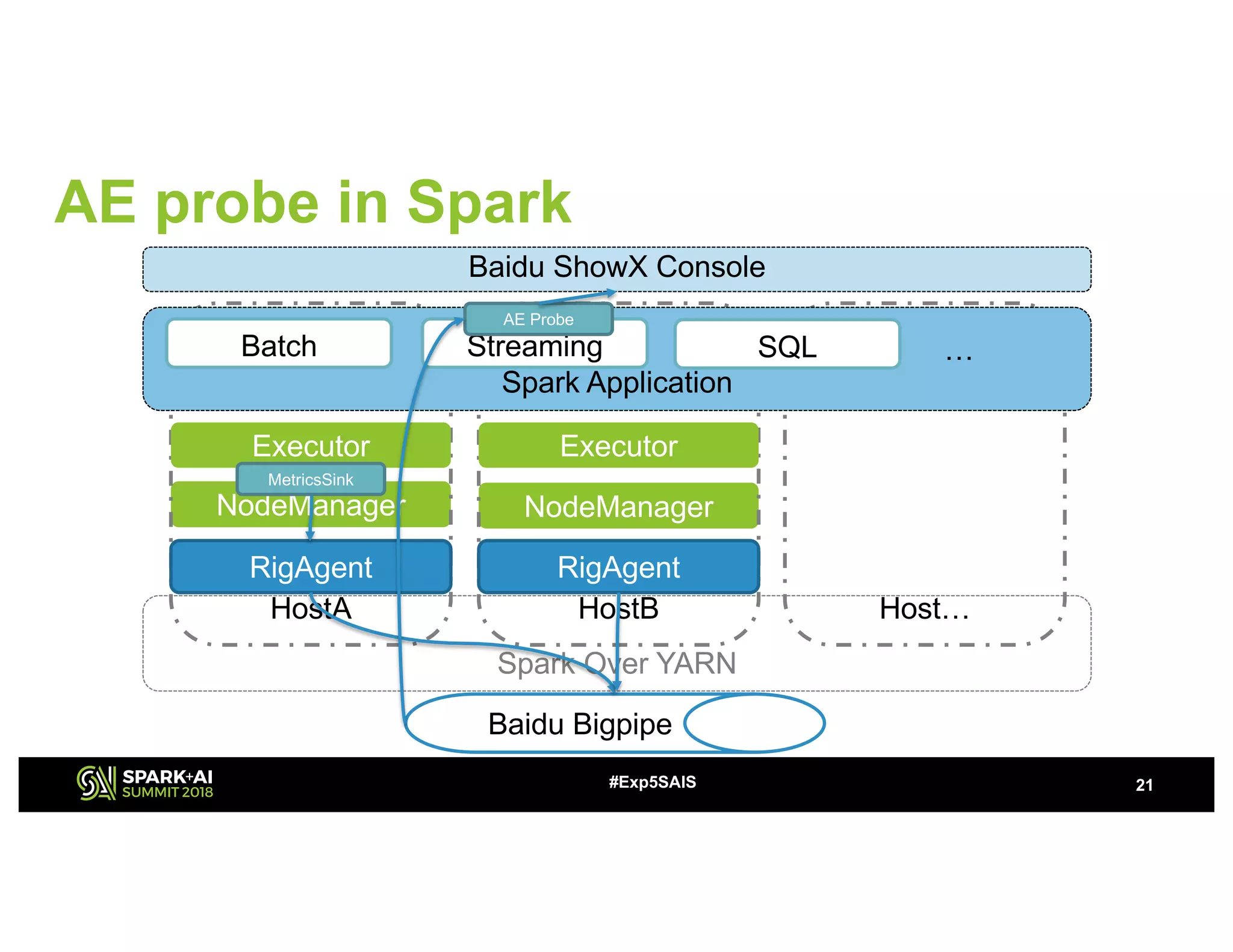
AE probe in Spark
#Exp5SAIS
Spark Over YARN
NodeManager
HostA
RigAgent
Executor
NodeManager
HostB
RigAgent
Executor
Host…
MetricsSink
Spark Application
Baidu ShowX Console
Baidu Bigpipe
Batch Streaming SQL …
AE Probe
22#Exp5SAIS
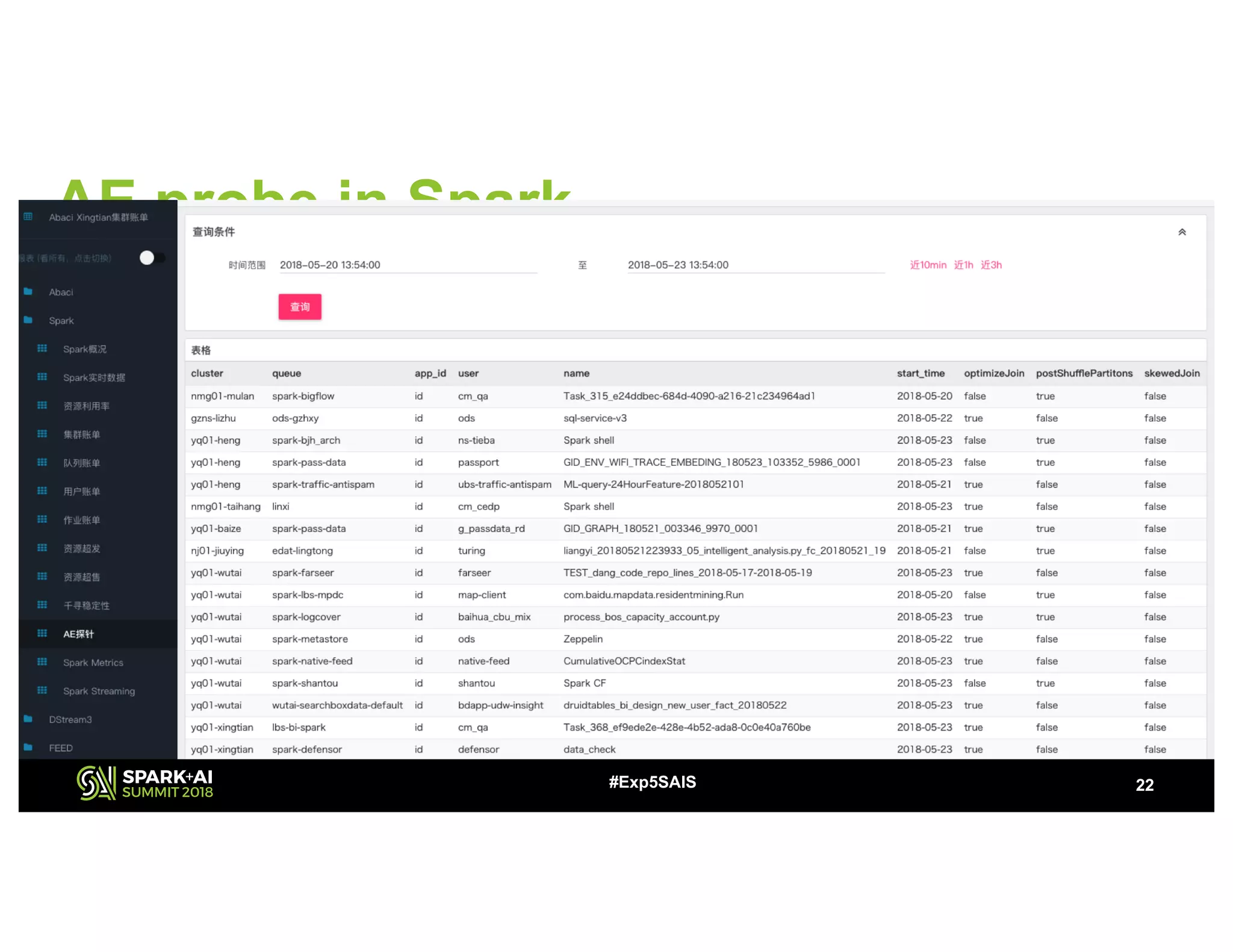
AE probe in Spark
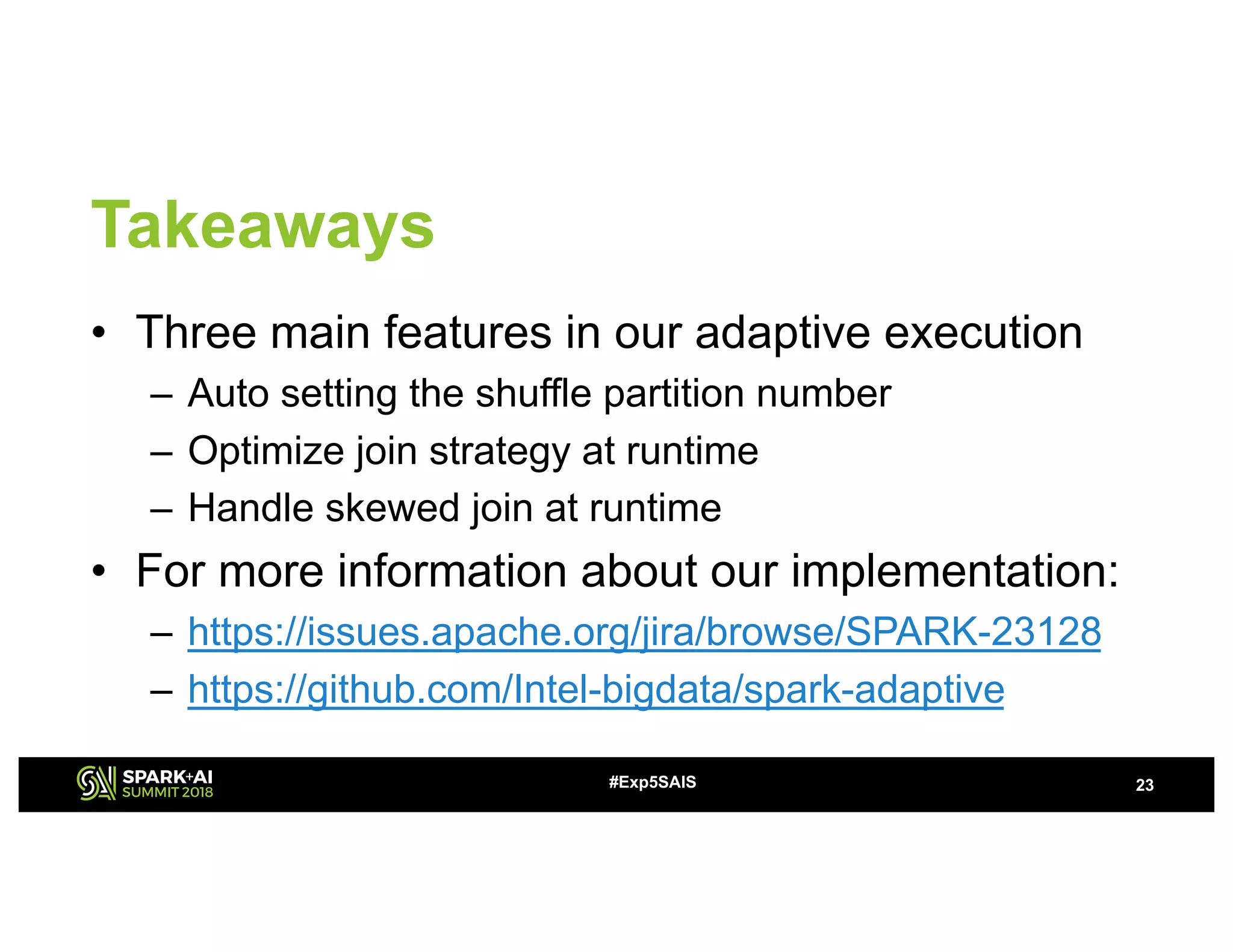
Takeaways
• Three main features in our adaptive execution
– Auto setting the shuffle partition number
– Optimize join strategy at runtime
– Handle skewed join at runtime
• For more information about our implementation:
– https://issues.apache.org/jira/browse/SPARK-23128
– https://github.com/Intel-bigdata/spark-adaptive
23#Exp5SAIS
Carson Wang carson.wang@intel.com
Yuanjian Li liyuanjian@baidu.com
Thank you!
#Exp5SAIS

Spark SQL Adaptive Execution Unleashes The Power of Cluster in Large Scale with Yuanjian li and Carson Wang

  • 1.
    Carson Wang (Intel),Yuanjian Li (Baidu) Spark SQL Adaptive Execution Unleashes The Power of Cluster in Large Scale #Exp5SAIS
  • 2.
    Agenda • Challenges inUsing Spark SQL • Adaptive Execution Introduction • Adaptive Execution in Baidu 2#Exp5SAIS
  • 3.
    Tuning Shuffle PartitionNumber • Too small Spill, OOM • Too large Scheduling overhead. More IO requests. Too many small output files • The same shuffle partition number doesn’t fit for all stages 3#Exp5SAIS
  • 4.
    Spark SQL JoinSelection • A Join may takes intermediate results as inputs. Spark SQL may choose an inefficient join strategy if it doesn’t know the exact size at planning phase. 4#Exp5SAIS
  • 5.
    Data Skew inJoin • Data in some partitions are extremely larger than other partitions. Data skew is a common source of slowness for shuffle joins. • Common ways to solve data skew – Increase shuffle partition number – Increase BroadcastJoin threashold – Add prefix to the skewed keys 5#Exp5SAIS
  • 6.
    Spark SQL ExecutionMode 6#Exp5SAIS
  • 7.
    Spark SQL AdaptiveExecution Mode 7#Exp5SAIS
  • 8.
    Auto Setting theReducer Number • Enable the feature – spark.sql.adaptive.enabled -> true • Configure the behavior – Target input size for a reduce task – Min/Max shuffle partition number 8#Exp5SAIS Min Shuffle Partition Number Max Shuffle Partition Number Best Shuffle Partition Number
  • 9.
    Auto Setting theReducer Number • Target size per reducer = 64 MB. • Min-Max shuffle partition number = 1 to 5 9#Exp5SAIS ShuffledRowRDD Partition 0 (70MB) Partition 1 (30MB) Partition 2 (20MB ) Partition 3 (10MB) Partition 4 (50MB) ShuffledRowRDD Partition 0 (70MB) Partition 1 (30MB) Partition 2 (20MB) Partition 3 (10MB) Partition 4 (50MB) Adaptive Execution uses 3 reducers at runtime.
  • 10.
    Optimize Join Strategyat Runtime 10#Exp5SAIS
  • 11.
    Optimize Join Strategyat Runtime • After optimizing SortMergeJoin to BroadcastJoin, each reduce task local read the whole map output file and join with the broadcasted table. 11#Exp5SAIS Map Task Executor ReduceTask Map Output File
  • 12.
    Handle Skewed Joinat Runtime • spark.sql.adaptive.skewedJoin.enabled -> true • A partition is thought as skewed if its data size or row count is N times larger than the median, and also larger than a pre-defined threshold. 12#Exp5SAIS
  • 13.
    Handle Skewed Joinat Runtime 13#Exp5SAIS …… Partition 0 (part0) Partition 0 (part1) Partition 0 (part2) Partition 0 Table 1 Table 2 Join Sort Sort SMJ Sort QS Input QS Input Sort SMJ Union …… QS Input QS Input Table 1 Partition 0 (part0) Table 2 Partition 0 Table 1 Parttition 1-N Table 2 Partition 1-N
  • 14.
    Spark in Baidu 14#Exp5SAIS •Spark import to Baidu • Version: 0.8 80 1000 3000 6500 9500 50 300 1500 5800 18000 0 5000 10000 15000 20000 Nodes Jobs/day 2014 2015 2016 2017 2018 • Build standalone cluster • Integrate with in-house FSPub-SubDW • Version: 1.4 • Build Cluster over YARN • Integrate with in-house Resource Scheduler System • Version: 1.6 • SQLGraph Service over Spark • OAP • Version: 2.1 • Structure Streaming • Spark Adaptive Execution • Hadoop to Spark • Version: 2.2
  • 15.
    • Specific userscene(SortMergeJoin -> BroadcastJoin) • Long running application or use Spark as a service • Graph & ML 15#Exp5SAIS AE Boosting Scenario in Baidu
  • 16.
    • Common featuresin the scenario: – Small table join big table in sub query – Small table generated by sub query • Key Point: – Identify & determine ‘small’ table • Acceleration ratio: – 50%~200% 16 SortMergeJoin -> BroadcastJoin #Exp5SAIS
  • 17.
    SELECT t.c1, t.id,t.c2, t.c3, t.c4, sum(t.num1), sum(t.num2), sum(t.num3) FROM ( SELECT c1, t1.id as id, c2, c3, c4, sum(num1s) as num1, sum (num2) as num2, sum(num3) as num3 FROM huge_table1 t1 INNER JOIN user_list t2 ON (t1.id = t2.id) WHERE (event_da y=20171107) and flag != 'true' group by c1, t1.id, c2, c3, c4 UNION ALL SELECT c1, t1.id as id, c2, c3, c4, sum(num1s) as num1, sum (num2) as num2, sum(num3) as num3 FROM huge_table2 t1 INNER JOIN user_list t2 ON (t1.id = t2.id) WHERE (event_da y=20171107) and flag != 'true' group by c1, t1.id, c2, c3, c4 ) t GROUP BY t.c1, t.id, t.c2, t.c3, c4 17#Exp5SAIS SortMergeJoin -> BroadcastJoin UserList Base Table1 Base Table2 SubQuery1 SubQuery2 Inner Join Inner Join Result Union & Aggregate #Exp5SAIS
  • 18.
    18 Long Running Application •Including scenario: – Long running batch job(> 1 hour) – Using Spark as a service • (LivyBaidu BigSQLSpark ShellZeppelin) – Spark Streaming • Key Point: – Adaptive parallelism adjustment • Acceleration ratio: – 50%~100% #Exp5SAIS
  • 19.
    19 Long Running Application Duration:52min 100 instance 10G executor.mem 4 executor.cores AE enable False Duration: 30min 100 instance 10G executor.mem 4 executor.cores AE enable True Min/MaxNumPostShufflePa rtitions 400/10000 targetPostShuffleInputSize 512M #Exp5SAIS
  • 20.
    20 GraphFrame & MLlib •Including scenario: – GraphFrame APP – MLlib • Key Point: – Adaptive parallelism adjustment • Acceleration ratio: – 50%~100% #Exp5SAIS
  • 21.
    21 AE probe inSpark #Exp5SAIS Spark Over YARN NodeManager HostA RigAgent Executor NodeManager HostB RigAgent Executor Host… MetricsSink Spark Application Baidu ShowX Console Baidu Bigpipe Batch Streaming SQL … AE Probe
  • 22.
  • 23.
    Takeaways • Three mainfeatures in our adaptive execution – Auto setting the shuffle partition number – Optimize join strategy at runtime – Handle skewed join at runtime • For more information about our implementation: – https://issues.apache.org/jira/browse/SPARK-23128 – https://github.com/Intel-bigdata/spark-adaptive 23#Exp5SAIS
  • 24.
    Carson Wang carson.wang@intel.com YuanjianLi liyuanjian@baidu.com Thank you! #Exp5SAIS