The Challenges of
Distributing Postgres:
A Citus Story
Ozgun Erdogan
DataEngConf NYC | October 2017
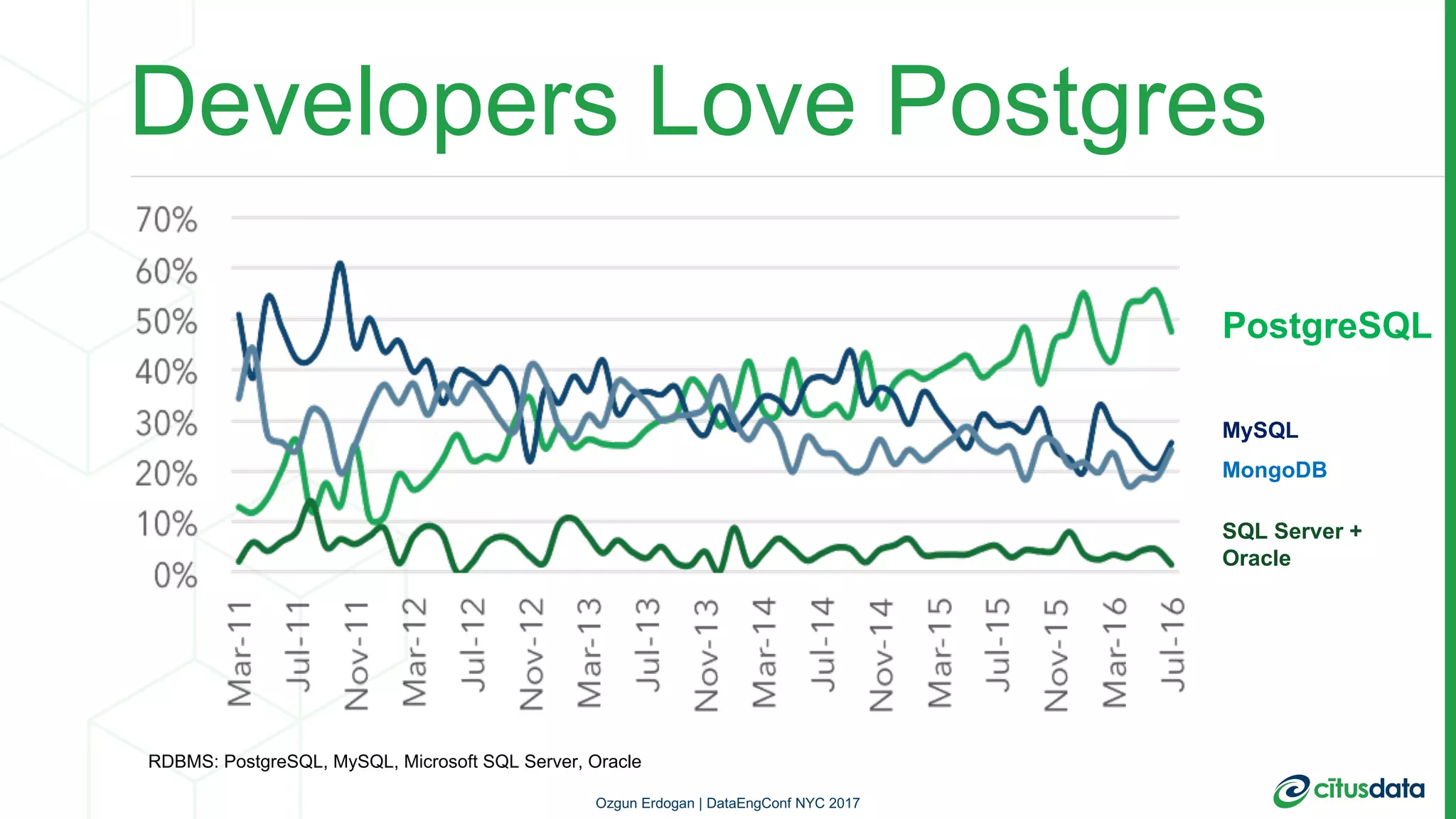
Developers Love Postgres
PostgreSQL
MySQL
MongoDB
SQL Server +
Oracle
RDBMS: PostgreSQL, MySQL, Microsoft SQL Server, Oracle
Ozgun Erdogan | DataEngConf NYC 2017
I love Postgres, too
3 Ozgun Erdogan | DataEngConf NYC 2017
Ozgun Erdogan
CTO of Citus Data
Distributed Systems
Distributed Databases
Formerly of Amazon
Love drinking margaritas
4
Our mission at Citus Data
5 Ozgun Erdogan | DataEngConf NYC 2017
Make it so SaaS businesses
never have to worry about
scaling their database again
What is the Citus database?
1.Scales out PostgreSQL
2.Extension to PostgreSQL
3.Available in 3 Ways
Ozgun Erdogan | DataEngConf NYC 2017
• Using sharding & replication
• Query engine parallelizes SQL queries across many nodes
• Using PostgreSQL extension APIs
Citus, Packaged Three Ways
Ozgun Erdogan | DataEngConf NYC 2017
Open
Source
Enterprise
Software
Fully-Managed
Database as a Service
github.com/citusdata/citus
Simplified	Citus	Architecture
3 Challenges Distributing Postgres
1. PostgreSQL and High Availability
2. To build new distributed database—or to fork?
3. Distributed transactions
Ozgun Erdogan | DataEngConf NYC 2017
PostgreSQL &
High Availability (HA)
Designing for a Cloud-native world
1
Why is High Availability hard?
PostgreSQL replication uses one primary &
multiple secondary nodes. Two challenges:
1. Most Postgres clients aren’t smart. When the
primary fails, they retry the same IP.
2. Postgres replicates entire state. This makes it
resource intensive to reconstruct new nodes from a
primary.
Ozgun Erdogan | DataEngConf NYC 2017
Database Failures Should Be Transparent
Ozgun Erdogan | DataEngConf NYC 2017
Database Failures Shouldn’t Be a Big Deal
1. PostgreSQL streaming replication to replicate from
primary to secondary. Back up to S3.
2. Volume level replication to replicate to secondary’s
volume. Back up to S3.
3. Incremental backups to S3. Reconstruct secondary
nodes from S3.
Ozgun Erdogan | DataEngConf NYC 2017
3 Methods for HA & Backups in Postgres
Postgres - Streaming Replication (1)
Write-ahead	logs		
(streaming	repl.)
Table foo
Primary	–
PostgreSQL	
streaming	repl.	
Table bar
WAL logs
Table foo
Table bar
WAL logs
Secondary	–
PostgreSQL	
streaming	repl.	
Monitoring	Agents	-
streaming	repl.	
setup	&	auto	failover
S3	/	Blob	Storage
(Encrypted)	
Backup
Process
Ozgun Erdogan | DataEngConf NYC 2017
Postgres – AWS RDS & Azure (2)
Postgres
Primary
Monitoring	Agents
(Auto	node	failover)
Persistent	Volume
Postgres
Standby	
S3	/	Blob	Storage
(Encrypted)	
Table foo
Table bar
WAL logs
Table foo
Table bar
WAL logs
Backup	process
Backup
Process
Ozgun Erdogan | DataEngConf NYC 2017
Persistent	Volume
Postgres – Reconstruct from WAL (3)
Postgres
Primary
Monitoring	Agents
(Auto	node	failover)
Persistent	Volume
Postgres
Secondary
Backup
Process
S3	/	Blob	Storage
(Encrypted)	
Table foo
Table bar
WAL logs
Persistent	Volume
Table foo
Table bar
WAL logs
Backup	process
Ozgun Erdogan | DataEngConf NYC 2017
WHO DOES THIS? PRIMARY BENEFITS
Streaming Replication
(local / ephemeral disk)
On-prem
Manual EC2
Simple to set up
Direct I/O: High I/O & large storage
Disk Mirroring
RDS
Azure Preview
Works for MySQL and PostgreSQL
Data durability in cloud environments
Reconstruct from WAL
Heroku
Citus Data
Enables Fork and PITR
Node reconstruction in background
(Data durability in cloud environments)
How do these approaches compare?
17 Ozgun Erdogan | DataEngConf NYC 2017
Summary
• In PostgreSQL, a database node’s state gets
replicated in its entirety. The replication can be set up
in three ways.
• Reconstructing a secondary node from S3 makes
bringing up or shooting down nodes easy.
• When you shard your database, the state you need to
replicate per node becomes smaller.
Ozgun Erdogan | DataEngConf NYC 2017
PostgreSQL has a
huge ecosystem.
How do you keep up with it?
2
3 ways to build a distributed database
1. Build a distributed database from scratch
2. Middleware sharding (mimic the parser)
3. Fork your favorite database (like PostgreSQL)
Ozgun Erdogan | DataEngConf NYC 2017
Example Transaction Block
Ozgun Erdogan | DataEngConf NYC 2017
Postgres Features, Tools & Frameworks
• PostgreSQL manual (US Letter)
• Clients for diff programming
languages
• ORMs, libraries, GUIs
• Tools (dump, restore, analyze)
• New features
Ozgun Erdogan | DataEngConf NYC 2017
At First, Forked PostgreSQL with Style
Ozgun Erdogan | DataEngConf NYC 2017
Two Stage Query Optimization
1. Plan to minimize network I/O
2. Nodes talk to each other using SQL over libpq
3. Learned to cooperate with planner / executor bit by bit
(Volcano style executor)
Ozgun Erdogan | DataEngConf NYC 2017
Citus Architecture (Simplified)
25
SELECT avg(revenue)
FROM sales
Coordinator
SELECT sum(revenue), count(revenue)
FROM table_1001
SELECT sum … FROM table_1003
Worker node 1
Table metadata
Table_1001
Table_1003
SELECT sum … FROM table_1002
SELECT sum … FROM table_1004
Worker node 2
Table_1002
Table_1004
Worker node N
.
.
.
.
.
.
Each node PostgreSQL with Citus installed
1 shard = 1 PostgreSQL table
Ozgun Erdogan | DataEngConf NYC 2017
Unfork Citus using Extension APIs
CREATE EXTENSION citus;
• System catalogs – Distributed metadata
• Planner hook – Insert, Update, Delete, Select
• Executor hook – Insert, Update, Delete, Select
• Utility hook – Alter Table, Create Index, Vacuum, etc.
• Transaction & resources handling – file descriptors, etc.
• Background worker process – Maintenance processes
(distributed deadlock detection, task tracker, etc.)
• Logical decoding – Online data migrations
Ozgun Erdogan | DataEngConf NYC 2017
PostgreSQL has transactions.
How to handle distributed transactions
3
BEGIN
INSERT
UPDATE
SELECT
COMMIT
ROLLBACK
Consistency in Distributed Databases
1. 2PC: All participating nodes need to be up
2. Paxos: Achieves consensus with quorum
3. Raft: More understandable alternative to
Paxos
Ozgun Erdogan | DataEngConf NYC 2017
Concurrency in Distributed Databases
Ozgun Erdogan | DataEngConf NYC 2017
LocksLocks
What	is	a	Lock?
• Protects	against	concurrent	modifications.
• Locks	are	released	at	the	end	of	a	transaction.
Deadlocks
Transactions	Block	on	1st Conflicting	LockWhat is a lock?
Protects against concurrent modifications
Locks released at end of transaction
BEGIN;
UPDATE data SET y = 2 WHERE x = 1;
<obtained lock on rows with x = 1>
COMMIT;
<all locks released>
BEGIN;
UPDATE data SET y = 5 WHERE x = 1;
<waiting for lock on rows with x = 1>
<obtained lock on rows with x = 1>
COMMIT;
Transactions	and	Concurrency
• Transactions	that	don’t	modify	the	same	row	
can	run	concurrently.
Transactions block on 1st lock that conflicts
BEGIN;
UPDATE data SET y = y - 1 WHERE x = 1;
COMMIT;
<all locks released>
BEGIN;
UPDATE data SET y = y + 1 WHERE x = 2;
UPDATE data SET y = y + 1 WHERE x = 1;
<waiting for lock on rows with x = 1>
<obtained lock on rows with x = 1>
COMMIT;
Transactions	and	Concurrency
• Transactions	that	don’t	modify	the	same	row	
can	run	concurrently.
Transactions block on 1st lock that conflicts
BEGIN;
UPDATE data SET y = y - 1 WHERE x = 1;
COMMIT;
<all locks released>
BEGIN;
UPDATE data SET y = y + 1 WHERE x = 2;
UPDATE data SET y = y + 1 WHERE x = 1;
<waiting for lock on rows with x = 1>
<obtained lock on rows with x = 1>
COMMIT;
(Distributed) deadlock!
BEGIN;
UPDATE data SET y = y - 1 WHERE x = 1;
UPDATE data SET y = y + 1 WHERE x = 2;
BEGIN;
UPDATE data SET y = y - 1 WHERE x = 2;
UPDATE data SET y = y + 1 WHERE x = 1;
But what if they start blocking each other?
Transactions	and	Concurrency
• Transactions	that	don’t	modify	the	same	row	
can	run	concurrently.
Transactions block on 1st lock that conflicts
BEGIN;
UPDATE data SET y = y - 1 WHERE x = 1;
COMMIT;
<all locks released>
BEGIN;
UPDATE data SET y = y + 1 WHERE x = 2;
UPDATE data SET y = y + 1 WHERE x = 1;
<waiting for lock on rows with x = 1>
<obtained lock on rows with x = 1>
COMMIT;
(Distributed) deadlock!
BEGIN;
UPDATE data SET y = y - 1 WHERE x = 1;
UPDATE data SET y = y + 1 WHERE x = 2;
BEGIN;
UPDATE data SET y = y - 1 WHERE x = 2;
UPDATE data SET y = y + 1 WHERE x = 1;
But what if they start blocking each other?Deadlock detection in PostgreSQL
Deadlock detection builds a graph of processes that
are waiting for each other.
Transactions	and	Concurrency
• Transactions	that	don’t	modify	the	same	row	
can	run	concurrently.
Transactions block on 1st lock that conflicts
BEGIN;
UPDATE data SET y = y - 1 WHERE x = 1;
COMMIT;
<all locks released>
BEGIN;
UPDATE data SET y = y + 1 WHERE x = 2;
UPDATE data SET y = y + 1 WHERE x = 1;
<waiting for lock on rows with x = 1>
<obtained lock on rows with x = 1>
COMMIT;
(Distributed) deadlock!
BEGIN;
UPDATE data SET y = y - 1 WHERE x = 1;
UPDATE data SET y = y + 1 WHERE x = 2;
BEGIN;
UPDATE data SET y = y - 1 WHERE x = 2;
UPDATE data SET y = y + 1 WHERE x = 1;
But what if they start blocking each other?Deadlock detection in PostgreSQL
Deadlock detection builds a graph of processes that
are waiting for each other.
Deadlock detection in PostgreSQL
Transactions are cancelled until the cycle is gone
Transactions	and	Concurrency
• Transactions	that	don’t	modify	the	same	row	
can	run	concurrently.
Transactions block on 1st lock that conflicts
BEGIN;
UPDATE data SET y = y - 1 WHERE x = 1;
COMMIT;
<all locks released>
BEGIN;
UPDATE data SET y = y + 1 WHERE x = 2;
UPDATE data SET y = y + 1 WHERE x = 1;
<waiting for lock on rows with x = 1>
<obtained lock on rows with x = 1>
COMMIT;
(Distributed) deadlock!
BEGIN;
UPDATE data SET y = y - 1 WHERE x = 1;
UPDATE data SET y = y + 1 WHERE x = 2;
BEGIN;
UPDATE data SET y = y - 1 WHERE x = 2;
UPDATE data SET y = y + 1 WHERE x = 1;
But what if they start blocking each other?Deadlock detection in PostgreSQL
Deadlock detection builds a graph of processes that
are waiting for each other.
Deadlock detection in PostgreSQL
Transactions are cancelled until the cycle is gone
Firstname Lastname | Citus Data | Meeting Name | Month Year
Deadlocks in Citus
Citus delegates transactions to nodes
Firstname Lastname | Citus Data | Meeting Name | Month Year
Deadlocks in Citus
Citus delegates transactions to nodes
Transactions	and	Concurrency
• Transactions	that	don’t	modify	the	same	row	
can	run	concurrently.
Transactions block on 1st lock that conflicts
BEGIN;
UPDATE data SET y = y - 1 WHERE x = 1;
COMMIT;
<all locks released>
BEGIN;
UPDATE data SET y = y + 1 WHERE x = 2;
UPDATE data SET y = y + 1 WHERE x = 1;
<waiting for lock on rows with x = 1>
<obtained lock on rows with x = 1>
COMMIT;
(Distributed) deadlock!
BEGIN;
UPDATE data SET y = y - 1 WHERE x = 1;
UPDATE data SET y = y + 1 WHERE x = 2;
BEGIN;
UPDATE data SET y = y - 1 WHERE x = 2;
UPDATE data SET y = y + 1 WHERE x = 1;
But what if they start blocking each other?Deadlock detection in PostgreSQL
Deadlock detection builds a graph of processes that
are waiting for each other.
Deadlock detection in PostgreSQL
Transactions are cancelled until the cycle is gone
Firstname Lastname | Citus Data | Meeting Name | Month Year
Deadlocks in Citus
Citus delegates transactions to nodes
Firstname Lastname | Citus Data | Meeting Name | Month Year
Deadlocks in Citus
Citus delegates transactions to nodes
Firstname Lastname | Citus Data | Meeting Name | Month Year
Deadlocks in Citus
PostgreSQL’s deadlock detector still works
Transactions	and	Concurrency
• Transactions	that	don’t	modify	the	same	row	
can	run	concurrently.
Transactions block on 1st lock that conflicts
BEGIN;
UPDATE data SET y = y - 1 WHERE x = 1;
COMMIT;
<all locks released>
BEGIN;
UPDATE data SET y = y + 1 WHERE x = 2;
UPDATE data SET y = y + 1 WHERE x = 1;
<waiting for lock on rows with x = 1>
<obtained lock on rows with x = 1>
COMMIT;
(Distributed) deadlock!
BEGIN;
UPDATE data SET y = y - 1 WHERE x = 1;
UPDATE data SET y = y + 1 WHERE x = 2;
BEGIN;
UPDATE data SET y = y - 1 WHERE x = 2;
UPDATE data SET y = y + 1 WHERE x = 1;
But what if they start blocking each other?Deadlock detection in PostgreSQL
Deadlock detection builds a graph of processes that
are waiting for each other.
Deadlock detection in PostgreSQL
Transactions are cancelled until the cycle is gone
Firstname Lastname | Citus Data | Meeting Name | Month Year
Deadlocks in Citus
Citus delegates transactions to nodes
Firstname Lastname | Citus Data | Meeting Name | Month Year
Deadlocks in Citus
Citus delegates transactions to nodes
Firstname Lastname | Citus Data | Meeting Name | Month Year
Deadlocks in Citus
PostgreSQL’s deadlock detector still works
Firstname Lastname | Citus Data | Meeting Name | Month Year
Deadlocks in Citus
When deadlocks span across node, PostgreSQL cannot help us
Firstname Lastname | Citus Data | Meeting Name | Month Year
Deadlocks in Citus
When deadlocks span across node, PostgreSQL cannot help us
Transactions	and	Concurrency
• Transactions	that	don’t	modify	the	same	row	
can	run	concurrently.
Transactions block on 1st lock that conflicts
BEGIN;
UPDATE data SET y = y - 1 WHERE x = 1;
COMMIT;
<all locks released>
BEGIN;
UPDATE data SET y = y + 1 WHERE x = 2;
UPDATE data SET y = y + 1 WHERE x = 1;
<waiting for lock on rows with x = 1>
<obtained lock on rows with x = 1>
COMMIT;
(Distributed) deadlock!
BEGIN;
UPDATE data SET y = y - 1 WHERE x = 1;
UPDATE data SET y = y + 1 WHERE x = 2;
BEGIN;
UPDATE data SET y = y - 1 WHERE x = 2;
UPDATE data SET y = y + 1 WHERE x = 1;
But what if they start blocking each other?Deadlock detection in PostgreSQL
Deadlock detection builds a graph of processes that
are waiting for each other.
Deadlock detection in PostgreSQL
Transactions are cancelled until the cycle is gone
Firstname Lastname | Citus Data | Meeting Name | Month Year
Deadlocks in Citus
Citus delegates transactions to nodes
Firstname Lastname | Citus Data | Meeting Name | Month Year
Deadlocks in Citus
Citus delegates transactions to nodes
Firstname Lastname | Citus Data | Meeting Name | Month Year
Deadlocks in Citus
PostgreSQL’s deadlock detector still works
Firstname Lastname | Citus Data | Meeting Name | Month Year
Deadlocks in Citus
When deadlocks span across node, PostgreSQL cannot help us
Firstname Lastname | Citus Data | Meeting Name | Month Year
Deadlocks in Citus
When deadlocks span across node, PostgreSQL cannot help us
Firstname Lastname | Citus Data | Meeting Name | Month Year
Deadlock detection in Citus 7
Citus 7 adds distributed deadlock detection
Transactions	and	Concurrency
• Transactions	that	don’t	modify	the	same	row	
can	run	concurrently.
Transactions block on 1st lock that conflicts
BEGIN;
UPDATE data SET y = y - 1 WHERE x = 1;
COMMIT;
<all locks released>
BEGIN;
UPDATE data SET y = y + 1 WHERE x = 2;
UPDATE data SET y = y + 1 WHERE x = 1;
<waiting for lock on rows with x = 1>
<obtained lock on rows with x = 1>
COMMIT;
(Distributed) deadlock!
BEGIN;
UPDATE data SET y = y - 1 WHERE x = 1;
UPDATE data SET y = y + 1 WHERE x = 2;
BEGIN;
UPDATE data SET y = y - 1 WHERE x = 2;
UPDATE data SET y = y + 1 WHERE x = 1;
But what if they start blocking each other?Deadlock detection in PostgreSQL
Deadlock detection builds a graph of processes that
are waiting for each other.
Deadlock detection in PostgreSQL
Transactions are cancelled until the cycle is gone
Firstname Lastname | Citus Data | Meeting Name | Month Year
Deadlocks in Citus
Citus delegates transactions to nodes
Firstname Lastname | Citus Data | Meeting Name | Month Year
Deadlocks in Citus
Citus delegates transactions to nodes
Firstname Lastname | Citus Data | Meeting Name | Month Year
Deadlocks in Citus
PostgreSQL’s deadlock detector still works
Firstname Lastname | Citus Data | Meeting Name | Month Year
Deadlocks in Citus
When deadlocks span across node, PostgreSQL cannot help us
Firstname Lastname | Citus Data | Meeting Name | Month Year
Deadlocks in Citus
When deadlocks span across node, PostgreSQL cannot help us
Firstname Lastname | Citus Data | Meeting Name | Month Year
Deadlock detection in Citus 7
Citus 7 adds distributed deadlock detection
Firstname Lastname | Citus Data | Meeting Name | Month Year
Deadlock detection in Citus 7
Citus 7 adds distributed deadlock detection.
Distributed transactions are… a
complex topic
• Most articles on distributed transactions focus on data
consistency.
• Data consistency is only one side of the coin. If you’re
using a relational database, your application benefits
from another key feature: deadlock detection.
• https://www.citusdata.com/blog/2017/08/31/databases
-and-distributed-deadlocks-a-faq
Ozgun Erdogan | DataEngConf NYC 2017
So now what? We talked about 3
challenges distributing Postgres…
1. PostgreSQL, Replication, High Availability
2. Tradeoffs in different approaches to building a
distributed database—and how we chose
PostgreSQL’s extension APIs
3. Distributed deadlock detection & distributed
transactions
Ozgun Erdogan | DataEngConf NYC 2017
45
“SQL is hard, not impossible, to scale”
© 2017 Citus Data. All right reserved.
ozgun@citusdata.com
Questions?
@citusdata
Ozgun Erdogan
www.citusdata.com

The Challenges of Distributing Postgres: A Citus Story

  • 1.
    The Challenges of DistributingPostgres: A Citus Story Ozgun Erdogan DataEngConf NYC | October 2017
  • 2.
    Developers Love Postgres PostgreSQL MySQL MongoDB SQLServer + Oracle RDBMS: PostgreSQL, MySQL, Microsoft SQL Server, Oracle Ozgun Erdogan | DataEngConf NYC 2017
  • 3.
    I love Postgres,too 3 Ozgun Erdogan | DataEngConf NYC 2017 Ozgun Erdogan CTO of Citus Data Distributed Systems Distributed Databases Formerly of Amazon Love drinking margaritas
  • 4.
  • 5.
    Our mission atCitus Data 5 Ozgun Erdogan | DataEngConf NYC 2017 Make it so SaaS businesses never have to worry about scaling their database again
  • 6.
    What is theCitus database? 1.Scales out PostgreSQL 2.Extension to PostgreSQL 3.Available in 3 Ways Ozgun Erdogan | DataEngConf NYC 2017 • Using sharding & replication • Query engine parallelizes SQL queries across many nodes • Using PostgreSQL extension APIs
  • 7.
    Citus, Packaged ThreeWays Ozgun Erdogan | DataEngConf NYC 2017 Open Source Enterprise Software Fully-Managed Database as a Service github.com/citusdata/citus
  • 8.
  • 9.
    3 Challenges DistributingPostgres 1. PostgreSQL and High Availability 2. To build new distributed database—or to fork? 3. Distributed transactions Ozgun Erdogan | DataEngConf NYC 2017
  • 10.
    PostgreSQL & High Availability(HA) Designing for a Cloud-native world 1
  • 11.
    Why is HighAvailability hard? PostgreSQL replication uses one primary & multiple secondary nodes. Two challenges: 1. Most Postgres clients aren’t smart. When the primary fails, they retry the same IP. 2. Postgres replicates entire state. This makes it resource intensive to reconstruct new nodes from a primary. Ozgun Erdogan | DataEngConf NYC 2017
  • 12.
    Database Failures ShouldBe Transparent Ozgun Erdogan | DataEngConf NYC 2017
  • 13.
    Database Failures Shouldn’tBe a Big Deal 1. PostgreSQL streaming replication to replicate from primary to secondary. Back up to S3. 2. Volume level replication to replicate to secondary’s volume. Back up to S3. 3. Incremental backups to S3. Reconstruct secondary nodes from S3. Ozgun Erdogan | DataEngConf NYC 2017 3 Methods for HA & Backups in Postgres
  • 14.
    Postgres - StreamingReplication (1) Write-ahead logs (streaming repl.) Table foo Primary – PostgreSQL streaming repl. Table bar WAL logs Table foo Table bar WAL logs Secondary – PostgreSQL streaming repl. Monitoring Agents - streaming repl. setup & auto failover S3 / Blob Storage (Encrypted) Backup Process Ozgun Erdogan | DataEngConf NYC 2017
  • 15.
    Postgres – AWSRDS & Azure (2) Postgres Primary Monitoring Agents (Auto node failover) Persistent Volume Postgres Standby S3 / Blob Storage (Encrypted) Table foo Table bar WAL logs Table foo Table bar WAL logs Backup process Backup Process Ozgun Erdogan | DataEngConf NYC 2017 Persistent Volume
  • 16.
    Postgres – Reconstructfrom WAL (3) Postgres Primary Monitoring Agents (Auto node failover) Persistent Volume Postgres Secondary Backup Process S3 / Blob Storage (Encrypted) Table foo Table bar WAL logs Persistent Volume Table foo Table bar WAL logs Backup process Ozgun Erdogan | DataEngConf NYC 2017
  • 17.
    WHO DOES THIS?PRIMARY BENEFITS Streaming Replication (local / ephemeral disk) On-prem Manual EC2 Simple to set up Direct I/O: High I/O & large storage Disk Mirroring RDS Azure Preview Works for MySQL and PostgreSQL Data durability in cloud environments Reconstruct from WAL Heroku Citus Data Enables Fork and PITR Node reconstruction in background (Data durability in cloud environments) How do these approaches compare? 17 Ozgun Erdogan | DataEngConf NYC 2017
  • 18.
    Summary • In PostgreSQL,a database node’s state gets replicated in its entirety. The replication can be set up in three ways. • Reconstructing a secondary node from S3 makes bringing up or shooting down nodes easy. • When you shard your database, the state you need to replicate per node becomes smaller. Ozgun Erdogan | DataEngConf NYC 2017
  • 19.
    PostgreSQL has a hugeecosystem. How do you keep up with it? 2
  • 20.
    3 ways tobuild a distributed database 1. Build a distributed database from scratch 2. Middleware sharding (mimic the parser) 3. Fork your favorite database (like PostgreSQL) Ozgun Erdogan | DataEngConf NYC 2017
  • 21.
    Example Transaction Block OzgunErdogan | DataEngConf NYC 2017
  • 22.
    Postgres Features, Tools& Frameworks • PostgreSQL manual (US Letter) • Clients for diff programming languages • ORMs, libraries, GUIs • Tools (dump, restore, analyze) • New features Ozgun Erdogan | DataEngConf NYC 2017
  • 23.
    At First, ForkedPostgreSQL with Style Ozgun Erdogan | DataEngConf NYC 2017
  • 24.
    Two Stage QueryOptimization 1. Plan to minimize network I/O 2. Nodes talk to each other using SQL over libpq 3. Learned to cooperate with planner / executor bit by bit (Volcano style executor) Ozgun Erdogan | DataEngConf NYC 2017
  • 25.
    Citus Architecture (Simplified) 25 SELECTavg(revenue) FROM sales Coordinator SELECT sum(revenue), count(revenue) FROM table_1001 SELECT sum … FROM table_1003 Worker node 1 Table metadata Table_1001 Table_1003 SELECT sum … FROM table_1002 SELECT sum … FROM table_1004 Worker node 2 Table_1002 Table_1004 Worker node N . . . . . . Each node PostgreSQL with Citus installed 1 shard = 1 PostgreSQL table Ozgun Erdogan | DataEngConf NYC 2017
  • 26.
    Unfork Citus usingExtension APIs CREATE EXTENSION citus; • System catalogs – Distributed metadata • Planner hook – Insert, Update, Delete, Select • Executor hook – Insert, Update, Delete, Select • Utility hook – Alter Table, Create Index, Vacuum, etc. • Transaction & resources handling – file descriptors, etc. • Background worker process – Maintenance processes (distributed deadlock detection, task tracker, etc.) • Logical decoding – Online data migrations Ozgun Erdogan | DataEngConf NYC 2017
  • 27.
    PostgreSQL has transactions. Howto handle distributed transactions 3
  • 28.
  • 29.
    Consistency in DistributedDatabases 1. 2PC: All participating nodes need to be up 2. Paxos: Achieves consensus with quorum 3. Raft: More understandable alternative to Paxos Ozgun Erdogan | DataEngConf NYC 2017
  • 30.
    Concurrency in DistributedDatabases Ozgun Erdogan | DataEngConf NYC 2017
  • 31.
  • 32.
  • 33.
    Transactions Block on 1st Conflicting LockWhat isa lock? Protects against concurrent modifications Locks released at end of transaction BEGIN; UPDATE data SET y = 2 WHERE x = 1; <obtained lock on rows with x = 1> COMMIT; <all locks released> BEGIN; UPDATE data SET y = 5 WHERE x = 1; <waiting for lock on rows with x = 1> <obtained lock on rows with x = 1> COMMIT;
  • 34.
    Transactions and Concurrency • Transactions that don’t modify the same row can run concurrently. Transactions blockon 1st lock that conflicts BEGIN; UPDATE data SET y = y - 1 WHERE x = 1; COMMIT; <all locks released> BEGIN; UPDATE data SET y = y + 1 WHERE x = 2; UPDATE data SET y = y + 1 WHERE x = 1; <waiting for lock on rows with x = 1> <obtained lock on rows with x = 1> COMMIT;
  • 35.
    Transactions and Concurrency • Transactions that don’t modify the same row can run concurrently. Transactions blockon 1st lock that conflicts BEGIN; UPDATE data SET y = y - 1 WHERE x = 1; COMMIT; <all locks released> BEGIN; UPDATE data SET y = y + 1 WHERE x = 2; UPDATE data SET y = y + 1 WHERE x = 1; <waiting for lock on rows with x = 1> <obtained lock on rows with x = 1> COMMIT; (Distributed) deadlock! BEGIN; UPDATE data SET y = y - 1 WHERE x = 1; UPDATE data SET y = y + 1 WHERE x = 2; BEGIN; UPDATE data SET y = y - 1 WHERE x = 2; UPDATE data SET y = y + 1 WHERE x = 1; But what if they start blocking each other?
  • 36.
    Transactions and Concurrency • Transactions that don’t modify the same row can run concurrently. Transactions blockon 1st lock that conflicts BEGIN; UPDATE data SET y = y - 1 WHERE x = 1; COMMIT; <all locks released> BEGIN; UPDATE data SET y = y + 1 WHERE x = 2; UPDATE data SET y = y + 1 WHERE x = 1; <waiting for lock on rows with x = 1> <obtained lock on rows with x = 1> COMMIT; (Distributed) deadlock! BEGIN; UPDATE data SET y = y - 1 WHERE x = 1; UPDATE data SET y = y + 1 WHERE x = 2; BEGIN; UPDATE data SET y = y - 1 WHERE x = 2; UPDATE data SET y = y + 1 WHERE x = 1; But what if they start blocking each other?Deadlock detection in PostgreSQL Deadlock detection builds a graph of processes that are waiting for each other.
  • 37.
    Transactions and Concurrency • Transactions that don’t modify the same row can run concurrently. Transactions blockon 1st lock that conflicts BEGIN; UPDATE data SET y = y - 1 WHERE x = 1; COMMIT; <all locks released> BEGIN; UPDATE data SET y = y + 1 WHERE x = 2; UPDATE data SET y = y + 1 WHERE x = 1; <waiting for lock on rows with x = 1> <obtained lock on rows with x = 1> COMMIT; (Distributed) deadlock! BEGIN; UPDATE data SET y = y - 1 WHERE x = 1; UPDATE data SET y = y + 1 WHERE x = 2; BEGIN; UPDATE data SET y = y - 1 WHERE x = 2; UPDATE data SET y = y + 1 WHERE x = 1; But what if they start blocking each other?Deadlock detection in PostgreSQL Deadlock detection builds a graph of processes that are waiting for each other. Deadlock detection in PostgreSQL Transactions are cancelled until the cycle is gone
  • 38.
    Transactions and Concurrency • Transactions that don’t modify the same row can run concurrently. Transactions blockon 1st lock that conflicts BEGIN; UPDATE data SET y = y - 1 WHERE x = 1; COMMIT; <all locks released> BEGIN; UPDATE data SET y = y + 1 WHERE x = 2; UPDATE data SET y = y + 1 WHERE x = 1; <waiting for lock on rows with x = 1> <obtained lock on rows with x = 1> COMMIT; (Distributed) deadlock! BEGIN; UPDATE data SET y = y - 1 WHERE x = 1; UPDATE data SET y = y + 1 WHERE x = 2; BEGIN; UPDATE data SET y = y - 1 WHERE x = 2; UPDATE data SET y = y + 1 WHERE x = 1; But what if they start blocking each other?Deadlock detection in PostgreSQL Deadlock detection builds a graph of processes that are waiting for each other. Deadlock detection in PostgreSQL Transactions are cancelled until the cycle is gone Firstname Lastname | Citus Data | Meeting Name | Month Year Deadlocks in Citus Citus delegates transactions to nodes Firstname Lastname | Citus Data | Meeting Name | Month Year Deadlocks in Citus Citus delegates transactions to nodes
  • 39.
    Transactions and Concurrency • Transactions that don’t modify the same row can run concurrently. Transactions blockon 1st lock that conflicts BEGIN; UPDATE data SET y = y - 1 WHERE x = 1; COMMIT; <all locks released> BEGIN; UPDATE data SET y = y + 1 WHERE x = 2; UPDATE data SET y = y + 1 WHERE x = 1; <waiting for lock on rows with x = 1> <obtained lock on rows with x = 1> COMMIT; (Distributed) deadlock! BEGIN; UPDATE data SET y = y - 1 WHERE x = 1; UPDATE data SET y = y + 1 WHERE x = 2; BEGIN; UPDATE data SET y = y - 1 WHERE x = 2; UPDATE data SET y = y + 1 WHERE x = 1; But what if they start blocking each other?Deadlock detection in PostgreSQL Deadlock detection builds a graph of processes that are waiting for each other. Deadlock detection in PostgreSQL Transactions are cancelled until the cycle is gone Firstname Lastname | Citus Data | Meeting Name | Month Year Deadlocks in Citus Citus delegates transactions to nodes Firstname Lastname | Citus Data | Meeting Name | Month Year Deadlocks in Citus Citus delegates transactions to nodes Firstname Lastname | Citus Data | Meeting Name | Month Year Deadlocks in Citus PostgreSQL’s deadlock detector still works
  • 40.
    Transactions and Concurrency • Transactions that don’t modify the same row can run concurrently. Transactions blockon 1st lock that conflicts BEGIN; UPDATE data SET y = y - 1 WHERE x = 1; COMMIT; <all locks released> BEGIN; UPDATE data SET y = y + 1 WHERE x = 2; UPDATE data SET y = y + 1 WHERE x = 1; <waiting for lock on rows with x = 1> <obtained lock on rows with x = 1> COMMIT; (Distributed) deadlock! BEGIN; UPDATE data SET y = y - 1 WHERE x = 1; UPDATE data SET y = y + 1 WHERE x = 2; BEGIN; UPDATE data SET y = y - 1 WHERE x = 2; UPDATE data SET y = y + 1 WHERE x = 1; But what if they start blocking each other?Deadlock detection in PostgreSQL Deadlock detection builds a graph of processes that are waiting for each other. Deadlock detection in PostgreSQL Transactions are cancelled until the cycle is gone Firstname Lastname | Citus Data | Meeting Name | Month Year Deadlocks in Citus Citus delegates transactions to nodes Firstname Lastname | Citus Data | Meeting Name | Month Year Deadlocks in Citus Citus delegates transactions to nodes Firstname Lastname | Citus Data | Meeting Name | Month Year Deadlocks in Citus PostgreSQL’s deadlock detector still works Firstname Lastname | Citus Data | Meeting Name | Month Year Deadlocks in Citus When deadlocks span across node, PostgreSQL cannot help us Firstname Lastname | Citus Data | Meeting Name | Month Year Deadlocks in Citus When deadlocks span across node, PostgreSQL cannot help us
  • 41.
    Transactions and Concurrency • Transactions that don’t modify the same row can run concurrently. Transactions blockon 1st lock that conflicts BEGIN; UPDATE data SET y = y - 1 WHERE x = 1; COMMIT; <all locks released> BEGIN; UPDATE data SET y = y + 1 WHERE x = 2; UPDATE data SET y = y + 1 WHERE x = 1; <waiting for lock on rows with x = 1> <obtained lock on rows with x = 1> COMMIT; (Distributed) deadlock! BEGIN; UPDATE data SET y = y - 1 WHERE x = 1; UPDATE data SET y = y + 1 WHERE x = 2; BEGIN; UPDATE data SET y = y - 1 WHERE x = 2; UPDATE data SET y = y + 1 WHERE x = 1; But what if they start blocking each other?Deadlock detection in PostgreSQL Deadlock detection builds a graph of processes that are waiting for each other. Deadlock detection in PostgreSQL Transactions are cancelled until the cycle is gone Firstname Lastname | Citus Data | Meeting Name | Month Year Deadlocks in Citus Citus delegates transactions to nodes Firstname Lastname | Citus Data | Meeting Name | Month Year Deadlocks in Citus Citus delegates transactions to nodes Firstname Lastname | Citus Data | Meeting Name | Month Year Deadlocks in Citus PostgreSQL’s deadlock detector still works Firstname Lastname | Citus Data | Meeting Name | Month Year Deadlocks in Citus When deadlocks span across node, PostgreSQL cannot help us Firstname Lastname | Citus Data | Meeting Name | Month Year Deadlocks in Citus When deadlocks span across node, PostgreSQL cannot help us Firstname Lastname | Citus Data | Meeting Name | Month Year Deadlock detection in Citus 7 Citus 7 adds distributed deadlock detection
  • 42.
    Transactions and Concurrency • Transactions that don’t modify the same row can run concurrently. Transactions blockon 1st lock that conflicts BEGIN; UPDATE data SET y = y - 1 WHERE x = 1; COMMIT; <all locks released> BEGIN; UPDATE data SET y = y + 1 WHERE x = 2; UPDATE data SET y = y + 1 WHERE x = 1; <waiting for lock on rows with x = 1> <obtained lock on rows with x = 1> COMMIT; (Distributed) deadlock! BEGIN; UPDATE data SET y = y - 1 WHERE x = 1; UPDATE data SET y = y + 1 WHERE x = 2; BEGIN; UPDATE data SET y = y - 1 WHERE x = 2; UPDATE data SET y = y + 1 WHERE x = 1; But what if they start blocking each other?Deadlock detection in PostgreSQL Deadlock detection builds a graph of processes that are waiting for each other. Deadlock detection in PostgreSQL Transactions are cancelled until the cycle is gone Firstname Lastname | Citus Data | Meeting Name | Month Year Deadlocks in Citus Citus delegates transactions to nodes Firstname Lastname | Citus Data | Meeting Name | Month Year Deadlocks in Citus Citus delegates transactions to nodes Firstname Lastname | Citus Data | Meeting Name | Month Year Deadlocks in Citus PostgreSQL’s deadlock detector still works Firstname Lastname | Citus Data | Meeting Name | Month Year Deadlocks in Citus When deadlocks span across node, PostgreSQL cannot help us Firstname Lastname | Citus Data | Meeting Name | Month Year Deadlocks in Citus When deadlocks span across node, PostgreSQL cannot help us Firstname Lastname | Citus Data | Meeting Name | Month Year Deadlock detection in Citus 7 Citus 7 adds distributed deadlock detection Firstname Lastname | Citus Data | Meeting Name | Month Year Deadlock detection in Citus 7 Citus 7 adds distributed deadlock detection.
  • 43.
    Distributed transactions are…a complex topic • Most articles on distributed transactions focus on data consistency. • Data consistency is only one side of the coin. If you’re using a relational database, your application benefits from another key feature: deadlock detection. • https://www.citusdata.com/blog/2017/08/31/databases -and-distributed-deadlocks-a-faq Ozgun Erdogan | DataEngConf NYC 2017
  • 44.
    So now what?We talked about 3 challenges distributing Postgres… 1. PostgreSQL, Replication, High Availability 2. Tradeoffs in different approaches to building a distributed database—and how we chose PostgreSQL’s extension APIs 3. Distributed deadlock detection & distributed transactions Ozgun Erdogan | DataEngConf NYC 2017
  • 45.
    45 “SQL is hard,not impossible, to scale”
  • 46.
    © 2017 CitusData. All right reserved. ozgun@citusdata.com Questions? @citusdata Ozgun Erdogan www.citusdata.com