THE	
  TECHNICAL	
  
WRITING	
  PROCESS	
  
NAVIN	
  CHARI	
  
DALHOUSIE	
  WRITING	
  CENTRE	
  
Stages	
  in	
  Research	
  
§  Iden>fy	
  your	
  topic	
  of	
  interest	
  
§  Perform	
  a	
  literature	
  review	
  
§  Generate	
  related	
  ques>ons	
  
§  State	
  your	
  unsolved	
  problem	
  or	
  hypothesis	
  
§  Find	
  or	
  develop	
  a	
  solu>on	
  
§  Document	
  your	
  results	
  
Thesis	
  Guidelines	
  
  §  Abstract	
  
  §  Introduc>on	
  (Objec>ve	
  &	
  Mo>va>on)	
  
  §  Literature	
  Review	
  
  §  Materials/Methods	
  
  §  Results	
  &	
  Discussion	
  
  §  Conclusions	
  &	
  Future	
  Work	
  
  §  References	
  
  This	
  presenta>on	
  will	
  focus	
  on	
  the	
  three	
  sec>ons	
  in	
  bold.	
  
ABSTRACT	
  WRITING	
  
Abstract:	
  Mo>va>on	
  
§  Why	
  do	
  we	
  care	
  about	
  the	
  Problem	
  and	
  the	
  Results?	
  	
  
    §  Importance	
  of	
  your	
  Work	
  
    §  Difficulty	
  of	
  the	
  Area	
  
    §  Impact	
  if	
  Successful	
  
§  Helps	
  to	
  make	
  the	
  problem	
  more	
  interes>ng	
  
Abstract:	
  Problem	
  Statement	
  
§  What	
  problem	
  are	
  you	
  trying	
  to	
  solve?	
  	
  
§  What	
  is	
  the	
  scope	
  of	
  your	
  work?	
  
     §  Generalized	
  approach,	
  or	
  for	
  a	
  specific	
  situa>on	
  
§  Be	
  careful	
  not	
  to	
  use	
  too	
  much	
  jargon	
  
§  Put	
  the	
  problem	
  statement	
  before	
  the	
  mo>va>on	
  
     §  Only	
  if	
  audience	
  understand	
  the	
  problem’s	
  importance	
  
Abstract:	
  Approach	
  
§  How	
  did	
  you	
  solve	
  or	
  progress	
  on	
  the	
  problem?	
  	
  
§  Did	
  you	
  use	
  simula>on,	
  analy>c	
  models,	
  solid	
  models,	
  
    FEA,	
  prototype	
  construc>on,	
  etc.?	
  
§  What	
  was	
  the	
  extent	
  of	
  your	
  work?	
  
§  What	
  important	
  variables	
  did	
  you	
  control,	
  ignore,	
  or	
  
    measure?	
  
Abstract:	
  Results	
  
§  What's	
  the	
  answer?	
  	
  
§  percent	
  faster,	
  cheaper,	
  smaller,	
  or	
  otherwise	
  be]er	
  
    than	
  something	
  else.	
  	
  
§  Put	
  the	
  result	
  there,	
  in	
  numbers.	
  	
  
§  Avoid	
  vague,	
  hand-­‐waving	
  results	
  such	
  as	
  "very",	
  
    "small",	
  or	
  "significant."	
  
Abstract:	
  Conclusions	
  
§  What	
  are	
  the	
  implica>ons	
  of	
  your	
  answer?	
  
    §  Is	
  it	
  going	
  to	
  change	
  the	
  world	
  	
  
§  Are	
  your	
  results	
  general,	
  poten>ally	
  generalizable,	
  or	
  
    specific	
  to	
  a	
  par>cular	
  case?	
  
LITERATURE	
  REVIEW	
  
Lit	
  Review:	
  Importance	
  
§  Provides	
  background	
  regarding	
  your	
  own	
  research	
  
§  Shows	
  your	
  familiarity	
  with	
  research	
  in	
  your	
  field	
  
§  Demonstrates	
  how	
  your	
  work	
  contributes	
  in	
  your	
  
    field’s	
  knowledge	
  base	
  
Lit	
  Review:	
  Outcomes	
  
§  Recogni>on	
  of	
  the	
  relevant	
  and	
  important	
  research	
  in	
  
    your	
  field	
  
§  Understanding	
  this	
  research,	
  by	
  organizing	
  and	
  
    evalua>ng	
  it	
  
§  Seeing	
  where	
  there	
  is	
  a	
  gap	
  in	
  the	
  research	
  which	
  
    your	
  study	
  will	
  a]empt	
  to	
  fill	
  
Lit	
  Review:	
  Steps	
  
§  Finding	
  Sources	
  
§  Synthesizing	
  Informa>on	


§  The	
  literature	
  review	
  is	
  both	
  a	
  step	
  and	
  an	
  itera>ve	
  
    feedback	
  loop	
  -­‐	
  Defining	
  an	
  unsolved	
  problem	
  
    determines	
  what	
  kind	
  of	
  literature	
  search	
  is	
  
    appropriate,	
  and	
  performing	
  a	
  literature	
  search	
  helps	
  
    define	
  an	
  unsolved	
  problem	


Lit	
  Review:	
  Tasks	
  
§  Brainstorming:	
  What	
  informa>on	
  you	
  will	
  need	
  
§  Researching:	
  Where	
  to	
  get	
  your	
  hands	
  on	
  it	
  
§  Developing	
  a	
  tracking	
  method	
  to	
  maintain	
  a	
  complete	
  
    record	
  of	
  all	
  of	
  the	
  informa>on	
  and	
  their	
  sources	
  
§  Construct	
  a	
  list	
  of	
  experts	
  in	
  your	
  field	
  
Lit	
  Review:	
  Wri>ng	
  &	
  Summarizing	
  
§  Become	
  familiar	
  with	
  the	
  geography	
  of	
  the	
  source	
  
§  Locate	
  	
  the	
  	
  point	
  of	
  the	
  argument	
  
§  Iden>fy	
  key	
  subpoints	
  
§  Iden>fy	
  key	
  themes	
  
§  Skim	
  paragraphs	
  
Lit	
  Review:	
  Condensing	
  Research	
  
§  Do	
  not	
  write	
  everything	
  down	
  
§  Create	
  your	
  own	
  	
  shortcuts	
  and	
  shorthand	
  
§  Use	
  numbers	
  for	
  numerical	
  terms	
  
§  Leave	
  out	
  vowels	
  when	
  you	
  can	
  
§  Record	
  all	
  vital	
  names,	
  dates,	
  and	
  defini>ons	
  
§  Mark	
  items	
  that	
  need	
  further	
  examina>on	
  
§  Check	
  accuracy	
  before	
  returning	
  or	
  filing	
  the	
  source	
  
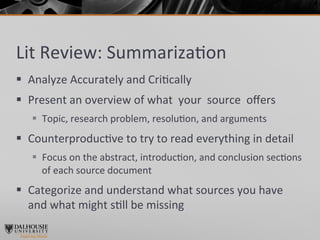
Lit	
  Review:	
  Summariza>on	
  
§  Analyze	
  Accurately	
  and	
  Cri>cally	
  
§  Present	
  an	
  overview	
  of	
  what	
  	
  your	
  	
  source	
  	
  offers	
  
     §  Topic,	
  research	
  problem,	
  resolu>on,	
  and	
  arguments	
  
§  Counterproduc>ve	
  to	
  try	
  to	
  read	
  everything	
  in	
  detail	
  
     §  Focus	
  on	
  the	
  abstract,	
  introduc>on,	
  and	
  conclusion	
  sec>ons	
  	
  
         of	
  each	
  source	
  document	
  	
  
§  Categorize	
  and	
  understand	
  what	
  sources	
  you	
  have	
  
    and	
  what	
  might	
  s>ll	
  be	
  missing	
  
REFERENCING	
  
Cita>ons	
  
§  Common	
  Styles	
  in	
  Engineering	
  Include:	
  
    §  APA	
  (Author,	
  Year)	
  
    §  h]p://owl.english.purdue.edu/owl/resource/560/01/	
  
    §  IEEE	
  [Footnotes]	
  
    §  h]p://www.ieee.org/documents/ieeecita>onref.pdf	
  

The technical writing process

  • 1.
    THE  TECHNICAL   WRITING  PROCESS   NAVIN  CHARI   DALHOUSIE  WRITING  CENTRE  
  • 2.
    Stages  in  Research   §  Iden>fy  your  topic  of  interest   §  Perform  a  literature  review   §  Generate  related  ques>ons   §  State  your  unsolved  problem  or  hypothesis   §  Find  or  develop  a  solu>on   §  Document  your  results  
  • 3.
    Thesis  Guidelines   §  Abstract   §  Introduc>on  (Objec>ve  &  Mo>va>on)   §  Literature  Review   §  Materials/Methods   §  Results  &  Discussion   §  Conclusions  &  Future  Work   §  References   This  presenta>on  will  focus  on  the  three  sec>ons  in  bold.  
  • 4.
  • 5.
    Abstract:  Mo>va>on   § Why  do  we  care  about  the  Problem  and  the  Results?     §  Importance  of  your  Work   §  Difficulty  of  the  Area   §  Impact  if  Successful   §  Helps  to  make  the  problem  more  interes>ng  
  • 6.
    Abstract:  Problem  Statement   §  What  problem  are  you  trying  to  solve?     §  What  is  the  scope  of  your  work?   §  Generalized  approach,  or  for  a  specific  situa>on   §  Be  careful  not  to  use  too  much  jargon   §  Put  the  problem  statement  before  the  mo>va>on   §  Only  if  audience  understand  the  problem’s  importance  
  • 7.
    Abstract:  Approach   § How  did  you  solve  or  progress  on  the  problem?     §  Did  you  use  simula>on,  analy>c  models,  solid  models,   FEA,  prototype  construc>on,  etc.?   §  What  was  the  extent  of  your  work?   §  What  important  variables  did  you  control,  ignore,  or   measure?  
  • 8.
    Abstract:  Results   § What's  the  answer?     §  percent  faster,  cheaper,  smaller,  or  otherwise  be]er   than  something  else.     §  Put  the  result  there,  in  numbers.     §  Avoid  vague,  hand-­‐waving  results  such  as  "very",   "small",  or  "significant."  
  • 9.
    Abstract:  Conclusions   § What  are  the  implica>ons  of  your  answer?   §  Is  it  going  to  change  the  world     §  Are  your  results  general,  poten>ally  generalizable,  or   specific  to  a  par>cular  case?  
  • 10.
  • 11.
    Lit  Review:  Importance   §  Provides  background  regarding  your  own  research   §  Shows  your  familiarity  with  research  in  your  field   §  Demonstrates  how  your  work  contributes  in  your   field’s  knowledge  base  
  • 12.
    Lit  Review:  Outcomes   §  Recogni>on  of  the  relevant  and  important  research  in   your  field   §  Understanding  this  research,  by  organizing  and   evalua>ng  it   §  Seeing  where  there  is  a  gap  in  the  research  which   your  study  will  a]empt  to  fill  
  • 13.
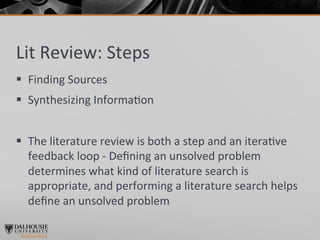
    Lit  Review:  Steps   §  Finding  Sources   §  Synthesizing  Informa>on     §  The  literature  review  is  both  a  step  and  an  itera>ve   feedback  loop  -­‐  Defining  an  unsolved  problem   determines  what  kind  of  literature  search  is   appropriate,  and  performing  a  literature  search  helps   define  an  unsolved  problem    
  • 14.
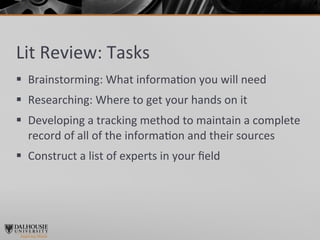
    Lit  Review:  Tasks   §  Brainstorming:  What  informa>on  you  will  need   §  Researching:  Where  to  get  your  hands  on  it   §  Developing  a  tracking  method  to  maintain  a  complete   record  of  all  of  the  informa>on  and  their  sources   §  Construct  a  list  of  experts  in  your  field  
  • 15.
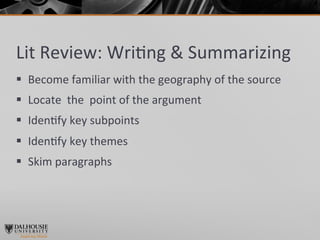
    Lit  Review:  Wri>ng  &  Summarizing   §  Become  familiar  with  the  geography  of  the  source   §  Locate    the    point  of  the  argument   §  Iden>fy  key  subpoints   §  Iden>fy  key  themes   §  Skim  paragraphs  
  • 16.
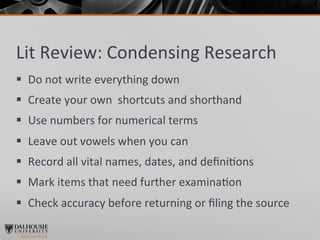
    Lit  Review:  Condensing  Research   §  Do  not  write  everything  down   §  Create  your  own    shortcuts  and  shorthand   §  Use  numbers  for  numerical  terms   §  Leave  out  vowels  when  you  can   §  Record  all  vital  names,  dates,  and  defini>ons   §  Mark  items  that  need  further  examina>on   §  Check  accuracy  before  returning  or  filing  the  source  
  • 17.
    Lit  Review:  Summariza>on   §  Analyze  Accurately  and  Cri>cally   §  Present  an  overview  of  what    your    source    offers   §  Topic,  research  problem,  resolu>on,  and  arguments   §  Counterproduc>ve  to  try  to  read  everything  in  detail   §  Focus  on  the  abstract,  introduc>on,  and  conclusion  sec>ons     of  each  source  document     §  Categorize  and  understand  what  sources  you  have   and  what  might  s>ll  be  missing  
  • 18.
  • 19.
    Cita>ons   §  Common  Styles  in  Engineering  Include:   §  APA  (Author,  Year)   §  h]p://owl.english.purdue.edu/owl/resource/560/01/   §  IEEE  [Footnotes]   §  h]p://www.ieee.org/documents/ieeecita>onref.pdf  

Editor's Notes

  • #14 Defining an unsolved problem determines what kind of literature search is appropriate, and performing a literature search helps define an unsolved problem