Writing Technical Papers
Stephen Boyles
June 16, 2017
Why is communication so
important?
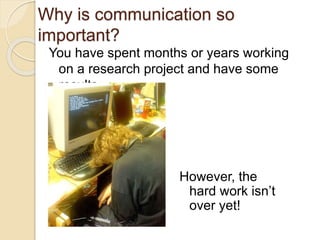
You have spent months or years working
on a research project and have some
results.
However, the
hard work isn’t
over yet!
Why is communication so
important?
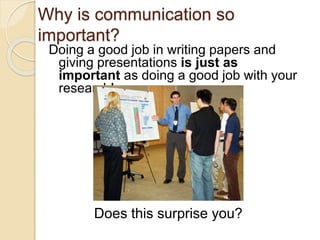
Doing a good job in writing papers and
giving presentations is just as
important as doing a good job with your
research!
Does this surprise you?
Reason #1
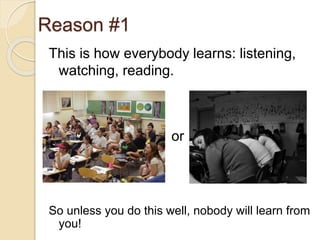
This is how everybody learns: listening,
watching, reading.
So unless you do this well, nobody will learn from
you!
or
Reason #2
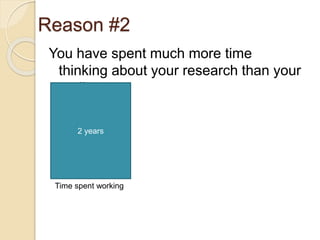
You have spent much more time
thinking about your research than your
audience.
2 years
Time spent working
Reason #2
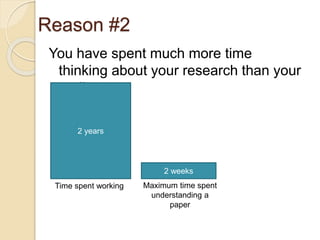
You have spent much more time
thinking about your research than your
audience.
2 years
2 weeks
Time spent working Maximum time spent
understanding a
paper
Reason #2
You have spent much more time
thinking about your research than your
audience.
2 years
2 weeks
15 minutes
Time spent working Maximum time spent
understanding a
paper
Time spent listening
to a conference talk
Reason #2
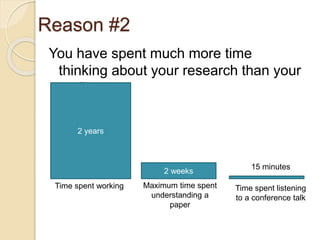
You have spent much more time
thinking about your research than your
audience.
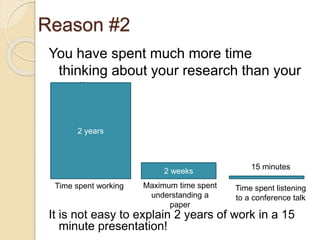
It is not easy to explain 2 years of work in a 15
minute presentation!
2 years
2 weeks
15 minutes
Time spent working Maximum time spent
understanding a
paper
Time spent listening
to a conference talk
Reason #3
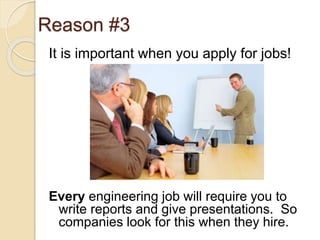
It is important when you apply for jobs!
Every engineering job will require you to
write reports and give presentations. So
companies look for this when they hire.
Reason #3
Furthermore, it is important to have a
reputation for quality research and
writing (not just quantity).
Reason #4
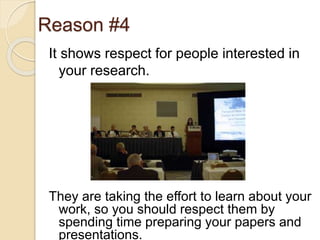
It shows respect for people interested in
your research.
They are taking the effort to learn about your
work, so you should respect them by
spending time preparing your papers and
presentations.
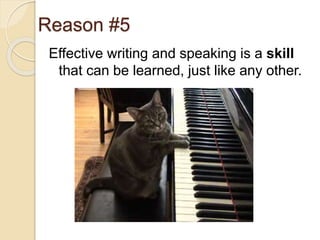
Reason #5
Effective writing and speaking is a skill
that can be learned, just like any other.
Ben Hodges:
“Don’t separate science and writing…. If you
don’t write it down, it isn’t science.
Remember how annoyed you get at
professors who stand in front of the class and
wave their hands about ideas rather than
writing them down on the board?”
Workshop Outline
1. What is the purpose of a paper?
2. Activity: identifying contributions
3. How to write specific sections?
4. Activity: evaluating example papers
5. Scheduling and time management
6. Panel discussion
7. Long-term “assignments”
Writing a Technical Paper
Who will be reading your paper?
 Experienced transportation
researchers
 Researchers in related fields
 Practicing engineers
 Graduate students learning the field
 Politicians or policy-makers
For different journals, there will be a
different “mix” of readers
How to apply this rule
If you are sending a paper to a journal for
the first time, learn about the journal.
 Read some recent papers published
there
 See where the authors work
 How long are the papers? How
detailed are they? How much
mathematics?
Example: Computers and Operations
Research vs. Networks and Spatial
What is the purpose of a paper?
The main purpose of a paper is to
report research findings… but not all
research findings are “publishable.”
What is the purpose of a paper?
The main purpose of a paper is to
report research findings… but not all
research findings are “publishable.”
A publishable contribution should
expand the frontiers of knowledge
(even if just slightly).
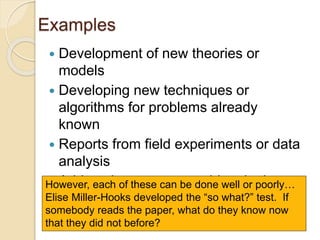
Examples
 Development of new theories or
models
 Developing new techniques or
algorithms for problems already
known
 Reports from field experiments or data
analysis
 Addressing an open problem in the
research literature
However, each of these can be done well or poorly…
Elise Miller-Hooks developed the “so what?” test. If
somebody reads the paper, what do they know now
that they did not before?
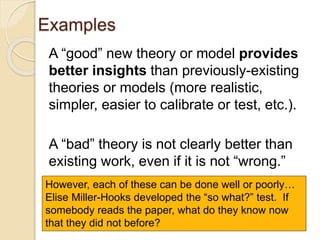
Examples
A “good” new theory or model provides
better insights than previously-existing
theories or models (more realistic,
simpler, easier to calibrate or test, etc.).
A “bad” theory is not clearly better than
existing work, even if it is not “wrong.”
However, each of these can be done well or poorly…
Elise Miller-Hooks developed the “so what?” test. If
somebody reads the paper, what do they know now
that they did not before?
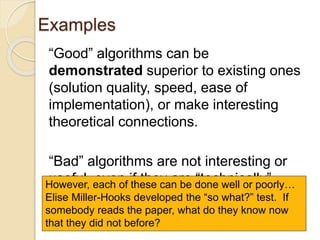
Examples
“Good” algorithms can be
demonstrated superior to existing ones
(solution quality, speed, ease of
implementation), or make interesting
theoretical connections.
“Bad” algorithms are not interesting or
useful, even if they are “technically”
novel.
However, each of these can be done well or poorly…
Elise Miller-Hooks developed the “so what?” test. If
somebody reads the paper, what do they know now
that they did not before?
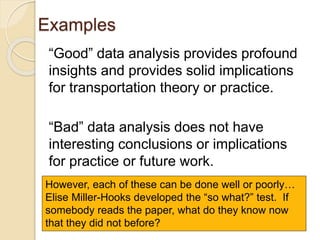
Examples
“Good” data analysis provides profound
insights and provides solid implications
for transportation theory or practice.
“Bad” data analysis does not have
interesting conclusions or implications
for practice or future work.
However, each of these can be done well or poorly…
Elise Miller-Hooks developed the “so what?” test. If
somebody reads the paper, what do they know now
that they did not before?
Miscellanea
Negative results can be useful too,
even if there is sometimes a bias
against them in the reviewing process.
Miscellanea
Your contributions are not simply
what you did. It is how your work
advances the field of transportation,
either from a practical or theoretical
perspective. This is what your paper
will be judged on.
It is possible for your research to be correct, and even
novel, without making a useful contribution!
Miscellanea
You should make every effort to make
the contributions clear to the reader.
Every section of your paper should
make an argument for your
contributions, in different ways.
Activity 1
In groups, take a look at the 3 papers.
Try to identify what the contributions
are, and in what ways the contributions
are strong or weak.
Present findings to rest of group when
done.
Throughout the research process, think about how
you will make the case for your contributions and
present them to readers.
Components of a paper
Warning: Not every paper has the
same sections in the same order. It can
vary by field, by journal, and by the
research topic.
The ultimate goal is to convey results in
a meaningful way. A familiar structure
can help with this, but structure serves
communication, not the other way
around. Once you become
comfortable with a standard structure,
do not be afraid to change it (if you
Abstract
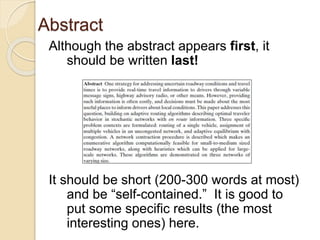
Although the abstract appears first, it
should be written last!
It should be short (200-300 words at most)
and be “self-contained.” It is good to
put some specific results (the most
interesting ones) here.
Introduction
The introduction should accomplish the
following tasks:
1. Say why your research topic is
important.
2. Preview the main contributions.
3. Provide the structure for the rest of
the paper.
The length of an introduction is very different for
different journals – this is why it helps to know the
journal!
Introduction
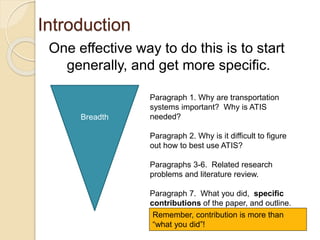
One effective way to do this is to start
generally, and get more specific.
Breadth
Paragraph 1. Why are transportation
systems important? Why is ATIS
needed?
Paragraph 2. Why is it difficult to figure
out how to best use ATIS?
Paragraphs 3-6. Related research
problems and literature review.
Paragraph 7. What you did, specific
contributions of the paper, and outline.
Remember, contribution is more than
“what you did”!
Daganzo style
1. Setting for paper, vague statement of
main goal
2. Justify importance of a specific issue
related to goal
3. Short literature review to establish
goal has not been accomplished yet
4. State how work fills this gap
5. Briefly, how did you do it?
6. Organization of paper
Literature Review
Why do a literature review if most of your
readers are experienced in your field?
 Make your contribution clear by
showing how it relates to other
research.
 Establish credibility by proving that
you know how your research is related
to what others are doing.
 Show respect to the other researchers
who did earlier work in your field – “no
research is done in a vacuum”!
 Help new researchers (such as
graduate students!) who are new to
your topic.
Literature Review
The most common mistake is just to list papers.
 How are the papers related to each other?
 Can the papers be classified in some way?
 Think like a historian (tell a story)
 How does your paper fit in?
 What makes your paper different? (Argue
for your contributions!)
 Write more about the papers which are
more closely related to your research.
Best literature review ever:
Larsson, T. and M. Patriksson. (1994) “Simplicial decomposition with disaggregated
representation for the traffic assignment problem.” Transportation Science 26,
4-17.
Problem Description
Here is where you provide specifics on your
research problem.
 If you use mathematical notation, define it
rigorously but concisely.
 If you use a data set, describe how you
obtained it, what information it contains, any
procedure you used to make the data
useful, etc.
 Think like a storyteller – exposition and
pacing are important! How do novels or
films introduce characters and plot
elements?After reading this section, the reader should know
exactly what research problem you solved.
Results and Analysis
Here you present the main findings! A
common mistake is to repeat
information from tables and
figures rather than providing useful
interpretation.
Use your analysis to provide concrete
support for the main contributions.
How long this part is, and what it contains, depends
heavily on your research topic and on the journal.
Example:
This is bad:
“Table 1 shows that the benefits on the
Barcelona network were 42.7%,
compared to 19.9% on the Chicago
network.”
Anybody can see this!
Example:
This is better:
“Table 1 shows that the benefits are
smaller for large networks.”
This points out a general trend, which is
useful. But it still doesn’t show much
insight.
Example:
This is better still:
“Table 1 shows that the benefits are
smaller for large networks. One
possible reason is that the proportion of
information nodes is lower.”
This offers an explanation, not just
repeating figures which can easily be
read from the table. It provides insight,
and can lead to hypotheses
(investigated either in this paper or as a
topic for future work)
The ideal is to relate the results to the
motivating questions and
contribution. Your results should
reinforce the points you are trying to
make.
Examples:
 If the contribution is a better algorithm,
you need to compare its performance
with the best alternatives.
 If the contribution is a new model that
has a new feature X, show that ignoring
X leads to serious errors
 What would a practitioner be interested
in?
Conclusion
A good conclusion should answer two
questions:
 What were the main findings from
this research?
 How might this research continue in
the future?
Someone should be able to read just the introduction
and conclusion, and understand the main points of your
research.
Activity 2
Take a more detailed read through the
papers (each group now has just 1
paper)
Present to the group what was in the
paper, the strengths and
weaknesses of each section, and
how the contribution is apparent in
different sections.
Writing strategies
Writing is difficult for many people
It’s not a natural skill for many engineers, but
we hold ourselves to high standards.
We recognize it is important, but it is
intimidating.
Often there are no hard deadlines.
You can always do more (both research and
revising).
This is a perfect recipe for
Assorted tips…
 Leave plenty of time for revision
 Have friends and colleagues read
the paper and give comments
 Write an outline first – the more time
you spend planning, the less time
you will need for writing.
 Focus on structure before details
 “Perfection is achieved, not when
there is nothing more to add, but
when there is nothing left to take
away” -- Hemingway
Writing strategies
 “Free writing” – force yourself to write
without stopping; you can always edit
or fill in gaps later.
 “Write drunk, edit sober.”
 Set aside uninterrupted time
 Set up long-term and short-term
schedules and goals.
These tips are all aimed at overcoming
procrastination:
-Outlining and structuring allow you to make progress in
small, non-intimidating ways, and then break down the
writing task into small, non-intimidating pieces.
-Free-writing forces you to overcome the need for
perfection the first time through.
-Asking friends and colleagues to review can force
deadlines on you (make them hold you accountable!)
To-do list
Every morning, make a list of everything
you need or want to get done; work
down the list.
Advantage: Simple
Disadvantage: Tends to focus on short-term needs
rather than long-term goals
ABC-123
A fancier to-do list. Mark each item as
either A, B, or C.
 A = urgent; has to be done today.
(important enough that you should work late to finish it)
 B = want to do today, but OK if you
don’t
(not important enough to stay late to finish)
 C = would like to do, but not urgent
(not important enough to stay late to finish)
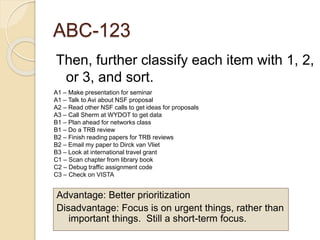
ABC-123
Then, further classify each item with 1, 2,
or 3, and sort.
Advantage: Better prioritization
Disadvantage: Focus is on urgent things, rather than
important things. Still a short-term focus.
A1 – Make presentation for seminar
A1 – Talk to Avi about NSF proposal
A2 – Read other NSF calls to get ideas for proposals
A3 – Call Sherm at WYDOT to get data
B1 – Plan ahead for networks class
B1 – Do a TRB review
B2 – Finish reading papers for TRB reviews
B2 – Email my paper to Dirck van Vliet
B3 – Look at international travel grant
C1 – Scan chapter from library book
C2 – Debug traffic assignment code
C3 – Check on VISTA
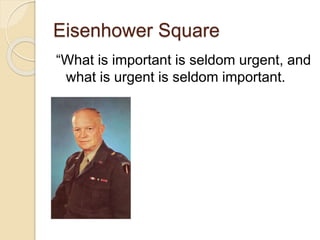
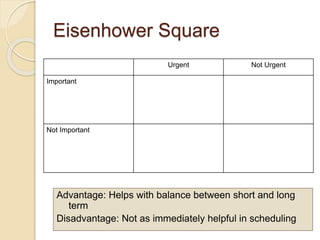
Eisenhower Square
“What is important is seldom urgent, and
what is urgent is seldom important.
Eisenhower Square
Urgent Not Urgent
Important
Not Important
Advantage: Helps with balance between short and long
term
Disadvantage: Not as immediately helpful in scheduling
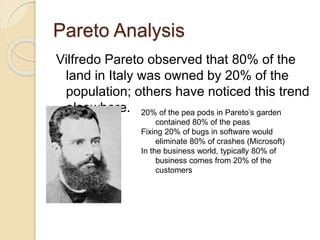
Pareto Analysis
Vilfredo Pareto observed that 80% of the
land in Italy was owned by 20% of the
population; others have noticed this trend
elsewhere. 20% of the pea pods in Pareto’s garden
contained 80% of the peas
Fixing 20% of bugs in software would
eliminate 80% of crashes (Microsoft)
In the business world, typically 80% of
business comes from 20% of the
customers
Pareto Analysis
Workplace studies have shown
 80% of tasks can be completed in 20% of your time; the remaining
20% of tasks require 80% of your time
 80% of your productivity can be accomplished by 20% of your tasks
Therefore, the tasks requiring less of your time should be done
first to maximize your productivity
Advantage: Emphasizes productivity
Disadvantage: Does not address long-term goals
Continuing Improvement…
Learning to manage time effectively is a
process of continuing improvement
Long-term commitment to improvement is better than
short bursts of organization and giving up when it
doesn’t work perfectly. Find what works for you, and
do not be afraid to experiment.
Closing thoughts…
 “Perfection is achieved, not when
there is nothing more to add, but
when there is nothing left to take
away” – Hemingway
 Different writers all have different
advice.
 Be prepared for peer review: we are
not all used to blunt feedback.
 Despite all this, writing should be
enjoyable – this is what makes your
work ultimately meaningful. The best
idea is useless if nobody knows
Electronic handouts include:
 “Suggestions and guidelines for good
writing” (Chandra Bhat)
 “Paper-writing: a guide for
transportation students” (Carlos
Daganzo)
 “Pet peeves, bêtes noires, and just
plain bad writing in journal papers,
theses and dissertations” (Ben Hodges)
 “Ten simple rules for mathematical
writing” (Dimitri Bertsekas)
 “Mathematical writing” (Don Knuth et
al.)
Panel discussion
Long-term goals
Form paper-writing groups:
1. Should include people working on
different topics
2. Serves as “internal” peer-review
3. Sets internal deadlines. Example:
June 23 – introduction and lit review
June 30 – numerical results done
July 5 – very rough first draft
July 10 – polished draft
Don’t be afraid to seek out feedback from
other people too. Ideally…
Someone from a completely different area
of transportation can judge whether your
contribution makes sense (broadly) and
that it is clearly described.
Someone from a similar area of
transportation can judge the contribution
in more details, and whether your results
support your claims.
Someone from your same lab can judge
the technical details.
Don’t be afraid to be harsh in internal
peer-reviews. It is better to hear this
from friends in the writing/revision
process than months later from journal
reviewers!

Writing Technical Papers

  • 1.
  • 2.
    Why is communicationso important? You have spent months or years working on a research project and have some results. However, the hard work isn’t over yet!
  • 3.
    Why is communicationso important? Doing a good job in writing papers and giving presentations is just as important as doing a good job with your research! Does this surprise you?
  • 4.
    Reason #1 This ishow everybody learns: listening, watching, reading. So unless you do this well, nobody will learn from you! or
  • 5.
    Reason #2 You havespent much more time thinking about your research than your audience. 2 years Time spent working
  • 6.
    Reason #2 You havespent much more time thinking about your research than your audience. 2 years 2 weeks Time spent working Maximum time spent understanding a paper
  • 7.
    Reason #2 You havespent much more time thinking about your research than your audience. 2 years 2 weeks 15 minutes Time spent working Maximum time spent understanding a paper Time spent listening to a conference talk
  • 8.
    Reason #2 You havespent much more time thinking about your research than your audience. It is not easy to explain 2 years of work in a 15 minute presentation! 2 years 2 weeks 15 minutes Time spent working Maximum time spent understanding a paper Time spent listening to a conference talk
  • 9.
    Reason #3 It isimportant when you apply for jobs! Every engineering job will require you to write reports and give presentations. So companies look for this when they hire.
  • 10.
    Reason #3 Furthermore, itis important to have a reputation for quality research and writing (not just quantity).
  • 11.
    Reason #4 It showsrespect for people interested in your research. They are taking the effort to learn about your work, so you should respect them by spending time preparing your papers and presentations.
  • 12.
    Reason #5 Effective writingand speaking is a skill that can be learned, just like any other.
  • 13.
    Ben Hodges: “Don’t separatescience and writing…. If you don’t write it down, it isn’t science. Remember how annoyed you get at professors who stand in front of the class and wave their hands about ideas rather than writing them down on the board?”
  • 14.
    Workshop Outline 1. Whatis the purpose of a paper? 2. Activity: identifying contributions 3. How to write specific sections? 4. Activity: evaluating example papers 5. Scheduling and time management 6. Panel discussion 7. Long-term “assignments”
  • 15.
  • 16.
    Who will bereading your paper?  Experienced transportation researchers  Researchers in related fields  Practicing engineers  Graduate students learning the field  Politicians or policy-makers For different journals, there will be a different “mix” of readers
  • 17.
    How to applythis rule If you are sending a paper to a journal for the first time, learn about the journal.  Read some recent papers published there  See where the authors work  How long are the papers? How detailed are they? How much mathematics? Example: Computers and Operations Research vs. Networks and Spatial
  • 18.
    What is thepurpose of a paper? The main purpose of a paper is to report research findings… but not all research findings are “publishable.”
  • 19.
    What is thepurpose of a paper? The main purpose of a paper is to report research findings… but not all research findings are “publishable.” A publishable contribution should expand the frontiers of knowledge (even if just slightly).
  • 20.
    Examples  Development ofnew theories or models  Developing new techniques or algorithms for problems already known  Reports from field experiments or data analysis  Addressing an open problem in the research literature However, each of these can be done well or poorly… Elise Miller-Hooks developed the “so what?” test. If somebody reads the paper, what do they know now that they did not before?
  • 21.
    Examples A “good” newtheory or model provides better insights than previously-existing theories or models (more realistic, simpler, easier to calibrate or test, etc.). A “bad” theory is not clearly better than existing work, even if it is not “wrong.” However, each of these can be done well or poorly… Elise Miller-Hooks developed the “so what?” test. If somebody reads the paper, what do they know now that they did not before?
  • 22.
    Examples “Good” algorithms canbe demonstrated superior to existing ones (solution quality, speed, ease of implementation), or make interesting theoretical connections. “Bad” algorithms are not interesting or useful, even if they are “technically” novel. However, each of these can be done well or poorly… Elise Miller-Hooks developed the “so what?” test. If somebody reads the paper, what do they know now that they did not before?
  • 23.
    Examples “Good” data analysisprovides profound insights and provides solid implications for transportation theory or practice. “Bad” data analysis does not have interesting conclusions or implications for practice or future work. However, each of these can be done well or poorly… Elise Miller-Hooks developed the “so what?” test. If somebody reads the paper, what do they know now that they did not before?
  • 24.
    Miscellanea Negative results canbe useful too, even if there is sometimes a bias against them in the reviewing process.
  • 25.
    Miscellanea Your contributions arenot simply what you did. It is how your work advances the field of transportation, either from a practical or theoretical perspective. This is what your paper will be judged on. It is possible for your research to be correct, and even novel, without making a useful contribution!
  • 26.
    Miscellanea You should makeevery effort to make the contributions clear to the reader. Every section of your paper should make an argument for your contributions, in different ways.
  • 27.
    Activity 1 In groups,take a look at the 3 papers. Try to identify what the contributions are, and in what ways the contributions are strong or weak. Present findings to rest of group when done. Throughout the research process, think about how you will make the case for your contributions and present them to readers.
  • 28.
  • 29.
    Warning: Not everypaper has the same sections in the same order. It can vary by field, by journal, and by the research topic. The ultimate goal is to convey results in a meaningful way. A familiar structure can help with this, but structure serves communication, not the other way around. Once you become comfortable with a standard structure, do not be afraid to change it (if you
  • 30.
    Abstract Although the abstractappears first, it should be written last! It should be short (200-300 words at most) and be “self-contained.” It is good to put some specific results (the most interesting ones) here.
  • 31.
    Introduction The introduction shouldaccomplish the following tasks: 1. Say why your research topic is important. 2. Preview the main contributions. 3. Provide the structure for the rest of the paper. The length of an introduction is very different for different journals – this is why it helps to know the journal!
  • 32.
    Introduction One effective wayto do this is to start generally, and get more specific. Breadth Paragraph 1. Why are transportation systems important? Why is ATIS needed? Paragraph 2. Why is it difficult to figure out how to best use ATIS? Paragraphs 3-6. Related research problems and literature review. Paragraph 7. What you did, specific contributions of the paper, and outline. Remember, contribution is more than “what you did”!
  • 33.
    Daganzo style 1. Settingfor paper, vague statement of main goal 2. Justify importance of a specific issue related to goal 3. Short literature review to establish goal has not been accomplished yet 4. State how work fills this gap 5. Briefly, how did you do it? 6. Organization of paper
  • 34.
    Literature Review Why doa literature review if most of your readers are experienced in your field?  Make your contribution clear by showing how it relates to other research.  Establish credibility by proving that you know how your research is related to what others are doing.  Show respect to the other researchers who did earlier work in your field – “no research is done in a vacuum”!  Help new researchers (such as graduate students!) who are new to your topic.
  • 35.
    Literature Review The mostcommon mistake is just to list papers.  How are the papers related to each other?  Can the papers be classified in some way?  Think like a historian (tell a story)  How does your paper fit in?  What makes your paper different? (Argue for your contributions!)  Write more about the papers which are more closely related to your research. Best literature review ever: Larsson, T. and M. Patriksson. (1994) “Simplicial decomposition with disaggregated representation for the traffic assignment problem.” Transportation Science 26, 4-17.
  • 36.
    Problem Description Here iswhere you provide specifics on your research problem.  If you use mathematical notation, define it rigorously but concisely.  If you use a data set, describe how you obtained it, what information it contains, any procedure you used to make the data useful, etc.  Think like a storyteller – exposition and pacing are important! How do novels or films introduce characters and plot elements?After reading this section, the reader should know exactly what research problem you solved.
  • 37.
    Results and Analysis Hereyou present the main findings! A common mistake is to repeat information from tables and figures rather than providing useful interpretation. Use your analysis to provide concrete support for the main contributions. How long this part is, and what it contains, depends heavily on your research topic and on the journal.
  • 38.
    Example: This is bad: “Table1 shows that the benefits on the Barcelona network were 42.7%, compared to 19.9% on the Chicago network.” Anybody can see this!
  • 39.
    Example: This is better: “Table1 shows that the benefits are smaller for large networks.” This points out a general trend, which is useful. But it still doesn’t show much insight.
  • 40.
    Example: This is betterstill: “Table 1 shows that the benefits are smaller for large networks. One possible reason is that the proportion of information nodes is lower.” This offers an explanation, not just repeating figures which can easily be read from the table. It provides insight, and can lead to hypotheses (investigated either in this paper or as a topic for future work)
  • 41.
    The ideal isto relate the results to the motivating questions and contribution. Your results should reinforce the points you are trying to make. Examples:  If the contribution is a better algorithm, you need to compare its performance with the best alternatives.  If the contribution is a new model that has a new feature X, show that ignoring X leads to serious errors  What would a practitioner be interested in?
  • 42.
    Conclusion A good conclusionshould answer two questions:  What were the main findings from this research?  How might this research continue in the future? Someone should be able to read just the introduction and conclusion, and understand the main points of your research.
  • 43.
    Activity 2 Take amore detailed read through the papers (each group now has just 1 paper) Present to the group what was in the paper, the strengths and weaknesses of each section, and how the contribution is apparent in different sections.
  • 44.
  • 45.
    Writing is difficultfor many people It’s not a natural skill for many engineers, but we hold ourselves to high standards. We recognize it is important, but it is intimidating. Often there are no hard deadlines. You can always do more (both research and revising). This is a perfect recipe for
  • 46.
    Assorted tips…  Leaveplenty of time for revision  Have friends and colleagues read the paper and give comments  Write an outline first – the more time you spend planning, the less time you will need for writing.  Focus on structure before details  “Perfection is achieved, not when there is nothing more to add, but when there is nothing left to take away” -- Hemingway
  • 47.
    Writing strategies  “Freewriting” – force yourself to write without stopping; you can always edit or fill in gaps later.  “Write drunk, edit sober.”  Set aside uninterrupted time  Set up long-term and short-term schedules and goals.
  • 48.
    These tips areall aimed at overcoming procrastination: -Outlining and structuring allow you to make progress in small, non-intimidating ways, and then break down the writing task into small, non-intimidating pieces. -Free-writing forces you to overcome the need for perfection the first time through. -Asking friends and colleagues to review can force deadlines on you (make them hold you accountable!)
  • 49.
    To-do list Every morning,make a list of everything you need or want to get done; work down the list. Advantage: Simple Disadvantage: Tends to focus on short-term needs rather than long-term goals
  • 50.
    ABC-123 A fancier to-dolist. Mark each item as either A, B, or C.  A = urgent; has to be done today. (important enough that you should work late to finish it)  B = want to do today, but OK if you don’t (not important enough to stay late to finish)  C = would like to do, but not urgent (not important enough to stay late to finish)
  • 51.
    ABC-123 Then, further classifyeach item with 1, 2, or 3, and sort. Advantage: Better prioritization Disadvantage: Focus is on urgent things, rather than important things. Still a short-term focus. A1 – Make presentation for seminar A1 – Talk to Avi about NSF proposal A2 – Read other NSF calls to get ideas for proposals A3 – Call Sherm at WYDOT to get data B1 – Plan ahead for networks class B1 – Do a TRB review B2 – Finish reading papers for TRB reviews B2 – Email my paper to Dirck van Vliet B3 – Look at international travel grant C1 – Scan chapter from library book C2 – Debug traffic assignment code C3 – Check on VISTA
  • 52.
    Eisenhower Square “What isimportant is seldom urgent, and what is urgent is seldom important.
  • 53.
    Eisenhower Square Urgent NotUrgent Important Not Important Advantage: Helps with balance between short and long term Disadvantage: Not as immediately helpful in scheduling
  • 54.
    Pareto Analysis Vilfredo Paretoobserved that 80% of the land in Italy was owned by 20% of the population; others have noticed this trend elsewhere. 20% of the pea pods in Pareto’s garden contained 80% of the peas Fixing 20% of bugs in software would eliminate 80% of crashes (Microsoft) In the business world, typically 80% of business comes from 20% of the customers
  • 55.
    Pareto Analysis Workplace studieshave shown  80% of tasks can be completed in 20% of your time; the remaining 20% of tasks require 80% of your time  80% of your productivity can be accomplished by 20% of your tasks Therefore, the tasks requiring less of your time should be done first to maximize your productivity Advantage: Emphasizes productivity Disadvantage: Does not address long-term goals
  • 56.
    Continuing Improvement… Learning tomanage time effectively is a process of continuing improvement Long-term commitment to improvement is better than short bursts of organization and giving up when it doesn’t work perfectly. Find what works for you, and do not be afraid to experiment.
  • 57.
    Closing thoughts…  “Perfectionis achieved, not when there is nothing more to add, but when there is nothing left to take away” – Hemingway  Different writers all have different advice.  Be prepared for peer review: we are not all used to blunt feedback.  Despite all this, writing should be enjoyable – this is what makes your work ultimately meaningful. The best idea is useless if nobody knows
  • 58.
    Electronic handouts include: “Suggestions and guidelines for good writing” (Chandra Bhat)  “Paper-writing: a guide for transportation students” (Carlos Daganzo)  “Pet peeves, bêtes noires, and just plain bad writing in journal papers, theses and dissertations” (Ben Hodges)  “Ten simple rules for mathematical writing” (Dimitri Bertsekas)  “Mathematical writing” (Don Knuth et al.)
  • 59.
  • 60.
    Long-term goals Form paper-writinggroups: 1. Should include people working on different topics 2. Serves as “internal” peer-review 3. Sets internal deadlines. Example: June 23 – introduction and lit review June 30 – numerical results done July 5 – very rough first draft July 10 – polished draft
  • 61.
    Don’t be afraidto seek out feedback from other people too. Ideally… Someone from a completely different area of transportation can judge whether your contribution makes sense (broadly) and that it is clearly described. Someone from a similar area of transportation can judge the contribution in more details, and whether your results support your claims. Someone from your same lab can judge the technical details.
  • 62.
    Don’t be afraidto be harsh in internal peer-reviews. It is better to hear this from friends in the writing/revision process than months later from journal reviewers!