WRITING THE
RESEARCH METHODOLOGY
You are expected to:
1.Write the research methodology;
2.Utilize materials and techniques to produce
creative work;
3.Present the research
proposal orally.
Writing the Research Methodology
 This part discusses the steps
and procedures that you will use in
conducting your research.
 This includes explaining the type of
research technique you will adopt in the
study, how you will get the data for the
study, whom or where you will get the
data from, and how you will analyse
the data that you will gather.
 Usually, this is the chapter 3,
the last section of the
research proposal.
Methodology
 Methodology is an essential chapter
in any research undertaking.
 This contains sets of instruments and
procedures in dealing with the research
problems.
Components of the section on research
methods
1. Research Design
 This section describes the specific
research approach you will use in the
study.
 This can be ethnography, case study,
historical, phenomenological, and
the like.
 The research design is dependent
on the purpose of the study and the
set of specific research questions you
have formulated.
2. Research Locale
 This section describes the setting or
location of your study.
 The specific description of the setting
is very important in a qualitative
research.
3. Sample or the Respondents
 This section describes the
respondents of the study.
 The description may include the
demographic profile of the respondents
such as age, educational background,
occupation, and other information.
4. Research Instruments
 This section outlines the
instruments you will use in the
study such as interview questions,
observation guide, survey form, focus
group discussion questions, and
others.
5. Data Collection Procedure
 This section describes the specific
steps you will undergo in order to
collect the data for your study.
 In some types of research, particularly
ethnographic and case studies, the
specific date (and sometime, exact
time) of doing the steps
(i.e., observingthe participants)
are important. The instruments used
to record data (i.e., pen and paper, audio
and/or video recorder) may also be
mentioned.
6. Data Analysis Procedure
 This section describes how you will
analyze the data that you will gather.
Research Proposal
Research Proposal
It presents the first three chapters
of the research:
 Problem and Its Background,
 Review of Related Literature, and
 Methodology.
Three Chapters
Chapter 1
 The Problem and Its Background
 This chapter presents the problem of
your study.
 You can also find here the significance,
scope and delimitation, and some
terms that need to be defined in
your study.
Chapter 2
 Review of Related Literature
 This chapter discusses the literature
and studies related to your present
study which forms the theoretical and
conceptual basis of your research.
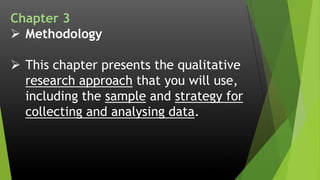
Chapter 3
 Methodology
 This chapter presents the qualitative
research approach that you will use,
including the sample and strategy for
collecting and analysing data.
Format
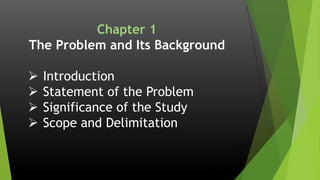
Chapter 1
The Problem and Its Background
 Introduction
 Statement of the Problem
 Significance of the Study
 Scope and Delimitation
Chapter 2
Review of Related Literature
Chapter 3
Methodology
 Research Design
Oral Presentation of the Proposal
Guidelines
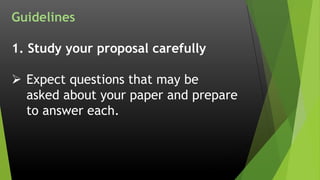
1. Study your proposal carefully
 Expect questions that may be
asked about your paper and prepare
to answer each.
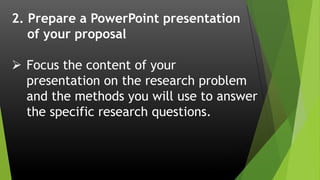
2. Prepare a PowerPoint presentation
of your proposal
 Focus the content of your
presentation on the research problem
and the methods you will use to answer
the specific research questions.
3. The allotted time for the
presentation of the proposal is
10 to 15 minutes to give more time
for questions. Thus, summarize your
proposal in a few slides.
4. Consider the comments and
feedbacks as suggestions to improve
your study.
5. Be confident. The defence is not
meant to “grill” you but to help you
improve and finalize the direction of
your research study.
6. Follow the dress code.

Practical Research 1_12_Writing the Research Methodology.pptx

  • 1.
  • 2.
    You are expectedto: 1.Write the research methodology; 2.Utilize materials and techniques to produce creative work; 3.Present the research proposal orally.
  • 3.
    Writing the ResearchMethodology  This part discusses the steps and procedures that you will use in conducting your research.  This includes explaining the type of research technique you will adopt in the study, how you will get the data for the study, whom or where you will get the data from, and how you will analyse the data that you will gather.
  • 4.
     Usually, thisis the chapter 3, the last section of the research proposal.
  • 5.
    Methodology  Methodology isan essential chapter in any research undertaking.  This contains sets of instruments and procedures in dealing with the research problems.
  • 6.
    Components of thesection on research methods 1. Research Design  This section describes the specific research approach you will use in the study.  This can be ethnography, case study, historical, phenomenological, and the like.
  • 7.
     The researchdesign is dependent on the purpose of the study and the set of specific research questions you have formulated. 2. Research Locale  This section describes the setting or location of your study.  The specific description of the setting is very important in a qualitative research.
  • 8.
    3. Sample orthe Respondents  This section describes the respondents of the study.  The description may include the demographic profile of the respondents such as age, educational background, occupation, and other information.
  • 9.
    4. Research Instruments This section outlines the instruments you will use in the study such as interview questions, observation guide, survey form, focus group discussion questions, and others.
  • 10.
    5. Data CollectionProcedure  This section describes the specific steps you will undergo in order to collect the data for your study.  In some types of research, particularly ethnographic and case studies, the specific date (and sometime, exact time) of doing the steps
  • 11.
    (i.e., observingthe participants) areimportant. The instruments used to record data (i.e., pen and paper, audio and/or video recorder) may also be mentioned. 6. Data Analysis Procedure  This section describes how you will analyze the data that you will gather.
  • 12.
  • 13.
    Research Proposal It presentsthe first three chapters of the research:  Problem and Its Background,  Review of Related Literature, and  Methodology.
  • 14.
  • 15.
    Chapter 1  TheProblem and Its Background  This chapter presents the problem of your study.  You can also find here the significance, scope and delimitation, and some terms that need to be defined in your study.
  • 16.
    Chapter 2  Reviewof Related Literature  This chapter discusses the literature and studies related to your present study which forms the theoretical and conceptual basis of your research.
  • 17.
    Chapter 3  Methodology This chapter presents the qualitative research approach that you will use, including the sample and strategy for collecting and analysing data.
  • 18.
  • 19.
    Chapter 1 The Problemand Its Background  Introduction  Statement of the Problem  Significance of the Study  Scope and Delimitation
  • 20.
    Chapter 2 Review ofRelated Literature
  • 21.
  • 22.
  • 23.
    Guidelines 1. Study yourproposal carefully  Expect questions that may be asked about your paper and prepare to answer each.
  • 24.
    2. Prepare aPowerPoint presentation of your proposal  Focus the content of your presentation on the research problem and the methods you will use to answer the specific research questions.
  • 25.
    3. The allottedtime for the presentation of the proposal is 10 to 15 minutes to give more time for questions. Thus, summarize your proposal in a few slides. 4. Consider the comments and feedbacks as suggestions to improve your study.
  • 26.
    5. Be confident.The defence is not meant to “grill” you but to help you improve and finalize the direction of your research study. 6. Follow the dress code.