Technical Report Writing
and Presentation
(MNE 312)
(Lesson 2)
STEPS OF WRITING PROCESS
 The writing process involves a series of steps
that guide a writer from the initial idea to the
final draft
 Understanding and following these steps can
help produce clear, well-organized, and
polished documents
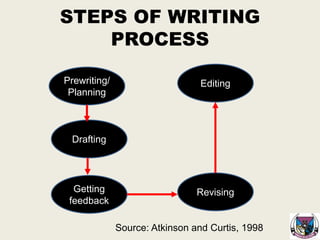
STEPS OF WRITING
PROCESS
Prewriting/
Planning
Drafting
Editing
Revising
Getting
feedback
Source: Atkinson and Curtis, 1998
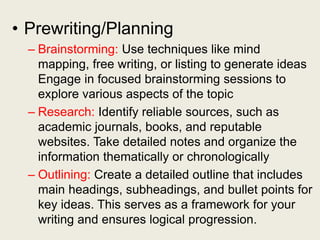
• Prewriting/Planning
– Brainstorming: Use techniques like mind
mapping, free writing, or listing to generate ideas
Engage in focused brainstorming sessions to
explore various aspects of the topic
– Research: Identify reliable sources, such as
academic journals, books, and reputable
websites. Take detailed notes and organize the
information thematically or chronologically
– Outlining: Create a detailed outline that includes
main headings, subheadings, and bullet points for
key ideas. This serves as a framework for your
writing and ensures logical progression.
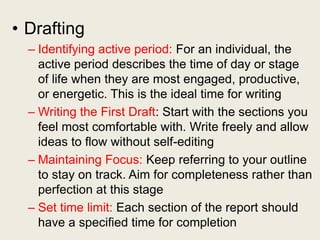
• Drafting
– Identifying active period: For an individual, the
active period describes the time of day or stage
of life when they are most engaged, productive,
or energetic. This is the ideal time for writing
– Writing the First Draft: Start with the sections you
feel most comfortable with. Write freely and allow
ideas to flow without self-editing
– Maintaining Focus: Keep referring to your outline
to stay on track. Aim for completeness rather than
perfection at this stage
– Set time limit: Each section of the report should
have a specified time for completion
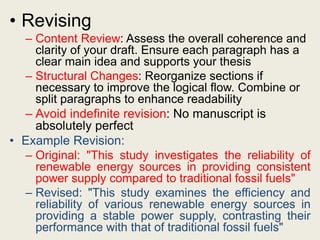
• Revising
– Content Review: Assess the overall coherence and
clarity of your draft. Ensure each paragraph has a
clear main idea and supports your thesis
– Structural Changes: Reorganize sections if
necessary to improve the logical flow. Combine or
split paragraphs to enhance readability
– Avoid indefinite revision: No manuscript is
absolutely perfect
• Example Revision:
– Original: "This study investigates the reliability of
renewable energy sources in providing consistent
power supply compared to traditional fossil fuels"
– Revised: "This study examines the efficiency and
reliability of various renewable energy sources in
providing a stable power supply, contrasting their
performance with that of traditional fossil fuels"
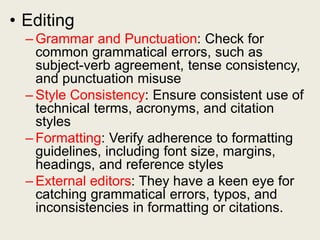
• Editing
– Grammar and Punctuation: Check for
common grammatical errors, such as
subject-verb agreement, tense consistency,
and punctuation misuse
– Style Consistency: Ensure consistent use of
technical terms, acronyms, and citation
styles
– Formatting: Verify adherence to formatting
guidelines, including font size, margins,
headings, and reference styles
– External editors: They have a keen eye for
catching grammatical errors, typos, and
inconsistencies in formatting or citations.
• Publishing
– Final Formatting: Ensure the document is
formatted according to specific guidelines, such
as APA, MLA, or Chicago style
– Final Review: Conduct a thorough review to
catch any remaining errors or inconsistencies
• Example:
Ensure the title page includes the title, author name,
institution, and date
Format references according to the required style
guide
Include necessary sections like acknowledgments,
appendices, or glossary if applicable
Common Mistakes Across the Writing
Process and How to Avoid Them
Skipping Steps:
Mistake: Skipping prewriting or revising stages.
Solution: Follow each step diligently to ensure a thorough
and polished final product
Rushing:
Mistake: Rushing through stages, particularly editing and
proofreading.
Solution: Allocate sufficient time for each stage and take
breaks to maintain focus
Ignoring Feedback:
Mistake: Failing to seek or incorporate feedback.
Solution: Actively seek feedback from peers, mentors, or
instructors and thoughtfully incorporate their suggestions
Common Mistakes Across the Writing
Process and How to Avoid Them
Inconsistent Style and Formatting:
Mistake: Inconsistent use of terminology, citation
styles, and formatting
Solution: Create a style guide for your document and
adhere to it consistently
Neglecting the Audience:
Mistake: Writing without considering the target
audience
Solution: Tailor the content, language, and style to suit
the knowledge level and expectations of your
audience
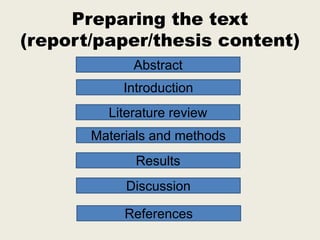
Preparing the text
(report/paper/thesis content)
Abstract
Introduction
Materials and methods
Results
Discussion
References
Literature review
How to write the Introduction
• The introduction is a critical part of a
technical report or research paper
• It sets the stage for the reader by providing
context, stating the research problem,
outlining the objectives, and summarizing
the structure of the paper
• A well-crafted introduction engages readers
and provides a clear understanding of the
purpose and significance of the study
Purpose of the Introduction
• Provide Context: Offer background information
that helps readers understand the research
topic
• State the Research Problem: Clearly articulate
the problem or question the research addresses
• Highlight the Importance: Explain the
significance of the research and its potential
impact
• Outline Objectives: State the specific objectives
or hypotheses of the study
• Preview the Structure: Provide a brief overview
of the structure of the paper or report
Structure of the Introduction
• General Background: Introduce the broad topic and provide
relevant background information
– Example: "The use of renewable energy sources has been
increasing worldwide due to concerns about climate change
and energy security."
• Research Problem: Clearly state the research problem or
question
– Example: "Despite the growth in renewable energy, there are
still significant challenges related to energy storage and grid
integration."
• Significance of the Study: Explain why the research is important
– Example: "Addressing these challenges is crucial for the
successful transition to sustainable energy systems and for
meeting international climate goals
• Research Objectives: Outline the main objectives or hypotheses
– Example: "This study aims to evaluate the efficiency of
different energy storage technologies and their integration into
the power grid."
Structure of the Introduction
• Methodology: Describing the methods to be used and
reasons for the choice of the methods
– Example: Comparative analysis of various storage
technologies through simulations and real-world data
collection
• Results/Findings: Announcing the principal
findings/results
– Example: The results reveal the most efficient energy storage
solutions and provide insights on optimal integration strategies
for enhancing grid reliability and performance
• Overview of the Paper: Provide a brief overview of the
structure of the paper
– Example: "The paper is structured as follows: Section 2
reviews the relevant literature, Section 3 describes the
methodology, Section 4 presents the results, and Section
5 discusses the findings and concludes the study."
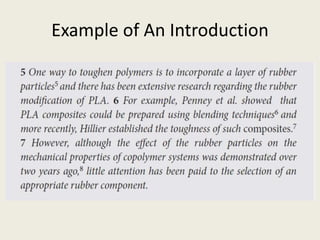
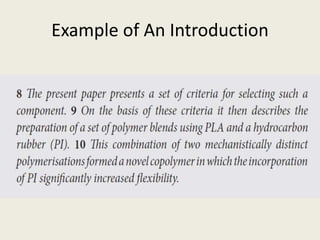
Example of An Introduction
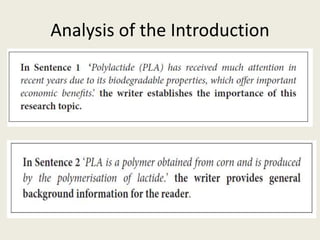
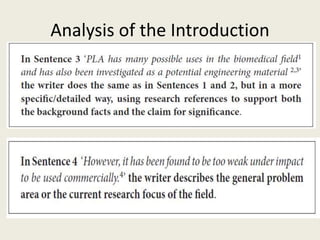
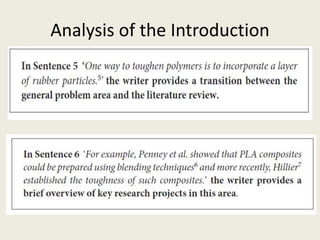
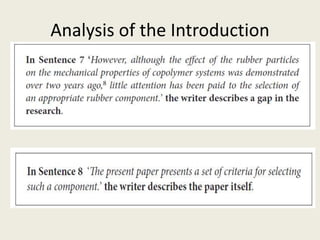
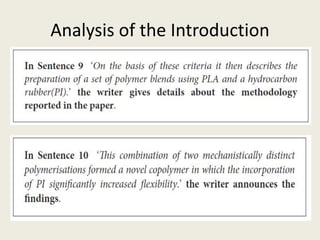
Analysis of the Introduction
Another Example of Introduction
• General Background:
Renewable energy sources, such as wind and solar power,
have become increasingly critical in the fight against climate
change. As global energy demand rises, integrating these
sustainable sources into the existing power grid poses
significant challenges
• Research Problem:
One of the major challenges is the efficient storage and
distribution of energy from intermittent renewable sources.
Current energy storage technologies often fall short in terms of
capacity and reliability
• Significance of the Study:
Improving energy storage solutions is essential for maximizing
the use of renewable energy and reducing dependence on fossil
fuels. This study's findings could contribute to more stable and
efficient energy systems, supporting global sustainability goals
Another Example of Introduction Cont.
• Research Objectives:
This study aims to evaluate the efficiency and
reliability of various energy storage technologies,
specifically comparing lithium-ion batteries and
supercapacitors in storing solar energy
• Overview of the Paper:
The paper is structured as follows: Section 2
reviews the relevant literature on energy storage
technologies, Section 3 describes the
methodology used in this study, Section 4
presents the results of the comparative analysis,
and Section 5 discusses the findings and
concludes the study
• How to write the Literature
review
Purpose: To contextualize the research –
previous research or background theory for
the research
Contents:
 Relationship between the research/study and
previous research in the area
 Key issues which underlie the study; previous
major findings on the area, by whom and
when
 Review of the finding: agreement or otherwise
Steps for writing Literature Review
• Understanding the Purpose:
–Define the specific objectives and scope of
your literature review
–Identify the significance of your research
topic within the broader academic context.
–Recognize the role of a literature review in
establishing the foundation for your
research
Steps for writing Literature Review
• Conducting a Comprehensive Search:
–Utilize academic databases, scholarly
journals, and reputable online repositories
–Use a combination of relevant keywords and
search strings to refine your search
–Consider inclusion and exclusion criteria to
ensure the relevance and quality of selected
literature
Steps for writing Literature Review
• Evaluating and Analyzing Literature:
–Critically assess the credibility and reliability
of sources
–Compare and contrast different
perspectives and methodologies within the
literature
–Identify key themes, trends, and gaps in
existing research
Steps for writing Literature Review
• Organizing and Synthesizing Findings:
–Create a coherent structure for your
literature review, based on identified themes
and subtopics
–Develop a conceptual framework that
outlines the relationship between different
studies and concepts
–Provide a clear and logical flow of
information, highlighting the progression of
ideas and arguments
Steps for writing Literature Review
• Integrating and Interpreting Information:
–Demonstrate an in-depth understanding of
the selected literature and its implications for
your research
–Analyze how various studies contribute to the
development of your research questions and
hypotheses
–Offer insightful interpretations and
explanations, emphasizing the relevance of
existing literature to the research
Steps for writing Literature Review
• Writing and Formatting:
–Follow the prescribed formatting style,
adhering to the guidelines provided by your
academic institution
–Maintain a formal and objective tone,
emphasizing clarity and coherence in your
writing
–Use appropriate citation and referencing to
acknowledge the contributions of other
scholars
Steps for writing Literature Review
• Revising and Editing:
–Review the literature review for clarity,
accuracy, and consistency of information
–Seek feedback from peers, mentors, or
academic advisors to improve the quality of
your review
–Revise and edit the content to ensure a
concise, well-structured, and coherent
narrative
Literature Catalogue
• A literature catalogue is essentially a
meticulously organized collection of research
materials relevant to a specific topic
• It is a foundational step in conducting a
comprehensive literature review to:
– Efficiently manage,
– Analyse, and
– Synthesize information
Key Components of a Literature Catalogue
• Bibliographic Information: Complete citation details
for each source (author, title, publication date,
journal/book, etc.)
• Keywords: Relevant keywords or descriptors for easy
searching and categorization
• Summary: A brief overview of the source's main
arguments or findings
• Evaluation: Critical assessment of the source's
strengths, weaknesses, methodology, and contribution
to the field
• Categorization: Grouping sources based on themes,
research questions, or other relevant criteria
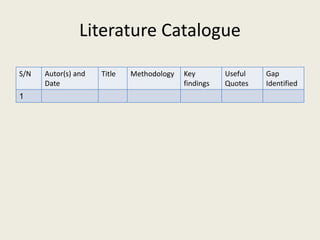
Literature Catalogue
S/N Autor(s) and
Date
Title Methodology Key
findings
Useful
Quotes
Gap
Identified
1
• How to write Materials and
Methods
Purpose: To describe experimental procedure and
give enough detail such that it can be reproduced by
any competent researcher.
Tenses:
• Present simple passive (e.g. is placed in the
furnace) - for standard procedure or to describe
standard piece of equipment used
• Past simple passive (was collected) – for what you
did.
Example: Sample for soil analysis were collected using the
method described by ISRM (2015) which uses….
• Materials and Methods contd…
Content:
• General introduction and overview of the
materials and methods and source(s) of the
materials/equipment used. e.g. In this study, the
rock samples were collected….
• Essential background information - description of
instruments, equipment or locations. e.g. The
mirrors are positioned near the focal plane
• Specific and precise details about material and
methods (i.e. quantities, temperatures, duration,
sequence etc). e.g. the model was calibrated
using convergence measurement from the mine
• Materials and Methods contd…
Content:
• Justification for the materials, methods and
equipment used e.g. The method enables….; the
advantage of using FLAC 3D for the analysis….
• Appropriate care that was taken during the
experiment e.g. The samples were sealed and
carefully transported to….
• Relationship between the method/material and
other studies e.g. The method is similar to ….or
exactly……or significantly different….
• Identification of problems or limitation e.g. …the
variations among the samples was negligible
How to write Results or Data analysis
Purpose: Presentation of the results
Tenses: Past tense
Contents:
• Revisiting the research aim/existing research e.g.
As mentioned earlier…..; In earlier studies…; The
main purpose of this work…
• General overview of results – explaining the
general pattern or trend of the results e.g. In most
cases…; It is apparent that both…; It is evident..
• Invitation to view results e.g. The stress data in
Fig. 1 indicate…; Fig.3 illustrates the findings..;
The overall….are reported in Fig. 6; Comparing
Figs. 1 and 4 shows that….
Results or Data analysis contd…
Contents:
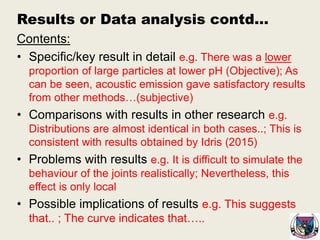
• Specific/key result in detail e.g. There was a lower
proportion of large particles at lower pH (Objective); As
can be seen, acoustic emission gave satisfactory results
from other methods…(subjective)
• Comparisons with results in other research e.g.
Distributions are almost identical in both cases..; This is
consistent with results obtained by Idris (2015)
• Problems with results e.g. It is difficult to simulate the
behaviour of the joints realistically; Nevertheless, this
effect is only local
• Possible implications of results e.g. This suggests
that.. ; The curve indicates that…..
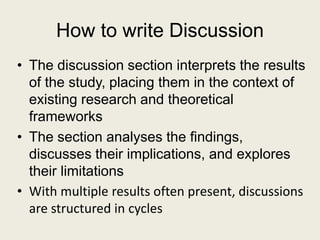
How to write Discussion
• The discussion section interprets the results
of the study, placing them in the context of
existing research and theoretical
frameworks
• The section analyses the findings,
discusses their implications, and explores
their limitations
• With multiple results often present, discussions
are structured in cycles
How to write Discussion
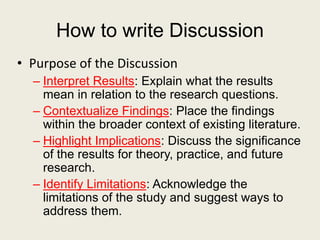
• Purpose of the Discussion
– Interpret Results: Explain what the results
mean in relation to the research questions.
– Contextualize Findings: Place the findings
within the broader context of existing literature.
– Highlight Implications: Discuss the significance
of the results for theory, practice, and future
research.
– Identify Limitations: Acknowledge the
limitations of the study and suggest ways to
address them.
How to write Discussion
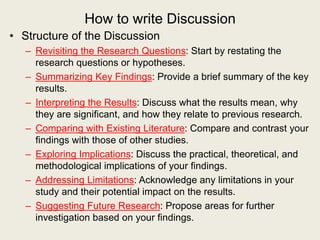
• Structure of the Discussion
– Revisiting the Research Questions: Start by restating the
research questions or hypotheses.
– Summarizing Key Findings: Provide a brief summary of the key
results.
– Interpreting the Results: Discuss what the results mean, why
they are significant, and how they relate to previous research.
– Comparing with Existing Literature: Compare and contrast your
findings with those of other studies.
– Exploring Implications: Discuss the practical, theoretical, and
methodological implications of your findings.
– Addressing Limitations: Acknowledge any limitations in your
study and their potential impact on the results.
– Suggesting Future Research: Propose areas for further
investigation based on your findings.
How to write Conclusion
• The conclusion section succinctly summarizes
the research findings and their implications
• It provides closure by revisiting the main points
of the paper and suggesting broader
implications and future directions
How to write Conclusion
• Purpose of the Conclusion
– Summarize Findings: Provide a concise
summary of the main findings
– Highlight Significance: Emphasize the
importance and impact of the research
– Suggest Future Research: Propose future
research directions
– Provide Closure: Offer a concluding perspective
on the study
How to write Conclusion
• Purpose of the Conclusion
– Summarize Findings: Provide a concise
summary of the main findings
– Highlight Significance: Emphasize the
importance and impact of the research
– Suggest Future Research: Propose future
research directions
– Provide Closure: Offer a concluding perspective
on the study
How to write Conclusion
• Structure of the Conclusion
– Restating the Main Findings: Summarize the key
results and their implications
• "In conclusion, this study found that [summary of
findings]."
– Discussing the Study's Contributions: Highlight the
contributions of the study to the field
• "This research contributes to the field by [contributions]."
– Suggesting Future Research: Propose areas for
further investigation
• "Further research is needed to [future research
directions]."
– Final Thoughts: Provide concluding remarks that
encapsulate the essence of the study
• "Overall, this study provides [final thoughts]."
Example of Discussion
Discussion
This study aimed to investigate the relationship between
X and Y. The results indicate a significant positive
correlation between X and Y, suggesting that as X
increases, Y also increases. These findings align with the
work of Smith et al. (2020), who found a similar
relationship in a different context. However, our study
extends these findings by demonstrating that this
relationship holds true in a broader population. One
limitation of our study is the reliance on self-reported
data, which may introduce bias. Future research should
consider using more objective measures to validate these
findings.
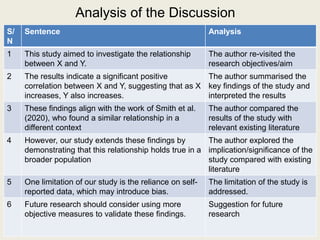
Analysis of the Discussion
S/
N
Sentence Analysis
1 This study aimed to investigate the relationship
between X and Y.
The author re-visited the
research objectives/aim
2 The results indicate a significant positive
correlation between X and Y, suggesting that as X
increases, Y also increases.
The author summarised the
key findings of the study and
interpreted the results
3 These findings align with the work of Smith et al.
(2020), who found a similar relationship in a
different context
The author compared the
results of the study with
relevant existing literature
4 However, our study extends these findings by
demonstrating that this relationship holds true in a
broader population
The author explored the
implication/significance of the
study compared with existing
literature
5 One limitation of our study is the reliance on self-
reported data, which may introduce bias.
The limitation of the study is
addressed.
6 Future research should consider using more
objective measures to validate these findings.
Suggestion for future
research
Example of Conclusion
Conclusion
In conclusion, this study provides evidence of a
positive correlation between X and Y. These
findings contribute to our understanding of [field]
and suggest practical applications for [specific
area]. Future research should explore this
relationship further, particularly in diverse
populations and using different methodologies.
Overall, this research enhances our knowledge
and provides a foundation for further investigation.
Analysis of the Conclusion
S/N Sentence Analysis
1 In conclusion, this study provides
evidence of a positive correlation between
X and Y.
The author again stated the
main finding of the study
2 These findings contribute to our
understanding of [field] and suggest
practical applications for [specific area].
The author discussed again
the contribution of the study
3 Future research should explore this
relationship further, particularly in diverse
populations and using different
methodologies.
The author suggested the
area for future research
based on the finding of the
study
4 Overall, this research enhances our
knowledge and provides a foundation for
further investigation.
The author gave the final
thought.
How to prepare the abstract
• An abstract is a brief summary of a
research report, article, thesis, or other
document
• It provides readers with a quick overview of
the study, including its objectives, methods,
results, and conclusions
• Crafting a well-structured abstract is
essential as it often determines whether a
reader will delve into the full document
• Purpose of an Abstract
Overview: It offers a snapshot of the main points
of the research
Guidance: It helps readers decide whether the full
document is relevant to their interests
Indexing: It aids in the indexing and retrieval of
the document in databases
• Types of Abstracts
Descriptive Abstracts: Briefly describe the
contents of the paper without detailing results or
conclusions. Typically 50-100 words
Informative Abstracts: Provide a more detailed
summary, including results and conclusions.
Typically 150-250 words
Structure of an Abstract
A well-structured abstract typically includes
the following components:
Background/Context: Briefly introduce the
research topic and its significance
Objectives: State the main goals or objectives of
the study
Methods: Summarize the methods used in the
research
Results: Present the key findings of the study.
Conclusions: Highlight the main conclusions
and implications of the research
Steps to Write an Effective Abstract
 Write the Paper First: Ensure the paper is
complete before drafting the abstract. This
ensures all key points are included.
 Identify Key Components: Extract the main
elements from each section of the paper:
introduction, methods, results, and discussion.
 Draft Concisely: Write a first draft without worrying
about length. Focus on clarity and conciseness.
 Revise for Clarity: Refine the draft to eliminate
unnecessary words and ensure readability. Aim for
a coherent and logical flow of information.
 Check Guidelines: Adhere to any specific
formatting or length guidelines provided by your
institution or publication.
Example of an Abstract
Title: Probabilistic Approaches to Estimating Variation
in the Mechanical Properties of Rock Masses
Abstract:
The probabilistic method of estimating mechanical
characteristics of a rock mass is discussed based on
Monte-Carlo simulation. The study aims to analyze the
inherent variability of rock mass properties using
extreme value statistics. Data from laboratory and field
tests were utilized for the simulations. Results indicate
that the mechanical properties follow the third type
asymptotic distribution of the smallest values. The
findings suggest that the proposed approach provides
a viable means of assessing variability in rock mass
properties, offering significant implications for
geotechnical engineering and risk assessment
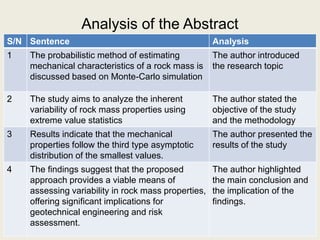
Analysis of the Abstract
S/N Sentence Analysis
1 The probabilistic method of estimating
mechanical characteristics of a rock mass is
discussed based on Monte-Carlo simulation
The author introduced
the research topic
2 The study aims to analyze the inherent
variability of rock mass properties using
extreme value statistics
The author stated the
objective of the study
and the methodology
3 Results indicate that the mechanical
properties follow the third type asymptotic
distribution of the smallest values.
The author presented the
results of the study
4 The findings suggest that the proposed
approach provides a viable means of
assessing variability in rock mass properties,
offering significant implications for
geotechnical engineering and risk
assessment.
The author highlighted
the main conclusion and
the implication of the
findings.

Technical Report Writing_Lesson_255.pptx

  • 1.
    Technical Report Writing andPresentation (MNE 312) (Lesson 2)
  • 2.
    STEPS OF WRITINGPROCESS  The writing process involves a series of steps that guide a writer from the initial idea to the final draft  Understanding and following these steps can help produce clear, well-organized, and polished documents
  • 3.
  • 4.
    • Prewriting/Planning – Brainstorming:Use techniques like mind mapping, free writing, or listing to generate ideas Engage in focused brainstorming sessions to explore various aspects of the topic – Research: Identify reliable sources, such as academic journals, books, and reputable websites. Take detailed notes and organize the information thematically or chronologically – Outlining: Create a detailed outline that includes main headings, subheadings, and bullet points for key ideas. This serves as a framework for your writing and ensures logical progression.
  • 5.
    • Drafting – Identifyingactive period: For an individual, the active period describes the time of day or stage of life when they are most engaged, productive, or energetic. This is the ideal time for writing – Writing the First Draft: Start with the sections you feel most comfortable with. Write freely and allow ideas to flow without self-editing – Maintaining Focus: Keep referring to your outline to stay on track. Aim for completeness rather than perfection at this stage – Set time limit: Each section of the report should have a specified time for completion
  • 6.
    • Revising – ContentReview: Assess the overall coherence and clarity of your draft. Ensure each paragraph has a clear main idea and supports your thesis – Structural Changes: Reorganize sections if necessary to improve the logical flow. Combine or split paragraphs to enhance readability – Avoid indefinite revision: No manuscript is absolutely perfect • Example Revision: – Original: "This study investigates the reliability of renewable energy sources in providing consistent power supply compared to traditional fossil fuels" – Revised: "This study examines the efficiency and reliability of various renewable energy sources in providing a stable power supply, contrasting their performance with that of traditional fossil fuels"
  • 7.
    • Editing – Grammarand Punctuation: Check for common grammatical errors, such as subject-verb agreement, tense consistency, and punctuation misuse – Style Consistency: Ensure consistent use of technical terms, acronyms, and citation styles – Formatting: Verify adherence to formatting guidelines, including font size, margins, headings, and reference styles – External editors: They have a keen eye for catching grammatical errors, typos, and inconsistencies in formatting or citations.
  • 8.
    • Publishing – FinalFormatting: Ensure the document is formatted according to specific guidelines, such as APA, MLA, or Chicago style – Final Review: Conduct a thorough review to catch any remaining errors or inconsistencies • Example: Ensure the title page includes the title, author name, institution, and date Format references according to the required style guide Include necessary sections like acknowledgments, appendices, or glossary if applicable
  • 9.
    Common Mistakes Acrossthe Writing Process and How to Avoid Them Skipping Steps: Mistake: Skipping prewriting or revising stages. Solution: Follow each step diligently to ensure a thorough and polished final product Rushing: Mistake: Rushing through stages, particularly editing and proofreading. Solution: Allocate sufficient time for each stage and take breaks to maintain focus Ignoring Feedback: Mistake: Failing to seek or incorporate feedback. Solution: Actively seek feedback from peers, mentors, or instructors and thoughtfully incorporate their suggestions
  • 10.
    Common Mistakes Acrossthe Writing Process and How to Avoid Them Inconsistent Style and Formatting: Mistake: Inconsistent use of terminology, citation styles, and formatting Solution: Create a style guide for your document and adhere to it consistently Neglecting the Audience: Mistake: Writing without considering the target audience Solution: Tailor the content, language, and style to suit the knowledge level and expectations of your audience
  • 11.
    Preparing the text (report/paper/thesiscontent) Abstract Introduction Materials and methods Results Discussion References Literature review
  • 12.
    How to writethe Introduction • The introduction is a critical part of a technical report or research paper • It sets the stage for the reader by providing context, stating the research problem, outlining the objectives, and summarizing the structure of the paper • A well-crafted introduction engages readers and provides a clear understanding of the purpose and significance of the study
  • 13.
    Purpose of theIntroduction • Provide Context: Offer background information that helps readers understand the research topic • State the Research Problem: Clearly articulate the problem or question the research addresses • Highlight the Importance: Explain the significance of the research and its potential impact • Outline Objectives: State the specific objectives or hypotheses of the study • Preview the Structure: Provide a brief overview of the structure of the paper or report
  • 14.
    Structure of theIntroduction • General Background: Introduce the broad topic and provide relevant background information – Example: "The use of renewable energy sources has been increasing worldwide due to concerns about climate change and energy security." • Research Problem: Clearly state the research problem or question – Example: "Despite the growth in renewable energy, there are still significant challenges related to energy storage and grid integration." • Significance of the Study: Explain why the research is important – Example: "Addressing these challenges is crucial for the successful transition to sustainable energy systems and for meeting international climate goals • Research Objectives: Outline the main objectives or hypotheses – Example: "This study aims to evaluate the efficiency of different energy storage technologies and their integration into the power grid."
  • 15.
    Structure of theIntroduction • Methodology: Describing the methods to be used and reasons for the choice of the methods – Example: Comparative analysis of various storage technologies through simulations and real-world data collection • Results/Findings: Announcing the principal findings/results – Example: The results reveal the most efficient energy storage solutions and provide insights on optimal integration strategies for enhancing grid reliability and performance • Overview of the Paper: Provide a brief overview of the structure of the paper – Example: "The paper is structured as follows: Section 2 reviews the relevant literature, Section 3 describes the methodology, Section 4 presents the results, and Section 5 discusses the findings and concludes the study."
  • 16.
    Example of AnIntroduction
  • 17.
    Example of AnIntroduction
  • 18.
    Example of AnIntroduction
  • 19.
    Analysis of theIntroduction
  • 20.
    Analysis of theIntroduction
  • 21.
    Analysis of theIntroduction
  • 22.
    Analysis of theIntroduction
  • 23.
    Analysis of theIntroduction
  • 24.
    Analysis of theIntroduction
  • 25.
    Another Example ofIntroduction • General Background: Renewable energy sources, such as wind and solar power, have become increasingly critical in the fight against climate change. As global energy demand rises, integrating these sustainable sources into the existing power grid poses significant challenges • Research Problem: One of the major challenges is the efficient storage and distribution of energy from intermittent renewable sources. Current energy storage technologies often fall short in terms of capacity and reliability • Significance of the Study: Improving energy storage solutions is essential for maximizing the use of renewable energy and reducing dependence on fossil fuels. This study's findings could contribute to more stable and efficient energy systems, supporting global sustainability goals
  • 26.
    Another Example ofIntroduction Cont. • Research Objectives: This study aims to evaluate the efficiency and reliability of various energy storage technologies, specifically comparing lithium-ion batteries and supercapacitors in storing solar energy • Overview of the Paper: The paper is structured as follows: Section 2 reviews the relevant literature on energy storage technologies, Section 3 describes the methodology used in this study, Section 4 presents the results of the comparative analysis, and Section 5 discusses the findings and concludes the study
  • 27.
    • How towrite the Literature review Purpose: To contextualize the research – previous research or background theory for the research Contents:  Relationship between the research/study and previous research in the area  Key issues which underlie the study; previous major findings on the area, by whom and when  Review of the finding: agreement or otherwise
  • 28.
    Steps for writingLiterature Review • Understanding the Purpose: –Define the specific objectives and scope of your literature review –Identify the significance of your research topic within the broader academic context. –Recognize the role of a literature review in establishing the foundation for your research
  • 29.
    Steps for writingLiterature Review • Conducting a Comprehensive Search: –Utilize academic databases, scholarly journals, and reputable online repositories –Use a combination of relevant keywords and search strings to refine your search –Consider inclusion and exclusion criteria to ensure the relevance and quality of selected literature
  • 30.
    Steps for writingLiterature Review • Evaluating and Analyzing Literature: –Critically assess the credibility and reliability of sources –Compare and contrast different perspectives and methodologies within the literature –Identify key themes, trends, and gaps in existing research
  • 31.
    Steps for writingLiterature Review • Organizing and Synthesizing Findings: –Create a coherent structure for your literature review, based on identified themes and subtopics –Develop a conceptual framework that outlines the relationship between different studies and concepts –Provide a clear and logical flow of information, highlighting the progression of ideas and arguments
  • 32.
    Steps for writingLiterature Review • Integrating and Interpreting Information: –Demonstrate an in-depth understanding of the selected literature and its implications for your research –Analyze how various studies contribute to the development of your research questions and hypotheses –Offer insightful interpretations and explanations, emphasizing the relevance of existing literature to the research
  • 33.
    Steps for writingLiterature Review • Writing and Formatting: –Follow the prescribed formatting style, adhering to the guidelines provided by your academic institution –Maintain a formal and objective tone, emphasizing clarity and coherence in your writing –Use appropriate citation and referencing to acknowledge the contributions of other scholars
  • 34.
    Steps for writingLiterature Review • Revising and Editing: –Review the literature review for clarity, accuracy, and consistency of information –Seek feedback from peers, mentors, or academic advisors to improve the quality of your review –Revise and edit the content to ensure a concise, well-structured, and coherent narrative
  • 35.
    Literature Catalogue • Aliterature catalogue is essentially a meticulously organized collection of research materials relevant to a specific topic • It is a foundational step in conducting a comprehensive literature review to: – Efficiently manage, – Analyse, and – Synthesize information
  • 36.
    Key Components ofa Literature Catalogue • Bibliographic Information: Complete citation details for each source (author, title, publication date, journal/book, etc.) • Keywords: Relevant keywords or descriptors for easy searching and categorization • Summary: A brief overview of the source's main arguments or findings • Evaluation: Critical assessment of the source's strengths, weaknesses, methodology, and contribution to the field • Categorization: Grouping sources based on themes, research questions, or other relevant criteria
  • 37.
    Literature Catalogue S/N Autor(s)and Date Title Methodology Key findings Useful Quotes Gap Identified 1
  • 38.
    • How towrite Materials and Methods Purpose: To describe experimental procedure and give enough detail such that it can be reproduced by any competent researcher. Tenses: • Present simple passive (e.g. is placed in the furnace) - for standard procedure or to describe standard piece of equipment used • Past simple passive (was collected) – for what you did. Example: Sample for soil analysis were collected using the method described by ISRM (2015) which uses….
  • 39.
    • Materials andMethods contd… Content: • General introduction and overview of the materials and methods and source(s) of the materials/equipment used. e.g. In this study, the rock samples were collected…. • Essential background information - description of instruments, equipment or locations. e.g. The mirrors are positioned near the focal plane • Specific and precise details about material and methods (i.e. quantities, temperatures, duration, sequence etc). e.g. the model was calibrated using convergence measurement from the mine
  • 40.
    • Materials andMethods contd… Content: • Justification for the materials, methods and equipment used e.g. The method enables….; the advantage of using FLAC 3D for the analysis…. • Appropriate care that was taken during the experiment e.g. The samples were sealed and carefully transported to…. • Relationship between the method/material and other studies e.g. The method is similar to ….or exactly……or significantly different…. • Identification of problems or limitation e.g. …the variations among the samples was negligible
  • 41.
    How to writeResults or Data analysis Purpose: Presentation of the results Tenses: Past tense Contents: • Revisiting the research aim/existing research e.g. As mentioned earlier…..; In earlier studies…; The main purpose of this work… • General overview of results – explaining the general pattern or trend of the results e.g. In most cases…; It is apparent that both…; It is evident.. • Invitation to view results e.g. The stress data in Fig. 1 indicate…; Fig.3 illustrates the findings..; The overall….are reported in Fig. 6; Comparing Figs. 1 and 4 shows that….
  • 42.
    Results or Dataanalysis contd… Contents: • Specific/key result in detail e.g. There was a lower proportion of large particles at lower pH (Objective); As can be seen, acoustic emission gave satisfactory results from other methods…(subjective) • Comparisons with results in other research e.g. Distributions are almost identical in both cases..; This is consistent with results obtained by Idris (2015) • Problems with results e.g. It is difficult to simulate the behaviour of the joints realistically; Nevertheless, this effect is only local • Possible implications of results e.g. This suggests that.. ; The curve indicates that…..
  • 43.
    How to writeDiscussion • The discussion section interprets the results of the study, placing them in the context of existing research and theoretical frameworks • The section analyses the findings, discusses their implications, and explores their limitations • With multiple results often present, discussions are structured in cycles
  • 44.
    How to writeDiscussion • Purpose of the Discussion – Interpret Results: Explain what the results mean in relation to the research questions. – Contextualize Findings: Place the findings within the broader context of existing literature. – Highlight Implications: Discuss the significance of the results for theory, practice, and future research. – Identify Limitations: Acknowledge the limitations of the study and suggest ways to address them.
  • 45.
    How to writeDiscussion • Structure of the Discussion – Revisiting the Research Questions: Start by restating the research questions or hypotheses. – Summarizing Key Findings: Provide a brief summary of the key results. – Interpreting the Results: Discuss what the results mean, why they are significant, and how they relate to previous research. – Comparing with Existing Literature: Compare and contrast your findings with those of other studies. – Exploring Implications: Discuss the practical, theoretical, and methodological implications of your findings. – Addressing Limitations: Acknowledge any limitations in your study and their potential impact on the results. – Suggesting Future Research: Propose areas for further investigation based on your findings.
  • 46.
    How to writeConclusion • The conclusion section succinctly summarizes the research findings and their implications • It provides closure by revisiting the main points of the paper and suggesting broader implications and future directions
  • 47.
    How to writeConclusion • Purpose of the Conclusion – Summarize Findings: Provide a concise summary of the main findings – Highlight Significance: Emphasize the importance and impact of the research – Suggest Future Research: Propose future research directions – Provide Closure: Offer a concluding perspective on the study
  • 48.
    How to writeConclusion • Purpose of the Conclusion – Summarize Findings: Provide a concise summary of the main findings – Highlight Significance: Emphasize the importance and impact of the research – Suggest Future Research: Propose future research directions – Provide Closure: Offer a concluding perspective on the study
  • 49.
    How to writeConclusion • Structure of the Conclusion – Restating the Main Findings: Summarize the key results and their implications • "In conclusion, this study found that [summary of findings]." – Discussing the Study's Contributions: Highlight the contributions of the study to the field • "This research contributes to the field by [contributions]." – Suggesting Future Research: Propose areas for further investigation • "Further research is needed to [future research directions]." – Final Thoughts: Provide concluding remarks that encapsulate the essence of the study • "Overall, this study provides [final thoughts]."
  • 50.
    Example of Discussion Discussion Thisstudy aimed to investigate the relationship between X and Y. The results indicate a significant positive correlation between X and Y, suggesting that as X increases, Y also increases. These findings align with the work of Smith et al. (2020), who found a similar relationship in a different context. However, our study extends these findings by demonstrating that this relationship holds true in a broader population. One limitation of our study is the reliance on self-reported data, which may introduce bias. Future research should consider using more objective measures to validate these findings.
  • 51.
    Analysis of theDiscussion S/ N Sentence Analysis 1 This study aimed to investigate the relationship between X and Y. The author re-visited the research objectives/aim 2 The results indicate a significant positive correlation between X and Y, suggesting that as X increases, Y also increases. The author summarised the key findings of the study and interpreted the results 3 These findings align with the work of Smith et al. (2020), who found a similar relationship in a different context The author compared the results of the study with relevant existing literature 4 However, our study extends these findings by demonstrating that this relationship holds true in a broader population The author explored the implication/significance of the study compared with existing literature 5 One limitation of our study is the reliance on self- reported data, which may introduce bias. The limitation of the study is addressed. 6 Future research should consider using more objective measures to validate these findings. Suggestion for future research
  • 52.
    Example of Conclusion Conclusion Inconclusion, this study provides evidence of a positive correlation between X and Y. These findings contribute to our understanding of [field] and suggest practical applications for [specific area]. Future research should explore this relationship further, particularly in diverse populations and using different methodologies. Overall, this research enhances our knowledge and provides a foundation for further investigation.
  • 53.
    Analysis of theConclusion S/N Sentence Analysis 1 In conclusion, this study provides evidence of a positive correlation between X and Y. The author again stated the main finding of the study 2 These findings contribute to our understanding of [field] and suggest practical applications for [specific area]. The author discussed again the contribution of the study 3 Future research should explore this relationship further, particularly in diverse populations and using different methodologies. The author suggested the area for future research based on the finding of the study 4 Overall, this research enhances our knowledge and provides a foundation for further investigation. The author gave the final thought.
  • 54.
    How to preparethe abstract • An abstract is a brief summary of a research report, article, thesis, or other document • It provides readers with a quick overview of the study, including its objectives, methods, results, and conclusions • Crafting a well-structured abstract is essential as it often determines whether a reader will delve into the full document
  • 55.
    • Purpose ofan Abstract Overview: It offers a snapshot of the main points of the research Guidance: It helps readers decide whether the full document is relevant to their interests Indexing: It aids in the indexing and retrieval of the document in databases • Types of Abstracts Descriptive Abstracts: Briefly describe the contents of the paper without detailing results or conclusions. Typically 50-100 words Informative Abstracts: Provide a more detailed summary, including results and conclusions. Typically 150-250 words
  • 56.
    Structure of anAbstract A well-structured abstract typically includes the following components: Background/Context: Briefly introduce the research topic and its significance Objectives: State the main goals or objectives of the study Methods: Summarize the methods used in the research Results: Present the key findings of the study. Conclusions: Highlight the main conclusions and implications of the research
  • 57.
    Steps to Writean Effective Abstract  Write the Paper First: Ensure the paper is complete before drafting the abstract. This ensures all key points are included.  Identify Key Components: Extract the main elements from each section of the paper: introduction, methods, results, and discussion.  Draft Concisely: Write a first draft without worrying about length. Focus on clarity and conciseness.  Revise for Clarity: Refine the draft to eliminate unnecessary words and ensure readability. Aim for a coherent and logical flow of information.  Check Guidelines: Adhere to any specific formatting or length guidelines provided by your institution or publication.
  • 58.
    Example of anAbstract Title: Probabilistic Approaches to Estimating Variation in the Mechanical Properties of Rock Masses Abstract: The probabilistic method of estimating mechanical characteristics of a rock mass is discussed based on Monte-Carlo simulation. The study aims to analyze the inherent variability of rock mass properties using extreme value statistics. Data from laboratory and field tests were utilized for the simulations. Results indicate that the mechanical properties follow the third type asymptotic distribution of the smallest values. The findings suggest that the proposed approach provides a viable means of assessing variability in rock mass properties, offering significant implications for geotechnical engineering and risk assessment
  • 59.
    Analysis of theAbstract S/N Sentence Analysis 1 The probabilistic method of estimating mechanical characteristics of a rock mass is discussed based on Monte-Carlo simulation The author introduced the research topic 2 The study aims to analyze the inherent variability of rock mass properties using extreme value statistics The author stated the objective of the study and the methodology 3 Results indicate that the mechanical properties follow the third type asymptotic distribution of the smallest values. The author presented the results of the study 4 The findings suggest that the proposed approach provides a viable means of assessing variability in rock mass properties, offering significant implications for geotechnical engineering and risk assessment. The author highlighted the main conclusion and the implication of the findings.