Kimberly Gilles
Technical Communications BS310
Dr. Janice Spangenburg
   Technical writing is the presentation of information that helps
    the reader to solve a particular problem.
   Technical writing is used in proposals, manuals, web pages,
    lab reports, newsletters, and many other kinds of professional
    documents.
   Technical writing is used to communicate information to
    management, employees, and other businesses.
   Technical writing can be considered the conduit between
    people who know technology and those who use it.


                                               Kimberly Gilles
                                               Technical Communications BS310
                                               Dr. Janice Spangenburg
   Technical writing requires transparency of expression
    and therefore a straightforward use of language.
   Technical writing requires the recognition of the overall
    goal prior to beginning a document.
   Writers must have knowledge of the intended audience.
   Documents must include certain key concepts so the
    information can be easily understood by the intended
    readers.
   Technical writing is solution based.


                                           Kimberly Gilles
                                           Technical Communications BS310
                                           Dr. Janice Spangenburg
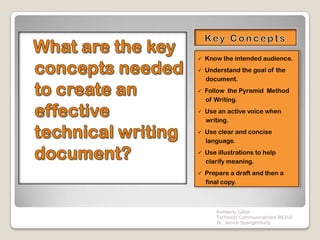
   Know the intended audience.
   Understand the goal of the
    document.
   Follow the Pyramid Method
    of Writing.
   Use an active voice when
    writing.
   Use clear and concise
    language.
   Use illustrations to help
    clarify meaning.
   Prepare a draft and then a
    final copy.


        Kimberly Gilles
        Technical Communications BS310
        Dr. Janice Spangenburg
When a  writer knows their
audience they are better positioned
to suggest and implement solutions,
by using appropriate language and
tone.

Readers  will fall into 1 of 4
categories: experts, technicians,
business, and lay-people

What are the readers' positions
and responsibilities?

What will the
             reader be expecting
from the document?

How will the   information be used?

What questions    will likely be
asked?


            Kimberly Gilles
            Technical Communications BS310
            Dr. Janice Spangenburg
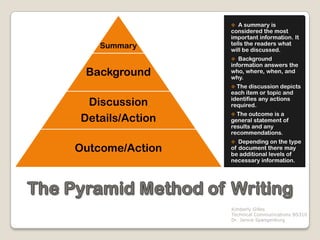
 A summary is
                 considered the most
                 important information. It
    Summary      tells the readers what
                 will be discussed.
                  Background
                 information answers the
 Background      who, where, when, and
                 why.
                  The discussion depicts
                 each item or topic and
 Discussion      identifies any actions
                 required.
                  The outcome is a
Details/Action   general statement of
                 results and any
                 recommendations.
                  Depending on the type
Outcome/Action   of document there may
                 be additional levels of
                 necessary information.


                 Kimberly Gilles
                 Technical Communications BS310
                 Dr. Janice Spangenburg
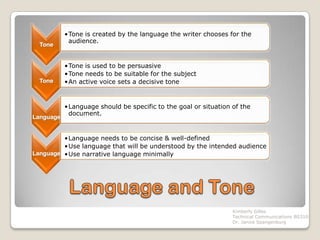
•Tone is created by the language the writer chooses for the
            audience.
  Tone


           •Tone is used to be persuasive
           •Tone needs to be suitable for the subject
  Tone     •An active voice sets a decisive tone


           •Language should be specific to the goal or situation of the
            document.
Language


         •Language needs to be concise & well-defined
         •Use language that will be understood by the intended audience
Language •Use narrative language minimally


                                                                 Kimberly Gilles
                                                                 Technical Communications BS310
                                                                 Dr. Janice Spangenburg
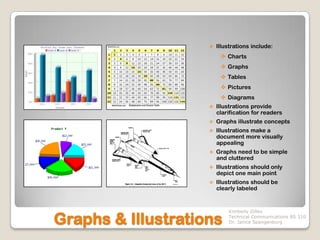
   Illustrations include:
                          Charts
                          Graphs
                          Tables
                          Pictures
                          Diagrams
                       Illustrations provide
                        clarification for readers
                       Graphs illustrate concepts
                       Illustrations make a
                        document more visually
                        appealing
                       Graphs need to be simple
                        and cluttered
                       Illustrations should only
                        depict one main point
                       Illustrations should be
                        clearly labeled


                            Kimberly Gilles

Graphs & Illustrations      Technical Communications BS 310
                            Dr. Janice Spangenburg
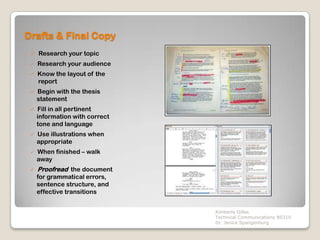
Drafts & Final Copy
  Research your topic
    Research your audience
    Know the layout of the
     report
    Begin with the thesis
     statement
    Fill in all pertinent
     information with correct
     tone and language
    Use illustrations when
     appropriate
    When finished – walk
     away
    Proofread the document
     for grammatical errors,
     sentence structure, and
     effective transitions


                                Kimberly Gilles
                                Technical Communications BS310
                                Dr. Janice Spangenburg

Technical Writing PowerPoint

  • 1.
    Kimberly Gilles Technical CommunicationsBS310 Dr. Janice Spangenburg
  • 2.
    Technical writing is the presentation of information that helps the reader to solve a particular problem.  Technical writing is used in proposals, manuals, web pages, lab reports, newsletters, and many other kinds of professional documents.  Technical writing is used to communicate information to management, employees, and other businesses.  Technical writing can be considered the conduit between people who know technology and those who use it. Kimberly Gilles Technical Communications BS310 Dr. Janice Spangenburg
  • 3.
    Technical writing requires transparency of expression and therefore a straightforward use of language.  Technical writing requires the recognition of the overall goal prior to beginning a document.  Writers must have knowledge of the intended audience.  Documents must include certain key concepts so the information can be easily understood by the intended readers.  Technical writing is solution based. Kimberly Gilles Technical Communications BS310 Dr. Janice Spangenburg
  • 4.
    Know the intended audience.  Understand the goal of the document.  Follow the Pyramid Method of Writing.  Use an active voice when writing.  Use clear and concise language.  Use illustrations to help clarify meaning.  Prepare a draft and then a final copy. Kimberly Gilles Technical Communications BS310 Dr. Janice Spangenburg
  • 5.
    When a writer knows their audience they are better positioned to suggest and implement solutions, by using appropriate language and tone. Readers will fall into 1 of 4 categories: experts, technicians, business, and lay-people What are the readers' positions and responsibilities? What will the reader be expecting from the document? How will the information be used? What questions will likely be asked? Kimberly Gilles Technical Communications BS310 Dr. Janice Spangenburg
  • 6.
     A summaryis considered the most important information. It Summary tells the readers what will be discussed.  Background information answers the Background who, where, when, and why.  The discussion depicts each item or topic and Discussion identifies any actions required.  The outcome is a Details/Action general statement of results and any recommendations.  Depending on the type Outcome/Action of document there may be additional levels of necessary information. Kimberly Gilles Technical Communications BS310 Dr. Janice Spangenburg
  • 7.
    •Tone is createdby the language the writer chooses for the audience. Tone •Tone is used to be persuasive •Tone needs to be suitable for the subject Tone •An active voice sets a decisive tone •Language should be specific to the goal or situation of the document. Language •Language needs to be concise & well-defined •Use language that will be understood by the intended audience Language •Use narrative language minimally Kimberly Gilles Technical Communications BS310 Dr. Janice Spangenburg
  • 8.
    Illustrations include:  Charts  Graphs  Tables  Pictures  Diagrams  Illustrations provide clarification for readers  Graphs illustrate concepts  Illustrations make a document more visually appealing  Graphs need to be simple and cluttered  Illustrations should only depict one main point  Illustrations should be clearly labeled Kimberly Gilles Graphs & Illustrations Technical Communications BS 310 Dr. Janice Spangenburg
  • 9.
    Drafts & FinalCopy  Research your topic  Research your audience  Know the layout of the report  Begin with the thesis statement  Fill in all pertinent information with correct tone and language  Use illustrations when appropriate  When finished – walk away  Proofread the document for grammatical errors, sentence structure, and effective transitions Kimberly Gilles Technical Communications BS310 Dr. Janice Spangenburg