ORIENTATION DAY
ENGLISH FOR
ACADEMIC AND
PROFESSIONAL
PURPOSES
October 19, 2021 | 2:00PM
PRAYER
#JCPians
josepayumojrmhs
#JCPians
josepayumojrmhs
Recall!
What is an
outline?
#JCPians
josepayumojrmhs
Recall!
Why is it
important to
make an
outline?
#JCPians
josepayumojrmhs
Recall!
What are
the two
kinds of
outline?
#JCPians
josepayumojrmhs
Recall!
Differentiate
the two
kinds of
outline.
ENGLISH FOR ACADEMIC AND
PROFESSIONAL PURPOSES
#JCPians
josepayumojrmhs
MODULE 5
CRITIQUE WRITING
Use appropriate critical approaches in writing a critique such as
formalism, feminism, etc. (CS_EN11/12A-EAPP-Ia-c-16)
#JCPians
josepayumojrmhs
CRITIQUE
genre of academic writing
that summarizes and
critically
evaluates a work or
concept
#JCPians
josepayumojrmhs
CRITIQUE
a. Creative works – novels, exhibits, film,
images, poetry
b. Research – monographs, journal articles,
systematic reviews
c. Media – news reports, feature articles
#JCPians
josepayumojrmhs
HOW TO WRITE A CRITIQUE PAPER
a. Study the work under discussion.
b. Make notes on key parts of the work.
c. Develop an understanding of the main argument
or purpose being expressed in the work.
d. Consider how the work relates to a broader issue
or context.
#JCPians
josepayumojrmhs
FOUR MAIN PARTS OF A CRITIQUE PAPER
1. Introduction
2. Body (Summary and Critical
Evaluation
3. Conclusion
4. List of References
#JCPians
josepayumojrmhs
1. Introduction
• name of the writer or creator of the work
• the name of the work being reviewed
• the date it was written or created and its purpose
• the explanation of the context in which the work was created
• a concluding sentence that signposts what the evaluation of the work will be
#JCPians
josepayumojrmhs
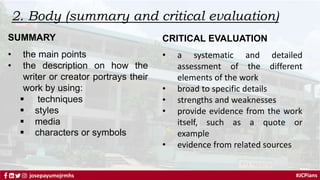
2. Body (summary and critical evaluation)
SUMMARY
• the main points
• the description on how the
writer or creator portrays their
work by using:
 techniques
 styles
 media
 characters or symbols
CRITICAL EVALUATION
• a systematic and detailed
assessment of the different
elements of the work
• broad to specific details
• strengths and weaknesses
• provide evidence from the work
itself, such as a quote or
example
• evidence from related sources
#JCPians
josepayumojrmhs
3. Conclusion
• overall impression of the evaluated work
• a summary of the key reasons identified during the critical evaluation
• recommendations for improvement on the work
#JCPians
josepayumojrmhs
4. List of References
• resources you cited in your critique paper
#JCPians
josepayumojrmhs
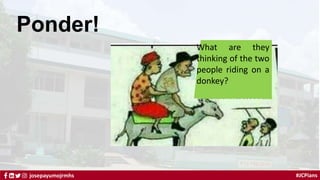
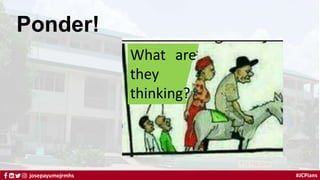
Ponder!
What are they
thinking of the two
people riding on a
donkey?
#JCPians
josepayumojrmhs
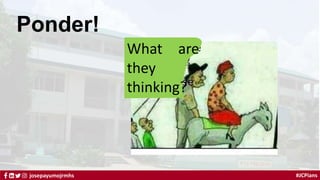
Ponder!
What are
they
thinking?
#JCPians
josepayumojrmhs
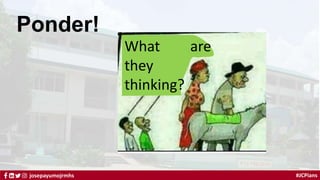
Ponder!
What are
they
thinking?
#JCPians
josepayumojrmhs
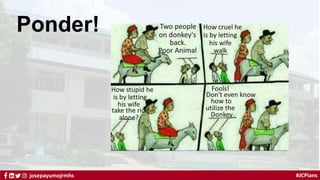
Ponder!
What are
they
thinking?
#JCPians
josepayumojrmhs
Ponder!
#JCPians
josepayumojrmhs
CRITICAL APPROACHES TO THE LITERATURE
1. Formalist Criticism
to determine how such elements work together
with the text's content to shape its effects upon
readers
#JCPians
josepayumojrmhs
CRITICAL APPROACHES TO THE LITERATURE
2. Biographical Criticism
focuses on explicating the literary work by using
the insight provided by knowledge of the
author’s life.
#JCPians
josepayumojrmhs
CRITICAL APPROACHES TO THE LITERATURE
3. Historical Criticism
• social, cultural, and intellectual context
• to understand the effect of a literary work
upon its original readers
#JCPians
josepayumojrmhs
CRITICAL APPROACHES TO THE LITERATURE
4. Gender Criticism
• examines how sexual identity influences the
creation and reception of literary works
• analysing how sexual identity influences the
reader of a text
#JCPians
josepayumojrmhs
CRITICAL APPROACHES TO THE LITERATURE
5. Psychological Criticism
interprets writings,
authors, and readers
through a psychological
lens
#JCPians
josepayumojrmhs
CRITICAL APPROACHES TO THE LITERATURE
6. Sociological Criticism
examines literature in the cultural, economic and
political context in which it is written or received
#JCPians
josepayumojrmhs
CRITICAL APPROACHES TO THE LITERATURE
7. Mythological Criticism
explores the artist's common
humanity by tracing how the individual
imagination uses myths and symbols
common to different cultures
#JCPians
josepayumojrmhs
CRITICAL APPROACHES TO THE LITERATURE
8. Reader-Response Criticism
to describe what happens in the reader's
mind while interpreting a text" and reflects that
reading, like writing, is a creative process
#JCPians
josepayumojrmhs
CRITICAL APPROACHES TO THE LITERATURE
9. Deconstructionist Criticism
rejects the traditional assumption that language
can accurately represent reality
#JCPians
josepayumojrmhs
WHAT’S IN
You can look for articles online. It can be a novel, film, image
or photograph, poem or a news report. Then, criticize its
content. Include the five parts of a critique paper. Write a
200-word essay. You may choose the focus of your critique
paper based on any of the approaches explained on pages
13-15. This will serve as your basis for your
interpretation/criticism.
MARILOU A. BUGTONG
Prepared by:
Thank You

EAPP_M5.pptx

Editor's Notes

  • #30 Deconstructionist critics regard language as a fundamentally unstable medium-the words "tree" or "dog," for instance, undoubtedly conjure up different mental images for different people-and therefore, because literature is made up of words, literature possesses no fixed, single meaning. Other goals of deconstructionists include (1) challenging the notion of authors' "ownership" of texts they create (and their ability to control the meaning of their texts) and (2) focusing on how language is used to achieve power, as when they try to understand how a some interpretations of a literary work come to be regarded as "truth."