Integrating Technology into the Classroom Doug Adams ALTEC [email_address]
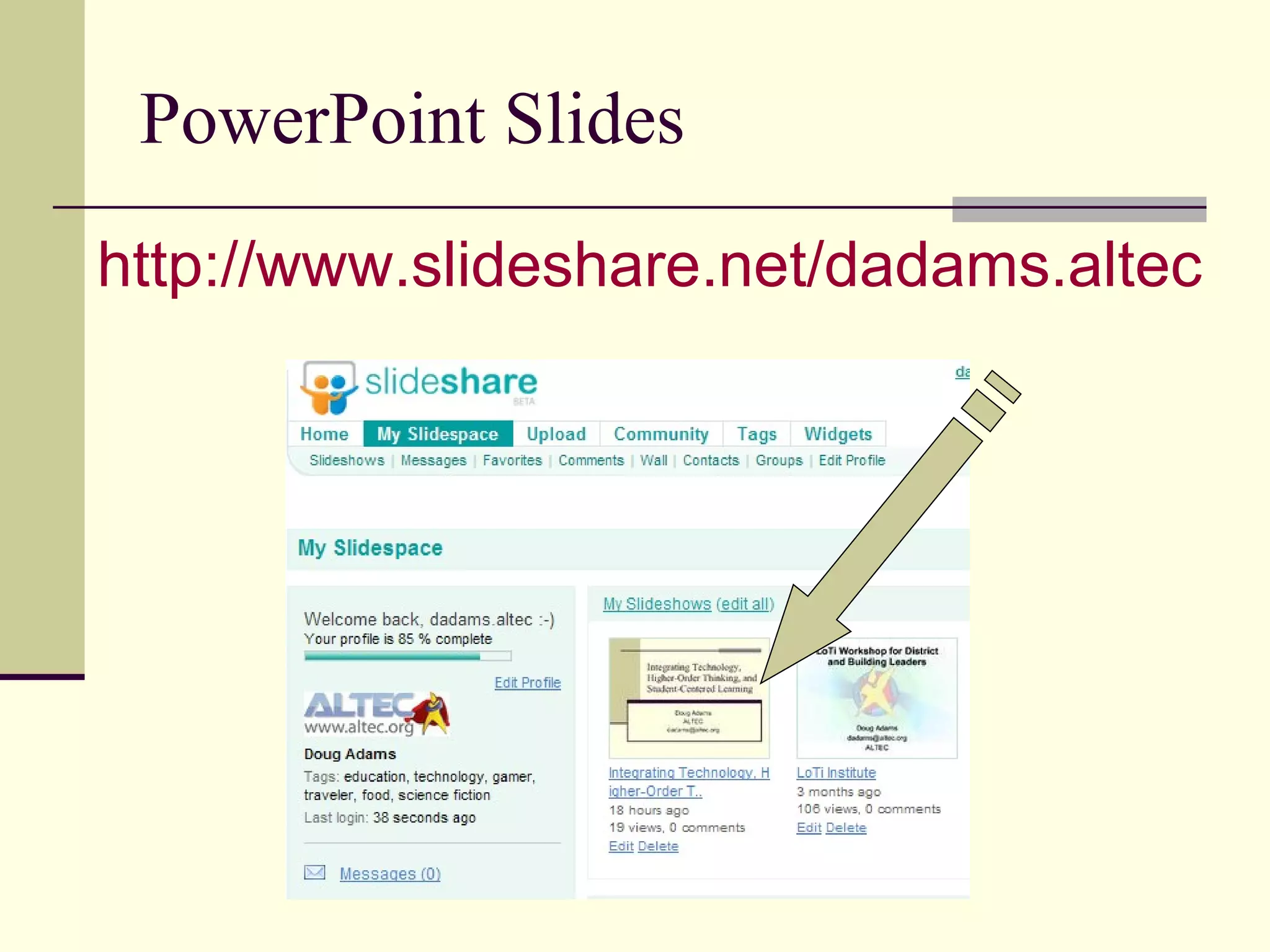
PowerPoint Slides http://www.slideshare.net/dadams.altec
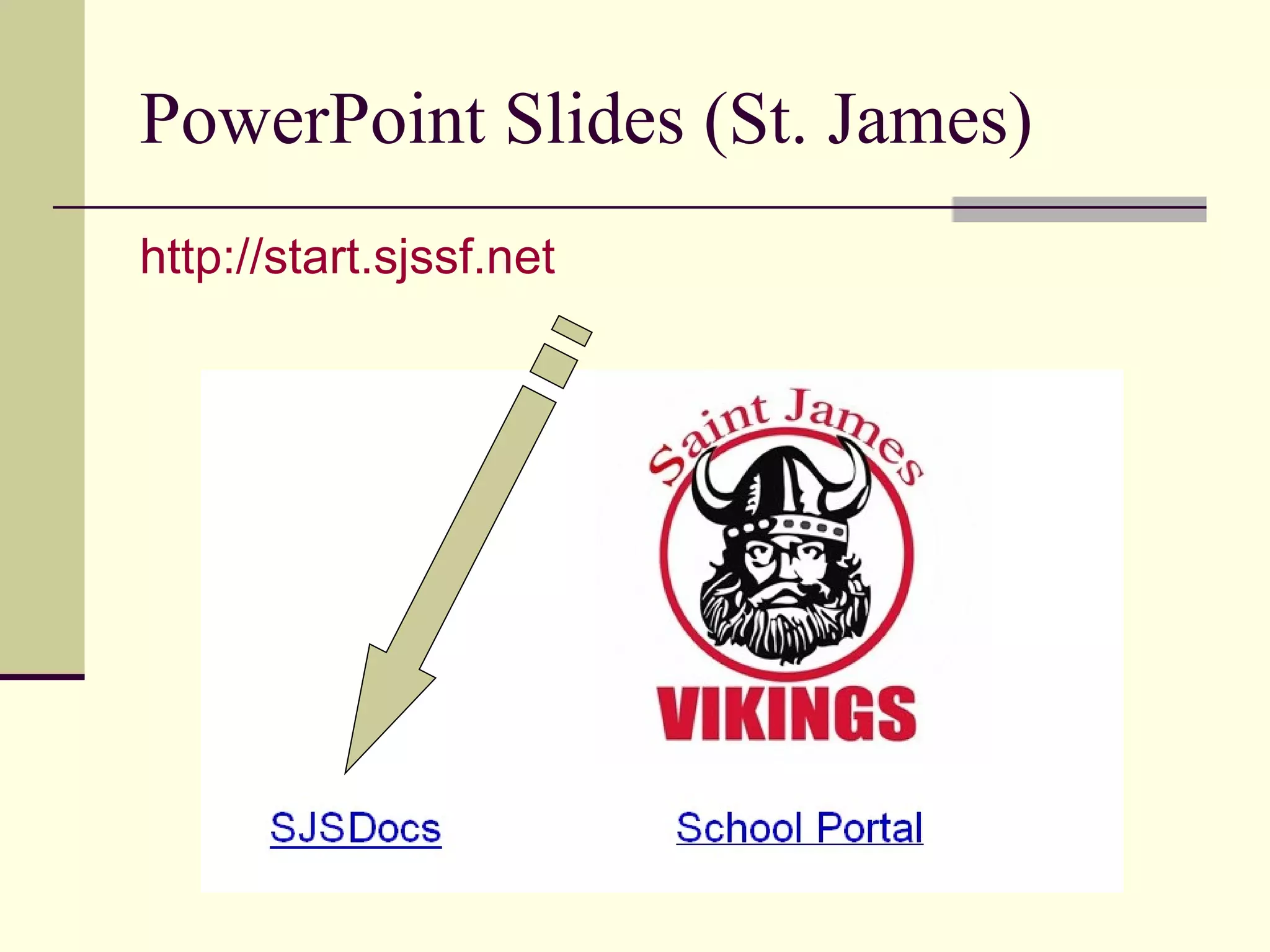
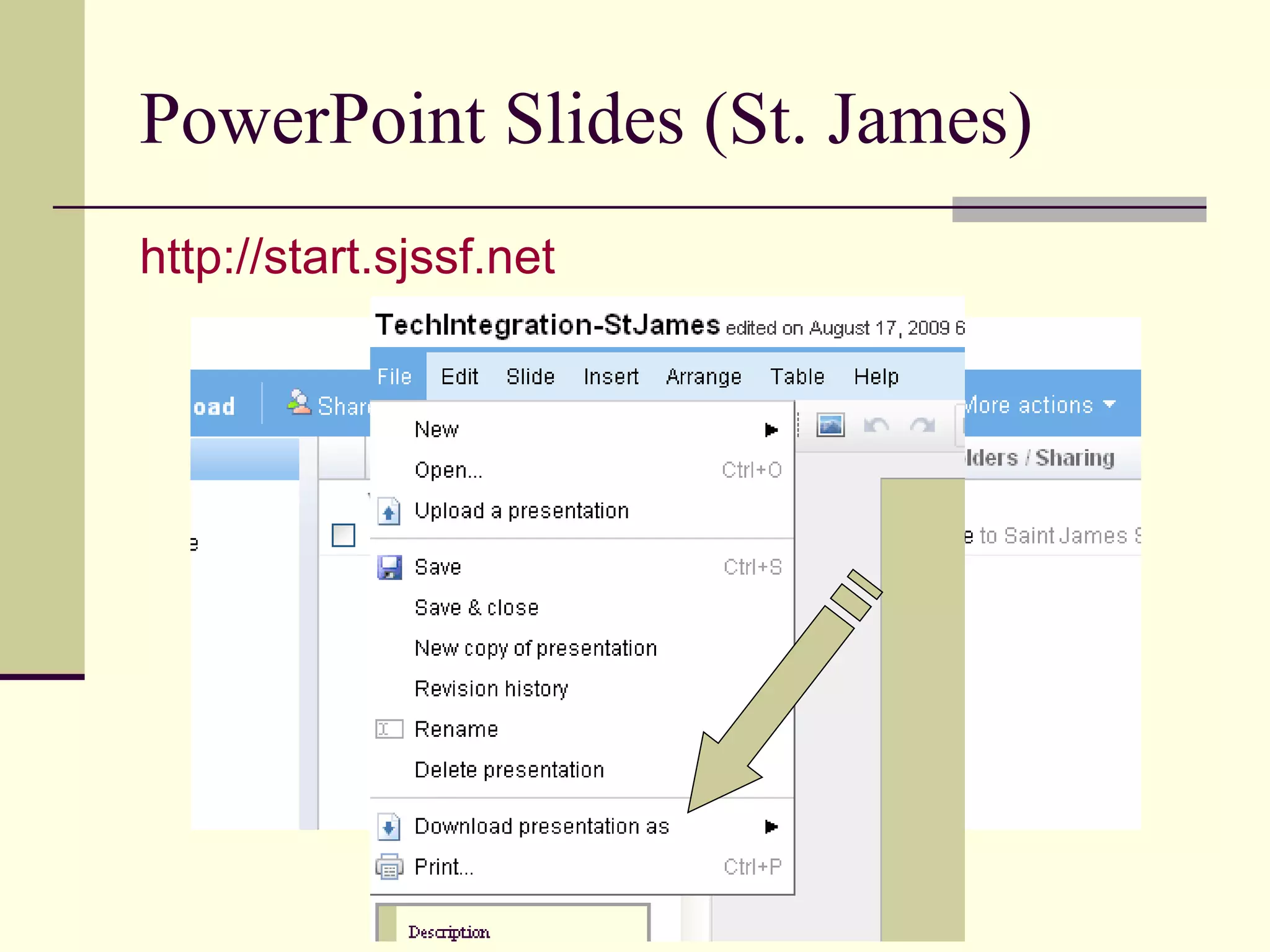
PowerPoint Slides (St. James) http://start.sjssf.net
Description Participants will learn about  integrating technology  into instructional activities through a combination of  group activities  and  discussions .  Emphasis will be placed on incorporating the use of  higher-order thinking  and  complex thinking  skills, as well as other  21st Century Skills  such as  collaboration  and  communication .
(Super-duper approximate)  Agenda Changing how we  “Do School” Technology Planning 21 st  Century Skills Group Activity Technology to Support Higher Order Thinking Intel Thinking Tools Project-Based Learning Lunch Collaboration Google Docs Games for Learning Authentic Learning Web 2.0 Tools in the classroom Google Earth/Lit Trips Access to Primary Sources 4Teachers Tools Conclusion
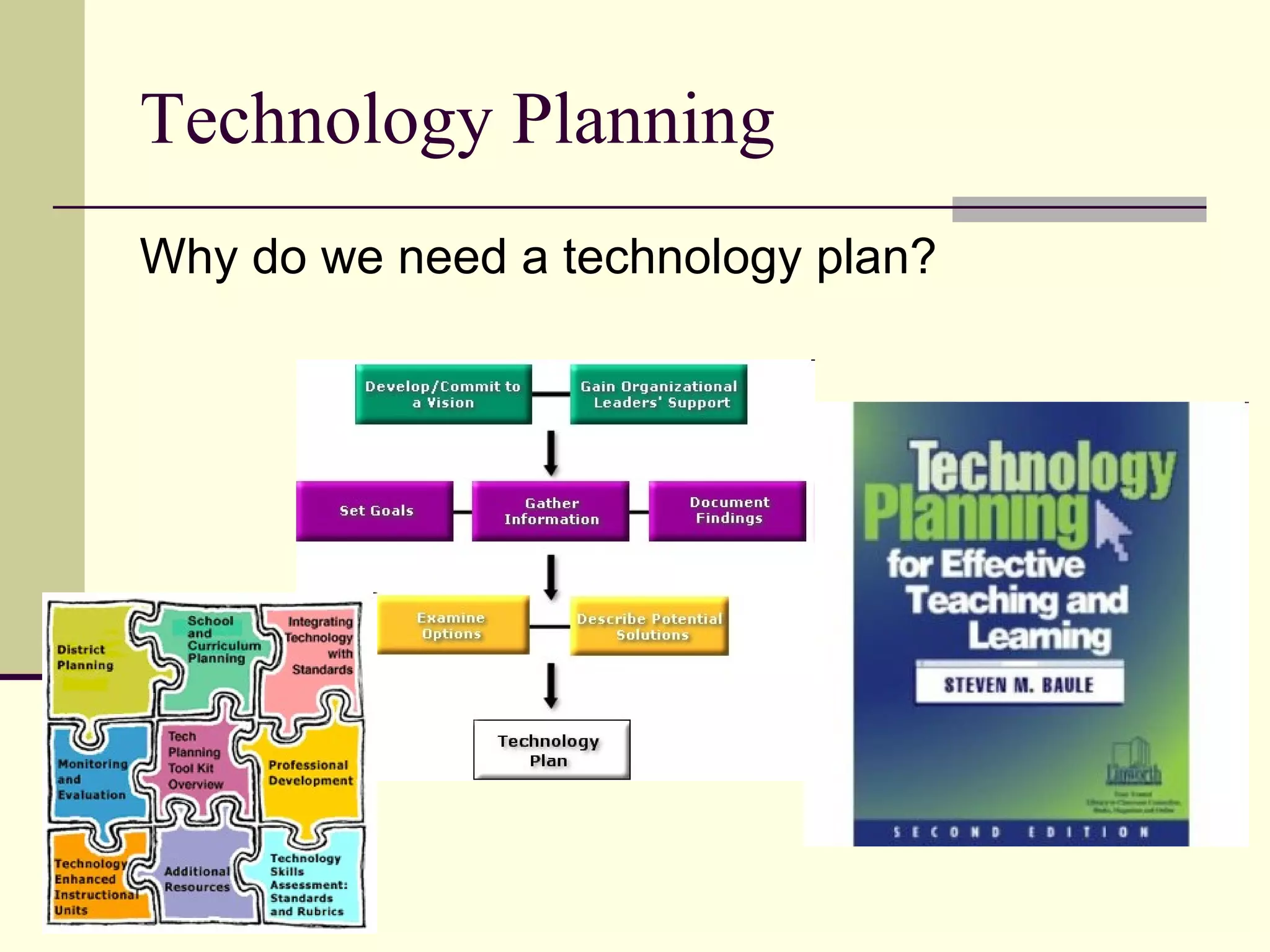
Technology Planning Why do we need a technology plan?
Technology Planning Should: Be a continuous process Be personal to the organization Owned by the members of the organization Be broad but realistic Involve all stakeholders Formalize procedures for making-decisions Be driven by goals and standards rather than technology “ Guiding Questions for Technology Planning”, NCRTEC, http://www.ncrtec.org/capacity/guidewww/gqhome.htm
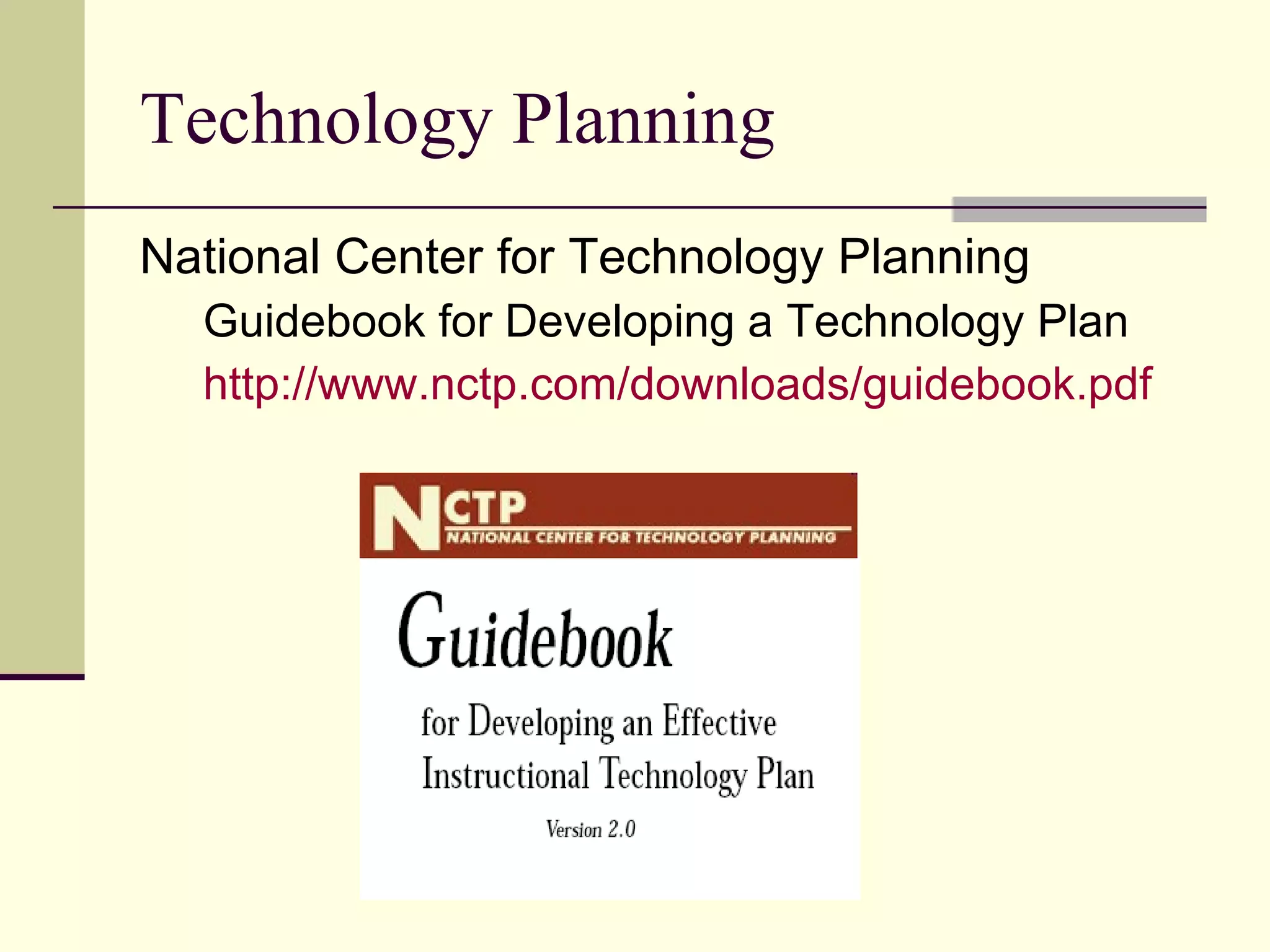
Technology Planning National Center for Technology Planning Guidebook for Developing a Technology Plan http://www.nctp.com/downloads/guidebook.pdf
Technology Committee Administration Teachers Staff (including maintenance!) Students Parents Community Businesses Other?
Cost-Benefit Analyses “ Businesses think of technology as an investment, schools think of it as an expense” Value of Investment (VOI) -  http://www.edtechvoi.org/   Total Cost of Ownership (TCO) -  http://www.classroomtco.org/ -- Consortium for School Networks (CoSN)
 
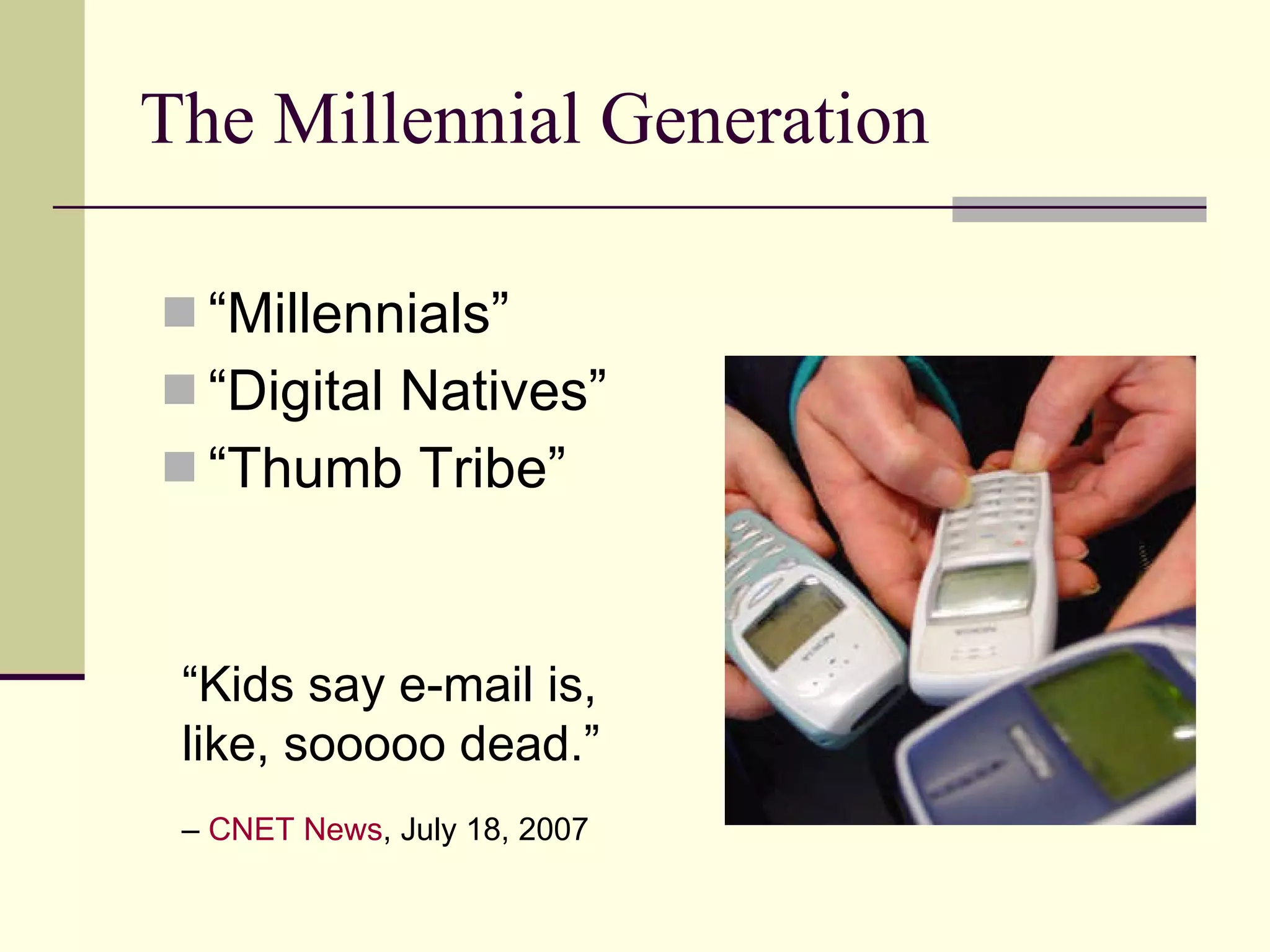
The Millennial Generation “ Millennials” “ Digital Natives” “ Thumb Tribe” “ Kids say e-mail is, like, sooooo dead.”   –  CNET News , July 18, 2007
The Millennial Generation “ Today’s students are no longer the people our educational system was designed to teach” Mark Prensky
Attitudes in the Millennial School “ I have to ‘ power down ’ when I go  to school.” “ When I am really busy,  I hate going to school  because I can’t do any work there.”
Characteristics of Digital Natives Active Multi-tasking Non-linear thinking Ubiquity Technical Fluency Expectations of Feedback Individualization Risk-taking Information sifting
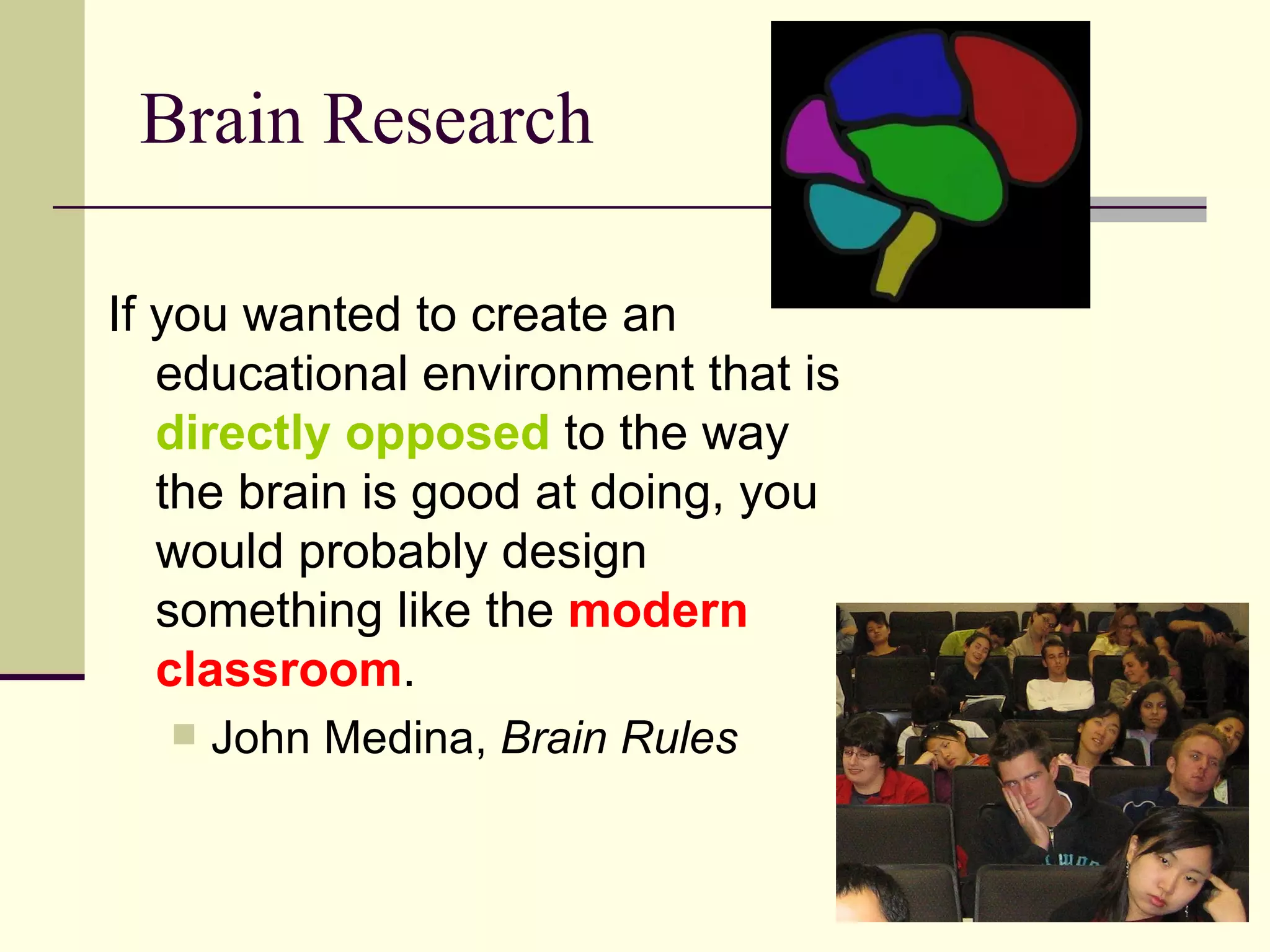
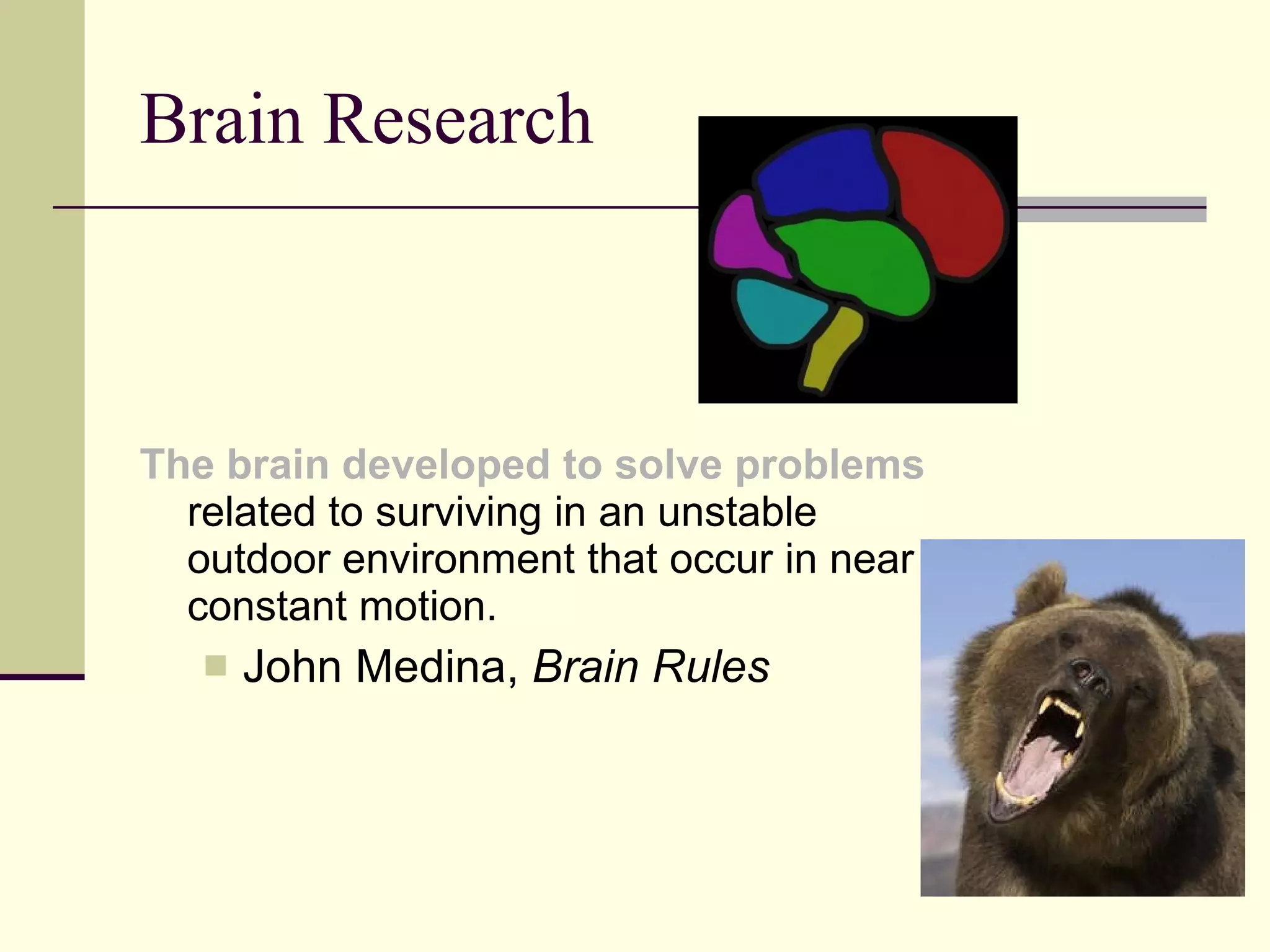
Brain Research The brain developed to solve problems  related to surviving in an unstable outdoor environment that occur in near constant motion.  John Medina,  Brain Rules
Brain Research If you wanted to create an educational environment that is  directly opposed  to the way the brain is good at doing, you would probably design something like the  modern classroom . John Medina,  Brain Rules
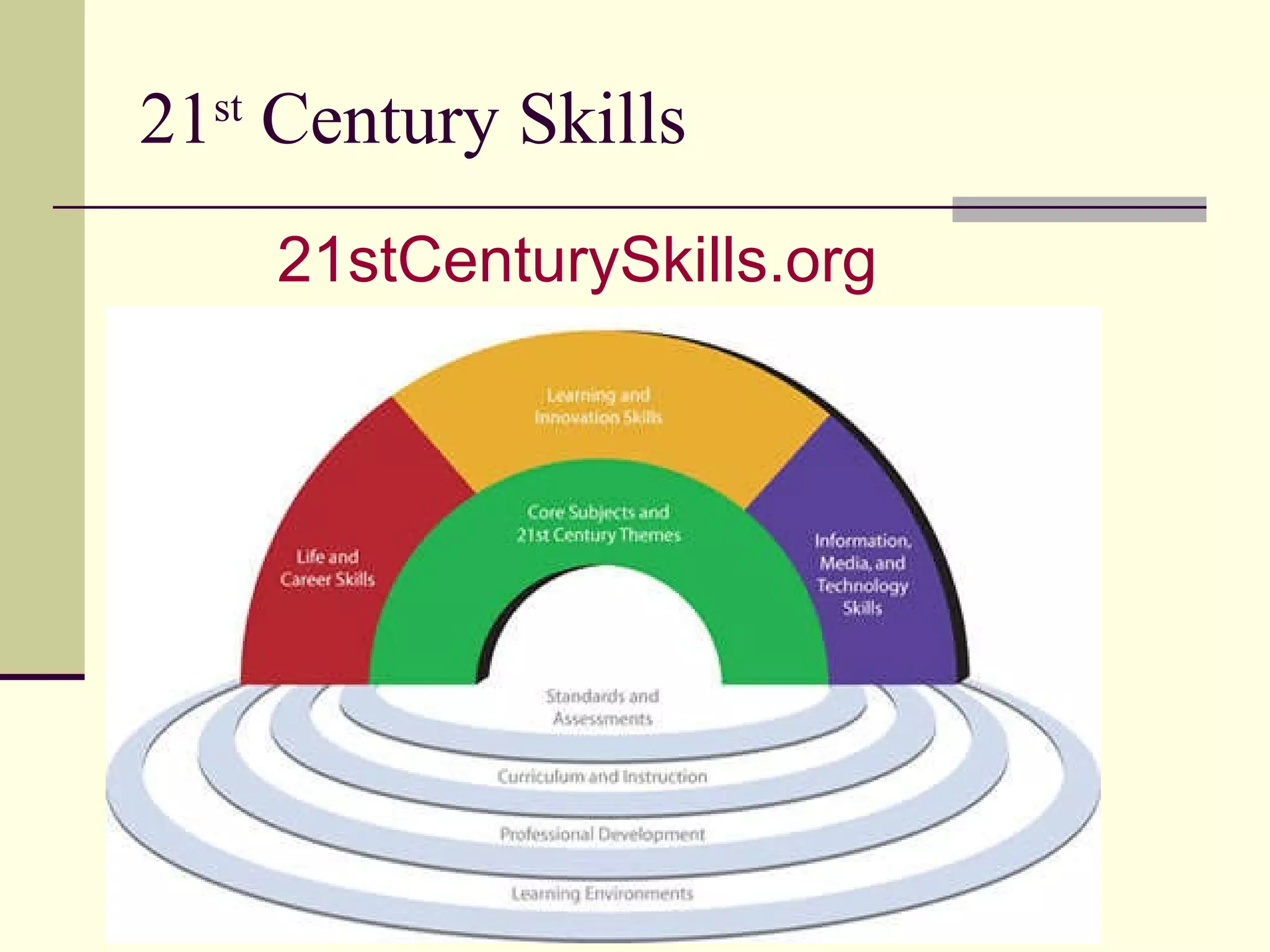
21 st  Century Skills 21stCenturySkills.org
21 st  Century Skills Core Subjects and 21 st  Century Themes Math, Language Arts, Science, Social Studies Global Awareness and Civic Literacy Economic and Business Literacy Health Literacy Learning and Innovation Skills Creativity Critical Thinking and Problem Solving Communication and Collaboration
21 st  Century Skills Information Media and Technology Skills Information and Media Literacy Communication and Technology Literacy Life and Career Skills Flexibility and Adaptability Initiative, Productivity, and Self-direction Social Skills Leadership, Accountability and Responsibility
Visual Ranking and 21 st  C Skills Intel’s Education Page http://intel.com/education K-12 Teaching Tools Visual Ranking Tool Click Student Log-In [email_address] Team ID Team Password
Visual Ranking and 21 st  C Skills In groups, sort the list from most important (top) to least important (bottom) For the  top three items , double click and explain why you ranked them as  most important For the  bottom two items , double click and explain why you ranked them as  least important
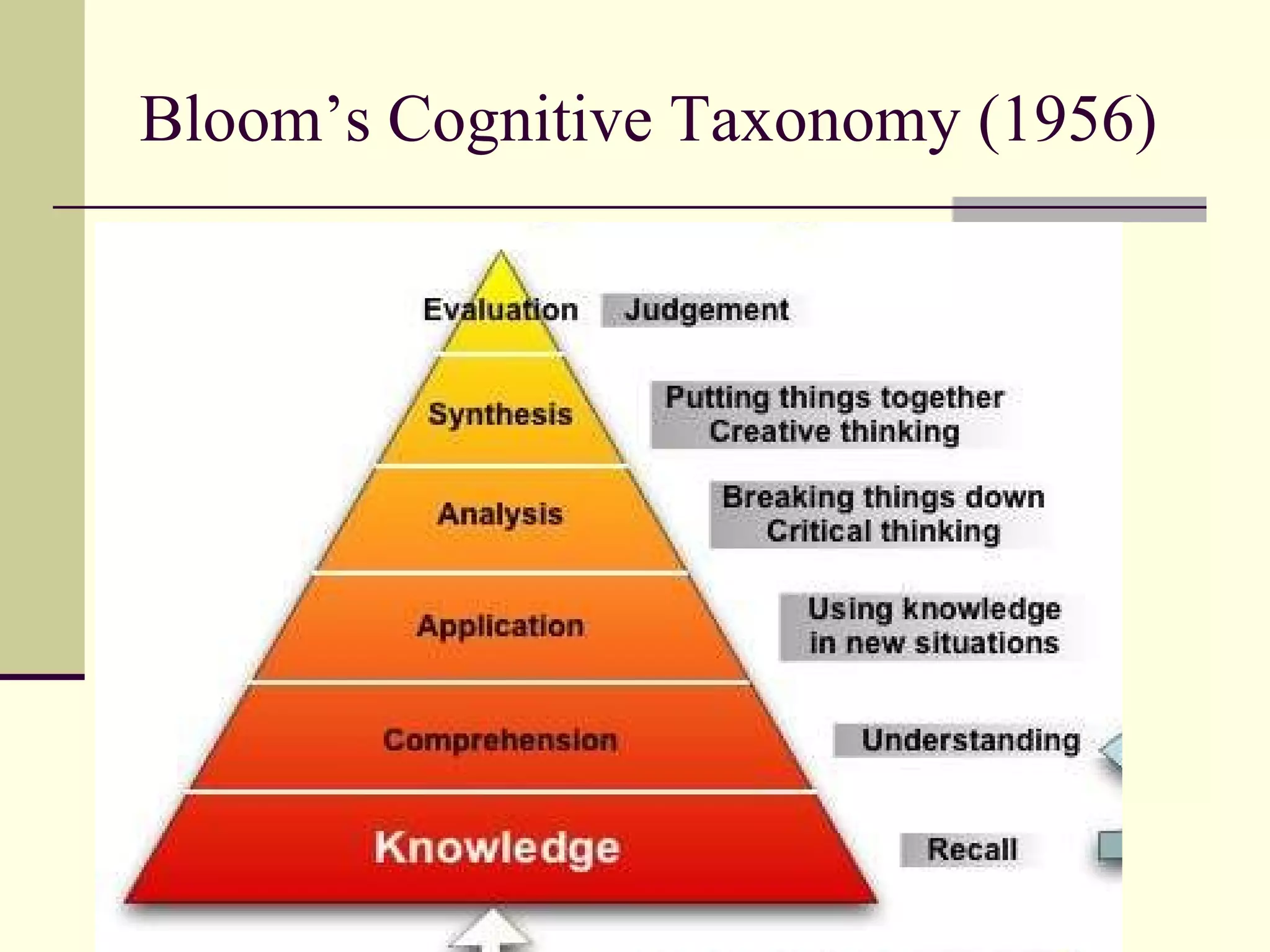
Bloom’s Cognitive Taxonomy (1956)
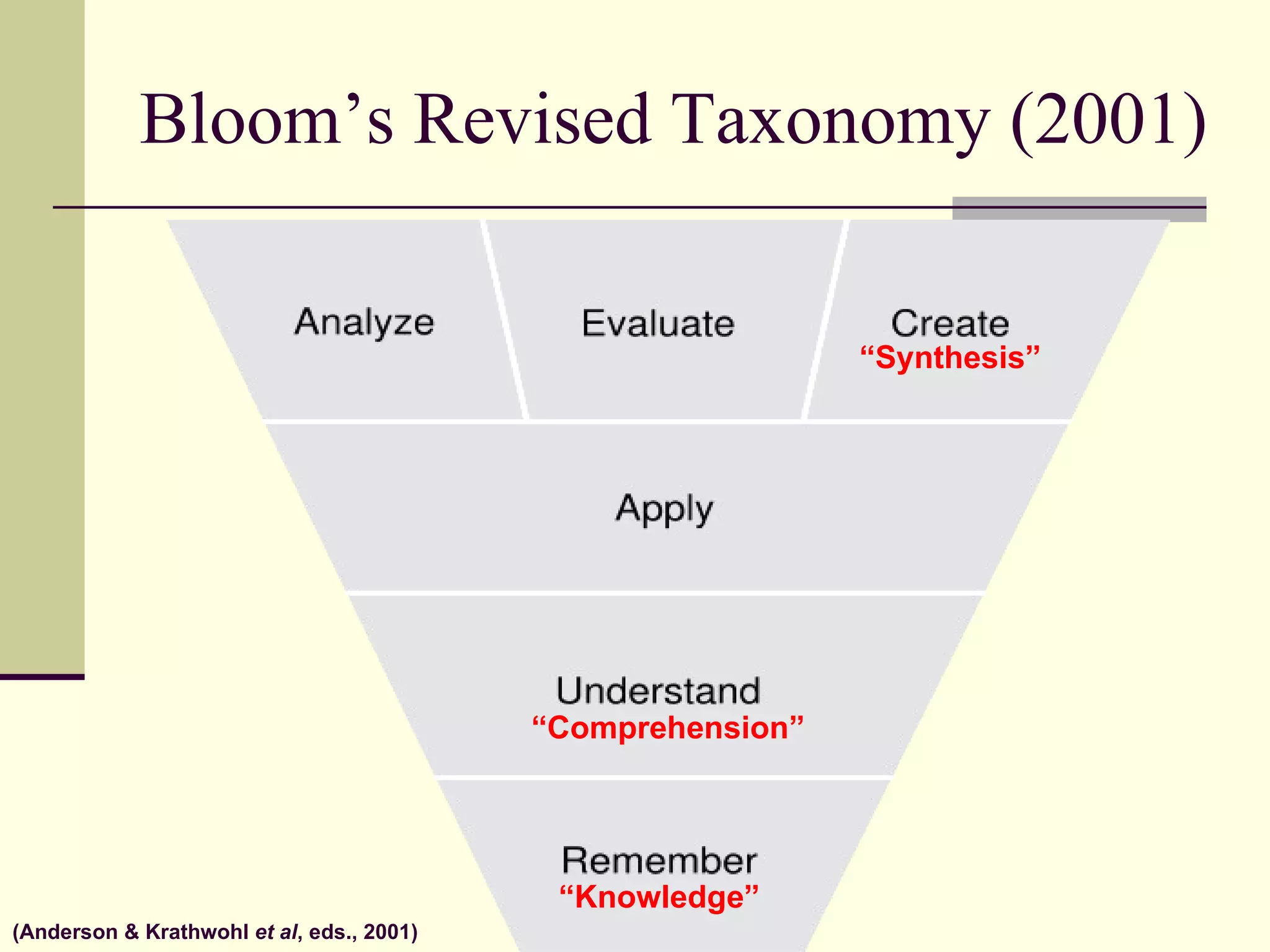
Bloom’s Revised Taxonomy (2001) (Anderson & Krathwohl  et al , eds., 2001) “ Knowledge” “ Comprehension” “ Synthesis”
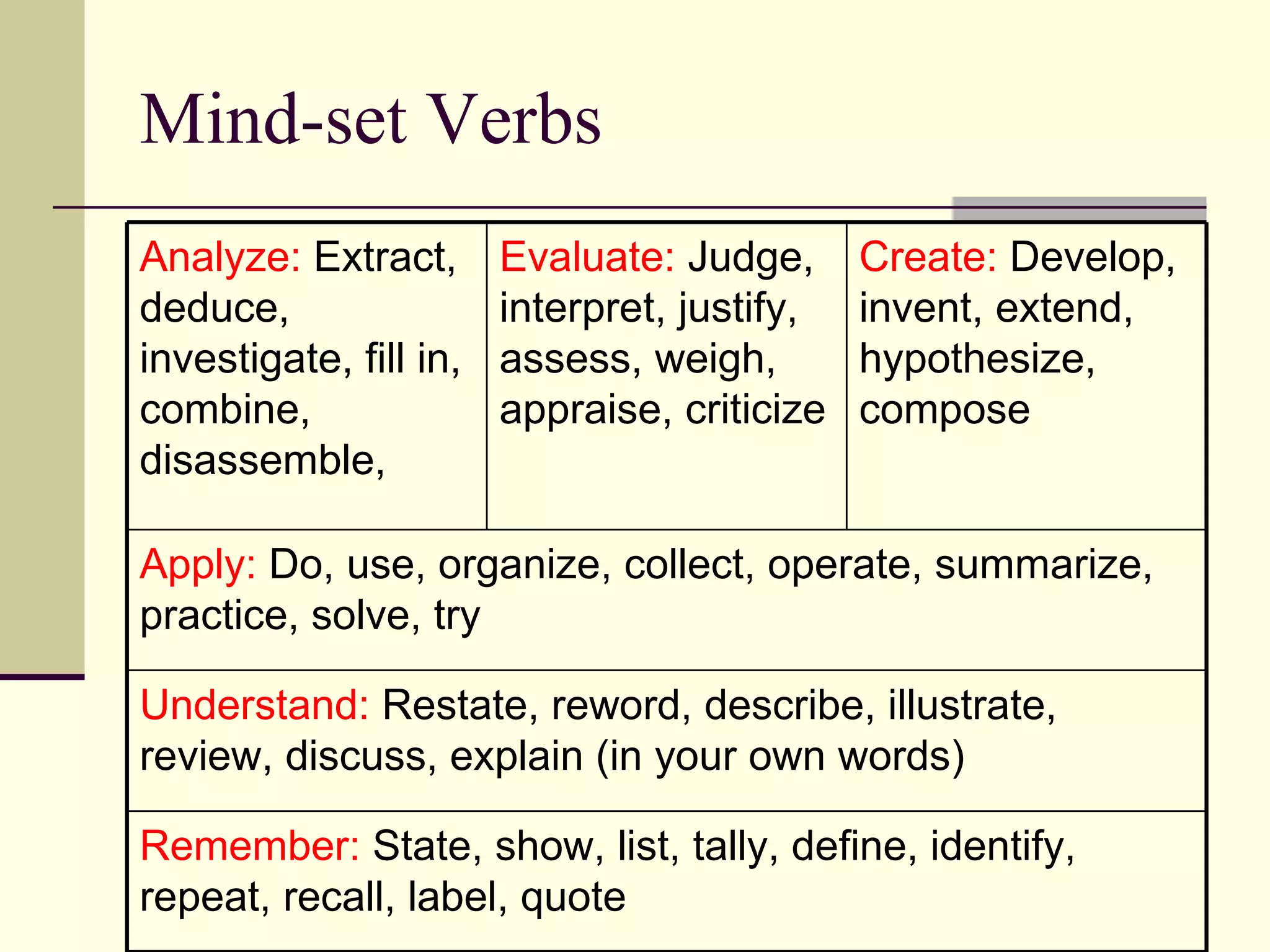
Mind-set Verbs Apply:  Do, use, organize, collect, operate, summarize, practice, solve, try Remember:  State, show, list, tally, define, identify, repeat, recall, label, quote Understand:  Restate, reword, describe, illustrate, review, discuss, explain (in your own words) Create:  Develop, invent, extend, hypothesize, compose Evaluate:  Judge, interpret, justify, assess, weigh, appraise, criticize Analyze:  Extract, deduce, investigate, fill in, combine, disassemble,
Organizing Bloom’s Taxonomy Level 3: High Creating something unique (to the learner) Making judgments, choices, decisions Breaking down concepts into component parts Level 2: Intermediate Using information, skills, and concepts in new situations Level 1: Low Understanding and interpreting information Acquiring and remembering new information
Why is it important to encourage higher-order thinking?
Supporting Higher-Order Thinking It is estimated that 90% of all test questions asked in the US are of “Low level” - knowledge and comprehension  (Wilen, W.W., 1992) “ Low level” doesn’t mean easy: Write an essay explaining the decline and fall of the Roman Empire incorporating at least five of the seven causes discussed in class from the writings of Gibbon and Toynbee “ High level” doesn’t mean hard: Which movie did you like more,  WALL-E  or  Cars ?  Why?
Curriculum Framing Questions Guide a unit of study and include:  Essential Questions Unit Questions  Content Questions
Essential Questions Are broad, open-ended questions  Address big ideas and enduring concepts Often cross discipline and help students see how subjects are related Example:  Why is math important to my life? How does conflict produce change? What lessons can be learned by running a city?
Unit Questions Are open-ended questions that tie directly to a project or unit Help students demonstrate the scope of their understanding of a subject Examples:  How important is measurement in building a home? How are changes in economics a factor in war? In the story,  Charlotte’s Web , how do the animals’ different abilities help Wilbur survive and succeed? How does stress on the environment impact biology?
Content Questions Are fact-based, concrete questions  Have a narrow set of correct answers Often relate to definitions, identifications, and general recall of information (example: questions found on a test) Examples: How do you find the values of unknowns in equations? What is a fable? Who is the main character in  To Kill a Mockingbird ? How are volcanoes made? Why is it cold in the winter when the sun is shining?
Technology and Complex Thinking Intel Thinking Tools   http:// www.intel.com /education/tools   Visual Ranking : Assign ranking to a list; and then debate differences, reach consensus, and organize ideas Seeing Reason : Investigate relationships in complex systems  Showing Evidence : Construct well-reasoned arguments that are supported by evidence, using a visual framework
Complex Thinking Strategies Decision Making Reasoning Investigation Experimental Inquiry Directed Problem Solving Creative Problem Solving Reflective Thinking
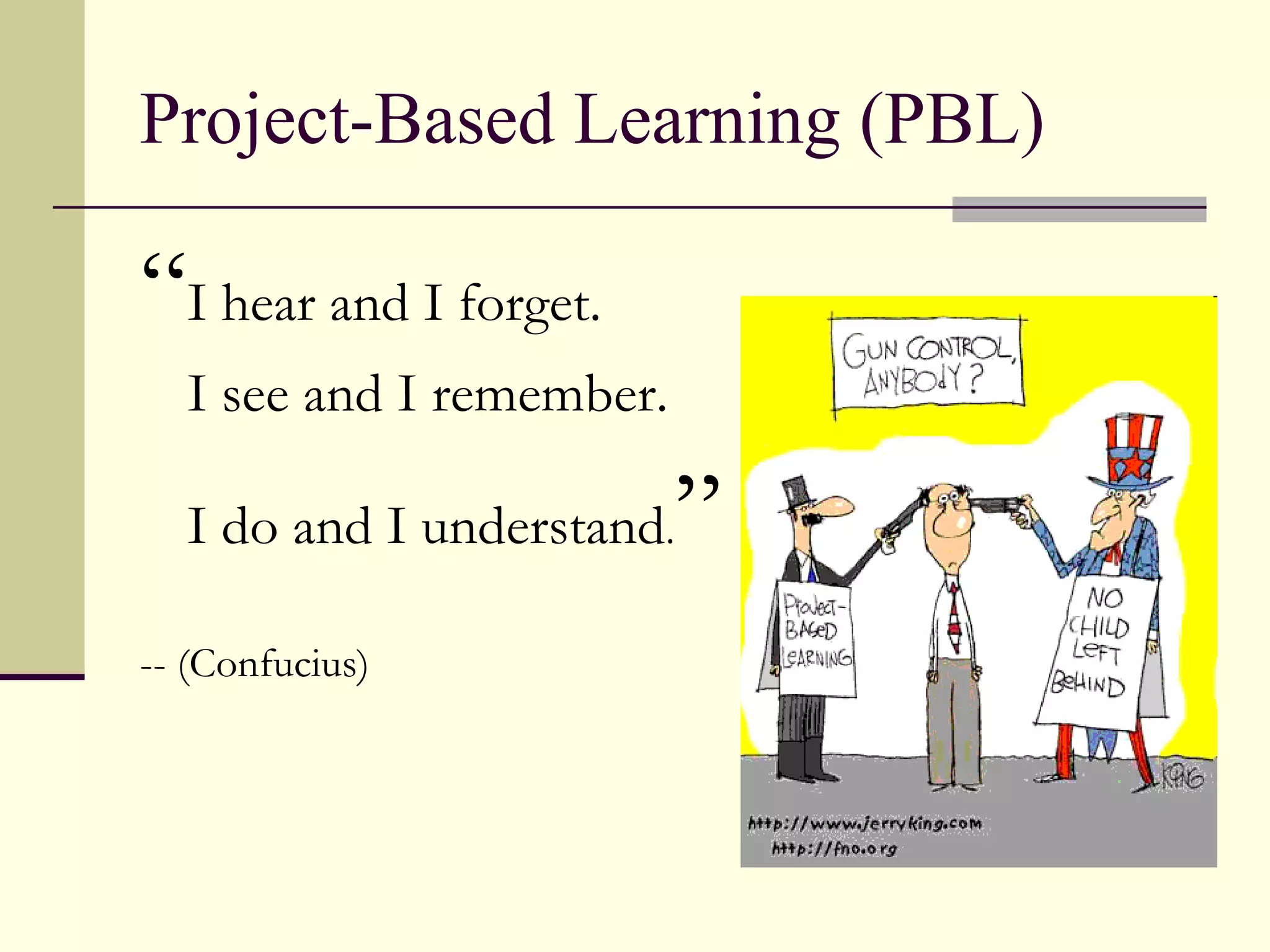
Project-Based Learning (PBL) “ I hear and I forget. I see and I remember.  I do and I understand . ” -- (Confucius)
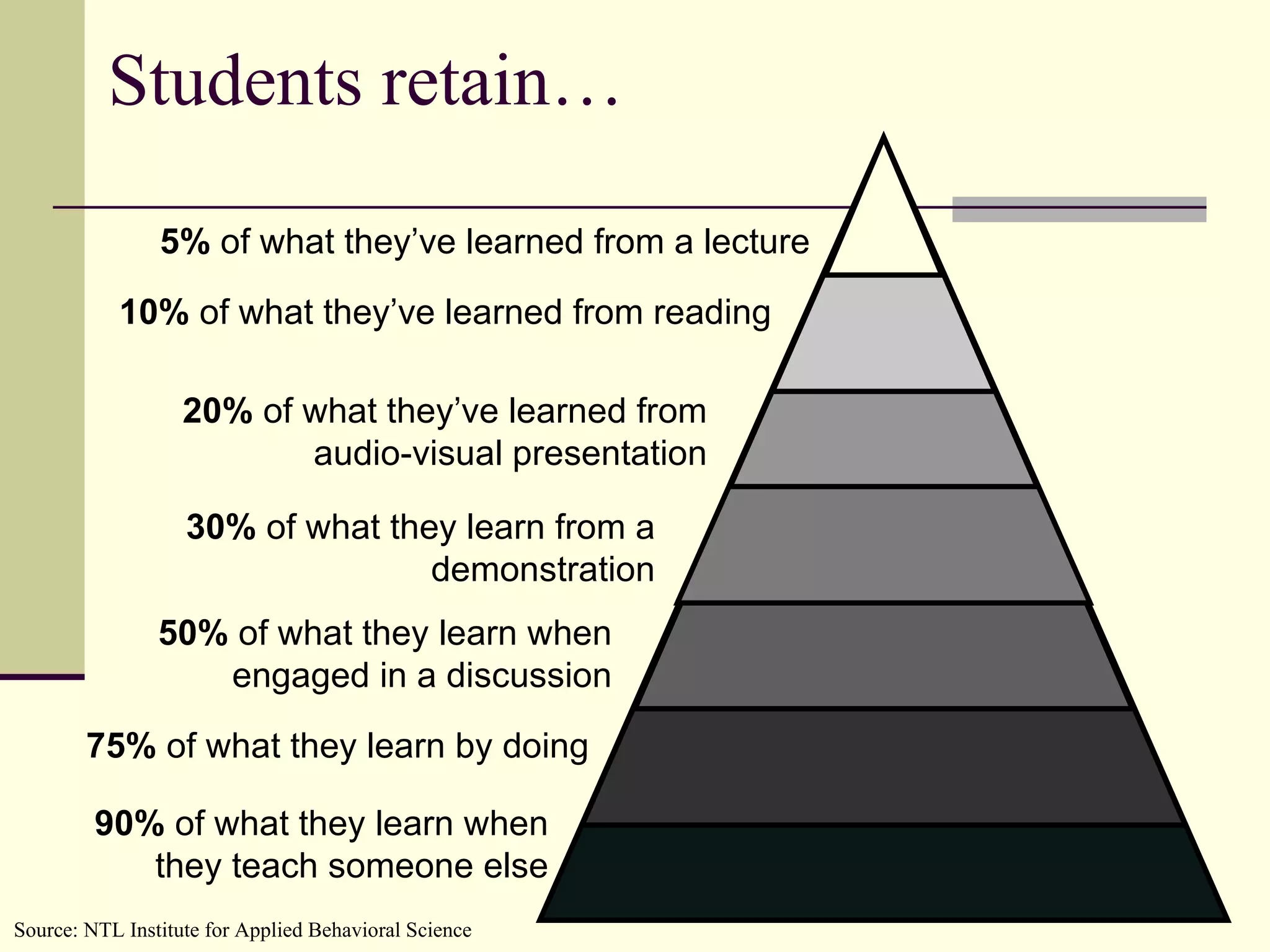
Students retain… 90%  of what they learn when they teach someone else 5%  of what they’ve learned from a lecture 10%  of what they’ve learned from reading 20%  of what they’ve learned from audio-visual presentation 30%  of what they learn from a demonstration 50%  of what they learn when engaged in a discussion 75%  of what they learn by doing Source: NTL Institute for Applied Behavioral Science
Why Projects? To learn collaboration,  work in teams . To learn critical thinking,  take on problems . To learn oral communication,  present . To learn written communication,  write . To learn technology,  use technology . To develop citizenship,  take on civic issues . To learn about careers,  do internships . To learn content,  do all of the above .
Project-Based Learning Resources Buck Institute for Education (BIE)  http://www.bie.org iEARN (International Education and Resource Network)  http://www.iearn.org/ Edutopia http://www.edutopia.org/project-learning
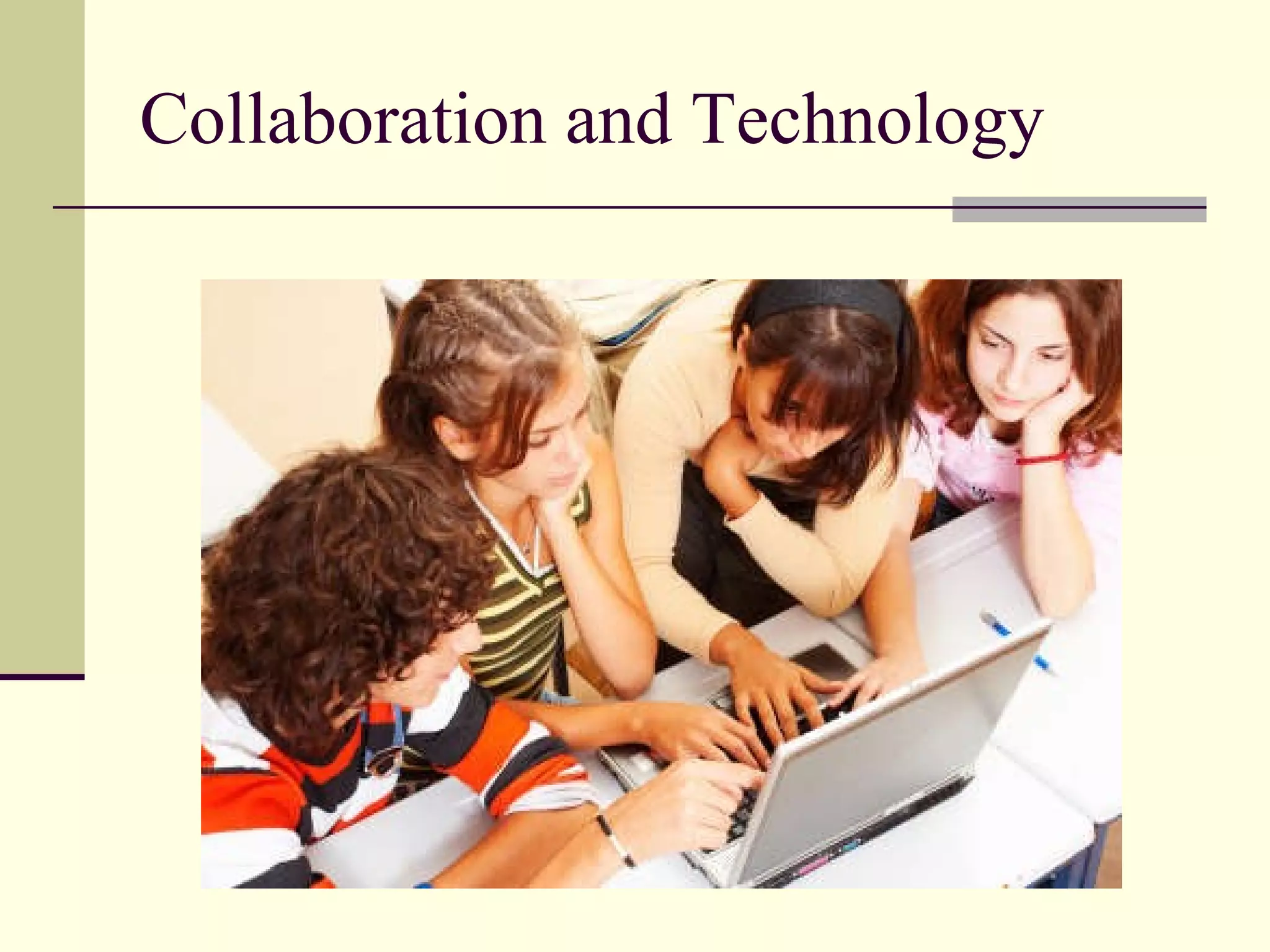
Collaboration and Technology
Collaborating with Google Docs http://docs.google.com Word Processing Spreadsheet Forms Presentations http:// start.sjssf.net
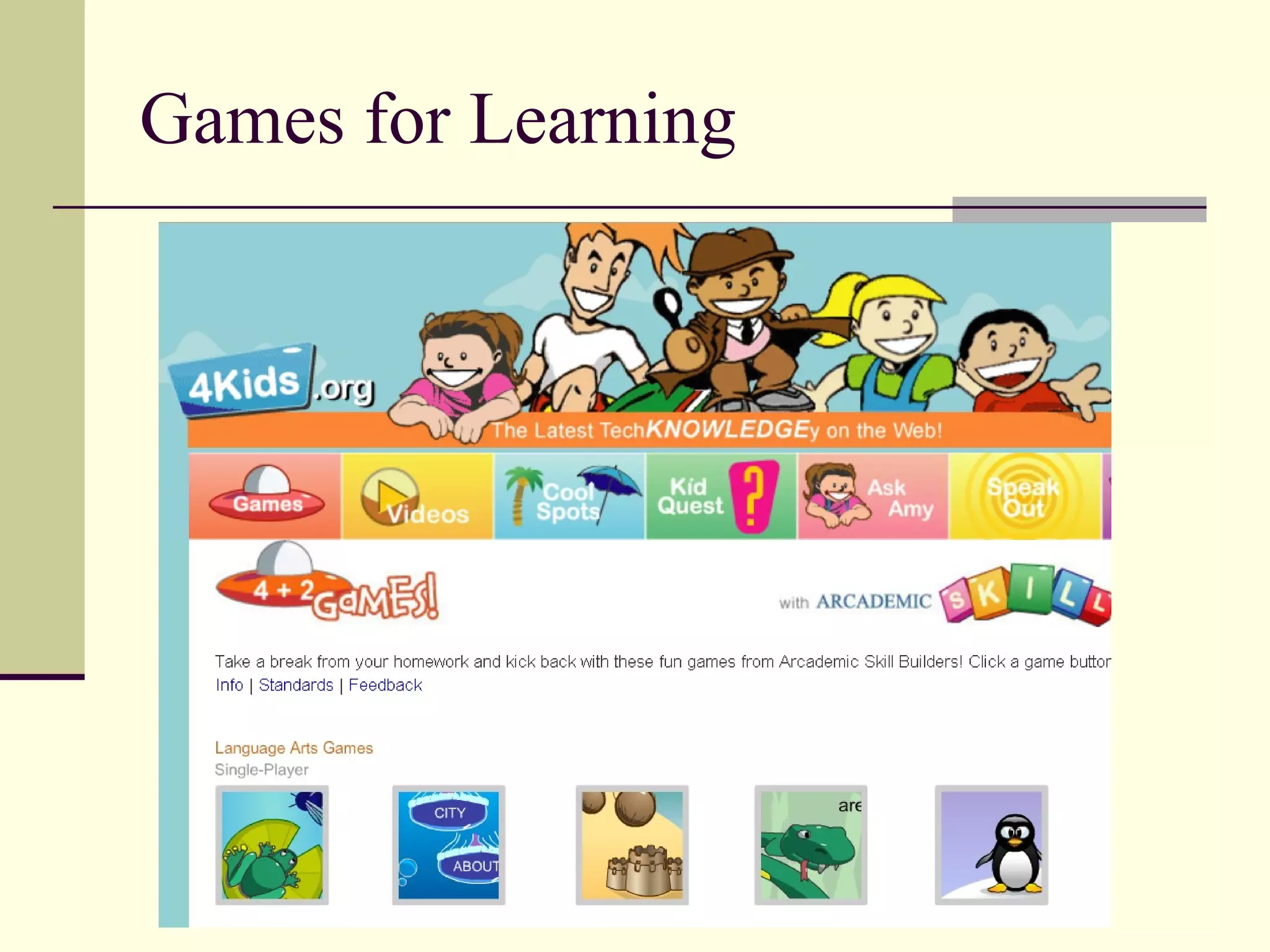
Games for Learning
Brain Research The brain developed to solve problems  related to surviving in an unstable outdoor environment that occur in near constant motion.  John Medina,  Brain Rules
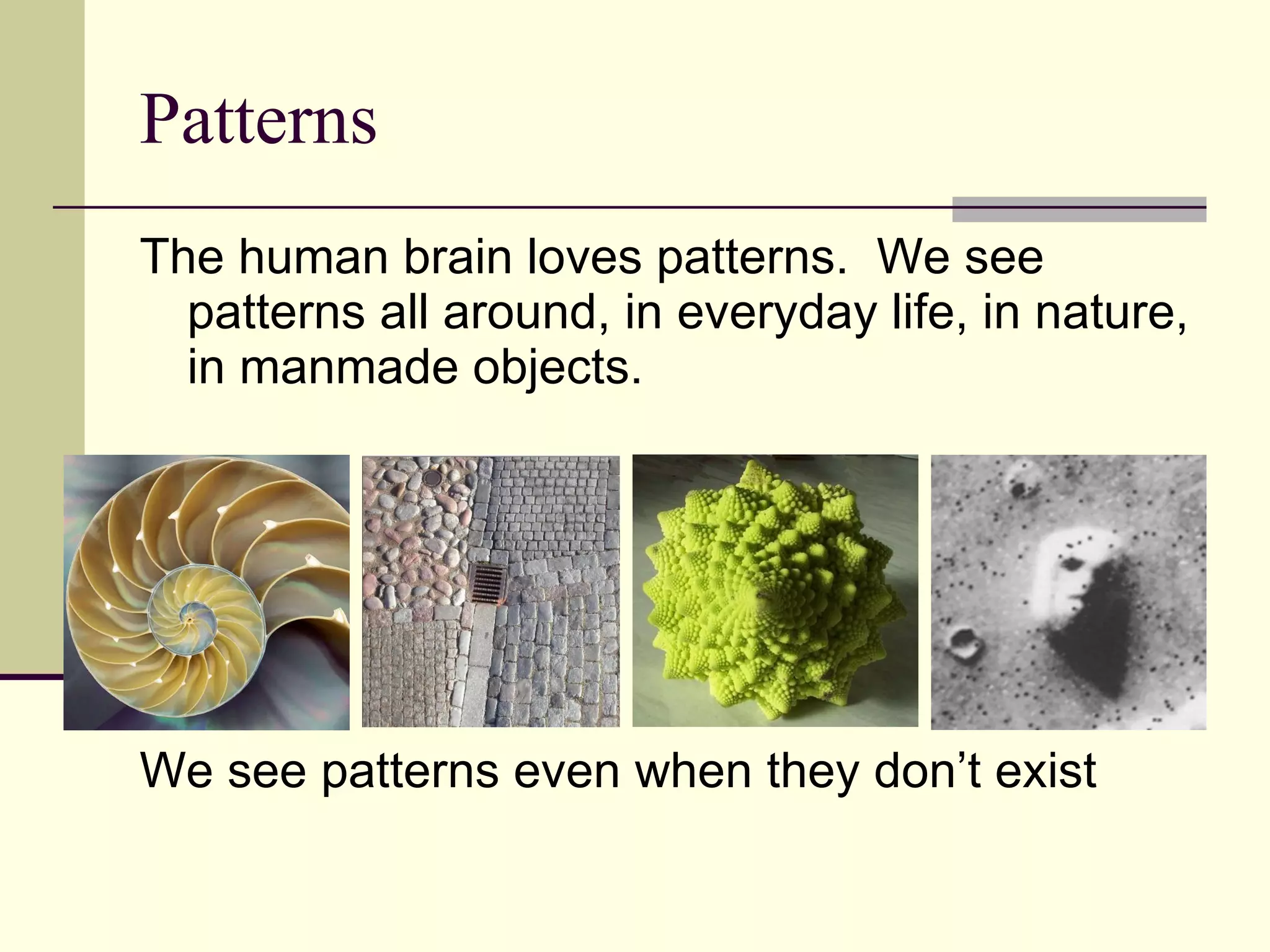
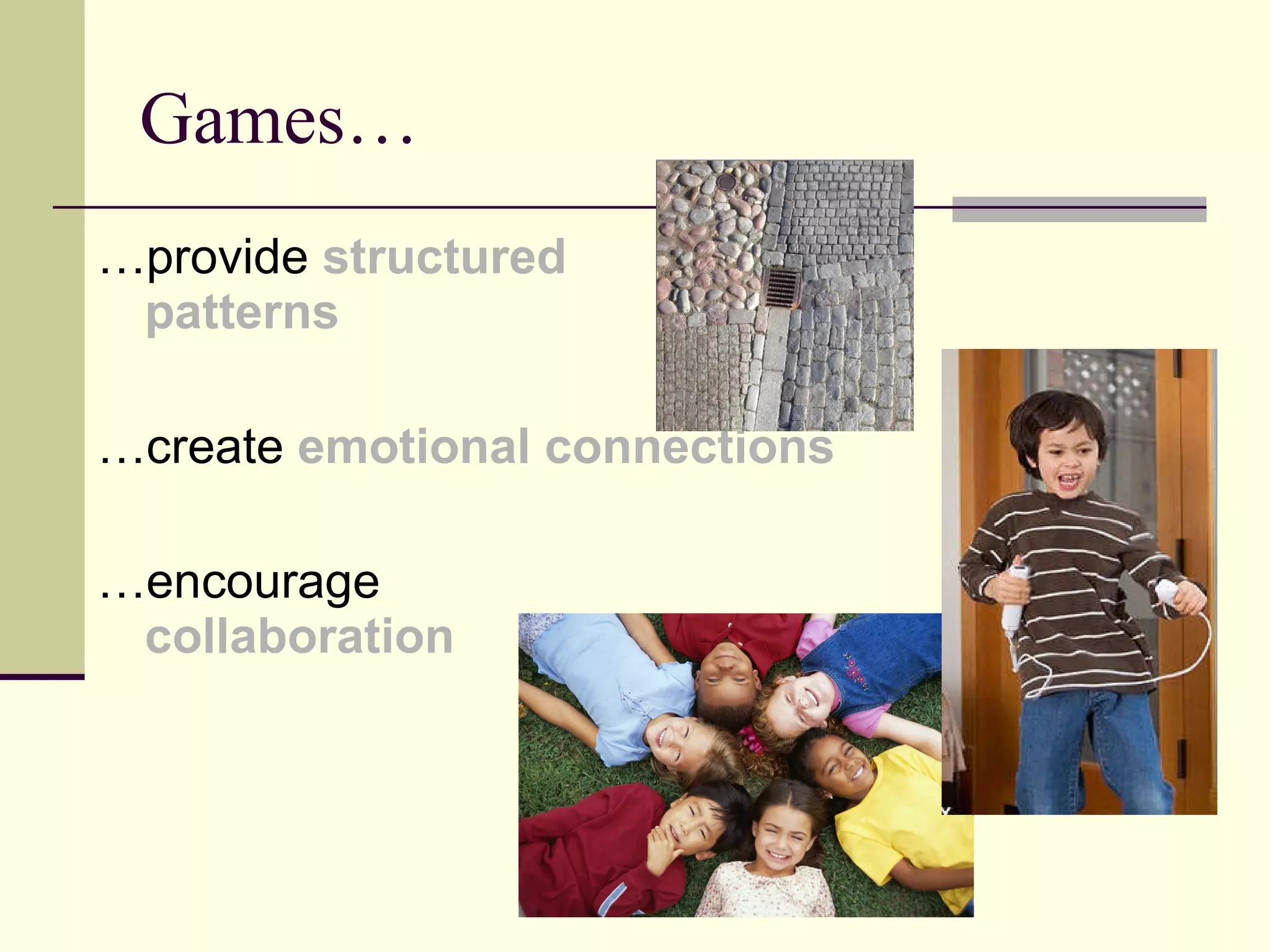
Patterns The human brain loves patterns.  We see patterns all around, in everyday life, in nature, in manmade objects. We see patterns even when they don’t exist
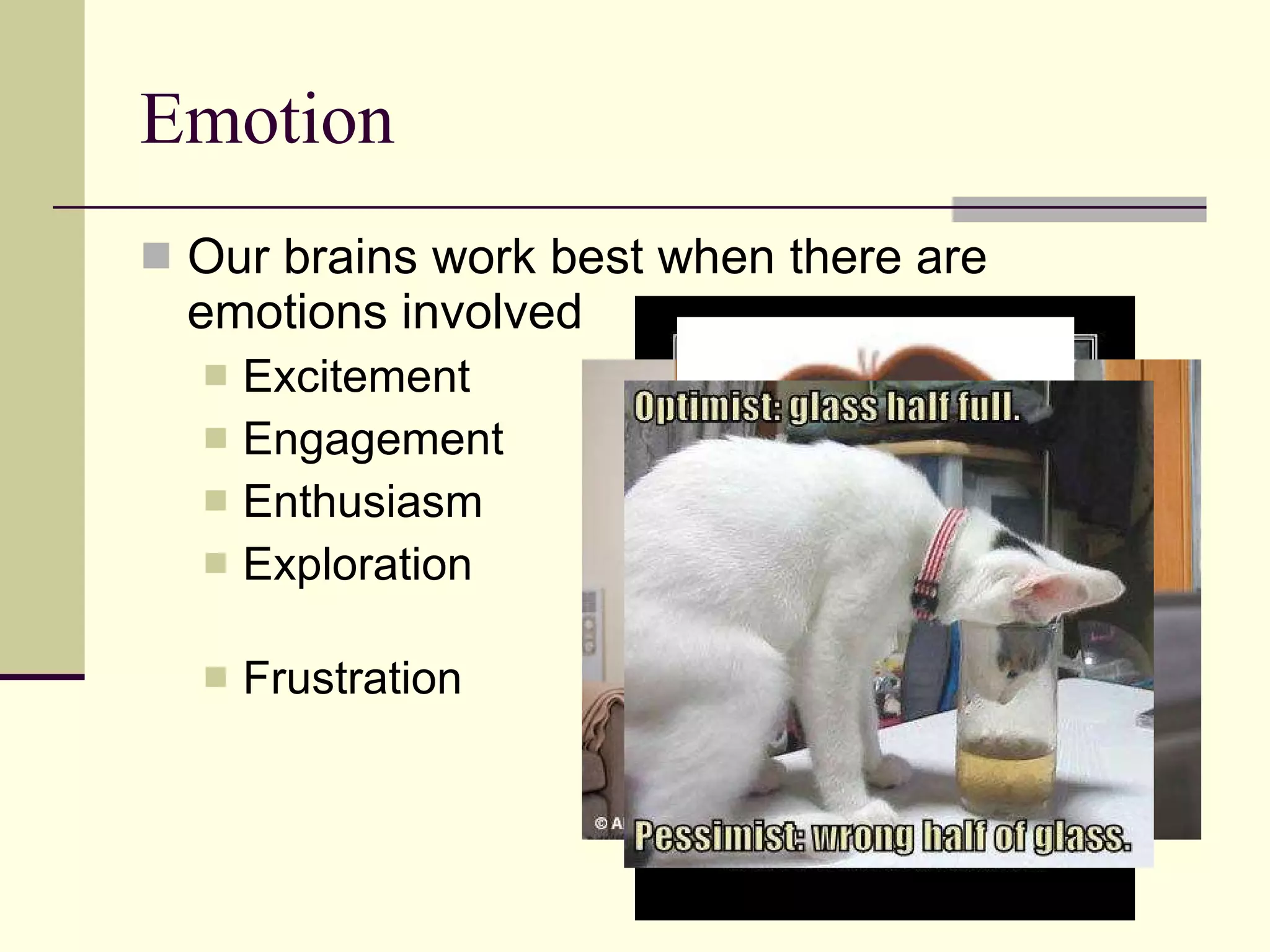
Emotion Our brains work best when there are emotions involved Excitement Engagement Enthusiasm Exploration Frustration
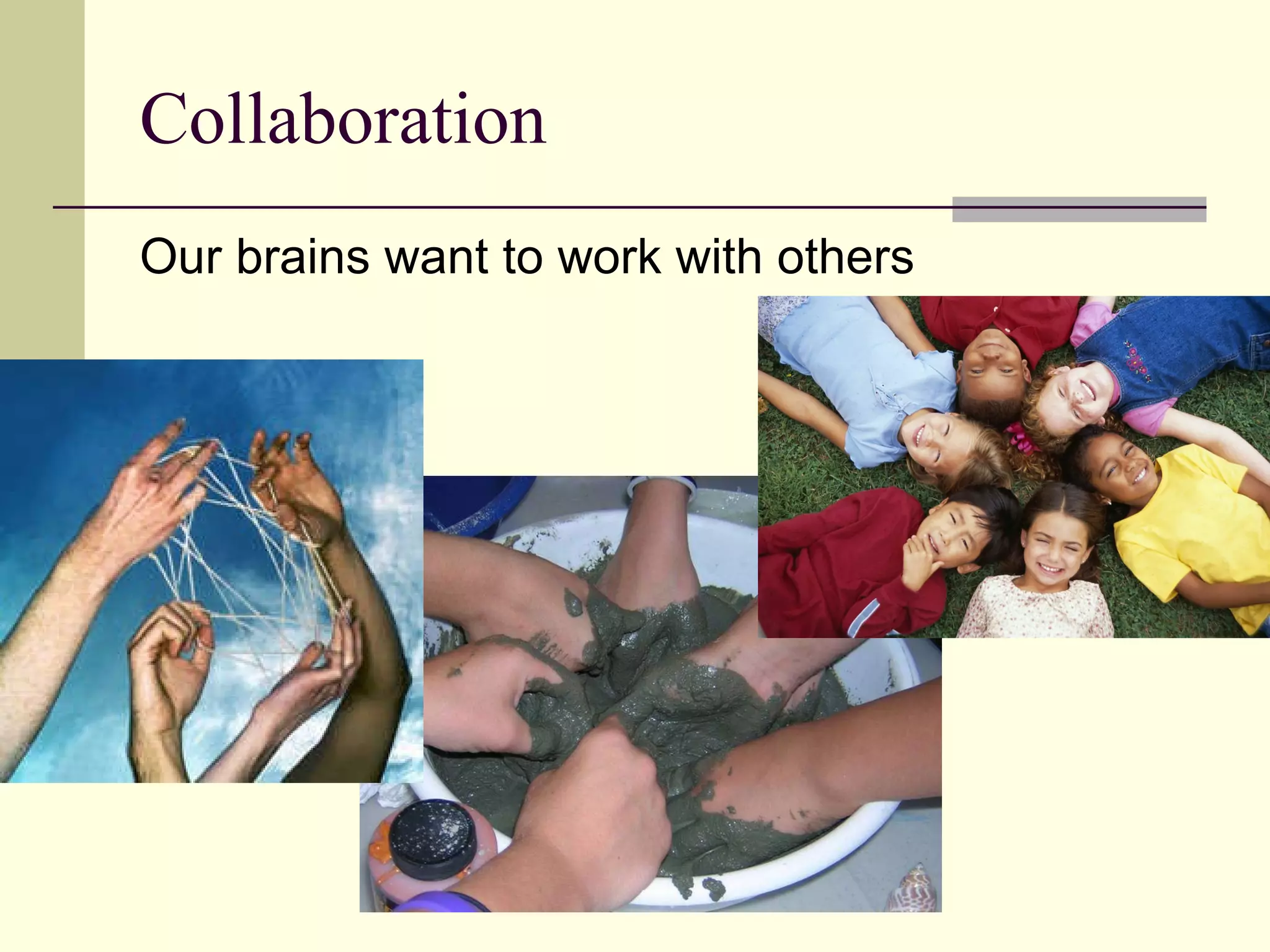
Collaboration Our brains want to work with others
Games… …provide  structured  patterns …create  emotional connections …encourage  collaboration
Video Games and HOTS “ Better theories of learning  are embedded in the video games many children play than in the schools they attend.” James Paul Gee What Video Games Have to Teach  Us About Learning and Literacy
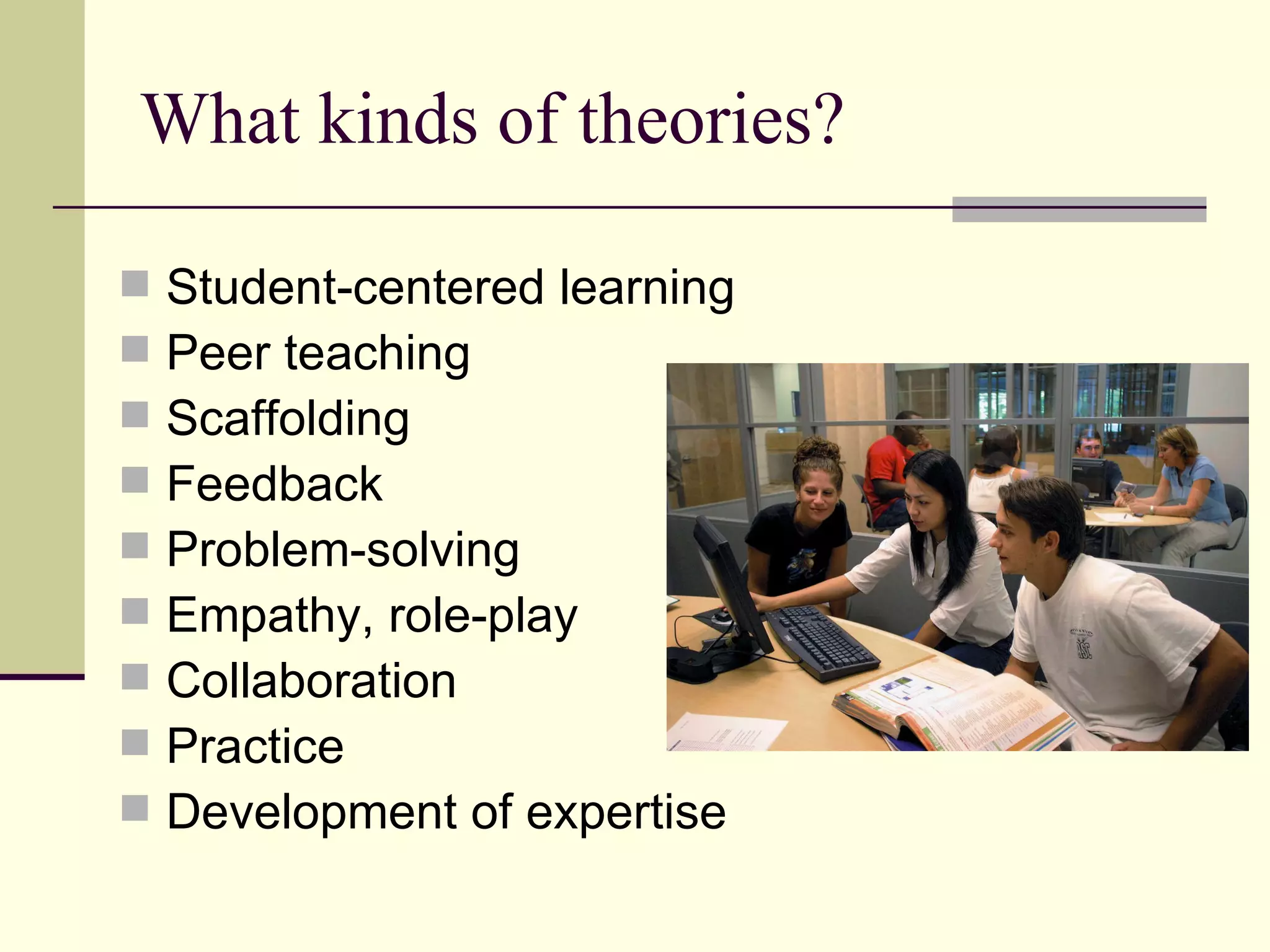
What kinds of theories? Student-centered learning Peer teaching Scaffolding Feedback Problem-solving Empathy, role-play Collaboration Practice Development of expertise
Scientific American A pernicious excitement to learn and play _____ has spread all over the country, and numerous clubs for playing this game have been formed in cities and villages. Why should we regret this? It may be asked.  We answer, _____ is a mere amusement of very inferior character, which robs the mind of valuable time that might be devoted to nobler acquirements, while it affords no benefit whatever to the body.  _____ has acquired a high reputation as being a means to discipline the mind, but persons engaged in sedentary occupations should never practice this cheerless game; they require out-door exercises—not this sort of mental gladiatorship.
Scientific American, July, 1859 A pernicious excitement to learn and play  chess  has spread all over the country, and numerous clubs for playing this game have been formed in cities and villages. Why should we regret this? It may be asked.  We answer,  chess  is a mere amusement of very inferior character, which robs the mind of valuable time that might be devoted to nobler acquirements, while it affords no benefit whatever to the body.  Chess  has acquired a high reputation as being a means to discipline the mind, but persons engaged in sedentary occupations should never practice this cheerless game; they require out-door exercises—not this sort of mental gladiatorship.
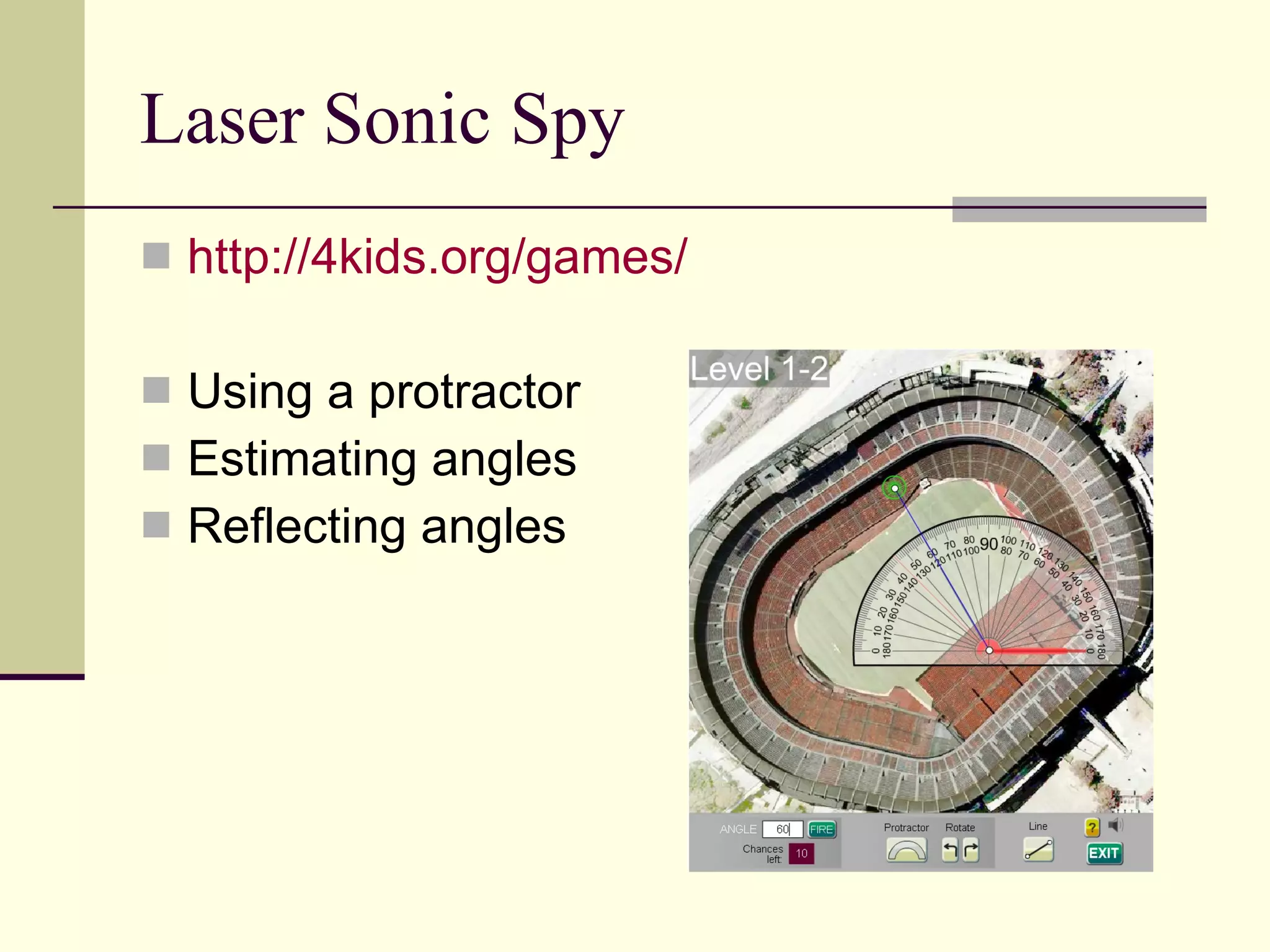
Laser Sonic Spy http://4kids.org/games/ Using a protractor Estimating angles Reflecting angles
Game Examples Food Force Stop Disasters Magic Pen You Are the Historian Team Treks Third World Farmer  Minyanland ElectroCity   Nanoquest   Real Lives Traveler IQ The Forbidden City Virtual History: Settling America Discover Babylon Dimension Math Lunar Quest Web Rangers Peacemaker Budget Hero
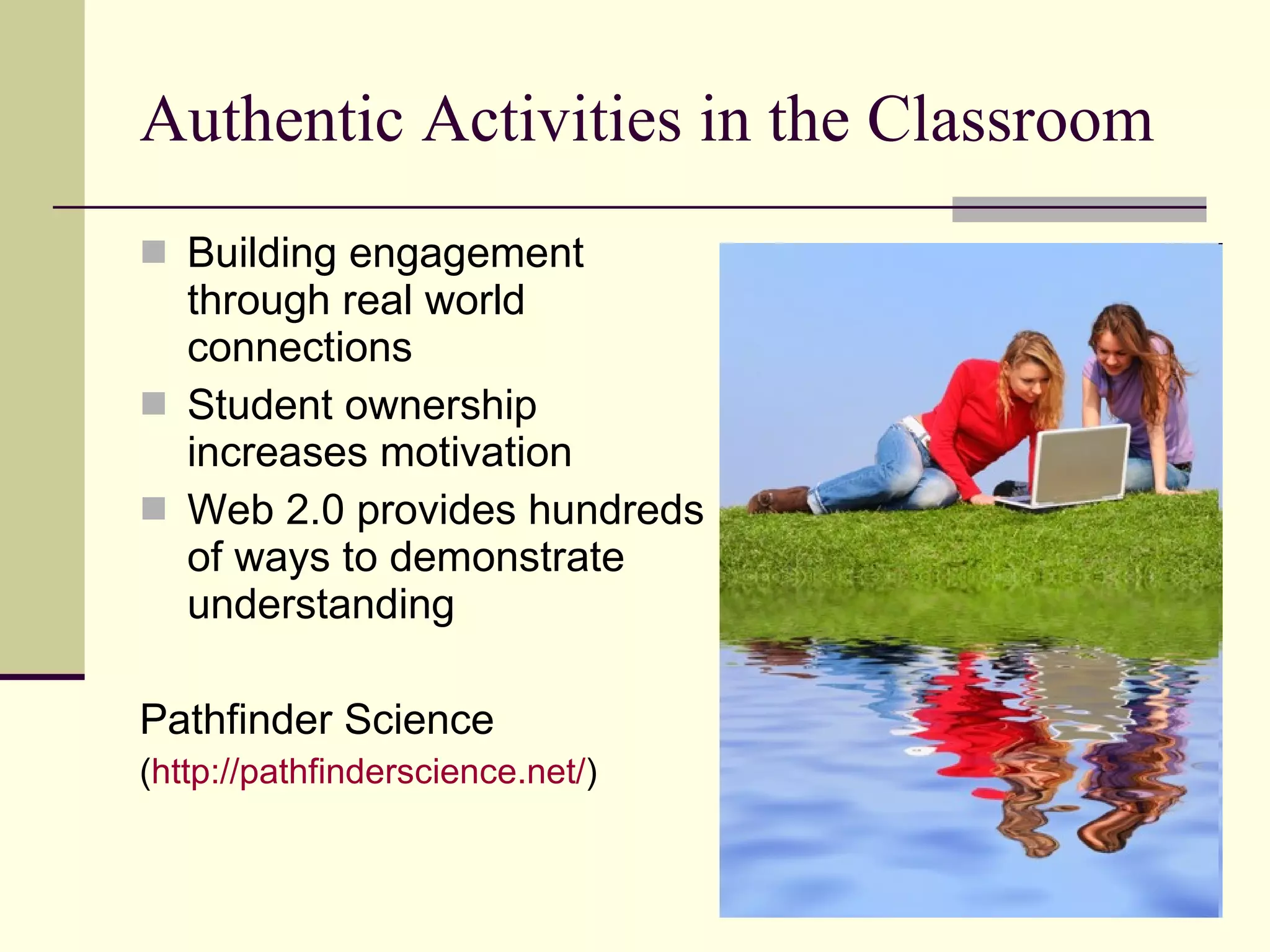
Authentic Activities in the Classroom Building engagement through real world connections Student ownership increases motivation Web 2.0 provides hundreds of ways to demonstrate understanding Pathfinder Science ( http:// pathfinderscience.net / )
Web 2.0 Users of the Web create information and have control over it Blogs, Wikis, YouTube The Web becomes truly interactive as different sites link data Mashups -  Flickr ,  Google Maps  Aggregators/Portals – IM, Twitter, RSS Social Bookmarking, “Folksonomies”
Engaged Learning Connect students to the world http://muti.co.za/static/newsmap.html   http://www.tenbyten.org/10x10.html http:// galleryofwriting.org Connect students to each other http:// www.epals.com
Authentic Learning with Web 2.0 Workshop  presented by blogger  Alan Levine Outline a story idea Find some media Pick a tool to build  the story 50 Ways to Tell the  Dominoe  Story
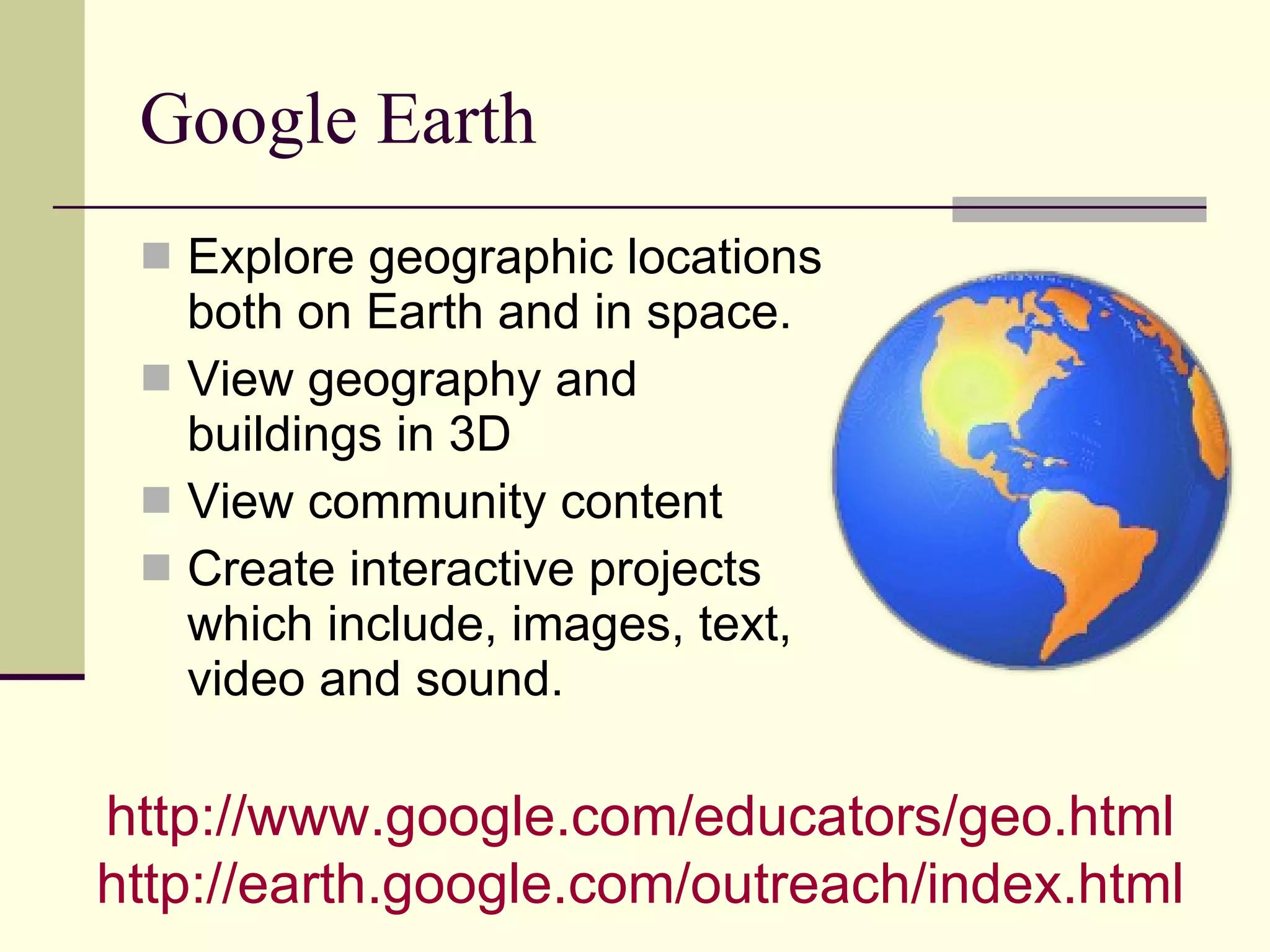
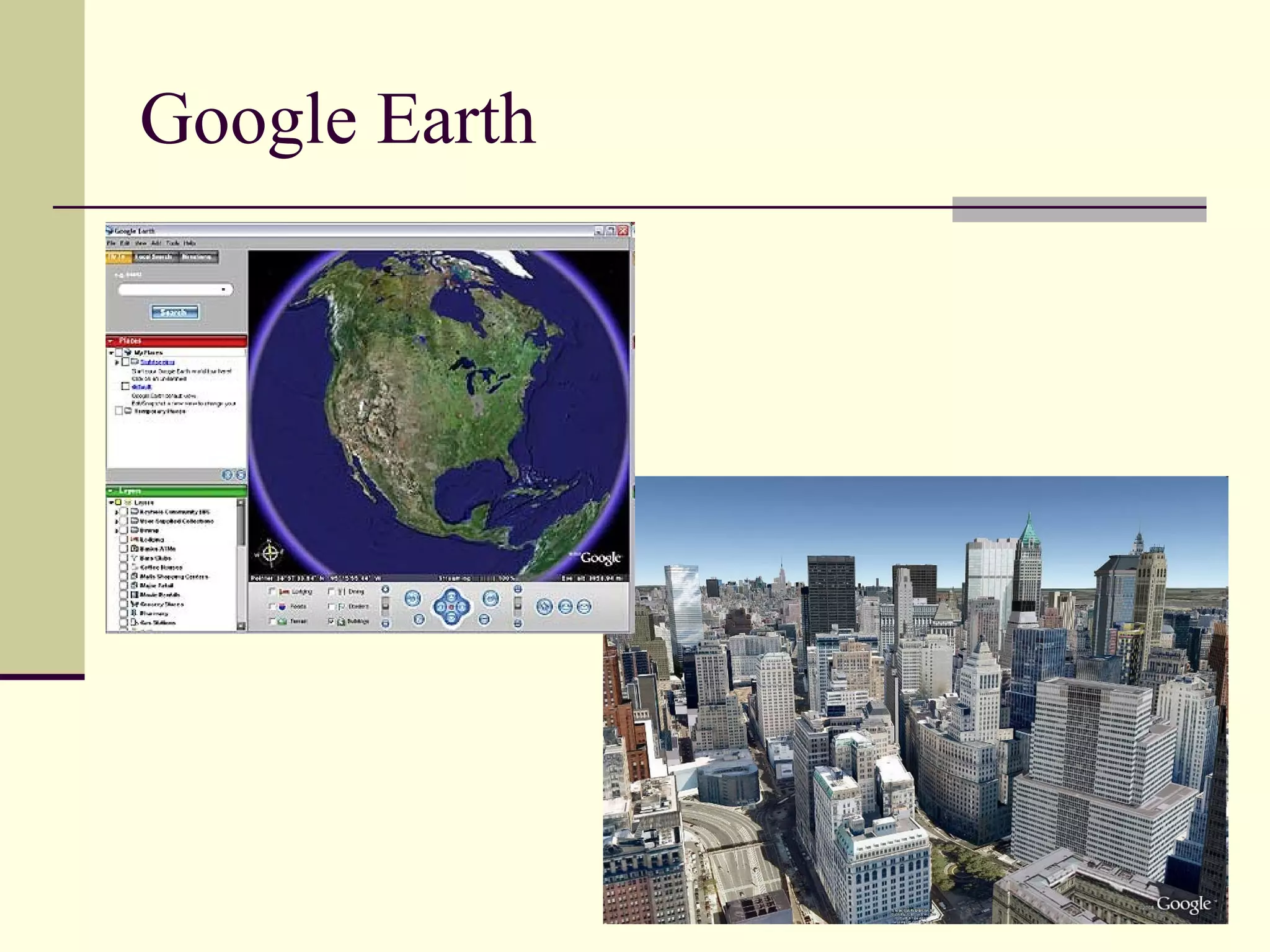
Google Earth Explore geographic locations both on Earth and in space. View geography and buildings in 3D View community content Create interactive projects which include, images, text, video and sound. http://www.google.com/educators/geo.html   http://earth.google.com/outreach/index.html
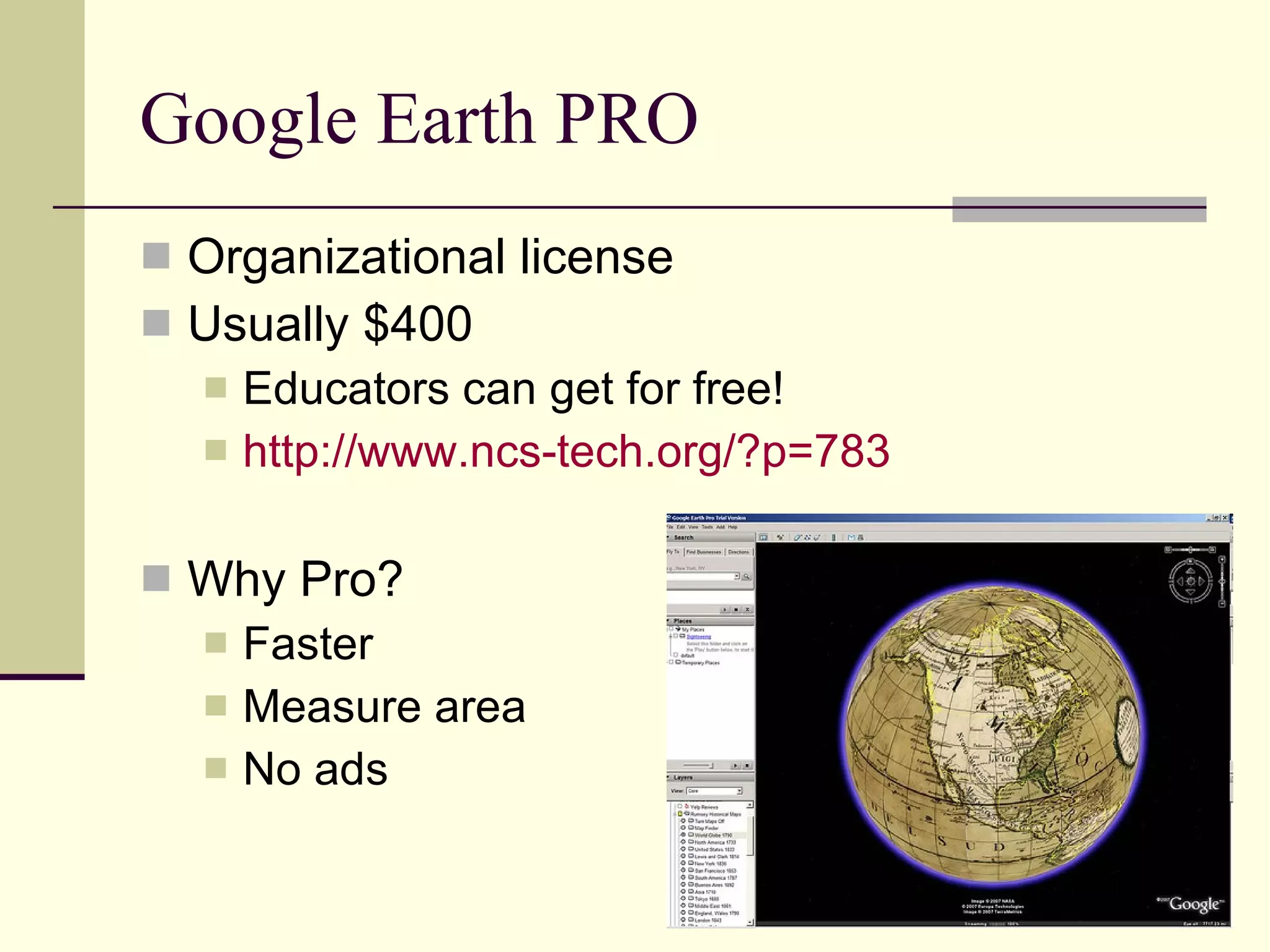
Google Earth PRO Organizational license Usually $400 Educators can get for free! http://www.ncs-tech.org/?p=783 Why Pro? Faster Measure area No ads
Google Earth
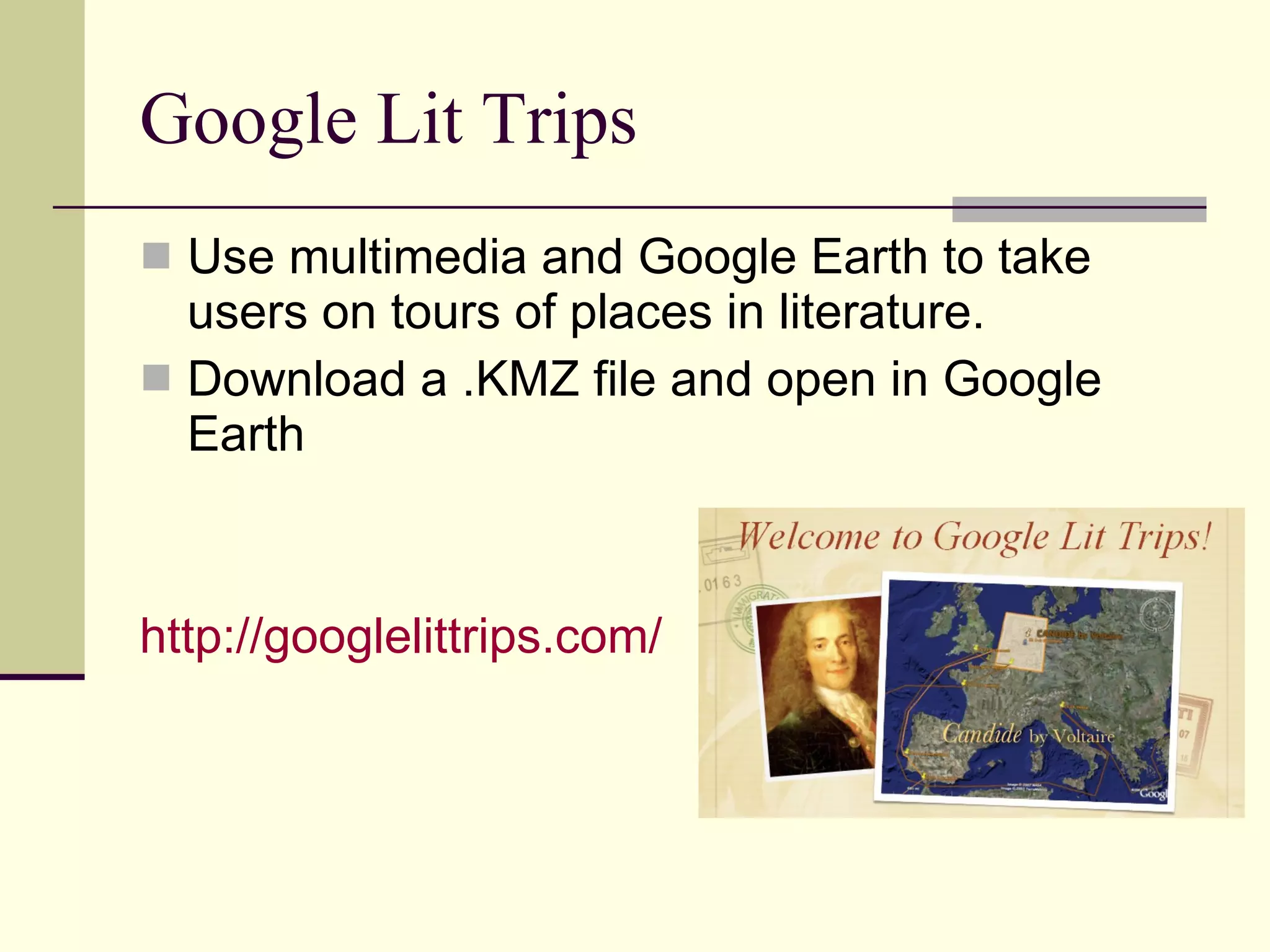
Google Lit Trips Use multimedia and Google Earth to take users on tours of places in literature. Download a .KMZ file and open in Google Earth http://googlelittrips.com/
Primary Source Material Engage Students Tie to prior knowledge Evaluate the source Look at details Make it personal Promote Inquiry Make speculations (creator, purpose, audience) Compare to other primary and secondary sources Talk about other places to find primary sources
Primary Source Example Library of Congress ( http:// www.loc.gov ) American Memory Project World Digital Library Thomas – Legislation Information Veteran’s history Teacher Resources
More Primary Sources Similar resources exist at many high-level government sites Geology & Geography ( http://USGS.gov )  Space and Physics ( http://NASA.gov )  Oceanography & Meteorology ( http://NOAA.gov )  Health & Medicine ( http://CDC.gov  &  http://HHS.gov )  Energy ( http://www.energy.gov )  Smithsonian Museums ( http:// si.edu )
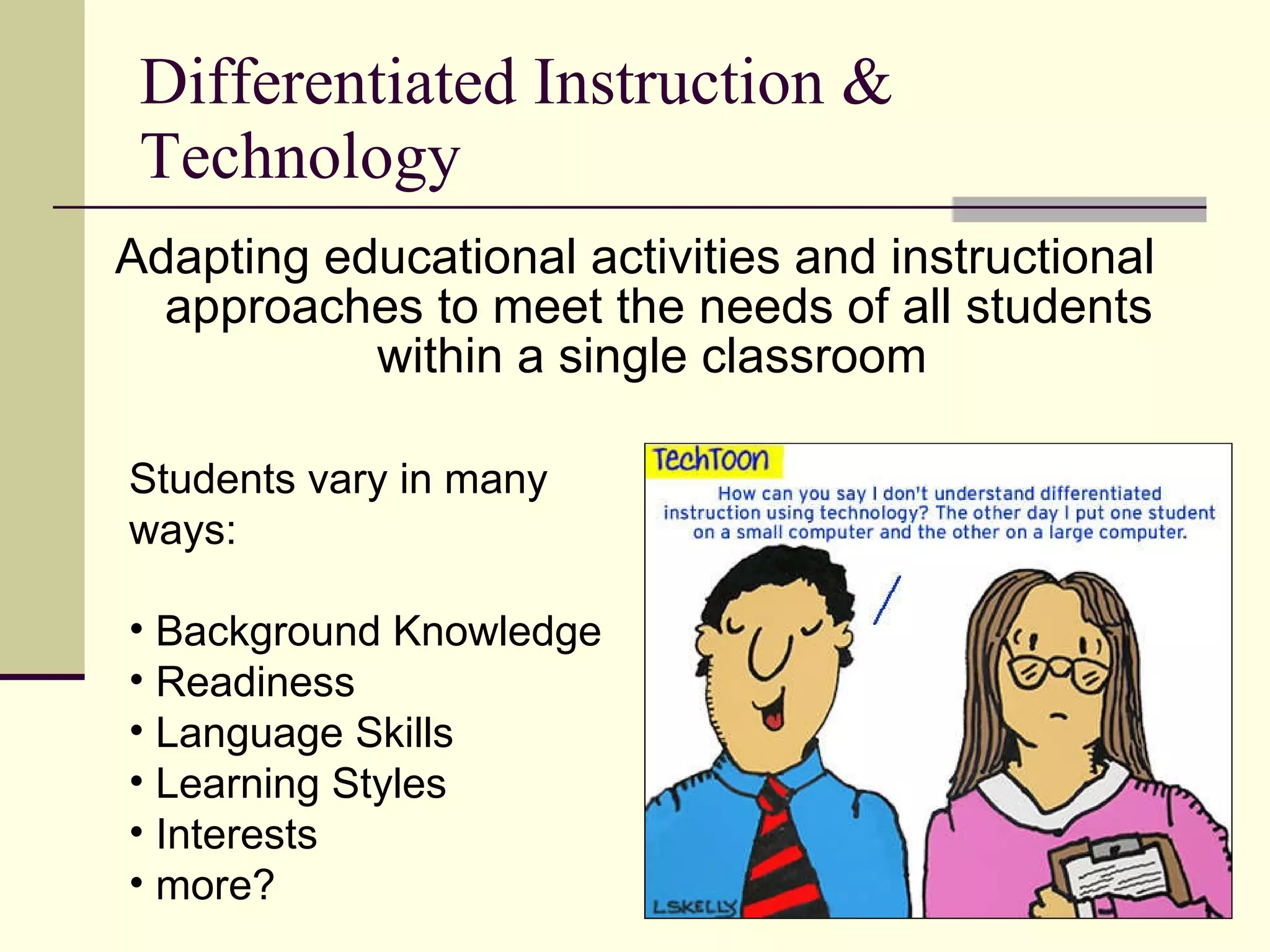
Differentiated Instruction & Technology Adapting educational activities and instructional approaches to meet the needs of all students within a single classroom  Students vary in many ways: Background Knowledge Readiness Language Skills Learning Styles Interests more?
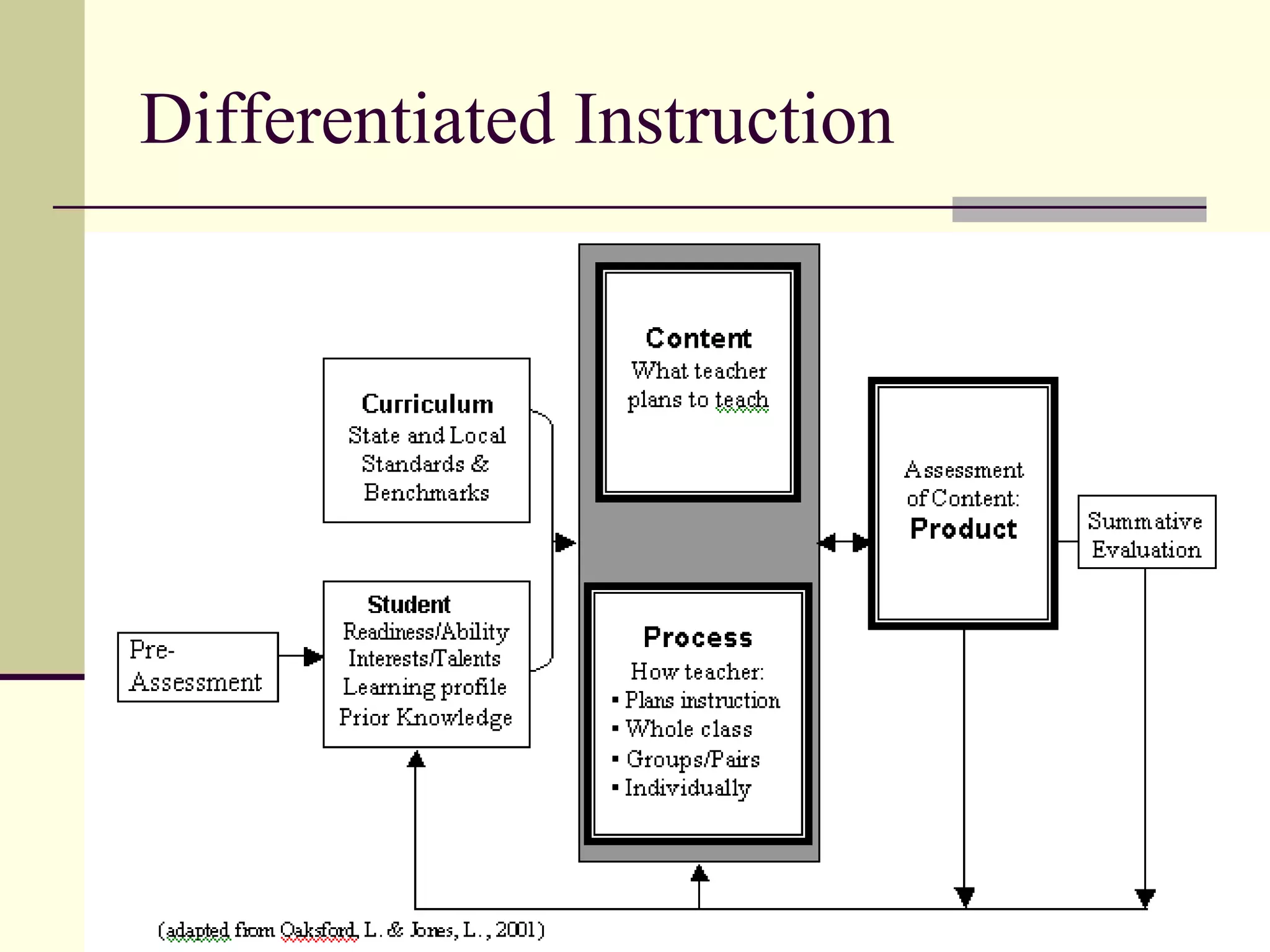
Differentiated Instruction
Differentiation - Content Student selection of topics/interests Compacting the curriculum Accelerated or remedial activities Example: ThinkTank ( http://thinktank.4teachers.org )
Differentiation - Process Vary the expectations and requirements Allow students to participate in setting goals Combine group work with individual activities Example: RubiStar and PBL Checklists ( http://rubistar.4teachers.org/ ) ( http://pblchecklist.4teachers.org/ )
Differentiation - Product Allow students to demonstrate knowledge in a variety of ways Vary performance expectations Example: KidsVid and Web Poster Wizard ( http:// kidsvid.altec.org / ) ( http://poster.4teachers.org/ )
Resources http://www.slideshare.net/dadams.altec Doug Adams [email_address] http:// altec.org

Tech Integration St James

  • 1.
    Integrating Technology intothe Classroom Doug Adams ALTEC [email_address]
  • 2.
  • 3.
    PowerPoint Slides (St.James) http://start.sjssf.net
  • 4.
    PowerPoint Slides (St.James) http://start.sjssf.net
  • 5.
    Description Participants willlearn about integrating technology into instructional activities through a combination of group activities and discussions . Emphasis will be placed on incorporating the use of higher-order thinking and complex thinking skills, as well as other 21st Century Skills such as collaboration and communication .
  • 6.
    (Super-duper approximate) Agenda Changing how we “Do School” Technology Planning 21 st Century Skills Group Activity Technology to Support Higher Order Thinking Intel Thinking Tools Project-Based Learning Lunch Collaboration Google Docs Games for Learning Authentic Learning Web 2.0 Tools in the classroom Google Earth/Lit Trips Access to Primary Sources 4Teachers Tools Conclusion
  • 7.
    Technology Planning Whydo we need a technology plan?
  • 8.
    Technology Planning Should:Be a continuous process Be personal to the organization Owned by the members of the organization Be broad but realistic Involve all stakeholders Formalize procedures for making-decisions Be driven by goals and standards rather than technology “ Guiding Questions for Technology Planning”, NCRTEC, http://www.ncrtec.org/capacity/guidewww/gqhome.htm
  • 9.
    Technology Planning NationalCenter for Technology Planning Guidebook for Developing a Technology Plan http://www.nctp.com/downloads/guidebook.pdf
  • 10.
    Technology Committee AdministrationTeachers Staff (including maintenance!) Students Parents Community Businesses Other?
  • 11.
    Cost-Benefit Analyses “Businesses think of technology as an investment, schools think of it as an expense” Value of Investment (VOI) - http://www.edtechvoi.org/ Total Cost of Ownership (TCO) - http://www.classroomtco.org/ -- Consortium for School Networks (CoSN)
  • 12.
  • 13.
    The Millennial Generation“ Millennials” “ Digital Natives” “ Thumb Tribe” “ Kids say e-mail is, like, sooooo dead.” – CNET News , July 18, 2007
  • 14.
    The Millennial Generation“ Today’s students are no longer the people our educational system was designed to teach” Mark Prensky
  • 15.
    Attitudes in theMillennial School “ I have to ‘ power down ’ when I go to school.” “ When I am really busy, I hate going to school because I can’t do any work there.”
  • 16.
    Characteristics of DigitalNatives Active Multi-tasking Non-linear thinking Ubiquity Technical Fluency Expectations of Feedback Individualization Risk-taking Information sifting
  • 17.
    Brain Research Thebrain developed to solve problems related to surviving in an unstable outdoor environment that occur in near constant motion. John Medina, Brain Rules
  • 18.
    Brain Research Ifyou wanted to create an educational environment that is directly opposed to the way the brain is good at doing, you would probably design something like the modern classroom . John Medina, Brain Rules
  • 19.
    21 st Century Skills 21stCenturySkills.org
  • 20.
    21 st Century Skills Core Subjects and 21 st Century Themes Math, Language Arts, Science, Social Studies Global Awareness and Civic Literacy Economic and Business Literacy Health Literacy Learning and Innovation Skills Creativity Critical Thinking and Problem Solving Communication and Collaboration
  • 21.
    21 st Century Skills Information Media and Technology Skills Information and Media Literacy Communication and Technology Literacy Life and Career Skills Flexibility and Adaptability Initiative, Productivity, and Self-direction Social Skills Leadership, Accountability and Responsibility
  • 22.
    Visual Ranking and21 st C Skills Intel’s Education Page http://intel.com/education K-12 Teaching Tools Visual Ranking Tool Click Student Log-In [email_address] Team ID Team Password
  • 23.
    Visual Ranking and21 st C Skills In groups, sort the list from most important (top) to least important (bottom) For the top three items , double click and explain why you ranked them as most important For the bottom two items , double click and explain why you ranked them as least important
  • 24.
  • 25.
    Bloom’s Revised Taxonomy(2001) (Anderson & Krathwohl et al , eds., 2001) “ Knowledge” “ Comprehension” “ Synthesis”
  • 26.
    Mind-set Verbs Apply: Do, use, organize, collect, operate, summarize, practice, solve, try Remember: State, show, list, tally, define, identify, repeat, recall, label, quote Understand: Restate, reword, describe, illustrate, review, discuss, explain (in your own words) Create: Develop, invent, extend, hypothesize, compose Evaluate: Judge, interpret, justify, assess, weigh, appraise, criticize Analyze: Extract, deduce, investigate, fill in, combine, disassemble,
  • 27.
    Organizing Bloom’s TaxonomyLevel 3: High Creating something unique (to the learner) Making judgments, choices, decisions Breaking down concepts into component parts Level 2: Intermediate Using information, skills, and concepts in new situations Level 1: Low Understanding and interpreting information Acquiring and remembering new information
  • 28.
    Why is itimportant to encourage higher-order thinking?
  • 29.
    Supporting Higher-Order ThinkingIt is estimated that 90% of all test questions asked in the US are of “Low level” - knowledge and comprehension (Wilen, W.W., 1992) “ Low level” doesn’t mean easy: Write an essay explaining the decline and fall of the Roman Empire incorporating at least five of the seven causes discussed in class from the writings of Gibbon and Toynbee “ High level” doesn’t mean hard: Which movie did you like more, WALL-E or Cars ? Why?
  • 30.
    Curriculum Framing QuestionsGuide a unit of study and include: Essential Questions Unit Questions Content Questions
  • 31.
    Essential Questions Arebroad, open-ended questions Address big ideas and enduring concepts Often cross discipline and help students see how subjects are related Example: Why is math important to my life? How does conflict produce change? What lessons can be learned by running a city?
  • 32.
    Unit Questions Areopen-ended questions that tie directly to a project or unit Help students demonstrate the scope of their understanding of a subject Examples: How important is measurement in building a home? How are changes in economics a factor in war? In the story, Charlotte’s Web , how do the animals’ different abilities help Wilbur survive and succeed? How does stress on the environment impact biology?
  • 33.
    Content Questions Arefact-based, concrete questions Have a narrow set of correct answers Often relate to definitions, identifications, and general recall of information (example: questions found on a test) Examples: How do you find the values of unknowns in equations? What is a fable? Who is the main character in To Kill a Mockingbird ? How are volcanoes made? Why is it cold in the winter when the sun is shining?
  • 34.
    Technology and ComplexThinking Intel Thinking Tools http:// www.intel.com /education/tools Visual Ranking : Assign ranking to a list; and then debate differences, reach consensus, and organize ideas Seeing Reason : Investigate relationships in complex systems Showing Evidence : Construct well-reasoned arguments that are supported by evidence, using a visual framework
  • 35.
    Complex Thinking StrategiesDecision Making Reasoning Investigation Experimental Inquiry Directed Problem Solving Creative Problem Solving Reflective Thinking
  • 36.
    Project-Based Learning (PBL)“ I hear and I forget. I see and I remember. I do and I understand . ” -- (Confucius)
  • 37.
    Students retain… 90% of what they learn when they teach someone else 5% of what they’ve learned from a lecture 10% of what they’ve learned from reading 20% of what they’ve learned from audio-visual presentation 30% of what they learn from a demonstration 50% of what they learn when engaged in a discussion 75% of what they learn by doing Source: NTL Institute for Applied Behavioral Science
  • 38.
    Why Projects? Tolearn collaboration, work in teams . To learn critical thinking, take on problems . To learn oral communication, present . To learn written communication, write . To learn technology, use technology . To develop citizenship, take on civic issues . To learn about careers, do internships . To learn content, do all of the above .
  • 39.
    Project-Based Learning ResourcesBuck Institute for Education (BIE) http://www.bie.org iEARN (International Education and Resource Network) http://www.iearn.org/ Edutopia http://www.edutopia.org/project-learning
  • 40.
  • 41.
    Collaborating with GoogleDocs http://docs.google.com Word Processing Spreadsheet Forms Presentations http:// start.sjssf.net
  • 42.
  • 43.
    Brain Research Thebrain developed to solve problems related to surviving in an unstable outdoor environment that occur in near constant motion. John Medina, Brain Rules
  • 44.
    Patterns The humanbrain loves patterns. We see patterns all around, in everyday life, in nature, in manmade objects. We see patterns even when they don’t exist
  • 45.
    Emotion Our brainswork best when there are emotions involved Excitement Engagement Enthusiasm Exploration Frustration
  • 46.
    Collaboration Our brainswant to work with others
  • 47.
    Games… …provide structured patterns …create emotional connections …encourage collaboration
  • 48.
    Video Games andHOTS “ Better theories of learning are embedded in the video games many children play than in the schools they attend.” James Paul Gee What Video Games Have to Teach Us About Learning and Literacy
  • 49.
    What kinds oftheories? Student-centered learning Peer teaching Scaffolding Feedback Problem-solving Empathy, role-play Collaboration Practice Development of expertise
  • 50.
    Scientific American Apernicious excitement to learn and play _____ has spread all over the country, and numerous clubs for playing this game have been formed in cities and villages. Why should we regret this? It may be asked. We answer, _____ is a mere amusement of very inferior character, which robs the mind of valuable time that might be devoted to nobler acquirements, while it affords no benefit whatever to the body. _____ has acquired a high reputation as being a means to discipline the mind, but persons engaged in sedentary occupations should never practice this cheerless game; they require out-door exercises—not this sort of mental gladiatorship.
  • 51.
    Scientific American, July,1859 A pernicious excitement to learn and play chess has spread all over the country, and numerous clubs for playing this game have been formed in cities and villages. Why should we regret this? It may be asked. We answer, chess is a mere amusement of very inferior character, which robs the mind of valuable time that might be devoted to nobler acquirements, while it affords no benefit whatever to the body. Chess has acquired a high reputation as being a means to discipline the mind, but persons engaged in sedentary occupations should never practice this cheerless game; they require out-door exercises—not this sort of mental gladiatorship.
  • 52.
    Laser Sonic Spyhttp://4kids.org/games/ Using a protractor Estimating angles Reflecting angles
  • 53.
    Game Examples FoodForce Stop Disasters Magic Pen You Are the Historian Team Treks Third World Farmer Minyanland ElectroCity Nanoquest Real Lives Traveler IQ The Forbidden City Virtual History: Settling America Discover Babylon Dimension Math Lunar Quest Web Rangers Peacemaker Budget Hero
  • 54.
    Authentic Activities inthe Classroom Building engagement through real world connections Student ownership increases motivation Web 2.0 provides hundreds of ways to demonstrate understanding Pathfinder Science ( http:// pathfinderscience.net / )
  • 55.
    Web 2.0 Usersof the Web create information and have control over it Blogs, Wikis, YouTube The Web becomes truly interactive as different sites link data Mashups - Flickr , Google Maps Aggregators/Portals – IM, Twitter, RSS Social Bookmarking, “Folksonomies”
  • 56.
    Engaged Learning Connectstudents to the world http://muti.co.za/static/newsmap.html http://www.tenbyten.org/10x10.html http:// galleryofwriting.org Connect students to each other http:// www.epals.com
  • 57.
    Authentic Learning withWeb 2.0 Workshop presented by blogger Alan Levine Outline a story idea Find some media Pick a tool to build the story 50 Ways to Tell the Dominoe Story
  • 58.
    Google Earth Exploregeographic locations both on Earth and in space. View geography and buildings in 3D View community content Create interactive projects which include, images, text, video and sound. http://www.google.com/educators/geo.html http://earth.google.com/outreach/index.html
  • 59.
    Google Earth PROOrganizational license Usually $400 Educators can get for free! http://www.ncs-tech.org/?p=783 Why Pro? Faster Measure area No ads
  • 60.
  • 61.
    Google Lit TripsUse multimedia and Google Earth to take users on tours of places in literature. Download a .KMZ file and open in Google Earth http://googlelittrips.com/
  • 62.
    Primary Source MaterialEngage Students Tie to prior knowledge Evaluate the source Look at details Make it personal Promote Inquiry Make speculations (creator, purpose, audience) Compare to other primary and secondary sources Talk about other places to find primary sources
  • 63.
    Primary Source ExampleLibrary of Congress ( http:// www.loc.gov ) American Memory Project World Digital Library Thomas – Legislation Information Veteran’s history Teacher Resources
  • 64.
    More Primary SourcesSimilar resources exist at many high-level government sites Geology & Geography ( http://USGS.gov ) Space and Physics ( http://NASA.gov ) Oceanography & Meteorology ( http://NOAA.gov ) Health & Medicine ( http://CDC.gov & http://HHS.gov ) Energy ( http://www.energy.gov ) Smithsonian Museums ( http:// si.edu )
  • 65.
    Differentiated Instruction &Technology Adapting educational activities and instructional approaches to meet the needs of all students within a single classroom Students vary in many ways: Background Knowledge Readiness Language Skills Learning Styles Interests more?
  • 66.
  • 67.
    Differentiation - ContentStudent selection of topics/interests Compacting the curriculum Accelerated or remedial activities Example: ThinkTank ( http://thinktank.4teachers.org )
  • 68.
    Differentiation - ProcessVary the expectations and requirements Allow students to participate in setting goals Combine group work with individual activities Example: RubiStar and PBL Checklists ( http://rubistar.4teachers.org/ ) ( http://pblchecklist.4teachers.org/ )
  • 69.
    Differentiation - ProductAllow students to demonstrate knowledge in a variety of ways Vary performance expectations Example: KidsVid and Web Poster Wizard ( http:// kidsvid.altec.org / ) ( http://poster.4teachers.org/ )
  • 70.
    Resources http://www.slideshare.net/dadams.altec DougAdams [email_address] http:// altec.org

Editor's Notes

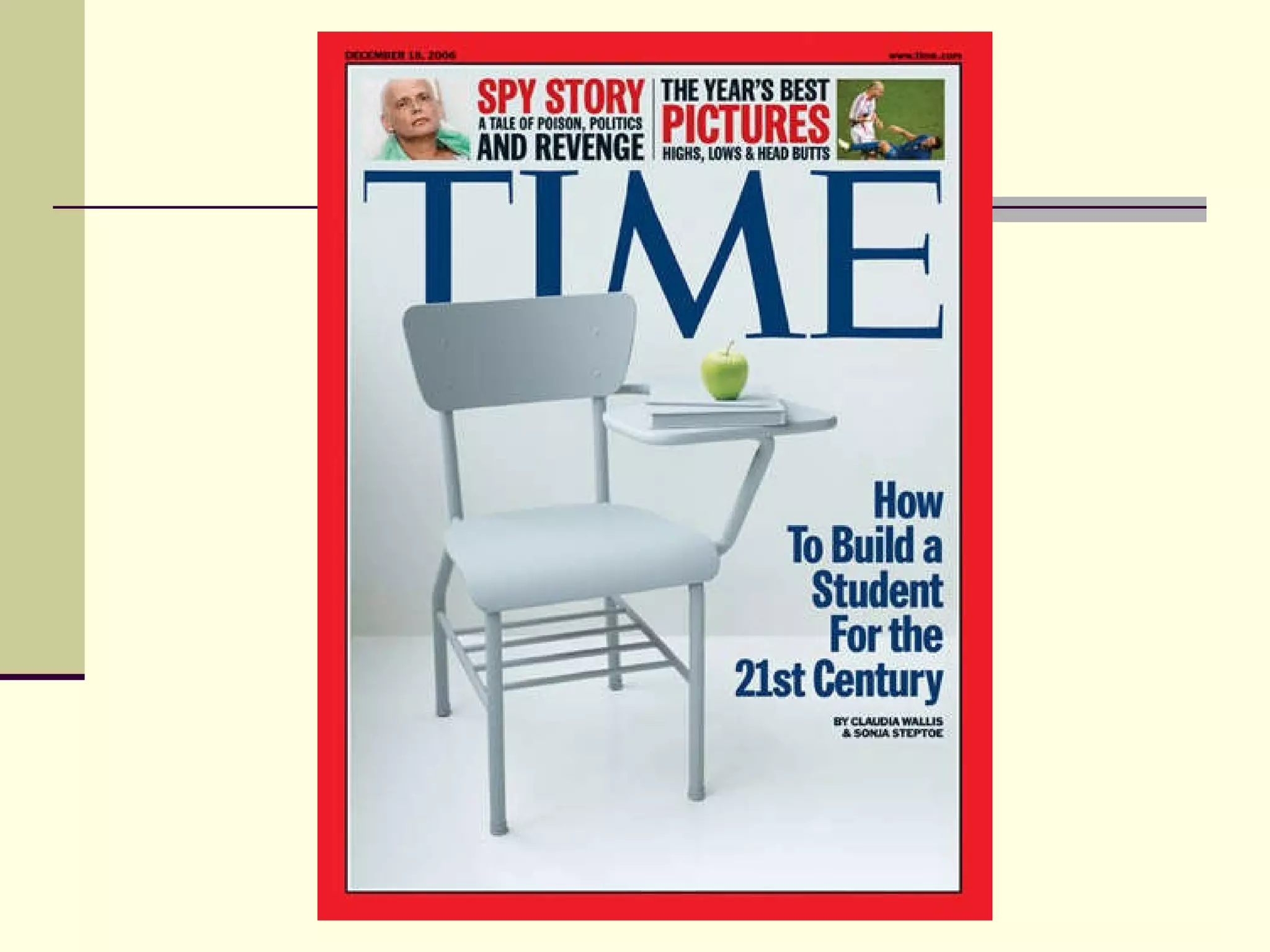
  • #13 TIME article starts with Rip Van Winkle He wakes up, sees people walking on the streets with metal things on their heads Totally lost, until he walks into a school, that’s familiar to him!! Schools were built on the Agrarian & Industrial model They do a nice job of highlighting the 21 st Century Skills necessary for kids to be competitive in a global economy: good examples Preparing for Jobs that don’t exist yet! China becoming #1 English speaking country India has more honors students than we have students Have to Power Down when they come to school NEED: Article link posted online (NING)
  • #14 Nicknames Thumb Tribe—Brayden story Characteristics—just to give you a picture NEED: VISUAL RANKING activity--instructor: [email_address] team name: team1, team2, team3... team8 team password: team1, team2, team3... team8
  • #17 Active Web 2.0 – students are creators. In his book Joystick Nation , J.C. Herz wrote “TV turned kids of the fifties and sixties into a nation of screen watchers, videogames have created a cadre of screen manipulators”. At the very least, kids expect to be able to comment. Usually they want to construct. Multi-tasking The brain is linear in its application. Multi-tasking is really quickly switching and frequently between tasks. This comes naturally to a digital native, but makes non-natives uncomfortable. Non-linear thinking Hypertext and information on demand allows students to explore. Depth of thought is often exchanged for breadth of experience, leaving detailed information for on-demand searching – why memorize the periodic table when you can look it up whenever you need it? Be aware stat student research may lead them away from their initial topic idea. Ubiquity Technology is everywhere, and kids expect to be able to connect with anyone, anytime. See “periodic table” above Technical Fluency Compare to a person who is speaking a foreign language. Even if you speak it well, a native speaker sounds like he is talking faster. A digital native just “knows” how to interact with technology just as a native of a foreign country knows how to interact in a new situation. A native speaker uses nuances, slang, and assumptions of cultural reference. “Invisible bike” or “Leeeroy Jenkins” or “RickRoll” Feedback Instant feedback is expected. Students will desire frequent reward opportunities. Very clear goals and requirements are desired. And those goals should be individualized as much as possible (next) Individualization Digital Natives expect that their technology will be customized for them. Gone are the days of the model-T (“any color you want as long as it is black”) or the princess phone. Web sites, stores, music, and even material things are individual and customized. Risk-takers Losing a game or failing a task just means that you need to try again. Learning new technology (which happens all the time) is a matter of just trying something and watching how it responds. Mastery principles should come into play to give students more opportunities – errors are chances to grow rather than failures to learn. Information sifting Students can manage vast amounts of information. They can quickly categorize data and find the relevant parts. For example, embedded advertising and popup windows.
  • #31 They help the teacher and the students focus on the task at hand, and tap into those higher order thinking levels by always keeping the big goal in mind.
  • #40 http://www.iste.org/content/navigationmenu/research/reports/the_road_ahead_background_papers_1997_/project-based_learning.htm