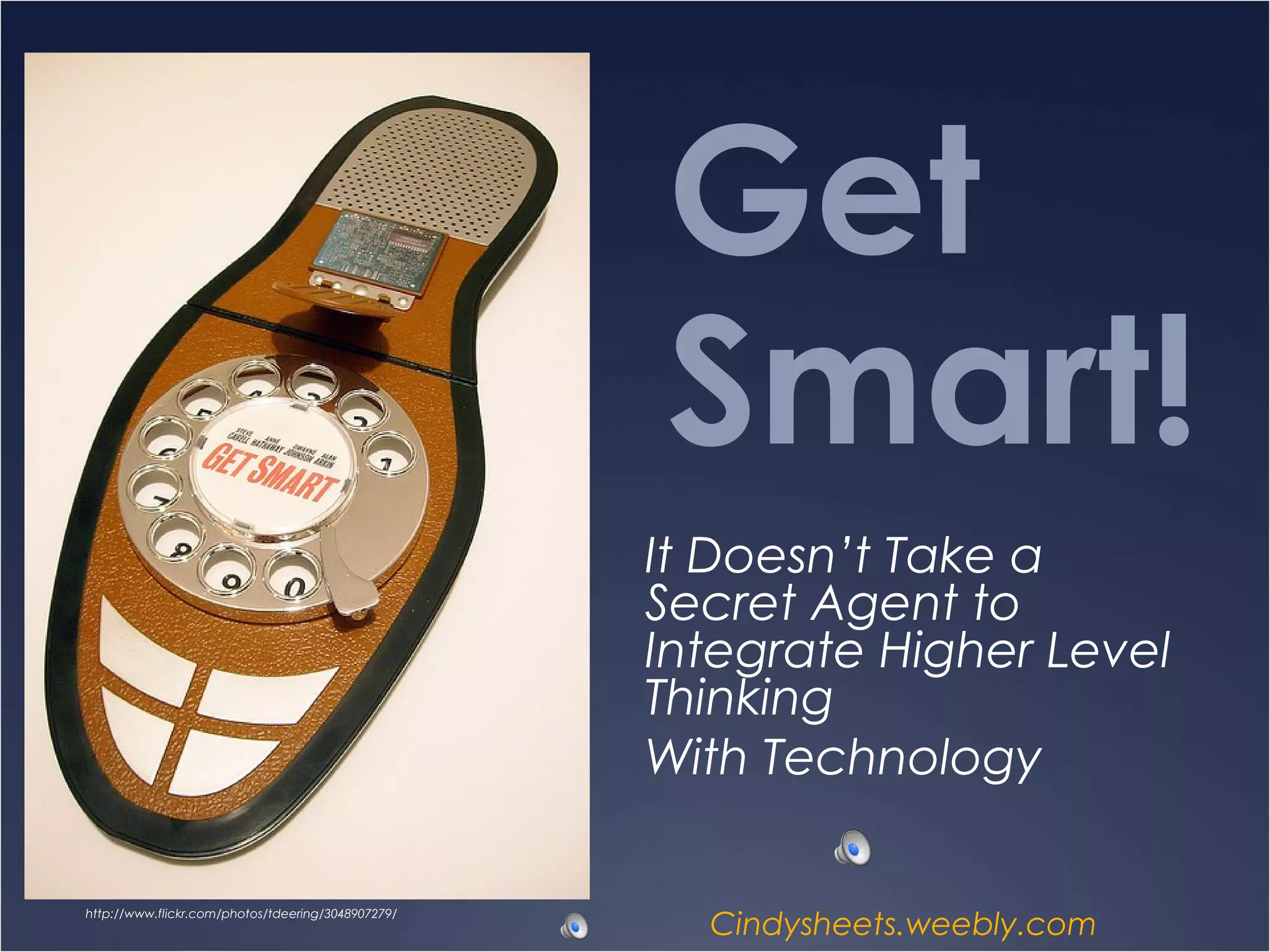
Get
Smart!
It Doesn’t Take a
Secret Agent to
Integrate Higher Level
Thinking
With Technology
http://www.flickr.com/photos/tdeering/3048907279/
Cindysheets.weebly.com
http://todaysmeet.com/getsmartpodstock
1. When I think about Common Core, I worry that
_____________.
2. I plan to use technology to implement Common
Core objectives by ___________________.
3. I encourage students to use higher level thinking
by _____________ ( or my favorite technique)
 LiveBinder
 Get Smart! (author = hisheets)
http://bit.ly/14ENmHA
Contact and Resources
 Website cindysheets.weebly.com
 Email - work cindysheets@smsd.org
 Email – personal cindysheets@aha-learners.org
 Plurk, Twitter hisheets
http://todaysmeet.com/getsmartpodstock2013
Goals
 Bloom’s Taxonomy
 Higher Level Thinking & CCSS (or KCCRS)
 Getting “Smart” in our teaching
 How we interact with students
 Questioning and discussions
 Using great tech tools
 Resources
 Projects
The world is moving at a tremendous
rate. No one knows where. We must
prepare our children, not for the world
of the past, not for our world, but for
their world, the world of the future.
John Dewey
‘Our kids will
spend the
rest of their
lives
in the future.
Are we
getting them
ready?’
Kevin Honeycutt
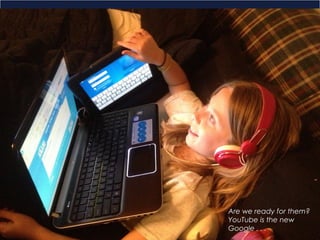
Are we ready for them?
YouTube is the new
Google . . .
Get Smart about Interacting with
Students
Worried about
Common
Core?
Think about that great unit . . .
 Was the lesson/unit open-ended enough to allow students to
pursue topics/projects of personal interest?
 Was there hands-on involvement apart from “textbook
learning”?
 Was the use of multiple sources to discover information and
solutions in evidence?
 Was the lesson/unit relevant to the everyday life of the
student?
 Was the lesson/unit interesting to you, the teacher?
 Did the lesson/unit connect to students’ prior learning
experiences and provide bridges to more advanced or diverse
learning opportunities?
Jim Delisle, Free Spirit Blog, July 12, 2013
CCSS
concepts
rather than
facts
 They appreciate nuances, such as how the
composition of an audience should affect
tone when speaking
 They use technology and digital media
strategically and capably.
 Conduct short as well as more sustained
research projects based on focused
questions, demonstrating understanding of the
subject under investigation.
 From Common Core introduction
 H. Lynn Erickson (Concept Based Curriculum)
The boss . . .who wants your best work, your art and your
genuine enthusiasm:
...can demand that you bring your best possible work
the first time, . . .
...or they can nurture you, encourage you, set
a high bar and then support you on your
way. They can teach you, cajole you and
introduce you to others that will do the same.
The first strategy is the factory mindset
You don't make art this way, or emotional connections,
or things that haven't been made before. You may
get the job done, but it's not clear if you'll make a
difference.
Seth Godin: Nature vs Nurture
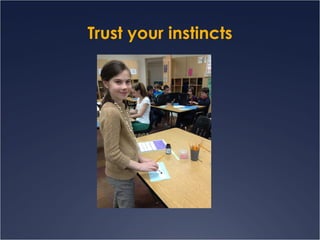
Trust your instincts
Jeff Danielian
NAGC
 "I have always believed that every student
deserves the opportunity to share what they
know and what they want to know.”
 "If it is skills you are evaluating, give them choice
of content. If it is content, give them choice of
product."
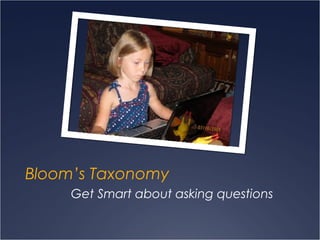
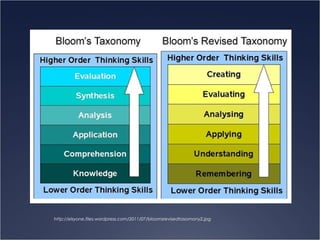
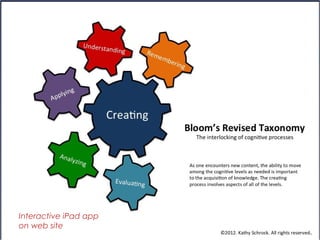
Bloom’s Taxonomy
Get Smart about asking questions
“To be ready for college, workforce training, and life
in a technological society,
students need the ability to gather, comprehend,
evaluate, synthesize, and report on information and ideas,
to conduct original research in order to answer questions or solve
problems,
and to analyze and create a high volume and extensive range of print
and non-print texts
in media forms old and new.”
From Common Core State Standards
http://elsyone.files.wordpress.com/2011/07/bloomsrevisedtaxomony2.jpg
Interactive iPad app
on web site
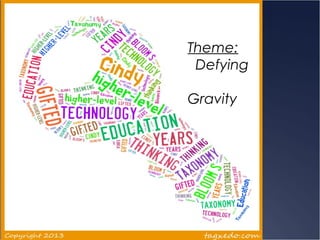
Theme:
Defying
Gravity
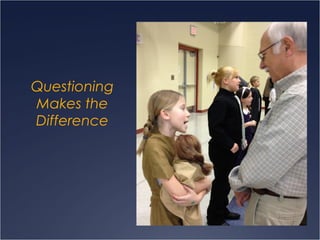
Questioning
Makes the
Difference
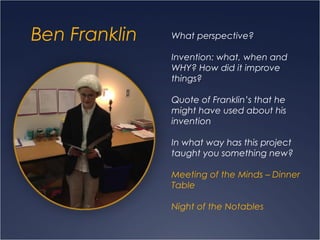
Ben Franklin What perspective?
Invention: what, when and
WHY? How did it improve
things?
Quote of Franklin’s that he
might have used about his
invention
In what way has this project
taught you something new?
Meeting of the Minds – Dinner
Table
Night of the Notables
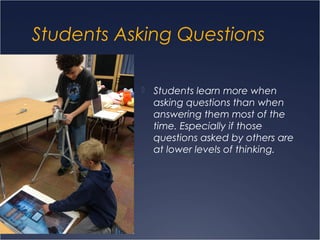
Students Asking Questions
 Students learn more when
asking questions than when
answering them most of the
time. Especially if those
questions asked by others are
at lower levels of thinking.
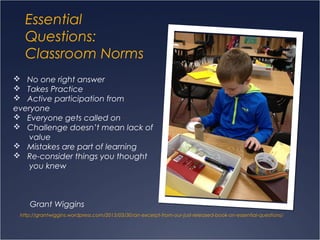
Essential
Questions:
Classroom Norms
 No one right answer
 Takes Practice
 Active participation from
everyone
 Everyone gets called on
 Challenge doesn’t mean lack of
value
 Mistakes are part of learning
 Re-consider things you thought
you knew
http://grantwiggins.wordpress.com/2013/03/30/an-excerpt-from-our-just-released-book-on-essential-questions/
Grant Wiggins
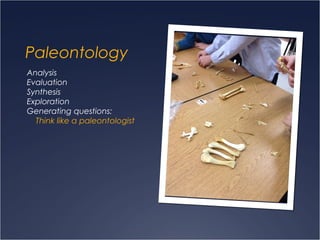
Paleontology
Analysis
Evaluation
Synthesis
Exploration
Generating questions:
Think like a paleontologist
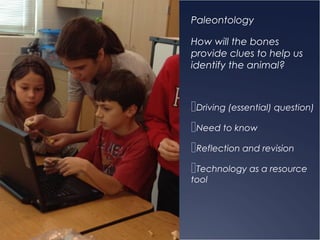
Paleontology
How will the bones
provide clues to help us
identify the animal?
Driving (essential) question)
Need to know
Reflection and revision
Technology as a resource
tool
“It doesn’t matter what you cover;
it matters how much you
develop the capacity to
discover.”
 Norm Chomsky, 2003
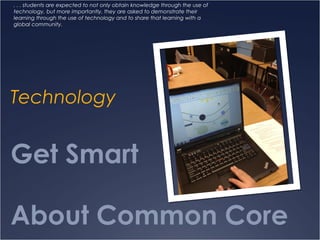
Get Smart
About Common Core
Technology
. . . students are expected to not only obtain knowledge through the use of
technology, but more importantly, they are asked to demonstrate their
learning through the use of technology and to share that learning with a
global community.
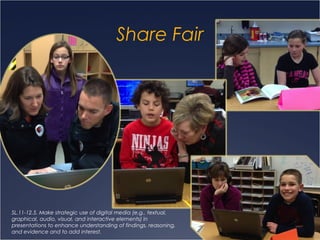
Share Fair
SL.11-12.5. Make strategic use of digital media (e.g., textual,
graphical, audio, visual, and interactive elements) in
presentations to enhance understanding of findings, reasoning,
and evidence and to add interest.
Choose the Media Based on the
Content
 Who is your audience?
 What content do you have to share?
 Why do you think this is the best format to share
it?
 What will it look like when completed? (model)
RI.8.7. Evaluate the advantages and disadvantages of using
different mediums (e.g., print or digital text, video, multimedia)
to present a particular topic or idea.
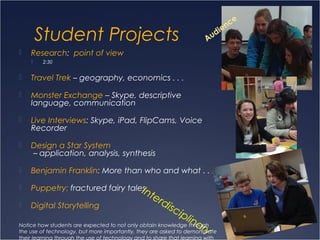
Student Projects
 Research: point of view
 2:30
 Travel Trek – geography, economics . . .
 Monster Exchange – Skype, descriptive
language, communication
 Live Interviews: Skype, iPad, FlipCams, Voice
Recorder
 Design a Star System
– application, analysis, synthesis
 Benjamin Franklin: More than who and what . . .
 Puppetry: fractured fairy tales
 Digital Storytelling
Interdisciplinary
Audience
Notice how students are expected to not only obtain knowledge through
the use of technology, but more importantly, they are asked to demonstrate
their learning through the use of technology and to share that learning with
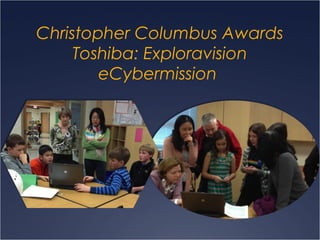
Christopher Columbus Awards
Toshiba: Exploravision
eCybermission
Endangered Species
•Scaffold research
•Purpose: Why should we
save this animal? Convince
me!
•Posters – Excel
•Slogans
•Presentation
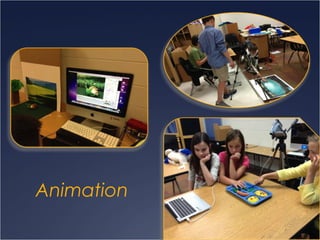
Animation
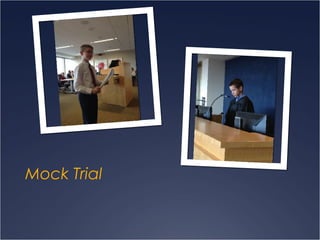
Mock Trial
Mapping Media to the Common Core
Wesley Fryer
 Maps.playingwithmedia.com
 Moving at the Speed of Creativity (blog)
 Terminology – change how we label things
 Idea of transliteracy:
 Transliteracy is the ability to read, write and
interact across a range of platforms, tools and
media from signing and orality through
handwriting, print, TV, radio and film, to digital
social networks.
Scratch & Math
Standards:
ISTE Nets Standards for Students:
Creativity and Innovation - 1.a, 1.b, 1.c
Communication and Collaboration - 2.b
Critical Thinking, Problem Solving, and Decision Making - 4.b
Technology Operations and Concepts - 6.c, 6.d
Math Common Core Standards:
5.OA-3, 5.NBT-1, 5.NBT-5, 5.MD-1, 5.MD-2, 5.MD-3, 5.G-1, 5.G-2, 5.G-3, 5.G-
4, 6.RP-3, 6.NS-2, 6.NS-5, 6.NS-7, 6.NS-8, 6.EE-9, 6.G-4, 7.NS-1, 7.NS-2, 7.G-1,
8.F-1, 8.F-4
http://labs.greenbush.us/moodle/course/view.php?id=15
Scratch Project-LA
3.3a Establish a situation and introduce a narrator and/or characters;
organize an event sequence that unfolds naturally.
3.3b Use dialogue and descriptions of actions, thoughts, and feelings to
develop experiences and events or show the response of characters to
situations.
3.3c Use temporal words and phrases to signal event order.
3.3d Provide a sense of closure.
http://www.ellencavanaugh.com/2013/02/18/scratch-programming-and-3rd-grade-common-core/
 Be willing to learn from students
 Teachers still have much to offer: critical thinking,
unlocking meaning, clear communication
 Teaching with technology can be transforming
 Encourage student autonomy
 Dual level of teaching content along with meta-
cognition- learning how to learn
 Welcome productive digressions
 Build a collaborative team, a PLN, and consider
including students as part of the team
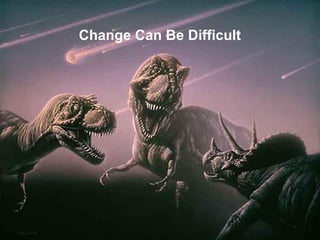
Change Can Be Difficult
“Start where
you are.
Use what you
have.
Do what you
can.”
Wesley Fryer, Playing with Media (Saskatchewan Public Schools)
Contact and Resources
 Email - work cindysheets@smsd.org
 Email – personal cindysheets@aha-
learners.org
 Plurk, Twitter hisheets
 Website
http://cindysheets.weebly.com
 LiveBinder for this session:
 http://www.livebinders.com/play/play?
present=true&id=917060
Resources
 Christopher Columbus Awards
 Toshiba Exploravision
 eCybermission
 http://www.livebinders.com/play/play?
id=303326 infusing technology in the common
core
 http://www.techwithtia.com/common-core.html

Get smart!short

  • 1.
    Get Smart! It Doesn’t Takea Secret Agent to Integrate Higher Level Thinking With Technology http://www.flickr.com/photos/tdeering/3048907279/ Cindysheets.weebly.com
  • 2.
    http://todaysmeet.com/getsmartpodstock 1. When Ithink about Common Core, I worry that _____________. 2. I plan to use technology to implement Common Core objectives by ___________________. 3. I encourage students to use higher level thinking by _____________ ( or my favorite technique)
  • 3.
     LiveBinder  GetSmart! (author = hisheets) http://bit.ly/14ENmHA
  • 4.
    Contact and Resources Website cindysheets.weebly.com  Email - work cindysheets@smsd.org  Email – personal cindysheets@aha-learners.org  Plurk, Twitter hisheets http://todaysmeet.com/getsmartpodstock2013
  • 5.
    Goals  Bloom’s Taxonomy Higher Level Thinking & CCSS (or KCCRS)  Getting “Smart” in our teaching  How we interact with students  Questioning and discussions  Using great tech tools  Resources  Projects
  • 6.
    The world ismoving at a tremendous rate. No one knows where. We must prepare our children, not for the world of the past, not for our world, but for their world, the world of the future. John Dewey
  • 7.
    ‘Our kids will spendthe rest of their lives in the future. Are we getting them ready?’ Kevin Honeycutt Are we ready for them? YouTube is the new Google . . .
  • 8.
    Get Smart aboutInteracting with Students
  • 9.
  • 10.
    Think about thatgreat unit . . .  Was the lesson/unit open-ended enough to allow students to pursue topics/projects of personal interest?  Was there hands-on involvement apart from “textbook learning”?  Was the use of multiple sources to discover information and solutions in evidence?  Was the lesson/unit relevant to the everyday life of the student?  Was the lesson/unit interesting to you, the teacher?  Did the lesson/unit connect to students’ prior learning experiences and provide bridges to more advanced or diverse learning opportunities? Jim Delisle, Free Spirit Blog, July 12, 2013
  • 11.
    CCSS concepts rather than facts  Theyappreciate nuances, such as how the composition of an audience should affect tone when speaking  They use technology and digital media strategically and capably.  Conduct short as well as more sustained research projects based on focused questions, demonstrating understanding of the subject under investigation.  From Common Core introduction  H. Lynn Erickson (Concept Based Curriculum)
  • 12.
    The boss .. .who wants your best work, your art and your genuine enthusiasm: ...can demand that you bring your best possible work the first time, . . . ...or they can nurture you, encourage you, set a high bar and then support you on your way. They can teach you, cajole you and introduce you to others that will do the same. The first strategy is the factory mindset You don't make art this way, or emotional connections, or things that haven't been made before. You may get the job done, but it's not clear if you'll make a difference. Seth Godin: Nature vs Nurture
  • 13.
  • 14.
    Jeff Danielian NAGC  "Ihave always believed that every student deserves the opportunity to share what they know and what they want to know.”  "If it is skills you are evaluating, give them choice of content. If it is content, give them choice of product."
  • 15.
    Bloom’s Taxonomy Get Smartabout asking questions
  • 16.
    “To be readyfor college, workforce training, and life in a technological society, students need the ability to gather, comprehend, evaluate, synthesize, and report on information and ideas, to conduct original research in order to answer questions or solve problems, and to analyze and create a high volume and extensive range of print and non-print texts in media forms old and new.” From Common Core State Standards
  • 17.
  • 18.
  • 19.
  • 20.
  • 21.
    Ben Franklin Whatperspective? Invention: what, when and WHY? How did it improve things? Quote of Franklin’s that he might have used about his invention In what way has this project taught you something new? Meeting of the Minds – Dinner Table Night of the Notables
  • 22.
    Students Asking Questions Students learn more when asking questions than when answering them most of the time. Especially if those questions asked by others are at lower levels of thinking.
  • 23.
    Essential Questions: Classroom Norms  Noone right answer  Takes Practice  Active participation from everyone  Everyone gets called on  Challenge doesn’t mean lack of value  Mistakes are part of learning  Re-consider things you thought you knew http://grantwiggins.wordpress.com/2013/03/30/an-excerpt-from-our-just-released-book-on-essential-questions/ Grant Wiggins
  • 24.
  • 25.
    Paleontology How will thebones provide clues to help us identify the animal? Driving (essential) question) Need to know Reflection and revision Technology as a resource tool
  • 26.
    “It doesn’t matterwhat you cover; it matters how much you develop the capacity to discover.”  Norm Chomsky, 2003
  • 27.
    Get Smart About CommonCore Technology . . . students are expected to not only obtain knowledge through the use of technology, but more importantly, they are asked to demonstrate their learning through the use of technology and to share that learning with a global community.
  • 28.
    Share Fair SL.11-12.5. Makestrategic use of digital media (e.g., textual, graphical, audio, visual, and interactive elements) in presentations to enhance understanding of findings, reasoning, and evidence and to add interest.
  • 29.
    Choose the MediaBased on the Content  Who is your audience?  What content do you have to share?  Why do you think this is the best format to share it?  What will it look like when completed? (model) RI.8.7. Evaluate the advantages and disadvantages of using different mediums (e.g., print or digital text, video, multimedia) to present a particular topic or idea.
  • 30.
    Student Projects  Research:point of view  2:30  Travel Trek – geography, economics . . .  Monster Exchange – Skype, descriptive language, communication  Live Interviews: Skype, iPad, FlipCams, Voice Recorder  Design a Star System – application, analysis, synthesis  Benjamin Franklin: More than who and what . . .  Puppetry: fractured fairy tales  Digital Storytelling Interdisciplinary Audience Notice how students are expected to not only obtain knowledge through the use of technology, but more importantly, they are asked to demonstrate their learning through the use of technology and to share that learning with
  • 31.
    Christopher Columbus Awards Toshiba:Exploravision eCybermission
  • 32.
    Endangered Species •Scaffold research •Purpose:Why should we save this animal? Convince me! •Posters – Excel •Slogans •Presentation
  • 33.
  • 34.
  • 35.
    Mapping Media tothe Common Core Wesley Fryer  Maps.playingwithmedia.com  Moving at the Speed of Creativity (blog)  Terminology – change how we label things  Idea of transliteracy:  Transliteracy is the ability to read, write and interact across a range of platforms, tools and media from signing and orality through handwriting, print, TV, radio and film, to digital social networks.
  • 36.
    Scratch & Math Standards: ISTENets Standards for Students: Creativity and Innovation - 1.a, 1.b, 1.c Communication and Collaboration - 2.b Critical Thinking, Problem Solving, and Decision Making - 4.b Technology Operations and Concepts - 6.c, 6.d Math Common Core Standards: 5.OA-3, 5.NBT-1, 5.NBT-5, 5.MD-1, 5.MD-2, 5.MD-3, 5.G-1, 5.G-2, 5.G-3, 5.G- 4, 6.RP-3, 6.NS-2, 6.NS-5, 6.NS-7, 6.NS-8, 6.EE-9, 6.G-4, 7.NS-1, 7.NS-2, 7.G-1, 8.F-1, 8.F-4 http://labs.greenbush.us/moodle/course/view.php?id=15
  • 37.
    Scratch Project-LA 3.3a Establisha situation and introduce a narrator and/or characters; organize an event sequence that unfolds naturally. 3.3b Use dialogue and descriptions of actions, thoughts, and feelings to develop experiences and events or show the response of characters to situations. 3.3c Use temporal words and phrases to signal event order. 3.3d Provide a sense of closure. http://www.ellencavanaugh.com/2013/02/18/scratch-programming-and-3rd-grade-common-core/
  • 38.
     Be willingto learn from students  Teachers still have much to offer: critical thinking, unlocking meaning, clear communication  Teaching with technology can be transforming  Encourage student autonomy  Dual level of teaching content along with meta- cognition- learning how to learn  Welcome productive digressions  Build a collaborative team, a PLN, and consider including students as part of the team
  • 39.
    Change Can BeDifficult
  • 40.
    “Start where you are. Usewhat you have. Do what you can.” Wesley Fryer, Playing with Media (Saskatchewan Public Schools)
  • 41.
    Contact and Resources Email - work cindysheets@smsd.org  Email – personal cindysheets@aha- learners.org  Plurk, Twitter hisheets  Website http://cindysheets.weebly.com  LiveBinder for this session:  http://www.livebinders.com/play/play? present=true&id=917060
  • 42.
    Resources  Christopher ColumbusAwards  Toshiba Exploravision  eCybermission  http://www.livebinders.com/play/play? id=303326 infusing technology in the common core  http://www.techwithtia.com/common-core.html

Editor's Notes

  • #22 Ben or another perspective – son, invention, user at the time Outline for scaffolding Research an invention, when, where, why? How did it improve life? Pick a quote of Franklin’s that he might have used about this invention