Creating a Positive Learning
Environment
Elements in Creating a Positive
Learning Environment
1) Physical Setting
2) Emotional Climate
Structuring the Physical
Environment
 Desk arrangements
 Student placement
 Classroom decoration
 Music in the classroom
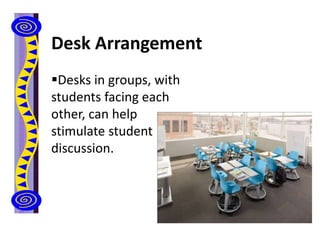
Desk Arrangement
Desks in groups, with
students facing each
other, can help
stimulate student
discussion.
Desk Arrangement
 Desks in single or double rows are
good for demonstrations and
independent work
Desk Arrangement
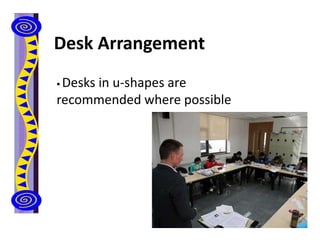
 Desks in u-shapes are
recommended where possible
Desk Arrangement
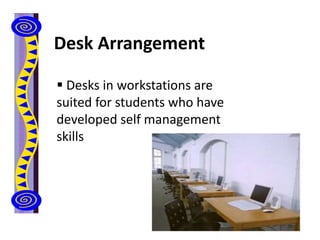
 Desks in workstations are
suited for students who have
developed self management
skills
Desk Arrangement
 Always remember in Desk Arrangement ,
all seating arrangements should
accommodate an inclusive learning
environment and that some classrooms
may require free and quiet spaces to
facilitate learning.
Student Placement
 Place easily distracted students away
from each other, doorways, windows and
areas of high traffic.
 Preferably, place to one side of the
classroom, close to the front.
 An inclusive classroom should place
students in areas of the class best suited
to their needs.
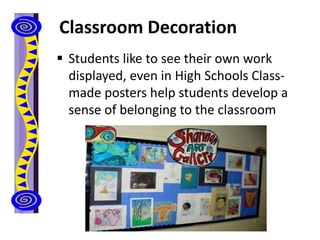
Classroom Decoration
 Students like to see their own work
displayed, even in High Schools Class-
made posters help students develop a
sense of belonging to the classroom
Music in the Classroom
 Music can be a great addition to any
classroom Use as reward Create positive
mood Helps broaden musical
experiences In inclusive classroom music
can: Comfort/calm and help focus (some
students).
Structuring the Emotional
Climate
“ It is the teacher’s responsibility to value each and every one of the
students in their class, so that each student feels special and
important.” (Groundwater-Smith et al, 1998, p. 95)
The bond between a teacher and student is much more important
for students with management and behavioral issues such as
Attention Deficit / Hyperactivity Disorder(ADHD) and Asperger’s.
Structuring the Emotional Environment ADHD Students need extra
motivation so they can maintain attention, work consistently, and
avoid boredom associated with repetitive tasks. (eg. Maths)
Asperger’s A bond with the teacher can encourage, inspire and
greatly assist them.
5 Basic Emotional Needs
(Robert Reasoner, 1995)
Psychological Safety
Positive Self-Image
 Feeling of Belonging
 Purpose Behavior
 Sense of Personal Competence
Psychological Safety
 In the classroom, it s achieved when the learners
know the following:
- What is expected
- Feel safe and protected
- Able to trust others
- Able to anticipate or predict the sequence of events
from experience
*Learners who feel secure and relatively free from
worry and anxiety feel comfortable and protected and
are more willing to take risk, enter new situation with
confidence and are better in focusing their energy on
the task at hand.
Positive Self Image
 A teacher can modify a learner’s self-
image by doing the following:
- Honoring each child’s uniqueness
- Demonstrating acceptance and caring
- Building self-awareness of their strength
and weakness
Feeling of Belonging
*Feeling of belonging make learners feel part
of something larger. They feel accepted and
valued as a member of the family, team or
culture and develop a healthy sense of pride.
This can be done by :
- Creating an accepting warm environment.
- Involving learners in class activities and give
them opportunity to be of service to others.
Purpose Behavior
*Learners need to engage in purposeful
behavior because it brings meaning to their
effort. If their efforts remain directed towards
pleasing or complying with the demands of
adults, learners will lack internal motivation.
* Teacher address the learners need for
purpose behavior when they convey clear
expectations, express confidence and faith in
their learners’ abilities, strengthen values,
such as responsibility, effort, honesty,
perseverance, determination, commitment
and help learners set realistic goals.
Sense of Personal
Competence, Self Esteem
*develops when students have accomplished
something worthwhile or behaved in a
personally or socially responsible way.
* a product of achievement, not the cause
*a chievement leads to self-esteem Global
Self-esteem: a general sense of pride in
oneself. Not necessarily a reality-based
evaluation Self-esteem leads to achievement
(McGrath, 2003) (Shokraii, 2005)
Strategies for Creating a
Positive Emotional Climate
 Greet students personally
 Make frequent eye contact
 Negotiate rules and routines with students
 Acknowledge positive behaviors
 Use positive language
 Interact with students outside the classroom
 Minimise embarrassment
 Use humour
 Use bibliotherapy
 Use class meetings
Teacher Expectations
 Pygmalion Effect or
- Rosenthal effect, refers to the phenomenon in
which the greater the expectation placed upon
people, often children or students and employees,
the better they perform.
- Pygmalion effect is a form of self-fulfilling
prophecy, and, in this respect, people will
internalize their negative label, and those with
positive labels succeed accordingly.
Teacher Expectations
 Self-fulfilling Prophecy
- a prediction that directly or indirectly causes itself
to become true, by the very terms of the prophecy
itself, due to positive feedback between belief and
behavior
- a prophecy, strongly held belief, or a delusion,
declared as truth when it is actually false may
sufficiently influence people, either through fear or
logical confusion, so that their reactions ultimately
fulfill the once-false belief.
Characteristics of Effective Teachers
(Kenneth Eble, The Recognition and Evaluation of Teaching , 1971)
1. Analytic/Synthetic Approach
a. Discusses points of view other than his/her own.
b. Contrasts implications of various theories.
c. Discusses recent developments in the field.
d. Presents origins of ideas and concepts.
e. Gives references for more interesting and
involvedpoints.
f. Presents facts and concepts from related fields
g. Emphasizes conceptual understanding
Characteristics of Effective Teachers
2. Organization/Clarity
a. Explains clearly.
b. Is well prepared.
c. Gives lectures that are easy to outline.
d. Is careful and precise in answering questions.
e. Summarizes major points.
f. States objectives for each class session.
g. Identifies what he/she considers important.
Characteristics of Effective Teachers
3. Instructor-Group Interaction
a. Encourages class discussion.
b. Invites students to share their knowledge and
experiences.
c. Clarifies thinking by identifying reasons for
questions.
d. Invites criticism of his/her own ideas.
e. Knows if the class is understanding him/her or
not.
f. Has interest and concern in the quality of
his/herteaching.
g. Has students apply concepts to demonstrate
understanding.
Characteristics of Effective Teachers
4. Instructor-Individual Student Interaction
a. Has a genuine interest in students.
b. Is friendly toward students.
c. Relates to students as individuals.
d. Recognizes and greets students out of class.
e. Is accessible to students out of class.
f. Is valued for advice not directly related to the
course.
g. Respects students as persons.
Characteristics of Effective Teachers
5. Dynamism/Enthusiasm
a. Is a dynamic and energetic person.
b. Has an interesting style of presentation.
c. Seems to enjoy teaching.
d. Is enthusiastic about the subject.
e. Seems to have self-confidence.
f. Varies the speed and tone of his/her
voice.g.Has a sense of humor.
Reported by:
Ms. Cynthia E. Calupas
Topic : Classroom Management &
Teacher’s Personality

Creating a positive learning environment

  • 1.
    Creating a PositiveLearning Environment
  • 2.
    Elements in Creatinga Positive Learning Environment 1) Physical Setting 2) Emotional Climate
  • 3.
    Structuring the Physical Environment Desk arrangements  Student placement  Classroom decoration  Music in the classroom
  • 4.
    Desk Arrangement Desks ingroups, with students facing each other, can help stimulate student discussion.
  • 5.
    Desk Arrangement  Desksin single or double rows are good for demonstrations and independent work
  • 6.
    Desk Arrangement  Desksin u-shapes are recommended where possible
  • 7.
    Desk Arrangement  Desksin workstations are suited for students who have developed self management skills
  • 8.
    Desk Arrangement  Alwaysremember in Desk Arrangement , all seating arrangements should accommodate an inclusive learning environment and that some classrooms may require free and quiet spaces to facilitate learning.
  • 9.
    Student Placement  Placeeasily distracted students away from each other, doorways, windows and areas of high traffic.  Preferably, place to one side of the classroom, close to the front.  An inclusive classroom should place students in areas of the class best suited to their needs.
  • 10.
    Classroom Decoration  Studentslike to see their own work displayed, even in High Schools Class- made posters help students develop a sense of belonging to the classroom
  • 11.
    Music in theClassroom  Music can be a great addition to any classroom Use as reward Create positive mood Helps broaden musical experiences In inclusive classroom music can: Comfort/calm and help focus (some students).
  • 12.
    Structuring the Emotional Climate “It is the teacher’s responsibility to value each and every one of the students in their class, so that each student feels special and important.” (Groundwater-Smith et al, 1998, p. 95) The bond between a teacher and student is much more important for students with management and behavioral issues such as Attention Deficit / Hyperactivity Disorder(ADHD) and Asperger’s. Structuring the Emotional Environment ADHD Students need extra motivation so they can maintain attention, work consistently, and avoid boredom associated with repetitive tasks. (eg. Maths) Asperger’s A bond with the teacher can encourage, inspire and greatly assist them.
  • 13.
    5 Basic EmotionalNeeds (Robert Reasoner, 1995) Psychological Safety Positive Self-Image  Feeling of Belonging  Purpose Behavior  Sense of Personal Competence
  • 14.
    Psychological Safety  Inthe classroom, it s achieved when the learners know the following: - What is expected - Feel safe and protected - Able to trust others - Able to anticipate or predict the sequence of events from experience *Learners who feel secure and relatively free from worry and anxiety feel comfortable and protected and are more willing to take risk, enter new situation with confidence and are better in focusing their energy on the task at hand.
  • 15.
    Positive Self Image A teacher can modify a learner’s self- image by doing the following: - Honoring each child’s uniqueness - Demonstrating acceptance and caring - Building self-awareness of their strength and weakness
  • 16.
    Feeling of Belonging *Feelingof belonging make learners feel part of something larger. They feel accepted and valued as a member of the family, team or culture and develop a healthy sense of pride. This can be done by : - Creating an accepting warm environment. - Involving learners in class activities and give them opportunity to be of service to others.
  • 17.
    Purpose Behavior *Learners needto engage in purposeful behavior because it brings meaning to their effort. If their efforts remain directed towards pleasing or complying with the demands of adults, learners will lack internal motivation. * Teacher address the learners need for purpose behavior when they convey clear expectations, express confidence and faith in their learners’ abilities, strengthen values, such as responsibility, effort, honesty, perseverance, determination, commitment and help learners set realistic goals.
  • 18.
    Sense of Personal Competence,Self Esteem *develops when students have accomplished something worthwhile or behaved in a personally or socially responsible way. * a product of achievement, not the cause *a chievement leads to self-esteem Global Self-esteem: a general sense of pride in oneself. Not necessarily a reality-based evaluation Self-esteem leads to achievement (McGrath, 2003) (Shokraii, 2005)
  • 19.
    Strategies for Creatinga Positive Emotional Climate  Greet students personally  Make frequent eye contact  Negotiate rules and routines with students  Acknowledge positive behaviors  Use positive language  Interact with students outside the classroom  Minimise embarrassment  Use humour  Use bibliotherapy  Use class meetings
  • 20.
    Teacher Expectations  PygmalionEffect or - Rosenthal effect, refers to the phenomenon in which the greater the expectation placed upon people, often children or students and employees, the better they perform. - Pygmalion effect is a form of self-fulfilling prophecy, and, in this respect, people will internalize their negative label, and those with positive labels succeed accordingly.
  • 21.
    Teacher Expectations  Self-fulfillingProphecy - a prediction that directly or indirectly causes itself to become true, by the very terms of the prophecy itself, due to positive feedback between belief and behavior - a prophecy, strongly held belief, or a delusion, declared as truth when it is actually false may sufficiently influence people, either through fear or logical confusion, so that their reactions ultimately fulfill the once-false belief.
  • 22.
    Characteristics of EffectiveTeachers (Kenneth Eble, The Recognition and Evaluation of Teaching , 1971) 1. Analytic/Synthetic Approach a. Discusses points of view other than his/her own. b. Contrasts implications of various theories. c. Discusses recent developments in the field. d. Presents origins of ideas and concepts. e. Gives references for more interesting and involvedpoints. f. Presents facts and concepts from related fields g. Emphasizes conceptual understanding
  • 23.
    Characteristics of EffectiveTeachers 2. Organization/Clarity a. Explains clearly. b. Is well prepared. c. Gives lectures that are easy to outline. d. Is careful and precise in answering questions. e. Summarizes major points. f. States objectives for each class session. g. Identifies what he/she considers important.
  • 24.
    Characteristics of EffectiveTeachers 3. Instructor-Group Interaction a. Encourages class discussion. b. Invites students to share their knowledge and experiences. c. Clarifies thinking by identifying reasons for questions. d. Invites criticism of his/her own ideas. e. Knows if the class is understanding him/her or not. f. Has interest and concern in the quality of his/herteaching. g. Has students apply concepts to demonstrate understanding.
  • 25.
    Characteristics of EffectiveTeachers 4. Instructor-Individual Student Interaction a. Has a genuine interest in students. b. Is friendly toward students. c. Relates to students as individuals. d. Recognizes and greets students out of class. e. Is accessible to students out of class. f. Is valued for advice not directly related to the course. g. Respects students as persons.
  • 26.
    Characteristics of EffectiveTeachers 5. Dynamism/Enthusiasm a. Is a dynamic and energetic person. b. Has an interesting style of presentation. c. Seems to enjoy teaching. d. Is enthusiastic about the subject. e. Seems to have self-confidence. f. Varies the speed and tone of his/her voice.g.Has a sense of humor.
  • 27.
    Reported by: Ms. CynthiaE. Calupas Topic : Classroom Management & Teacher’s Personality