Creating a Positive Classroom Environment Source: http://i43.photobucket.com/albums/e354/mcat780/Welcome/
Agenda How to structure the physical environment How to structure the emotional environment The role of self-esteem in the classroom
Structuring the Physical Environment Konza, Grainger & Bradshaw (2001) in their book,  Classroom Management: A Survival Guide  explain that the physical environment of a classroom explains a lot about your expectations as a teacher.
Structuring the Physical Environment Desk arrangements Student placement Classroom decoration Music in the classroom
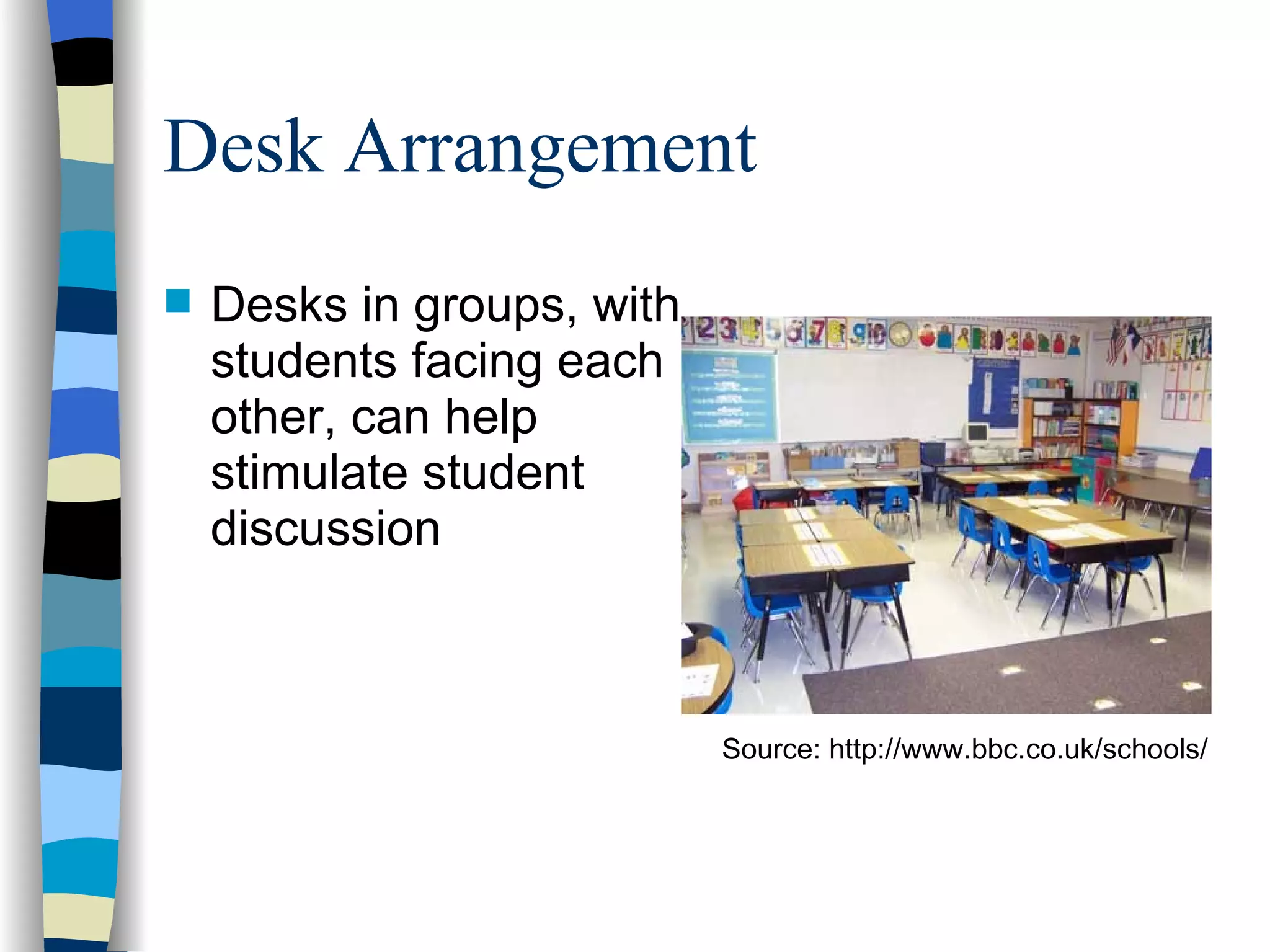
Desk Arrangement Desks in groups, with students facing each other, can help stimulate student discussion  Source: http://www.bbc.co.uk/schools/
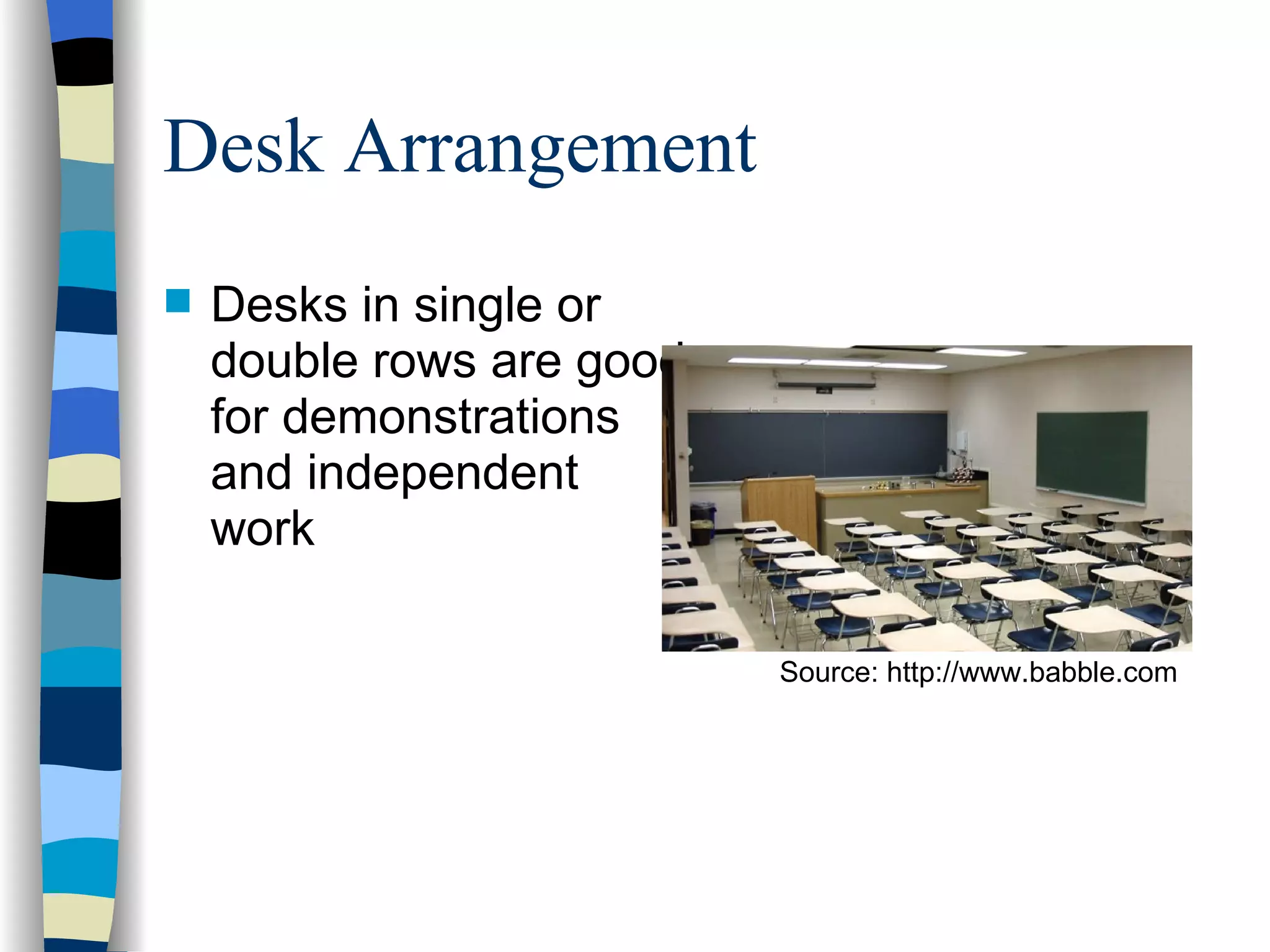
Desk Arrangement Desks in single or double rows are good for demonstrations and independent work Source: http://www.babble.com
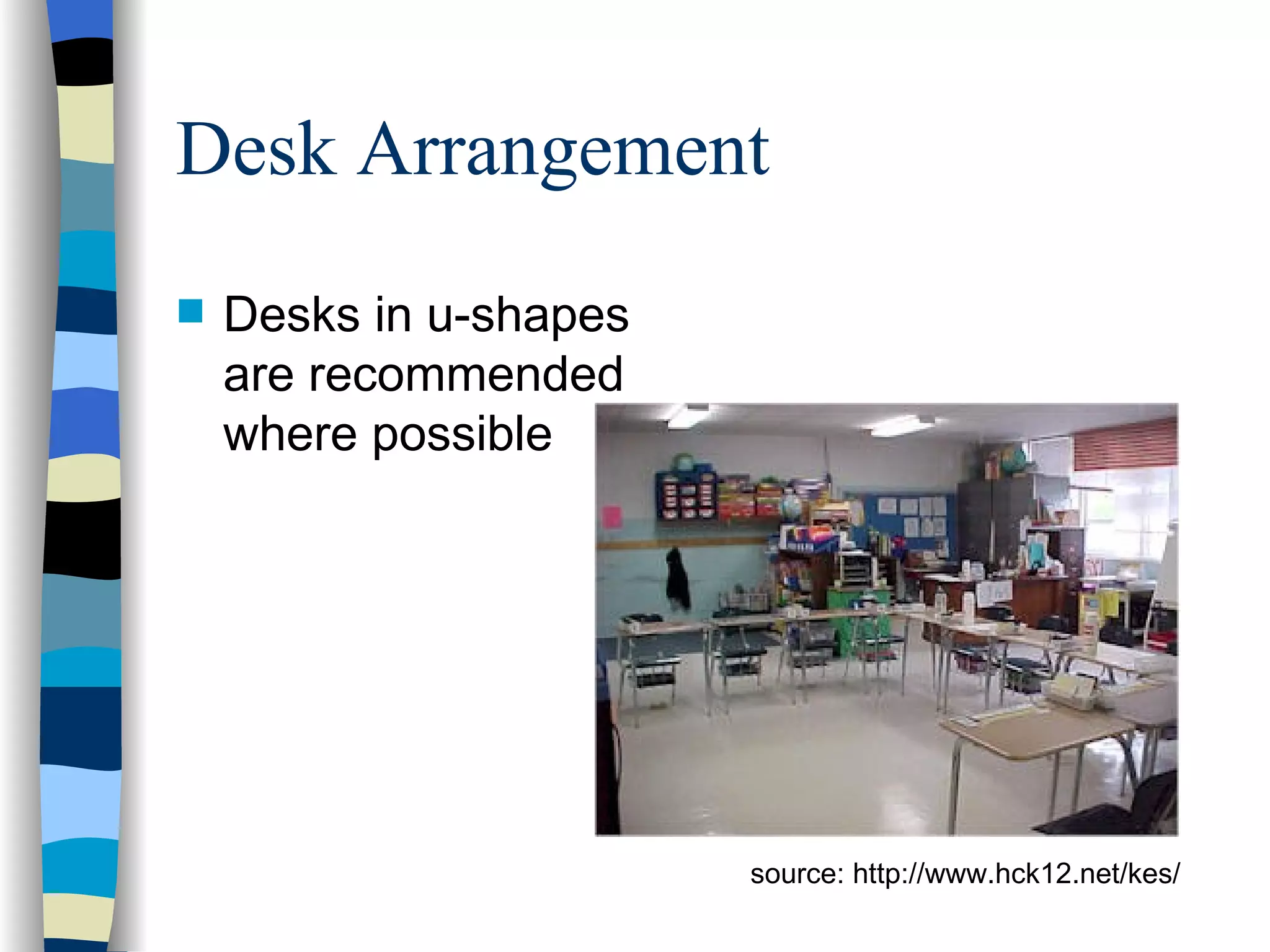
Desk Arrangement Desks in u-shapes are recommended where possible source: http://www.hck12.net/kes/
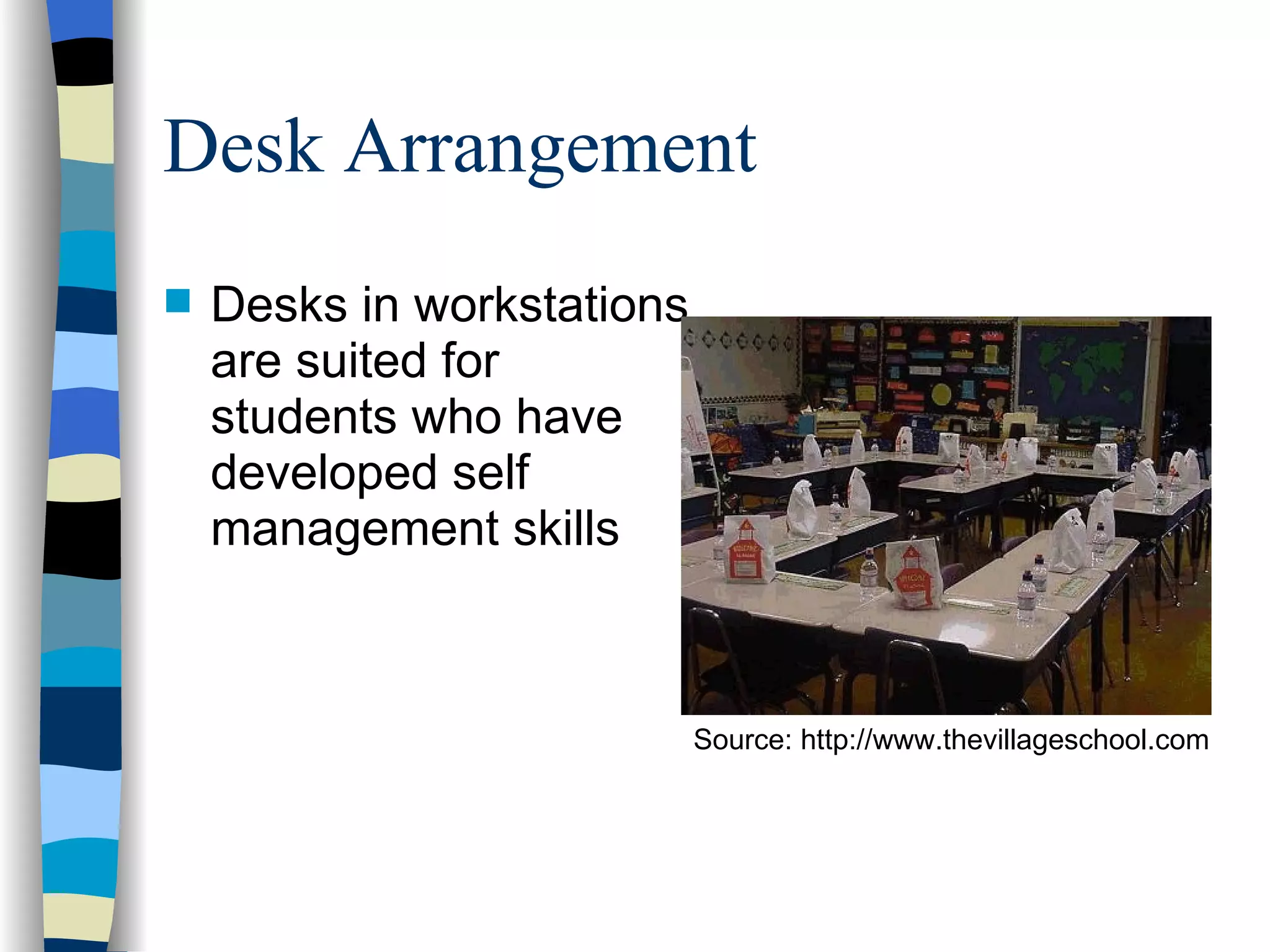
Desk Arrangement Desks in workstations are suited for students who have developed self management skills Source: http://www.thevillageschool.com
Desk Arrangement Remember, all seating arrangements should accommodate an inclusive learning environment Foreman (1996) notes that some classrooms may require free and quiet spaces to facilitate learning
Student Placement Place easily distracted students away from each other, doorways, windows and areas of high traffic Preferably, place to one side of the classroom, close to the front An inclusive classroom should place students in areas of the class best suited to their needs
Classroom Decoration Students like to see their own work displayed, even in High Schools Class-made posters help students develop a sense of belonging to the classroom Plants and animals can have positive effects on the classroom (Nicholls, 2006)
Music in the Classroom Music can be a great addition to any classroom Use as reward Create positive mood Helps broaden musical experiences In inclusive classroom music can: Comfort/calm and help focus (some students)
Structuring the Emotional Environment “ It is the teacher’s responsibility to value each and every one of the students in their class, so that each student feels special and important.” (Groundwater-Smith et al, 1998, p. 95)
Structuring the Emotional Environment The bond between a teacher and student is much more important for students with management and behavioural issues such as ADHD and Asperger’s.
Structuring the Emotional Environment ADHD  Students need extra motivation so they can maintain attention, work consistently, and avoid boredom associated with repetitive tasks. (eg. Maths) Asperger’s A bond with the teacher can encourage, inspire and greatly assist them.
Knowing and Liking You Who you are What you stand for What you will ask them to do What you will not ask them to do What you will do for them What you will not do for them  (Glasser, 1993, p.32)
Strategies Greet students personally Make frequent eye contact Negotiate rules and routines with students Acknowledge positive behaviours Use positive language Interact with students outside the classroom
Strategies Minimise embarrassment Use humour Use bibliotherapy Use class meetings  (Konza et al, 2001, p.30-33) Take home buddies Yellow pages (Lacey, 2006, p.31)
Self-esteem Defined An individual's sense of their value or worth, or the extent to which a person values, approves of, appreciates, prizes, or likes him or herself (Blascovich &  Tomaka, 1991).  A favourable or unfavourable attitude toward the self (Rosenberg, 1965)
Self-esteem Pop Quiz A) Increasing a students self-esteem will result in increased achievement. B) Increasing a students achievement will result in increased self-esteem.
Self-esteem: The Research Shows Increased self-esteem does not result in increased achievement. (Baumeister, Campbell, Krueger, & Vohs, 2005, p. 84) (Craven, Marsh & Burnett, 2003) (Hattie, 1992)
Group 1: What causes good and bad grades? "I can be proud of myself."  "I can do this."  "I am better than most of the other people in this school."  "I am satisfied with myself."  Students who did not improve were thinking: "I'm ashamed of myself."  "I don't deserve to be in college."  "I'm worthless." BOTTOM LINE: Hold your head--and your self-esteem--high.
Group 2: What causes good and bad grades? "I need to work harder."  "I can learn this material if l apply myself."  "I can control what happens to me in this class."  "I have what it takes to do this."  Students who did not improve were thinking: "It's not my fault."  "This test was too hard."  "I'm not good at this." BOTTOM LINE: Take personal control of your performance.
Results? By the end of the course, the average grade for students in the first group dropped below 50 percent -- a failing grade. The average for students in the second group was 62 percent -- a D minus, which is poor but still passing.
Similar Research “ 6 percent of Korean eighth-graders surveyed expressed confidence in their math skills, compared with 39 percent of U.S. eighth-graders. But a respected international math assessment showed Koreans scoring far ahead of their peers in the United States, raising questions about the importance of self-esteem.” (washingtonpost.com, 2006)
Self-esteem Breakdown Earned Self-esteem:  develops when students have accomplished something worthwhile or behaved in a personally or socially responsible way. A product of achievement, not the cause Achievement leads to self-esteem Global Self-esteem:  a general sense of pride in oneself.  Not necessarily a reality-based evaluation Self-esteem leads to achievement (McGrath, 2003) (Shokraii, 2005)
Implications for Teachers? Don’t disregard self-esteem Focus on techniques that will result in increased earned self-esteem Don't shield students from feelings of sadness, frustration, and anxiety when they lose, fail or make mistakes Teach resiliency and self-control
Strategies Pro-social values Coping skills Courage Managing feelings Social Skills Goal achievement (SMART) Evidence-based self-knowledge (McGrath, 2003)
Be the Teacher In order to establish a positive emotional environment in your classroom you must first arrange the room in a manner that will facilitate your long term goals. The physical space is the groundwork for  the type of classroom you run. The Information: You are the teacher of a year 8 class.  The class is relatively small being comprised of 12 students.  Within the class you are aware of students with the following circumstances: Student A - ADHD tendencies, constantly seeking attention and going off task in class. Student B - Identified as having RD, 3 years behind class. Involved in peer-assistance program. Student C - Physical disability and is confined to a wheelchair. Top performing student. Student D - Diagnosed Asperger’s. Only likes to sit next to student B. Student E - Extremely shy, does not like to work in groups, exhibits poor task management skills. The Task: You have three options for your classroom arrangement: rows, groups or u-shape.  Decide which arrangement would best suit this class.  Discuss your reasoning as a group.
Thank you one and all. Good luck on your assignment next week!

Creating A Positive Classroom Environment 1192954359997023 3

  • 1.
    Creating a PositiveClassroom Environment Source: http://i43.photobucket.com/albums/e354/mcat780/Welcome/
  • 2.
    Agenda How tostructure the physical environment How to structure the emotional environment The role of self-esteem in the classroom
  • 3.
    Structuring the PhysicalEnvironment Konza, Grainger & Bradshaw (2001) in their book, Classroom Management: A Survival Guide explain that the physical environment of a classroom explains a lot about your expectations as a teacher.
  • 4.
    Structuring the PhysicalEnvironment Desk arrangements Student placement Classroom decoration Music in the classroom
  • 5.
    Desk Arrangement Desksin groups, with students facing each other, can help stimulate student discussion Source: http://www.bbc.co.uk/schools/
  • 6.
    Desk Arrangement Desksin single or double rows are good for demonstrations and independent work Source: http://www.babble.com
  • 7.
    Desk Arrangement Desksin u-shapes are recommended where possible source: http://www.hck12.net/kes/
  • 8.
    Desk Arrangement Desksin workstations are suited for students who have developed self management skills Source: http://www.thevillageschool.com
  • 9.
    Desk Arrangement Remember,all seating arrangements should accommodate an inclusive learning environment Foreman (1996) notes that some classrooms may require free and quiet spaces to facilitate learning
  • 10.
    Student Placement Placeeasily distracted students away from each other, doorways, windows and areas of high traffic Preferably, place to one side of the classroom, close to the front An inclusive classroom should place students in areas of the class best suited to their needs
  • 11.
    Classroom Decoration Studentslike to see their own work displayed, even in High Schools Class-made posters help students develop a sense of belonging to the classroom Plants and animals can have positive effects on the classroom (Nicholls, 2006)
  • 12.
    Music in theClassroom Music can be a great addition to any classroom Use as reward Create positive mood Helps broaden musical experiences In inclusive classroom music can: Comfort/calm and help focus (some students)
  • 13.
    Structuring the EmotionalEnvironment “ It is the teacher’s responsibility to value each and every one of the students in their class, so that each student feels special and important.” (Groundwater-Smith et al, 1998, p. 95)
  • 14.
    Structuring the EmotionalEnvironment The bond between a teacher and student is much more important for students with management and behavioural issues such as ADHD and Asperger’s.
  • 15.
    Structuring the EmotionalEnvironment ADHD Students need extra motivation so they can maintain attention, work consistently, and avoid boredom associated with repetitive tasks. (eg. Maths) Asperger’s A bond with the teacher can encourage, inspire and greatly assist them.
  • 16.
    Knowing and LikingYou Who you are What you stand for What you will ask them to do What you will not ask them to do What you will do for them What you will not do for them (Glasser, 1993, p.32)
  • 17.
    Strategies Greet studentspersonally Make frequent eye contact Negotiate rules and routines with students Acknowledge positive behaviours Use positive language Interact with students outside the classroom
  • 18.
    Strategies Minimise embarrassmentUse humour Use bibliotherapy Use class meetings (Konza et al, 2001, p.30-33) Take home buddies Yellow pages (Lacey, 2006, p.31)
  • 19.
    Self-esteem Defined Anindividual's sense of their value or worth, or the extent to which a person values, approves of, appreciates, prizes, or likes him or herself (Blascovich & Tomaka, 1991). A favourable or unfavourable attitude toward the self (Rosenberg, 1965)
  • 20.
    Self-esteem Pop QuizA) Increasing a students self-esteem will result in increased achievement. B) Increasing a students achievement will result in increased self-esteem.
  • 21.
    Self-esteem: The ResearchShows Increased self-esteem does not result in increased achievement. (Baumeister, Campbell, Krueger, & Vohs, 2005, p. 84) (Craven, Marsh & Burnett, 2003) (Hattie, 1992)
  • 22.
    Group 1: Whatcauses good and bad grades? "I can be proud of myself." "I can do this." "I am better than most of the other people in this school." "I am satisfied with myself." Students who did not improve were thinking: "I'm ashamed of myself." "I don't deserve to be in college." "I'm worthless." BOTTOM LINE: Hold your head--and your self-esteem--high.
  • 23.
    Group 2: Whatcauses good and bad grades? "I need to work harder." "I can learn this material if l apply myself." "I can control what happens to me in this class." "I have what it takes to do this." Students who did not improve were thinking: "It's not my fault." "This test was too hard." "I'm not good at this." BOTTOM LINE: Take personal control of your performance.
  • 24.
    Results? By theend of the course, the average grade for students in the first group dropped below 50 percent -- a failing grade. The average for students in the second group was 62 percent -- a D minus, which is poor but still passing.
  • 25.
    Similar Research “6 percent of Korean eighth-graders surveyed expressed confidence in their math skills, compared with 39 percent of U.S. eighth-graders. But a respected international math assessment showed Koreans scoring far ahead of their peers in the United States, raising questions about the importance of self-esteem.” (washingtonpost.com, 2006)
  • 26.
    Self-esteem Breakdown EarnedSelf-esteem: develops when students have accomplished something worthwhile or behaved in a personally or socially responsible way. A product of achievement, not the cause Achievement leads to self-esteem Global Self-esteem: a general sense of pride in oneself. Not necessarily a reality-based evaluation Self-esteem leads to achievement (McGrath, 2003) (Shokraii, 2005)
  • 27.
    Implications for Teachers?Don’t disregard self-esteem Focus on techniques that will result in increased earned self-esteem Don't shield students from feelings of sadness, frustration, and anxiety when they lose, fail or make mistakes Teach resiliency and self-control
  • 28.
    Strategies Pro-social valuesCoping skills Courage Managing feelings Social Skills Goal achievement (SMART) Evidence-based self-knowledge (McGrath, 2003)
  • 29.
    Be the TeacherIn order to establish a positive emotional environment in your classroom you must first arrange the room in a manner that will facilitate your long term goals. The physical space is the groundwork for the type of classroom you run. The Information: You are the teacher of a year 8 class. The class is relatively small being comprised of 12 students. Within the class you are aware of students with the following circumstances: Student A - ADHD tendencies, constantly seeking attention and going off task in class. Student B - Identified as having RD, 3 years behind class. Involved in peer-assistance program. Student C - Physical disability and is confined to a wheelchair. Top performing student. Student D - Diagnosed Asperger’s. Only likes to sit next to student B. Student E - Extremely shy, does not like to work in groups, exhibits poor task management skills. The Task: You have three options for your classroom arrangement: rows, groups or u-shape. Decide which arrangement would best suit this class. Discuss your reasoning as a group.
  • 30.
    Thank you oneand all. Good luck on your assignment next week!