WIND TURBINE TOWER
LOADINGS
CALCULATION
Tower Specification
 Structural Steel JIS SS400.
 Ultimate Strength 415 MPa.
 Yield Strength 230 MPa.
Dead Loads
 Dead loads consist of the weight of all
materials of construction incorporated
into the structure (i.e. tower and wind
turbine).
Wind Loads
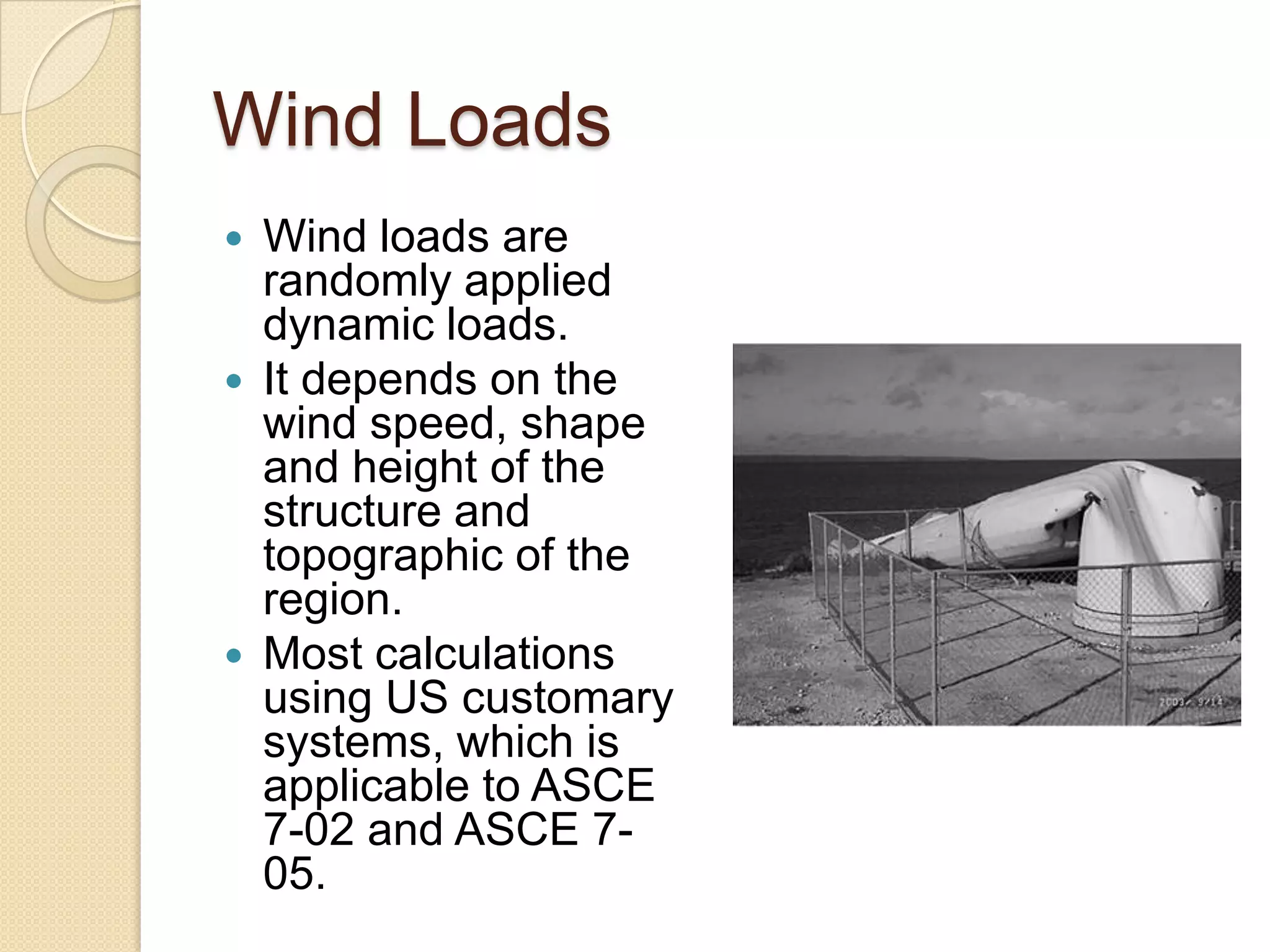
 Wind loads are
randomly applied
dynamic loads.
 It depends on the
wind speed, shape
and height of the
structure and
topographic of the
region.
 Most calculations
using US customary
systems, which is
applicable to ASCE
7-02 and ASCE 7-
05.
Assumption
Components Assumption for Analysis
Tower Cylindrical Poles
Wind Turbine Lattice Frameworks (Є= 0.36)
Basic Wind Speed, V
and Wind Directionality Factor,
Kd The basic wind speed, V, assumed as
134.216 mph or 60 m/s.
 The wind directionality factor, Kd, for
wind turbine tower is 0.95 for tower
and 0.85 for the DS wind turbine.
Importance Factor, I
 An importance
factor, I, for the
wind turbine tower
(Building Category
III or IV) is 1.15.
Building Type I
Category I -
Buildings and other
structures with low
hazard to human life
in the event of
failure, such as
agricultural facilities.
0.77
Category II – Other
buildings.
1.00
Category III and IV -
Buildings and other
structures with a
substantial hazard to
human life in the
event of failure, such
as hospitals,
communication
towers and power
generating stations
1.15
Surface Roughness and
Exposure
 It is assumed that
the tower would be
installed on a
terrain with surface
roughness and
exposure category
of C (town/ small
city).
Exposure
Category B,
ex. 臺北
Exposure
Category C,
ex. 板橋
Exposure
Category D,
ex. 金門
Velocity Pressure Exponent
Coefficient, Kz
 Velocity pressure
exponent, Kz, depe
nds on the site
relative height to
the ground, z.
 This means for
rooftop
structure, z, would
be the total height
of the component
and the building its
installed.
Nominal height
above ground level,
z
K z for
Exposure
C
ft m
0-15 0-4.6 0.85
20 6.1 0.90
25 7.6 0.94
30 9.1 0.98
40 12.2 1.04
50 15.2 1.09
60 18 1.13
70 21.3 1.17
80 24.4 1.21
90 27.4 1.24
100 30.5 1.26
Topographic Factor, Kzt and
Force Coefficient, Cf
 The value of Kzt
was taken as 1 with
assumption flat
region
environment.
 The values of Cf
were taken from
Figures 6-19 and
6-21 of the code.
 The values are 1.2
for the tower and
1.1 for the wind
turbine.
Velocity Pressure, qz
 The velocity pressure, qz, evaluated at
height z shall be calculated by:
Gust Effect Factor, G
 Gust effect factor, G, could be
calculated by Eq. 6-4 of the code.
 This factor increased with structure
height.
Design Wind Loads, F
 Design wind force for
each component shall
be determined by:
 Moment because of
wind force calculated
as:
FWT
FTOWER
a
b
bFaFM WTTOWER

Wind Load of Wind Turbine Tower

  • 1.
  • 2.
    Tower Specification  StructuralSteel JIS SS400.  Ultimate Strength 415 MPa.  Yield Strength 230 MPa.
  • 3.
    Dead Loads  Deadloads consist of the weight of all materials of construction incorporated into the structure (i.e. tower and wind turbine).
  • 4.
    Wind Loads  Windloads are randomly applied dynamic loads.  It depends on the wind speed, shape and height of the structure and topographic of the region.  Most calculations using US customary systems, which is applicable to ASCE 7-02 and ASCE 7- 05.
  • 5.
    Assumption Components Assumption forAnalysis Tower Cylindrical Poles Wind Turbine Lattice Frameworks (Є= 0.36)
  • 6.
    Basic Wind Speed,V and Wind Directionality Factor, Kd The basic wind speed, V, assumed as 134.216 mph or 60 m/s.  The wind directionality factor, Kd, for wind turbine tower is 0.95 for tower and 0.85 for the DS wind turbine.
  • 7.
    Importance Factor, I An importance factor, I, for the wind turbine tower (Building Category III or IV) is 1.15. Building Type I Category I - Buildings and other structures with low hazard to human life in the event of failure, such as agricultural facilities. 0.77 Category II – Other buildings. 1.00 Category III and IV - Buildings and other structures with a substantial hazard to human life in the event of failure, such as hospitals, communication towers and power generating stations 1.15
  • 8.
    Surface Roughness and Exposure It is assumed that the tower would be installed on a terrain with surface roughness and exposure category of C (town/ small city). Exposure Category B, ex. 臺北 Exposure Category C, ex. 板橋 Exposure Category D, ex. 金門
  • 9.
    Velocity Pressure Exponent Coefficient,Kz  Velocity pressure exponent, Kz, depe nds on the site relative height to the ground, z.  This means for rooftop structure, z, would be the total height of the component and the building its installed. Nominal height above ground level, z K z for Exposure C ft m 0-15 0-4.6 0.85 20 6.1 0.90 25 7.6 0.94 30 9.1 0.98 40 12.2 1.04 50 15.2 1.09 60 18 1.13 70 21.3 1.17 80 24.4 1.21 90 27.4 1.24 100 30.5 1.26
  • 10.
    Topographic Factor, Kztand Force Coefficient, Cf  The value of Kzt was taken as 1 with assumption flat region environment.  The values of Cf were taken from Figures 6-19 and 6-21 of the code.  The values are 1.2 for the tower and 1.1 for the wind turbine.
  • 11.
    Velocity Pressure, qz The velocity pressure, qz, evaluated at height z shall be calculated by:
  • 12.
    Gust Effect Factor,G  Gust effect factor, G, could be calculated by Eq. 6-4 of the code.  This factor increased with structure height.
  • 13.
    Design Wind Loads,F  Design wind force for each component shall be determined by:  Moment because of wind force calculated as: FWT FTOWER a b bFaFM WTTOWER