GUIDE FOR THE DESIGN OF
CRANE-SUPPORTING STEEL STRUCTURES
SECOND EDITION
R.A. MACCRIMMON
NIAGARA FALLS, ONTARIO
Canadian Institute of Steel Construction
Institut canadien de la construction en acier
3760 14th Avenue, Suite 200
Markham, Ontario L3R 3T7
Copyright © 2009
by
Canadian Institute of Steel Construction
All rights reserved.
This book or any part thereof must not be reproduced
in any form without the written permission of the publisher.
Second Edition
First Printing, December 2007
Second Revised Printing, January 2009
Third Printing, August 2009
Fourth Revised Printing, February 2010
Fifth Revised Printing, July 2012
ISBN 978-0-88811-132-6
PRINTED IN CANADA
iii
TABLE OF CONTENTS
FOREWORD . . . . . . . . . . . . . . . . . . . . . . . . . . . . . . . . . . . . . . . . . . . . . . . . . vi
PREFACE TO THE SECOND EDITION . . . . . . . . . . . . . . . . . . . . . . . . . . . . . . . . . . vii
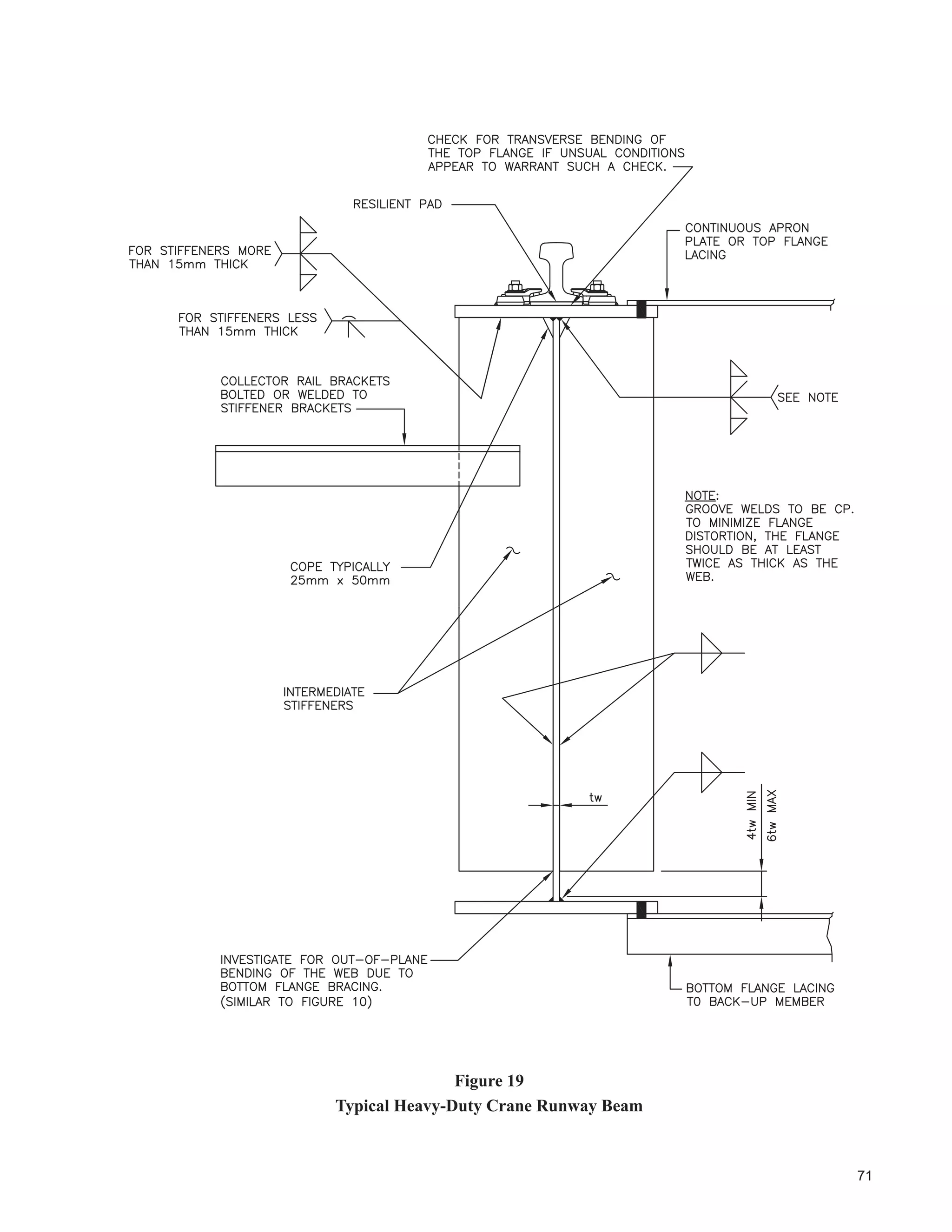
CHAPTER 1 - INTRODUCTION . . . . . . . . . . . . . . . . . . . . . . . . . . . . . . . . . . . . . . 1
CHAPTER 2 - LOADS
2.1 General . . . . . . . . . . . . . . . . . . . . . . . . . . . . . . . . . . . . . . . . . . . . . . . . . 2
2.2 Symbols and Notation . . . . . . . . . . . . . . . . . . . . . . . . . . . . . . . . . . . . . . . . . 2
 /RDGV 6SHFL¿F WR UDQH6XSSRUWLQJ 6WUXFWXUHV . . . . . . . . . . . . . . . . . . . . . . . . . . . . 3
2.3.1 General . . . . . . . . . . . . . . . . . . . . . . . . . . . . . . . . . . . . . . . . . . . . . . 3
2.3.2 Vertical Loads . . . . . . . . . . . . . . . . . . . . . . . . . . . . . . . . . . . . . . . . . . 3
2.3.3 Side Thrust . . . . . . . . . . . . . . . . . . . . . . . . . . . . . . . . . . . . . . . . . . . . 5
2.3.4 Traction Load. . . . . . . . . . . . . . . . . . . . . . . . . . . . . . . . . . . . . . . . . . . 5
2.3.5 Bumper Impact . . . . . . . . . . . . . . . . . . . . . . . . . . . . . . . . . . . . . . . . . . 5
2.3.6 Vibrations. . . . . . . . . . . . . . . . . . . . . . . . . . . . . . . . . . . . . . . . . . . . . 5
 /RDG RPELQDWLRQV 6SHFL¿F WR UDQH6XSSRUWLQJ 6WUXFWXUHV . . . . . . . . . . . . . . . . . . . . . 6
2.4.1 Fatigue . . . . . . . . . . . . . . . . . . . . . . . . . . . . . . . . . . . . . . . . . . . . . . 7
2.4.2 Ultimate Limit States of Strength and Stability . . . . . . . . . . . . . . . . . . . . . . . . . 7
CHAPTER 3 - DESIGN FOR REPEATED LOADS
3.1 General . . . . . . . . . . . . . . . . . . . . . . . . . . . . . . . . . . . . . . . . . . . . . . . . . 8
3.2 Exclusion for Limited Number of Cycles . . . . . . . . . . . . . . . . . . . . . . . . . . . . . . . 8
3.3 Detailed Load-Induced Fatigue Assessment . . . . . . . . . . . . . . . . . . . . . . . . . . . . . . 9
3.3.1 General . . . . . . . . . . . . . . . . . . . . . . . . . . . . . . . . . . . . . . . . . . . . . . 9
3.3.2 Palmgren-Miner Rule . . . . . . . . . . . . . . . . . . . . . . . . . . . . . . . . . . . . . . 10
3.3.3 Equivalent Stress Range . . . . . . . . . . . . . . . . . . . . . . . . . . . . . . . . . . . . . 10
3.3.4 Equivalent Number of Cycles . . . . . . . . . . . . . . . . . . . . . . . . . . . . . . . . . . 11
3.3.5 Fatigue Design Procedure . . . . . . . . . . . . . . . . . . . . . . . . . . . . . . . . . . . . 11
 ODVVL¿FDWLRQ RI 6WUXFWXUH . . . . . . . . . . . . . . . . . . . . . . . . . . . . . . . . . . . . . . . 12
3.4.1 General . . . . . . . . . . . . . . . . . . . . . . . . . . . . . . . . . . . . . . . . . . . . . . 12
 UDQH 6HUYLFH ODVVL¿FDWLRQ . . . . . . . . . . . . . . . . . . . . . . . . . . . . . . . . . . . 12
3.4.3 Number of Full Load Cycles Based on Class of Crane . . . . . . . . . . . . . . . . . . . . . 14
3.4.4 Fatigue Loading Criteria Based on Duty Cycle Analysis . . . . . . . . . . . . . . . . . . . . 16
3.4.5 Preparation of Design Criteria Documentation . . . . . . . . . . . . . . . . . . . . . . . . . 17
3.4.5.1 Fatigue Criteria Documentation Based on Duty Cycle Analysis . . . . . . . . . . . . . 17
iv
3.4.5.2 Criteria Documentation Based on Class of Crane Service (Abbreviated Procedure) . . . 18
3.5 Examples of Duty Cycle Analyses . . . . . . . . . . . . . . . . . . . . . . . . . . . . . . . . . . . 18
3.5.1 Crane-Carrying Steel Structures Structural Class of Service SA, SB, SC . . . . . . . . . . . . 18
3.5.2 Crane-Carrying Steel Structures Structural Class of Service SD, SE, SF . . . . . . . . . . . . 19
CHAPTER 4 - DESIGN AND CONSTRUCTION MEASURES CHECKLIST
4.1 General . . . . . . . . . . . . . . . . . . . . . . . . . . . . . . . . . . . . . . . . . . . . . . . . . 20
4.2 Comments on the Checklist . . . . . . . . . . . . . . . . . . . . . . . . . . . . . . . . . . . . . . 27
CHAPTER 5 - OTHER TOPICS
5.1 General . . . . . . . . . . . . . . . . . . . . . . . . . . . . . . . . . . . . . . . . . . . . . . . . . 32
5.2 Crane-Structure Interaction in Mill or Similar Buildings . . . . . . . . . . . . . . . . . . . . . . . 32
5.3 Clearances . . . . . . . . . . . . . . . . . . . . . . . . . . . . . . . . . . . . . . . . . . . . . . . 32
5.4 Methods of Analysis . . . . . . . . . . . . . . . . . . . . . . . . . . . . . . . . . . . . . . . . . . 33
5.5 Notional Loads . . . . . . . . . . . . . . . . . . . . . . . . . . . . . . . . . . . . . . . . . . . . . 33
5.6 Segmented Columns . . . . . . . . . . . . . . . . . . . . . . . . . . . . . . . . . . . . . . . . . . 33
5.7 Building Longitudinal Bracing. . . . . . . . . . . . . . . . . . . . . . . . . . . . . . . . . . . . . 33
5.8 Building Expansion Joints . . . . . . . . . . . . . . . . . . . . . . . . . . . . . . . . . . . . . . . 34
5.9 Mono-symmetric Crane Runway Beams, Lateral-Torsional Buckling . . . . . . . . . . . . . . . . 34
5.9.1 Design Method . . . . . . . . . . . . . . . . . . . . . . . . . . . . . . . . . . . . . . . . . . 35
5.10 Biaxial Bending . . . . . . . . . . . . . . . . . . . . . . . . . . . . . . . . . . . . . . . . . . . . 36
5.11 Heavy Construction . . . . . . . . . . . . . . . . . . . . . . . . . . . . . . . . . . . . . . . . . . 37
5.12 Intermediate Web Stiffeners. . . . . . . . . . . . . . . . . . . . . . . . . . . . . . . . . . . . . . 37
5.13 Links to Crane Runway Beams . . . . . . . . . . . . . . . . . . . . . . . . . . . . . . . . . . . . 37
5.14 Bottom Flange Bracing . . . . . . . . . . . . . . . . . . . . . . . . . . . . . . . . . . . . . . . . 38
5.15 Attachments . . . . . . . . . . . . . . . . . . . . . . . . . . . . . . . . . . . . . . . . . . . . . . 38
5.16 End Stops . . . . . . . . . . . . . . . . . . . . . . . . . . . . . . . . . . . . . . . . . . . . . . . 38
5.17 Unequal Depth Beams . . . . . . . . . . . . . . . . . . . . . . . . . . . . . . . . . . . . . . . . 38
5.18 Underslung Cranes and Monorails . . . . . . . . . . . . . . . . . . . . . . . . . . . . . . . . . . 38
5.19 Jib Cranes . . . . . . . . . . . . . . . . . . . . . . . . . . . . . . . . . . . . . . . . . . . . . . . 39
5.20 Truss Type Crane Runway Supports . . . . . . . . . . . . . . . . . . . . . . . . . . . . . . . . . 39
5.21 Column Bases and Anchor Rods . . . . . . . . . . . . . . . . . . . . . . . . . . . . . . . . . . . 40
5.22 Dissimilar Materials. . . . . . . . . . . . . . . . . . . . . . . . . . . . . . . . . . . . . . . . . . 40
5.23 Rails. . . . . . . . . . . . . . . . . . . . . . . . . . . . . . . . . . . . . . . . . . . . . . . . . . 40
5.24 Rail Attachments . . . . . . . . . . . . . . . . . . . . . . . . . . . . . . . . . . . . . . . . . . . 40
5.25 Outdoor Crane Runways . . . . . . . . . . . . . . . . . . . . . . . . . . . . . . . . . . . . . . . 40
v
5.26 Seismic Design . . . . . . . . . . . . . . . . . . . . . . . . . . . . . . . . . . . . . . . . . . . . 40
5.27 Standards for Welding for Structures Subjected to Fatigue. . . . . . . . . . . . . . . . . . . . . . 41
5.28 Erection Tolerances . . . . . . . . . . . . . . . . . . . . . . . . . . . . . . . . . . . . . . . . . . 41
5.29 Standards for Inspection . . . . . . . . . . . . . . . . . . . . . . . . . . . . . . . . . . . . . . . 42
5.30 Maintenance and Repair . . . . . . . . . . . . . . . . . . . . . . . . . . . . . . . . . . . . . . . 42
CHAPTER 6 - REHABILITATION AND UPGRADING OF EXISTING CRANE-CARRYING STEEL
STRUCTURES
6.1 General . . . . . . . . . . . . . . . . . . . . . . . . . . . . . . . . . . . . . . . . . . . . . . . . . 43
6.2 Inspections, Condition Surveys, Reporting . . . . . . . . . . . . . . . . . . . . . . . . . . . . . . 43
6.3 Loads, Load Combinations. . . . . . . . . . . . . . . . . . . . . . . . . . . . . . . . . . . . . . . 44
6.4 Structural Modelling . . . . . . . . . . . . . . . . . . . . . . . . . . . . . . . . . . . . . . . . . . 44
6.5 Reinforcing, Replacement . . . . . . . . . . . . . . . . . . . . . . . . . . . . . . . . . . . . . . . 45
6.5.1 Reinforcing an Existing Runway Beam . . . . . . . . . . . . . . . . . . . . . . . . . . . . . 45
6.5.2 Reinforcing an Existing Column. . . . . . . . . . . . . . . . . . . . . . . . . . . . . . . . . 45
6.5.3 Welding to Existing Structures. . . . . . . . . . . . . . . . . . . . . . . . . . . . . . . . . . 45
CHAPTER 7 - SUGGESTED PROCEDURE FOR DESIGN OF CRANE RUNWAY BEAMS
7.1 General . . . . . . . . . . . . . . . . . . . . . . . . . . . . . . . . . . . . . . . . . . . . . . . . . 46
7.2 Design Criteria . . . . . . . . . . . . . . . . . . . . . . . . . . . . . . . . . . . . . . . . . . . . . 46
7.3 Design Procedure. . . . . . . . . . . . . . . . . . . . . . . . . . . . . . . . . . . . . . . . . . . . 48
REFERENCES. . . . . . . . . . . . . . . . . . . . . . . . . . . . . . . . . . . . . . . . . . . . . . . . . 50
FIGURES . . . . . . . . . . . . . . . . . . . . . . . . . . . . . . . . . . . . . . . . . . . . . . . . . . . 52
APPENDIX A - DESIGN EXAMPLES
Design Example 1
Illustration of Design of a Mono-symmetric Section Crane Runway Beam . . . . . . . . . . . . . . . . 80
Design Example 2
Illustration of Design of a Heavy-Duty Plate Girder Type Crane Runway Beam . . . . . . . . . . . . . 95
INDEX . . . . . . . . . . . . . . . . . . . . . . . . . . . . . . . . . . . . . . . . . . . . . . . . . . .122
vi
FOREWORD
The Canadian Institute of Steel Construction is a national industry organization representing the structural steel,
open-web steel joist and steel plate fabricating industries in Canada. Formed in 1930 and granted a Federal
FKDUWHU LQ  WKH ,6 IXQFWLRQV DV D QRQSUR¿W RUJDQL]DWLRQ SURPRWLQJ WKH HI¿FLHQW DQG HFRQRPLF XVH RI
fabricated steel in construction.
As a member of the Canadian Steel Construction Council, the Institute has a general interest in all uses of steel
in construction. CISC works in close co-operation with the Steel Structures Education Foundation (SSEF) to
develop educational courses and programmes related to the design and construction of steel structures. The
CISC supports and actively participates in the work of the Standards Council of Canada, the Canadian Standards
Association, the Canadian Commission on Building and Fire Codes and numerous other organizations, in Canada
and other countries, involved in research work and the preparation of codes and standards.
Preparation of engineering plans is not a function of the CISC. The Institute does provide technical information
through its professional engineering staff, through the preparation and dissemination of publications, and through
the medium of seminars, courses, meetings, video tapes, and computer programs.Architects, engineers and others
interested in steel construction are encouraged to make use of CISC information services.
This publication has been prepared and published by the Canadian Institute of Steel Construction. It is an important
part of a continuing effort to provide current, practical, information to assist educators, designers, fabricators, and
others interested in the use of steel in construction.
Although no effort has been spared in an attempt to ensure that all data in this book is factual and that the
numerical values are accurate to a degree consistent with current structural design practice, the Canadian Institute
of Steel Construction, the author and his employer, Hatch, do not assume responsibility for errors or oversights
resulting from the use of the information contained herein. Anyone making use of the contents of this book
assumes all liability arising from such use. All suggestions for improvement of this publication will receive full
consideration for future printings.
CISC is located at
3760 14th
Avenue, Suite 200
Markham, Ontario, L3R 3T7
and may also be contacted via one or more of the following:
Telephone: 905-946-0864
Fax: 905-946-8574
Email: info@cisc-icca.ca
Website: www.cisc-icca.ca
Revisions
This Edition of the Design Guide supersedes all previous versions posted on the CISC website: www.cisc-icca.
ca. Future revisions to this Design Guide will be posted on this website. Users are encouraged to visit this website
periodically for updates.
vii
PREFACE TO THE SECOND EDITION
6LQFH WKH ¿UVW SULQWLQJ RI WKLV GHVLJQ JXLGH LQ -DQXDU  WKH DXWKRU KDV UHFHLYHG PDQ XVHIXO DQG FRQVWUXFWLYH
comments along with questions, answers to which could generate more information for the designer of these
structures.
$GGLWLRQDOO FKDQJHV WR WKH 1DWLRQDO %XLOGLQJ RGH RI DQDGD 1%
DQG UH¿QHPHQWV WR WKH FRPSDQLRQ ORDG
concept upon which load combinations are based have occurred. CSA Standard S16, Limit States Design of Steel
Structures is being updated and new provisions that affect the design of these structures are being introduced.
7KH VHFRQG HGLWLRQ UHÀHFWV WKH VLJQL¿FDQW FKDQJHV WKDW DUH ZDUUDQWHG GXH WR WKH DERYH LQIRUPDWLRQ DQG QRZ
includes an index.
7KH ¿UVW WZR FKDSWHUV FRQWDLQ DQ LQWURGXFWLRQ WKDW H[SODLQV WKH LQWHQW RI WKH SXEOLFDWLRQ XQFKDQJHG
DQG
information on loads and load combinations. Important changes in this area are included, most notably in the
UH¿QHPHQW RI WKH ORDG FRPELQDWLRQV VHFWLRQ 
KDSWHU  'HVLJQ IRU 5HSHDWHG /RDGV UHPDLQV HVVHQWLDOO XQFKDQJHG ZLWK D IHZ FODUL¿FDWLRQV DGGHG
Chapters 4, 5 and 6, Design and Construction Measures Checklist, Other Topics, and Rehabilitation and Upgrades
KDYH EHHQ XSGDWHG WR UHÀHFW FRPPHQWV DQG DGGLWLRQDO LQIRUPDWLRQ
References have been added and updated.
6HYHUDO FRPPHQWV DQG TXHVWLRQV UHODWHG WR WKH ¿JXUHV DQG GHVLJQ H[DPSOHV KDYH SURPSWHG UHYLVLRQV WR VRPH RI
WKH ¿JXUHV DQG WKH WZR GHVLJQ H[DPSOHV
7KH LQWHQW RI WKLV SXEOLFDWLRQ UHPDLQV WR SURYLGH D UHIHUHQFH IRU WKH SUDFWLFLQJ GHVLJQHU WKDW UHÀHFWV DQDGLDQ DQG
North American practice.
The author wishes to thank all those who took the time to comment and provide suggestions. Special thanks to
the late David Ricker (reference 27) who took the time to constructively comment in depth, providing a number
of suggestions which have been incorporated into this edition.
viii
1
CHAPTER 1 - INTRODUCTION
7KLV JXLGH ¿OOV D ORQJVWDQGLQJ QHHG IRU WHFKQLFDO LQIRUPDWLRQ IRU WKH GHVLJQ DQG FRQVWUXFWLRQ RI FUDQHVXSSRUWLQJ
steel structures that is compatible with Canadian codes and standards written in Limit States format. It is intended
to be used in conjunction with the National Building Code of Canada, 2010 (NBCC 2010), and Canadian Standards
Association (CSA) Standard S16-09, Limit States Design of Steel Structures (S16-09). Previous editions of these
GRFXPHQWV KDYH QRW FRYHUHG PDQ ORDGLQJ DQG GHVLJQ LVVXHV RI FUDQHVXSSRUWLQJ VWHHO VWUXFWXUHV LQ VXI¿FLHQW
detail.
While many references are available as given herein, they do not cover loads and load combinations for limit
VWDWHV GHVLJQ QRU DUH WKH ZHOO FRUUHODWHG WR WKH FODVV RI FUDQHV EHLQJ VXSSRUWHG ODVVHV RI FUDQHV DUH GH¿QHG
LQ 6$ 6WDQGDUG % RU LQ VSHFL¿FDWLRQV RI WKH UDQH 0DQXIDFWXUHUV $VVRFLDWLRQ RI $PHULFD 0$$
7KLV
guide provides information on how to apply the current Canadian Codes and Standards to aspects of design of
crane-supporting structures such as loads, load combinations, repeated loads, notional loads, mono-symmetrical
sections, analysis for torsion, stepped columns, and distortion-induced fatigue.
The purpose of this design guide is twofold:
1. To provide the owner and the designer with a practical set of guidelines, design aids, and references that can
be applied when designing or assessing the condition of crane-supporting steel structures.
2. To provide examples of design of key components of crane-supporting structures in accordance with:
(a) loads and load combinations that have proven to be reliable and are generally accepted by the industry,
(b) the recommendations contained herein, including NBCC 2010 limit states load combinations,
(c) the provisions of the latest edition of S16-09, and,
(d) duty cycle analysis.
The scope of this design guide includes crane-supporting steel structures regardless of the type of crane. The
interaction of the crane and its supporting structure is addressed. The design of the crane itself, including jib
FUDQHV JDQWU FUDQHV RUH EULGJHV DQG WKH OLNH LV EHRQG WKH VFRSH RI WKLV *XLGH DQG LV FRYHUHG E VSHFL¿FDWLRQV
such as those published by the CMAA.
Design and construction of foundations is beyond the scope of this document but loads, load combinations,
WROHUDQFHV DQG GHÀHFWLRQV VKRXOG EH LQ DFFRUGDQFH ZLWK WKH UHFRPPHQGDWLRQV FRQWDLQHG KHUHLQ )RU DGGLWLRQDO
information see Fisher (2004).
,Q WKH XVH RI WKLV JXLGH OLJKWGXW RYHUKHDG FUDQHV DUH GH¿QHG DV 0$$ODVVHV$DQG % DQG LQ VRPH FDVHV  6HH
Table 3.1. Design for fatigue is often not required for Classes A and B but is not excluded from consideration.
The symbols and notations of S16-09 are followed unless otherwise noted. Welding symbols are generally in
accordance with CSA W59-03.
The recommendations of this guide may not cover all design measures. It is the responsibility of the designer of
the crane-supporting structure to consider such measures. Comments for future editions are welcome.
The author wishes to acknowledge the help and advice of Hatch, for corporate support and individual assistance
of colleagues too numerous to mention individually, all those who have offered suggestions, and special thanks
to Gary Hodgson, Mike Gilmor and Laurie Kennedy for their encouragement and contributions.
2
CHAPTER 2 - LOADS
2.1 General
Because crane loads dominate the design of many structural elements in crane-supporting structures, this guide
VSHFL¿HV DQG H[SDQGV WKH ORDGV DQG FRPELQDWLRQV WKDW PXVW EH FRQVLGHUHG RYHU WKRVH JLYHQ LQ WKH 1% 
The crane loads are considered as separate loads from the other live loads due to use and occupancy and
environmental effects such as rain, snow, wind, earthquakes, lateral loads due to pressure of soil and water, and
temperature effects because they are independent from them.
Of all building structures, fatigue considerations are most important for those supporting cranes. Be that as it may,
GHVLJQHUV JHQHUDOO GHVLJQ ¿UVW IRU WKH XOWLPDWH OLPLW VWDWHV RI VWUHQJWK DQG VWDELOLW WKDW DUH OLNHO WR FRQWURO DQG
then check for the fatigue and serviceability limit states. For the ultimate limit states, the factored resistance may
allow yielding over portions of the cross section depending on the class of the cross-section as given in Clause
 RI 6 $V JLYHQ LQ ODXVH  RI 6 WKH IDWLJXH OLPLW VWDWH LV FRQVLGHUHG DW WKH VSHFL¿HG ORDG OHYHO ±
the load that is likely to be applied repeatedly. The fatigue resistance depends very much on the particular detail
DV ODXVH  VKRZV +RZHYHU WKH GHWDLO FDQ EH PRGL¿HG UHORFDWHG RU HYHQ DYRLGHG VXFK WKDW IDWLJXH GRHV QRW
FRQWURO 6HUYLFHDELOLW FULWHULD VXFK DV GHÀHFWLRQV DUH DOVR VDWLV¿HG DW WKH VSHFL¿HG ORDG OHYHO
Crane loads have many unique characteristics that lead to the following considerations:
(a) An impact factor, applied to vertical wheel loads to account for the dynamic effects as the crane moves and
IRU RWKHU HIIHFWV VXFK DV VQDWFKLQJ RI WKH ORDG IURP WKH ÀRRU DQG IURP EUDNLQJ RI WKH KRLVW PHFKDQLVP
(b) For single cranes, the improbability of some loads, some of short duration, of acting simultaneously is
considered.
(c) For multiple cranes in one aisle or cranes in several aisles, load combinations are restricted to those with a
reasonable probability of occurrence.
(d) Lateral loads are applied to the crane rail to account for such effects as acceleration and braking forces of
the trolley and lifted load, skewing of the travelling crane, rail misalignment, and not picking the load up
vertically.
(e) Longitudinal forces due to acceleration and braking of the crane bridge and not picking the load up vertically
are considered.
(f) Crane runway end stops are designed for possible accidental impact at full bridge speed.
(g) Certain specialized classes of cranes such as magnet cranes, clamshell bucket cranes, cranes with rigid masts
(such as under hung stacker cranes) require special consideration.
This guide generally follows accepted North American practice that has evolved from years of experience in the
design and construction of light to moderate service and up to and including steel mill buildings that support
overhead travelling cranes (AISE 2003, Fisher 2004, Griggs and Innis 1978, Griggs 1976). Similar practices,
widely used for other types of crane services, such as underslung cranes and monorails, have served well (MBMA
2006). The companion action approach for load combinations as used in the NBCC 2005, and similar to that in
ASCE (2002), is followed.
2.2 Symbols and Notation
The following symbols and nomenclature, based on accepted practice are expanded to cover loads not given in
Part 4 of the NBCC 2010. The symbol, L, is all the live loads excluding loads due to cranes. The symbol C means
a crane load.
Cvs - vertical load due to a single crane
Cvm - vertical load due to multiple cranes
Css - side thrust due to a single crane
Csm - side thrust due to multiple cranes
Cis - impact due to a single crane
3
Cim - impact due to multiple cranes
Cls - longitudinal traction due to a single crane in one aisle only
Clm - longitudinal traction due to multiple cranes
Cbs - bumper impact due to a single crane
Cd - dead load of all cranes, positioned for maximum seismic effects
D - dead load
E - earthquake load (see Part 4, NBCC 2010)
H - load due to lateral pressure of soil and water in soil
L  OLYH ORDG GXH WR XVH DQG RFFXSDQF LQFOXGLQJ GXVW EXLOGXS H[FOXGHV FUDQH ORDGV GH¿QHG DERYH
S - snow load (see Part 4, NBCC 2010)
T - See Part 4, NBCC 2010, but may also include forces induced by operating temperatures
W - wind load (see Part 4, NBCC 2010)
Additional information on loads follows in Section 2.3.
 /RDGV 6SHFL¿F WR UDQH6XSSRUWLQJ 6WUXFWXUHV
2.3.1 General
The following load and load combinations are, in general, for structures that support electrically powered, top
running overhead travelling cranes, underslung cranes, and monorails. For examples of several different types of
cranes and their supporting structures, see Weaver (1985) and MBMA (2006).
/DWHUDO IRUFHV GXH WR FUDQHV DUH KLJKO YDULDEOH 7KH FUDQH GXW FFOH PD EH D ZHOOGH¿QHG VHULHV RI RSHUDWLRQV
such as the pick up of a maximum load near one end of the bridge, traversing to the centre of the bridge while
travelling along the length of the runway, releasing most of the load and travelling back for another load. This is
sometimes the case in steel mills and foundries. On the other hand, the operation may be random as in warehousing
operations. Weaver (1985) provides examples of duty cycle analyses albeit more appropriate for crane selection
than for the supporting structure.
UDQHVXSSRUWLQJ VWUXFWXUHV DUH QRW XVXDOO GHVLJQHG IRU D VSHFL¿F URXWLQH EXW XVH UHFRPPHQGHG IDFWRUV IRU FUDQH
loading as shown in Table 2.1. These are based on North American practice (Fisher 2004, Griggs and Innis 1978,
Rowswell 1987). Other jurisdictions, e.g., Eurocodes, have similar but different factors. In addition to these, load
IDFWRUV IRU WKH XOWLPDWH OLPLW VWDWHV DV JLYHQ LQ 6HFWLRQ  DUH DSSOLHG $ VWDWLVWLFDOO VLJQL¿FDQW QXPEHU RI ¿HOG
REVHUYDWLRQV DUH QHHGHG WR UH¿QH WKHVH IDFWRUV
AISE (2003) notes that some of the recommended crane runway loadings may be somewhat conservative. This
is deemed appropriate for new mill type building design where the cost of conservatism should be relatively low.
However when assessing existing structures as covered in Chapter 6, engineering judgment should be applied
judiciously as renovation costs are generally higher. See AISE (2003), CMAA (2010), Griggs (1976), Millman
(1991) and Weaver (1985) for more information.
2.3.2 Vertical Loads
Impact, or dynamic load allowance, is applied only to crane vertical wheel loads, and is only considered in the
design of runway beams and their connections. Impact is factored as a live load.AISE Report No. 13 recommends
that impact be included in design for fatigue, as it is directed to the design of mill buildings. For most applications,
this is thought to be a conservative approach. Following Rowswell (1978) and Millman (1996) impact is not
included in design for fatigue.
For certain applications such as lifting of hydraulic gates, the lifted load can jamb and without load limiting
devices, the line pull can approach the stalling torque of the motor, which may be two to three times the nominal
crane lifting capacity. This possibility should be made known to the designer of the structure.
4
Table 2.l
UDQH 9HUWLFDO /RDG 6LGH 7KUXVW DQG 7UDFWLYH )RUFH
DV 3HUFHQWDJHV RI 5HVSHFWLYH /RDGV
Crane
Typea
Vertical Load
,QFOXGLQJ
Impact
7RWDO 6LGH 7KUXVW  *UHDWHVW RI
Tractive
Forcei
0D[LPXP
Wheel Loadb /LIWHG /RDGc
Combined
:HLJKW RI
/LIWHG /RDGc
and Trolley
Combined
:HLJKW RI
/LIWHG /RDGc
and Crane
:HLJKW
0D[LPXP
Load on
Driven
Wheels
Cab Operated
or Radio
Controlled
125 40d
20e
10d 20
Clamshell
Bucket and
Magnet Cranesf
125 100 20 10 20
Guided Arm
Cranes, Stacker
Cranes
125 200 40g
15 20
Maintenance
Cranes
120 30d 20 10d 20
Pendant
Controlled
Cranesj
110 20 10 20
Chain Operated
Cranesh 105 10 10
Monorails 115 10 10
1RWHV
(a) Crane service as distinct from crane type is shown in Section 3.4.2.
(b) Occurs with trolley hard over to one end of bridge.
(c) Lifted load includes the total weight lifted by the hoist mechanism but unless otherwise noted, not including the column,
ram, or other material handling device which is rigidly guided in a vertical direction during hoisting.
(d) Steel mill crane service (AISE 2003).
(e) This criterion has provided satisfactory service for light (see Table 3.1) to moderate duty applications and is consistent with
the minimum requirements of the NBCC 2010.
(f) Severe service as in scrap yards and does not include magnet cranes lifting products such as coils and plate in a warehousing
type operation.
(g) Lifted load includes rigid arm. The rigid arm contributes to side thrust.
(h) Because of the slow nature of the operation, dynamic forces are less than for a pendant controlled cranes.
(i) The maximum load on the driven wheels is applied to each rail simultaneously.
(j) For bridge speeds not exceeding 0.8 m/sec
5
,Q GHWHUPLQLQJ FUDQH YHUWLFDO ORDGV WKH GHDG ZHLJKW RI WKH XQORDGHG FUDQH FRPSRQHQWV E GH¿QLWLRQ LV D GHDG
load. Historically, information provided on weights of crane components, particularly trolleys, has been rather
unreliable and therefore is not necessarily covered by the commonly used dead load factor. Caution should be
H[HUFLVHG DQG LI GHHPHG QHFHVVDU WKH ZHLJKW VKRXOG EH YHUL¿HG E ZHLJKLQJ
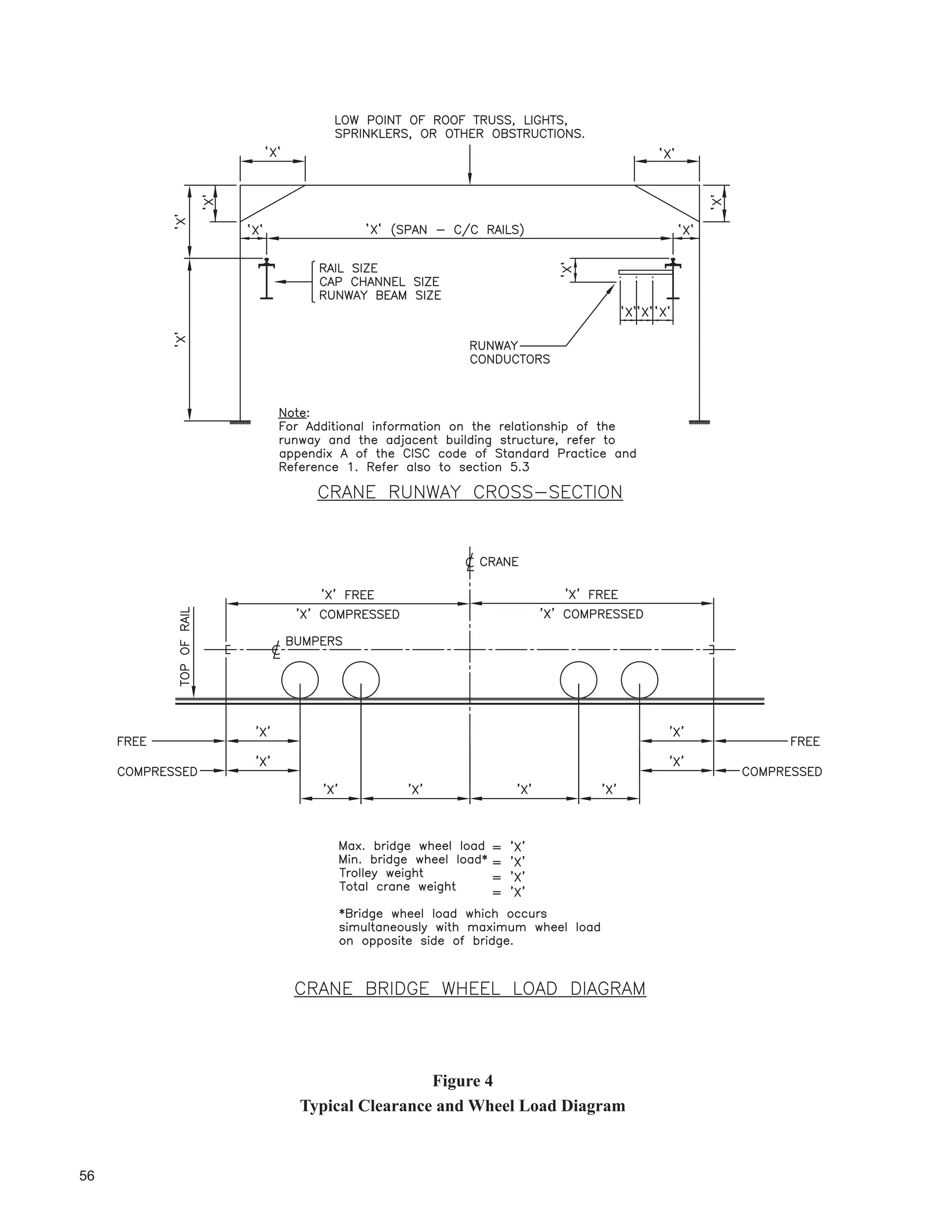
Crane manufacturers provide information on maximum wheel loads. These loads may differ from wheel to
wheel, depending on the relative positions of the crane components and the lifted load. The designer usually has
to determine the concurrent wheel loads on the opposite rail from statics, knowing the masses of the unloaded
crane, the trolley, the lifted load, and the range of the hook(s) (often called hook approach) from side to side.
See Figure 4. Note that minimum wheel loads combined with other loads such as side thrust may govern certain
aspects of design. Foundation stability should be checked under these conditions.
2.3.3 Side Thrust
Crane side thrust is a horizontal force of short duration applied transversely by the crane wheels to the rails.
)RU WRS UXQQLQJ FUDQHV WKH WKUXVW LV DSSOLHG DW WKH WRS RI WKH UXQZD UDLOV XVXDOO E GRXEOHÀDQJHG ZKHHOV
,I WKH ZKHHOV DUH QRW GRXEOHÀDQJHG VSHFLDO SURYLVLRQV QRW FRYHUHG E WKLV GRFXPHQW DUH UHTXLUHG WR HQVXUH
satisfactory service and safety. For more information see CMAA (2010) and Weaver (1985). For underslung
FUDQHV WKH ORDG LV DSSOLHG DW WRS RI WKH ERWWRP ÀDQJH 6LGH WKUXVW DULVHV IURP RQH RU PRUH RI
‡ acceleration or braking of the crane trolley(s)
‡ trolley impact with the end stop
‡ non-vertical hoisting action
‡ skewing or “crabbing” of the crane as it moves along the runway
‡ misaligned crane rails or bridge end trucks
The effect of the side thrust forces are combined with other design loads as presented subsequently. Side thrust
(total side thrust from Table 2.1) is distributed to each side of the runway in accordance with the relative lateral
stiffness of the supporting structures. For new construction it is assumed that the cranes and supporting structures
DUH ZLWKLQ WROHUDQFHV 6HYHUH PLVDOLJQPHQW DV RQH PD ¿QG LQ ROGHU RU SRRUO PDLQWDLQHG VWUXFWXUHV FDQ OHDG WR
unaccounted-for forces and consequential serious damage.
Side thrust from monorails is due only to non-vertical hoisting action and swinging; therefore, the values in
Table 2.1 are less than those for bridge cranes.
The number of cycles of side thrust is taken as one-half the number of vertical load cycles because the thrust can
be in two opposite directions.
More information can be found in AISE (2003), CMAA (2010), Fisher (2004), Griggs and Innis (1978), Griggs
(1976), Millman (1996), Rowswell (1987), and Tremblay and Legault (1996).
2.3.4 Traction Load
Longitudinal crane tractive force is of short duration, caused by crane bridge acceleration or braking. The locations
RI GULYHQ ZKHHOV VKRXOG EH HVWDEOLVKHG EHIRUH ¿QDO GHVLJQ ,I WKH QXPEHU RI GULYHQ ZKHHOV LV XQNQRZQ WDNH WKH
tractive force as 10% of the total wheel loads.
2.3.5 Bumper Impact
This is a longitudinal force exerted on the crane runway by a moving crane bridge striking the end stop. The NBCC
 GRHV QRW VSHFL¿FDOO FRYHU WKLV ORDG FDVH 3URYLQFLDO UHJXODWLRQV LQFOXGLQJ IRU LQGXVWULDO HVWDEOLVKPHQWV
should be reviewed by the structure designer. Following AISE (2003), it is recommended that it be based on the
full rated speed of the bridge, power off. Because it is an accidental event, the load factor is taken as 1.0.
2.3.6 Vibrations
Although rarely a problem, resonance should be avoided. An imperfection in a trolley or bridge wheel could set
up undesirable forcing frequencies.
6
)URP 5RZVZHOO
WKH SUREDEOH DPSOL¿FDWLRQ RI VWUHVV WKDW PD RFFXU LV JLYHQ E WKH IROORZLQJ PDJQL¿FDWLRQ
factor:
 /RDG RPELQDWLRQV 6SHFL¿F WR UDQH6XSSRUWLQJ 6WUXFWXUHV
The structure must also be designed for load combinations without cranes, in accordance with the NBCC 2010.
Load combinations comprising fewer loads than those shown below may govern.
:KHUH PXOWLSOH FUDQHV RU PXOWLSOH DLVOHV DUH LQYROYHG RQO ORDG FRPELQDWLRQV WKDW KDYH D VLJQL¿FDQW SRVVLELOLW
of occurring need to be considered. Load combinations given in the NBCC 2010, including crane loads, are
presented here.
Crane load combinations C1
to C7 shown in Table 2.2 are combinations of the crane loads given in Section 2.2 that
are used in the industry. For more information see AISE (2003), Fisher (2004), and MBMA (2006).
For load combinations involving column-mounted jib cranes, see Fisher and Thomas (2002).
Table 2.2
Crane Load Combinations
C1 Cvs + 0.5Css Fatigue
C2 Cvs + (Cis or Css) + Cls Single crane in a single aisle.
C3 Cvm + Css + Cls Any number of cranes in single or multiple aisles.
C4 Cvm + 0.5Csm + 0.9Clm Two cranes in tandem in one aisle only. No more than two
need be considered except in extraordinary circumstances.
C5 Cvm + 0.5Csm + Cim + 0.5Clm One crane in each adjacent aisle.
C6 Cvm + 0.5Csm Maximum of two cranes in each adjacent aisle, side thrust
from two cranes in one aisle only. No more than two need be
considered except in extraordinary circumstances.
C7 Cvs + Cis + Cbs Bumper impact
Magnification Factor
natural frequency
forcing frequency
1
1
2=
-= G
7
2.4.1 Fatigue
The calculated fatigue stress range at the detail under consideration, to meet the requirements of Clause 26 of
S16-09 and as described in Chapter 3 of this document, will be taken as that due to C1.
Note: Dead load is a steady state and does not contribute to the stress range. However, the dead load stress
may cause the stress range to be entirely in compression and therefore favourable or wholly or partly in
tension and therefore unfavourable.
2.4.2 Ultimate Limit States of Strength and Stability
In each of the following inequalities, for load combinations with crane loads, the factored resistance, IR, and
the effect of factored loads such as 0.9D, are expressed in consistent units of axial force, shear force or moment
acting on the member or element of concern. The most unfavourable combination governs.
Case Principal Loads Companion Loads
1. IR • D
2. IR • D or 0.9D) + (1.5C + 1.0L) 1.0S or 0.4W
3. IR • D or 0.9D) + (1.5L + 1.0C) 0.5S or 0.4W
4. IR • D or 0.9D) + 1.5S (1.0C + 0.5L)
5. IR • D or 0.9D) + 1.4W (1.0C + 0.5L) See Note 8.
6. IR • D or 0.9D) + 1.0C7
. IR • D + 1.0E 1.0Cd + 0.5L + 0.25S
8. IR • D + C1
where C is any one of the crane load combinations C2 to C6 from Table 2.2.
/RDGV ' / 6 : DQG ( DUH ORDGV GH¿QHG LQ WKH 1DWLRQDO %XLOGLQJ RGH RI DQDGD 1%
LVVXHG E WKH
Canadian Commission on Building and Fire Codes with the exception that the load L is all the live loads excluding
loads due to cranes. Notes (1) through (9) of table 4.1.3.2.B of the 2010 NBCC shall apply to the factored load
combinations.
Notes:
1) The combinations above cover the whole steel structure. For design of the crane runway beams in an
enclosed structure for instance, S and W would not normally apply.
2) Crane runway columns and occasionally crane runway beams support other areas with live loads.
3) The effects of factored imposed deformation, 1.25T, lateral earth pressure, 1.5H, factored pre-stress, 1.0P,
shall be considered where they affect structural safety.
4) The earthquake load, E, includes earthquake-induced horizontal earth pressures.
5) Crane wheel loads are positioned for the maximum effect on the element of the structure being considered.
6) The basic NBCC load factors shown above are in accordance with information available at the time of
publication of this document. The designer should check for updates.
7) Note that the NBCC requires that for storage areas the companion load factor must be increased to 1.0.
8) Side thrust due to cranes need not be combined with full wind load.
8
CHAPTER 3 - DESIGN FOR REPEATED LOADS
3.1 General
7KH PRVW VLJQL¿FDQW GLIIHUHQFH EHWZHHQ RUGLQDU LQGXVWULDO EXLOGLQJV DQG WKRVH VWUXFWXUHV WKDW VXSSRUW FUDQHV LV
the repetitive loading caused by cranes. Steel structures that support cranes and hoists require special attention
to the design and the details of construction in order to provide safe and serviceable structures, particularly as
related to fatigue. The fatigue life of a structure can be described as the number of cycles of loading required
WR LQLWLDWH DQG SURSDJDWH D IDWLJXH FUDFN WR ¿QDO IUDFWXUH )RU PRUH GHWDLOHG LQIRUPDWLRQ VHH 'HPR DQG )LVKHU
(1976), Kulak and Grondin (2009), Fisher, Kulak and Smith (1997), Fisher and Van de Pas (2002), Millman
(1996), Reemsnyder and Demo (1998) and Ricker (1982).
The vast majority of crane runway beam problems, whether welded or bolted, are caused by fatigue cracking
of welds, bolts and parent metal. Problems have not been restricted to the crane runway beams, however. For
example, trusses or joists that are not designed for repeated loads from monorails or underslung cranes have
IDLOHG GXH WR XQDFFRXQWHGIRU IDWLJXH ORDGLQJ )RU DOO FUDQH VHUYLFH FODVVL¿FDWLRQV WKH GHVLJQHU PXVW H[DPLQH WKH
structural components and details that are subjected to repeated loads to ensure the structure has adequate fatigue
resistance. Members to be checked for fatigue are members whose loss due to fatigue damage would adversely
affect the integrity of the structural system.
As given in S16-09, Clause 26, the principal factors affecting the fatigue performance of a structural detail are
considered to be the nature of the detail, the range of stress to which the detail is subjected, and the number of
cycles of a load. The susceptibility of details to fatigue varies and, for convenience, Clause 26, in common with
IDWLJXH UHTXLUHPHQWV LQ VWDQGDUGV ZRUOGZLGH VSHFL¿HV D OLPLWHG QXPEHU RI GHWDLO FDWHJRULHV )RU HDFK FDWHJRU
the relationship between the allowable fatigue stress range of constant amplitude and the number of cycles of
loading is given. These are the S-N (stress vs. number of cycles) curves.
Two methods of assessing crane-supporting structures for fatigue have developed. Historically, at least for
VWUXFWXUHV ZLWK UHODWLYHO KHDY FUDQH VHUYLFH WKH ¿UVW RI WKHVH ZDV WR FODVVLI WKH VWUXFWXUH E ³ORDGLQJ FRQGLWLRQ´
as related to the crane service. Section 3.4.1 covers this. While this has worked reasonably well, this approach has
two shortcomings. First, the number of cycles, by “pigeon-holing” the structure, may be set somewhat too high as
related to the service life of the structure in question, and second, only the maximum stress range is considered.
The second, more recent, approach is to assess the various ranges of stress and corresponding numbers of cycles
to which the detail is subjected and to try to determine the cumulative effect using the Palmgren-Miner rule as
given in Section 3.3.2. This can be advantageous, especially in examining existing structures.
The assessment of the number of cycles nN requires care as an element of the structure may be exposed to fewer
or more repetitions than the number of crane lifts or traverses along the runway. For example, if out-of-plane
EHQGLQJ LV H[HUWHG RQ D FUDQH UXQZD EHDP ZHE DW LWV MXQFWLRQ ZLWK WKH WRS ÀDQJH E D UDLO ZKLFK LV RIIFHQWUH
D VLJQL¿FDQW UHSHWLWLYH ORDG RFFXUV DW HYHU ZKHHO SDVVDJH DQG WKH QXPEHU RI FFOHV LV ³Q´ WLPHV WKH QXPEHU RI
crane passages “N” where “n” is the number of wheels on the rail, per crane. Also, for short-span crane runway
beams depending on the distances between the crane wheels, one pass of the crane can result in more than one
loading cycle on the beam, particularly if cantilevers are involved. On the other hand, when the crane lifts and
traverses are distributed among several bays, a particular runway beam will have fewer repetitions than the
number of lifts. For additional discussion of crane-structure interaction, see Section 5.2.
The provisions here apply to structures supporting electrically operated, top running, overhead travelling cranes
(commonly referred to as EOT’s), underslung cranes, and monorails. Light-duty crane support structures, where
components are subjected to not more than 20 000 cycles of repeated load and where high ranges of stress in
fatigue susceptible details are not present, need not be designed for fatigue.
It is necessary to evaluate the effect of repeated crane loadings before concluding that fewer than 20 000 cycles of
loading will occur. Referring to Table 3.3 and 3.4, and Section 3.4.3, even supporting structures for Crane Service
ODVVL¿FDWLRQ $ FRXOG UHTXLUH FRQVLGHUDWLRQ RI VRPHZKDW PRUH WKDQ   IXOO FFOHV RI UHSHDWHG ORDG
 ([FOXVLRQ IRU /LPLWHG 1XPEHU RI FOHV
Clause 26.3.5 of S16-09 presents the situation when the number of stress range cycles of loading is limited and
fatigue is therefore not likely to be a problem. First, fatigue-sensitive details with high stress ranges, likely with
9
stress reversals, are excluded from these provisions and should be investigated for fatigue in any case. Second, the
requirements of Clause 26.1 that the member and connection be designed, detailed, and fabricated to minimize
stress concentrations and abrupt changes in cross section are to be met. Only then, if the number of cycles is less
than the greater of two criteria, 20 000 or fsr
3
c is no fatigue check required. The detail category may determine
the limit. For example, for detail category E, from Table 10, the fatigue life constant, J = 361 u 109
MPa and,
say, calculations give a fatigue stress range, ƒsr
= 210 MPa . Hence the second criterion yields a limit of 39 000
cycles. Therefore, the limit of 39 000 cycles controls and if the detail is subject to fewer than 39 000 cycles, no
fatigue check is necessary.
 'HWDLOHG /RDG,QGXFHG )DWLJXH $VVHVVPHQW
3.3.1 General
Clause 26.3.2 of S16-09 gives the design criterion for load-induced fatigue as follows:
Fsr • ¦sr
where
ƒsr = calculated stress range at the detail due to passage of the fatigue load
Fsr = fatigue resistance
F
/
srt
1 3
$=
h
c
M
e o
J = fatigue life constant, see Clause 26.3.4
K number of stress range cycles at given detail for each application of load
N = number of applications of load
Fsrt = constant amplitude threshold stress range, see Clauses 26.3.3 and 26.3.4.
Above the constant amplitude fatigue threshold stress range, the fatigue resistance (in terms of stress range) is
considered to vary inversely as the number of stress range cycles to the 1/3 power. Rearranging the expression for
the fatigue resistance, the number of cycles to failure is:
N Fsr
3
=h c
Accordingly the number of cycles to failure varies inversely as the stress range to the third power. Below the
constant amplitude fatigue threshold stress range, the number of cycles to failure varies inversely as the stress
UDQJH WR WKH ¿IWK SRZHU
The effect of low stress range cycles will usually be small on crane-supporting structures but should be investigated
nonetheless. It requires the addition of a second term to the equivalent stress range (see Section 3.3.3) where the
value of m is 5 for the relevant low stress range cycles.
As stated in Section 2.4, a dead load is a steady state and does not contribute to stress range. However, the dead
load stress may cause the stress range to be entirely in compression and therefore favourable or wholly or partly
in tension and therefore unfavourable. In this regard, web members of trusses subjected to live load compressive
stresses may cycle in tension when the dead load stress is tensile. This condition may also apply to cantilever and
continuous beams. On the other hand, the compressive stresses due to dead load in columns may override the
tensile stresses due to bending moments.
For additional information on analysis of stress histories where complex stress variations are involved, see Fisher,
Kulak and Smith (1997), and Kulak and Grondin (2009).
10
3.3.2 Palmgren -Miner Rule
The total or cumulative damage that results from fatigue loading, not applied at constant amplitude, by S16-09
must satisfy the Palmgren-Miner Rule:
.
N
N
1 0
fi
i
#
h_ i
 H!
where:
N i
h_ i = number of expected stress range cycles at stress range level i.
N¿ = number of cycles that would cause failure at stress range i.
In a typical example, the number of cycles at load level 1 is 208 000 and the number of cycles to cause failure
at load level 1 is 591 000. The number of cycles at load level 2 is 104 000 and the number of cycles to cause
failure at load level 2 is 372 000. The total effect or “damage” of the two different stress ranges is
3.3.3 Equivalent Stress Range
The Palmgren-Miner rule may also be expressed as an equivalent stress range.
e i i
m
1
m
=v a vD D8 B!
where:
evD = the equivalent stress range
ia =
Nfi
i
hM_ i
ivD = the stress range level i.
m = 3 for stress ranges at or above the constant amplitude threshold stress range. For stress ranges
below the threshold, m = 5.
For example, if the stress range at level 1 in the above example is 188 MPa and the stress range at level 2 is
219 MPa, then the equivalent stress range is
MPa
312 000
208 000 188
312 000
104 000 219 2003 3
1
3
.+c ^ c ^m h m h F
A calculation of the number of cycles to failure (see Section 3.3.1) and where J 3 930×109
gives 491 000 cycles.
Since the actual number of cycles is 312 000, the percentage of life expended (damage) is 312 000/491 000)
·100% = 64%. This is essentially the same result as in 3.3.2 (equivalent stress range was rounded off).
.  . OK
591000
208 000
372 000
104 000 0 63 1 0+ =
11
3.3.4 Equivalent Number of Cycles
)RU D SDUWLFXODU GHWDLO RQ D VSHFL¿F FUDQH UXQZD EHDP WKH FXPXODWLYH IDWLJXH GDPDJH UDWLR FDQ EH DVVHVVHG
considering that:
(1) the detail has a unique fatigue life constant as listed in Table 10 of S16-09,
(2) the stress range is proportional to the load,
(3) the number of cycles at the detail, nN, is proportional to the number of cycles of load on the crane
runway beam, N,
(4) above and below the constant amplitude fatigue threshold stress range the number of cycles to failure
varies inversely as the stress range to the 3rd
and 5th
power, respectively.
The equivalent number of cycles at the highest stress range level, Ne ,where Nm is the number at the highest stress
range level, for cycles above the constant amplitude fatigue threshold stress range, is
/N N C Cm i i m
3
+ ^ h8 B!
where Cm and Ci are the respective proportional constants of the stress ranges at the maximum stress range level
and the stress range level, respectively, to the crane-induced load. For cycles below the constant amplitude fatigue
WKUHVKROG VWUHVV UDQJH VLPLODU WHUPV DUH GHYHORSHG EDVHG RQ WKH ÀDWWHU  VORSH RI WKH 61 GLDJUDP 0DQ FFOHV
below the constant amplitude fatigue threshold stress range do cause fatigue damage, albeit at a reduced rate.
For the example in Section 3.3.3, the equivalent number of cycles at the highest stress range level is
104 000 + 208 000 (188/219)3
= 104 000 + 131 584 = 235 584 cycles
A calculation of the number of cycles to failure (see Section 3.3.1) and where J = 3930u109
gives 374 160 cycles.
The percentage of life expended (damage) is (235 584/374 160)·100% = 63%. This is the same result as in
Section 3.3.2.
This approach is useful for relating duty cycle information to class of service and can be used to simplify
calculations as shown in Section 3.5 and Appendix A, Design Example 2.
3.3.5 Fatigue Design Procedure
The recommended procedure for design for fatigue is as follows:
‡ Choose details that are not susceptible to fatigue.
‡ 0LQLPL]H GHÀHFWLRQV DQG GLVWRUWLRQV ZLWKLQ OLPLWV RI FRVWV DQG SUDFWLFDELOLW
‡ Avoid unaccounted-for restraints.
‡ Avoid abrupt changes in cross section.
‡ Minimize range of stress where practicable.
‡ Account for eccentricities of loads such as misalignment of crane rails.
‡ Examine components and determine fatigue categories.
‡ Calculate stress ranges for each detail.
‡ Calculate fatigue lives for each detail.
‡ Compare the fatigue life of the details to the results obtained from the detailed load-induced fatigue
assessment.
‡ Adjust the design as necessary to provide adequate resistance to fatigue
12
 ODVVL¿FDWLRQ RI 6WUXFWXUH
3.4.1 General
7R SURYLGH DQ DSSURSULDWH GHVLJQ RI WKH FUDQHVXSSRUWLQJ VWUXFWXUH WKH 2ZQHU PXVW SURYLGH VXI¿FLHQWO GHWDLOHG
information, usually in the form of a duty cycle analysis or results thereof. While the structure designer may
provide input to a duty cycle analysis, the basic time and motion analysis should be done by plant operations
personnel. A duty cycle analysis of interest to the structure designer should yield the spectrum of loading cycles
for the structure taking into account such items as:
± QXPEHUV RI FUDQHV LQFOXGLQJ IXWXUH XVH
± WRWDO QXPEHU RI FFOHV IRU HDFK FUDQH E ORDG OHYHO
± WKH GLVWULEXWLRQ RI WKH DERYH FFOHV IRU HDFK FUDQH RYHU WKH OHQJWK RI WKH UXQZD DQG DORQJ WKH OHQJWK RI WKH
bridge of the crane(s).
The number of cycles of loading, by load level, can therefore be determined for the critical location and for all
other elements of the structure.
In the past it was somewhat common for designers to classify the structure based on ranges of number of cycles
at full load. In some references (Fisher 2004, AISE 2003, CMAA 2010, MBMA 2006) this was associated with
a loading condition. Some of these references (Fisher 2004, Fisher and Van de Pas 2002, and MBMA 2006)
provide information on relating the loading condition to class of crane service. A duty cycle analysis was done to
the extent required to assess which of several loading conditions was most suitable.
New fatigue provisions are based on working with actual numbers of cycles and require consideration of
cumulative fatigue damage. Therefore the loading condition concept is no longer recommended, and is used only
for reference.
In order that the designer can determine KN for all structural elements subject to fatigue assessment, the design
criteria should contain a statement to the effect that cycles refers to crane loading cycles N.
8QOHVV RWKHUZLVH VSHFL¿HG E WKH RZQHU ODXVH  RI 6 JLYHV D OLIH RI  HDUV ,W LV QRZ FRPPRQ IRU
owners to specify a service life span of less than 50 years.
This section of the guide provides methods of classifying the crane-supporting structure, describes preparation of
the structure design criteria for fatigue, and describes fatigue design procedure.
 UDQH 6HUYLFH ODVVL¿FDWLRQ
UDQH VHUYLFH FODVVL¿FDWLRQV DV JLYHQ LQ 6$ % FORVHO UHVHPEOH WKH VDPH FODVVL¿FDWLRQV RI WKH UDQH
0DQXIDFWXUHU¶V $VVRFLDWLRQ RI $PHULFD 0$$
/LIWLQJ FDSDFLW LV QRW UHVWULFWHG LQ DQ FODVVL¿FDWLRQ DQG WKHUH
LV D ZLGH YDULDWLRQ LQ GXW FFOHV ZLWKLQ HDFK FODVVL¿FDWLRQ )RU LQVWDQFH QXPEHU RI OLIWV SHU KRXU GRHV QRW
necessarily suggest continuous duty and may be more relevant to rating of electrical gear than to structural
design. Weaver (1985) provides additional information on the operation of several types of crane service and
QRWHV WKDW WKH VHUYLFH FODVVL¿FDWLRQ PD GLIIHU IRU WKH GLIIHUHQW FRPSRQHQWV RI D FUDQH 7KH PDLQ KRLVW DX[LOLDU
KRLVW DQG EULGJH PD KDYH WKUHH GLIIHUHQW FODVVL¿FDWLRQV
Bridge speeds vary from 0.2 m/sec (usually massive cranes in powerhouses) to 2 m/sec (usually lower capacity
cab-operated industrial cranes), to as much or more than 5 m/sec in some automated installations.
There are many more cranes of Classes A and B, used for lighter duty, than heavy-duty cranes of Classes D, E and
F. Class C cranes of moderate service may in some cases be included in this lighter duty category. For additional
information, see Table 3.1.
Lighter duty cranes may be pendant, cab, or radio controlled. While fatigue must be considered, many of the
problems associated with their supporting structures are due to poor design details, loose construction tolerances
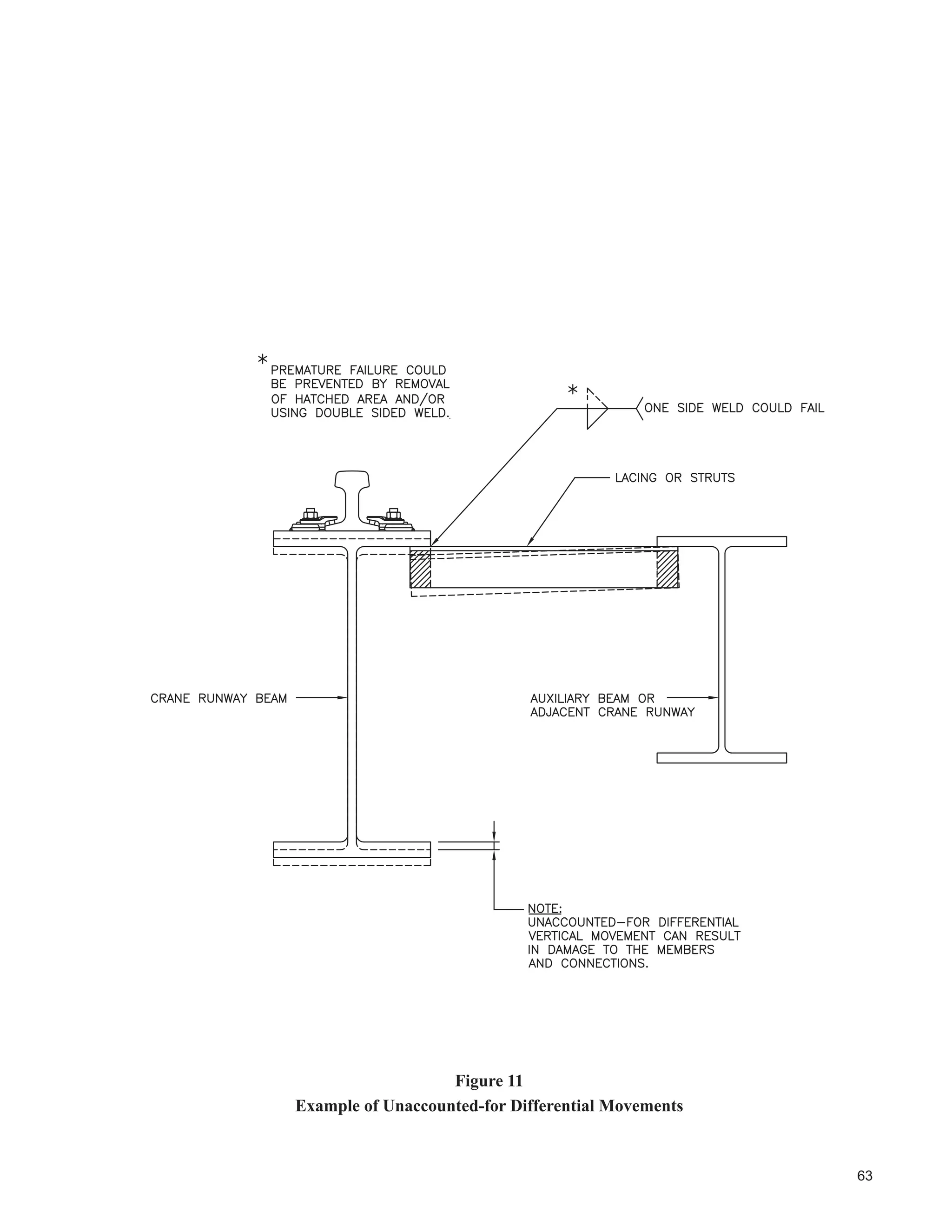
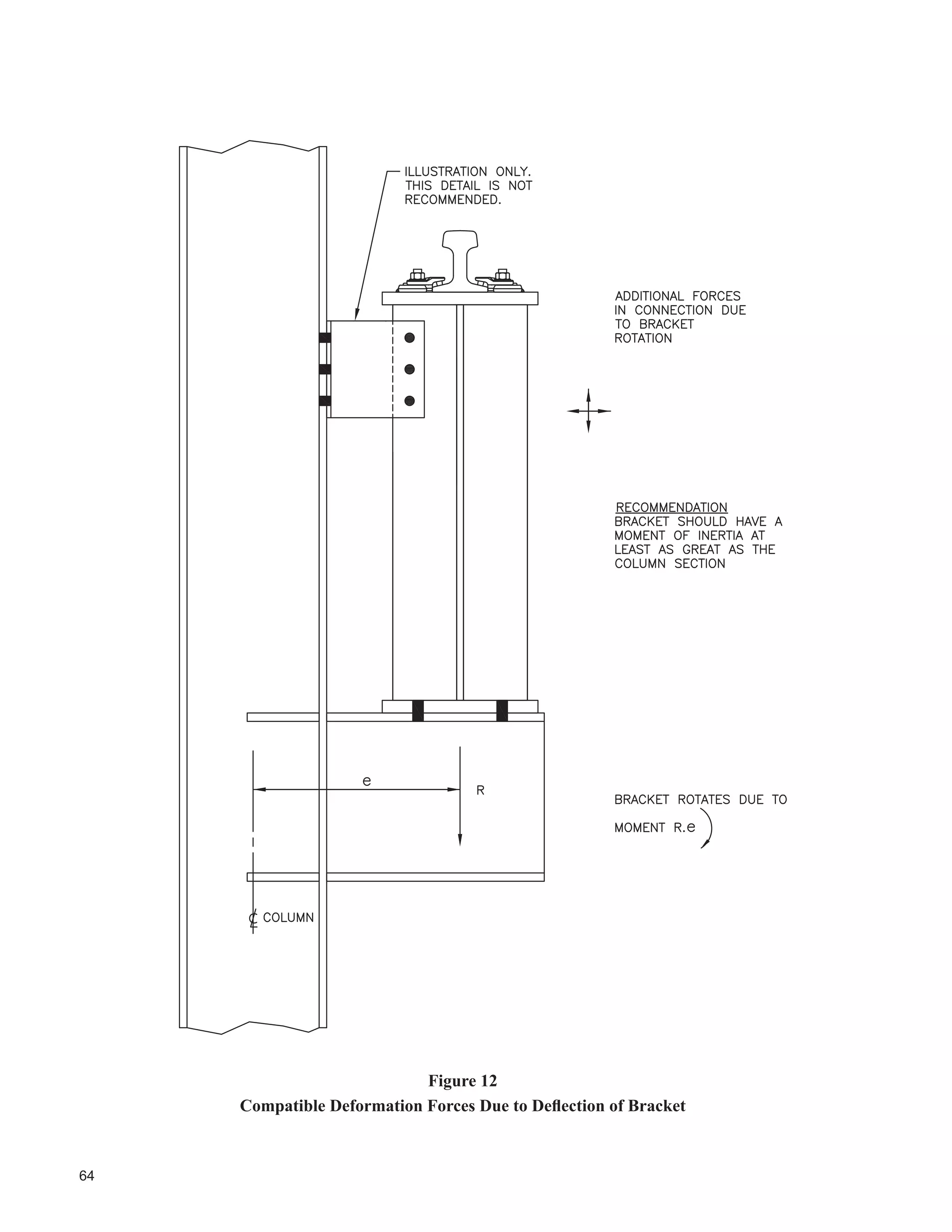
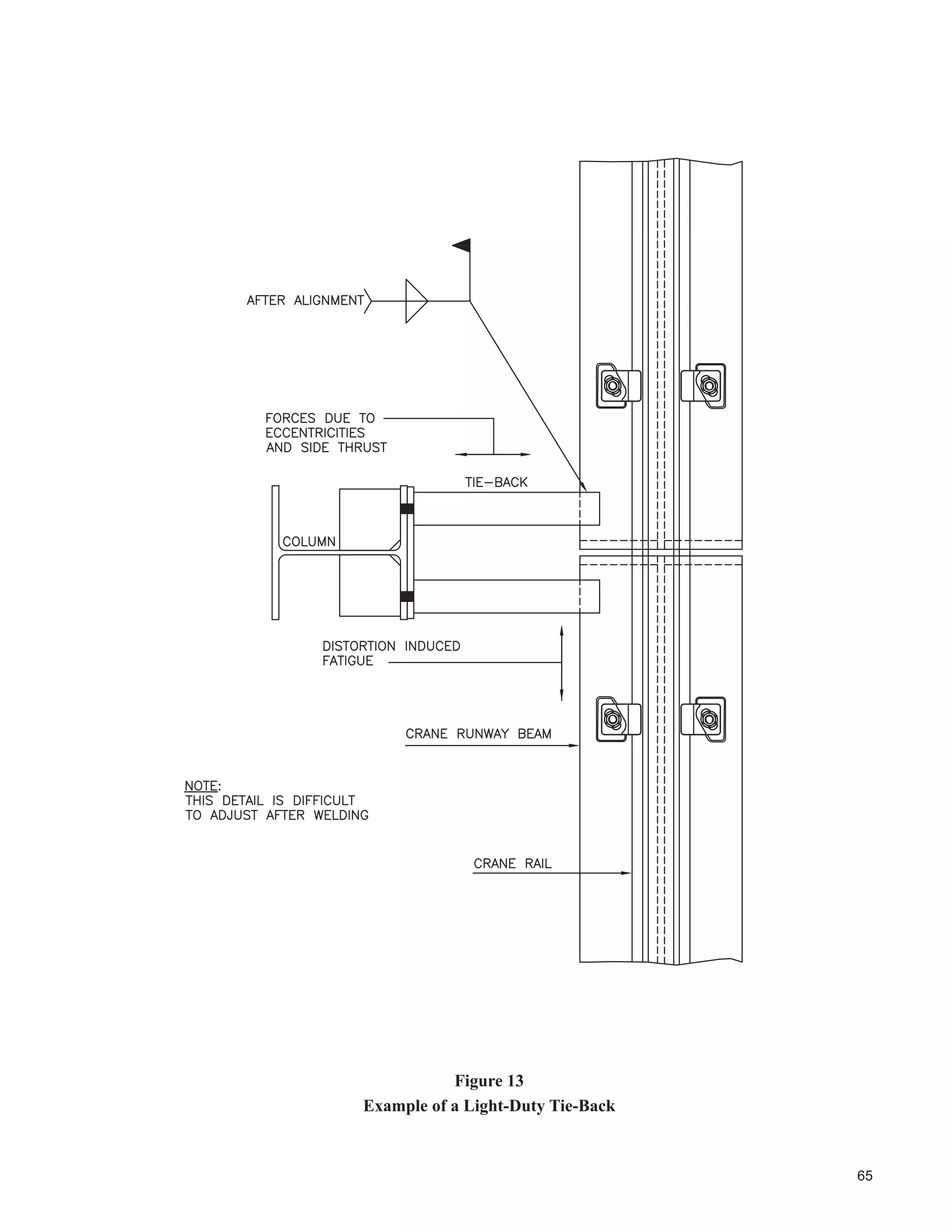
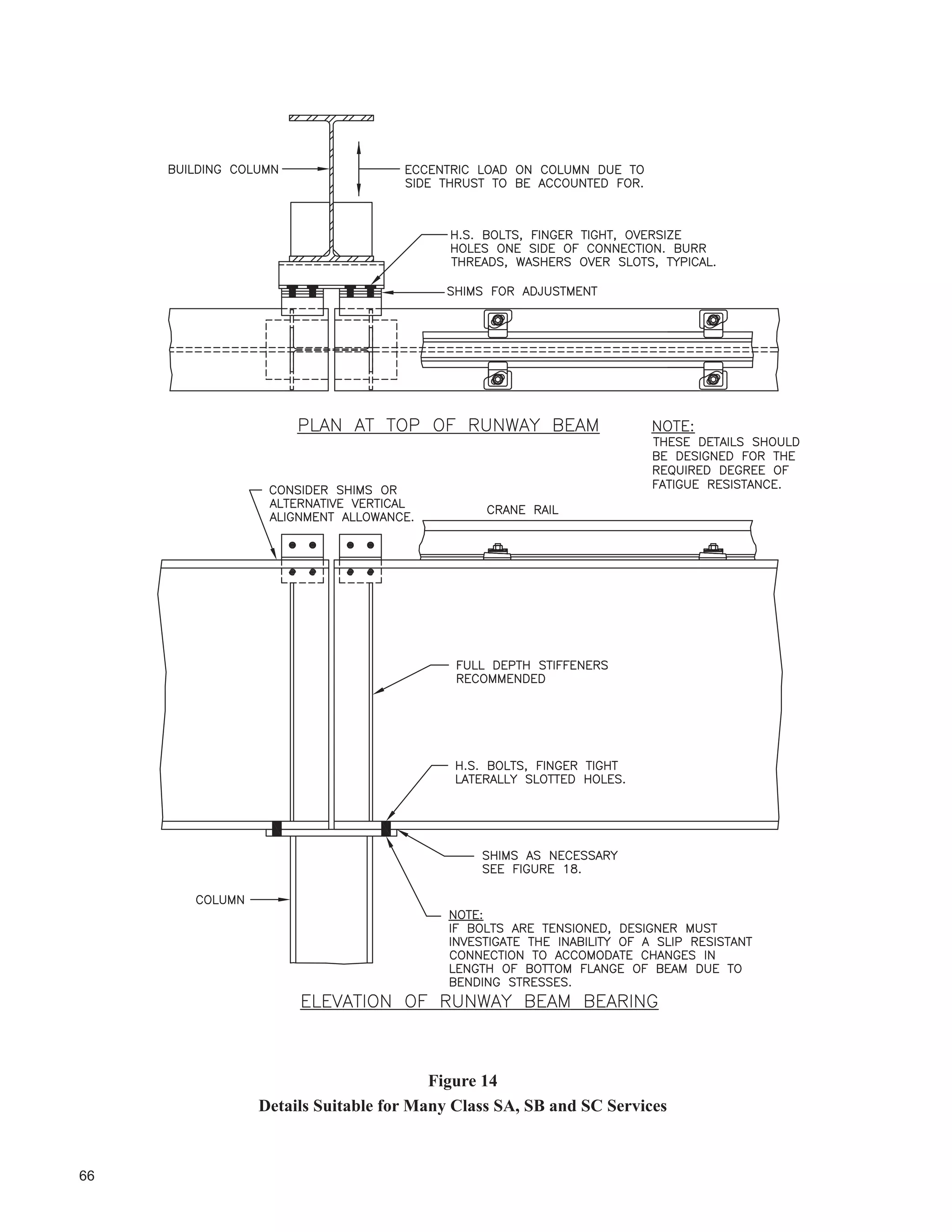
DQG XQDFFRXQWHGIRU IRUFHV DQG GHÀHFWLRQV ([DPSOHV RI SRRU GHWDLOV DUH ZHOGLQJ UXQZD EHDPV WR FROXPQV DQG
EUDFNHWV DQG LQDSSURSULDWH XVH RI VWDQGDUG EHDP FRQQHFWLRQV 5HIHU WR WKH ¿JXUHV IRU RWKHU H[DPSOHV 5HJDUGLQJ
Table 2.1, the designer must decide, after assessing the design criteria (see Chapter 7), which of the three lighter
duty crane types should apply.
For chain-operated cranes, because of the slow (usually less than 1 m/sec hoisting, trolley and bridge speed)
QDWXUH RI WKH RSHUDWLRQ WKH QXPEHU RI FFOHV H[SHFWHG DUH QRW VXI¿FLHQW WR ZDUUDQW GHVLJQ IRU IDWLJXH
13
3RUWLRQV RI WKH FODVVL¿FDWLRQV UHOHYDQW WR WKH VXSSRUWLQJ VWUXFWXUH DUH JLYHQ KHUH 7KH VHUYLFH FODVVL¿FDWLRQ LV
based on the frequency of use of the crane and the percentage of the lifts at or near rated capacity.
‡ ODVV $ 6WDQGE RU ,QIUHTXHQW 6HUYLFH
This covers cranes used in installations such as powerhouses, public utilities, turbine rooms, motor rooms,
and transformer stations, where precise handling of equipment at slow speeds with long, idle periods between
lifts is required. Hoisting at the rated capacity may be done for initial installation of equipment and for
infrequent maintenance.
‡ ODVV % /LJKW 6HUYLFH
This covers cranes used in repair shops, light assembly operations, service buildings, light warehousing, or
similar duty, where service requirements are light and the speed is slow. Loads may vary from no load to
occasional full-rated loads, with 2 - 5 lifts per hour.
‡ ODVV  0RGHUDWH 6HUYLFH
This covers cranes used in machine shops or paper mill machine rooms, or similar duty, where service
requirements are moderate. The cranes will handle loads that average 50% of the rated capacity, with 5 -10
lifts/hour, with not over 50% of the lifts at rated capacity.
‡ ODVV ' +HDY 6HUYLFH
This covers cranes that may be used in heavy machine shops, foundries, fabricating plants, steel warehouses,
container yards, lumber mills, or similar duty, and standard-duty bucket and magnet operations where heavy-
duty production is required. Loads approaching 50% of the rated capacity are handled constantly during the
working period. High speeds are desirable for this type of service, with 10 - 20 lifts/hour, with not over 65%
of the lifts at rated capacity.
‡ ODVV ( 6HYHUH 6HUYLFH
This requires cranes capable of handling loads approaching the rated capacity throughout their life.
Applications may include magnet, bucket, and magnet/bucket combination cranes for scrap yards, cement
mills, lumber mills, fertilizer plants, container handling, or similar duty, with 20 or more lifts/hour at or near
the rated capacity.
‡ ODVV ) RQWLQXRXV 6HYHUH 6HUYLFH
This requires cranes capable of handling loads approaching rated capacity continuously under severe service
conditions throughout their life. Applications may include custom-designed specialty cranes essential to
performing the critical work tasks affecting the total production facility. These cranes must provide the
highest reliability, with special attention to ease-of-maintenance features.
7KH ORDG VSHFWUXP UHÀHFWLQJ WKH DFWXDO RU DQWLFLSDWHG FUDQH VHUYLFH FRQGLWLRQV DV FORVHO DV SRVVLEOH PD EH
XVHG WR HVWDEOLVK WKH FUDQH VHUYLFH FODVVL¿FDWLRQ 7KH ORDG VSHFWUXP 0$$
OHDGV WR D PHDQ HIIHFWLYH ORDG
IDFWRU DSSOLHG WR WKH HTXLSPHQW DW D VSHFL¿HG IUHTXHQF 3URSHUO VL]HG FUDQH FRPSRQHQWV DUH VHOHFWHG EDVHG RQ
the mean effective load factor and use as given in Table 3.1 adapted from CMAA (2010).
From the load spectrum (CMAA 2010), the mean effective load factor is:
k W Pi i
3
3= !
where:
k = Mean effective load factor (used to establish crane service class only).
Wi = Load magnitude; expressed as a ratio of the lift load to the rated capacity. Lifts of the hoisting
gear without the lifted load must be included.
Pi = The ratio of cycles under the lift load magnitude condition to the total number of cycles.
Ȉ Pi = 1.0
14
For example, if from 100 000 lifts, 10 000 are at full capacity, 70 000 are at 30% of capacity, and 20 000 are at
10% of capacity, then:
. . . . . . .k 1 0 0 1 0 3 0 7 0 1 0 2 0 4923 3 33
# # #= + + =
7DEOH  VKRZV D GH¿QLWLRQ RI UDQH 6HUYLFH ODVV LQ WHUPV RI /RDG ODVV DQG XVH 1RWH WKDW WKLV WDEOH GRHV QRW
necessarily describe the crane-carrying structure.
Table 3.1
UDQH 6HUYLFH ODVVL¿FDWLRQ EDVHG RQ N
k 0HDQ (IIHFWLYH
Load Factor
Use
,UUHJXODU
occasional
XVH IROORZHG
E ORQJ LGOH
periods
5HJXODU XVH
RI
intermittent
operation
5HJXODU XVH
in
FRQWLQXRXV
operation
5HJXODU XVH
in severe
FRQWLQXRXV
operation
”  A* B* C D
0.531  k ”  B* C* D E
0.671  k ”  C D D F
0.85  k ”  D E F F

 *HQHUDOO ¿WV WKH OLJKWGXW FDWHJRU RI VHUYLFH
3.4.3 Number of Full Load Cycles Based on Class of Crane
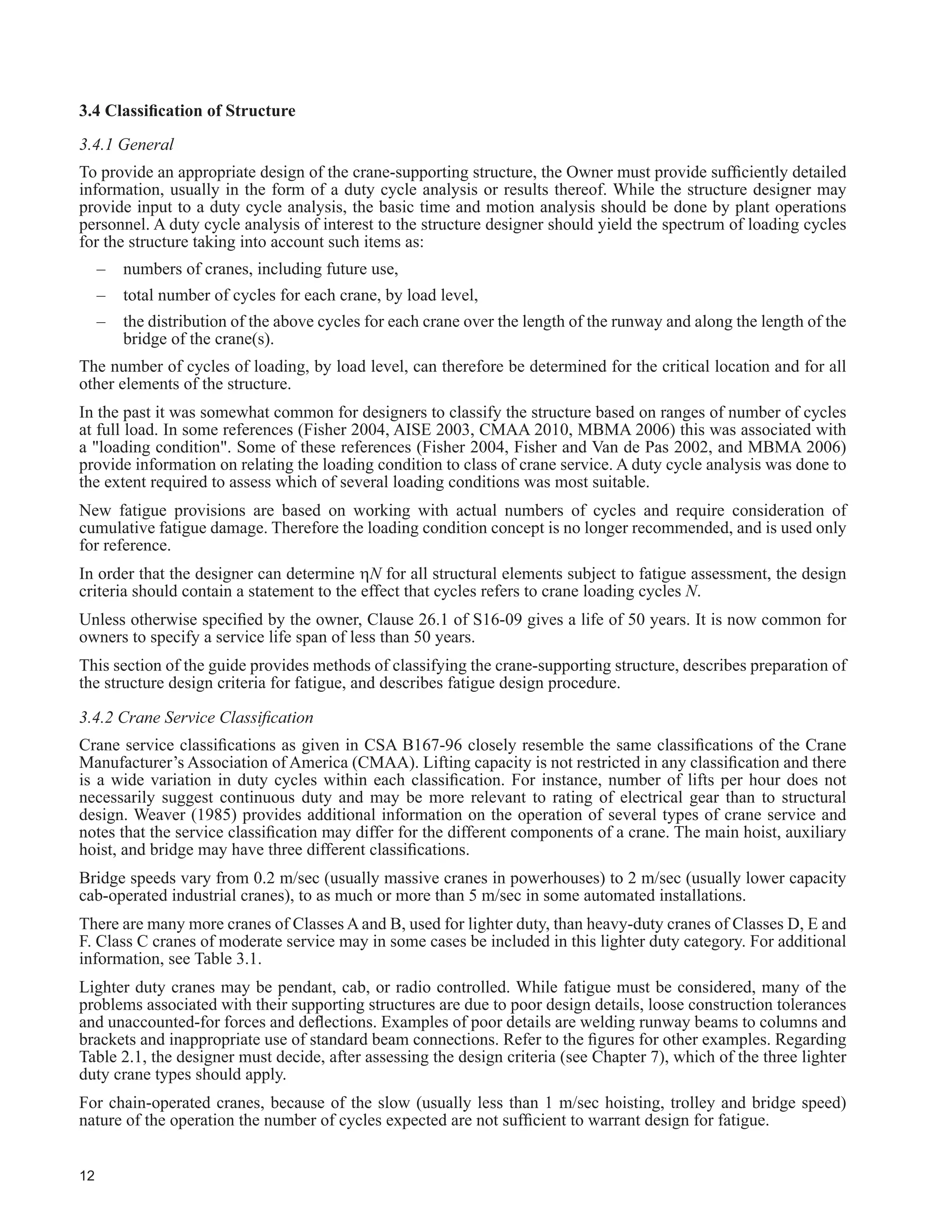
The number of full load cycles from the CMAA fatigue criteria for crane design is listed in Table 3.2.
These criteria cannot be applied directly to a supporting structure. Issues that must be considered are:
(a) span lengths of the supporting structure compared to the crane wheel spacing.
(b) the number of spans over which the crane operates. For instance, if the crane operates randomly over “x”
spans, the equivalent number of full load cycles for each span might be more like the number of cycles
above, divided by “x”. On the other hand, in a production type operation, each span on one side of the
runway may be subjected to almost the same number of full load cycles as the crane is designed for if the
crane travels the length of the runway fully loaded each time.
(c) the number of cranes.
(d) over or under utilization of the crane with respect to its class.
15
For Class of Crane Service A, B, or C where the lifting operation is randomly distributed along the length of
the runway beams and across the crane bridge, it is suggested that the number of cycles of loading of varying
amplitude for components of the crane-supporting structure can be estimated as the number of full load cycles for
the class of crane divided by the number of spans and multiplied by the number of cranes, further provided that
the life of the runway is the same as the life of the crane.
Table 3.2
0$$ 1XPEHU RI )XOO /RDG FOHV E ODVV RI UDQH
ODVV RI UDQH 1XPEHU RI 7KRXVDQGV RI )XOO /RDG FOHV
A 100
B 200
C 500
D 800
E 2 000
F  2 000
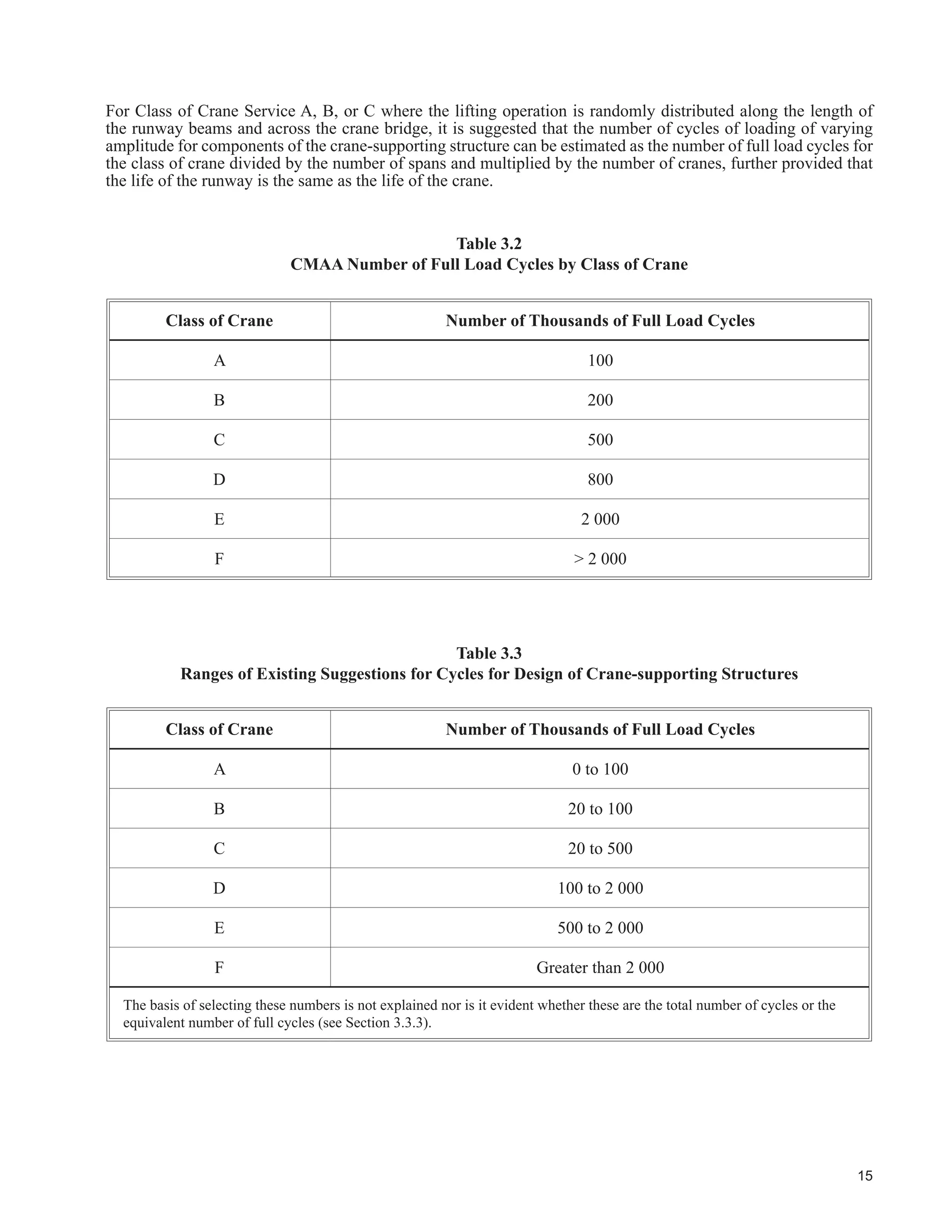
Table 3.3
5DQJHV RI ([LVWLQJ 6XJJHVWLRQV IRU FOHV IRU 'HVLJQ RI UDQHVXSSRUWLQJ 6WUXFWXUHV
ODVV RI UDQH 1XPEHU RI 7KRXVDQGV RI )XOO /RDG FOHV
A 0 to 100
B 20 to 100
C 20 to 500
D 100 to 2 000
E 500 to 2 000
F Greater than 2 000
The basis of selecting these numbers is not explained nor is it evident whether these are the total number of cycles or the
equivalent number of full cycles (see Section 3.3.3).
16
For instance, the runway for a new Class C crane, 5 spans, would be designed for 100 000 cycles.
The suggested numbers of cycles for the design of the crane-supporting structure as a function of the class of
crane vary widely among the sources. The basis of the recommendations is not clear. Fisher (2004), Fisher and
Van de Pas (2001), and MBMA (2006) give the values shown in Table 3.3.
Table 3.4 presents the recommended number of cycles for the design of the crane-supporting structure based on
WKH VWUXFWXUDO FODVV RI VHUYLFH LWVHOI GHULYHG IURP WKH FUDQH VHUYLFH FODVVL¿FDWLRQ 7KH QXPEHUV ZHUH GHWHUPLQHG
by duty cycle analyses as presented in Section 3.4.4. Examples of the analyses are given in Section 3.5. “N” is
GH¿QHG DV IXOO ORDG FFOHV (DFK IXOO ORDG FFOH FDQ H[HUW Q1 FFOHV RQ WKH VXSSRUWLQJ VWUXFWXUH 7R GLIIHUHQWLDWH
IURP WKH FUDQH WKH FODVV RI VHUYLFH IRU WKH FUDQHVXSSRUWLQJ VWUXFWXUH ZLOO EH SUH¿[HG ZLWK 6
By comparing the recommended number of cycles in Table 3.4 to the number of cycles for the crane in Table 3.2,
LW DSSHDUV WKDW IRU WKLV DSSURDFK WR VWUXFWXUDO FODVVL¿FDWLRQ WKH VWUXFWXUDO FODVV RI VHUYLFH VKRXOG EH  RI WKH
full load cycles for crane Classes A, B and C, and 50% for crane Classes D, E and F.
The information in Table 3.4 is not meant to take the place of a duty cycle analysis for the installation being
investigated.
3.4.4 Fatigue Loading Criteria Based on Duty Cycle Analysis
As discussed in Sections 3.4.1 and 3.4.3, a duty cycle analysis for one or more cranes will yield the spectrum
of loading cycles for the crane-supporting structure. Note that only the results of the duty cycle analysis that are
of interest to the structure designer are shown herein. To determine the location of the critical element of the
structure and its loading spectrum requires a time and motion study beyond the scope of this document. Weaver
(1985) and Millman (1996) provide examples of duty cycle analyses.
Table 3.4
5HFRPPHQGHG 1XPEHU RI FOHV IRU 'HVLJQ RI WKH UDQHVXSSRUWLQJ 6WUXFWXUH
6WUXFWXUDO ODVV
RI 6HUYLFH Recommended a
1XPEHU RI 7KRXVDQGV RI )XOO /RDG FOHV 1
SA 20
SB 40
SC 100
SD 400
SE 1 000
SF Greater than 2 000 b
a Used as a calibration of the supporting structure (Structural Class of Service) to class of crane service in Chapter 4. As is the
case for the crane, the supporting structure will withstand many more cycles of varying amplitude loading.
E 'XH WR WKH XQOLPLWHG IDWLJXH OLIH RI WKH FUDQH D GXW FFOH DQG DQDOVLV LV UHTXLUHG WR GH¿QH WKH IDWLJXH GHVLJQ FULWHULD
17
After identifying the critical component of the structure and the equivalent number of full loading cycles, the
fatigue design criteria for the structure can be prepared.
This is the most accurate and is the preferred method of determining the fatigue design criteria.
3.4.5 Preparation of Design Criteria Documentation
The structural class of service for entry into Checklist Table 4.1 is determined from the duty cycle information or
from previous procedures related to crane service class.
Refer also to Chapter 7 for other information that should be obtained for preparation of the design criteria.
 )DWLJXH ULWHULD 'RFXPHQWDWLRQ %DVHG RQ 'XW FOH $QDOVLV
Compute N, the equivalent number of full loading cycles for the location deemed most critical. This is the lower
limit of N to be used in Table 4.1. For example, if N is calculated to be 500 000 cycles, go to Structural Class of
Service SD. Use the actual numbers of cycles of loading from that point on. The spectrum of loading cycles for
the critical elements of the structure should be included in the design criteria.
The design criteria statement for fatigue design might appear as follows:
The supporting structure will be designed for cyclic loading due to cranes for the loads as follows:
Load Level, % of Maximum
Wheel Loads
Number of Thousands of Cycles, N*
100 10
75 50
52 100
25 200
* Means number of passes of cranes.
Design for cyclic side thrust loading will be for 50% of each number of cycles above with the corresponding percentage of side
thrust for cyclic loading.
18
 ULWHULD 'RFXPHQWDWLRQ %DVHG RQ ODVV RI UDQH 6HUYLFH $EEUHYLDWHG 3URFHGXUH
The design criteria statement for fatigue design might appear as follows:
The supporting structure will be designed for cyclic loading due to cranes for the following loads.
Load Level, % of Maximum
Wheel Loads
Number of Cycles, N*
100 40 000
* Means number of passes of cranes
Design for cyclic side thrust loading will be for 50% of the number of cycles above with the corresponding
percentage of side thrust for cyclic loading.
 ([DPSOHV RI 'XW FOH $QDOVHV
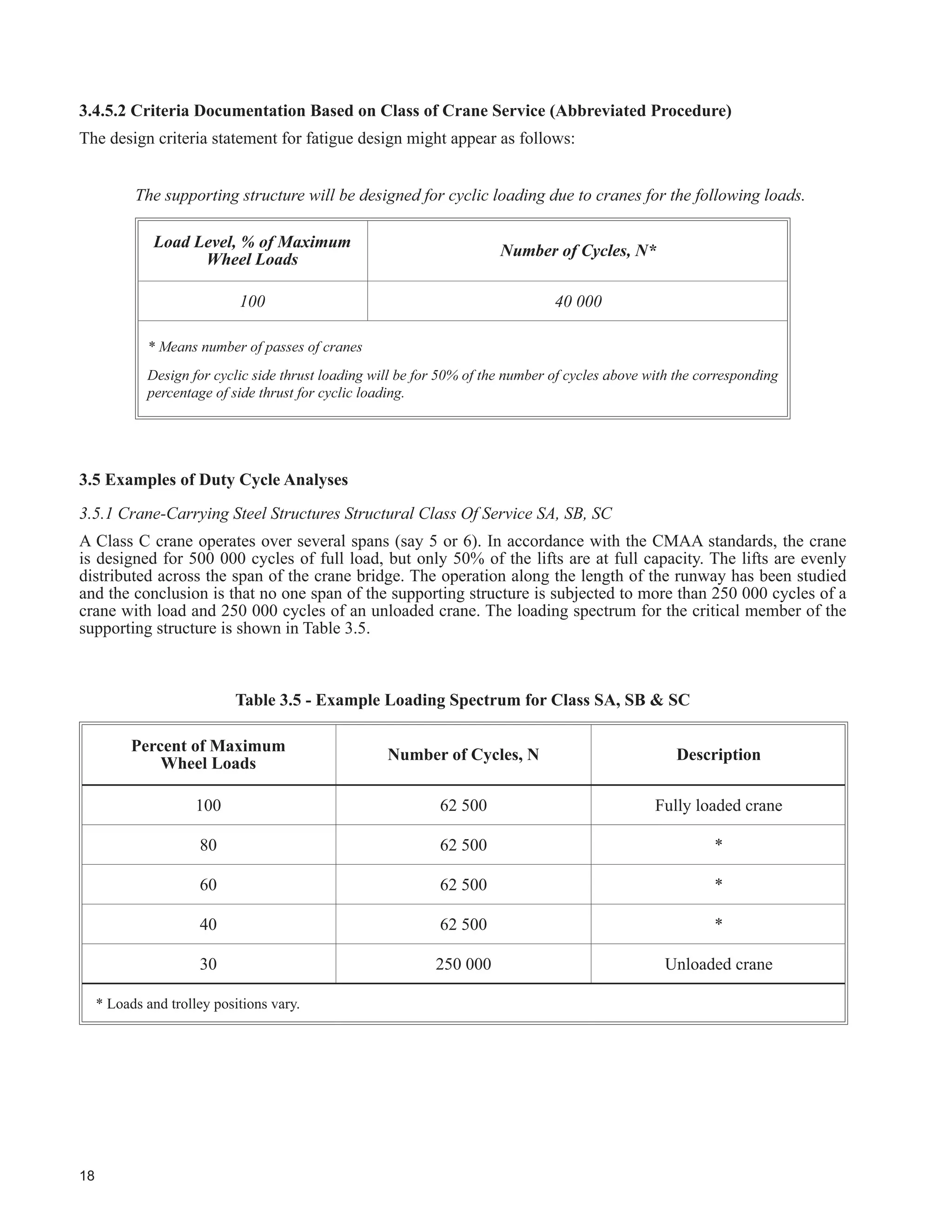
3.5.1 Crane-Carrying Steel Structures Structural Class Of Service SA, SB, SC
A Class C crane operates over several spans (say 5 or 6). In accordance with the CMAA standards, the crane
is designed for 500 000 cycles of full load, but only 50% of the lifts are at full capacity. The lifts are evenly
distributed across the span of the crane bridge. The operation along the length of the runway has been studied
and the conclusion is that no one span of the supporting structure is subjected to more than 250 000 cycles of a
crane with load and 250 000 cycles of an unloaded crane. The loading spectrum for the critical member of the
supporting structure is shown in Table 3.5.
7DEOH   ([DPSOH /RDGLQJ 6SHFWUXP IRU ODVV 6$ 6% 6
3HUFHQW RI 0D[LPXP
Wheel Loads
1XPEHU RI FOHV 1 Description
100 62 500 Fully loaded crane
80 62 500 *
60 62 500 *
40 62 500 *
30 250 000 Unloaded crane
* Loads and trolley positions vary.
19
The equivalent number of cycles at full wheel loads is calculated as follows:
. . . .
cycles
N 62 500 62 500 0 8 0 6 0 4 250 000 0 3
62 500 49 500 6 750 118 750
3 3 3 3
#= + + + +
= + + =
^ h
The supporting structure should be designed for, say, 120 000 full cycles.
118 750 cycles is 24% of the number of cycles that the crane is designed for.
The above duty cycle is probably more severe than most for these classes of cranes and this type of operation,
so use 20% as the criterion. This should serve as a conservative assessment for most applications.
3.5.2 Crane-Carrying Steel Structures Structural Class of Service SD, SE, SF
$ ODVV ' RU ( FUDQH RSHUDWHV LQ D ZHOO GH¿QHG SURGXFWLRQ PRGH RYHU VHYHUDO VSDQV 7KH FUDQH LV GHVLJQHG IRU
2 000 000 cycles of full load. In addition to the loaded cycles, the supporting structure will be subjected to an
HTXDO QXPEHU RI XQORDGHG FFOHV 7KH RSHUDWLRQ KDV EHHQ VWXGLHG WKH FULWLFDO PHPEHU LV LGHQWL¿HG DQG WKH
conclusion is that the loading spectrum for the critical member of the supporting structure is as follows:
The equivalent number of cycles at full wheel loads is calculated as shown in Table 3.6.
. . . .
cycles
N 500 000 500 000 0 8 0 6 0 4 2 000 000 0 3
500 000 396 000 54 000 950 000
3 3 3 3
#= + + + +
= + + =
^ h
The supporting structure should be designed for, say, 1 000 000 full cycles.
950 000 cycles is 48 % of the number of cycles that the crane is designed for.
The above duty cycle is probably more severe than most for these classes of cranes and this type of operation. Use
50 % as the criterion. This should serve as a conservative assessment for most applications.
7DEOH   ([DPSOH /RDGLQJ 6SHFWUXP IRU ODVV 6' 6( 6)
3HUFHQW RI 0D[LPXP
Wheel Loads
1XPEHU RI FOHV 1 Description
100 500 000 Fully loaded crane
80 500 000 *
60 500 000 *
40 500 000 *
30 2 000 000 Unloaded crane
* Loads and trolley positions vary.
20
CHAPTER 4 - DESIGN AND CONSTRUCTION MEASURES CHECKLIST
4.1 General
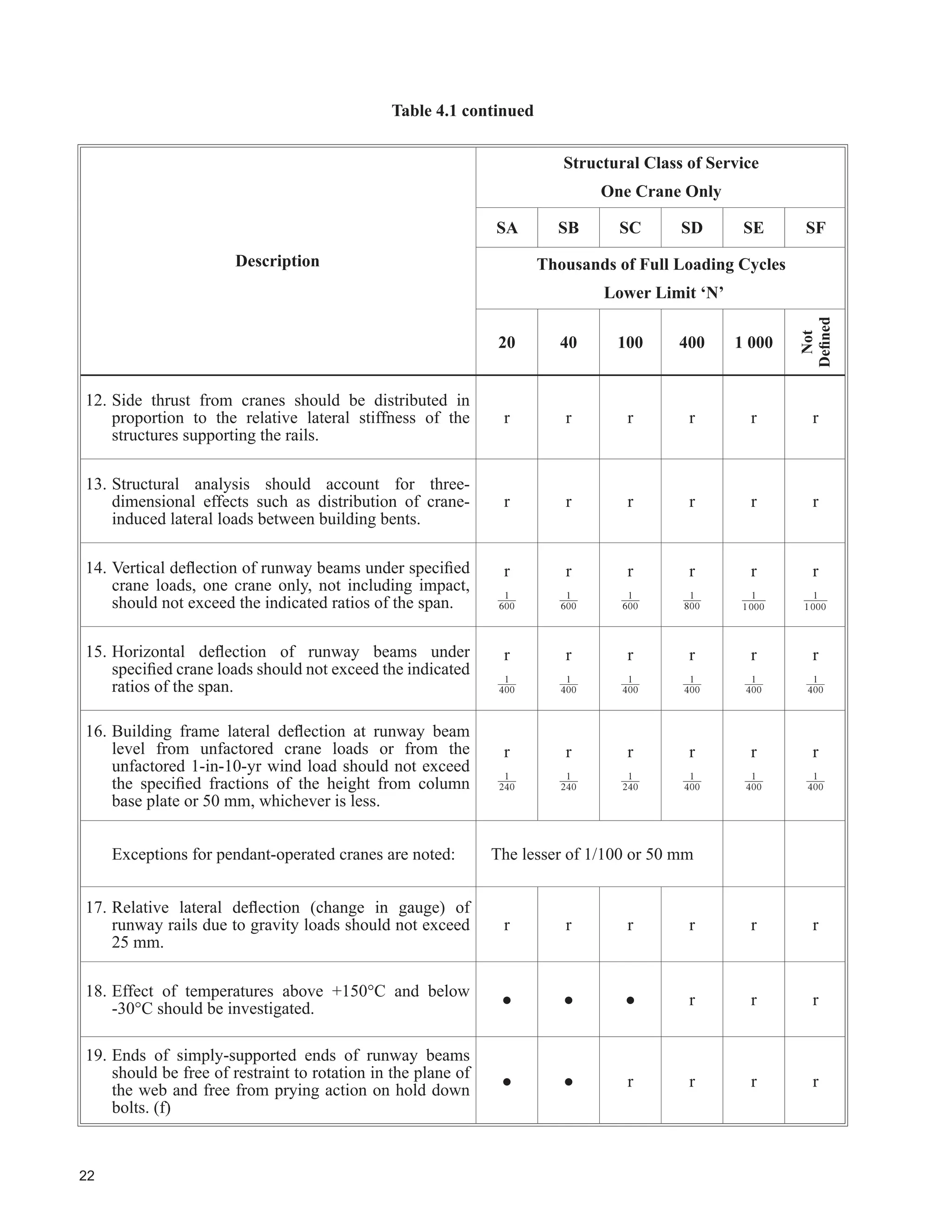
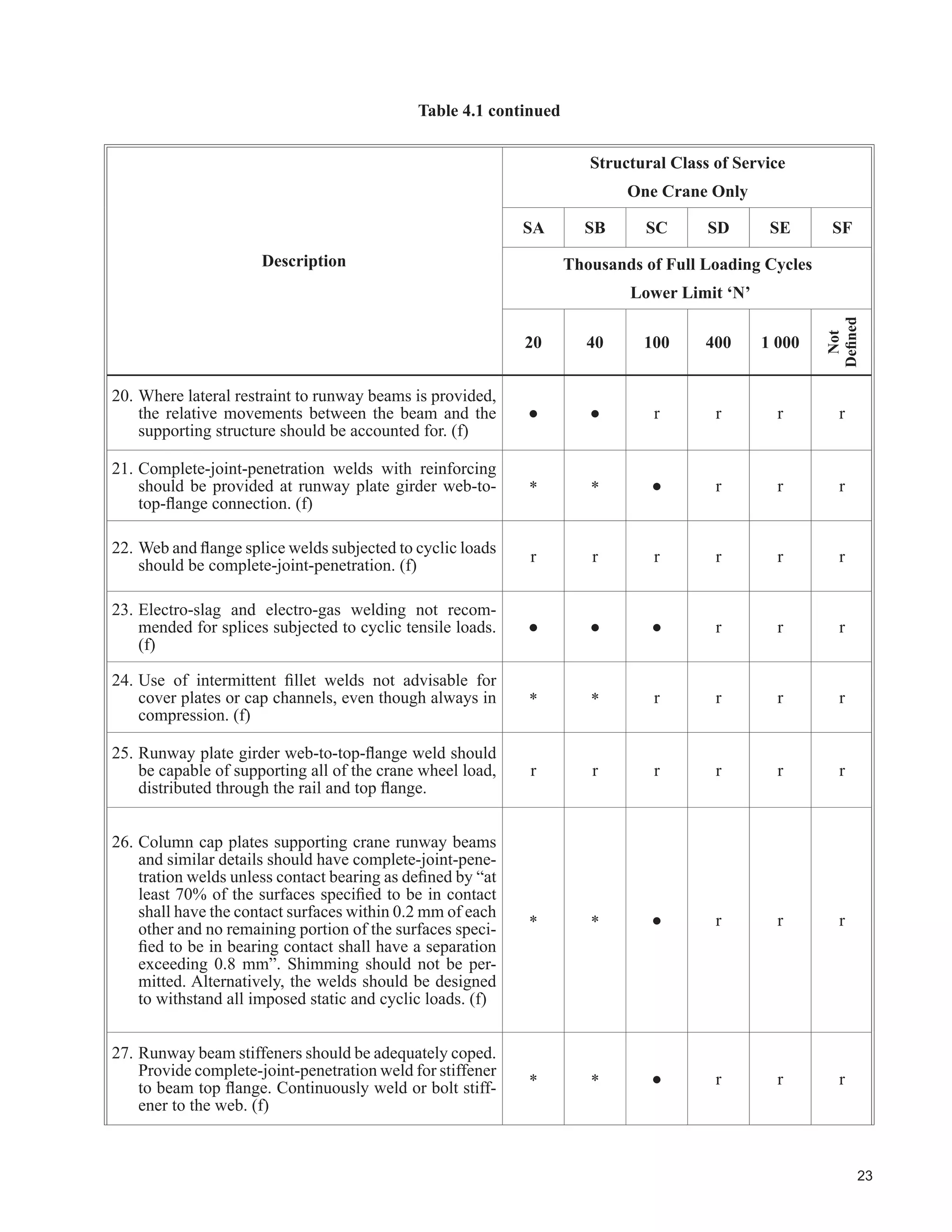
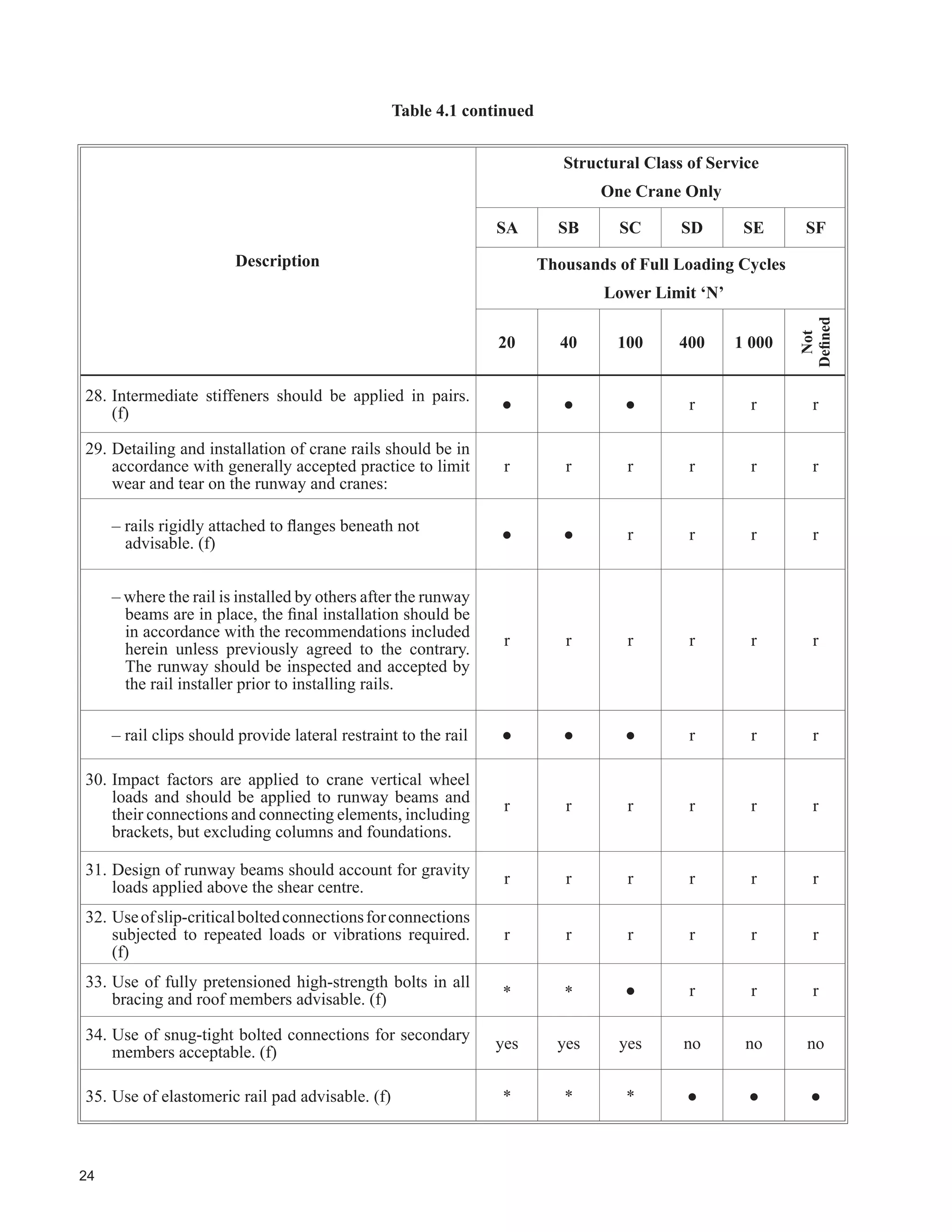
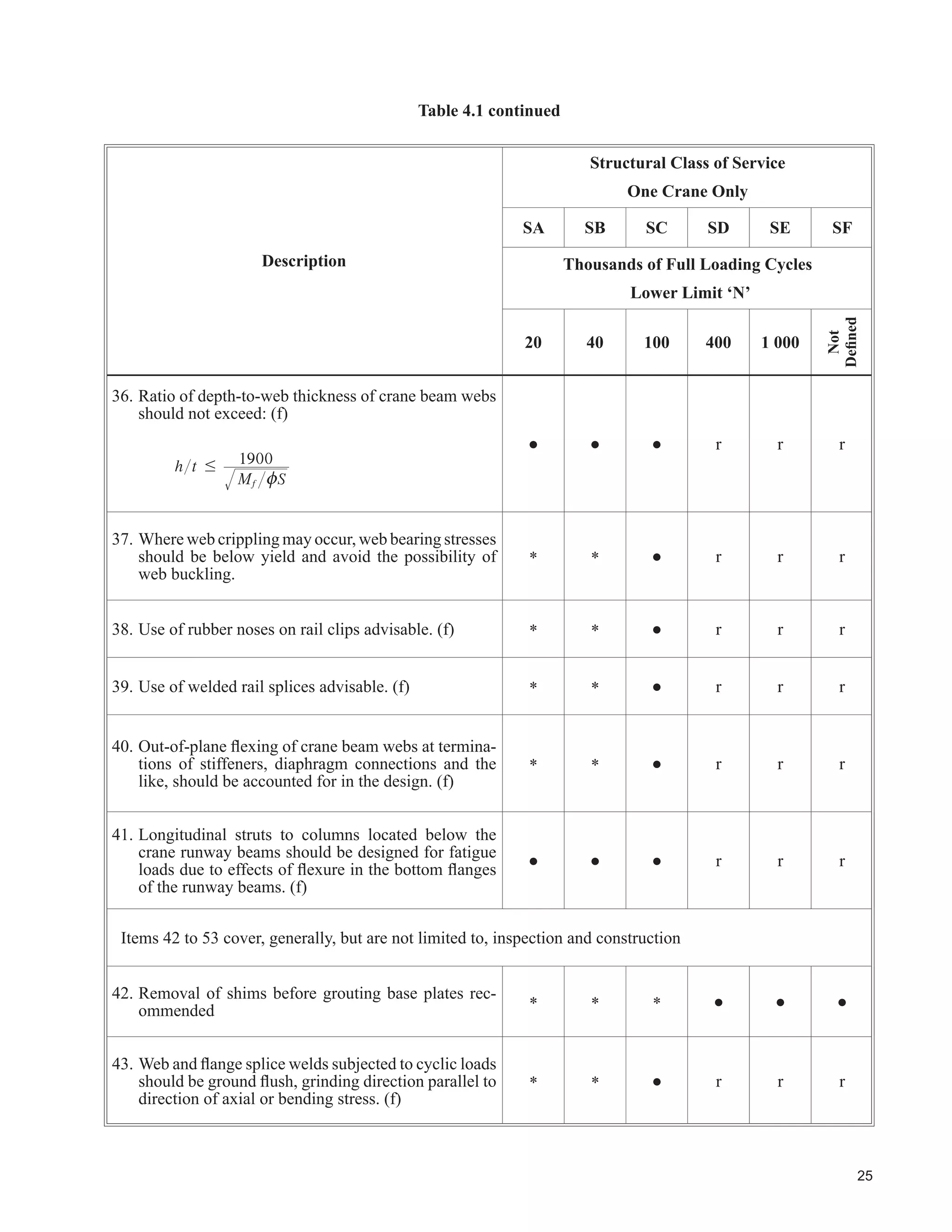
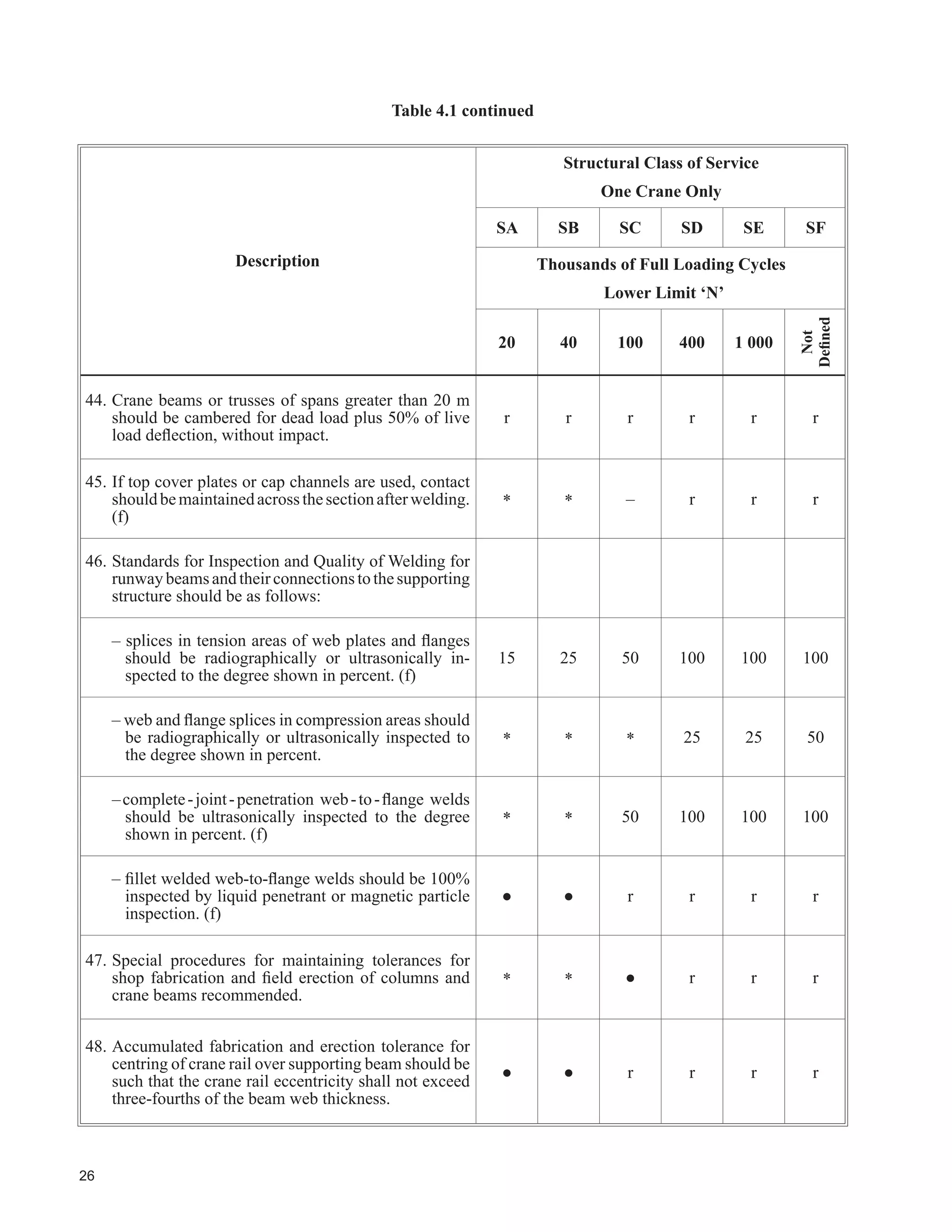
The checklist in Table 4.1, calibrated to structural class of service (see Section 3.4.3), has been prepared as a
JXLGH IRU WKH GHVLJQ FULWHULD DQG FRQVWUXFWLRQ VSHFL¿FDWLRQV 2WKHU VHFWLRQV RI WKLV GHVLJQ JXLGH SURYLGH DGGLWLRQDO
recommendations. “Runway beam” refers to the runway beam or girder. Items that may be fatigue related
KDYH EHHQ LGHQWL¿HG ZLWK DQ I
WKHUHIRUH SDUWV RI WKH VWUXFWXUHV VXEMHFWHG WR OHVV WKDQ   FFOHV DUH QRW
necessarily of concern. Items designated * are not usually required. Those designated “Ɣ´ DUH UHFRPPHQGHG
Those designated “r” are required in order to provide a structure that can reasonably be expected to perform in
a satisfactory manner. A checklist prepared by other engineers experienced in the design of crane-supporting
structures may differ.
3DUDOOHOLQJ WKH UHTXLUHPHQWV RI ODXVH  RI 6 LW LV VXJJHVWHG WKDW EHIRUH ¿QDO GHVLJQ D GHVLJQ FULWHULD
document should be prepared by the designer of the structure for approval by the owner. As a minimum, this
GRFXPHQW VKRXOG GH¿QH WKH FRGHV DQG VWDQGDUGV WKH PDWHULDOV RI FRQVWUXFWLRQ WKH H[SHFWHG OLIH RI WKH VWUXFWXUH
FUDQH VHUYLFH FODVVL¿FDWLRQV ORDGV DQG ORDG FRPELQDWLRQV FULWHULD IRU GHVLJQ IRU IDWLJXH DQG D UHFRUG RI WKH
design and construction measures selected. Foundation conditions and limitations should also be included.
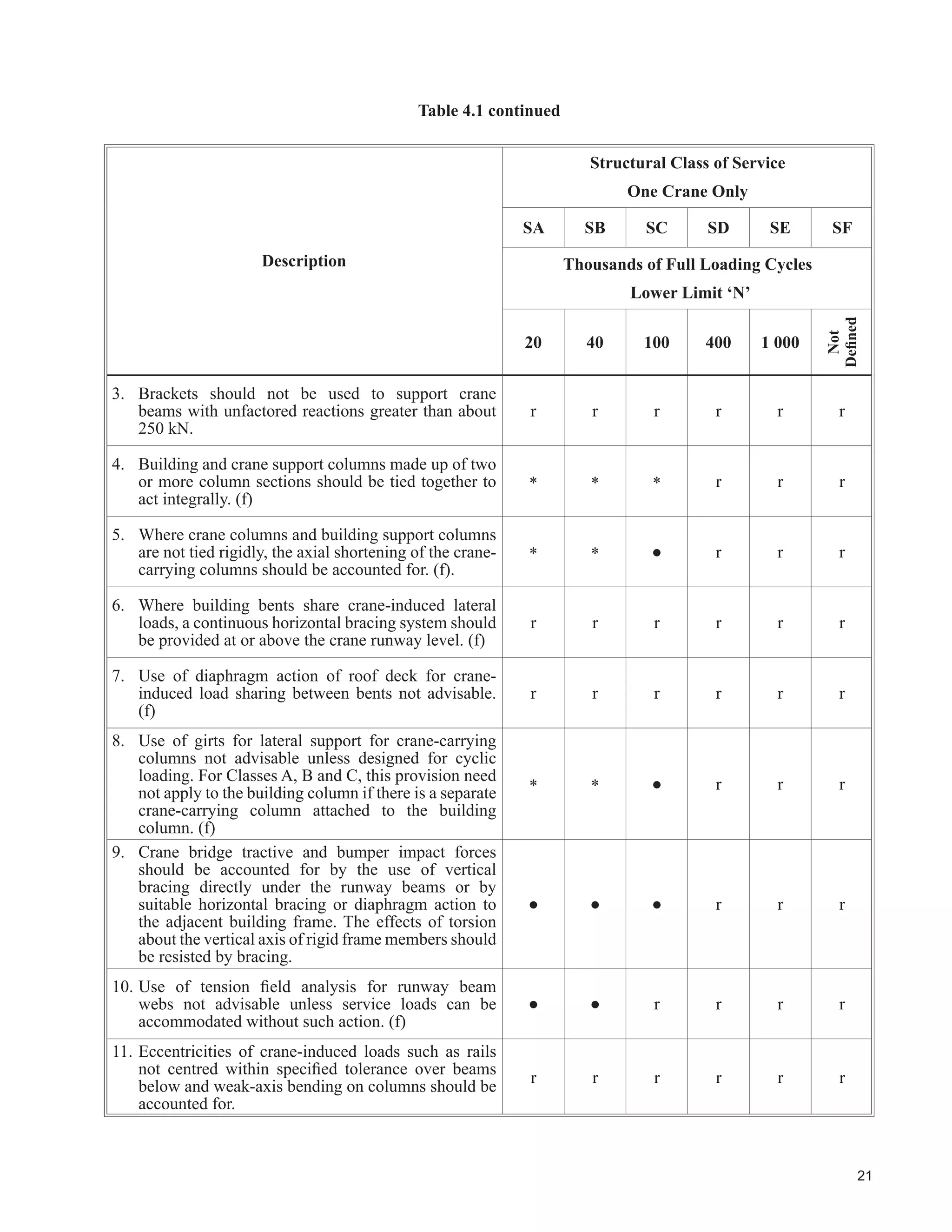
Table 4.1
'HVLJQ KHFNOLVW IRU UDQH6XSSRUWLQJ 6WHHO 6WUXFWXUHV
Description
6WUXFWXUDO ODVV RI 6HUYLFH
One Crane Only
SA SB SC SD SE SF
7KRXVDQGV RI )XOO /RDGLQJ FOHV
/RZHU /LPLW µ1¶
20 40 100 400 1 000
Not
'H¿QHG
Items 1 to 41 are generally related, but not limited to, analysis and design
1. Designdrawingsshouldshowcraneclearances,crane
load criteria including numbers, relative positions,
lifting capacity, dead load of bridge, trolley and
lifting devices, maximum wheel loads, bridge speed,
bumper impact loads at the ends of the runway, and
fatigue loading criteria for vertical and horizontal
crane-induced loads by the criteria determined in
accordance with Sections 3.4.5.1 or 3.4.5.2.
r r r r r r
2. Use of continuous and cantilevered runway beams
is not recommended without careful evaluation
of possible problems due to uneven settlement of
VXSSRUWV XSOLIW IDWLJXH DQG GLI¿FXOW LQ UHLQIRUFLQJ
or replacing.
Ɣ Ɣ r r r r
21
7DEOH  FRQWLQXHG
Description
6WUXFWXUDO ODVV RI 6HUYLFH
One Crane Only
SA SB SC SD SE SF
7KRXVDQGV RI )XOO /RDGLQJ FOHV
/RZHU /LPLW µ1¶
20 40 100 400 1 000
Not
'H¿QHG
3. Brackets should not be used to support crane
beams with unfactored reactions greater than about
250 kN.
r r r r r r
4. Building and crane support columns made up of two
or more column sections should be tied together to
act integrally. (f)
* * * r r r
5. Where crane columns and building support columns
are not tied rigidly, the axial shortening of the crane-
carrying columns should be accounted for. (f).
* * Ɣ r r r
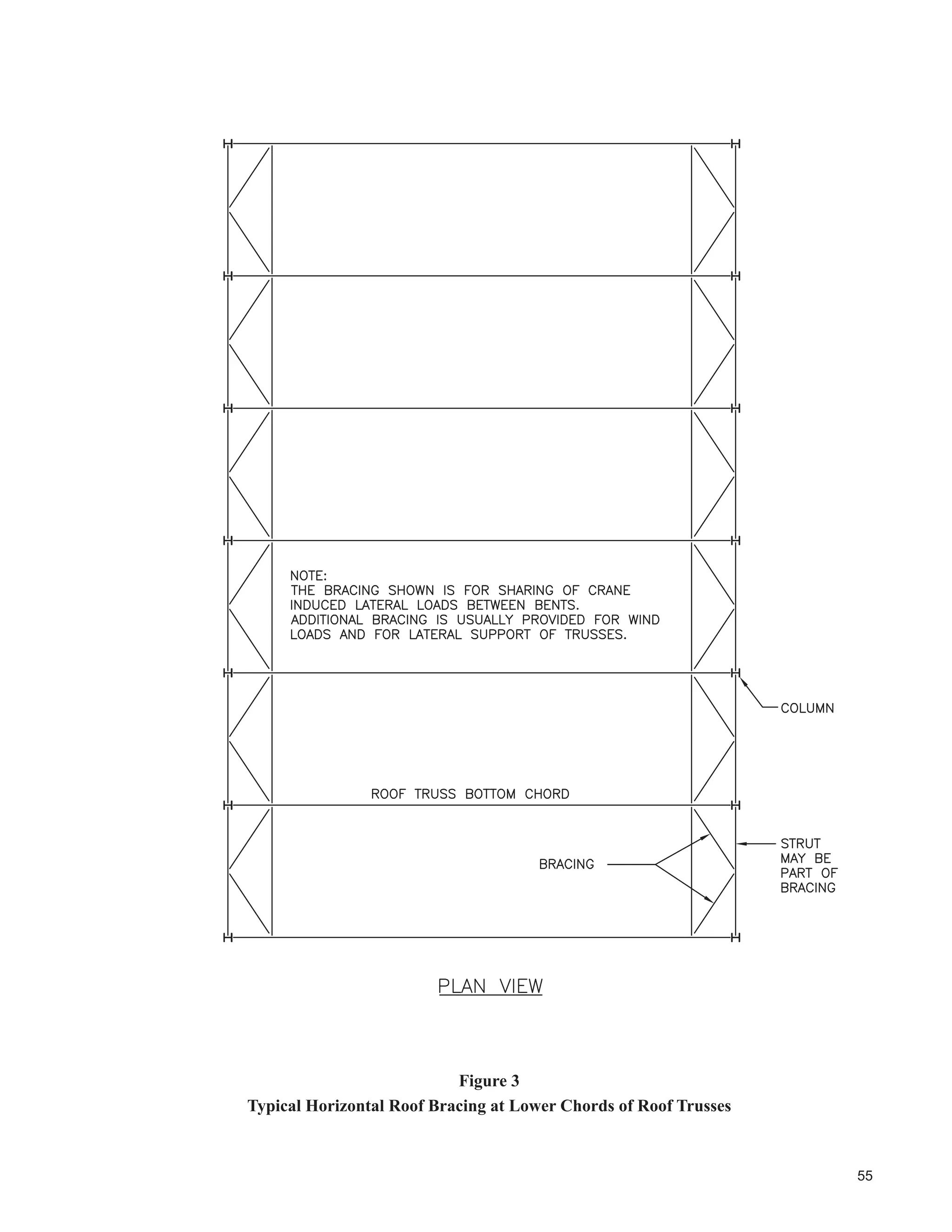
6. Where building bents share crane-induced lateral
loads, a continuous horizontal bracing system should
be provided at or above the crane runway level. (f)
r r r r r r
7. Use of diaphragm action of roof deck for crane-
induced load sharing between bents not advisable.
(f)
r r r r r r
8. Use of girts for lateral support for crane-carrying
columns not advisable unless designed for cyclic
loading. For Classes A, B and C, this provision need
not apply to the building column if there is a separate
crane-carrying column attached to the building
column. (f)
* * Ɣ r r r
9. Crane bridge tractive and bumper impact forces
should be accounted for by the use of vertical
bracing directly under the runway beams or by
suitable horizontal bracing or diaphragm action to
the adjacent building frame. The effects of torsion
about the vertical axis of rigid frame members should
be resisted by bracing.
Ɣ Ɣ Ɣ r r r
 8VH RI WHQVLRQ ¿HOG DQDOVLV IRU UXQZD EHDP
webs not advisable unless service loads can be
accommodated without such action. (f)
Ɣ Ɣ r r r r
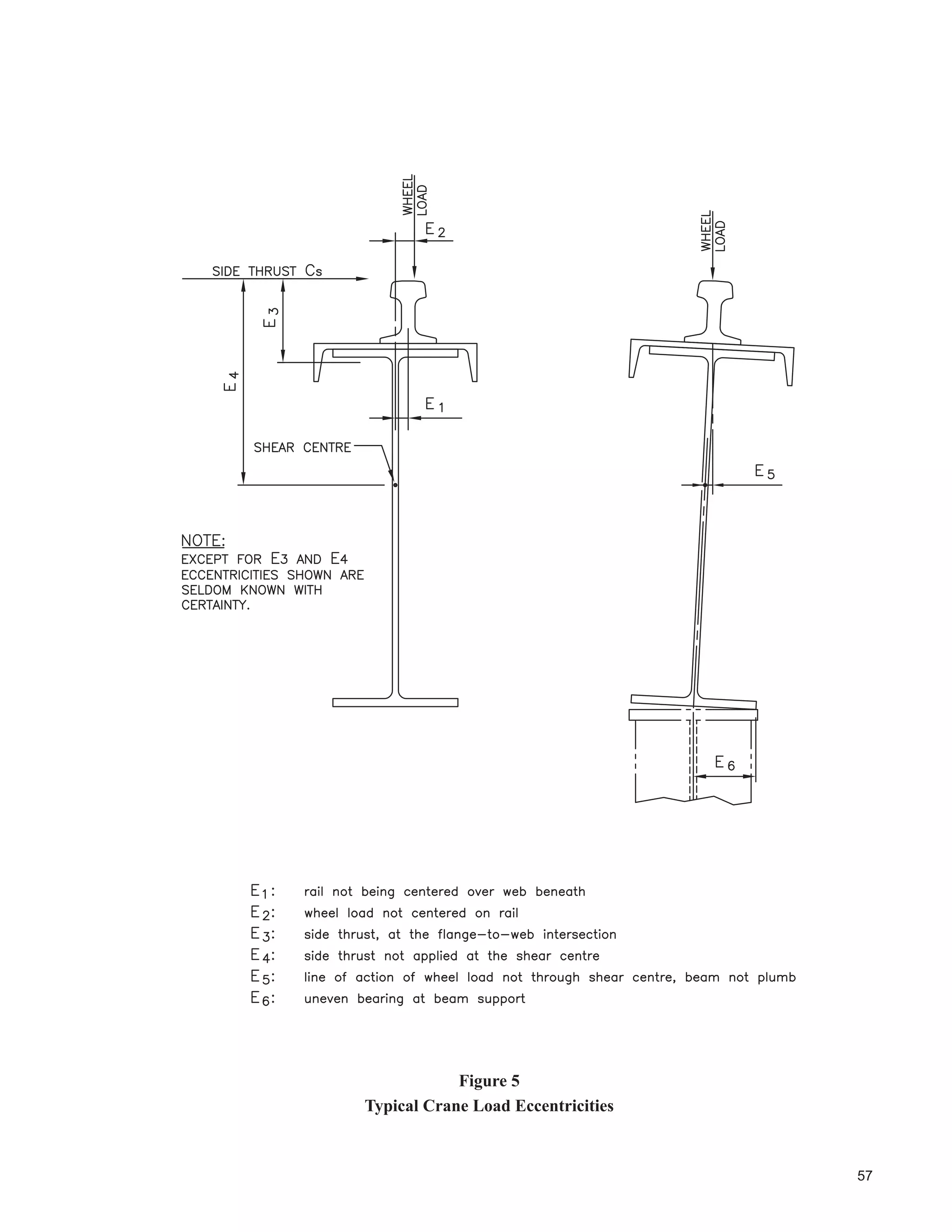
11. Eccentricities of crane-induced loads such as rails
QRW FHQWUHG ZLWKLQ VSHFL¿HG WROHUDQFH RYHU EHDPV
below and weak-axis bending on columns should be
accounted for.
r r r r r r
22
7DEOH  FRQWLQXHG
Description
6WUXFWXUDO ODVV RI 6HUYLFH
One Crane Only
SA SB SC SD SE SF
7KRXVDQGV RI )XOO /RDGLQJ FOHV
/RZHU /LPLW µ1¶
20 40 100 400 1 000
Not
'H¿QHG
12. Side thrust from cranes should be distributed in
proportion to the relative lateral stiffness of the
structures supporting the rails.
r r r r r r
13. Structural analysis should account for three-
dimensional effects such as distribution of crane-
induced lateral loads between building bents.
r r r r r r
 9HUWLFDO GHÀHFWLRQ RI UXQZD EHDPV XQGHU VSHFL¿HG
crane loads, one crane only, not including impact,
should not exceed the indicated ratios of the span.
r
600
1
r
600
1
r
600
1
r
800
1
r
1000
1
r
1000
1
 +RUL]RQWDO GHÀHFWLRQ RI UXQZD EHDPV XQGHU
VSHFL¿HG FUDQH ORDGV VKRXOG QRW H[FHHG WKH LQGLFDWHG
ratios of the span.
r
400
1
r
400
1
r
400
1
r
400
1
r
400
1
r
400
1
 %XLOGLQJ IUDPH ODWHUDO GHÀHFWLRQ DW UXQZD EHDP
level from unfactored crane loads or from the
unfactored 1-in-10-yr wind load should not exceed
WKH VSHFL¿HG IUDFWLRQV RI WKH KHLJKW IURP FROXPQ
base plate or 50 mm, whichever is less.
r
240
1
r
240
1
r
240
1
r
400
1
r
400
1
r
400
1
Exceptions for pendant-operated cranes are noted: The lesser of 1/100 or 50 mm
 5HODWLYH ODWHUDO GHÀHFWLRQ FKDQJH LQ JDXJH
RI
runway rails due to gravity loads should not exceed
25 mm.
r r r r r r
18. Effect of temperatures above +150°C and below
-30°C should be investigated.
Ɣ Ɣ Ɣ r r r
19. Ends of simply-supported ends of runway beams
should be free of restraint to rotation in the plane of
the web and free from prying action on hold down
bolts. (f)
Ɣ Ɣ r r r r
23
7DEOH  FRQWLQXHG
Description
6WUXFWXUDO ODVV RI 6HUYLFH
One Crane Only
SA SB SC SD SE SF
7KRXVDQGV RI )XOO /RDGLQJ FOHV
/RZHU /LPLW µ1¶
20 40 100 400 1 000
Not
'H¿QHG
20. Where lateral restraint to runway beams is provided,
the relative movements between the beam and the
supporting structure should be accounted for. (f)
Ɣ Ɣ r r r r
21. Complete-joint-penetration welds with reinforcing
should be provided at runway plate girder web-to-
WRSÀDQJH FRQQHFWLRQ I
* * Ɣ r r r
 :HE DQG ÀDQJH VSOLFH ZHOGV VXEMHFWHG WR FFOLF ORDGV
should be complete-joint-penetration. (f)
r r r r r r
23. Electro-slag and electro-gas welding not recom-
mended for splices subjected to cyclic tensile loads.
(f)
Ɣ Ɣ Ɣ r r r
 8VH RI LQWHUPLWWHQW ¿OOHW ZHOGV QRW DGYLVDEOH IRU
cover plates or cap channels, even though always in
compression. (f)
* * r r r r
 5XQZD SODWH JLUGHU ZHEWRWRSÀDQJH ZHOG VKRXOG
be capable of supporting all of the crane wheel load,
GLVWULEXWHG WKURXJK WKH UDLO DQG WRS ÀDQJH
r r r r r r
26. Column cap plates supporting crane runway beams
and similar details should have complete-joint-pene-
WUDWLRQ ZHOGV XQOHVV FRQWDFW EHDULQJ DV GH¿QHG E ³DW
OHDVW  RI WKH VXUIDFHV VSHFL¿HG WR EH LQ FRQWDFW
shall have the contact surfaces within 0.2 mm of each
other and no remaining portion of the surfaces speci-
¿HG WR EH LQ EHDULQJ FRQWDFW VKDOO KDYH D VHSDUDWLRQ
exceeding 0.8 mm”. Shimming should not be per-
mitted. Alternatively, the welds should be designed
to withstand all imposed static and cyclic loads. (f)
* * Ɣ r r r
27. Runway beam stiffeners should be adequately coped.
Provide complete-joint-penetration weld for stiffener
WR EHDP WRS ÀDQJH RQWLQXRXVO ZHOG RU EROW VWLII-
ener to the web. (f)
* * Ɣ r r r
24
7DEOH  FRQWLQXHG
Description
6WUXFWXUDO ODVV RI 6HUYLFH
One Crane Only
SA SB SC SD SE SF
7KRXVDQGV RI )XOO /RDGLQJ FOHV
/RZHU /LPLW µ1¶
20 40 100 400 1 000
Not
'H¿QHG
28. Intermediate stiffeners should be applied in pairs.
(f)
Ɣ Ɣ Ɣ r r r
29. Detailing and installation of crane rails should be in
accordance with generally accepted practice to limit
wear and tear on the runway and cranes:
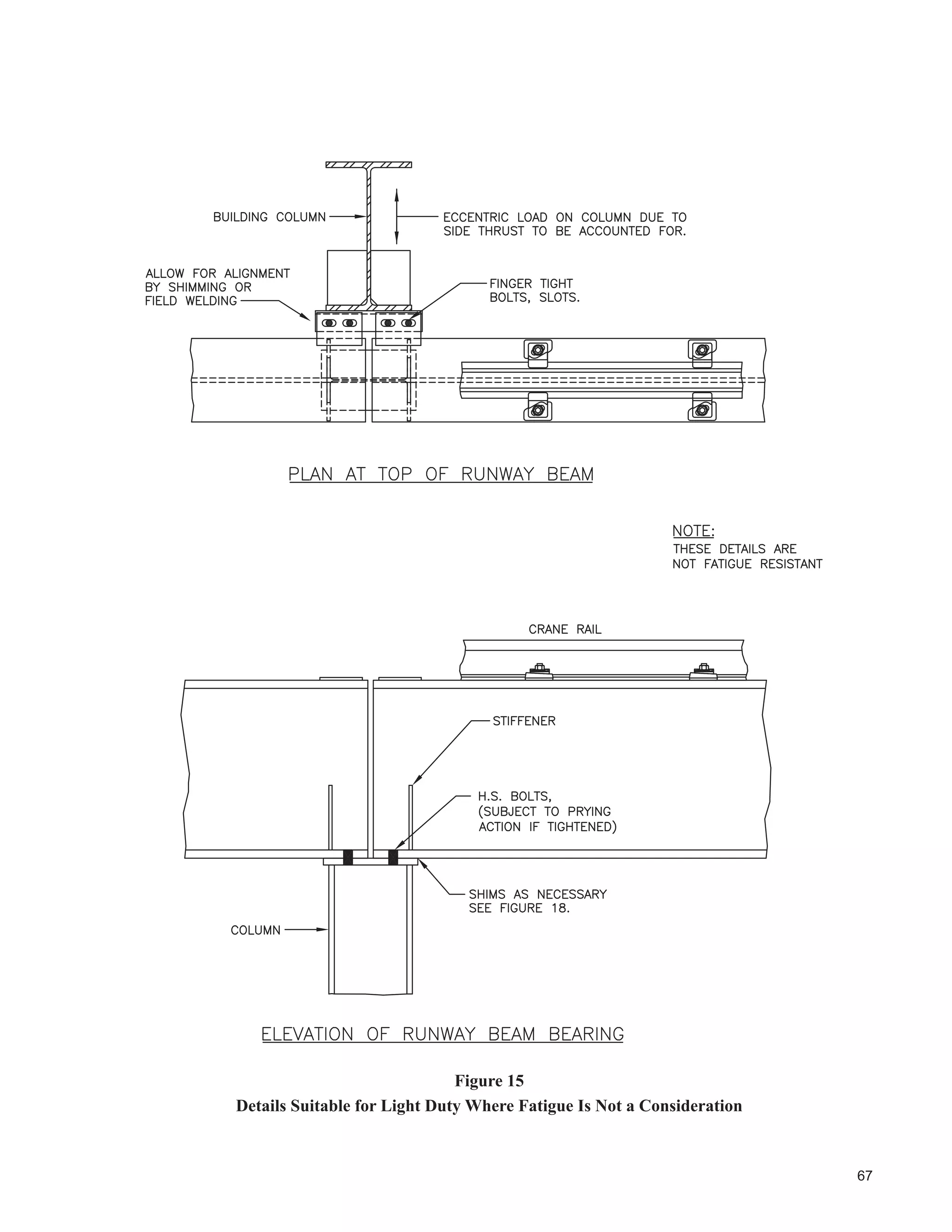
r r r r r r
± UDLOV ULJLGO DWWDFKHG WR ÀDQJHV EHQHDWK QRW
advisable. (f)
Ɣ Ɣ r r r r
± ZKHUH WKH UDLO LV LQVWDOOHG E RWKHUV DIWHU WKH UXQZD
EHDPV DUH LQ SODFH WKH ¿QDO LQVWDOODWLRQ VKRXOG EH
in accordance with the recommendations included
herein unless previously agreed to the contrary.
The runway should be inspected and accepted by
the rail installer prior to installing rails.
r r r r r r
± UDLO FOLSV VKRXOG SURYLGH ODWHUDO UHVWUDLQW WR WKH UDLO Ɣ Ɣ Ɣ r r r
30. Impact factors are applied to crane vertical wheel
loads and should be applied to runway beams and
their connections and connecting elements, including
brackets, but excluding columns and foundations.
r r r r r r
31. Design of runway beams should account for gravity
loads applied above the shear centre.
r r r r r r
32. Useofslip-criticalboltedconnectionsforconnections
subjected to repeated loads or vibrations required.
(f)
r r r r r r
33. Use of fully pretensioned high-strength bolts in all
bracing and roof members advisable. (f) * * Ɣ r r r
34. Use of snug-tight bolted connections for secondary
members acceptable. (f)
yes yes yes no no no
35. Use of elastomeric rail pad advisable. (f) * * * Ɣ Ɣ Ɣ
25
7DEOH  FRQWLQXHG
Description
6WUXFWXUDO ODVV RI 6HUYLFH
One Crane Only
SA SB SC SD SE SF
7KRXVDQGV RI )XOO /RDGLQJ FOHV
/RZHU /LPLW µ1¶
20 40 100 400 1 000
Not
'H¿QHG
36. Ratio of depth-to-web thickness of crane beam webs
should not exceed: (f)
h t
M S
1900
f
#
z
Ɣ Ɣ Ɣ r r r
37. Where web crippling may occur, web bearing stresses
should be below yield and avoid the possibility of
web buckling.
* * Ɣ r r r
38. Use of rubber noses on rail clips advisable. (f) * * Ɣ r r r
39. Use of welded rail splices advisable. (f) * * Ɣ r r r
 2XWRISODQH ÀH[LQJ RI FUDQH EHDP ZHEV DW WHUPLQD-
tions of stiffeners, diaphragm connections and the
like, should be accounted for in the design. (f)
* * Ɣ r r r
41. Longitudinal struts to columns located below the
crane runway beams should be designed for fatigue
ORDGV GXH WR HIIHFWV RI ÀH[XUH LQ WKH ERWWRP ÀDQJHV
of the runway beams. (f)
Ɣ Ɣ Ɣ r r r
Items 42 to 53 cover, generally, but are not limited to, inspection and construction
42. Removal of shims before grouting base plates rec-
ommended * * * Ɣ Ɣ Ɣ
 :HE DQG ÀDQJH VSOLFH ZHOGV VXEMHFWHG WR FFOLF ORDGV
VKRXOG EH JURXQG ÀXVK JULQGLQJ GLUHFWLRQ SDUDOOHO WR
direction of axial or bending stress. (f)
* * Ɣ r r r
26
7DEOH  FRQWLQXHG
Description
6WUXFWXUDO ODVV RI 6HUYLFH
One Crane Only
SA SB SC SD SE SF
7KRXVDQGV RI )XOO /RDGLQJ FOHV
/RZHU /LPLW µ1¶
20 40 100 400 1 000
Not
'H¿QHG
44. Crane beams or trusses of spans greater than 20 m
should be cambered for dead load plus 50% of live
ORDG GHÀHFWLRQ ZLWKRXW LPSDFW
r r r r r r
45. If top cover plates or cap channels are used, contact
shouldbemaintainedacrossthesectionafterwelding.
(f)
* * ± r r r
46. Standards for Inspection and Quality of Welding for
runwaybeamsandtheirconnectionstothesupporting
structure should be as follows:
± VSOLFHV LQ WHQVLRQ DUHDV RI ZHE SODWHV DQG ÀDQJHV
should be radiographically or ultrasonically in-
spected to the degree shown in percent. (f)
15 25 50 100 100 100
± ZHE DQG ÀDQJH VSOLFHV LQ FRPSUHVVLRQ DUHDV VKRXOG
be radiographically or ultrasonically inspected to
the degree shown in percent.
* * * 25 25 50
±complete-joint-penetration web-to-ÀDQJH ZHOGV
should be ultrasonically inspected to the degree
shown in percent. (f)
* * 50 100 100 100
± ¿OOHW ZHOGHG ZHEWRÀDQJH ZHOGV VKRXOG EH 
inspected by liquid penetrant or magnetic particle
inspection. (f)
Ɣ Ɣ r r r r
47. Special procedures for maintaining tolerances for
VKRS IDEULFDWLRQ DQG ¿HOG HUHFWLRQ RI FROXPQV DQG
crane beams recommended.
* * Ɣ r r r
48. Accumulated fabrication and erection tolerance for
centring of crane rail over supporting beam should be
such that the crane rail eccentricity shall not exceed
three-fourths of the beam web thickness.
Ɣ Ɣ r r r r
27
7DEOH  FRQWLQXHG
Description
6WUXFWXUDO ODVV RI 6HUYLFH
One Crane Only
SA SB SC SD SE SF
7KRXVDQGV RI )XOO /RDGLQJ FOHV
/RZHU /LPLW µ1¶
20 40 100 400 1 000
Not
'H¿QHG
49. Unless otherwise agreed with the crane manufacturer,
centre-to-centre distance of crane rails as constructed
should not exceed the indicated distance in mm from
the theoretical dimension at 20ºC.
r
r 10
r
r 10
r
r 10
r
r 8
r
r 6
r
r 6
50. Tops of adjacent runway beam ends should be level
to within the distances shown in mm.
3 3 3 2 2 2
51. Crane runway beam bearings should be detailed,
fabricated and assembled so that even bearing is
DFKLHYHG DIWHU ¿QDO DOLJQPHQW 1R JDS VKRXOG H[FHHG
1.0 mm. Any proposal for shimming should achieve
the required tolerances and should be submitted to
the designer for review. (f)
* * Ɣ r r r
52. Flanges of crane runway beams, for a distance of
500 mm from their ends, should not be curved as
viewed in cross section, and should be normal to the
webs to within 1 mm in 300 mm.
Ɣ Ɣ Ɣ r r r
53. Ends of rails at splices should be hardened and
milled. (f) * * Ɣ r r r
 RPPHQWV RQ WKH KHFNOLVW
Comments on the checklist in Table 4.1 are given in Table 4.2 on an item-by-item basis. Background information
RQ PRVW RI WKH PHDVXUHV FDQ EH IRXQG LQ WKH UHIHUHQFHV 7KH UHFRPPHQGDWLRQV IRU UDQH 6HUYLFH ODVVL¿FDWLRQV$
DQG % WDNH LQWR FRQVLGHUDWLRQ DW OHDVW   FFOHV RI ORDGLQJ EXW EHFDXVH WKH DUH GH¿QHG DV LQIUHTXHQW RU OLJKW
service cranes, they are generally less stringent than for Classes C to F. There is a wide range of duty cycles for
Class C but because severe problems have not been widespread historically, the recommendations are somewhat
less severe than for Class D.
:KHQ PHDVXUHV DUH FRUUHODWHG WR FUDQH VHUYLFH FODVVL¿FDWLRQ LW VKRXOG EH QRWHG WKDW WKH VXJJHVWHG PHDVXUHV KDYH
been calibrated to a concept of a crane runway of several spans and with one crane on each runway. See Section
3.4.3 for details.
28
For all classes, the designer of the structure should advise the owner prior to completing the design if recommended
measures are not intended to be implemented, along with reasons. For design-build projects, it is recommended
WKDW WKH RZQHU¶V VSHFL¿FDWLRQ UHTXLUHV WKDW WKH VDPH LQIRUPDWLRQ LV LQFOXGHG LQ WKH SURSRVDO
Table 4.2
RPPHQWV RI KHFNOLVW IRU 'HVLJQ RI UDQH6XSSRUWLQJ 6WHHO 6WUXFWXUHV
Item Comment
See
)LJXUH
2
Occasionally runway beams are designed as simple span but supplied in lengths that
provide continuity over supports. Fisher (2004) and Rowswell (1987) provide information
on this topic. The structure designer should consider the effect of settlement of supports,
particularly for underslung cranes. The owner should be made aware of any proposal to
provide continuity or cantilever construction, and the implications thereof.
-
3
The recommended method for supporting crane runway beams is use of stepped columns
ZLWK ¿[HG EDVHV %UDFNHWV VKRXOG EH DYRLGHG IRU DOO EXW WKH OLJKWHU GXW FUDQHV DQG IRU FODVV
of service D, E, and F.
1
4
The crane runway support is sometimes designed as a separate set of columns, beams, and
longitudinal bracing, attached to the adjacent building support columns for lateral support
of the runway and to reduce the unsupported length of crane runway carrying columns. This
is acceptable if properly executed, taking into account movements such as shown in Figure
8. However, the interconnecting elements are occasionally subjected to unaccounted-for
repeated forces and distortion-induced fatigue. Flexible connections are undesirable for the
PRUH VHYHUH FODVVL¿FDWLRQV RI VHUYLFHV
1
8
5
Refer also to Item 4. The interconnecting elements and connections may be subject to
distortion-induced fatigue.
8
6
For light-capacity cranes where building framing is relatively rugged, sharing of loads
between building bents may not be required. Unless it can be shown that without help
from roof diaphragm action, horizontal differential movement of adjacent columns due to
crane side thrust or crane gravity loads is less than column spacing divided by 2 000, it is
recommended that continuous horizontal bracing should be provided at roof level. In this
ZD WKH URR¿QJ PDWHULDO ZLOO QRW EH VXEMHFW WR UHSHDWHG VHYHUH GLDSKUDJP DFWLRQ
3
7
This item does not preclude the use of metal deck to provide lateral support to compression
ÀDQJHV RI SXUOLQV DQG WRS FKRUGV RI MRLVWV RU IRU GLDSKUDJP DFWLRQ SURYLGHG WKDW DQ HIIHFWLYH
horizontal bracing system for crane loads is in place.
-
8 This recommendation need not apply on light-duty structures. -
9 Refer to Fisher (2004) for additional information. -
10
Clause 26.4.2 of S16-09 places a restriction on the h/w ratio under fatigue conditions.
7HQVLRQ¿HOG DQDOVLV LV D SRVWEXFNOLQJ DQDOVLV DQG LV QRW GHVLUDEOH XQGHU EXFNOLQJ
distortion fatigue conditions.
-
11 Several eccentricities should be considered. 5
29
7DEOH  FRQWLQXHG
Item Comment
See
)LJXUH
13
Some degree of three-dimensional analysis is required to adequately assess loads in hori-
zontal bracing. Refer to Fisher (2004) and Griggs (1976) for additional information.
3
14/15
5HFRPPHQGHG GHÀHFWLRQ OLPLWV IRU ,WHPV  DQG  DUH FRQVLVWHQW ZLWK WKH UHFRPPHQGDWLRQV
RI WKH 0$$ 'HÀHFWLRQV DUH HODVWLF EHDP GHÀHFWLRQV 'LIIHUHQWLDO VHWWOHPHQW RI IRXQGDWLRQV
can cause serious problems and should be limited to 12 mm unless special measures are
incorporated.
-
17
([FHVVLYHO ÀH[LEOH FROXPQV DQG URRI IUDPLQJ PHPEHUV FDQ UHVXOW LQ XQGHVLUDEOH FKDQJHV
in rail-to-rail distance, even under crane-induced gravity loads that cause sway of the
structure. These movements can create crane operational problems and unaccounted-for
lateral and torsional loads on the crane runway beams and their supports. Final runway
alignment should be left until after the full dead load of the roof is in place.
1
18
For applications where the ambient temperature range lies between +150°C and -30°C,
structural steel meeting the requirements of CSA G40.21 grade 350W can be expected to
perform adequately. For service at elevated temperatures, changes in properties of the steel
may warrant adjustment of design parameters. While notch toughness at low temperatures
is often required by bridge codes, this is not usually a requirement for crane runway beams,
one reason being the relatively small cost of replacement compared to a bridge beam.
-
19
Limiting restraint to rotation and prying action on bolts can often be accommodated by
OLPLWLQJ GHÀHFWLRQV DQG E PRYLQJ WKH KROGGRZQ EROWV IURP EHWZHHQ WKH FROXPQ ÀDQJHV
to outside as shown in Figures 14 and 18. The cap plate thickness should be limited or use
RI ¿QJHU WLJKW EROWV LV UHFRPPHQGHG WR PLQLPL]H SULQJ DFWLRQ RQ WKH EROWV 1RWH WKDW WKH
eccentricity of vertical loads shown in Figure 18 may cause a state of tension in the column
ÀDQJHV )RU GHVLJQ IRU IDWLJXH ODUJH UDQJHV RI VWUHVV PD KDYH WR EH FRQVLGHUHG .QHH EUDFH
struts should not be used, in particular for class of service C, D, E and F.
9
14
15
18
20
Where lateral restraint is not provided, the runway beams should be designed for bending
about both the strong and weak axes. See AISC (1993), Rowswell and Packer (1989),
and Rowswell (1987).The use of details that are rigid in out-of-plane directions should be
avoided. S16-01 requires consideration of the effects of distortion-induced fatigue.
13
14
15
16
21
7KH ZHEWRÀDQJH ZHOG FDQ EH VXEMHFWHG WR WRUVLRQDO IRUFHV GXH WR ODWHUDO ORDGV DSSOLHG
DW WKH WRS RI WKH UDLO DQG UDLOWRÀDQJH FRQWDFW VXUIDFH QRW FHQWUHG RYHU WKH ZHE EHQHDWK
for instance. There is no directly applicable fatigue category. Refer to AISE (2003) for
additional information.
5
10
24
8VH RI LQWHUPLWWHQW ¿OOHW ZHOGV RQ WHQVLRQ DUHDV RI EXLOWXS UXQZD EHDPV LV SURKLELWHG
E 6$ : ,QWHUPLWWHQW ¿OOHW ZHOGV KDYH VKRZQ SRRU UHVLVWDQFH WR IDWLJXH DQG DUH
categorically not allowed on dynamically loaded structures by some authorities such as
AISE (2003) and AWS (1999). The use of these welds should be restricted to applications
where fatigue is not a consideration.
-
30
7DEOH  FRQWLQXHG
Item Comment
See
)LJXUH
26
The recommendations for contact bearing are similar to railroad bridge standards and are
more stringent than for statically loaded structures.
9
18
27 5HIHU WR )LVKHU
5HIHU WR ¿JXUHV IRU GHWDLOV DW ERWWRP ÀDQJH
16
18
19
29
Square bars welded to the crane runway beam beneath have been used successfully for less
severe applications. Welds fastening rail bars should be properly sized to resist vertical
ORDGV VKHDU ÀRZ ORDGV DQG IDWLJXH 7KH HIIHFWV RI LQGXFHG FRQWLQXLW LQ RWKHUZLVH VLPSOH
VSDQV VKRXOG EH DFFRXQWHG IRU ,QWHUPLWWHQW ¿OOHW ZHOGV DUH QRW DOORZHG LQ WHQVLRQ DUHDV DV
would occur on continuous beams. A method to allow realignment of the rail and supporting
beam should be provided. Railway type, ASCE, or other rails of hardened material should
not be welded to the supporting structure under any circumstance. Bolted splices should be
staggered. Rail splices should not occur over ends of beams. See Fisher (2004) and AISE
(2003) for more information on detailing practices. A gap should be provided between the
end of the rail and the end stop to allow for thermal movement of the rail.
13
14
15
16
17
18
30
The designer should review the complete connection that supports the runway beam for
fatigue. Impact factors should be applied to cantilever brackets and for underslung cranes
and monorails, to adjacent truss members and connections.
-
31 Refer to Section 5.9 and the CISC commentary on S16-09.
5
6
32
S16-09, Clause 22.2.2 provides requirements for use of pretensioned bolts and slip-critical
connections. Some judgement on the part of the designer is required to determine whether
the fatigue loads warrant slip-critical connections for all main and secondary members,
particularly where structural integrity would not be compromised. Slip-critical connections
IRU ZLQG ORDGV RU UHYHUVDOV GXH WR ZLQG ORDGV DUH QRW QRUPDOO UHTXLUHG 8VH RI ¿QJHUWLJKW
bolts with burred threads or welded nuts is not recommended for connections subject to
fatigue but may be considered, however, for lighter duty structures such as shown in Figures
14 and 15.
-
33
Bolts have come loose due to vibration and dropped, causing not only weakened connections,
but also a safety hazard.
-
34
Snug-tight bolts are acceptable in light-duty applications for roof members, girts, and the
like.
-
35
Elastomeric bearing pads have been shown to reduce noise, increase rail life, and reduce
VWUHVVHV DW WKH ZHEWRÀDQJH MXQFWLRQ RI WKH FUDQH UXQZD EHDP EHQHDWK
19
36 From AISE (2003) and S16-09. -
37 See Item 9. -
31
7DEOH  FRQWLQXHG
Item Comment
See
)LJXUH
38
Rubber nosings have been shown to reduce failures of rail clips due to uplift from “bow
wave” effect while at the same time resisting uplift. Rubber nosings should be used with
elastomeric rail pads.
19
39
$OWKRXJK UDLO UHSODFHPHQW PD EH UHJDUGHG DV PRUH GLI¿FXOW ZLWK ZHOGHG VSOLFHV LW FDQ EH
DUJXHG WKDW UHSODFHPHQW VKRXOG EH OHVV IUHTXHQW WKDQ ZLWK EROWHG VSOLFHV 2WKHU EHQH¿WV RI
welded splices include noise reduction, impact reduction and reduced wheel wear. Welded
rail splices should be used with elastomeric rail pads. This measure provides continuity and
avoids “pinch points”.
-
40 0DQ IDLOXUHV KDYH RFFXUUHG GXH WR RXWRISODQH ÀH[LQJ
10
19
41
$V WKH ERWWRP ÀDQJH RI WKH FUDQH UXQZD EHDP HORQJDWHV GXH WR ÀH[XUH UHSHDWHG ORDGV DUH
imposed on struts beneath it.
9
42
There is no general agreement, but shims left in place are reported to have caused splitting
of the concrete beneath. Levelling screws are always an option and are recommended for
large loose base plates. The usual method of removing shims is to leave edges exposed and
SXOO WKHP DIWHU WKH JURXW KDV VXI¿FLHQWO FXUHG
-
43
Only experienced operators should do this work and caution must be exercised to avoid
notching the parent metal, particularly at tapers and changes in plate thickness.
25
45
:HOGLQJ RI FDS FKDQQHOV WR WRS ÀDQJHV RIWHQ UHVXOWV LQ D JDS EHWZHHQ WKH FKDQQHO ZHE DQG
WKH ÀDQJH EHQHDWK WKH FUDQH UDLO VXEMHFWLQJ WKH ZHOGV WR XQGHVLUDEOH DQG XQDFFRXQWHGIRU
forces that can cause premature cracking. The criteria for contact should be considered
similar to that contained in Clause 28.5 of S16-09.
-
46
Thisitemshouldbereadinconjunctionwithrequirementsforweldingdetails.Adiscontinuity
LQ D FRQWLQXRXV ¿OOHW ZHOG LQ DUHDV RI WHQVLRQ RU UHYHUVDO FDQ OHDG WR D IDWLJXHLQGXFHG FUDFN
in the parent metal. Failure of any NDT test in a tension zone should lead to 100% testing
of all tension area welds. Failure of the test in a compressive zone should result in testing
double the recommended percentage.
25
47
See Section 5.27, Fisher (2004), ASCE (2002), and AISE (2003) for additional informa-
tion.
24
48
The effect of rail eccentricity from the centre line of the runway beam web beneath under
repeated loads can lead to premature failure due to unaccounted-for torsional loads. Refer
to Item 21, Section 5.28 and the references for more information.
5
49
This tolerance is subject to review by the crane manufacturer and the structure designer and
may be increased, depending on the rail-to-rail distance and the crane wheel design.
24
51 See Item 26
6
16
18
52 To provide proper bearing and to keep webs vertical and in line. -
32
CHAPTER 5 - OTHER TOPICS
5.1 General
7KLV FKDSWHU SUHVHQWV D QXPEHU RI WRSLFV EULHÀ 0RUH GHWDLOHG LQIRUPDWLRQ PD EH IRXQG LQ WKH UHIHUHQFHV FLWHG
 UDQH6WUXFWXUH ,QWHUDFWLRQ LQ 0LOO RU 6LPLODU %XLOGLQJV
Obviouslythecraneitselfandthesupportingstructureinteract.Theextenttowhichthestructuraldesignertakesthis
into account is a matter of judgement. That the crane bridge ties the two crane rails together is acknowledged when
the transverse lateral forces due to trolley accelerations or to picking the load up non-vertically are distributed to
the two crane rails in proportion to the lateral stiffness of the supporting structure. It is only necessary that friction
RU WKH GRXEOHÀDQJHG ZKHHOV WUDQVIHU WKHVH IRUFHV WR WKH UDLOV ,W IROORZV WKDW WKH FUDQH FRXOG EH FRQVLGHUHG D SDUW
of the structure under other load combinations provided only that the frictional force exceeds the appropriate
VSHFL¿HG RU IDFWRUHG WUDQVYHUVH ODWHUDO IRUFHV GHSHQGLQJ RQ WKH OLPLW VWDWH EHLQJ LQYHVWLJDWHG
A second factor to consider is that the dead weight of the crane may not be distributed symmetrically either
transversely or longitudinally resulting in heavier wheel loads on one rail than the other or loads distributed
non-uniformly along one rail from front to back. Be that as it may, pairs of crane wheels are usually articulated
such that the vertical loads within the pair on a side are equal while multiple articulations increase the number of
wheels with nominally equal loads.
Beyond this, however, the transverse stiffness of the crane end truck assemblies can affect the distribution of the
lateral forces to the rails. Keep in mind that the function of the truck assemblies is to distribute the load to the
wheels. In buildings such as mill buildings, heavy-duty cranes with several sets of wheels may have a wheelbase
longer than the bay spacing. The crane does not simply impose a set of independent wheel loads on the structure
because the end assembly may have a lateral stiffness comparable to that of the crane runway beam. It is not
a question of a wind or other such load, with no structure behind it, which follows the structure as it deforms.
%XW DV WKH FUDQH UXQZD EHDP GHÀHFWV WKH HQG WUXFN DVVHPEO WHQGV WR VSDQ EHWZHHQ WKH ZKHHOV WKDW DUH DFWLQJ
against the hard spots. While common practice has been historically not to take this into account, the assessment
RI FUDQHVWUXFWXUH LQWHUDFWLRQ SDUWLFXODUO ZKHQ H[DPLQLQJ H[LVWLQJ VWUXFWXUHV PD EH EHQH¿FLDO )RU H[DPSOH
the end truck assembly may in fact supply some continuity from span to span for transverse loads even when the
lateral stiffening trusses are not continuous.
Note 7KH DUJXPHQW SUHVHQWHG DERYH DSSOLHV WR VLGH WKUXVWV ZKHUH IULFWLRQ RU ÀDQJHG ZKHHOV PD JHQHUDWH WKH VKHDU
forces necessary for the two elements being bent to act together.
5.3 Clearances
Every crane requires operating space that must be kept free of obstructions. The layout of an industrial building with
overhead cranes must be developed in conjunction with this envelope.AISE (2003), CMAA(2010), MBMA(2006)
and Weaver (1985) provide blank clearance diagrams. Problem areas that have been encountered are:
‡ cranes fouling with building frame knee braces,
‡ LQVXI¿FLHQW FOHDUDQFH DOORZHG WR WKH XQGHUVLGH RI WKH URRI VWUXFWXUH DERYH VRPHWLPHV GXH WR GHÀHFWLRQV
and structural connections not shown on the design drawings,
‡ LQVXI¿FLHQW FOHDUDQFH XQGHU FUDQH UXQZD EHDPV
‡ LQVXI¿FLHQW FOHDUDQFH WR IDFH RI FROXPQV :HDYHU
VXJJHVWV WKDW LI SHUVRQQHO DUH DOORZHG RQ WKH UXQZD
then there should be about 450 mm clearance to face of columns, as little as 25 mm if not. Refer also to owner’s
safety standards,
‡ LQVXI¿FLHQWFOHDUDQFHWRWKHEXLOGLQJHQGZDOOUHVXOWLQJLQUHGXFHGRSHUDWLQJVSDFHRUFRVWO³GRJKRXVH´H[WHQVLRQV
to the ends of the runways.
See Figure 4 for important clearance considerations. The references cited above give several other possible clearance
considerations.
33
 0HWKRGV RI $QDOVLV
At the very least second-order elastic methods of analysis should be used for structures covered by this design
guide in keeping with the philosophy of S16-09. Plastic design methods are not recommended except perhaps for
UHKDELOLWDWLRQ VWXGLHV ZKHUH DVSHFWV VXFK DV GHÀHFWLRQ DQG IDWLJXH PD QRW FRQWURO
Use of computerized structural modelling with proven software to account for sway effects, P-', instead of the
more approximate methods of Clause 8.7.1 of S16-09 are recommended. Commonly used computer software is
easily capable of not only doing second-order elastic analysis, but by adding joints along the length of compression
members subject to bending; the P-G effects (Clause 13.8.4 of S16-09) are generated along with the P-' effects.
RQVLGHUDWLRQ RI WKHVH HIIHFWV FDQ EH VLPSOL¿HG E MXGLFLRXV VWUXFWXUDO PRGHOOLQJ 7KH H[SHULHQFHG GHVLJQHU
should be able to isolate critical load combinations and thus reduce the number of load combinations that require
a second-order analysis.
5.5 Notional Loads
S16-09 requires use of “notional loads” to assess stability effects (Clause 8.7.2). This approach is somewhat
different from AISE and AISC methods where effective lengths using the well known but approximate elastic
IDFWRU ³.´ DUH XVHG 7KHLU XVH DYRLGV ZHDN EHDPV 1RWLRQDO ORDGV DUH ¿FWLWLRXV RU SVHXGRODWHUDO ORDGV WDNHQ
in S16-09 as a small percentage (0.5%) of the factored gravity loads at each “storey” of the structure. The
translational load effects thus generated (otherwise there might be no lateral load) transform the sway buckling
or bifurcation problem to an in-plane strength problem. There is no need to consider “effective” length factors
greater than one.
The use of notional loads applied to a crane-supporting structure requires considerations beyond those usually
encountered in residential or commercial construction because lateral loads are applied at the crane runway beam
OHYHO 7KH GH¿QLWLRQ RI D ³VWRUH´ IRU DQ LQGXVWULDO EXLOGLQJ PD EH RSHQ WR LQWHUSUHWDWLRQ DQG WKH FRQFHSWV RI
“effective” and “equivalent” lengths as applied to stepped columns requires steps in the analysis and design that
are not well covered in commonly used design aids.
MacCrimmon and Kennedy (1997) provide more detailed information and a worked example is presented. See
also Section 5.6.
 6HJPHQWHG ROXPQV
6HJPHQWHG FROXPQV PD EH RI FRQVWDQW RU YDULQJ VWHSSHG
FURVV VHFWLRQ 6HYHUDO GLIIHUHQW FROXPQ FRQ¿JXUDWLRQV
can be used for crane-carrying structures (see Fisher 2004 and Galambos 1998). If a member has a constant
cross section with axial loads applied between in-plane lateral supports or frame connections, or if the member
cross section changes between in-plane lateral supports or frame connections, it it considered to be segmented.
Where segmented columns are used and where the components of built-up sections are connected so that they act
integrally, the concept of “equivalent lengths” of the column segments may be applied and a buckling analysis
may be required. Ziemian (2010) and MacCrimmon and Kennedy (1997) provide the designer with information
on limit states analysis and design methods. Fisher (2004) and AISE (2003) contain design aids.
Section 5.5 refers to aspects of notional loads that require consideration. Schmidt (2001) provides an alternative
VLPSOL¿HG PHWKRG RI DQDOVLV RI VWHSSHG FROXPQV XVLQJ QRWLRQDO ORDGV EXW ZLWK FDXWLRQV WKDW IXUWKHU UHVHDUFK LV
required.
 %XLOGLQJ /RQJLWXGLQDO %UDFLQJ
For lighter crane duty service, a properly designed single plane of vertical bracing at the columns should provide
satisfactory service. A decision whether to add another plane of vertical bracing, under the runway beams, should
be taken considering the magnitude of the longitudinal forces and the effects of eccentricity in plan. Refer to
reference 9 for more information. It is suggested that when the magnitude of longitudinal forces due to traction or
HQG VWRS FROOLVLRQ H[FHHG D VSHFL¿HG
ORDG RI  N1 WKDW D VHFRQG SODQH RI EUDFLQJ VKRXOG EH LQWURGXFHG )RU
ODUJH IRUFHV DQG IRU UDQH 6HUYLFH ODVVL¿FDWLRQV  DQG XS EUDFLQJ DOVR LQ WKH SODQH RI WKH FUDQH UXQZD EHDPV
similar to that shown in Figure 9 is recommended.
Compared to ordinary industrial buildings, it is even more important in crane-carrying structures subjected to
repeated loads that the longitudinal bracing be located as close as possible to the mid point between expansion
joints or ends of the building.
34
7KH LQWHUDFWLRQ RI FRQWLQXRXV FUDQH UDLOV WKDW DUH DOORZHG WR ³ÀRDW´ DORQJ WKH OHQJWK RI WKH UXQZD DQG D ORQJ
building with expansion joints is complex. Experience has shown that these installations usually perform well
ZKHQ WHPSHUDWXUH ÀXFWXDWLRQV DUH QRW WRR H[WUHPH DV LV WKH XVXDO FDVH LQGRRUV 7KH UDLO PLJKW WHQG WR PLJUDWH
along the length of the runway, and adjustments may be necessary.
For more information, see Fisher (2004).
 %XLOGLQJ ([SDQVLRQ -RLQWV
Distance between expansion joints, in general, should not exceed 150 m. Use of double columns is
recommended over sliding joints, particularly where design for fatigue is required and for Crane Service
ODVVL¿FDWLRQV  DQG XS )RU PRUH LQIRUPDWLRQ VHH )LVKHU
Expansion joints are not usually provided in crane rails. Refer also to section 5.25. The rail is allowed to
³ÀRDW´ RYHU WKH MRLQW
 0RQRVPPHWULF UDQH 5XQZD %HDPV /DWHUDO7RUVLRQDO %XFNOLQJ
Mono-symmetric sections such as shown in Figure 5 for crane runway beams are used not only for top
running cranes, but for monorails and underslung cranes as well. These sections often have long laterally
unsupported spans.
CSA Standard S16-09 includes provisions for analysis of three-plate sections. Other commonly used sections
VXFK DV D ZLGHÀDQJH ZLWK D FDS FKDQQHO DUH QRW VSHFL¿FDOO FRYHUHG )RU RWKHU VLQJOVPPHWULF VKDSHV
“a rational method of analysis shall be used.” The Commentary refers to Ziemian (2010). The 2010 edition
RI WKH $,6 6SHFL¿FDWLRQ IRU 6WUXFWXUDO 6WHHO %XLOGLQJV DQG 7UDKDLU
SURYLGH DGGLWLRQDO LQIRUPDWLRQ
Additionally, practical and theoretical aspects of crane runway beams that are mono-symmetric (I-shaped
beams with channel caps, for instance) are addressed by Ellifrit and Lue (1998), Ziemian (2010), Johnson
and Laman (2010), Laman (1996), Lue and Ellifrit (1993), Salmon and Johnson (1996), Trahair (2011) and
Tremblay and Legault (1996).
Top running cranes apply loads to the crane runway beams above the shear centre (see Figure 5), thereby
reducing resistance to lateral-torsional buckling. Additionally, side thrust is applied at or above the top
ÀDQJH OHYHO JHQHUDWLQJ D WRUVLRQDO PRPHQW RQ WKH VHFWLRQ
A problem of concern is that torsional effects due to accidental eccentricities as shown in Figure 5 (see also
DUH QRW ZHOO GH¿QHG DQG H[SHULHQFH PXVW EH UHOLHG XSRQ 7R DFFRXQW IRU WKH DERYH GHVLJQHUV XVH D
SURFHGXUH NQRZQ DV WKH ÀH[XUH DQDORJ VHH )LJXUH
ZKHUHE WKH WRS ÀDQJH LV GHVLJQHG WR UHVLVW DOO ODWHUDO
ORDGV DQG WKH ERWWRP ÀDQJH DVVLVWV LQ UHVLVWLQJ WRUVLRQDO ORDGV 7KH FRPSUHVVLYH VWUHVV GXH WR WKH ZDUSLQJ
FRPSRQHQW LV WKH PRVW LPSRUWDQW TXDQWLW DQG WKH VKHDU VWUHVV FRQWULEXWLRQV DUH QRW RI PXFK VLJQL¿FDQFH
7KH LQÀXHQFHV RI WKH ZDUSLQJ VHFWLRQ FRQVWDQW Cw , the St-Venant torsion constant J DOVR WKH LQÀXHQFH RI
welding details, are addressed by Tremblay and Legault 1996.
Regardless of the degree of investigation of the effects of torsion, lateral-torsional buckling must be
considered. The procedure for doubly symmetrical I-shaped sections is given in S16-09. These calculations
involve the quantities Cw , J DQG WKH FRHI¿FLHQW RI PRQRVPPHWU E. Fisher (2004) and Ellifrit and Lue
(1998) provide useful recommendations and examples. Values for Cw for beams with cap channels can be
found in Fisher (2004), and Lue and Ellifrit (1993). Approximations of built-up beam moment resistances
for varying unbraced lengths are provided by Johnson and Laman (2010) and Laman (1996) along with a
Fortran program to generate moment capacities for these sections.
Sections other than beams with cap channels are often used. To aid in calculating section properties, the
CISC has made available on its website a design aid for determining torsional section properties of steel
shapes. Calculations for a W section with a continuously welded cap plate instead of a cap channel are
VLPLODU WR WKRVH IRU D VLQJOH ÀDQJH SODWH RI VLPLODU DUHD DQG PRPHQW RI LQHUWLD LQ WKH  D[LV
35
A design method in accordance with S16-09 follows and is used in Appendix A, Design Example 1.
5.9.1 Design Method
A rational method for calculating the factored moment resistance of a laterally unsupported beam, similar to the
method proposed by Ellifritt and Lue (1998) and in accordance with S16-09 is as follows:
Referring to the typical moment resistance
diagram above for unbraced lengths, the
portion of the curve for the intermediate
or inelastic range is reasonably close to a
straight line. S16-09 uses a straight line
transition from the elastic buckling curve
at Mu = Myr, L = Lyr to Mu = Mp , L = Lp.
Establish the class of section in bending
and determine if the limiting strength may
be governed by the yield stress or by local
ÀDQJH RU ZHE EXFNOLQJ
For L L M Mu u p≤ =, (plastic region)
For L L Lu yr ≤ (inelastic region)
The unfactored moment resistance for
simply supported beams under uniform
moment, loaded at the shear centre, can be
determined by the following formula:
M
M M M
L L
L L
Mr
p p yr
u
yr u
p
φ
= − −( ) −
−
⎡
⎣
⎢
⎢
⎤
⎦
⎥
⎥
≤
For L L M Myr r u =, φ (elastic region)
Note that Lyr cannot be calculated directly and must be solved by trial and error iteration until the unbraced length
used in the formula for Mu produces a moment Mu = Myr. That length is then Lyr.
The general formula for Mu , the critical elastic moment of the unbraced mono-symmetric beam, is given in
S16-09, Clause 13.6(e)(ii):
M
EI
L
GJ L
EI
C
I
u
y
x x
y
w
y
= + + +
⎛
⎝
⎜
⎜
⎞
⎠
⎟
⎟
⎡
⎣
⎢
⎢
⎤
⎦
⎥
⎥
ω π
β β
π
3
2
2
2
2
2
2
4
0RPHQW UHVLVWDQFH IRU XQEUDFHG OHQJWK /
SODVWLF LQHODVWLF HODVWLF
0U
0S
/X /U
36
Ex, Cw and J can be calculated using information from the Technical Resources at the CISC website for calculating
torsional sectional properties. Refer also to Design Example 1, step 12.
Myr = 0.7Sx Fy with Sx taken as the smaller of the two potential values
Lyr = length L obtained by setting Mu = Myr
L r E F
r
F
u t y
t
y
1 1
490
.
where:
r
b
h w
b t
t
c
c
c c
=
+
⎛
⎝
⎜
⎞
⎠
⎟12 1
3
where:
hc = depth of the web in compression
bc ZLGWK RI FRPSUHVVLRQ ÀDQJH
tc WKLFNQHVV RI FRPSUHVVLRQ ÀDQJH
 %LD[LDO %HQGLQJ
Crane runway beams subject to biaxial bending are proportioned in accordance with Clause 13.8.3 of S16-09,
which when the axial compression is zero, gives
M
M
M
M
fx
rx
fy
ry
+ ≤ 1 0.
The capacity of the member is examined for
(a) overall member strength, and
(b) lateral-torsional buckling strength.
It is noted that this formulation requires lateral-torsional buckling about the strong axis to be considered as
appropriate and allows inelastic action to be considered provided that the width-thickness ratios of the elements
DUH VXI¿FLHQWO VWRFN
See Appendix A, Design Examples 1 and 2.
37
 +HDY RQVWUXFWLRQ
A commonly encountered detail involving what is commonly referred to as an apron plate is shown in Figure
7, along with recommendations based on S16-09. The designer should refer also to Clause 11.2 and Table 2 of
S16-09 for criteria for maximum width-to-thickness ratios. The design of such members for horizontal strength is
usually done by rational analysis if the section that resists lateral forces is of reasonable depth (say about span/15
minimum) and can function as a web-horizontal beam. See Design Example 2 in Appendix A.
Web crippling and yielding under concentrated wheel loads is covered in S16-09, Clause 14.3.2. In accordance
with AISE 2003 and CMAA 2010, the concentrated wheel load is distributed at 1:1 from the top of the rail to the
contact surface at the top of the beam. Canadian practice and the calculation in Example 2 suggest that a slope of
2.5H to 1V is appropriate.
Referring to Figure 5, crane load eccentricities can cause local out-of-plane bending in the web. An exact analysis
is complex. DIN, Australian Standards, and work by Cornell University address this topic. Rowswell (1987)
notes that AISE does not take into account the wheel load acting off the centre of the web, or the tilt of the beam
VHFWLRQ DFFRXQWLQJ IRU WKHVH DQG RWKHU HFFHQWULFLWLHV E XVH RI WKH ÀH[XUH DQDORJ ([SHULHQFH LQ WKH LQGXVWU LV
WKDW XVH RI WKH ÀH[XUH DQDORJ JHQHUDOO SURYLGHV VDWLVIDFWRU UHVXOWV IRU FRPPRQO XVHG UROOHG EHDP VHFWLRQV
3UREOHPV XVXDOO FUDFNHG ZHOGV KDYH RFFXUUHG LQ SODWH JLUGHU VHFWLRQV SDUWLFXODUO ZKHUH ZHEV DUH ¿OOHW ZHOGHG
WR WRS ÀDQJHV DQG ZKHUH IDWLJXH EHFRPHV D IDFWRU *RRG UHVXOWV KDYH EHHQ DFKLHYHG XVLQJ FRPSOHWHMRLQW
SHQHWUDWLRQ ZHOGV ZLWK UHLQIRUFLQJ IRU WKH ZHEWRÀDQJH FRQQHFWLRQ
It is recommended that local torsional effects be examined for welded sections. See Appendix A, Design Example
2 for typical calculations.
For crane runway beams, including welded sections, it is not common practice to check interaction of out-of-plane
HIIHFWVDQGSULQFLSDOVWUHVVHVLQWKHORFDOZHEWRÀDQJHUHJLRQSHUKDSVEHFDXVHRIWKHFRPSOH[GLVWULEXWLRQRIIRUFHV
and because of experience in the industry. More research on this topic is needed. Additional recommendations
for large, heavy-duty crane runway girders with apron plates as one would encounter in steelmaking facilities are
given by Fisher (2004), AISE (2003) and Rowswell (1987).
Some references show a calculation of local wheel support stresses based on older editions of AISE Technical
Report No.13. This is no longer recommended and is not included in AISE (2003).
A bearing detail that has been used successfully is shown in Figure 20. This detail can reduce eccentricities,
facilitates achieving tolerances in squareness and elevation, and reduces restraints at beam bearings.
As noted in Chapter 4, special measures are usually implemented to control shop and erection tolerances.
 ,QWHUPHGLDWH :HE 6WLIIHQHUV
For longer spans and heavier installations, a decision often must be made whether to use partial or full-depth
intermediate web stiffeners (see Figure 19) or to use a thicker web and avoid the use of these stiffeners. Partial-
GHSWK VWLIIHQHUV ZHOGHG WR WKH WRS ÀDQJH DUH VRPHWLPHV XVHG WR VXSSRUW WKH WRS ÀDQJH UHVLVW ZHE EXFNOLQJ DQG
resist torsional forces. Structures of each type have been providing satisfactory service. If weight is not the
governing factor, many experienced designers would agree that a thicker web without intermediate stiffeners is
WKH EHWWHU VROXWLRQ EHFDXVH RI VLPSOLFLW PRUH UXJJHG ZHEWRÀDQJH FRQQHFWLRQ HOLPLQDWLRQ RI GHWDLOV VXEMHFW WR
fatigue in the tension zone of the web and distortion-induced to fatigue.
Useofhorizontalwebstiffenersasforhighwaybridgesisnotcommonandisnotrecommendedfornewconstruction
for the same reasons as noted above. These stiffeners may be part of a solution for upgrading, however. Caution
must be exercised in zones of tension, particularly at splices in the stiffeners. If the stiffeners are not butt welded
full strength and ground in the direction of stress, a fatigue crack might propagate into the web.
 /LQNV WR UDQH 5XQZD %HDPV
To accommodate differential longitudinal and vertical movements between the crane runway beam and supporting
structure, but at the same time to provide lateral restraint to the beam, articulated links are often provided for
UDQH 6HUYLFH ODVVL¿FDWLRQV  DQG XS VHH ,WHPV  DQG  LQ 6HFWLRQ
)RU PRUH LQIRUPDWLRQ VHH *ULJJV
(1976), Rowswell and Packer (1989), Rowswell (1987), and Figures 16 and 17. To limit lateral movement (b) in
Figure 17, the link angle should not exceed 10 degrees.
38
These links often are a proprietary design with hardened spherical bearings. Manufacturer’s literature is usually
UHIHUHQFHG GXULQJ SUHSDUDWLRQ RI WKH GHVLJQ DQG VSHFL¿FDWLRQV
With due regard to considerations such as patents and class of service, these links are sometimes designed by the
structure designer.
 %RWWRP )ODQJH %UDFLQJ
$,6(
UHFRPPHQGV WKDW ODWHUDO EUDFLQJ VHH )LJXUH
EH SURYLGHG WR ERWWRP ÀDQJHV RI FUDQH UXQZD
beams that span more than about 11 m. Canadian Standards do not require such measures.
7KHUH DUH PDQ VXFFHVVIXO LQVWDOODWLRQV ZLWK VSDQV XS WR  P WKDW GR QRW LQFOXGH ERWWRP ÀDQJH ODWHUDO UHVWUDLQWV
It is suggested that, for the usual crane runway beam proportions and for structures built and maintained within
WKH VSHFL¿HG WROHUDQFHV WKH QHHG IRU ERWWRP ÀDQJH EUDFLQJ VKRXOG EH DW WKH GLVFUHWLRQ RI WKH RZQHU DQG WKH
structure designer.
5.15 Attachments
The design drawings should state that no attachments should be made to the crane runway beams without
authorization of the designer.
Attachments for the collector rails to power the cranes should be located above the neutral axis of the beams and
should be bolted if attached directly to the web. See Figure 19.
5.16 End Stops
End stops on crane runways may or may not have an energy-dissipating device to reduce the impact on the end
stop. Devices such as rubber, springs, or hydraulic bumpers may be mounted on the end stops or on the cranes.
)RU OLJKWGXW DSSOLFDWLRQV UXEEHU EXPSHUV DUH RIWHQ XVHG )RU UDQH 6HUYLFH ODVVL¿FDWLRQV  DQG XS KGUDXOLF
EXPSHUV DUH XVXDOO VSHFL¿HG )RU PRUH LQIRUPDWLRQ VHH )LVKHU
$,6(
0$$
5RZVZHOO
(1987) and Tremblay and Legault (1996).
Design of end stops should include an assessment of the maximum factored load that the end stop and the rest of
the supporting structure can reasonably resist, and this force should be made known to the crane and/or bumper
designer.
%XPSHU VSHFL¿FDWLRQV DUH XVXDOO SUHSDUHG ZLWK WKH DLG RI WKH PDQXIDFWXUHU¶V OLWHUDWXUH
 8QHTXDO 'HSWK %HDPV
Where unequal depth beams meet at a support, several different details have been used. For heavier duty cycle
DSSOLFDWLRQV UDQH 6HUYLFH ODVVL¿FDWLRQ  DQG XS VXJJHVWHG GHWDLOV DUH VKRZQ LQ )LJXUHV  DQG 
³6WRROV´ RQ WKH ERWWRP RI WKH VKDOORZ EHDP DUH JHQHUDOO QRW UHFRPPHQGHG EHFDXVH RI WKH PDJQL¿HG ORQJLWXGLQDO
PRYHPHQW GXH WR URWDWLRQ RI WKH HQG RI WKH EHDP DQG ERWWRP ÀDQJH HORQJDWLRQ 'HWDLOV WKDW LQYROYH RQH EHDP
EHDULQJ RQ WKH HQG RI WKH RWKHU VHH )LJXUH
SUHVHQW LPSOLFDWLRQV RI VHTXHQFH RI HUHFWLRQ DQG GLI¿FXOWLHV LQ
replacement of the deeper beam.
 8QGHUVOXQJ UDQHV DQG 0RQRUDLOV
These installations are somewhat different from other overhead cranes because the loads from the crane runway
beams usually are not transferred directly to the columns. See Section 2.3.3 for additional information. Locations
and loads are often subject to changes to suit plant operations. Installations are often proposed for structures not
designed for this duty. Runway beams are often supplied by the crane supplier. Quite often, the runway beams
will be suspended from roof beams or specially designed open-web joists which are really trusses. Runway beams
should never be supported by open-web joists unless specially designed for this service.
39
Important considerations are as follows:
‡ RPSUHVVLRQ ÀDQJHV DUH JHQHUDOO XQVXSSRUWHG ODWHUDOO
‡ 5XQZD EHDPV DUH XVXDOO FRQWLQXRXV 7KH GHVLJQ VKRXOG DFFRXQW IRU VXFK WKLQJV DV YHUWLFDO ÀH[LELOLW RI
supports and for differential settlement.
‡ Runway beams are subjected to secondary stresses at trolley wheels. Design procedures are given in CMAA
(reference 5).
‡ The building designer must coordinate support locations with the runway beam supplier and the specially
GHVLJQHG RSHQZHE MRLVW VXSSOLHU 7KH GHJUHH RI ÀH[LELOLW RI VXSSRUW ORFDWLRQV VKRXOG EH FRQVLGHUHG
‡ At hanger locations, methods of vertical and lateral adjustment should be incorporated in the hanger design
so that the runway beams can be aligned and so that loads will be distributed evenly and in accordance with
the design assumptions.
‡ Requirements for design for fatigue should be made known to the open-web joist designer by showing
requirements on the structure design drawings.
‡ Anti sway braces should be provided at hanger locations, otherwise premature failure due to fatigue may
occur (see Figure 23).
‡ Longitudinal sway braces should be provided at regular intervals (say 10 m).
‡ Splices in runway beams require special attention to allow a smooth running crane. Typical splices are
shown by Fisher (2004) and Goldman (1990).
‡ 6SHFLDOL]HG DQG KEULG EHDPV VXFK DV :7 RU ::7 WRS ZLWK 67 RU VSHFLDO ERWWRP ÀDQJH DUH XVHG DQG PD
be fabricated from a mix of different steels. Information for design of these beams is provided by CMAA
*DODPERV
*ROGPDQ
DQG :HDYHU
HUWDLQ FRQ¿JXUDWLRQV RI KEULG EHDPV DUH
manufactured as proprietary items. Manufacturers’ literature, including design aids, is available.
‡ )LVKHU
UHFRPPHQGV WKDW WKH GHÀHFWLRQ GXH WR ZKHHO ORDGV VKRXOG EH OLPLWHG WR VSDQ
Curved monorail beams should be analysed as horizontally unsupported curved beams. The Australian Standard
for crane runways and monorails AS1418.18 includes a provision that if the horizontal radius is larger than twice
the distance between supports and provided that there is continuity by at least one span on each side of the section
being considered, the effect of curvature can be neglected.
For more information on these structures, see Fisher (2004), Goldman (1990), and Weaver (1985).
 -LE UDQHV
-LE FUDQHV XVXDOO KDYH D URWDWLQJ ERRP DWWDFKHG WR D PDVW ZKLFK LV KHOG LQ D YHUWLFDO SRVLWLRQ E ÀRRU DQG FHLOLQJ
PRXQWLQJ RU E FROXPQ RU ZDOO PRXQWLQJ $ ÀRRU PRXQWHG YDULDWLRQ LV VRPHWLPHV FDOOHG D SLOODU FUDQH 7KH KRLVW
is usually mounted on the boom as a monorail.
Jib cranes are often an add-on to facilitate material handling. Unaccounted-for forces can cause several problems
including column distortion, column failures, crane runway misalignments, and excessive column base shear.
)LVKHU DQG 7KRPDV
SURYLGH UHFRPPHQGDWLRQV ([FHVVLYH GHÀHFWLRQ RI WKH ERRP FDQ OHDG WR D GRZQKLOO ORVV
RI FRQWURO RI WKH KRLVW )LVKHU
UHFRPPHQGV WKDW GHÀHFWLRQ VKRXOG EH OLPLWHG WR ERRP OHQJWK GLYLGHG E 
The outer end of the boom may also be set slightly higher than the end that is attached to the mast.
 7UXVV 7SH UDQH 5XQZD 6XSSRUWV
Long spans may require the use of primary trusses instead of crane runway beams. The design of these trusses
is similar in many ways to railroad design but in this case the rail is usually supported directly on the top chord.
The structural analysis should be done with the aid of computers and must account for secondary stresses due
WR WKH XVXDO ¿[LW RI WKH MRLQWV 6HH ODXVH  RI 6 GHWDLOHG PHWKRG RI WUXVV GHVLJQ 7KH MRLQWV DQG
members, particularly at the top chord, should account for torsional forces as from side thrust and eccentricity of
rail placement. See Figure 5.
For these structures, careful attention to design for fatigue is necessary.
For more information, see Fisher (2004).
40
 ROXPQ %DVHV DQG $QFKRU 5RGV
Design of crane-carrying columns sometimes requires the use of shear keys. Anchor rods may be subjected to
repeated upward loads. Fang (2012), Fisher (2004) and Cannon and Godfrey (1981) provide useful information.
6WULFW WROHUDQFHV RQ DQFKRU URG SODFHPHQW DUH RIWHQ VSHFL¿HG VR WKDW WKH FUDQH UXQZD EHDPV FDQ EH HUHFWHG
within the required tolerances.
5.22 Dissimilar Materials
Special consideration should be given to the interaction of crane-carrying steel structures subject to movement
and vibration with other materials that are often more rigid and brittle such as masonry.
ROXPQV DUH VRPHWLPHV WLHG WR WKH ZDOO VVWHP 6RPH ÀH[LELOLW VKRXOG EH SURYLGHG DW WKH FRQQHFWLRQ VHH )LJXUH
2). Fisher (2004) provides recommendations.
)RU UDQH 6HUYLFH ODVVL¿FDWLRQV  DQG XS WKH VWHHO VWUXFWXUH VKRXOG EH LVRODWHG IURP PDVRQU LI GLVWUHVV LQ WKH
masonry is to be avoided.
5.23 Rails
Rails are usually selected by the crane manufacturer. CMAA (2010), Goldman (1990) and Weaver (1985) provide
additional information.
There is no published criteria for crane rail replacement due to wear and tear. The decision to replace due to wear
and tear is not usually based on structural considerations unless adverse effects on the structure are noted.
Refer also to Chapter 4, Item 29.
5.24 Rail Attachments
)RU OLJKWHU GXW DSSOLFDWLRQV KRRN EROWV RU QRQSDWHQWHG UDLO FOLSV DUH VRPHWLPHV VSHFL¿HG )LVKHU
FRQWDLQV
recommendations and limitations for use of hook bolts.
5DLO FOLSV IRU UDQH 6HUYLFH ODVVL¿FDWLRQV  DQG XS DUH XVXDOO WZRSODWH UDLO FODPSV RU SDWHQWHG PDQXIDFWXUHG
clips. For the patented clip, the designer usually refers to manufacturer’s literature when specifying the type of
clip, spacing, and attachment of the clips to the support.
The clips shown in the Figures 8 to 22 are a manufactured type. Other types may be suitable.
For more information, see Fisher (2004), Ricker (1982), Rowswell (1987) and Weaver (1985).
 2XWGRRU UDQH 5XQZDV
Outdoor runways require special attention to the following:
‡ Because there is usually no tie across the top, the distance between the rails (gauge) is vulnerable to change
due to foundation conditions.
‡ In extremely cold climates, consideration should be given to use of brittle fracture resistant steel (WT or
AT) for crane service Classes D and up.
‡ Distance between expansion joints should be carefully evaluated, considering ranges in temperature.
Temperature differential might warrant an expansion joint at an entrance to a building.
‡ Other environmental effects such as from wind, snow and ice should be considered.
Fisher (2004), Rowswell (1987) and Tremblay and Legault (1996) provide more information.
 6HLVPLF 'HVLJQ
AISE (2003) and Weaver (1985) provide information on measures sometimes used where there is danger of
displacement of wheels from rails.
41
Currentseismicprovisionscontainrecommendationsforanchoringofarchitectural,electricalandmechanicalcomponents
of structures, but do not deal in depth with travelling cranes.
AISE (2003) and MBMA(2006) suggest that the designer consider the dead load of cranes parked for maximum effect.
In case of seismic activity, the mass of the crane will interact with the mass of the supporting structure, acting as a tie
between rails, whether the crane and supporting structure were so designed or not.
Suggestions are:
‡ The designer should check to ensure that the effect of the lateral load due to “E” does not govern over side thrust
on the crane runway beams.
‡ )RU ]RQHV RI KLJKHU VHLVPLF DFWLYLW ZKHUH LW FDQ EH VKRZQ WKDW WKHUH LV D VLJQL¿FDQW ULVN RI GLVSODFHPHQW KROG
down devices should be considered.
‡ In zones where seismic design provisions may be more severe than for wind, the designer should consider use
of a dynamic structural analysis, considering the crane(s) as a tie between rails. The resulting forces on the crane
should be made known to the crane manufacturer.
ThespecialseismicdesignprovisionsoftheNBCC2010andClause27ofS16-09“SeismicDesign”aremostappropriate
for building structures characterized by residential and commercial occupancies. Richard, Koboevic and Tremblay
(2011) note that application of the provisions to many industrial buildings is not straightforward for practicing engineers.
The authors provide useful information and a design example for a typical crane-supporting steel structure.
 6WDQGDUGV IRU :HOGLQJ IRU 6WUXFWXUHV 6XEMHFWHG WR )DWLJXH
7KH FRQVWUXFWLRQ VSHFL¿FDWLRQ VKRXOG GH¿QH ZKLFK SRUWLRQV RI WKH VWUXFWXUH ZLOO EH VXEMHFW WR WKH PRUH VWULQJHQW
requirements for cyclically loaded structures. See Figure 25 for typical requirements. Usually the critical elements would
be the crane runway beams and their attachments to the supports, but it is the responsibility of the structure designer
to determine if any other components (specially designed open-web joists supporting monorails, for example) need be
included in this category.
Flange plates used in the design of heavy-duty runways should be inspected for the presence of lamellar inclusions in
accordance with the provisions of W59. Material not meeting the standards should be rejected.
See also Chapter 4, Item 26.
5.28 Erection Tolerances
Situations shown in Figure 5 must be minimzed or eliminated.
Where possible, bearings and lateral restraints should permit lateral adjustment of the crane runway beams to maintain
alignment with the crane rail. This is often accomplished by use of slotted or oversize holes, and shims. See Figures 13
to 17. Alignment procedures should be reviewed by the designer of the structure. For instance, an incorrect alignment
sequence could result in uneven bearing and eccentricities such as E6 on Figure 5.
Anchor bolt locations should be carefully checked before erection of structural steel. Base plates must be accurately
located so that required tolerances in crane runway beams can be achieved.
42
Erection tolerances of crane runway rails should be compatible with minimization of eccentricities on the
supporting structure and within tolerances set by the crane manufacturers. Allowable sweep of crane runway
beams should be consistent with design assumptions for rail eccentricity, rail clip adjustment tolerances and rail
alignment tolerances.
8QOHVV WKH VWUXFWXUH LV VXLWDEO UHVLVWDQW WR FKDQJH LQ JDXJH RI FUDQH UDLOV XQGHU URRI GHDG ORDG ¿QDO DOLJQPHQW RI
the crane runway beams should be deferred until the full dead load of the roof is in place.
Figure 24 shows the requirements of the CMAA. It is based on requirements for satisfactory crane performance.
Other tolerances such as those shown in table 4.1 are related to fabrication and erection tolerances. Both criteria
VKRXOG DSSO 7KH IDEULFDWLRQ VSHFL¿FDWLRQ VKRXOG DFFRXQW IRU UHTXLUHG WROHUDQFHV ZKLFK PD EH PRUH VHYHUH WKDQ
the individual standards permit.
,Q FDVH RI FRQÀLFW ZLWK ODXVH  RI 6 DQG UHFRPPHQGDWLRQV FRQWDLQHG HOVHZKHUH LQ WKLV GHVLJQ JXLGH
the more stringent requirements should govern.
KHFNLQJ RI HUHFWLRQ WROHUDQFHV VKRXOG EH E LQGHSHQGHQW VXUYH :KHUH WKH VSHFL¿HG WROHUDQFHV DUH H[FHHGHG
WKH GHVLJQHU VKRXOG EH QRWL¿HG $IWHU DVVHVVPHQW WKH GHVLJQHU VKRXOG VSHFLI UHPHGLDO PHDVXUHV DV PD EH UH-
quired.
 6WDQGDUGV IRU ,QVSHFWLRQ
Refer also to Sections 5.27 and 5.28.
Figure 25 shows commonly used standards for welding and inspection of crane runway beams.
See W59 for more information.
5HIHUULQJ WR 6$ 6WDQGDUG : :HOGLQJ LQVSHFWLRQ RUJDQL]DWLRQV DQG LQGLYLGXDO LQVSHFWRUV PXVW EH FHUWL¿HG
to CSA Standards W178 and W178.2 respectively. For inspection of other aspects of fabrication and erection,
QR VWDQGDUG IRU FHUWL¿FDWLRQ H[LVWV ,QVSHFWRUV VKRXOG EH FRPSOHWHO IDPLOLDU ZLWK WKH UHTXLUHPHQWV RI WKH GHVLJQ
GUDZLQJV DQG SURMHFW VSHFL¿FDWLRQV LQFOXGLQJ DOO VSHFL¿HG VWDQGDUGV DQG FRGHV LQFOXGLQJ UHTXLUHPHQWV IRU
dynamically loaded structures as may be applicable.
6$6WDQGDUG % VSHFL¿HV WKH PLQLPXP UHTXLUHPHQWV IRU LQVSHFWLRQ WHVWLQJ DQG PDLQWHQDQFH RI FUDQHV DQG
LQFOXGHV VXSSRUWLQJ VWUXFWXUHV 6HFWLRQ  VSHFL¿HV WKDW D 3URIHVVLRQDO (QJLQHHU PXVW FHUWLI WKH VXSSRUWLQJ
structure. The user is advised to consult with the jurisdiction having authority regarding adoption of this Standard,
and whether there may be exemptions or additions.
5.30 Maintenance and Repair
Crane-carrying structures subjected to fatigue, in combination with:
‡ age,
‡ unintended use (often called abuse),
‡ inadequate design,
‡ imperfections in materials,
‡ substandard fabrication,
‡ substandard erection methods, and
‡ building component movements, such as foundations,
require maintenance and repair. Repair procedures should incorporate the recommendations of an experienced
structure designer, or the repair can create effects that are more serious that the original imperfection.
Referring also to item 5.29, it is recommended that periodic inspection and maintenance be done and a checklist
should be prepared for the maintenance personnel.
Fisher (2004), Millman (1991, 1996) and Reemsnyder and Demo (1978) provide additional information.
43
CHAPTER 6 - REHABILITATION AND UPGRADING OF EXISTING
CRANE-CARRYING STEEL STRUCTURES
6.1 General
Designers may be asked to assess and report on the condition of a crane-carrying steel structure for different
reasons such as:
‡ concern about the condition of the structure,
‡ due diligence brought on by a change in ownership,
‡ to extend the useful life under the same operating conditions,
‡ to increase production by adding cranes or other equipment, and
‡ to modify processes and add new and possibly heavier cranes or other equipment.
The structure may be several decades old, materials of construction are not clear, drawings and calculations are
nonexistent, and past crane duty cycles unknown. The local building code authority may be unprepared to accept
measures which might be interpreted as contrary to the provisions of the local building code.
Little guidance is available that is directly related to crane-carrying structures in Canada. AISE (2003) and
Millman (1991) provide guidance and are the basis of several of the recommendations contained herein. AISE
(2003) provides an appendix that addresses recommended practices for inspecting and upgrading of existing mill
building structures. Note that the NBCC Commentary contains relevant information.
 ,QVSHFWLRQV RQGLWLRQ 6XUYHV 5HSRUWLQJ
An inspection plan should be prepared that is based on the following as a minimum:
‡ site visits,
‡ UHYLHZ RI H[LVWLQJ GUDZLQJV VSHFL¿FDWLRQV FDOFXODWLRQV VLWH UHSRUWV SKRWRJUDSKV
‡ DYDLODEOH UHFRUGV RI PRGL¿FDWLRQV WR WKH VWUXFWXUH DQG HTXLSPHQW
‡ interviews with plant personnel, to gain insight into the operation, past and present, and
‡ review of the applicable codes and standards.
7KH ¿HOG LQVSHFWLRQ PD LQYROYH XVH RI D SURIHVVLRQDO LQVSHFWLRQ DQG WHVWLQJ DJHQF DQG PD LQFOXGH WKH
following:
‡ visual inspection noting defects such as corrosion, cracks, missing components, reduction of area,
detrimental effects of welding, and physical damage,
‡ visual inspection of crane rails and their connections,
‡ visual inspection of connections,
‡ UHFRUGLQJ RI ¿HOG DOWHUDWLRQV QRW QRWHG RQ DYDLODEOH GUDZLQJV
‡ comments on misalignments and settlement, including need for an alignment survey, and
‡ special investigations such as identifying older steel, weldability, nondestructive testing, measurements of
DFWXDO FUDQH ZKHHO ORDGV VWUDLQ JDXJLQJ LPSDFW PHDVXUHPHQWV GHÀHFWLRQ XQGHU OLYH ORDG PHDVXUHPHQWV
and thermal loads.
A common problem when evaluating older structures is to identify older steel. S16-01 covers this in Clause 5.2.
7KH UHSRUW RI WKH ¿HOG LQVSHFWLRQ VKRXOG EH WDLORUHG WR WKH XOWLPDWH SXUSRVH RI WKH LQVSHFWLRQ 6XJJHVWHG FRQWHQWV
as a minimum, are as follows:
‡ background, including purpose of the inspection,
‡ scope,
‡ available records, records of discussions,
44
‡ general description of the structure,
‡ ¿HOG FRQGLWLRQV
‡ history of the use of the structure, including crane duty cycles,
‡ history of performance and maintenance of the structure,
‡ description of defects,
‡ GHVFULSWLRQ RI PRGL¿FDWLRQV
‡ photographs, results of testing,
‡ special investigations, and
‡ need for further work.
6.3 Loads, Load Combinations
The loads and load combinations given in Chapter 2 of this guide have proven satisfactory for the design of new
facilities. It is recognized (AISE 2003) that some of the loads are conservative, particularly those generated by
crane or trolley motion. A study of overload conditions may reveal a very low probability of occurrence and/or
short duration such that, with the owner’s approval, these overloads can be eliminated from further consideration
or used with reduced load combination factors. For instance, the probability of simultaneous occurrence of
maximum vertical loads from more than two cranes along with impact will likely be low enough that a reduced
load combination factor can be used. For more information, see Millman (1991).
A history of satisfactory performance over many years combined with a knowledge of operating conditions may
SURYLGH WKH QHFHVVDU GHJUHH RI FRQ¿GHQFH VR WKDW ORDGV ORDG FRPELQDWLRQ DQG IDWLJXH GHVLJQ FULWHULD FDQ EH
realistically assigned for the particular operations.
Millman (1991) recommends exclusion of “Any combination of instantaneous dynamic crane loads which
originate from different functional processes.” The following examples are provided:
‡ hoist operation and trolley travel,
‡ crane and trolley travel,
‡ hoist operation and crane travel, and
‡ trolley bumper collision and hoist operation.
,PSDFW IDFWRUV FDQ EH UHDVVHVVHG EDVHG RQ VWXGLHV DQG ¿HOG PHDVXUHPHQWV 6HH 0LOOPDQ
IRU PRUH
information.
6LGH WKUXVW ORDGV FDQ EH VWXGLHG DQDOWLFDOO DQG FDQ EH DVVHVVHG LQ WKH ¿HOG XVLQJ VWUDLQ JDXJHV XQGHU WKH PRVW
severe operating conditions. Many experienced designers would agree that for side thrust, providing that loads
on the trolley end stop do not govern and that the runway is not badly out of alignment, side thrust should not be
expected to exceed the lateral loads generated by friction due to locked trolley wheels. Thus, side thrust values
may not be expected to exceed those for normal radio controlled cranes as shown in Table 2.1, unless unusual
conditions exist at the trolley end stops.
Regarding fatigue, the simultaneous occurrence of maximum vertical wheel loads with side thrust can sometimes
be eliminated from consideration.
The weight of cranes can be considered to be dead load (see Section 2.3.2). If weighing in place is required, this
can be done using load cells. Duty cycle analyses can be done to study the effects of fatigue.
Environmental loads are based on probability of occurrence during the life of the structure. If the expected
remaining life of the structure is somewhat less than for a new structure, the probabilities of exceedance could be
examinedandthentheparametersmightbeadjustedaccordingly.Thisexaminationandresultingrecommendations
VKRXOG EH XQGHUWDNHQ E TXDOL¿HG SHRSOH
 6WUXFWXUDO 0RGHOOLQJ
Modern methods of analysis using three-dimensional computerized models will provide the most accurate
information on how loads will be distributed throughout the structure, including the foundations, and may result
in substantial cost savings.
45
Cranes often act as links between two sides of a runway (see Section 5.1). This action should not be assumed for
new designs unless the cranes are designed to act this way, but if it can be shown that this is happening without
ill effect, it may be included in the assessment.
Where lateral-torsional buckling is a critical consideration, Ellifritt and Lue (1998) question whether lateral-
torsional buckling can occur, given that the crane acts as a link. The linked beam may have a reserve of lateral
strength to prevent lateral-torsional buckling, being more lightly loaded than the beam under investigation. Refer
also to Section 5.2.
 5HLQIRUFLQJ 5HSODFHPHQW
When these conditions are encountered, an inspection plan should be drawn up in accordance with guidelines
presented above.
Methods of repairs and replacements are varied and are a challenge to the ingenuity of the designer. Considerations
may include, but are not limited to:
‡ degree and nature of physical damage,
‡ degree of deterioration, from corrosion, for instance,
‡ materials of construction,
‡ weldability,
‡ existing details,
‡ fatigue life remaining,
‡ ease of construction and replacement,
‡ expected future service conditions, and
‡ past performance under similar conditions.
Acceptance criteria for older buildings where tolerances are outside those recommended for new construction
should be established by an experienced designer after careful study, on an individual basis.
6.5.1 Reinforcing an Existing Runway Beam
Solutions that have been applied to this common problem are:
‡ add vertical stiffeners,
‡ add horizontal stiffeners,
‡ add lateral support,
‡ weld a tee on the bottom,
‡ ZHOG DQJOHV WR WKH WRS ÀDQJH
‡ UHFRQ¿JXUH WKH UXQZD EHDP DV D WUXVV DQG
‡ install new columns.
6.5.2 Reinforcing an Existing Column
Solutions include adding metal by welding and also adding a new column under the existing brackets.
Structures have been stiffened by adding horizontal bracing to improve load sharing between frames.
6.5.3 Welding to Existing Structures
Remember that loads may not be shared uniformly between existing and new material, particularly if there is
VLJQL¿FDQW ORDG LQ WKH H[LVWLQJ PHPEHU
RQ¿UP ZHOGDELOLW SDUWLFXODUO IRU ROGHU VWUXFWXUHV
Develop welding techniques that will not compromise the strength of the existing load-carrying member due to
excessive heat input.
Practical hints can be found in the July 2002 issue of “Modern Steel Construction”, published by the AISC.
46
CHAPTER 7 - SUGGESTED PROCEDURE FOR DESIGN OF
CRANE RUNWAY BEAMS
7.1 General
Two examples are provided in Appendix A to illustrate the design of top running crane runway beams. Fisher
(2004), Fisher and Van de Pas (2002), Kulak and Grondin (2006), and Salmon and Johnson (1996) also provide
examples, including monorails, to limit states design principles.
An outline of the general procedure for the design of top running crane runway beams is presented in Table 7.1.
7KH RUGHU LV VRPHZKDW ÀH[LEOH 3URFHGXUHV DUH VLPLODU IRU RWKHU WSHV RI UXQZDV
 'HVLJQ ULWHULD
Establish, with the owner’s approval, the design criteria. A checklist of items to consider should be prepared and
should include some or all of the data in Table 7.1. Refer also to Section 4.1.
Table 7.1
'HVLJQ ULWHULD IRU UDQH6XSSRUWLQJ 6WHHO 6WUXFWXUH
'HVLJQ ULWHULD 9DOXH8QLWV
Codes and Standards
Importance (see NBCC 2005)
Life of the Structure years
Materials (Plates, Shapes, Fasteners, etc.)
Span mm
Provision for Future Expansion?
Simple Span?
Lateral Support for Top Flange?
Top of Rail Elevation, or Height from Main Floor m
Required Clearance to U/S Beam mm
Side Thrust Equally Distributed Both Sides of Runway?
Number of Cranes, Each Runway
Collector Rail Mounting Details
47
7DEOH  FRQWLQXHG
'HVLJQ ULWHULD 9DOXH8QLWV
Design for Future Additional Cranes
Jib Cranes, or Provision for Jib Cranes
Design for Future Upgrades
Class of Cranes CMAA Class
Service (Description)
Type of Duty (see Table 2.1 and Section 3.4.2)
Crane Hook Capacity # hook(s) each
Capacity each hook kg
Weight of Crane Bridge kg*
Weight of Crane Trolley kg*
Bridge Wheels per Rail Total Number
Driven
Bridge Wheel Spacing mm
Minimum Distance Between Wheels of Cranes in Tandem mm
Maximum Wheel Load, Each Crane (not including impact) kN
Minimum Wheel Load, Each Crane (not including impact) kN
Crane Rail Description
Self load kN/m
Rail Joints (bolted or welded)
Resilient Pad Under Rail?
Bridge Speed m/sec
Type of Bumper
48
7DEOH  FRQWLQXHG
'HVLJQ ULWHULD 9DOXH8QLWV
Bumpers Supplied with Crane?
Bumper Force on Runway End Stop (Ultimate Load) kN
Fatigue Criteria:
Vertical - Equivalent passes on one crane, maximum wheel
loads
Horizontal - Equivalent cycles of side thrust at 50% of
maximum side thrust
# of passes
# of cycles
'HÀHFWLRQ ULWHULD
Vertical Limit (one crane, not including impact)
Horizontal Limit
Span/
Span/
Impact Criteria:
Percentage of maximum wheel loads, one crane only %
Foundation Conditions, Limitations
Other Considerations (such as extreme temperatures, etc.)

:HLJKW HUWL¿HG
 'HVLJQ 3URFHGXUH
‡ Calculate Side Thrust
Using the side thrust criteria from Table 7.1 and Table 2.1, calculate the side thrust force Cs from each
crane to each side of the runway and distribute to the wheels, usually equally. Calculate the side thrust
to each wheel as a percentage of the maximum vertical load to each wheel.
‡ Select a Preliminary Section
8VLQJ WKH ZKHHO ORDGV GHÀHFWLRQ FULWHULD DQG DSSUR[LPDWH PHWKRGV FKRRVH D VHFWLRQ WKDW DIWHU IXUWKHU
analysis, could provide the required moments of inertia about each axis.
‡ Moving Load Analysis
From manual calculations (for assistance, see Beam Diagrams and Formulae in the CISC Handbook),
RU XVLQJ D FRPSXWHU FRPSXWH WKH JRYHUQLQJ GHÀHFWLRQV EHQGLQJ PRPHQWV VKHDUV DQG UHDFWLRQV IRU
49
the wheel loads for a single crane and for multiple cranes as may be required. Effects of impact should
not be included at this time.
5HYLHZ WKH VHFWLRQ SURSHUWLHV UHTXLUHG IRU GHÀHFWLRQ DQG DGMXVW DQG UHFDOFXODWH LI QHFHVVDU
‡ 5H¿QH WKH 7ULDO 6HFWLRQ
Determine class and member properties.
‡ Calculate Other Forces in the Vertical Plane
Calculate loads due to Dead Loads, Axial Loads, Tractive Loads, Temperature, Bracing, etc.
‡ Calculate effects of Torsional Loads
‡ 5HHYDOXDWH 'HÀHFWLRQV
‡ Calculate Factored Loads
‡ Calculate Factored Resistance and Compare to Factored Loads
‡ Check Local Wheel Support
‡ Iterate as Necessary
‡ Design Stiffeners
‡ Design Bearings and Lateral Restraints
‡ Design Element Welds and/or Bolts for Factored Loads
‡ Check for Fatigue Resistance
50
REFERENCES
1. AISE. 2003. Guide for the Design and Construction of Mill Buildings. Association of Iron and Steel
Engineers.Technical Report No. 13, Pittsburgh, Pennsylvania.
2. ASCE. 2002. Minimum Design Loads for Buildings and Other Structures. American Society of Civil
Engineers. Standard SEI/ASCE 7-02, New York.
3. Cannon, R.W., Godfrey, D.A. and Moreadith F.L. 1981. Guide to the Design of Anchor Bolts and Other
Steel Embedments. Concrete International, Vol. 3, No. 7, July. Farmington, Illinois.
 0$$  6SHFL¿FDWLRQV IRU 7RS 5XQQLQJ %ULGJH DQG *DQWU 7SH 0XOWLSOH *LUGHU (OHFWULF 2YHUKHDG
7UDYHOOLQJ UDQHV UDQH 0DQXIDFWXUHUV$VVRFLDWLRQ RI$PHULFD DQ$I¿OLDWH RI 0DWHULDO +DQGOLQJ ,QGXVWU
6SHFL¿FDWLRQ  5HYLVHG  KDUORWWH 1RUWK DUROLQD
 0$$  6SHFL¿FDWLRQV IRU 7RS 5XQQLQJ DQG 8QGHU 5XQQLQJ 6LQJOH *LUGHU (OHFWULF 7UDYHOOLQJ
UDQHV 8WLOL]LQJ 8QGHU 5XQQLQJ 7UROOH +RLVW UDQH 0DQXIDFWXUHUV $VVRFLDWLRQ RI $PHULFD DQ $I¿OLDWH
RI 0DWHULDO +DQGOLQJ ,QGXVWU 6SHFL¿FDWLRQ  5HYLVHG KDUORWWH 1RUWK DUROLQD
6. CSA.1996.SafetyStandardforMaintenanceandInspectionofOverheadCranes,GantryCranes,Monorails,
Hoists, and Trolleys. Canadian Standards Association Standard B167-96, Etobicoke, Canada.
7. Demo, D.A. and Fisher, J.W. 1976. Analysis of Fatigue of Welded Crane Runway Girders. American
Society of Civil Engineers. Journal of the Structural Division, May. Chicago, Illinois.
8. Ellifritt, D.S., and Lue, D.-M. 1998. Design of Crane Runway Beam with Channel Cap. American Institute
of Steel Construction. Engineering Journal, Second Quarter. Chicago, Illinois
9. Fang, S.-F. 2012. Applications of Pretensioned Anchor Rods in Industrial Facilities. American Institute of
Steel Construction. Engineering Journal, First Quarter. Chicago. Illinois.
10. Fisher, J.M. 2004. Industrial Buildings, Roofs to Column Anchorage. Second Edition. American Institute
of Steel Construction, Inc. Steel Design Guide Series 7. Chicago, Illinois.
11. Fisher, J.W., Kulak, G.L. and Smith, I.F.C. 1997. A Fatigue Primer for Structural Engineers. Advanced
Technology for Large Structural SystemsATLSS Report No. 97-11. Lehigh University, October. Bethlehem,
Pennsylvania.
12. Fisher, J.M., and Thomas, S.J. 2002. Design Concepts for Jib Cranes. American Institute of Steel
Construction. Engineering Journal, Second Quarter. Chicago, Illinois.
13. Fisher, J.M., and Van de Pas, J.P. 2002. New Fatigue Provisions for the Design of Crane Runway Girders.
American Institute of Steel Construction. Engineering Journal, Second Quarter. Chicago, Illinois.
14. Ziemian, R.D. 2010. Guide to Stability Design Criteria for Metal Structures, Sixth Edition. John Wiley and
Sons, Inc., Hoboken, New Jersey.
15. Goldman, C. 1990. Design of Crane Runway Girders for Top Running and Under Running Cranes and
Monorails. Canadian Journal of Civil Engineering, Volume 17. Montreal, Quebec.
16. Griggs, P.H., and Innis, R.H. 1978. Support Your Overhead Crane. Association of Iron and Steel Engineers.
Proceedings of the 1978 Annual Convention, Chicago, September 25 -27. Pittsburgh, Pennsylvania.
17. Griggs, P.H. 1976. Mill Building Structures. Proceedings of the Canadian Structural Engineering
Conference, 1976. Toronto, Ontario.
18. Johnson, P.C. and Laman, J.A. 2010. Singly Symmetric Combination Section Crane Girder Design Aids.
American Institute of Steel Construction. Engineering Journal. Fourth Quarter. Chicago, Illinois.
19. Kulak, G.L. and Grondin, G.Y. 2010. Limit States Design in Structural Steel, Ninth Edition. Canadian
Institute of Steel Construction, Markham, Ontario.
20. Kulak, G.L., Fisher, J.W., and Struik, J.A. 1987 Guide to Design Criteria for Bolted and Riveted Joints,
Second Edition. John Wiley and Sons, Inc., New York, New York.
21. Laman,J.A.1996.LRFDCraneGirderDesignProcedureandAids.AmericanInstituteofSteelConstruction.
Engineering Journal, Fourth Quarter. Chicago, Illinois.
51
22. Lue, T., and Ellifritt, D.S. 1993. The Warping Constant for the W-Section with a Channel Cap. American
Institute of Steel Construction. Engineering Journal, First Quarter. Chicago, Illinois.
23. MacCrimmon, R.A., and Kennedy, D.J.L. 1997. Load and Resistance Factor Design and Analysis of
Stepped Crane Columns in Industrial Buildings. American Institute of Steel Construction. Engineering
Journal, First Quarter. Chicago, Illinois.
24. MBMA. 2006. Low Rise Building Systems Manual. Metal Building Manufacturers Association, Inc.
Cleveland, Ohio.
25. Millman, R. 1996. Fatigue LifeAnalysis of Crane Runway Girders.Association of Iron and Steel Engineers.
Iron and Steel Engineer, Vol. 73, No. 7. Pittsburgh, Pennsylvania.
26. Millman, R. 1991. Old Mill Buildings vs. Current Design Loads-A Survival Approach. Association of Iron
and Steel Engineers. Iron and Steel Engineer, Vol. 68, No. 5. Pittsburgh, Pennsylvania.
27. Mueller, J.E. 1965. Lessons from Crane Runways. American Institute of Steel Construction. Engineering
Journal, January. Chicago, Illinois.
28. Reemsnyder, H.S. and Demo, D.A. 1978. Fatigue Cracking in Welded Crane Runway Girders: Causes and
Repair Procedures. Association of Iron and Steel Engineers. Iron and Steel Engineer, April. Pittsburgh,
Pennsylvania.
29. Richard, J., Koboevic, S. and Tremblay, R. 2011. Seismic Design and Response of Crane-Supported and
Heavy Industrial Steel Structures. American Institute of Steel Construction. Engineering Journal, Third
Quarter. Chicago, Illinois.
30. Ricker, D.T. 1982. Tips for Avoiding Crane Runway Problems. American Institute of Steel Construction.
Engineering Journal, Fourth Quarter. Chicago, Illinois.
31. Rowswell, J.C. 1987. Crane Runway Systems. Rowswell and Associates, Consulting Engineers, Sault Ste.
Marie, Ontario.
32. Rowswell, J.C., and Packer J.A. 1989. Crane Girder Tie-Back Connections. Association of Iron and Steel
Engineers. Iron and Steel Engineer, January. Pittsburgh, Pennsylvania.
33. Salmon, C.G., and Johnson, J.E. 1996. Steel Structures Design and Behavior, Emphasizing Load and
Resistance Factor Design, Fourth Edition. Harper Collins College Publishers. New York, New York.
34. Schmidt, J.A. 2001. Design of Mill Building Columns Using Notional Loads. American Institute of Steel
Construction. Engineering Journal, Second Quarter. Chicago, Illinois.
35. Trahair, N.S. 2011. Inelastic Buckling of Monosymmetric I-Beams, Research Report R920. The University
of Sydney School of Civil Engineering. Sydney, Australia.
36. Tremblay, R., and Legault, P. 1996. Torsional Properties of Built-Up Crane Runway Girders. Canadian
Society of Civil Engineers. 1st
Structural Specialty Conference, Edmonton, Alberta.
37. Weaver, W.M. 1985. Whiting Crane Handbook, 4th
Edition, Third Printing, Whiting Corporation. Harvey,
Illinois.
52
FIGURES
53
)LJXUH 
$ RPPRQ ([DPSOH RI D UDQH6XSSRUWLQJ 6WUXFWXUH
54
)LJXUH 
,OOXVWUDWLRQ RI ,QWHUDFWLRQ RI 'LVVLPLODU 0DWHULDOV
55
)LJXUH 
7SLFDO +RUL]RQWDO 5RRI %UDFLQJ DW /RZHU KRUGV RI 5RRI 7UXVVHV
56
)LJXUH 
7SLFDO OHDUDQFH DQG :KHHO /RDG 'LDJUDP
57
)LJXUH 
Typical Crane Load Eccentricities
58
)LJXUH 
)OH[XUH $QDORJ
,e
d
d
d
2 2
1
2
1
. .For many cases, , and satisfactory results are obtained
E DSSOLQJ DOO WKH VLGH WKUXVW WR WKH WRS ÀDQJH
( )M C e d F d
F C
d
e
d
d
F F C F
F C
d
e
d
d
0
0
1
b s t
t s
x b s t
b s
2 1
1 1
2
1 1
2
`
`
= = + -
= +
= + =
= + -


F
F
!
!
59
)LJXUH 
5XQZD %HDP ZLWK $SURQ 3ODWH
60
)LJXUH 
7SLFDO 'DPDJH QHDU ROXPQV 'XH WR )DWLJXH DQG 8QDFFRXQWHGIRU )RUFHV
61
)LJXUH 
([DPSOHV RI 8QDFFRXQWHGIRU )RUFHV DQG )DWLJXH 'DPDJH DW %HDP 6XSSRUWV
62
)LJXUH 
([DPSOHV RI 8QDFFRXQWHGIRU )RUFHV DQG )DWLJXH DW %HDP /DWHUDO 5HVWUDLQWV
63
)LJXUH 
([DPSOH RI 8QDFFRXQWHGIRU 'LIIHUHQWLDO 0RYHPHQWV
64
)LJXUH 
RPSDWLEOH 'HIRUPDWLRQ )RUFHV 'XH WR 'HÀHFWLRQ RI %UDFNHW
65
)LJXUH 
([DPSOH RI D /LJKW'XW 7LH%DFN
66
)LJXUH 
'HWDLOV 6XLWDEOH IRU 0DQ ODVV 6$ 6% DQG 6 6HUYLFHV
67
)LJXUH 
'HWDLOV 6XLWDEOH IRU /LJKW 'XW :KHUH )DWLJXH ,V 1RW D RQVLGHUDWLRQ
68
)LJXUH 
([DPSOH RI D )DWLJXH5HVLVWDQW %HDP 6XSSRUW
69
)LJXUH 
'HWDLOV IURP )LJXUH
70
)LJXUH 
%HDULQJ 'HWDLO 6XLWDEOH IRU DOO ODVVHV RI 6HUYLFH
71
)LJXUH 
7SLFDO +HDY'XW UDQH 5XQZD %HDP
72
)LJXUH 
([DPSOH RI D +HDY'XW %HDULQJ 'HWDLO ZLWK 0LQLPDO (QG 5HVWUDLQW DQG (FFHQWULFLW
73
)LJXUH 
'HWDLOV IRU %HDP KDQJH LQ 'HSWK
74
)LJXUH 
$OWHUQDWLYH 'HWDLO IRU KDQJH LQ 'HSWK
75
)LJXUH 
'HWDLOV IRU 6XSSRUW RI 8QGHUVOXQJ UDQHV
76
)LJXUH 
UDQH 5XQZD %HDP (UHFWLRQ 7ROHUDQFHV
77
)LJXUH 
7SLFDO :HOGLQJ DQG ,QVSHFWLRQ 3UDFWLFH IRU +HDY'XW %HDPV
78
79
APPENDIX A
DESIGN EXAMPLES
80
'HVLJQ ([DPSOH 
,OOXVWUDWLRQ RI 'HVLJQ RI D 0RQRVPPHWULF 6HFWLRQ UDQH 5XQZD %HDP
(Note: Design is for bending strength only and is not a complete design)
'HVLJQ ULWHULD 9DOXH8QLWV
Codes and Standards CSA S16-01
Importance (see NBCC 2005) N.A.
Life of the Structure N.A
Materials (Plates, Shapes, Fasteners, etc.) CSA G40.21 Grade 350W
Span 10 670 mm
Provision for Future Expansion? N.A.
Simple Span? Yes
Lateral Support for Top Flange? No
Top of Rail Elevation, or Height from Main Floor N.A.
Required Clearances to U/S Beam N.A.
Side Thrust Equally Distributed Both Sides of Runway? Yes
Number of Cranes, Each Runway 1
Collector Rail Mounting Details N.A.
Design for Future Additional Cranes No
Jib Cranes, or Provision for Jib Cranes No
Design for Future Upgrades No
Class of Cranes CMAA Class A
Service (Description) N.A
Type of Duty (see table 2.1) Light
Crane Hook Capacity # hook(s) each
Capacity each hook
1
22.68 tonnes, incl. lifting gear
Weight of Crane Bridge N.A
81
'HVLJQ ULWHULD 9DOXH8QLWV
Weight of Crane Trolley 2 721 kg
Bridge Wheels per Rail Total Number
Driven
Two
One
Bridge Wheel Spacing 3 050 mm
Minimum Distance Between Wheels of Cranes in Tandem N.A
Maximum Wheel Load, Each Crane (not including impact) 169.0 kN
Crane Rail Description
Self Load
ASCE 40, 89 mm height
19.8 kg/m
Rail Joints (bolted or welded) N.A.
Resilient Pad Under Rail? N.A.
Bridge Speed N.A.
Type of Bumpers N.A.
Bumpers Supplied with Crane? N.A.
Bumper Force on Runway End Stop (Ultimate Load) N.A.
Fatigue Criteria:
Vertical - Equivalent passes of one crane, maximum
wheel loads
Horizontal - Equivalent cycles of side thrust at 50% of
maximum side thrust
N.A.
'HÀHFWLRQ ULWHULD
Vertical Limit (one crane, not including impact)
Horizontal Limit
Span/600
Span/400
Impact Criteria:
Percentage of maximum wheel loads, one crane only
25%
Other Considerations N.A.

:HLJKW HUWL¿HG N.A
82
'HVLJQ 'DWD
Lifted Load
kg . m/s
. kN
1000
22 680 9 81
222 4
2
#
= =
^ ^h h
Trolley Load
kg . m/s
. kN
1000
2 721 9 81
26 69
2
#
= =
^ ^h h
Crane Runway Beam Span = 10 670 mm
Crane Wheel Base = 3 050 mm
Maximum Wheel Loads = 169 kN, not including impact
DOFXODWH Mx
)LJXUH $
Wheel Loads
Point of maximum bending moment is at . mm0 5 10 670
2
3 050 4 573- =b l
MLL
under wheel load closest to mid-span = 144.9 u 4.573 = 662.6 kN·m
If necessary, the left reaction (144.9) or the right reaction (193.1) can be calculated as follows:
.
. . .
( )
.
. .R right wheel left wheel169
10 67
10 67 4 573 3 050
169
10 67
10 67 4 573
l =
- +
+ -^
^
h
h
7 6A @
. . . kN48 3 96 6 144 9= + =
.
. .
.
.R right wheel left wheel169
10 67
4 573 3 050 169
10 67
4 573
r = + =^ ^h h
6 @
. . . kN120 7 72 4 193 1= + =
C
C.G.
Wheel Load
10 670
4 573 3 050
763 763
169 kN 169 kN
R=144.9 kN R=193.1 kN
M
=662.3
kN
.m
M
=588.6
kN
.m
83
)LJXUH $
5XQZD %HDP 6HFWLRQ
W610u217
(All units in mm)
A = 27 800 d = 628 rx = 262
Ix = 1 910u106 b = 328 Zx = 6 850
Sx = 6 070u103 t = 27.7 ry = 76.7
ly = 163u106 w = 16.5 Zy = 1 530
Sy = 995u103
J = 5 600u103
Cw = 14 700u109
Rail 40#
, d = 89 mm
Bp = 381 mm
tp = 12.7 mm
640.7mm
328 mm
W610 x 217

Guide for the design of crane supporting steel structures

  • 1.
    GUIDE FOR THEDESIGN OF CRANE-SUPPORTING STEEL STRUCTURES SECOND EDITION R.A. MACCRIMMON NIAGARA FALLS, ONTARIO Canadian Institute of Steel Construction Institut canadien de la construction en acier 3760 14th Avenue, Suite 200 Markham, Ontario L3R 3T7
  • 2.
    Copyright © 2009 by CanadianInstitute of Steel Construction All rights reserved. This book or any part thereof must not be reproduced in any form without the written permission of the publisher. Second Edition First Printing, December 2007 Second Revised Printing, January 2009 Third Printing, August 2009 Fourth Revised Printing, February 2010 Fifth Revised Printing, July 2012 ISBN 978-0-88811-132-6 PRINTED IN CANADA
  • 3.
    iii TABLE OF CONTENTS FOREWORD. . . . . . . . . . . . . . . . . . . . . . . . . . . . . . . . . . . . . . . . . . . . . . . . . vi PREFACE TO THE SECOND EDITION . . . . . . . . . . . . . . . . . . . . . . . . . . . . . . . . . . vii CHAPTER 1 - INTRODUCTION . . . . . . . . . . . . . . . . . . . . . . . . . . . . . . . . . . . . . . 1 CHAPTER 2 - LOADS 2.1 General . . . . . . . . . . . . . . . . . . . . . . . . . . . . . . . . . . . . . . . . . . . . . . . . . 2 2.2 Symbols and Notation . . . . . . . . . . . . . . . . . . . . . . . . . . . . . . . . . . . . . . . . . 2 /RDGV 6SHFL¿F WR UDQH6XSSRUWLQJ 6WUXFWXUHV . . . . . . . . . . . . . . . . . . . . . . . . . . . . 3 2.3.1 General . . . . . . . . . . . . . . . . . . . . . . . . . . . . . . . . . . . . . . . . . . . . . . 3 2.3.2 Vertical Loads . . . . . . . . . . . . . . . . . . . . . . . . . . . . . . . . . . . . . . . . . . 3 2.3.3 Side Thrust . . . . . . . . . . . . . . . . . . . . . . . . . . . . . . . . . . . . . . . . . . . . 5 2.3.4 Traction Load. . . . . . . . . . . . . . . . . . . . . . . . . . . . . . . . . . . . . . . . . . . 5 2.3.5 Bumper Impact . . . . . . . . . . . . . . . . . . . . . . . . . . . . . . . . . . . . . . . . . . 5 2.3.6 Vibrations. . . . . . . . . . . . . . . . . . . . . . . . . . . . . . . . . . . . . . . . . . . . . 5 /RDG RPELQDWLRQV 6SHFL¿F WR UDQH6XSSRUWLQJ 6WUXFWXUHV . . . . . . . . . . . . . . . . . . . . . 6 2.4.1 Fatigue . . . . . . . . . . . . . . . . . . . . . . . . . . . . . . . . . . . . . . . . . . . . . . 7 2.4.2 Ultimate Limit States of Strength and Stability . . . . . . . . . . . . . . . . . . . . . . . . . 7 CHAPTER 3 - DESIGN FOR REPEATED LOADS 3.1 General . . . . . . . . . . . . . . . . . . . . . . . . . . . . . . . . . . . . . . . . . . . . . . . . . 8 3.2 Exclusion for Limited Number of Cycles . . . . . . . . . . . . . . . . . . . . . . . . . . . . . . . 8 3.3 Detailed Load-Induced Fatigue Assessment . . . . . . . . . . . . . . . . . . . . . . . . . . . . . . 9 3.3.1 General . . . . . . . . . . . . . . . . . . . . . . . . . . . . . . . . . . . . . . . . . . . . . . 9 3.3.2 Palmgren-Miner Rule . . . . . . . . . . . . . . . . . . . . . . . . . . . . . . . . . . . . . . 10 3.3.3 Equivalent Stress Range . . . . . . . . . . . . . . . . . . . . . . . . . . . . . . . . . . . . . 10 3.3.4 Equivalent Number of Cycles . . . . . . . . . . . . . . . . . . . . . . . . . . . . . . . . . . 11 3.3.5 Fatigue Design Procedure . . . . . . . . . . . . . . . . . . . . . . . . . . . . . . . . . . . . 11 ODVVL¿FDWLRQ RI 6WUXFWXUH . . . . . . . . . . . . . . . . . . . . . . . . . . . . . . . . . . . . . . . 12 3.4.1 General . . . . . . . . . . . . . . . . . . . . . . . . . . . . . . . . . . . . . . . . . . . . . . 12 UDQH 6HUYLFH ODVVL¿FDWLRQ . . . . . . . . . . . . . . . . . . . . . . . . . . . . . . . . . . . 12 3.4.3 Number of Full Load Cycles Based on Class of Crane . . . . . . . . . . . . . . . . . . . . . 14 3.4.4 Fatigue Loading Criteria Based on Duty Cycle Analysis . . . . . . . . . . . . . . . . . . . . 16 3.4.5 Preparation of Design Criteria Documentation . . . . . . . . . . . . . . . . . . . . . . . . . 17 3.4.5.1 Fatigue Criteria Documentation Based on Duty Cycle Analysis . . . . . . . . . . . . . 17
  • 4.
    iv 3.4.5.2 Criteria DocumentationBased on Class of Crane Service (Abbreviated Procedure) . . . 18 3.5 Examples of Duty Cycle Analyses . . . . . . . . . . . . . . . . . . . . . . . . . . . . . . . . . . . 18 3.5.1 Crane-Carrying Steel Structures Structural Class of Service SA, SB, SC . . . . . . . . . . . . 18 3.5.2 Crane-Carrying Steel Structures Structural Class of Service SD, SE, SF . . . . . . . . . . . . 19 CHAPTER 4 - DESIGN AND CONSTRUCTION MEASURES CHECKLIST 4.1 General . . . . . . . . . . . . . . . . . . . . . . . . . . . . . . . . . . . . . . . . . . . . . . . . . 20 4.2 Comments on the Checklist . . . . . . . . . . . . . . . . . . . . . . . . . . . . . . . . . . . . . . 27 CHAPTER 5 - OTHER TOPICS 5.1 General . . . . . . . . . . . . . . . . . . . . . . . . . . . . . . . . . . . . . . . . . . . . . . . . . 32 5.2 Crane-Structure Interaction in Mill or Similar Buildings . . . . . . . . . . . . . . . . . . . . . . . 32 5.3 Clearances . . . . . . . . . . . . . . . . . . . . . . . . . . . . . . . . . . . . . . . . . . . . . . . 32 5.4 Methods of Analysis . . . . . . . . . . . . . . . . . . . . . . . . . . . . . . . . . . . . . . . . . . 33 5.5 Notional Loads . . . . . . . . . . . . . . . . . . . . . . . . . . . . . . . . . . . . . . . . . . . . . 33 5.6 Segmented Columns . . . . . . . . . . . . . . . . . . . . . . . . . . . . . . . . . . . . . . . . . . 33 5.7 Building Longitudinal Bracing. . . . . . . . . . . . . . . . . . . . . . . . . . . . . . . . . . . . . 33 5.8 Building Expansion Joints . . . . . . . . . . . . . . . . . . . . . . . . . . . . . . . . . . . . . . . 34 5.9 Mono-symmetric Crane Runway Beams, Lateral-Torsional Buckling . . . . . . . . . . . . . . . . 34 5.9.1 Design Method . . . . . . . . . . . . . . . . . . . . . . . . . . . . . . . . . . . . . . . . . . 35 5.10 Biaxial Bending . . . . . . . . . . . . . . . . . . . . . . . . . . . . . . . . . . . . . . . . . . . . 36 5.11 Heavy Construction . . . . . . . . . . . . . . . . . . . . . . . . . . . . . . . . . . . . . . . . . . 37 5.12 Intermediate Web Stiffeners. . . . . . . . . . . . . . . . . . . . . . . . . . . . . . . . . . . . . . 37 5.13 Links to Crane Runway Beams . . . . . . . . . . . . . . . . . . . . . . . . . . . . . . . . . . . . 37 5.14 Bottom Flange Bracing . . . . . . . . . . . . . . . . . . . . . . . . . . . . . . . . . . . . . . . . 38 5.15 Attachments . . . . . . . . . . . . . . . . . . . . . . . . . . . . . . . . . . . . . . . . . . . . . . 38 5.16 End Stops . . . . . . . . . . . . . . . . . . . . . . . . . . . . . . . . . . . . . . . . . . . . . . . 38 5.17 Unequal Depth Beams . . . . . . . . . . . . . . . . . . . . . . . . . . . . . . . . . . . . . . . . 38 5.18 Underslung Cranes and Monorails . . . . . . . . . . . . . . . . . . . . . . . . . . . . . . . . . . 38 5.19 Jib Cranes . . . . . . . . . . . . . . . . . . . . . . . . . . . . . . . . . . . . . . . . . . . . . . . 39 5.20 Truss Type Crane Runway Supports . . . . . . . . . . . . . . . . . . . . . . . . . . . . . . . . . 39 5.21 Column Bases and Anchor Rods . . . . . . . . . . . . . . . . . . . . . . . . . . . . . . . . . . . 40 5.22 Dissimilar Materials. . . . . . . . . . . . . . . . . . . . . . . . . . . . . . . . . . . . . . . . . . 40 5.23 Rails. . . . . . . . . . . . . . . . . . . . . . . . . . . . . . . . . . . . . . . . . . . . . . . . . . 40 5.24 Rail Attachments . . . . . . . . . . . . . . . . . . . . . . . . . . . . . . . . . . . . . . . . . . . 40 5.25 Outdoor Crane Runways . . . . . . . . . . . . . . . . . . . . . . . . . . . . . . . . . . . . . . . 40
  • 5.
    v 5.26 Seismic Design. . . . . . . . . . . . . . . . . . . . . . . . . . . . . . . . . . . . . . . . . . . . 40 5.27 Standards for Welding for Structures Subjected to Fatigue. . . . . . . . . . . . . . . . . . . . . . 41 5.28 Erection Tolerances . . . . . . . . . . . . . . . . . . . . . . . . . . . . . . . . . . . . . . . . . . 41 5.29 Standards for Inspection . . . . . . . . . . . . . . . . . . . . . . . . . . . . . . . . . . . . . . . 42 5.30 Maintenance and Repair . . . . . . . . . . . . . . . . . . . . . . . . . . . . . . . . . . . . . . . 42 CHAPTER 6 - REHABILITATION AND UPGRADING OF EXISTING CRANE-CARRYING STEEL STRUCTURES 6.1 General . . . . . . . . . . . . . . . . . . . . . . . . . . . . . . . . . . . . . . . . . . . . . . . . . 43 6.2 Inspections, Condition Surveys, Reporting . . . . . . . . . . . . . . . . . . . . . . . . . . . . . . 43 6.3 Loads, Load Combinations. . . . . . . . . . . . . . . . . . . . . . . . . . . . . . . . . . . . . . . 44 6.4 Structural Modelling . . . . . . . . . . . . . . . . . . . . . . . . . . . . . . . . . . . . . . . . . . 44 6.5 Reinforcing, Replacement . . . . . . . . . . . . . . . . . . . . . . . . . . . . . . . . . . . . . . . 45 6.5.1 Reinforcing an Existing Runway Beam . . . . . . . . . . . . . . . . . . . . . . . . . . . . . 45 6.5.2 Reinforcing an Existing Column. . . . . . . . . . . . . . . . . . . . . . . . . . . . . . . . . 45 6.5.3 Welding to Existing Structures. . . . . . . . . . . . . . . . . . . . . . . . . . . . . . . . . . 45 CHAPTER 7 - SUGGESTED PROCEDURE FOR DESIGN OF CRANE RUNWAY BEAMS 7.1 General . . . . . . . . . . . . . . . . . . . . . . . . . . . . . . . . . . . . . . . . . . . . . . . . . 46 7.2 Design Criteria . . . . . . . . . . . . . . . . . . . . . . . . . . . . . . . . . . . . . . . . . . . . . 46 7.3 Design Procedure. . . . . . . . . . . . . . . . . . . . . . . . . . . . . . . . . . . . . . . . . . . . 48 REFERENCES. . . . . . . . . . . . . . . . . . . . . . . . . . . . . . . . . . . . . . . . . . . . . . . . . 50 FIGURES . . . . . . . . . . . . . . . . . . . . . . . . . . . . . . . . . . . . . . . . . . . . . . . . . . . 52 APPENDIX A - DESIGN EXAMPLES Design Example 1 Illustration of Design of a Mono-symmetric Section Crane Runway Beam . . . . . . . . . . . . . . . . 80 Design Example 2 Illustration of Design of a Heavy-Duty Plate Girder Type Crane Runway Beam . . . . . . . . . . . . . 95 INDEX . . . . . . . . . . . . . . . . . . . . . . . . . . . . . . . . . . . . . . . . . . . . . . . . . . .122
  • 6.
    vi FOREWORD The Canadian Instituteof Steel Construction is a national industry organization representing the structural steel, open-web steel joist and steel plate fabricating industries in Canada. Formed in 1930 and granted a Federal FKDUWHU LQ WKH ,6 IXQFWLRQV DV D QRQSUR¿W RUJDQL]DWLRQ SURPRWLQJ WKH HI¿FLHQW DQG HFRQRPLF XVH RI fabricated steel in construction. As a member of the Canadian Steel Construction Council, the Institute has a general interest in all uses of steel in construction. CISC works in close co-operation with the Steel Structures Education Foundation (SSEF) to develop educational courses and programmes related to the design and construction of steel structures. The CISC supports and actively participates in the work of the Standards Council of Canada, the Canadian Standards Association, the Canadian Commission on Building and Fire Codes and numerous other organizations, in Canada and other countries, involved in research work and the preparation of codes and standards. Preparation of engineering plans is not a function of the CISC. The Institute does provide technical information through its professional engineering staff, through the preparation and dissemination of publications, and through the medium of seminars, courses, meetings, video tapes, and computer programs.Architects, engineers and others interested in steel construction are encouraged to make use of CISC information services. This publication has been prepared and published by the Canadian Institute of Steel Construction. It is an important part of a continuing effort to provide current, practical, information to assist educators, designers, fabricators, and others interested in the use of steel in construction. Although no effort has been spared in an attempt to ensure that all data in this book is factual and that the numerical values are accurate to a degree consistent with current structural design practice, the Canadian Institute of Steel Construction, the author and his employer, Hatch, do not assume responsibility for errors or oversights resulting from the use of the information contained herein. Anyone making use of the contents of this book assumes all liability arising from such use. All suggestions for improvement of this publication will receive full consideration for future printings. CISC is located at 3760 14th Avenue, Suite 200 Markham, Ontario, L3R 3T7 and may also be contacted via one or more of the following: Telephone: 905-946-0864 Fax: 905-946-8574 Email: info@cisc-icca.ca Website: www.cisc-icca.ca Revisions This Edition of the Design Guide supersedes all previous versions posted on the CISC website: www.cisc-icca. ca. Future revisions to this Design Guide will be posted on this website. Users are encouraged to visit this website periodically for updates.
  • 7.
    vii PREFACE TO THESECOND EDITION 6LQFH WKH ¿UVW SULQWLQJ RI WKLV GHVLJQ JXLGH LQ -DQXDU WKH DXWKRU KDV UHFHLYHG PDQ XVHIXO DQG FRQVWUXFWLYH comments along with questions, answers to which could generate more information for the designer of these structures. $GGLWLRQDOO FKDQJHV WR WKH 1DWLRQDO %XLOGLQJ RGH RI DQDGD 1%
  • 8.
    DQG UH¿QHPHQWV WRWKH FRPSDQLRQ ORDG concept upon which load combinations are based have occurred. CSA Standard S16, Limit States Design of Steel Structures is being updated and new provisions that affect the design of these structures are being introduced. 7KH VHFRQG HGLWLRQ UHÀHFWV WKH VLJQL¿FDQW FKDQJHV WKDW DUH ZDUUDQWHG GXH WR WKH DERYH LQIRUPDWLRQ DQG QRZ includes an index. 7KH ¿UVW WZR FKDSWHUV FRQWDLQ DQ LQWURGXFWLRQ WKDW H[SODLQV WKH LQWHQW RI WKH SXEOLFDWLRQ XQFKDQJHG
  • 9.
    DQG information on loadsand load combinations. Important changes in this area are included, most notably in the UH¿QHPHQW RI WKH ORDG FRPELQDWLRQV VHFWLRQ KDSWHU 'HVLJQ IRU 5HSHDWHG /RDGV UHPDLQV HVVHQWLDOO XQFKDQJHG ZLWK D IHZ FODUL¿FDWLRQV DGGHG Chapters 4, 5 and 6, Design and Construction Measures Checklist, Other Topics, and Rehabilitation and Upgrades KDYH EHHQ XSGDWHG WR UHÀHFW FRPPHQWV DQG DGGLWLRQDO LQIRUPDWLRQ References have been added and updated. 6HYHUDO FRPPHQWV DQG TXHVWLRQV UHODWHG WR WKH ¿JXUHV DQG GHVLJQ H[DPSOHV KDYH SURPSWHG UHYLVLRQV WR VRPH RI WKH ¿JXUHV DQG WKH WZR GHVLJQ H[DPSOHV 7KH LQWHQW RI WKLV SXEOLFDWLRQ UHPDLQV WR SURYLGH D UHIHUHQFH IRU WKH SUDFWLFLQJ GHVLJQHU WKDW UHÀHFWV DQDGLDQ DQG North American practice. The author wishes to thank all those who took the time to comment and provide suggestions. Special thanks to the late David Ricker (reference 27) who took the time to constructively comment in depth, providing a number of suggestions which have been incorporated into this edition.
  • 10.
  • 11.
    1 CHAPTER 1 -INTRODUCTION 7KLV JXLGH ¿OOV D ORQJVWDQGLQJ QHHG IRU WHFKQLFDO LQIRUPDWLRQ IRU WKH GHVLJQ DQG FRQVWUXFWLRQ RI FUDQHVXSSRUWLQJ steel structures that is compatible with Canadian codes and standards written in Limit States format. It is intended to be used in conjunction with the National Building Code of Canada, 2010 (NBCC 2010), and Canadian Standards Association (CSA) Standard S16-09, Limit States Design of Steel Structures (S16-09). Previous editions of these GRFXPHQWV KDYH QRW FRYHUHG PDQ ORDGLQJ DQG GHVLJQ LVVXHV RI FUDQHVXSSRUWLQJ VWHHO VWUXFWXUHV LQ VXI¿FLHQW detail. While many references are available as given herein, they do not cover loads and load combinations for limit VWDWHV GHVLJQ QRU DUH WKH ZHOO FRUUHODWHG WR WKH FODVV RI FUDQHV EHLQJ VXSSRUWHG ODVVHV RI FUDQHV DUH GH¿QHG LQ 6$ 6WDQGDUG % RU LQ VSHFL¿FDWLRQV RI WKH UDQH 0DQXIDFWXUHUV $VVRFLDWLRQ RI $PHULFD 0$$
  • 12.
    7KLV guide provides informationon how to apply the current Canadian Codes and Standards to aspects of design of crane-supporting structures such as loads, load combinations, repeated loads, notional loads, mono-symmetrical sections, analysis for torsion, stepped columns, and distortion-induced fatigue. The purpose of this design guide is twofold: 1. To provide the owner and the designer with a practical set of guidelines, design aids, and references that can be applied when designing or assessing the condition of crane-supporting steel structures. 2. To provide examples of design of key components of crane-supporting structures in accordance with: (a) loads and load combinations that have proven to be reliable and are generally accepted by the industry, (b) the recommendations contained herein, including NBCC 2010 limit states load combinations, (c) the provisions of the latest edition of S16-09, and, (d) duty cycle analysis. The scope of this design guide includes crane-supporting steel structures regardless of the type of crane. The interaction of the crane and its supporting structure is addressed. The design of the crane itself, including jib FUDQHV JDQWU FUDQHV RUH EULGJHV DQG WKH OLNH LV EHRQG WKH VFRSH RI WKLV *XLGH DQG LV FRYHUHG E VSHFL¿FDWLRQV such as those published by the CMAA. Design and construction of foundations is beyond the scope of this document but loads, load combinations, WROHUDQFHV DQG GHÀHFWLRQV VKRXOG EH LQ DFFRUGDQFH ZLWK WKH UHFRPPHQGDWLRQV FRQWDLQHG KHUHLQ )RU DGGLWLRQDO information see Fisher (2004). ,Q WKH XVH RI WKLV JXLGH OLJKWGXW RYHUKHDG FUDQHV DUH GH¿QHG DV 0$$ODVVHV$DQG % DQG LQ VRPH FDVHV 6HH Table 3.1. Design for fatigue is often not required for Classes A and B but is not excluded from consideration. The symbols and notations of S16-09 are followed unless otherwise noted. Welding symbols are generally in accordance with CSA W59-03. The recommendations of this guide may not cover all design measures. It is the responsibility of the designer of the crane-supporting structure to consider such measures. Comments for future editions are welcome. The author wishes to acknowledge the help and advice of Hatch, for corporate support and individual assistance of colleagues too numerous to mention individually, all those who have offered suggestions, and special thanks to Gary Hodgson, Mike Gilmor and Laurie Kennedy for their encouragement and contributions.
  • 13.
    2 CHAPTER 2 -LOADS 2.1 General Because crane loads dominate the design of many structural elements in crane-supporting structures, this guide VSHFL¿HV DQG H[SDQGV WKH ORDGV DQG FRPELQDWLRQV WKDW PXVW EH FRQVLGHUHG RYHU WKRVH JLYHQ LQ WKH 1% The crane loads are considered as separate loads from the other live loads due to use and occupancy and environmental effects such as rain, snow, wind, earthquakes, lateral loads due to pressure of soil and water, and temperature effects because they are independent from them. Of all building structures, fatigue considerations are most important for those supporting cranes. Be that as it may, GHVLJQHUV JHQHUDOO GHVLJQ ¿UVW IRU WKH XOWLPDWH OLPLW VWDWHV RI VWUHQJWK DQG VWDELOLW WKDW DUH OLNHO WR FRQWURO DQG then check for the fatigue and serviceability limit states. For the ultimate limit states, the factored resistance may allow yielding over portions of the cross section depending on the class of the cross-section as given in Clause RI 6 $V JLYHQ LQ ODXVH RI 6 WKH IDWLJXH OLPLW VWDWH LV FRQVLGHUHG DW WKH VSHFL¿HG ORDG OHYHO ± the load that is likely to be applied repeatedly. The fatigue resistance depends very much on the particular detail DV ODXVH VKRZV +RZHYHU WKH GHWDLO FDQ EH PRGL¿HG UHORFDWHG RU HYHQ DYRLGHG VXFK WKDW IDWLJXH GRHV QRW FRQWURO 6HUYLFHDELOLW FULWHULD VXFK DV GHÀHFWLRQV DUH DOVR VDWLV¿HG DW WKH VSHFL¿HG ORDG OHYHO Crane loads have many unique characteristics that lead to the following considerations: (a) An impact factor, applied to vertical wheel loads to account for the dynamic effects as the crane moves and IRU RWKHU HIIHFWV VXFK DV VQDWFKLQJ RI WKH ORDG IURP WKH ÀRRU DQG IURP EUDNLQJ RI WKH KRLVW PHFKDQLVP (b) For single cranes, the improbability of some loads, some of short duration, of acting simultaneously is considered. (c) For multiple cranes in one aisle or cranes in several aisles, load combinations are restricted to those with a reasonable probability of occurrence. (d) Lateral loads are applied to the crane rail to account for such effects as acceleration and braking forces of the trolley and lifted load, skewing of the travelling crane, rail misalignment, and not picking the load up vertically. (e) Longitudinal forces due to acceleration and braking of the crane bridge and not picking the load up vertically are considered. (f) Crane runway end stops are designed for possible accidental impact at full bridge speed. (g) Certain specialized classes of cranes such as magnet cranes, clamshell bucket cranes, cranes with rigid masts (such as under hung stacker cranes) require special consideration. This guide generally follows accepted North American practice that has evolved from years of experience in the design and construction of light to moderate service and up to and including steel mill buildings that support overhead travelling cranes (AISE 2003, Fisher 2004, Griggs and Innis 1978, Griggs 1976). Similar practices, widely used for other types of crane services, such as underslung cranes and monorails, have served well (MBMA 2006). The companion action approach for load combinations as used in the NBCC 2005, and similar to that in ASCE (2002), is followed. 2.2 Symbols and Notation The following symbols and nomenclature, based on accepted practice are expanded to cover loads not given in Part 4 of the NBCC 2010. The symbol, L, is all the live loads excluding loads due to cranes. The symbol C means a crane load. Cvs - vertical load due to a single crane Cvm - vertical load due to multiple cranes Css - side thrust due to a single crane Csm - side thrust due to multiple cranes Cis - impact due to a single crane
  • 14.
    3 Cim - impactdue to multiple cranes Cls - longitudinal traction due to a single crane in one aisle only Clm - longitudinal traction due to multiple cranes Cbs - bumper impact due to a single crane Cd - dead load of all cranes, positioned for maximum seismic effects D - dead load E - earthquake load (see Part 4, NBCC 2010) H - load due to lateral pressure of soil and water in soil L OLYH ORDG GXH WR XVH DQG RFFXSDQF LQFOXGLQJ GXVW EXLOGXS H[FOXGHV FUDQH ORDGV GH¿QHG DERYH
  • 15.
    S - snowload (see Part 4, NBCC 2010) T - See Part 4, NBCC 2010, but may also include forces induced by operating temperatures W - wind load (see Part 4, NBCC 2010) Additional information on loads follows in Section 2.3. /RDGV 6SHFL¿F WR UDQH6XSSRUWLQJ 6WUXFWXUHV 2.3.1 General The following load and load combinations are, in general, for structures that support electrically powered, top running overhead travelling cranes, underslung cranes, and monorails. For examples of several different types of cranes and their supporting structures, see Weaver (1985) and MBMA (2006). /DWHUDO IRUFHV GXH WR FUDQHV DUH KLJKO YDULDEOH 7KH FUDQH GXW FFOH PD EH D ZHOOGH¿QHG VHULHV RI RSHUDWLRQV such as the pick up of a maximum load near one end of the bridge, traversing to the centre of the bridge while travelling along the length of the runway, releasing most of the load and travelling back for another load. This is sometimes the case in steel mills and foundries. On the other hand, the operation may be random as in warehousing operations. Weaver (1985) provides examples of duty cycle analyses albeit more appropriate for crane selection than for the supporting structure. UDQHVXSSRUWLQJ VWUXFWXUHV DUH QRW XVXDOO GHVLJQHG IRU D VSHFL¿F URXWLQH EXW XVH UHFRPPHQGHG IDFWRUV IRU FUDQH loading as shown in Table 2.1. These are based on North American practice (Fisher 2004, Griggs and Innis 1978, Rowswell 1987). Other jurisdictions, e.g., Eurocodes, have similar but different factors. In addition to these, load IDFWRUV IRU WKH XOWLPDWH OLPLW VWDWHV DV JLYHQ LQ 6HFWLRQ DUH DSSOLHG $ VWDWLVWLFDOO VLJQL¿FDQW QXPEHU RI ¿HOG REVHUYDWLRQV DUH QHHGHG WR UH¿QH WKHVH IDFWRUV AISE (2003) notes that some of the recommended crane runway loadings may be somewhat conservative. This is deemed appropriate for new mill type building design where the cost of conservatism should be relatively low. However when assessing existing structures as covered in Chapter 6, engineering judgment should be applied judiciously as renovation costs are generally higher. See AISE (2003), CMAA (2010), Griggs (1976), Millman (1991) and Weaver (1985) for more information. 2.3.2 Vertical Loads Impact, or dynamic load allowance, is applied only to crane vertical wheel loads, and is only considered in the design of runway beams and their connections. Impact is factored as a live load.AISE Report No. 13 recommends that impact be included in design for fatigue, as it is directed to the design of mill buildings. For most applications, this is thought to be a conservative approach. Following Rowswell (1978) and Millman (1996) impact is not included in design for fatigue. For certain applications such as lifting of hydraulic gates, the lifted load can jamb and without load limiting devices, the line pull can approach the stalling torque of the motor, which may be two to three times the nominal crane lifting capacity. This possibility should be made known to the designer of the structure.
  • 16.
    4 Table 2.l UDQH 9HUWLFDO/RDG 6LGH 7KUXVW DQG 7UDFWLYH )RUFH DV 3HUFHQWDJHV RI 5HVSHFWLYH /RDGV Crane Typea Vertical Load ,QFOXGLQJ Impact 7RWDO 6LGH 7KUXVW *UHDWHVW RI Tractive Forcei 0D[LPXP Wheel Loadb /LIWHG /RDGc Combined :HLJKW RI /LIWHG /RDGc and Trolley Combined :HLJKW RI /LIWHG /RDGc and Crane :HLJKW 0D[LPXP Load on Driven Wheels Cab Operated or Radio Controlled 125 40d 20e 10d 20 Clamshell Bucket and Magnet Cranesf 125 100 20 10 20 Guided Arm Cranes, Stacker Cranes 125 200 40g 15 20 Maintenance Cranes 120 30d 20 10d 20 Pendant Controlled Cranesj 110 20 10 20 Chain Operated Cranesh 105 10 10 Monorails 115 10 10 1RWHV (a) Crane service as distinct from crane type is shown in Section 3.4.2. (b) Occurs with trolley hard over to one end of bridge. (c) Lifted load includes the total weight lifted by the hoist mechanism but unless otherwise noted, not including the column, ram, or other material handling device which is rigidly guided in a vertical direction during hoisting. (d) Steel mill crane service (AISE 2003). (e) This criterion has provided satisfactory service for light (see Table 3.1) to moderate duty applications and is consistent with the minimum requirements of the NBCC 2010. (f) Severe service as in scrap yards and does not include magnet cranes lifting products such as coils and plate in a warehousing type operation. (g) Lifted load includes rigid arm. The rigid arm contributes to side thrust. (h) Because of the slow nature of the operation, dynamic forces are less than for a pendant controlled cranes. (i) The maximum load on the driven wheels is applied to each rail simultaneously. (j) For bridge speeds not exceeding 0.8 m/sec
  • 17.
    5 ,Q GHWHUPLQLQJ FUDQHYHUWLFDO ORDGV WKH GHDG ZHLJKW RI WKH XQORDGHG FUDQH FRPSRQHQWV E GH¿QLWLRQ LV D GHDG load. Historically, information provided on weights of crane components, particularly trolleys, has been rather unreliable and therefore is not necessarily covered by the commonly used dead load factor. Caution should be H[HUFLVHG DQG LI GHHPHG QHFHVVDU WKH ZHLJKW VKRXOG EH YHUL¿HG E ZHLJKLQJ Crane manufacturers provide information on maximum wheel loads. These loads may differ from wheel to wheel, depending on the relative positions of the crane components and the lifted load. The designer usually has to determine the concurrent wheel loads on the opposite rail from statics, knowing the masses of the unloaded crane, the trolley, the lifted load, and the range of the hook(s) (often called hook approach) from side to side. See Figure 4. Note that minimum wheel loads combined with other loads such as side thrust may govern certain aspects of design. Foundation stability should be checked under these conditions. 2.3.3 Side Thrust Crane side thrust is a horizontal force of short duration applied transversely by the crane wheels to the rails. )RU WRS UXQQLQJ FUDQHV WKH WKUXVW LV DSSOLHG DW WKH WRS RI WKH UXQZD UDLOV XVXDOO E GRXEOHÀDQJHG ZKHHOV ,I WKH ZKHHOV DUH QRW GRXEOHÀDQJHG VSHFLDO SURYLVLRQV QRW FRYHUHG E WKLV GRFXPHQW DUH UHTXLUHG WR HQVXUH satisfactory service and safety. For more information see CMAA (2010) and Weaver (1985). For underslung FUDQHV WKH ORDG LV DSSOLHG DW WRS RI WKH ERWWRP ÀDQJH 6LGH WKUXVW DULVHV IURP RQH RU PRUH RI ‡ acceleration or braking of the crane trolley(s) ‡ trolley impact with the end stop ‡ non-vertical hoisting action ‡ skewing or “crabbing” of the crane as it moves along the runway ‡ misaligned crane rails or bridge end trucks The effect of the side thrust forces are combined with other design loads as presented subsequently. Side thrust (total side thrust from Table 2.1) is distributed to each side of the runway in accordance with the relative lateral stiffness of the supporting structures. For new construction it is assumed that the cranes and supporting structures DUH ZLWKLQ WROHUDQFHV 6HYHUH PLVDOLJQPHQW DV RQH PD ¿QG LQ ROGHU RU SRRUO PDLQWDLQHG VWUXFWXUHV FDQ OHDG WR unaccounted-for forces and consequential serious damage. Side thrust from monorails is due only to non-vertical hoisting action and swinging; therefore, the values in Table 2.1 are less than those for bridge cranes. The number of cycles of side thrust is taken as one-half the number of vertical load cycles because the thrust can be in two opposite directions. More information can be found in AISE (2003), CMAA (2010), Fisher (2004), Griggs and Innis (1978), Griggs (1976), Millman (1996), Rowswell (1987), and Tremblay and Legault (1996). 2.3.4 Traction Load Longitudinal crane tractive force is of short duration, caused by crane bridge acceleration or braking. The locations RI GULYHQ ZKHHOV VKRXOG EH HVWDEOLVKHG EHIRUH ¿QDO GHVLJQ ,I WKH QXPEHU RI GULYHQ ZKHHOV LV XQNQRZQ WDNH WKH tractive force as 10% of the total wheel loads. 2.3.5 Bumper Impact This is a longitudinal force exerted on the crane runway by a moving crane bridge striking the end stop. The NBCC GRHV QRW VSHFL¿FDOO FRYHU WKLV ORDG FDVH 3URYLQFLDO UHJXODWLRQV LQFOXGLQJ IRU LQGXVWULDO HVWDEOLVKPHQWV should be reviewed by the structure designer. Following AISE (2003), it is recommended that it be based on the full rated speed of the bridge, power off. Because it is an accidental event, the load factor is taken as 1.0. 2.3.6 Vibrations Although rarely a problem, resonance should be avoided. An imperfection in a trolley or bridge wheel could set up undesirable forcing frequencies.
  • 18.
  • 19.
    WKH SUREDEOH DPSOL¿FDWLRQRI VWUHVV WKDW PD RFFXU LV JLYHQ E WKH IROORZLQJ PDJQL¿FDWLRQ factor: /RDG RPELQDWLRQV 6SHFL¿F WR UDQH6XSSRUWLQJ 6WUXFWXUHV The structure must also be designed for load combinations without cranes, in accordance with the NBCC 2010. Load combinations comprising fewer loads than those shown below may govern. :KHUH PXOWLSOH FUDQHV RU PXOWLSOH DLVOHV DUH LQYROYHG RQO ORDG FRPELQDWLRQV WKDW KDYH D VLJQL¿FDQW SRVVLELOLW of occurring need to be considered. Load combinations given in the NBCC 2010, including crane loads, are presented here. Crane load combinations C1 to C7 shown in Table 2.2 are combinations of the crane loads given in Section 2.2 that are used in the industry. For more information see AISE (2003), Fisher (2004), and MBMA (2006). For load combinations involving column-mounted jib cranes, see Fisher and Thomas (2002). Table 2.2 Crane Load Combinations C1 Cvs + 0.5Css Fatigue C2 Cvs + (Cis or Css) + Cls Single crane in a single aisle. C3 Cvm + Css + Cls Any number of cranes in single or multiple aisles. C4 Cvm + 0.5Csm + 0.9Clm Two cranes in tandem in one aisle only. No more than two need be considered except in extraordinary circumstances. C5 Cvm + 0.5Csm + Cim + 0.5Clm One crane in each adjacent aisle. C6 Cvm + 0.5Csm Maximum of two cranes in each adjacent aisle, side thrust from two cranes in one aisle only. No more than two need be considered except in extraordinary circumstances. C7 Cvs + Cis + Cbs Bumper impact Magnification Factor natural frequency forcing frequency 1 1 2= -= G
  • 20.
    7 2.4.1 Fatigue The calculatedfatigue stress range at the detail under consideration, to meet the requirements of Clause 26 of S16-09 and as described in Chapter 3 of this document, will be taken as that due to C1. Note: Dead load is a steady state and does not contribute to the stress range. However, the dead load stress may cause the stress range to be entirely in compression and therefore favourable or wholly or partly in tension and therefore unfavourable. 2.4.2 Ultimate Limit States of Strength and Stability In each of the following inequalities, for load combinations with crane loads, the factored resistance, IR, and the effect of factored loads such as 0.9D, are expressed in consistent units of axial force, shear force or moment acting on the member or element of concern. The most unfavourable combination governs. Case Principal Loads Companion Loads 1. IR • D 2. IR • D or 0.9D) + (1.5C + 1.0L) 1.0S or 0.4W 3. IR • D or 0.9D) + (1.5L + 1.0C) 0.5S or 0.4W 4. IR • D or 0.9D) + 1.5S (1.0C + 0.5L) 5. IR • D or 0.9D) + 1.4W (1.0C + 0.5L) See Note 8. 6. IR • D or 0.9D) + 1.0C7 . IR • D + 1.0E 1.0Cd + 0.5L + 0.25S 8. IR • D + C1 where C is any one of the crane load combinations C2 to C6 from Table 2.2. /RDGV ' / 6 : DQG ( DUH ORDGV GH¿QHG LQ WKH 1DWLRQDO %XLOGLQJ RGH RI DQDGD 1%
  • 21.
    LVVXHG E WKH CanadianCommission on Building and Fire Codes with the exception that the load L is all the live loads excluding loads due to cranes. Notes (1) through (9) of table 4.1.3.2.B of the 2010 NBCC shall apply to the factored load combinations. Notes: 1) The combinations above cover the whole steel structure. For design of the crane runway beams in an enclosed structure for instance, S and W would not normally apply. 2) Crane runway columns and occasionally crane runway beams support other areas with live loads. 3) The effects of factored imposed deformation, 1.25T, lateral earth pressure, 1.5H, factored pre-stress, 1.0P, shall be considered where they affect structural safety. 4) The earthquake load, E, includes earthquake-induced horizontal earth pressures. 5) Crane wheel loads are positioned for the maximum effect on the element of the structure being considered. 6) The basic NBCC load factors shown above are in accordance with information available at the time of publication of this document. The designer should check for updates. 7) Note that the NBCC requires that for storage areas the companion load factor must be increased to 1.0. 8) Side thrust due to cranes need not be combined with full wind load.
  • 22.
    8 CHAPTER 3 -DESIGN FOR REPEATED LOADS 3.1 General 7KH PRVW VLJQL¿FDQW GLIIHUHQFH EHWZHHQ RUGLQDU LQGXVWULDO EXLOGLQJV DQG WKRVH VWUXFWXUHV WKDW VXSSRUW FUDQHV LV the repetitive loading caused by cranes. Steel structures that support cranes and hoists require special attention to the design and the details of construction in order to provide safe and serviceable structures, particularly as related to fatigue. The fatigue life of a structure can be described as the number of cycles of loading required WR LQLWLDWH DQG SURSDJDWH D IDWLJXH FUDFN WR ¿QDO IUDFWXUH )RU PRUH GHWDLOHG LQIRUPDWLRQ VHH 'HPR DQG )LVKHU (1976), Kulak and Grondin (2009), Fisher, Kulak and Smith (1997), Fisher and Van de Pas (2002), Millman (1996), Reemsnyder and Demo (1998) and Ricker (1982). The vast majority of crane runway beam problems, whether welded or bolted, are caused by fatigue cracking of welds, bolts and parent metal. Problems have not been restricted to the crane runway beams, however. For example, trusses or joists that are not designed for repeated loads from monorails or underslung cranes have IDLOHG GXH WR XQDFFRXQWHGIRU IDWLJXH ORDGLQJ )RU DOO FUDQH VHUYLFH FODVVL¿FDWLRQV WKH GHVLJQHU PXVW H[DPLQH WKH structural components and details that are subjected to repeated loads to ensure the structure has adequate fatigue resistance. Members to be checked for fatigue are members whose loss due to fatigue damage would adversely affect the integrity of the structural system. As given in S16-09, Clause 26, the principal factors affecting the fatigue performance of a structural detail are considered to be the nature of the detail, the range of stress to which the detail is subjected, and the number of cycles of a load. The susceptibility of details to fatigue varies and, for convenience, Clause 26, in common with IDWLJXH UHTXLUHPHQWV LQ VWDQGDUGV ZRUOGZLGH VSHFL¿HV D OLPLWHG QXPEHU RI GHWDLO FDWHJRULHV )RU HDFK FDWHJRU the relationship between the allowable fatigue stress range of constant amplitude and the number of cycles of loading is given. These are the S-N (stress vs. number of cycles) curves. Two methods of assessing crane-supporting structures for fatigue have developed. Historically, at least for VWUXFWXUHV ZLWK UHODWLYHO KHDY FUDQH VHUYLFH WKH ¿UVW RI WKHVH ZDV WR FODVVLI WKH VWUXFWXUH E ³ORDGLQJ FRQGLWLRQ´ as related to the crane service. Section 3.4.1 covers this. While this has worked reasonably well, this approach has two shortcomings. First, the number of cycles, by “pigeon-holing” the structure, may be set somewhat too high as related to the service life of the structure in question, and second, only the maximum stress range is considered. The second, more recent, approach is to assess the various ranges of stress and corresponding numbers of cycles to which the detail is subjected and to try to determine the cumulative effect using the Palmgren-Miner rule as given in Section 3.3.2. This can be advantageous, especially in examining existing structures. The assessment of the number of cycles nN requires care as an element of the structure may be exposed to fewer or more repetitions than the number of crane lifts or traverses along the runway. For example, if out-of-plane EHQGLQJ LV H[HUWHG RQ D FUDQH UXQZD EHDP ZHE DW LWV MXQFWLRQ ZLWK WKH WRS ÀDQJH E D UDLO ZKLFK LV RIIFHQWUH D VLJQL¿FDQW UHSHWLWLYH ORDG RFFXUV DW HYHU ZKHHO SDVVDJH DQG WKH QXPEHU RI FFOHV LV ³Q´ WLPHV WKH QXPEHU RI crane passages “N” where “n” is the number of wheels on the rail, per crane. Also, for short-span crane runway beams depending on the distances between the crane wheels, one pass of the crane can result in more than one loading cycle on the beam, particularly if cantilevers are involved. On the other hand, when the crane lifts and traverses are distributed among several bays, a particular runway beam will have fewer repetitions than the number of lifts. For additional discussion of crane-structure interaction, see Section 5.2. The provisions here apply to structures supporting electrically operated, top running, overhead travelling cranes (commonly referred to as EOT’s), underslung cranes, and monorails. Light-duty crane support structures, where components are subjected to not more than 20 000 cycles of repeated load and where high ranges of stress in fatigue susceptible details are not present, need not be designed for fatigue. It is necessary to evaluate the effect of repeated crane loadings before concluding that fewer than 20 000 cycles of loading will occur. Referring to Table 3.3 and 3.4, and Section 3.4.3, even supporting structures for Crane Service ODVVL¿FDWLRQ $ FRXOG UHTXLUH FRQVLGHUDWLRQ RI VRPHZKDW PRUH WKDQ IXOO FFOHV RI UHSHDWHG ORDG ([FOXVLRQ IRU /LPLWHG 1XPEHU RI FOHV Clause 26.3.5 of S16-09 presents the situation when the number of stress range cycles of loading is limited and fatigue is therefore not likely to be a problem. First, fatigue-sensitive details with high stress ranges, likely with
  • 23.
    9 stress reversals, areexcluded from these provisions and should be investigated for fatigue in any case. Second, the requirements of Clause 26.1 that the member and connection be designed, detailed, and fabricated to minimize stress concentrations and abrupt changes in cross section are to be met. Only then, if the number of cycles is less than the greater of two criteria, 20 000 or fsr 3 c is no fatigue check required. The detail category may determine the limit. For example, for detail category E, from Table 10, the fatigue life constant, J = 361 u 109 MPa and, say, calculations give a fatigue stress range, ƒsr = 210 MPa . Hence the second criterion yields a limit of 39 000 cycles. Therefore, the limit of 39 000 cycles controls and if the detail is subject to fewer than 39 000 cycles, no fatigue check is necessary. 'HWDLOHG /RDG,QGXFHG )DWLJXH $VVHVVPHQW 3.3.1 General Clause 26.3.2 of S16-09 gives the design criterion for load-induced fatigue as follows: Fsr • ¦sr where ƒsr = calculated stress range at the detail due to passage of the fatigue load Fsr = fatigue resistance F / srt 1 3 $= h c M e o J = fatigue life constant, see Clause 26.3.4 K number of stress range cycles at given detail for each application of load N = number of applications of load Fsrt = constant amplitude threshold stress range, see Clauses 26.3.3 and 26.3.4. Above the constant amplitude fatigue threshold stress range, the fatigue resistance (in terms of stress range) is considered to vary inversely as the number of stress range cycles to the 1/3 power. Rearranging the expression for the fatigue resistance, the number of cycles to failure is: N Fsr 3 =h c Accordingly the number of cycles to failure varies inversely as the stress range to the third power. Below the constant amplitude fatigue threshold stress range, the number of cycles to failure varies inversely as the stress UDQJH WR WKH ¿IWK SRZHU The effect of low stress range cycles will usually be small on crane-supporting structures but should be investigated nonetheless. It requires the addition of a second term to the equivalent stress range (see Section 3.3.3) where the value of m is 5 for the relevant low stress range cycles. As stated in Section 2.4, a dead load is a steady state and does not contribute to stress range. However, the dead load stress may cause the stress range to be entirely in compression and therefore favourable or wholly or partly in tension and therefore unfavourable. In this regard, web members of trusses subjected to live load compressive stresses may cycle in tension when the dead load stress is tensile. This condition may also apply to cantilever and continuous beams. On the other hand, the compressive stresses due to dead load in columns may override the tensile stresses due to bending moments. For additional information on analysis of stress histories where complex stress variations are involved, see Fisher, Kulak and Smith (1997), and Kulak and Grondin (2009).
  • 24.
    10 3.3.2 Palmgren -MinerRule The total or cumulative damage that results from fatigue loading, not applied at constant amplitude, by S16-09 must satisfy the Palmgren-Miner Rule: . N N 1 0 fi i # h_ i H! where: N i h_ i = number of expected stress range cycles at stress range level i. N¿ = number of cycles that would cause failure at stress range i. In a typical example, the number of cycles at load level 1 is 208 000 and the number of cycles to cause failure at load level 1 is 591 000. The number of cycles at load level 2 is 104 000 and the number of cycles to cause failure at load level 2 is 372 000. The total effect or “damage” of the two different stress ranges is 3.3.3 Equivalent Stress Range The Palmgren-Miner rule may also be expressed as an equivalent stress range. e i i m 1 m =v a vD D8 B! where: evD = the equivalent stress range ia = Nfi i hM_ i ivD = the stress range level i. m = 3 for stress ranges at or above the constant amplitude threshold stress range. For stress ranges below the threshold, m = 5. For example, if the stress range at level 1 in the above example is 188 MPa and the stress range at level 2 is 219 MPa, then the equivalent stress range is MPa 312 000 208 000 188 312 000 104 000 219 2003 3 1 3 .+c ^ c ^m h m h F A calculation of the number of cycles to failure (see Section 3.3.1) and where J 3 930×109 gives 491 000 cycles. Since the actual number of cycles is 312 000, the percentage of life expended (damage) is 312 000/491 000) ·100% = 64%. This is essentially the same result as in 3.3.2 (equivalent stress range was rounded off). . . OK 591000 208 000 372 000 104 000 0 63 1 0+ =
  • 25.
    11 3.3.4 Equivalent Numberof Cycles )RU D SDUWLFXODU GHWDLO RQ D VSHFL¿F FUDQH UXQZD EHDP WKH FXPXODWLYH IDWLJXH GDPDJH UDWLR FDQ EH DVVHVVHG considering that: (1) the detail has a unique fatigue life constant as listed in Table 10 of S16-09, (2) the stress range is proportional to the load, (3) the number of cycles at the detail, nN, is proportional to the number of cycles of load on the crane runway beam, N, (4) above and below the constant amplitude fatigue threshold stress range the number of cycles to failure varies inversely as the stress range to the 3rd and 5th power, respectively. The equivalent number of cycles at the highest stress range level, Ne ,where Nm is the number at the highest stress range level, for cycles above the constant amplitude fatigue threshold stress range, is /N N C Cm i i m 3 + ^ h8 B! where Cm and Ci are the respective proportional constants of the stress ranges at the maximum stress range level and the stress range level, respectively, to the crane-induced load. For cycles below the constant amplitude fatigue WKUHVKROG VWUHVV UDQJH VLPLODU WHUPV DUH GHYHORSHG EDVHG RQ WKH ÀDWWHU VORSH RI WKH 61 GLDJUDP 0DQ FFOHV below the constant amplitude fatigue threshold stress range do cause fatigue damage, albeit at a reduced rate. For the example in Section 3.3.3, the equivalent number of cycles at the highest stress range level is 104 000 + 208 000 (188/219)3 = 104 000 + 131 584 = 235 584 cycles A calculation of the number of cycles to failure (see Section 3.3.1) and where J = 3930u109 gives 374 160 cycles. The percentage of life expended (damage) is (235 584/374 160)·100% = 63%. This is the same result as in Section 3.3.2. This approach is useful for relating duty cycle information to class of service and can be used to simplify calculations as shown in Section 3.5 and Appendix A, Design Example 2. 3.3.5 Fatigue Design Procedure The recommended procedure for design for fatigue is as follows: ‡ Choose details that are not susceptible to fatigue. ‡ 0LQLPL]H GHÀHFWLRQV DQG GLVWRUWLRQV ZLWKLQ OLPLWV RI FRVWV DQG SUDFWLFDELOLW ‡ Avoid unaccounted-for restraints. ‡ Avoid abrupt changes in cross section. ‡ Minimize range of stress where practicable. ‡ Account for eccentricities of loads such as misalignment of crane rails. ‡ Examine components and determine fatigue categories. ‡ Calculate stress ranges for each detail. ‡ Calculate fatigue lives for each detail. ‡ Compare the fatigue life of the details to the results obtained from the detailed load-induced fatigue assessment. ‡ Adjust the design as necessary to provide adequate resistance to fatigue
  • 26.
    12 ODVVL¿FDWLRQ RI6WUXFWXUH 3.4.1 General 7R SURYLGH DQ DSSURSULDWH GHVLJQ RI WKH FUDQHVXSSRUWLQJ VWUXFWXUH WKH 2ZQHU PXVW SURYLGH VXI¿FLHQWO GHWDLOHG information, usually in the form of a duty cycle analysis or results thereof. While the structure designer may provide input to a duty cycle analysis, the basic time and motion analysis should be done by plant operations personnel. A duty cycle analysis of interest to the structure designer should yield the spectrum of loading cycles for the structure taking into account such items as: ± QXPEHUV RI FUDQHV LQFOXGLQJ IXWXUH XVH ± WRWDO QXPEHU RI FFOHV IRU HDFK FUDQH E ORDG OHYHO ± WKH GLVWULEXWLRQ RI WKH DERYH FFOHV IRU HDFK FUDQH RYHU WKH OHQJWK RI WKH UXQZD DQG DORQJ WKH OHQJWK RI WKH bridge of the crane(s). The number of cycles of loading, by load level, can therefore be determined for the critical location and for all other elements of the structure. In the past it was somewhat common for designers to classify the structure based on ranges of number of cycles at full load. In some references (Fisher 2004, AISE 2003, CMAA 2010, MBMA 2006) this was associated with a loading condition. Some of these references (Fisher 2004, Fisher and Van de Pas 2002, and MBMA 2006) provide information on relating the loading condition to class of crane service. A duty cycle analysis was done to the extent required to assess which of several loading conditions was most suitable. New fatigue provisions are based on working with actual numbers of cycles and require consideration of cumulative fatigue damage. Therefore the loading condition concept is no longer recommended, and is used only for reference. In order that the designer can determine KN for all structural elements subject to fatigue assessment, the design criteria should contain a statement to the effect that cycles refers to crane loading cycles N. 8QOHVV RWKHUZLVH VSHFL¿HG E WKH RZQHU ODXVH RI 6 JLYHV D OLIH RI HDUV ,W LV QRZ FRPPRQ IRU owners to specify a service life span of less than 50 years. This section of the guide provides methods of classifying the crane-supporting structure, describes preparation of the structure design criteria for fatigue, and describes fatigue design procedure. UDQH 6HUYLFH ODVVL¿FDWLRQ UDQH VHUYLFH FODVVL¿FDWLRQV DV JLYHQ LQ 6$ % FORVHO UHVHPEOH WKH VDPH FODVVL¿FDWLRQV RI WKH UDQH 0DQXIDFWXUHU¶V $VVRFLDWLRQ RI $PHULFD 0$$
  • 27.
    /LIWLQJ FDSDFLW LVQRW UHVWULFWHG LQ DQ FODVVL¿FDWLRQ DQG WKHUH LV D ZLGH YDULDWLRQ LQ GXW FFOHV ZLWKLQ HDFK FODVVL¿FDWLRQ )RU LQVWDQFH QXPEHU RI OLIWV SHU KRXU GRHV QRW necessarily suggest continuous duty and may be more relevant to rating of electrical gear than to structural design. Weaver (1985) provides additional information on the operation of several types of crane service and QRWHV WKDW WKH VHUYLFH FODVVL¿FDWLRQ PD GLIIHU IRU WKH GLIIHUHQW FRPSRQHQWV RI D FUDQH 7KH PDLQ KRLVW DX[LOLDU KRLVW DQG EULGJH PD KDYH WKUHH GLIIHUHQW FODVVL¿FDWLRQV Bridge speeds vary from 0.2 m/sec (usually massive cranes in powerhouses) to 2 m/sec (usually lower capacity cab-operated industrial cranes), to as much or more than 5 m/sec in some automated installations. There are many more cranes of Classes A and B, used for lighter duty, than heavy-duty cranes of Classes D, E and F. Class C cranes of moderate service may in some cases be included in this lighter duty category. For additional information, see Table 3.1. Lighter duty cranes may be pendant, cab, or radio controlled. While fatigue must be considered, many of the problems associated with their supporting structures are due to poor design details, loose construction tolerances DQG XQDFFRXQWHGIRU IRUFHV DQG GHÀHFWLRQV ([DPSOHV RI SRRU GHWDLOV DUH ZHOGLQJ UXQZD EHDPV WR FROXPQV DQG EUDFNHWV DQG LQDSSURSULDWH XVH RI VWDQGDUG EHDP FRQQHFWLRQV 5HIHU WR WKH ¿JXUHV IRU RWKHU H[DPSOHV 5HJDUGLQJ Table 2.1, the designer must decide, after assessing the design criteria (see Chapter 7), which of the three lighter duty crane types should apply. For chain-operated cranes, because of the slow (usually less than 1 m/sec hoisting, trolley and bridge speed) QDWXUH RI WKH RSHUDWLRQ WKH QXPEHU RI FFOHV H[SHFWHG DUH QRW VXI¿FLHQW WR ZDUUDQW GHVLJQ IRU IDWLJXH
  • 28.
    13 3RUWLRQV RI WKHFODVVL¿FDWLRQV UHOHYDQW WR WKH VXSSRUWLQJ VWUXFWXUH DUH JLYHQ KHUH 7KH VHUYLFH FODVVL¿FDWLRQ LV based on the frequency of use of the crane and the percentage of the lifts at or near rated capacity. ‡ ODVV $ 6WDQGE RU ,QIUHTXHQW 6HUYLFH
  • 29.
    This covers cranesused in installations such as powerhouses, public utilities, turbine rooms, motor rooms, and transformer stations, where precise handling of equipment at slow speeds with long, idle periods between lifts is required. Hoisting at the rated capacity may be done for initial installation of equipment and for infrequent maintenance. ‡ ODVV % /LJKW 6HUYLFH
  • 30.
    This covers cranesused in repair shops, light assembly operations, service buildings, light warehousing, or similar duty, where service requirements are light and the speed is slow. Loads may vary from no load to occasional full-rated loads, with 2 - 5 lifts per hour. ‡ ODVV 0RGHUDWH 6HUYLFH
  • 31.
    This covers cranesused in machine shops or paper mill machine rooms, or similar duty, where service requirements are moderate. The cranes will handle loads that average 50% of the rated capacity, with 5 -10 lifts/hour, with not over 50% of the lifts at rated capacity. ‡ ODVV ' +HDY 6HUYLFH
  • 32.
    This covers cranesthat may be used in heavy machine shops, foundries, fabricating plants, steel warehouses, container yards, lumber mills, or similar duty, and standard-duty bucket and magnet operations where heavy- duty production is required. Loads approaching 50% of the rated capacity are handled constantly during the working period. High speeds are desirable for this type of service, with 10 - 20 lifts/hour, with not over 65% of the lifts at rated capacity. ‡ ODVV ( 6HYHUH 6HUYLFH
  • 33.
    This requires cranescapable of handling loads approaching the rated capacity throughout their life. Applications may include magnet, bucket, and magnet/bucket combination cranes for scrap yards, cement mills, lumber mills, fertilizer plants, container handling, or similar duty, with 20 or more lifts/hour at or near the rated capacity. ‡ ODVV ) RQWLQXRXV 6HYHUH 6HUYLFH
  • 34.
    This requires cranescapable of handling loads approaching rated capacity continuously under severe service conditions throughout their life. Applications may include custom-designed specialty cranes essential to performing the critical work tasks affecting the total production facility. These cranes must provide the highest reliability, with special attention to ease-of-maintenance features. 7KH ORDG VSHFWUXP UHÀHFWLQJ WKH DFWXDO RU DQWLFLSDWHG FUDQH VHUYLFH FRQGLWLRQV DV FORVHO DV SRVVLEOH PD EH XVHG WR HVWDEOLVK WKH FUDQH VHUYLFH FODVVL¿FDWLRQ 7KH ORDG VSHFWUXP 0$$
  • 35.
    OHDGV WR DPHDQ HIIHFWLYH ORDG IDFWRU DSSOLHG WR WKH HTXLSPHQW DW D VSHFL¿HG IUHTXHQF 3URSHUO VL]HG FUDQH FRPSRQHQWV DUH VHOHFWHG EDVHG RQ the mean effective load factor and use as given in Table 3.1 adapted from CMAA (2010). From the load spectrum (CMAA 2010), the mean effective load factor is: k W Pi i 3 3= ! where: k = Mean effective load factor (used to establish crane service class only). Wi = Load magnitude; expressed as a ratio of the lift load to the rated capacity. Lifts of the hoisting gear without the lifted load must be included. Pi = The ratio of cycles under the lift load magnitude condition to the total number of cycles. Ȉ Pi = 1.0
  • 36.
    14 For example, iffrom 100 000 lifts, 10 000 are at full capacity, 70 000 are at 30% of capacity, and 20 000 are at 10% of capacity, then: . . . . . . .k 1 0 0 1 0 3 0 7 0 1 0 2 0 4923 3 33 # # #= + + = 7DEOH VKRZV D GH¿QLWLRQ RI UDQH 6HUYLFH ODVV LQ WHUPV RI /RDG ODVV DQG XVH 1RWH WKDW WKLV WDEOH GRHV QRW necessarily describe the crane-carrying structure. Table 3.1 UDQH 6HUYLFH ODVVL¿FDWLRQ EDVHG RQ N k 0HDQ (IIHFWLYH Load Factor Use ,UUHJXODU occasional XVH IROORZHG E ORQJ LGOH periods 5HJXODU XVH RI intermittent operation 5HJXODU XVH in FRQWLQXRXV operation 5HJXODU XVH in severe FRQWLQXRXV operation ” A* B* C D 0.531 k ” B* C* D E 0.671 k ” C D D F 0.85 k ” D E F F *HQHUDOO ¿WV WKH OLJKWGXW FDWHJRU RI VHUYLFH 3.4.3 Number of Full Load Cycles Based on Class of Crane The number of full load cycles from the CMAA fatigue criteria for crane design is listed in Table 3.2. These criteria cannot be applied directly to a supporting structure. Issues that must be considered are: (a) span lengths of the supporting structure compared to the crane wheel spacing. (b) the number of spans over which the crane operates. For instance, if the crane operates randomly over “x” spans, the equivalent number of full load cycles for each span might be more like the number of cycles above, divided by “x”. On the other hand, in a production type operation, each span on one side of the runway may be subjected to almost the same number of full load cycles as the crane is designed for if the crane travels the length of the runway fully loaded each time. (c) the number of cranes. (d) over or under utilization of the crane with respect to its class.
  • 37.
    15 For Class ofCrane Service A, B, or C where the lifting operation is randomly distributed along the length of the runway beams and across the crane bridge, it is suggested that the number of cycles of loading of varying amplitude for components of the crane-supporting structure can be estimated as the number of full load cycles for the class of crane divided by the number of spans and multiplied by the number of cranes, further provided that the life of the runway is the same as the life of the crane. Table 3.2 0$$ 1XPEHU RI )XOO /RDG FOHV E ODVV RI UDQH ODVV RI UDQH 1XPEHU RI 7KRXVDQGV RI )XOO /RDG FOHV A 100 B 200 C 500 D 800 E 2 000 F 2 000 Table 3.3 5DQJHV RI ([LVWLQJ 6XJJHVWLRQV IRU FOHV IRU 'HVLJQ RI UDQHVXSSRUWLQJ 6WUXFWXUHV ODVV RI UDQH 1XPEHU RI 7KRXVDQGV RI )XOO /RDG FOHV A 0 to 100 B 20 to 100 C 20 to 500 D 100 to 2 000 E 500 to 2 000 F Greater than 2 000 The basis of selecting these numbers is not explained nor is it evident whether these are the total number of cycles or the equivalent number of full cycles (see Section 3.3.3).
  • 38.
    16 For instance, therunway for a new Class C crane, 5 spans, would be designed for 100 000 cycles. The suggested numbers of cycles for the design of the crane-supporting structure as a function of the class of crane vary widely among the sources. The basis of the recommendations is not clear. Fisher (2004), Fisher and Van de Pas (2001), and MBMA (2006) give the values shown in Table 3.3. Table 3.4 presents the recommended number of cycles for the design of the crane-supporting structure based on WKH VWUXFWXUDO FODVV RI VHUYLFH LWVHOI GHULYHG IURP WKH FUDQH VHUYLFH FODVVL¿FDWLRQ 7KH QXPEHUV ZHUH GHWHUPLQHG by duty cycle analyses as presented in Section 3.4.4. Examples of the analyses are given in Section 3.5. “N” is GH¿QHG DV IXOO ORDG FFOHV (DFK IXOO ORDG FFOH FDQ H[HUW Q1 FFOHV RQ WKH VXSSRUWLQJ VWUXFWXUH 7R GLIIHUHQWLDWH IURP WKH FUDQH WKH FODVV RI VHUYLFH IRU WKH FUDQHVXSSRUWLQJ VWUXFWXUH ZLOO EH SUH¿[HG ZLWK 6 By comparing the recommended number of cycles in Table 3.4 to the number of cycles for the crane in Table 3.2, LW DSSHDUV WKDW IRU WKLV DSSURDFK WR VWUXFWXUDO FODVVL¿FDWLRQ WKH VWUXFWXUDO FODVV RI VHUYLFH VKRXOG EH RI WKH full load cycles for crane Classes A, B and C, and 50% for crane Classes D, E and F. The information in Table 3.4 is not meant to take the place of a duty cycle analysis for the installation being investigated. 3.4.4 Fatigue Loading Criteria Based on Duty Cycle Analysis As discussed in Sections 3.4.1 and 3.4.3, a duty cycle analysis for one or more cranes will yield the spectrum of loading cycles for the crane-supporting structure. Note that only the results of the duty cycle analysis that are of interest to the structure designer are shown herein. To determine the location of the critical element of the structure and its loading spectrum requires a time and motion study beyond the scope of this document. Weaver (1985) and Millman (1996) provide examples of duty cycle analyses. Table 3.4 5HFRPPHQGHG 1XPEHU RI FOHV IRU 'HVLJQ RI WKH UDQHVXSSRUWLQJ 6WUXFWXUH 6WUXFWXUDO ODVV RI 6HUYLFH Recommended a 1XPEHU RI 7KRXVDQGV RI )XOO /RDG FOHV 1 SA 20 SB 40 SC 100 SD 400 SE 1 000 SF Greater than 2 000 b a Used as a calibration of the supporting structure (Structural Class of Service) to class of crane service in Chapter 4. As is the case for the crane, the supporting structure will withstand many more cycles of varying amplitude loading. E 'XH WR WKH XQOLPLWHG IDWLJXH OLIH RI WKH FUDQH D GXW FFOH DQG DQDOVLV LV UHTXLUHG WR GH¿QH WKH IDWLJXH GHVLJQ FULWHULD
  • 39.
    17 After identifying thecritical component of the structure and the equivalent number of full loading cycles, the fatigue design criteria for the structure can be prepared. This is the most accurate and is the preferred method of determining the fatigue design criteria. 3.4.5 Preparation of Design Criteria Documentation The structural class of service for entry into Checklist Table 4.1 is determined from the duty cycle information or from previous procedures related to crane service class. Refer also to Chapter 7 for other information that should be obtained for preparation of the design criteria. )DWLJXH ULWHULD 'RFXPHQWDWLRQ %DVHG RQ 'XW FOH $QDOVLV Compute N, the equivalent number of full loading cycles for the location deemed most critical. This is the lower limit of N to be used in Table 4.1. For example, if N is calculated to be 500 000 cycles, go to Structural Class of Service SD. Use the actual numbers of cycles of loading from that point on. The spectrum of loading cycles for the critical elements of the structure should be included in the design criteria. The design criteria statement for fatigue design might appear as follows: The supporting structure will be designed for cyclic loading due to cranes for the loads as follows: Load Level, % of Maximum Wheel Loads Number of Thousands of Cycles, N* 100 10 75 50 52 100 25 200 * Means number of passes of cranes. Design for cyclic side thrust loading will be for 50% of each number of cycles above with the corresponding percentage of side thrust for cyclic loading.
  • 40.
    18 ULWHULD 'RFXPHQWDWLRQ%DVHG RQ ODVV RI UDQH 6HUYLFH $EEUHYLDWHG 3URFHGXUH
  • 41.
    The design criteriastatement for fatigue design might appear as follows: The supporting structure will be designed for cyclic loading due to cranes for the following loads. Load Level, % of Maximum Wheel Loads Number of Cycles, N* 100 40 000 * Means number of passes of cranes Design for cyclic side thrust loading will be for 50% of the number of cycles above with the corresponding percentage of side thrust for cyclic loading. ([DPSOHV RI 'XW FOH $QDOVHV 3.5.1 Crane-Carrying Steel Structures Structural Class Of Service SA, SB, SC A Class C crane operates over several spans (say 5 or 6). In accordance with the CMAA standards, the crane is designed for 500 000 cycles of full load, but only 50% of the lifts are at full capacity. The lifts are evenly distributed across the span of the crane bridge. The operation along the length of the runway has been studied and the conclusion is that no one span of the supporting structure is subjected to more than 250 000 cycles of a crane with load and 250 000 cycles of an unloaded crane. The loading spectrum for the critical member of the supporting structure is shown in Table 3.5. 7DEOH ([DPSOH /RDGLQJ 6SHFWUXP IRU ODVV 6$ 6% 6 3HUFHQW RI 0D[LPXP Wheel Loads 1XPEHU RI FOHV 1 Description 100 62 500 Fully loaded crane 80 62 500 * 60 62 500 * 40 62 500 * 30 250 000 Unloaded crane * Loads and trolley positions vary.
  • 42.
    19 The equivalent numberof cycles at full wheel loads is calculated as follows: . . . . cycles N 62 500 62 500 0 8 0 6 0 4 250 000 0 3 62 500 49 500 6 750 118 750 3 3 3 3 #= + + + + = + + = ^ h The supporting structure should be designed for, say, 120 000 full cycles. 118 750 cycles is 24% of the number of cycles that the crane is designed for. The above duty cycle is probably more severe than most for these classes of cranes and this type of operation, so use 20% as the criterion. This should serve as a conservative assessment for most applications. 3.5.2 Crane-Carrying Steel Structures Structural Class of Service SD, SE, SF $ ODVV ' RU ( FUDQH RSHUDWHV LQ D ZHOO GH¿QHG SURGXFWLRQ PRGH RYHU VHYHUDO VSDQV 7KH FUDQH LV GHVLJQHG IRU 2 000 000 cycles of full load. In addition to the loaded cycles, the supporting structure will be subjected to an HTXDO QXPEHU RI XQORDGHG FFOHV 7KH RSHUDWLRQ KDV EHHQ VWXGLHG WKH FULWLFDO PHPEHU LV LGHQWL¿HG DQG WKH conclusion is that the loading spectrum for the critical member of the supporting structure is as follows: The equivalent number of cycles at full wheel loads is calculated as shown in Table 3.6. . . . . cycles N 500 000 500 000 0 8 0 6 0 4 2 000 000 0 3 500 000 396 000 54 000 950 000 3 3 3 3 #= + + + + = + + = ^ h The supporting structure should be designed for, say, 1 000 000 full cycles. 950 000 cycles is 48 % of the number of cycles that the crane is designed for. The above duty cycle is probably more severe than most for these classes of cranes and this type of operation. Use 50 % as the criterion. This should serve as a conservative assessment for most applications. 7DEOH ([DPSOH /RDGLQJ 6SHFWUXP IRU ODVV 6' 6( 6) 3HUFHQW RI 0D[LPXP Wheel Loads 1XPEHU RI FOHV 1 Description 100 500 000 Fully loaded crane 80 500 000 * 60 500 000 * 40 500 000 * 30 2 000 000 Unloaded crane * Loads and trolley positions vary.
  • 43.
    20 CHAPTER 4 -DESIGN AND CONSTRUCTION MEASURES CHECKLIST 4.1 General The checklist in Table 4.1, calibrated to structural class of service (see Section 3.4.3), has been prepared as a JXLGH IRU WKH GHVLJQ FULWHULD DQG FRQVWUXFWLRQ VSHFL¿FDWLRQV 2WKHU VHFWLRQV RI WKLV GHVLJQ JXLGH SURYLGH DGGLWLRQDO recommendations. “Runway beam” refers to the runway beam or girder. Items that may be fatigue related KDYH EHHQ LGHQWL¿HG ZLWK DQ I
  • 44.
    WKHUHIRUH SDUWV RIWKH VWUXFWXUHV VXEMHFWHG WR OHVV WKDQ FFOHV DUH QRW necessarily of concern. Items designated * are not usually required. Those designated “Ɣ´ DUH UHFRPPHQGHG Those designated “r” are required in order to provide a structure that can reasonably be expected to perform in a satisfactory manner. A checklist prepared by other engineers experienced in the design of crane-supporting structures may differ. 3DUDOOHOLQJ WKH UHTXLUHPHQWV RI ODXVH RI 6 LW LV VXJJHVWHG WKDW EHIRUH ¿QDO GHVLJQ D GHVLJQ FULWHULD document should be prepared by the designer of the structure for approval by the owner. As a minimum, this GRFXPHQW VKRXOG GH¿QH WKH FRGHV DQG VWDQGDUGV WKH PDWHULDOV RI FRQVWUXFWLRQ WKH H[SHFWHG OLIH RI WKH VWUXFWXUH FUDQH VHUYLFH FODVVL¿FDWLRQV ORDGV DQG ORDG FRPELQDWLRQV FULWHULD IRU GHVLJQ IRU IDWLJXH DQG D UHFRUG RI WKH design and construction measures selected. Foundation conditions and limitations should also be included. Table 4.1 'HVLJQ KHFNOLVW IRU UDQH6XSSRUWLQJ 6WHHO 6WUXFWXUHV Description 6WUXFWXUDO ODVV RI 6HUYLFH One Crane Only SA SB SC SD SE SF 7KRXVDQGV RI )XOO /RDGLQJ FOHV /RZHU /LPLW µ1¶ 20 40 100 400 1 000 Not 'H¿QHG Items 1 to 41 are generally related, but not limited to, analysis and design 1. Designdrawingsshouldshowcraneclearances,crane load criteria including numbers, relative positions, lifting capacity, dead load of bridge, trolley and lifting devices, maximum wheel loads, bridge speed, bumper impact loads at the ends of the runway, and fatigue loading criteria for vertical and horizontal crane-induced loads by the criteria determined in accordance with Sections 3.4.5.1 or 3.4.5.2. r r r r r r 2. Use of continuous and cantilevered runway beams is not recommended without careful evaluation of possible problems due to uneven settlement of VXSSRUWV XSOLIW IDWLJXH DQG GLI¿FXOW LQ UHLQIRUFLQJ or replacing. Ɣ Ɣ r r r r
  • 45.
    21 7DEOH FRQWLQXHG Description 6WUXFWXUDOODVV RI 6HUYLFH One Crane Only SA SB SC SD SE SF 7KRXVDQGV RI )XOO /RDGLQJ FOHV /RZHU /LPLW µ1¶ 20 40 100 400 1 000 Not 'H¿QHG 3. Brackets should not be used to support crane beams with unfactored reactions greater than about 250 kN. r r r r r r 4. Building and crane support columns made up of two or more column sections should be tied together to act integrally. (f) * * * r r r 5. Where crane columns and building support columns are not tied rigidly, the axial shortening of the crane- carrying columns should be accounted for. (f). * * Ɣ r r r 6. Where building bents share crane-induced lateral loads, a continuous horizontal bracing system should be provided at or above the crane runway level. (f) r r r r r r 7. Use of diaphragm action of roof deck for crane- induced load sharing between bents not advisable. (f) r r r r r r 8. Use of girts for lateral support for crane-carrying columns not advisable unless designed for cyclic loading. For Classes A, B and C, this provision need not apply to the building column if there is a separate crane-carrying column attached to the building column. (f) * * Ɣ r r r 9. Crane bridge tractive and bumper impact forces should be accounted for by the use of vertical bracing directly under the runway beams or by suitable horizontal bracing or diaphragm action to the adjacent building frame. The effects of torsion about the vertical axis of rigid frame members should be resisted by bracing. Ɣ Ɣ Ɣ r r r 8VH RI WHQVLRQ ¿HOG DQDOVLV IRU UXQZD EHDP webs not advisable unless service loads can be accommodated without such action. (f) Ɣ Ɣ r r r r 11. Eccentricities of crane-induced loads such as rails QRW FHQWUHG ZLWKLQ VSHFL¿HG WROHUDQFH RYHU EHDPV below and weak-axis bending on columns should be accounted for. r r r r r r
  • 46.
    22 7DEOH FRQWLQXHG Description 6WUXFWXUDOODVV RI 6HUYLFH One Crane Only SA SB SC SD SE SF 7KRXVDQGV RI )XOO /RDGLQJ FOHV /RZHU /LPLW µ1¶ 20 40 100 400 1 000 Not 'H¿QHG 12. Side thrust from cranes should be distributed in proportion to the relative lateral stiffness of the structures supporting the rails. r r r r r r 13. Structural analysis should account for three- dimensional effects such as distribution of crane- induced lateral loads between building bents. r r r r r r 9HUWLFDO GHÀHFWLRQ RI UXQZD EHDPV XQGHU VSHFL¿HG crane loads, one crane only, not including impact, should not exceed the indicated ratios of the span. r 600 1 r 600 1 r 600 1 r 800 1 r 1000 1 r 1000 1 +RUL]RQWDO GHÀHFWLRQ RI UXQZD EHDPV XQGHU VSHFL¿HG FUDQH ORDGV VKRXOG QRW H[FHHG WKH LQGLFDWHG ratios of the span. r 400 1 r 400 1 r 400 1 r 400 1 r 400 1 r 400 1 %XLOGLQJ IUDPH ODWHUDO GHÀHFWLRQ DW UXQZD EHDP level from unfactored crane loads or from the unfactored 1-in-10-yr wind load should not exceed WKH VSHFL¿HG IUDFWLRQV RI WKH KHLJKW IURP FROXPQ base plate or 50 mm, whichever is less. r 240 1 r 240 1 r 240 1 r 400 1 r 400 1 r 400 1 Exceptions for pendant-operated cranes are noted: The lesser of 1/100 or 50 mm 5HODWLYH ODWHUDO GHÀHFWLRQ FKDQJH LQ JDXJH
  • 47.
    RI runway rails dueto gravity loads should not exceed 25 mm. r r r r r r 18. Effect of temperatures above +150°C and below -30°C should be investigated. Ɣ Ɣ Ɣ r r r 19. Ends of simply-supported ends of runway beams should be free of restraint to rotation in the plane of the web and free from prying action on hold down bolts. (f) Ɣ Ɣ r r r r
  • 48.
    23 7DEOH FRQWLQXHG Description 6WUXFWXUDOODVV RI 6HUYLFH One Crane Only SA SB SC SD SE SF 7KRXVDQGV RI )XOO /RDGLQJ FOHV /RZHU /LPLW µ1¶ 20 40 100 400 1 000 Not 'H¿QHG 20. Where lateral restraint to runway beams is provided, the relative movements between the beam and the supporting structure should be accounted for. (f) Ɣ Ɣ r r r r 21. Complete-joint-penetration welds with reinforcing should be provided at runway plate girder web-to- WRSÀDQJH FRQQHFWLRQ I
  • 49.
    * * Ɣr r r :HE DQG ÀDQJH VSOLFH ZHOGV VXEMHFWHG WR FFOLF ORDGV should be complete-joint-penetration. (f) r r r r r r 23. Electro-slag and electro-gas welding not recom- mended for splices subjected to cyclic tensile loads. (f) Ɣ Ɣ Ɣ r r r 8VH RI LQWHUPLWWHQW ¿OOHW ZHOGV QRW DGYLVDEOH IRU cover plates or cap channels, even though always in compression. (f) * * r r r r 5XQZD SODWH JLUGHU ZHEWRWRSÀDQJH ZHOG VKRXOG be capable of supporting all of the crane wheel load, GLVWULEXWHG WKURXJK WKH UDLO DQG WRS ÀDQJH r r r r r r 26. Column cap plates supporting crane runway beams and similar details should have complete-joint-pene- WUDWLRQ ZHOGV XQOHVV FRQWDFW EHDULQJ DV GH¿QHG E ³DW OHDVW RI WKH VXUIDFHV VSHFL¿HG WR EH LQ FRQWDFW shall have the contact surfaces within 0.2 mm of each other and no remaining portion of the surfaces speci- ¿HG WR EH LQ EHDULQJ FRQWDFW VKDOO KDYH D VHSDUDWLRQ exceeding 0.8 mm”. Shimming should not be per- mitted. Alternatively, the welds should be designed to withstand all imposed static and cyclic loads. (f) * * Ɣ r r r 27. Runway beam stiffeners should be adequately coped. Provide complete-joint-penetration weld for stiffener WR EHDP WRS ÀDQJH RQWLQXRXVO ZHOG RU EROW VWLII- ener to the web. (f) * * Ɣ r r r
  • 50.
    24 7DEOH FRQWLQXHG Description 6WUXFWXUDOODVV RI 6HUYLFH One Crane Only SA SB SC SD SE SF 7KRXVDQGV RI )XOO /RDGLQJ FOHV /RZHU /LPLW µ1¶ 20 40 100 400 1 000 Not 'H¿QHG 28. Intermediate stiffeners should be applied in pairs. (f) Ɣ Ɣ Ɣ r r r 29. Detailing and installation of crane rails should be in accordance with generally accepted practice to limit wear and tear on the runway and cranes: r r r r r r ± UDLOV ULJLGO DWWDFKHG WR ÀDQJHV EHQHDWK QRW advisable. (f) Ɣ Ɣ r r r r ± ZKHUH WKH UDLO LV LQVWDOOHG E RWKHUV DIWHU WKH UXQZD EHDPV DUH LQ SODFH WKH ¿QDO LQVWDOODWLRQ VKRXOG EH in accordance with the recommendations included herein unless previously agreed to the contrary. The runway should be inspected and accepted by the rail installer prior to installing rails. r r r r r r ± UDLO FOLSV VKRXOG SURYLGH ODWHUDO UHVWUDLQW WR WKH UDLO Ɣ Ɣ Ɣ r r r 30. Impact factors are applied to crane vertical wheel loads and should be applied to runway beams and their connections and connecting elements, including brackets, but excluding columns and foundations. r r r r r r 31. Design of runway beams should account for gravity loads applied above the shear centre. r r r r r r 32. Useofslip-criticalboltedconnectionsforconnections subjected to repeated loads or vibrations required. (f) r r r r r r 33. Use of fully pretensioned high-strength bolts in all bracing and roof members advisable. (f) * * Ɣ r r r 34. Use of snug-tight bolted connections for secondary members acceptable. (f) yes yes yes no no no 35. Use of elastomeric rail pad advisable. (f) * * * Ɣ Ɣ Ɣ
  • 51.
    25 7DEOH FRQWLQXHG Description 6WUXFWXUDOODVV RI 6HUYLFH One Crane Only SA SB SC SD SE SF 7KRXVDQGV RI )XOO /RDGLQJ FOHV /RZHU /LPLW µ1¶ 20 40 100 400 1 000 Not 'H¿QHG 36. Ratio of depth-to-web thickness of crane beam webs should not exceed: (f) h t M S 1900 f # z Ɣ Ɣ Ɣ r r r 37. Where web crippling may occur, web bearing stresses should be below yield and avoid the possibility of web buckling. * * Ɣ r r r 38. Use of rubber noses on rail clips advisable. (f) * * Ɣ r r r 39. Use of welded rail splices advisable. (f) * * Ɣ r r r 2XWRISODQH ÀH[LQJ RI FUDQH EHDP ZHEV DW WHUPLQD- tions of stiffeners, diaphragm connections and the like, should be accounted for in the design. (f) * * Ɣ r r r 41. Longitudinal struts to columns located below the crane runway beams should be designed for fatigue ORDGV GXH WR HIIHFWV RI ÀH[XUH LQ WKH ERWWRP ÀDQJHV of the runway beams. (f) Ɣ Ɣ Ɣ r r r Items 42 to 53 cover, generally, but are not limited to, inspection and construction 42. Removal of shims before grouting base plates rec- ommended * * * Ɣ Ɣ Ɣ :HE DQG ÀDQJH VSOLFH ZHOGV VXEMHFWHG WR FFOLF ORDGV VKRXOG EH JURXQG ÀXVK JULQGLQJ GLUHFWLRQ SDUDOOHO WR direction of axial or bending stress. (f) * * Ɣ r r r
  • 52.
    26 7DEOH FRQWLQXHG Description 6WUXFWXUDOODVV RI 6HUYLFH One Crane Only SA SB SC SD SE SF 7KRXVDQGV RI )XOO /RDGLQJ FOHV /RZHU /LPLW µ1¶ 20 40 100 400 1 000 Not 'H¿QHG 44. Crane beams or trusses of spans greater than 20 m should be cambered for dead load plus 50% of live ORDG GHÀHFWLRQ ZLWKRXW LPSDFW r r r r r r 45. If top cover plates or cap channels are used, contact shouldbemaintainedacrossthesectionafterwelding. (f) * * ± r r r 46. Standards for Inspection and Quality of Welding for runwaybeamsandtheirconnectionstothesupporting structure should be as follows: ± VSOLFHV LQ WHQVLRQ DUHDV RI ZHE SODWHV DQG ÀDQJHV should be radiographically or ultrasonically in- spected to the degree shown in percent. (f) 15 25 50 100 100 100 ± ZHE DQG ÀDQJH VSOLFHV LQ FRPSUHVVLRQ DUHDV VKRXOG be radiographically or ultrasonically inspected to the degree shown in percent. * * * 25 25 50 ±complete-joint-penetration web-to-ÀDQJH ZHOGV should be ultrasonically inspected to the degree shown in percent. (f) * * 50 100 100 100 ± ¿OOHW ZHOGHG ZHEWRÀDQJH ZHOGV VKRXOG EH inspected by liquid penetrant or magnetic particle inspection. (f) Ɣ Ɣ r r r r 47. Special procedures for maintaining tolerances for VKRS IDEULFDWLRQ DQG ¿HOG HUHFWLRQ RI FROXPQV DQG crane beams recommended. * * Ɣ r r r 48. Accumulated fabrication and erection tolerance for centring of crane rail over supporting beam should be such that the crane rail eccentricity shall not exceed three-fourths of the beam web thickness. Ɣ Ɣ r r r r
  • 53.
    27 7DEOH FRQWLQXHG Description 6WUXFWXUDOODVV RI 6HUYLFH One Crane Only SA SB SC SD SE SF 7KRXVDQGV RI )XOO /RDGLQJ FOHV /RZHU /LPLW µ1¶ 20 40 100 400 1 000 Not 'H¿QHG 49. Unless otherwise agreed with the crane manufacturer, centre-to-centre distance of crane rails as constructed should not exceed the indicated distance in mm from the theoretical dimension at 20ºC. r r 10 r r 10 r r 10 r r 8 r r 6 r r 6 50. Tops of adjacent runway beam ends should be level to within the distances shown in mm. 3 3 3 2 2 2 51. Crane runway beam bearings should be detailed, fabricated and assembled so that even bearing is DFKLHYHG DIWHU ¿QDO DOLJQPHQW 1R JDS VKRXOG H[FHHG 1.0 mm. Any proposal for shimming should achieve the required tolerances and should be submitted to the designer for review. (f) * * Ɣ r r r 52. Flanges of crane runway beams, for a distance of 500 mm from their ends, should not be curved as viewed in cross section, and should be normal to the webs to within 1 mm in 300 mm. Ɣ Ɣ Ɣ r r r 53. Ends of rails at splices should be hardened and milled. (f) * * Ɣ r r r RPPHQWV RQ WKH KHFNOLVW Comments on the checklist in Table 4.1 are given in Table 4.2 on an item-by-item basis. Background information RQ PRVW RI WKH PHDVXUHV FDQ EH IRXQG LQ WKH UHIHUHQFHV 7KH UHFRPPHQGDWLRQV IRU UDQH 6HUYLFH ODVVL¿FDWLRQV$ DQG % WDNH LQWR FRQVLGHUDWLRQ DW OHDVW FFOHV RI ORDGLQJ EXW EHFDXVH WKH DUH GH¿QHG DV LQIUHTXHQW RU OLJKW service cranes, they are generally less stringent than for Classes C to F. There is a wide range of duty cycles for Class C but because severe problems have not been widespread historically, the recommendations are somewhat less severe than for Class D. :KHQ PHDVXUHV DUH FRUUHODWHG WR FUDQH VHUYLFH FODVVL¿FDWLRQ LW VKRXOG EH QRWHG WKDW WKH VXJJHVWHG PHDVXUHV KDYH been calibrated to a concept of a crane runway of several spans and with one crane on each runway. See Section 3.4.3 for details.
  • 54.
    28 For all classes,the designer of the structure should advise the owner prior to completing the design if recommended measures are not intended to be implemented, along with reasons. For design-build projects, it is recommended WKDW WKH RZQHU¶V VSHFL¿FDWLRQ UHTXLUHV WKDW WKH VDPH LQIRUPDWLRQ LV LQFOXGHG LQ WKH SURSRVDO Table 4.2 RPPHQWV RI KHFNOLVW IRU 'HVLJQ RI UDQH6XSSRUWLQJ 6WHHO 6WUXFWXUHV Item Comment See )LJXUH 2 Occasionally runway beams are designed as simple span but supplied in lengths that provide continuity over supports. Fisher (2004) and Rowswell (1987) provide information on this topic. The structure designer should consider the effect of settlement of supports, particularly for underslung cranes. The owner should be made aware of any proposal to provide continuity or cantilever construction, and the implications thereof. - 3 The recommended method for supporting crane runway beams is use of stepped columns ZLWK ¿[HG EDVHV %UDFNHWV VKRXOG EH DYRLGHG IRU DOO EXW WKH OLJKWHU GXW FUDQHV DQG IRU FODVV of service D, E, and F. 1 4 The crane runway support is sometimes designed as a separate set of columns, beams, and longitudinal bracing, attached to the adjacent building support columns for lateral support of the runway and to reduce the unsupported length of crane runway carrying columns. This is acceptable if properly executed, taking into account movements such as shown in Figure 8. However, the interconnecting elements are occasionally subjected to unaccounted-for repeated forces and distortion-induced fatigue. Flexible connections are undesirable for the PRUH VHYHUH FODVVL¿FDWLRQV RI VHUYLFHV 1 8 5 Refer also to Item 4. The interconnecting elements and connections may be subject to distortion-induced fatigue. 8 6 For light-capacity cranes where building framing is relatively rugged, sharing of loads between building bents may not be required. Unless it can be shown that without help from roof diaphragm action, horizontal differential movement of adjacent columns due to crane side thrust or crane gravity loads is less than column spacing divided by 2 000, it is recommended that continuous horizontal bracing should be provided at roof level. In this ZD WKH URR¿QJ PDWHULDO ZLOO QRW EH VXEMHFW WR UHSHDWHG VHYHUH GLDSKUDJP DFWLRQ 3 7 This item does not preclude the use of metal deck to provide lateral support to compression ÀDQJHV RI SXUOLQV DQG WRS FKRUGV RI MRLVWV RU IRU GLDSKUDJP DFWLRQ SURYLGHG WKDW DQ HIIHFWLYH horizontal bracing system for crane loads is in place. - 8 This recommendation need not apply on light-duty structures. - 9 Refer to Fisher (2004) for additional information. - 10 Clause 26.4.2 of S16-09 places a restriction on the h/w ratio under fatigue conditions. 7HQVLRQ¿HOG DQDOVLV LV D SRVWEXFNOLQJ DQDOVLV DQG LV QRW GHVLUDEOH XQGHU EXFNOLQJ distortion fatigue conditions. - 11 Several eccentricities should be considered. 5
  • 55.
    29 7DEOH FRQWLQXHG ItemComment See )LJXUH 13 Some degree of three-dimensional analysis is required to adequately assess loads in hori- zontal bracing. Refer to Fisher (2004) and Griggs (1976) for additional information. 3 14/15 5HFRPPHQGHG GHÀHFWLRQ OLPLWV IRU ,WHPV DQG DUH FRQVLVWHQW ZLWK WKH UHFRPPHQGDWLRQV RI WKH 0$$ 'HÀHFWLRQV DUH HODVWLF EHDP GHÀHFWLRQV 'LIIHUHQWLDO VHWWOHPHQW RI IRXQGDWLRQV can cause serious problems and should be limited to 12 mm unless special measures are incorporated. - 17 ([FHVVLYHO ÀH[LEOH FROXPQV DQG URRI IUDPLQJ PHPEHUV FDQ UHVXOW LQ XQGHVLUDEOH FKDQJHV in rail-to-rail distance, even under crane-induced gravity loads that cause sway of the structure. These movements can create crane operational problems and unaccounted-for lateral and torsional loads on the crane runway beams and their supports. Final runway alignment should be left until after the full dead load of the roof is in place. 1 18 For applications where the ambient temperature range lies between +150°C and -30°C, structural steel meeting the requirements of CSA G40.21 grade 350W can be expected to perform adequately. For service at elevated temperatures, changes in properties of the steel may warrant adjustment of design parameters. While notch toughness at low temperatures is often required by bridge codes, this is not usually a requirement for crane runway beams, one reason being the relatively small cost of replacement compared to a bridge beam. - 19 Limiting restraint to rotation and prying action on bolts can often be accommodated by OLPLWLQJ GHÀHFWLRQV DQG E PRYLQJ WKH KROGGRZQ EROWV IURP EHWZHHQ WKH FROXPQ ÀDQJHV to outside as shown in Figures 14 and 18. The cap plate thickness should be limited or use RI ¿QJHU WLJKW EROWV LV UHFRPPHQGHG WR PLQLPL]H SULQJ DFWLRQ RQ WKH EROWV 1RWH WKDW WKH eccentricity of vertical loads shown in Figure 18 may cause a state of tension in the column ÀDQJHV )RU GHVLJQ IRU IDWLJXH ODUJH UDQJHV RI VWUHVV PD KDYH WR EH FRQVLGHUHG .QHH EUDFH struts should not be used, in particular for class of service C, D, E and F. 9 14 15 18 20 Where lateral restraint is not provided, the runway beams should be designed for bending about both the strong and weak axes. See AISC (1993), Rowswell and Packer (1989), and Rowswell (1987).The use of details that are rigid in out-of-plane directions should be avoided. S16-01 requires consideration of the effects of distortion-induced fatigue. 13 14 15 16 21 7KH ZHEWRÀDQJH ZHOG FDQ EH VXEMHFWHG WR WRUVLRQDO IRUFHV GXH WR ODWHUDO ORDGV DSSOLHG DW WKH WRS RI WKH UDLO DQG UDLOWRÀDQJH FRQWDFW VXUIDFH QRW FHQWUHG RYHU WKH ZHE EHQHDWK for instance. There is no directly applicable fatigue category. Refer to AISE (2003) for additional information. 5 10 24 8VH RI LQWHUPLWWHQW ¿OOHW ZHOGV RQ WHQVLRQ DUHDV RI EXLOWXS UXQZD EHDPV LV SURKLELWHG E 6$ : ,QWHUPLWWHQW ¿OOHW ZHOGV KDYH VKRZQ SRRU UHVLVWDQFH WR IDWLJXH DQG DUH categorically not allowed on dynamically loaded structures by some authorities such as AISE (2003) and AWS (1999). The use of these welds should be restricted to applications where fatigue is not a consideration. -
  • 56.
    30 7DEOH FRQWLQXHG ItemComment See )LJXUH 26 The recommendations for contact bearing are similar to railroad bridge standards and are more stringent than for statically loaded structures. 9 18 27 5HIHU WR )LVKHU
  • 57.
    5HIHU WR ¿JXUHVIRU GHWDLOV DW ERWWRP ÀDQJH 16 18 19 29 Square bars welded to the crane runway beam beneath have been used successfully for less severe applications. Welds fastening rail bars should be properly sized to resist vertical ORDGV VKHDU ÀRZ ORDGV DQG IDWLJXH 7KH HIIHFWV RI LQGXFHG FRQWLQXLW LQ RWKHUZLVH VLPSOH VSDQV VKRXOG EH DFFRXQWHG IRU ,QWHUPLWWHQW ¿OOHW ZHOGV DUH QRW DOORZHG LQ WHQVLRQ DUHDV DV would occur on continuous beams. A method to allow realignment of the rail and supporting beam should be provided. Railway type, ASCE, or other rails of hardened material should not be welded to the supporting structure under any circumstance. Bolted splices should be staggered. Rail splices should not occur over ends of beams. See Fisher (2004) and AISE (2003) for more information on detailing practices. A gap should be provided between the end of the rail and the end stop to allow for thermal movement of the rail. 13 14 15 16 17 18 30 The designer should review the complete connection that supports the runway beam for fatigue. Impact factors should be applied to cantilever brackets and for underslung cranes and monorails, to adjacent truss members and connections. - 31 Refer to Section 5.9 and the CISC commentary on S16-09. 5 6 32 S16-09, Clause 22.2.2 provides requirements for use of pretensioned bolts and slip-critical connections. Some judgement on the part of the designer is required to determine whether the fatigue loads warrant slip-critical connections for all main and secondary members, particularly where structural integrity would not be compromised. Slip-critical connections IRU ZLQG ORDGV RU UHYHUVDOV GXH WR ZLQG ORDGV DUH QRW QRUPDOO UHTXLUHG 8VH RI ¿QJHUWLJKW bolts with burred threads or welded nuts is not recommended for connections subject to fatigue but may be considered, however, for lighter duty structures such as shown in Figures 14 and 15. - 33 Bolts have come loose due to vibration and dropped, causing not only weakened connections, but also a safety hazard. - 34 Snug-tight bolts are acceptable in light-duty applications for roof members, girts, and the like. - 35 Elastomeric bearing pads have been shown to reduce noise, increase rail life, and reduce VWUHVVHV DW WKH ZHEWRÀDQJH MXQFWLRQ RI WKH FUDQH UXQZD EHDP EHQHDWK 19 36 From AISE (2003) and S16-09. - 37 See Item 9. -
  • 58.
    31 7DEOH FRQWLQXHG ItemComment See )LJXUH 38 Rubber nosings have been shown to reduce failures of rail clips due to uplift from “bow wave” effect while at the same time resisting uplift. Rubber nosings should be used with elastomeric rail pads. 19 39 $OWKRXJK UDLO UHSODFHPHQW PD EH UHJDUGHG DV PRUH GLI¿FXOW ZLWK ZHOGHG VSOLFHV LW FDQ EH DUJXHG WKDW UHSODFHPHQW VKRXOG EH OHVV IUHTXHQW WKDQ ZLWK EROWHG VSOLFHV 2WKHU EHQH¿WV RI welded splices include noise reduction, impact reduction and reduced wheel wear. Welded rail splices should be used with elastomeric rail pads. This measure provides continuity and avoids “pinch points”. - 40 0DQ IDLOXUHV KDYH RFFXUUHG GXH WR RXWRISODQH ÀH[LQJ 10 19 41 $V WKH ERWWRP ÀDQJH RI WKH FUDQH UXQZD EHDP HORQJDWHV GXH WR ÀH[XUH UHSHDWHG ORDGV DUH imposed on struts beneath it. 9 42 There is no general agreement, but shims left in place are reported to have caused splitting of the concrete beneath. Levelling screws are always an option and are recommended for large loose base plates. The usual method of removing shims is to leave edges exposed and SXOO WKHP DIWHU WKH JURXW KDV VXI¿FLHQWO FXUHG - 43 Only experienced operators should do this work and caution must be exercised to avoid notching the parent metal, particularly at tapers and changes in plate thickness. 25 45 :HOGLQJ RI FDS FKDQQHOV WR WRS ÀDQJHV RIWHQ UHVXOWV LQ D JDS EHWZHHQ WKH FKDQQHO ZHE DQG WKH ÀDQJH EHQHDWK WKH FUDQH UDLO VXEMHFWLQJ WKH ZHOGV WR XQGHVLUDEOH DQG XQDFFRXQWHGIRU forces that can cause premature cracking. The criteria for contact should be considered similar to that contained in Clause 28.5 of S16-09. - 46 Thisitemshouldbereadinconjunctionwithrequirementsforweldingdetails.Adiscontinuity LQ D FRQWLQXRXV ¿OOHW ZHOG LQ DUHDV RI WHQVLRQ RU UHYHUVDO FDQ OHDG WR D IDWLJXHLQGXFHG FUDFN in the parent metal. Failure of any NDT test in a tension zone should lead to 100% testing of all tension area welds. Failure of the test in a compressive zone should result in testing double the recommended percentage. 25 47 See Section 5.27, Fisher (2004), ASCE (2002), and AISE (2003) for additional informa- tion. 24 48 The effect of rail eccentricity from the centre line of the runway beam web beneath under repeated loads can lead to premature failure due to unaccounted-for torsional loads. Refer to Item 21, Section 5.28 and the references for more information. 5 49 This tolerance is subject to review by the crane manufacturer and the structure designer and may be increased, depending on the rail-to-rail distance and the crane wheel design. 24 51 See Item 26 6 16 18 52 To provide proper bearing and to keep webs vertical and in line. -
  • 59.
    32 CHAPTER 5 -OTHER TOPICS 5.1 General 7KLV FKDSWHU SUHVHQWV D QXPEHU RI WRSLFV EULHÀ 0RUH GHWDLOHG LQIRUPDWLRQ PD EH IRXQG LQ WKH UHIHUHQFHV FLWHG UDQH6WUXFWXUH ,QWHUDFWLRQ LQ 0LOO RU 6LPLODU %XLOGLQJV Obviouslythecraneitselfandthesupportingstructureinteract.Theextenttowhichthestructuraldesignertakesthis into account is a matter of judgement. That the crane bridge ties the two crane rails together is acknowledged when the transverse lateral forces due to trolley accelerations or to picking the load up non-vertically are distributed to the two crane rails in proportion to the lateral stiffness of the supporting structure. It is only necessary that friction RU WKH GRXEOHÀDQJHG ZKHHOV WUDQVIHU WKHVH IRUFHV WR WKH UDLOV ,W IROORZV WKDW WKH FUDQH FRXOG EH FRQVLGHUHG D SDUW of the structure under other load combinations provided only that the frictional force exceeds the appropriate VSHFL¿HG RU IDFWRUHG WUDQVYHUVH ODWHUDO IRUFHV GHSHQGLQJ RQ WKH OLPLW VWDWH EHLQJ LQYHVWLJDWHG A second factor to consider is that the dead weight of the crane may not be distributed symmetrically either transversely or longitudinally resulting in heavier wheel loads on one rail than the other or loads distributed non-uniformly along one rail from front to back. Be that as it may, pairs of crane wheels are usually articulated such that the vertical loads within the pair on a side are equal while multiple articulations increase the number of wheels with nominally equal loads. Beyond this, however, the transverse stiffness of the crane end truck assemblies can affect the distribution of the lateral forces to the rails. Keep in mind that the function of the truck assemblies is to distribute the load to the wheels. In buildings such as mill buildings, heavy-duty cranes with several sets of wheels may have a wheelbase longer than the bay spacing. The crane does not simply impose a set of independent wheel loads on the structure because the end assembly may have a lateral stiffness comparable to that of the crane runway beam. It is not a question of a wind or other such load, with no structure behind it, which follows the structure as it deforms. %XW DV WKH FUDQH UXQZD EHDP GHÀHFWV WKH HQG WUXFN DVVHPEO WHQGV WR VSDQ EHWZHHQ WKH ZKHHOV WKDW DUH DFWLQJ against the hard spots. While common practice has been historically not to take this into account, the assessment RI FUDQHVWUXFWXUH LQWHUDFWLRQ SDUWLFXODUO ZKHQ H[DPLQLQJ H[LVWLQJ VWUXFWXUHV PD EH EHQH¿FLDO )RU H[DPSOH the end truck assembly may in fact supply some continuity from span to span for transverse loads even when the lateral stiffening trusses are not continuous. Note 7KH DUJXPHQW SUHVHQWHG DERYH DSSOLHV WR VLGH WKUXVWV ZKHUH IULFWLRQ RU ÀDQJHG ZKHHOV PD JHQHUDWH WKH VKHDU forces necessary for the two elements being bent to act together. 5.3 Clearances Every crane requires operating space that must be kept free of obstructions. The layout of an industrial building with overhead cranes must be developed in conjunction with this envelope.AISE (2003), CMAA(2010), MBMA(2006) and Weaver (1985) provide blank clearance diagrams. Problem areas that have been encountered are: ‡ cranes fouling with building frame knee braces, ‡ LQVXI¿FLHQW FOHDUDQFH DOORZHG WR WKH XQGHUVLGH RI WKH URRI VWUXFWXUH DERYH VRPHWLPHV GXH WR GHÀHFWLRQV and structural connections not shown on the design drawings, ‡ LQVXI¿FLHQW FOHDUDQFH XQGHU FUDQH UXQZD EHDPV ‡ LQVXI¿FLHQW FOHDUDQFH WR IDFH RI FROXPQV :HDYHU
  • 60.
    VXJJHVWV WKDW LISHUVRQQHO DUH DOORZHG RQ WKH UXQZD then there should be about 450 mm clearance to face of columns, as little as 25 mm if not. Refer also to owner’s safety standards, ‡ LQVXI¿FLHQWFOHDUDQFHWRWKHEXLOGLQJHQGZDOOUHVXOWLQJLQUHGXFHGRSHUDWLQJVSDFHRUFRVWO³GRJKRXVH´H[WHQVLRQV to the ends of the runways. See Figure 4 for important clearance considerations. The references cited above give several other possible clearance considerations.
  • 61.
    33 0HWKRGV RI$QDOVLV At the very least second-order elastic methods of analysis should be used for structures covered by this design guide in keeping with the philosophy of S16-09. Plastic design methods are not recommended except perhaps for UHKDELOLWDWLRQ VWXGLHV ZKHUH DVSHFWV VXFK DV GHÀHFWLRQ DQG IDWLJXH PD QRW FRQWURO Use of computerized structural modelling with proven software to account for sway effects, P-', instead of the more approximate methods of Clause 8.7.1 of S16-09 are recommended. Commonly used computer software is easily capable of not only doing second-order elastic analysis, but by adding joints along the length of compression members subject to bending; the P-G effects (Clause 13.8.4 of S16-09) are generated along with the P-' effects. RQVLGHUDWLRQ RI WKHVH HIIHFWV FDQ EH VLPSOL¿HG E MXGLFLRXV VWUXFWXUDO PRGHOOLQJ 7KH H[SHULHQFHG GHVLJQHU should be able to isolate critical load combinations and thus reduce the number of load combinations that require a second-order analysis. 5.5 Notional Loads S16-09 requires use of “notional loads” to assess stability effects (Clause 8.7.2). This approach is somewhat different from AISE and AISC methods where effective lengths using the well known but approximate elastic IDFWRU ³.´ DUH XVHG 7KHLU XVH DYRLGV ZHDN EHDPV 1RWLRQDO ORDGV DUH ¿FWLWLRXV RU SVHXGRODWHUDO ORDGV WDNHQ in S16-09 as a small percentage (0.5%) of the factored gravity loads at each “storey” of the structure. The translational load effects thus generated (otherwise there might be no lateral load) transform the sway buckling or bifurcation problem to an in-plane strength problem. There is no need to consider “effective” length factors greater than one. The use of notional loads applied to a crane-supporting structure requires considerations beyond those usually encountered in residential or commercial construction because lateral loads are applied at the crane runway beam OHYHO 7KH GH¿QLWLRQ RI D ³VWRUH´ IRU DQ LQGXVWULDO EXLOGLQJ PD EH RSHQ WR LQWHUSUHWDWLRQ DQG WKH FRQFHSWV RI “effective” and “equivalent” lengths as applied to stepped columns requires steps in the analysis and design that are not well covered in commonly used design aids. MacCrimmon and Kennedy (1997) provide more detailed information and a worked example is presented. See also Section 5.6. 6HJPHQWHG ROXPQV 6HJPHQWHG FROXPQV PD EH RI FRQVWDQW RU YDULQJ VWHSSHG
  • 62.
    FURVV VHFWLRQ 6HYHUDOGLIIHUHQW FROXPQ FRQ¿JXUDWLRQV can be used for crane-carrying structures (see Fisher 2004 and Galambos 1998). If a member has a constant cross section with axial loads applied between in-plane lateral supports or frame connections, or if the member cross section changes between in-plane lateral supports or frame connections, it it considered to be segmented. Where segmented columns are used and where the components of built-up sections are connected so that they act integrally, the concept of “equivalent lengths” of the column segments may be applied and a buckling analysis may be required. Ziemian (2010) and MacCrimmon and Kennedy (1997) provide the designer with information on limit states analysis and design methods. Fisher (2004) and AISE (2003) contain design aids. Section 5.5 refers to aspects of notional loads that require consideration. Schmidt (2001) provides an alternative VLPSOL¿HG PHWKRG RI DQDOVLV RI VWHSSHG FROXPQV XVLQJ QRWLRQDO ORDGV EXW ZLWK FDXWLRQV WKDW IXUWKHU UHVHDUFK LV required. %XLOGLQJ /RQJLWXGLQDO %UDFLQJ For lighter crane duty service, a properly designed single plane of vertical bracing at the columns should provide satisfactory service. A decision whether to add another plane of vertical bracing, under the runway beams, should be taken considering the magnitude of the longitudinal forces and the effects of eccentricity in plan. Refer to reference 9 for more information. It is suggested that when the magnitude of longitudinal forces due to traction or HQG VWRS FROOLVLRQ H[FHHG D VSHFL¿HG
  • 63.
    ORDG RI N1 WKDW D VHFRQG SODQH RI EUDFLQJ VKRXOG EH LQWURGXFHG )RU ODUJH IRUFHV DQG IRU UDQH 6HUYLFH ODVVL¿FDWLRQV DQG XS EUDFLQJ DOVR LQ WKH SODQH RI WKH FUDQH UXQZD EHDPV similar to that shown in Figure 9 is recommended. Compared to ordinary industrial buildings, it is even more important in crane-carrying structures subjected to repeated loads that the longitudinal bracing be located as close as possible to the mid point between expansion joints or ends of the building.
  • 64.
    34 7KH LQWHUDFWLRQ RIFRQWLQXRXV FUDQH UDLOV WKDW DUH DOORZHG WR ³ÀRDW´ DORQJ WKH OHQJWK RI WKH UXQZD DQG D ORQJ building with expansion joints is complex. Experience has shown that these installations usually perform well ZKHQ WHPSHUDWXUH ÀXFWXDWLRQV DUH QRW WRR H[WUHPH DV LV WKH XVXDO FDVH LQGRRUV 7KH UDLO PLJKW WHQG WR PLJUDWH along the length of the runway, and adjustments may be necessary. For more information, see Fisher (2004). %XLOGLQJ ([SDQVLRQ -RLQWV Distance between expansion joints, in general, should not exceed 150 m. Use of double columns is recommended over sliding joints, particularly where design for fatigue is required and for Crane Service ODVVL¿FDWLRQV DQG XS )RU PRUH LQIRUPDWLRQ VHH )LVKHU
  • 65.
    Expansion joints arenot usually provided in crane rails. Refer also to section 5.25. The rail is allowed to ³ÀRDW´ RYHU WKH MRLQW 0RQRVPPHWULF UDQH 5XQZD %HDPV /DWHUDO7RUVLRQDO %XFNOLQJ Mono-symmetric sections such as shown in Figure 5 for crane runway beams are used not only for top running cranes, but for monorails and underslung cranes as well. These sections often have long laterally unsupported spans. CSA Standard S16-09 includes provisions for analysis of three-plate sections. Other commonly used sections VXFK DV D ZLGHÀDQJH ZLWK D FDS FKDQQHO DUH QRW VSHFL¿FDOO FRYHUHG )RU RWKHU VLQJOVPPHWULF VKDSHV “a rational method of analysis shall be used.” The Commentary refers to Ziemian (2010). The 2010 edition RI WKH $,6 6SHFL¿FDWLRQ IRU 6WUXFWXUDO 6WHHO %XLOGLQJV DQG 7UDKDLU
  • 66.
    SURYLGH DGGLWLRQDO LQIRUPDWLRQ Additionally,practical and theoretical aspects of crane runway beams that are mono-symmetric (I-shaped beams with channel caps, for instance) are addressed by Ellifrit and Lue (1998), Ziemian (2010), Johnson and Laman (2010), Laman (1996), Lue and Ellifrit (1993), Salmon and Johnson (1996), Trahair (2011) and Tremblay and Legault (1996). Top running cranes apply loads to the crane runway beams above the shear centre (see Figure 5), thereby reducing resistance to lateral-torsional buckling. Additionally, side thrust is applied at or above the top ÀDQJH OHYHO JHQHUDWLQJ D WRUVLRQDO PRPHQW RQ WKH VHFWLRQ A problem of concern is that torsional effects due to accidental eccentricities as shown in Figure 5 (see also
  • 67.
    DUH QRW ZHOOGH¿QHG DQG H[SHULHQFH PXVW EH UHOLHG XSRQ 7R DFFRXQW IRU WKH DERYH GHVLJQHUV XVH D SURFHGXUH NQRZQ DV WKH ÀH[XUH DQDORJ VHH )LJXUH
  • 68.
    ZKHUHE WKH WRSÀDQJH LV GHVLJQHG WR UHVLVW DOO ODWHUDO ORDGV DQG WKH ERWWRP ÀDQJH DVVLVWV LQ UHVLVWLQJ WRUVLRQDO ORDGV 7KH FRPSUHVVLYH VWUHVV GXH WR WKH ZDUSLQJ FRPSRQHQW LV WKH PRVW LPSRUWDQW TXDQWLW DQG WKH VKHDU VWUHVV FRQWULEXWLRQV DUH QRW RI PXFK VLJQL¿FDQFH 7KH LQÀXHQFHV RI WKH ZDUSLQJ VHFWLRQ FRQVWDQW Cw , the St-Venant torsion constant J DOVR WKH LQÀXHQFH RI welding details, are addressed by Tremblay and Legault 1996. Regardless of the degree of investigation of the effects of torsion, lateral-torsional buckling must be considered. The procedure for doubly symmetrical I-shaped sections is given in S16-09. These calculations involve the quantities Cw , J DQG WKH FRHI¿FLHQW RI PRQRVPPHWU E. Fisher (2004) and Ellifrit and Lue (1998) provide useful recommendations and examples. Values for Cw for beams with cap channels can be found in Fisher (2004), and Lue and Ellifrit (1993). Approximations of built-up beam moment resistances for varying unbraced lengths are provided by Johnson and Laman (2010) and Laman (1996) along with a Fortran program to generate moment capacities for these sections. Sections other than beams with cap channels are often used. To aid in calculating section properties, the CISC has made available on its website a design aid for determining torsional section properties of steel shapes. Calculations for a W section with a continuously welded cap plate instead of a cap channel are VLPLODU WR WKRVH IRU D VLQJOH ÀDQJH SODWH RI VLPLODU DUHD DQG PRPHQW RI LQHUWLD LQ WKH D[LV
  • 69.
    35 A design methodin accordance with S16-09 follows and is used in Appendix A, Design Example 1. 5.9.1 Design Method A rational method for calculating the factored moment resistance of a laterally unsupported beam, similar to the method proposed by Ellifritt and Lue (1998) and in accordance with S16-09 is as follows: Referring to the typical moment resistance diagram above for unbraced lengths, the portion of the curve for the intermediate or inelastic range is reasonably close to a straight line. S16-09 uses a straight line transition from the elastic buckling curve at Mu = Myr, L = Lyr to Mu = Mp , L = Lp. Establish the class of section in bending and determine if the limiting strength may be governed by the yield stress or by local ÀDQJH RU ZHE EXFNOLQJ For L L M Mu u p≤ =, (plastic region) For L L Lu yr ≤ (inelastic region) The unfactored moment resistance for simply supported beams under uniform moment, loaded at the shear centre, can be determined by the following formula: M M M M L L L L Mr p p yr u yr u p φ = − −( ) − − ⎡ ⎣ ⎢ ⎢ ⎤ ⎦ ⎥ ⎥ ≤ For L L M Myr r u =, φ (elastic region) Note that Lyr cannot be calculated directly and must be solved by trial and error iteration until the unbraced length used in the formula for Mu produces a moment Mu = Myr. That length is then Lyr. The general formula for Mu , the critical elastic moment of the unbraced mono-symmetric beam, is given in S16-09, Clause 13.6(e)(ii): M EI L GJ L EI C I u y x x y w y = + + + ⎛ ⎝ ⎜ ⎜ ⎞ ⎠ ⎟ ⎟ ⎡ ⎣ ⎢ ⎢ ⎤ ⎦ ⎥ ⎥ ω π β β π 3 2 2 2 2 2 2 4 0RPHQW UHVLVWDQFH IRU XQEUDFHG OHQJWK / SODVWLF LQHODVWLF HODVWLF 0U 0S /X /U
  • 70.
    36 Ex, Cw andJ can be calculated using information from the Technical Resources at the CISC website for calculating torsional sectional properties. Refer also to Design Example 1, step 12. Myr = 0.7Sx Fy with Sx taken as the smaller of the two potential values Lyr = length L obtained by setting Mu = Myr L r E F r F u t y t y 1 1 490 . where: r b h w b t t c c c c = + ⎛ ⎝ ⎜ ⎞ ⎠ ⎟12 1 3 where: hc = depth of the web in compression bc ZLGWK RI FRPSUHVVLRQ ÀDQJH tc WKLFNQHVV RI FRPSUHVVLRQ ÀDQJH %LD[LDO %HQGLQJ Crane runway beams subject to biaxial bending are proportioned in accordance with Clause 13.8.3 of S16-09, which when the axial compression is zero, gives M M M M fx rx fy ry + ≤ 1 0. The capacity of the member is examined for (a) overall member strength, and (b) lateral-torsional buckling strength. It is noted that this formulation requires lateral-torsional buckling about the strong axis to be considered as appropriate and allows inelastic action to be considered provided that the width-thickness ratios of the elements DUH VXI¿FLHQWO VWRFN See Appendix A, Design Examples 1 and 2.
  • 71.
    37 +HDY RQVWUXFWLRQ Acommonly encountered detail involving what is commonly referred to as an apron plate is shown in Figure 7, along with recommendations based on S16-09. The designer should refer also to Clause 11.2 and Table 2 of S16-09 for criteria for maximum width-to-thickness ratios. The design of such members for horizontal strength is usually done by rational analysis if the section that resists lateral forces is of reasonable depth (say about span/15 minimum) and can function as a web-horizontal beam. See Design Example 2 in Appendix A. Web crippling and yielding under concentrated wheel loads is covered in S16-09, Clause 14.3.2. In accordance with AISE 2003 and CMAA 2010, the concentrated wheel load is distributed at 1:1 from the top of the rail to the contact surface at the top of the beam. Canadian practice and the calculation in Example 2 suggest that a slope of 2.5H to 1V is appropriate. Referring to Figure 5, crane load eccentricities can cause local out-of-plane bending in the web. An exact analysis is complex. DIN, Australian Standards, and work by Cornell University address this topic. Rowswell (1987) notes that AISE does not take into account the wheel load acting off the centre of the web, or the tilt of the beam VHFWLRQ DFFRXQWLQJ IRU WKHVH DQG RWKHU HFFHQWULFLWLHV E XVH RI WKH ÀH[XUH DQDORJ ([SHULHQFH LQ WKH LQGXVWU LV WKDW XVH RI WKH ÀH[XUH DQDORJ JHQHUDOO SURYLGHV VDWLVIDFWRU UHVXOWV IRU FRPPRQO XVHG UROOHG EHDP VHFWLRQV 3UREOHPV XVXDOO FUDFNHG ZHOGV KDYH RFFXUUHG LQ SODWH JLUGHU VHFWLRQV SDUWLFXODUO ZKHUH ZHEV DUH ¿OOHW ZHOGHG WR WRS ÀDQJHV DQG ZKHUH IDWLJXH EHFRPHV D IDFWRU *RRG UHVXOWV KDYH EHHQ DFKLHYHG XVLQJ FRPSOHWHMRLQW SHQHWUDWLRQ ZHOGV ZLWK UHLQIRUFLQJ IRU WKH ZHEWRÀDQJH FRQQHFWLRQ It is recommended that local torsional effects be examined for welded sections. See Appendix A, Design Example 2 for typical calculations. For crane runway beams, including welded sections, it is not common practice to check interaction of out-of-plane HIIHFWVDQGSULQFLSDOVWUHVVHVLQWKHORFDOZHEWRÀDQJHUHJLRQSHUKDSVEHFDXVHRIWKHFRPSOH[GLVWULEXWLRQRIIRUFHV and because of experience in the industry. More research on this topic is needed. Additional recommendations for large, heavy-duty crane runway girders with apron plates as one would encounter in steelmaking facilities are given by Fisher (2004), AISE (2003) and Rowswell (1987). Some references show a calculation of local wheel support stresses based on older editions of AISE Technical Report No.13. This is no longer recommended and is not included in AISE (2003). A bearing detail that has been used successfully is shown in Figure 20. This detail can reduce eccentricities, facilitates achieving tolerances in squareness and elevation, and reduces restraints at beam bearings. As noted in Chapter 4, special measures are usually implemented to control shop and erection tolerances. ,QWHUPHGLDWH :HE 6WLIIHQHUV For longer spans and heavier installations, a decision often must be made whether to use partial or full-depth intermediate web stiffeners (see Figure 19) or to use a thicker web and avoid the use of these stiffeners. Partial- GHSWK VWLIIHQHUV ZHOGHG WR WKH WRS ÀDQJH DUH VRPHWLPHV XVHG WR VXSSRUW WKH WRS ÀDQJH UHVLVW ZHE EXFNOLQJ DQG resist torsional forces. Structures of each type have been providing satisfactory service. If weight is not the governing factor, many experienced designers would agree that a thicker web without intermediate stiffeners is WKH EHWWHU VROXWLRQ EHFDXVH RI VLPSOLFLW PRUH UXJJHG ZHEWRÀDQJH FRQQHFWLRQ HOLPLQDWLRQ RI GHWDLOV VXEMHFW WR fatigue in the tension zone of the web and distortion-induced to fatigue. Useofhorizontalwebstiffenersasforhighwaybridgesisnotcommonandisnotrecommendedfornewconstruction for the same reasons as noted above. These stiffeners may be part of a solution for upgrading, however. Caution must be exercised in zones of tension, particularly at splices in the stiffeners. If the stiffeners are not butt welded full strength and ground in the direction of stress, a fatigue crack might propagate into the web. /LQNV WR UDQH 5XQZD %HDPV To accommodate differential longitudinal and vertical movements between the crane runway beam and supporting structure, but at the same time to provide lateral restraint to the beam, articulated links are often provided for UDQH 6HUYLFH ODVVL¿FDWLRQV DQG XS VHH ,WHPV DQG LQ 6HFWLRQ
  • 72.
    )RU PRUH LQIRUPDWLRQVHH *ULJJV (1976), Rowswell and Packer (1989), Rowswell (1987), and Figures 16 and 17. To limit lateral movement (b) in Figure 17, the link angle should not exceed 10 degrees.
  • 73.
    38 These links oftenare a proprietary design with hardened spherical bearings. Manufacturer’s literature is usually UHIHUHQFHG GXULQJ SUHSDUDWLRQ RI WKH GHVLJQ DQG VSHFL¿FDWLRQV With due regard to considerations such as patents and class of service, these links are sometimes designed by the structure designer. %RWWRP )ODQJH %UDFLQJ $,6(
  • 74.
    UHFRPPHQGV WKDW ODWHUDOEUDFLQJ VHH )LJXUH
  • 75.
    EH SURYLGHG WRERWWRP ÀDQJHV RI FUDQH UXQZD beams that span more than about 11 m. Canadian Standards do not require such measures. 7KHUH DUH PDQ VXFFHVVIXO LQVWDOODWLRQV ZLWK VSDQV XS WR P WKDW GR QRW LQFOXGH ERWWRP ÀDQJH ODWHUDO UHVWUDLQWV It is suggested that, for the usual crane runway beam proportions and for structures built and maintained within WKH VSHFL¿HG WROHUDQFHV WKH QHHG IRU ERWWRP ÀDQJH EUDFLQJ VKRXOG EH DW WKH GLVFUHWLRQ RI WKH RZQHU DQG WKH structure designer. 5.15 Attachments The design drawings should state that no attachments should be made to the crane runway beams without authorization of the designer. Attachments for the collector rails to power the cranes should be located above the neutral axis of the beams and should be bolted if attached directly to the web. See Figure 19. 5.16 End Stops End stops on crane runways may or may not have an energy-dissipating device to reduce the impact on the end stop. Devices such as rubber, springs, or hydraulic bumpers may be mounted on the end stops or on the cranes. )RU OLJKWGXW DSSOLFDWLRQV UXEEHU EXPSHUV DUH RIWHQ XVHG )RU UDQH 6HUYLFH ODVVL¿FDWLRQV DQG XS KGUDXOLF EXPSHUV DUH XVXDOO VSHFL¿HG )RU PRUH LQIRUPDWLRQ VHH )LVKHU
  • 76.
  • 77.
  • 78.
    5RZVZHOO (1987) and Tremblayand Legault (1996). Design of end stops should include an assessment of the maximum factored load that the end stop and the rest of the supporting structure can reasonably resist, and this force should be made known to the crane and/or bumper designer. %XPSHU VSHFL¿FDWLRQV DUH XVXDOO SUHSDUHG ZLWK WKH DLG RI WKH PDQXIDFWXUHU¶V OLWHUDWXUH 8QHTXDO 'HSWK %HDPV Where unequal depth beams meet at a support, several different details have been used. For heavier duty cycle DSSOLFDWLRQV UDQH 6HUYLFH ODVVL¿FDWLRQ DQG XS VXJJHVWHG GHWDLOV DUH VKRZQ LQ )LJXUHV DQG ³6WRROV´ RQ WKH ERWWRP RI WKH VKDOORZ EHDP DUH JHQHUDOO QRW UHFRPPHQGHG EHFDXVH RI WKH PDJQL¿HG ORQJLWXGLQDO PRYHPHQW GXH WR URWDWLRQ RI WKH HQG RI WKH EHDP DQG ERWWRP ÀDQJH HORQJDWLRQ 'HWDLOV WKDW LQYROYH RQH EHDP EHDULQJ RQ WKH HQG RI WKH RWKHU VHH )LJXUH
  • 79.
    SUHVHQW LPSOLFDWLRQV RIVHTXHQFH RI HUHFWLRQ DQG GLI¿FXOWLHV LQ replacement of the deeper beam. 8QGHUVOXQJ UDQHV DQG 0RQRUDLOV These installations are somewhat different from other overhead cranes because the loads from the crane runway beams usually are not transferred directly to the columns. See Section 2.3.3 for additional information. Locations and loads are often subject to changes to suit plant operations. Installations are often proposed for structures not designed for this duty. Runway beams are often supplied by the crane supplier. Quite often, the runway beams will be suspended from roof beams or specially designed open-web joists which are really trusses. Runway beams should never be supported by open-web joists unless specially designed for this service.
  • 80.
    39 Important considerations areas follows: ‡ RPSUHVVLRQ ÀDQJHV DUH JHQHUDOO XQVXSSRUWHG ODWHUDOO ‡ 5XQZD EHDPV DUH XVXDOO FRQWLQXRXV 7KH GHVLJQ VKRXOG DFFRXQW IRU VXFK WKLQJV DV YHUWLFDO ÀH[LELOLW RI supports and for differential settlement. ‡ Runway beams are subjected to secondary stresses at trolley wheels. Design procedures are given in CMAA (reference 5). ‡ The building designer must coordinate support locations with the runway beam supplier and the specially GHVLJQHG RSHQZHE MRLVW VXSSOLHU 7KH GHJUHH RI ÀH[LELOLW RI VXSSRUW ORFDWLRQV VKRXOG EH FRQVLGHUHG ‡ At hanger locations, methods of vertical and lateral adjustment should be incorporated in the hanger design so that the runway beams can be aligned and so that loads will be distributed evenly and in accordance with the design assumptions. ‡ Requirements for design for fatigue should be made known to the open-web joist designer by showing requirements on the structure design drawings. ‡ Anti sway braces should be provided at hanger locations, otherwise premature failure due to fatigue may occur (see Figure 23). ‡ Longitudinal sway braces should be provided at regular intervals (say 10 m). ‡ Splices in runway beams require special attention to allow a smooth running crane. Typical splices are shown by Fisher (2004) and Goldman (1990). ‡ 6SHFLDOL]HG DQG KEULG EHDPV VXFK DV :7 RU ::7 WRS ZLWK 67 RU VSHFLDO ERWWRP ÀDQJH DUH XVHG DQG PD be fabricated from a mix of different steels. Information for design of these beams is provided by CMAA
  • 81.
  • 82.
  • 83.
  • 84.
    HUWDLQ FRQ¿JXUDWLRQV RIKEULG EHDPV DUH manufactured as proprietary items. Manufacturers’ literature, including design aids, is available. ‡ )LVKHU
  • 85.
    UHFRPPHQGV WKDW WKHGHÀHFWLRQ GXH WR ZKHHO ORDGV VKRXOG EH OLPLWHG WR VSDQ Curved monorail beams should be analysed as horizontally unsupported curved beams. The Australian Standard for crane runways and monorails AS1418.18 includes a provision that if the horizontal radius is larger than twice the distance between supports and provided that there is continuity by at least one span on each side of the section being considered, the effect of curvature can be neglected. For more information on these structures, see Fisher (2004), Goldman (1990), and Weaver (1985). -LE UDQHV -LE FUDQHV XVXDOO KDYH D URWDWLQJ ERRP DWWDFKHG WR D PDVW ZKLFK LV KHOG LQ D YHUWLFDO SRVLWLRQ E ÀRRU DQG FHLOLQJ PRXQWLQJ RU E FROXPQ RU ZDOO PRXQWLQJ $ ÀRRU PRXQWHG YDULDWLRQ LV VRPHWLPHV FDOOHG D SLOODU FUDQH 7KH KRLVW is usually mounted on the boom as a monorail. Jib cranes are often an add-on to facilitate material handling. Unaccounted-for forces can cause several problems including column distortion, column failures, crane runway misalignments, and excessive column base shear. )LVKHU DQG 7KRPDV
  • 86.
    SURYLGH UHFRPPHQGDWLRQV ([FHVVLYHGHÀHFWLRQ RI WKH ERRP FDQ OHDG WR D GRZQKLOO ORVV RI FRQWURO RI WKH KRLVW )LVKHU
  • 87.
    UHFRPPHQGV WKDW GHÀHFWLRQVKRXOG EH OLPLWHG WR ERRP OHQJWK GLYLGHG E The outer end of the boom may also be set slightly higher than the end that is attached to the mast. 7UXVV 7SH UDQH 5XQZD 6XSSRUWV Long spans may require the use of primary trusses instead of crane runway beams. The design of these trusses is similar in many ways to railroad design but in this case the rail is usually supported directly on the top chord. The structural analysis should be done with the aid of computers and must account for secondary stresses due WR WKH XVXDO ¿[LW RI WKH MRLQWV 6HH ODXVH RI 6 GHWDLOHG PHWKRG RI WUXVV GHVLJQ 7KH MRLQWV DQG members, particularly at the top chord, should account for torsional forces as from side thrust and eccentricity of rail placement. See Figure 5. For these structures, careful attention to design for fatigue is necessary. For more information, see Fisher (2004).
  • 88.
    40 ROXPQ %DVHVDQG $QFKRU 5RGV Design of crane-carrying columns sometimes requires the use of shear keys. Anchor rods may be subjected to repeated upward loads. Fang (2012), Fisher (2004) and Cannon and Godfrey (1981) provide useful information. 6WULFW WROHUDQFHV RQ DQFKRU URG SODFHPHQW DUH RIWHQ VSHFL¿HG VR WKDW WKH FUDQH UXQZD EHDPV FDQ EH HUHFWHG within the required tolerances. 5.22 Dissimilar Materials Special consideration should be given to the interaction of crane-carrying steel structures subject to movement and vibration with other materials that are often more rigid and brittle such as masonry. ROXPQV DUH VRPHWLPHV WLHG WR WKH ZDOO VVWHP 6RPH ÀH[LELOLW VKRXOG EH SURYLGHG DW WKH FRQQHFWLRQ VHH )LJXUH 2). Fisher (2004) provides recommendations. )RU UDQH 6HUYLFH ODVVL¿FDWLRQV DQG XS WKH VWHHO VWUXFWXUH VKRXOG EH LVRODWHG IURP PDVRQU LI GLVWUHVV LQ WKH masonry is to be avoided. 5.23 Rails Rails are usually selected by the crane manufacturer. CMAA (2010), Goldman (1990) and Weaver (1985) provide additional information. There is no published criteria for crane rail replacement due to wear and tear. The decision to replace due to wear and tear is not usually based on structural considerations unless adverse effects on the structure are noted. Refer also to Chapter 4, Item 29. 5.24 Rail Attachments )RU OLJKWHU GXW DSSOLFDWLRQV KRRN EROWV RU QRQSDWHQWHG UDLO FOLSV DUH VRPHWLPHV VSHFL¿HG )LVKHU
  • 89.
    FRQWDLQV recommendations and limitationsfor use of hook bolts. 5DLO FOLSV IRU UDQH 6HUYLFH ODVVL¿FDWLRQV DQG XS DUH XVXDOO WZRSODWH UDLO FODPSV RU SDWHQWHG PDQXIDFWXUHG clips. For the patented clip, the designer usually refers to manufacturer’s literature when specifying the type of clip, spacing, and attachment of the clips to the support. The clips shown in the Figures 8 to 22 are a manufactured type. Other types may be suitable. For more information, see Fisher (2004), Ricker (1982), Rowswell (1987) and Weaver (1985). 2XWGRRU UDQH 5XQZDV Outdoor runways require special attention to the following: ‡ Because there is usually no tie across the top, the distance between the rails (gauge) is vulnerable to change due to foundation conditions. ‡ In extremely cold climates, consideration should be given to use of brittle fracture resistant steel (WT or AT) for crane service Classes D and up. ‡ Distance between expansion joints should be carefully evaluated, considering ranges in temperature. Temperature differential might warrant an expansion joint at an entrance to a building. ‡ Other environmental effects such as from wind, snow and ice should be considered. Fisher (2004), Rowswell (1987) and Tremblay and Legault (1996) provide more information. 6HLVPLF 'HVLJQ AISE (2003) and Weaver (1985) provide information on measures sometimes used where there is danger of displacement of wheels from rails.
  • 90.
    41 Currentseismicprovisionscontainrecommendationsforanchoringofarchitectural,electricalandmechanicalcomponents of structures, butdo not deal in depth with travelling cranes. AISE (2003) and MBMA(2006) suggest that the designer consider the dead load of cranes parked for maximum effect. In case of seismic activity, the mass of the crane will interact with the mass of the supporting structure, acting as a tie between rails, whether the crane and supporting structure were so designed or not. Suggestions are: ‡ The designer should check to ensure that the effect of the lateral load due to “E” does not govern over side thrust on the crane runway beams. ‡ )RU ]RQHV RI KLJKHU VHLVPLF DFWLYLW ZKHUH LW FDQ EH VKRZQ WKDW WKHUH LV D VLJQL¿FDQW ULVN RI GLVSODFHPHQW KROG down devices should be considered. ‡ In zones where seismic design provisions may be more severe than for wind, the designer should consider use of a dynamic structural analysis, considering the crane(s) as a tie between rails. The resulting forces on the crane should be made known to the crane manufacturer. ThespecialseismicdesignprovisionsoftheNBCC2010andClause27ofS16-09“SeismicDesign”aremostappropriate for building structures characterized by residential and commercial occupancies. Richard, Koboevic and Tremblay (2011) note that application of the provisions to many industrial buildings is not straightforward for practicing engineers. The authors provide useful information and a design example for a typical crane-supporting steel structure. 6WDQGDUGV IRU :HOGLQJ IRU 6WUXFWXUHV 6XEMHFWHG WR )DWLJXH 7KH FRQVWUXFWLRQ VSHFL¿FDWLRQ VKRXOG GH¿QH ZKLFK SRUWLRQV RI WKH VWUXFWXUH ZLOO EH VXEMHFW WR WKH PRUH VWULQJHQW requirements for cyclically loaded structures. See Figure 25 for typical requirements. Usually the critical elements would be the crane runway beams and their attachments to the supports, but it is the responsibility of the structure designer to determine if any other components (specially designed open-web joists supporting monorails, for example) need be included in this category. Flange plates used in the design of heavy-duty runways should be inspected for the presence of lamellar inclusions in accordance with the provisions of W59. Material not meeting the standards should be rejected. See also Chapter 4, Item 26. 5.28 Erection Tolerances Situations shown in Figure 5 must be minimzed or eliminated. Where possible, bearings and lateral restraints should permit lateral adjustment of the crane runway beams to maintain alignment with the crane rail. This is often accomplished by use of slotted or oversize holes, and shims. See Figures 13 to 17. Alignment procedures should be reviewed by the designer of the structure. For instance, an incorrect alignment sequence could result in uneven bearing and eccentricities such as E6 on Figure 5. Anchor bolt locations should be carefully checked before erection of structural steel. Base plates must be accurately located so that required tolerances in crane runway beams can be achieved.
  • 91.
    42 Erection tolerances ofcrane runway rails should be compatible with minimization of eccentricities on the supporting structure and within tolerances set by the crane manufacturers. Allowable sweep of crane runway beams should be consistent with design assumptions for rail eccentricity, rail clip adjustment tolerances and rail alignment tolerances. 8QOHVV WKH VWUXFWXUH LV VXLWDEO UHVLVWDQW WR FKDQJH LQ JDXJH RI FUDQH UDLOV XQGHU URRI GHDG ORDG ¿QDO DOLJQPHQW RI the crane runway beams should be deferred until the full dead load of the roof is in place. Figure 24 shows the requirements of the CMAA. It is based on requirements for satisfactory crane performance. Other tolerances such as those shown in table 4.1 are related to fabrication and erection tolerances. Both criteria VKRXOG DSSO 7KH IDEULFDWLRQ VSHFL¿FDWLRQ VKRXOG DFFRXQW IRU UHTXLUHG WROHUDQFHV ZKLFK PD EH PRUH VHYHUH WKDQ the individual standards permit. ,Q FDVH RI FRQÀLFW ZLWK ODXVH RI 6 DQG UHFRPPHQGDWLRQV FRQWDLQHG HOVHZKHUH LQ WKLV GHVLJQ JXLGH the more stringent requirements should govern. KHFNLQJ RI HUHFWLRQ WROHUDQFHV VKRXOG EH E LQGHSHQGHQW VXUYH :KHUH WKH VSHFL¿HG WROHUDQFHV DUH H[FHHGHG WKH GHVLJQHU VKRXOG EH QRWL¿HG $IWHU DVVHVVPHQW WKH GHVLJQHU VKRXOG VSHFLI UHPHGLDO PHDVXUHV DV PD EH UH- quired. 6WDQGDUGV IRU ,QVSHFWLRQ Refer also to Sections 5.27 and 5.28. Figure 25 shows commonly used standards for welding and inspection of crane runway beams. See W59 for more information. 5HIHUULQJ WR 6$ 6WDQGDUG : :HOGLQJ LQVSHFWLRQ RUJDQL]DWLRQV DQG LQGLYLGXDO LQVSHFWRUV PXVW EH FHUWL¿HG to CSA Standards W178 and W178.2 respectively. For inspection of other aspects of fabrication and erection, QR VWDQGDUG IRU FHUWL¿FDWLRQ H[LVWV ,QVSHFWRUV VKRXOG EH FRPSOHWHO IDPLOLDU ZLWK WKH UHTXLUHPHQWV RI WKH GHVLJQ GUDZLQJV DQG SURMHFW VSHFL¿FDWLRQV LQFOXGLQJ DOO VSHFL¿HG VWDQGDUGV DQG FRGHV LQFOXGLQJ UHTXLUHPHQWV IRU dynamically loaded structures as may be applicable. 6$6WDQGDUG % VSHFL¿HV WKH PLQLPXP UHTXLUHPHQWV IRU LQVSHFWLRQ WHVWLQJ DQG PDLQWHQDQFH RI FUDQHV DQG LQFOXGHV VXSSRUWLQJ VWUXFWXUHV 6HFWLRQ VSHFL¿HV WKDW D 3URIHVVLRQDO (QJLQHHU PXVW FHUWLI WKH VXSSRUWLQJ structure. The user is advised to consult with the jurisdiction having authority regarding adoption of this Standard, and whether there may be exemptions or additions. 5.30 Maintenance and Repair Crane-carrying structures subjected to fatigue, in combination with: ‡ age, ‡ unintended use (often called abuse), ‡ inadequate design, ‡ imperfections in materials, ‡ substandard fabrication, ‡ substandard erection methods, and ‡ building component movements, such as foundations, require maintenance and repair. Repair procedures should incorporate the recommendations of an experienced structure designer, or the repair can create effects that are more serious that the original imperfection. Referring also to item 5.29, it is recommended that periodic inspection and maintenance be done and a checklist should be prepared for the maintenance personnel. Fisher (2004), Millman (1991, 1996) and Reemsnyder and Demo (1978) provide additional information.
  • 92.
    43 CHAPTER 6 -REHABILITATION AND UPGRADING OF EXISTING CRANE-CARRYING STEEL STRUCTURES 6.1 General Designers may be asked to assess and report on the condition of a crane-carrying steel structure for different reasons such as: ‡ concern about the condition of the structure, ‡ due diligence brought on by a change in ownership, ‡ to extend the useful life under the same operating conditions, ‡ to increase production by adding cranes or other equipment, and ‡ to modify processes and add new and possibly heavier cranes or other equipment. The structure may be several decades old, materials of construction are not clear, drawings and calculations are nonexistent, and past crane duty cycles unknown. The local building code authority may be unprepared to accept measures which might be interpreted as contrary to the provisions of the local building code. Little guidance is available that is directly related to crane-carrying structures in Canada. AISE (2003) and Millman (1991) provide guidance and are the basis of several of the recommendations contained herein. AISE (2003) provides an appendix that addresses recommended practices for inspecting and upgrading of existing mill building structures. Note that the NBCC Commentary contains relevant information. ,QVSHFWLRQV RQGLWLRQ 6XUYHV 5HSRUWLQJ An inspection plan should be prepared that is based on the following as a minimum: ‡ site visits, ‡ UHYLHZ RI H[LVWLQJ GUDZLQJV VSHFL¿FDWLRQV FDOFXODWLRQV VLWH UHSRUWV SKRWRJUDSKV ‡ DYDLODEOH UHFRUGV RI PRGL¿FDWLRQV WR WKH VWUXFWXUH DQG HTXLSPHQW ‡ interviews with plant personnel, to gain insight into the operation, past and present, and ‡ review of the applicable codes and standards. 7KH ¿HOG LQVSHFWLRQ PD LQYROYH XVH RI D SURIHVVLRQDO LQVSHFWLRQ DQG WHVWLQJ DJHQF DQG PD LQFOXGH WKH following: ‡ visual inspection noting defects such as corrosion, cracks, missing components, reduction of area, detrimental effects of welding, and physical damage, ‡ visual inspection of crane rails and their connections, ‡ visual inspection of connections, ‡ UHFRUGLQJ RI ¿HOG DOWHUDWLRQV QRW QRWHG RQ DYDLODEOH GUDZLQJV ‡ comments on misalignments and settlement, including need for an alignment survey, and ‡ special investigations such as identifying older steel, weldability, nondestructive testing, measurements of DFWXDO FUDQH ZKHHO ORDGV VWUDLQ JDXJLQJ LPSDFW PHDVXUHPHQWV GHÀHFWLRQ XQGHU OLYH ORDG PHDVXUHPHQWV and thermal loads. A common problem when evaluating older structures is to identify older steel. S16-01 covers this in Clause 5.2. 7KH UHSRUW RI WKH ¿HOG LQVSHFWLRQ VKRXOG EH WDLORUHG WR WKH XOWLPDWH SXUSRVH RI WKH LQVSHFWLRQ 6XJJHVWHG FRQWHQWV as a minimum, are as follows: ‡ background, including purpose of the inspection, ‡ scope, ‡ available records, records of discussions,
  • 93.
    44 ‡ general descriptionof the structure, ‡ ¿HOG FRQGLWLRQV ‡ history of the use of the structure, including crane duty cycles, ‡ history of performance and maintenance of the structure, ‡ description of defects, ‡ GHVFULSWLRQ RI PRGL¿FDWLRQV ‡ photographs, results of testing, ‡ special investigations, and ‡ need for further work. 6.3 Loads, Load Combinations The loads and load combinations given in Chapter 2 of this guide have proven satisfactory for the design of new facilities. It is recognized (AISE 2003) that some of the loads are conservative, particularly those generated by crane or trolley motion. A study of overload conditions may reveal a very low probability of occurrence and/or short duration such that, with the owner’s approval, these overloads can be eliminated from further consideration or used with reduced load combination factors. For instance, the probability of simultaneous occurrence of maximum vertical loads from more than two cranes along with impact will likely be low enough that a reduced load combination factor can be used. For more information, see Millman (1991). A history of satisfactory performance over many years combined with a knowledge of operating conditions may SURYLGH WKH QHFHVVDU GHJUHH RI FRQ¿GHQFH VR WKDW ORDGV ORDG FRPELQDWLRQ DQG IDWLJXH GHVLJQ FULWHULD FDQ EH realistically assigned for the particular operations. Millman (1991) recommends exclusion of “Any combination of instantaneous dynamic crane loads which originate from different functional processes.” The following examples are provided: ‡ hoist operation and trolley travel, ‡ crane and trolley travel, ‡ hoist operation and crane travel, and ‡ trolley bumper collision and hoist operation. ,PSDFW IDFWRUV FDQ EH UHDVVHVVHG EDVHG RQ VWXGLHV DQG ¿HOG PHDVXUHPHQWV 6HH 0LOOPDQ
  • 94.
    IRU PRUH information. 6LGH WKUXVWORDGV FDQ EH VWXGLHG DQDOWLFDOO DQG FDQ EH DVVHVVHG LQ WKH ¿HOG XVLQJ VWUDLQ JDXJHV XQGHU WKH PRVW severe operating conditions. Many experienced designers would agree that for side thrust, providing that loads on the trolley end stop do not govern and that the runway is not badly out of alignment, side thrust should not be expected to exceed the lateral loads generated by friction due to locked trolley wheels. Thus, side thrust values may not be expected to exceed those for normal radio controlled cranes as shown in Table 2.1, unless unusual conditions exist at the trolley end stops. Regarding fatigue, the simultaneous occurrence of maximum vertical wheel loads with side thrust can sometimes be eliminated from consideration. The weight of cranes can be considered to be dead load (see Section 2.3.2). If weighing in place is required, this can be done using load cells. Duty cycle analyses can be done to study the effects of fatigue. Environmental loads are based on probability of occurrence during the life of the structure. If the expected remaining life of the structure is somewhat less than for a new structure, the probabilities of exceedance could be examinedandthentheparametersmightbeadjustedaccordingly.Thisexaminationandresultingrecommendations VKRXOG EH XQGHUWDNHQ E TXDOL¿HG SHRSOH 6WUXFWXUDO 0RGHOOLQJ Modern methods of analysis using three-dimensional computerized models will provide the most accurate information on how loads will be distributed throughout the structure, including the foundations, and may result in substantial cost savings.
  • 95.
    45 Cranes often actas links between two sides of a runway (see Section 5.1). This action should not be assumed for new designs unless the cranes are designed to act this way, but if it can be shown that this is happening without ill effect, it may be included in the assessment. Where lateral-torsional buckling is a critical consideration, Ellifritt and Lue (1998) question whether lateral- torsional buckling can occur, given that the crane acts as a link. The linked beam may have a reserve of lateral strength to prevent lateral-torsional buckling, being more lightly loaded than the beam under investigation. Refer also to Section 5.2. 5HLQIRUFLQJ 5HSODFHPHQW When these conditions are encountered, an inspection plan should be drawn up in accordance with guidelines presented above. Methods of repairs and replacements are varied and are a challenge to the ingenuity of the designer. Considerations may include, but are not limited to: ‡ degree and nature of physical damage, ‡ degree of deterioration, from corrosion, for instance, ‡ materials of construction, ‡ weldability, ‡ existing details, ‡ fatigue life remaining, ‡ ease of construction and replacement, ‡ expected future service conditions, and ‡ past performance under similar conditions. Acceptance criteria for older buildings where tolerances are outside those recommended for new construction should be established by an experienced designer after careful study, on an individual basis. 6.5.1 Reinforcing an Existing Runway Beam Solutions that have been applied to this common problem are: ‡ add vertical stiffeners, ‡ add horizontal stiffeners, ‡ add lateral support, ‡ weld a tee on the bottom, ‡ ZHOG DQJOHV WR WKH WRS ÀDQJH ‡ UHFRQ¿JXUH WKH UXQZD EHDP DV D WUXVV DQG ‡ install new columns. 6.5.2 Reinforcing an Existing Column Solutions include adding metal by welding and also adding a new column under the existing brackets. Structures have been stiffened by adding horizontal bracing to improve load sharing between frames. 6.5.3 Welding to Existing Structures Remember that loads may not be shared uniformly between existing and new material, particularly if there is VLJQL¿FDQW ORDG LQ WKH H[LVWLQJ PHPEHU RQ¿UP ZHOGDELOLW SDUWLFXODUO IRU ROGHU VWUXFWXUHV Develop welding techniques that will not compromise the strength of the existing load-carrying member due to excessive heat input. Practical hints can be found in the July 2002 issue of “Modern Steel Construction”, published by the AISC.
  • 96.
    46 CHAPTER 7 -SUGGESTED PROCEDURE FOR DESIGN OF CRANE RUNWAY BEAMS 7.1 General Two examples are provided in Appendix A to illustrate the design of top running crane runway beams. Fisher (2004), Fisher and Van de Pas (2002), Kulak and Grondin (2006), and Salmon and Johnson (1996) also provide examples, including monorails, to limit states design principles. An outline of the general procedure for the design of top running crane runway beams is presented in Table 7.1. 7KH RUGHU LV VRPHZKDW ÀH[LEOH 3URFHGXUHV DUH VLPLODU IRU RWKHU WSHV RI UXQZDV 'HVLJQ ULWHULD Establish, with the owner’s approval, the design criteria. A checklist of items to consider should be prepared and should include some or all of the data in Table 7.1. Refer also to Section 4.1. Table 7.1 'HVLJQ ULWHULD IRU UDQH6XSSRUWLQJ 6WHHO 6WUXFWXUH 'HVLJQ ULWHULD 9DOXH8QLWV Codes and Standards Importance (see NBCC 2005) Life of the Structure years Materials (Plates, Shapes, Fasteners, etc.) Span mm Provision for Future Expansion? Simple Span? Lateral Support for Top Flange? Top of Rail Elevation, or Height from Main Floor m Required Clearance to U/S Beam mm Side Thrust Equally Distributed Both Sides of Runway? Number of Cranes, Each Runway Collector Rail Mounting Details
  • 97.
    47 7DEOH FRQWLQXHG 'HVLJQULWHULD 9DOXH8QLWV Design for Future Additional Cranes Jib Cranes, or Provision for Jib Cranes Design for Future Upgrades Class of Cranes CMAA Class Service (Description) Type of Duty (see Table 2.1 and Section 3.4.2) Crane Hook Capacity # hook(s) each Capacity each hook kg Weight of Crane Bridge kg* Weight of Crane Trolley kg* Bridge Wheels per Rail Total Number Driven Bridge Wheel Spacing mm Minimum Distance Between Wheels of Cranes in Tandem mm Maximum Wheel Load, Each Crane (not including impact) kN Minimum Wheel Load, Each Crane (not including impact) kN Crane Rail Description Self load kN/m Rail Joints (bolted or welded) Resilient Pad Under Rail? Bridge Speed m/sec Type of Bumper
  • 98.
    48 7DEOH FRQWLQXHG 'HVLJQULWHULD 9DOXH8QLWV Bumpers Supplied with Crane? Bumper Force on Runway End Stop (Ultimate Load) kN Fatigue Criteria: Vertical - Equivalent passes on one crane, maximum wheel loads Horizontal - Equivalent cycles of side thrust at 50% of maximum side thrust # of passes # of cycles 'HÀHFWLRQ ULWHULD Vertical Limit (one crane, not including impact) Horizontal Limit Span/ Span/ Impact Criteria: Percentage of maximum wheel loads, one crane only % Foundation Conditions, Limitations Other Considerations (such as extreme temperatures, etc.) :HLJKW HUWL¿HG 'HVLJQ 3URFHGXUH ‡ Calculate Side Thrust Using the side thrust criteria from Table 7.1 and Table 2.1, calculate the side thrust force Cs from each crane to each side of the runway and distribute to the wheels, usually equally. Calculate the side thrust to each wheel as a percentage of the maximum vertical load to each wheel. ‡ Select a Preliminary Section 8VLQJ WKH ZKHHO ORDGV GHÀHFWLRQ FULWHULD DQG DSSUR[LPDWH PHWKRGV FKRRVH D VHFWLRQ WKDW DIWHU IXUWKHU analysis, could provide the required moments of inertia about each axis. ‡ Moving Load Analysis From manual calculations (for assistance, see Beam Diagrams and Formulae in the CISC Handbook), RU XVLQJ D FRPSXWHU FRPSXWH WKH JRYHUQLQJ GHÀHFWLRQV EHQGLQJ PRPHQWV VKHDUV DQG UHDFWLRQV IRU
  • 99.
    49 the wheel loadsfor a single crane and for multiple cranes as may be required. Effects of impact should not be included at this time. 5HYLHZ WKH VHFWLRQ SURSHUWLHV UHTXLUHG IRU GHÀHFWLRQ DQG DGMXVW DQG UHFDOFXODWH LI QHFHVVDU ‡ 5H¿QH WKH 7ULDO 6HFWLRQ Determine class and member properties. ‡ Calculate Other Forces in the Vertical Plane Calculate loads due to Dead Loads, Axial Loads, Tractive Loads, Temperature, Bracing, etc. ‡ Calculate effects of Torsional Loads ‡ 5HHYDOXDWH 'HÀHFWLRQV ‡ Calculate Factored Loads ‡ Calculate Factored Resistance and Compare to Factored Loads ‡ Check Local Wheel Support ‡ Iterate as Necessary ‡ Design Stiffeners ‡ Design Bearings and Lateral Restraints ‡ Design Element Welds and/or Bolts for Factored Loads ‡ Check for Fatigue Resistance
  • 100.
    50 REFERENCES 1. AISE. 2003.Guide for the Design and Construction of Mill Buildings. Association of Iron and Steel Engineers.Technical Report No. 13, Pittsburgh, Pennsylvania. 2. ASCE. 2002. Minimum Design Loads for Buildings and Other Structures. American Society of Civil Engineers. Standard SEI/ASCE 7-02, New York. 3. Cannon, R.W., Godfrey, D.A. and Moreadith F.L. 1981. Guide to the Design of Anchor Bolts and Other Steel Embedments. Concrete International, Vol. 3, No. 7, July. Farmington, Illinois. 0$$ 6SHFL¿FDWLRQV IRU 7RS 5XQQLQJ %ULGJH DQG *DQWU 7SH 0XOWLSOH *LUGHU (OHFWULF 2YHUKHDG 7UDYHOOLQJ UDQHV UDQH 0DQXIDFWXUHUV$VVRFLDWLRQ RI$PHULFD DQ$I¿OLDWH RI 0DWHULDO +DQGOLQJ ,QGXVWU 6SHFL¿FDWLRQ 5HYLVHG KDUORWWH 1RUWK DUROLQD 0$$ 6SHFL¿FDWLRQV IRU 7RS 5XQQLQJ DQG 8QGHU 5XQQLQJ 6LQJOH *LUGHU (OHFWULF 7UDYHOOLQJ UDQHV 8WLOL]LQJ 8QGHU 5XQQLQJ 7UROOH +RLVW UDQH 0DQXIDFWXUHUV $VVRFLDWLRQ RI $PHULFD DQ $I¿OLDWH RI 0DWHULDO +DQGOLQJ ,QGXVWU 6SHFL¿FDWLRQ 5HYLVHG KDUORWWH 1RUWK DUROLQD 6. CSA.1996.SafetyStandardforMaintenanceandInspectionofOverheadCranes,GantryCranes,Monorails, Hoists, and Trolleys. Canadian Standards Association Standard B167-96, Etobicoke, Canada. 7. Demo, D.A. and Fisher, J.W. 1976. Analysis of Fatigue of Welded Crane Runway Girders. American Society of Civil Engineers. Journal of the Structural Division, May. Chicago, Illinois. 8. Ellifritt, D.S., and Lue, D.-M. 1998. Design of Crane Runway Beam with Channel Cap. American Institute of Steel Construction. Engineering Journal, Second Quarter. Chicago, Illinois 9. Fang, S.-F. 2012. Applications of Pretensioned Anchor Rods in Industrial Facilities. American Institute of Steel Construction. Engineering Journal, First Quarter. Chicago. Illinois. 10. Fisher, J.M. 2004. Industrial Buildings, Roofs to Column Anchorage. Second Edition. American Institute of Steel Construction, Inc. Steel Design Guide Series 7. Chicago, Illinois. 11. Fisher, J.W., Kulak, G.L. and Smith, I.F.C. 1997. A Fatigue Primer for Structural Engineers. Advanced Technology for Large Structural SystemsATLSS Report No. 97-11. Lehigh University, October. Bethlehem, Pennsylvania. 12. Fisher, J.M., and Thomas, S.J. 2002. Design Concepts for Jib Cranes. American Institute of Steel Construction. Engineering Journal, Second Quarter. Chicago, Illinois. 13. Fisher, J.M., and Van de Pas, J.P. 2002. New Fatigue Provisions for the Design of Crane Runway Girders. American Institute of Steel Construction. Engineering Journal, Second Quarter. Chicago, Illinois. 14. Ziemian, R.D. 2010. Guide to Stability Design Criteria for Metal Structures, Sixth Edition. John Wiley and Sons, Inc., Hoboken, New Jersey. 15. Goldman, C. 1990. Design of Crane Runway Girders for Top Running and Under Running Cranes and Monorails. Canadian Journal of Civil Engineering, Volume 17. Montreal, Quebec. 16. Griggs, P.H., and Innis, R.H. 1978. Support Your Overhead Crane. Association of Iron and Steel Engineers. Proceedings of the 1978 Annual Convention, Chicago, September 25 -27. Pittsburgh, Pennsylvania. 17. Griggs, P.H. 1976. Mill Building Structures. Proceedings of the Canadian Structural Engineering Conference, 1976. Toronto, Ontario. 18. Johnson, P.C. and Laman, J.A. 2010. Singly Symmetric Combination Section Crane Girder Design Aids. American Institute of Steel Construction. Engineering Journal. Fourth Quarter. Chicago, Illinois. 19. Kulak, G.L. and Grondin, G.Y. 2010. Limit States Design in Structural Steel, Ninth Edition. Canadian Institute of Steel Construction, Markham, Ontario. 20. Kulak, G.L., Fisher, J.W., and Struik, J.A. 1987 Guide to Design Criteria for Bolted and Riveted Joints, Second Edition. John Wiley and Sons, Inc., New York, New York. 21. Laman,J.A.1996.LRFDCraneGirderDesignProcedureandAids.AmericanInstituteofSteelConstruction. Engineering Journal, Fourth Quarter. Chicago, Illinois.
  • 101.
    51 22. Lue, T.,and Ellifritt, D.S. 1993. The Warping Constant for the W-Section with a Channel Cap. American Institute of Steel Construction. Engineering Journal, First Quarter. Chicago, Illinois. 23. MacCrimmon, R.A., and Kennedy, D.J.L. 1997. Load and Resistance Factor Design and Analysis of Stepped Crane Columns in Industrial Buildings. American Institute of Steel Construction. Engineering Journal, First Quarter. Chicago, Illinois. 24. MBMA. 2006. Low Rise Building Systems Manual. Metal Building Manufacturers Association, Inc. Cleveland, Ohio. 25. Millman, R. 1996. Fatigue LifeAnalysis of Crane Runway Girders.Association of Iron and Steel Engineers. Iron and Steel Engineer, Vol. 73, No. 7. Pittsburgh, Pennsylvania. 26. Millman, R. 1991. Old Mill Buildings vs. Current Design Loads-A Survival Approach. Association of Iron and Steel Engineers. Iron and Steel Engineer, Vol. 68, No. 5. Pittsburgh, Pennsylvania. 27. Mueller, J.E. 1965. Lessons from Crane Runways. American Institute of Steel Construction. Engineering Journal, January. Chicago, Illinois. 28. Reemsnyder, H.S. and Demo, D.A. 1978. Fatigue Cracking in Welded Crane Runway Girders: Causes and Repair Procedures. Association of Iron and Steel Engineers. Iron and Steel Engineer, April. Pittsburgh, Pennsylvania. 29. Richard, J., Koboevic, S. and Tremblay, R. 2011. Seismic Design and Response of Crane-Supported and Heavy Industrial Steel Structures. American Institute of Steel Construction. Engineering Journal, Third Quarter. Chicago, Illinois. 30. Ricker, D.T. 1982. Tips for Avoiding Crane Runway Problems. American Institute of Steel Construction. Engineering Journal, Fourth Quarter. Chicago, Illinois. 31. Rowswell, J.C. 1987. Crane Runway Systems. Rowswell and Associates, Consulting Engineers, Sault Ste. Marie, Ontario. 32. Rowswell, J.C., and Packer J.A. 1989. Crane Girder Tie-Back Connections. Association of Iron and Steel Engineers. Iron and Steel Engineer, January. Pittsburgh, Pennsylvania. 33. Salmon, C.G., and Johnson, J.E. 1996. Steel Structures Design and Behavior, Emphasizing Load and Resistance Factor Design, Fourth Edition. Harper Collins College Publishers. New York, New York. 34. Schmidt, J.A. 2001. Design of Mill Building Columns Using Notional Loads. American Institute of Steel Construction. Engineering Journal, Second Quarter. Chicago, Illinois. 35. Trahair, N.S. 2011. Inelastic Buckling of Monosymmetric I-Beams, Research Report R920. The University of Sydney School of Civil Engineering. Sydney, Australia. 36. Tremblay, R., and Legault, P. 1996. Torsional Properties of Built-Up Crane Runway Girders. Canadian Society of Civil Engineers. 1st Structural Specialty Conference, Edmonton, Alberta. 37. Weaver, W.M. 1985. Whiting Crane Handbook, 4th Edition, Third Printing, Whiting Corporation. Harvey, Illinois.
  • 102.
  • 103.
    53 )LJXUH $ RPPRQ([DPSOH RI D UDQH6XSSRUWLQJ 6WUXFWXUH
  • 104.
    54 )LJXUH ,OOXVWUDWLRQ RI,QWHUDFWLRQ RI 'LVVLPLODU 0DWHULDOV
  • 105.
    55 )LJXUH 7SLFDO +RUL]RQWDO5RRI %UDFLQJ DW /RZHU KRUGV RI 5RRI 7UXVVHV
  • 106.
    56 )LJXUH 7SLFDO OHDUDQFHDQG :KHHO /RDG 'LDJUDP
  • 107.
    57 )LJXUH Typical CraneLoad Eccentricities
  • 108.
    58 )LJXUH )OH[XUH $QDORJ ,e d d d 22 1 2 1 . .For many cases, , and satisfactory results are obtained E DSSOLQJ DOO WKH VLGH WKUXVW WR WKH WRS ÀDQJH ( )M C e d F d F C d e d d F F C F F C d e d d 0 0 1 b s t t s x b s t b s 2 1 1 1 2 1 1 2 ` ` = = + - = + = + = = + - F F ! !
  • 109.
    59 )LJXUH 5XQZD %HDPZLWK $SURQ 3ODWH
  • 110.
    60 )LJXUH 7SLFDO 'DPDJHQHDU ROXPQV 'XH WR )DWLJXH DQG 8QDFFRXQWHGIRU )RUFHV
  • 111.
    61 )LJXUH ([DPSOHV RI8QDFFRXQWHGIRU )RUFHV DQG )DWLJXH 'DPDJH DW %HDP 6XSSRUWV
  • 112.
    62 )LJXUH ([DPSOHV RI8QDFFRXQWHGIRU )RUFHV DQG )DWLJXH DW %HDP /DWHUDO 5HVWUDLQWV
  • 113.
    63 )LJXUH ([DPSOH RI8QDFFRXQWHGIRU 'LIIHUHQWLDO 0RYHPHQWV
  • 114.
    64 )LJXUH RPSDWLEOH 'HIRUPDWLRQ)RUFHV 'XH WR 'HÀHFWLRQ RI %UDFNHW
  • 115.
    65 )LJXUH ([DPSOH RID /LJKW'XW 7LH%DFN
  • 116.
    66 )LJXUH 'HWDLOV 6XLWDEOHIRU 0DQ ODVV 6$ 6% DQG 6 6HUYLFHV
  • 117.
    67 )LJXUH 'HWDLOV 6XLWDEOHIRU /LJKW 'XW :KHUH )DWLJXH ,V 1RW D RQVLGHUDWLRQ
  • 118.
    68 )LJXUH ([DPSOH RID )DWLJXH5HVLVWDQW %HDP 6XSSRUW
  • 119.
  • 120.
    70 )LJXUH %HDULQJ 'HWDLO6XLWDEOH IRU DOO ODVVHV RI 6HUYLFH
  • 121.
    71 )LJXUH 7SLFDO +HDY'XWUDQH 5XQZD %HDP
  • 122.
    72 )LJXUH ([DPSOH RID +HDY'XW %HDULQJ 'HWDLO ZLWK 0LQLPDO (QG 5HVWUDLQW DQG (FFHQWULFLW
  • 123.
    73 )LJXUH 'HWDLOV IRU%HDP KDQJH LQ 'HSWK
  • 124.
    74 )LJXUH $OWHUQDWLYH 'HWDLOIRU KDQJH LQ 'HSWK
  • 125.
    75 )LJXUH 'HWDLOV IRU6XSSRUW RI 8QGHUVOXQJ UDQHV
  • 126.
    76 )LJXUH UDQH 5XQZD%HDP (UHFWLRQ 7ROHUDQFHV
  • 127.
    77 )LJXUH 7SLFDO :HOGLQJDQG ,QVSHFWLRQ 3UDFWLFH IRU +HDY'XW %HDPV
  • 128.
  • 129.
  • 130.
    80 'HVLJQ ([DPSOH ,OOXVWUDWLRQRI 'HVLJQ RI D 0RQRVPPHWULF 6HFWLRQ UDQH 5XQZD %HDP (Note: Design is for bending strength only and is not a complete design) 'HVLJQ ULWHULD 9DOXH8QLWV Codes and Standards CSA S16-01 Importance (see NBCC 2005) N.A. Life of the Structure N.A Materials (Plates, Shapes, Fasteners, etc.) CSA G40.21 Grade 350W Span 10 670 mm Provision for Future Expansion? N.A. Simple Span? Yes Lateral Support for Top Flange? No Top of Rail Elevation, or Height from Main Floor N.A. Required Clearances to U/S Beam N.A. Side Thrust Equally Distributed Both Sides of Runway? Yes Number of Cranes, Each Runway 1 Collector Rail Mounting Details N.A. Design for Future Additional Cranes No Jib Cranes, or Provision for Jib Cranes No Design for Future Upgrades No Class of Cranes CMAA Class A Service (Description) N.A Type of Duty (see table 2.1) Light Crane Hook Capacity # hook(s) each Capacity each hook 1 22.68 tonnes, incl. lifting gear Weight of Crane Bridge N.A
  • 131.
    81 'HVLJQ ULWHULD 9DOXH8QLWV Weightof Crane Trolley 2 721 kg Bridge Wheels per Rail Total Number Driven Two One Bridge Wheel Spacing 3 050 mm Minimum Distance Between Wheels of Cranes in Tandem N.A Maximum Wheel Load, Each Crane (not including impact) 169.0 kN Crane Rail Description Self Load ASCE 40, 89 mm height 19.8 kg/m Rail Joints (bolted or welded) N.A. Resilient Pad Under Rail? N.A. Bridge Speed N.A. Type of Bumpers N.A. Bumpers Supplied with Crane? N.A. Bumper Force on Runway End Stop (Ultimate Load) N.A. Fatigue Criteria: Vertical - Equivalent passes of one crane, maximum wheel loads Horizontal - Equivalent cycles of side thrust at 50% of maximum side thrust N.A. 'HÀHFWLRQ ULWHULD Vertical Limit (one crane, not including impact) Horizontal Limit Span/600 Span/400 Impact Criteria: Percentage of maximum wheel loads, one crane only 25% Other Considerations N.A. :HLJKW HUWL¿HG N.A
  • 132.
    82 'HVLJQ 'DWD Lifted Load kg. m/s . kN 1000 22 680 9 81 222 4 2 # = = ^ ^h h Trolley Load kg . m/s . kN 1000 2 721 9 81 26 69 2 # = = ^ ^h h Crane Runway Beam Span = 10 670 mm Crane Wheel Base = 3 050 mm Maximum Wheel Loads = 169 kN, not including impact
  • 133.
    DOFXODWH Mx )LJXUH $ WheelLoads Point of maximum bending moment is at . mm0 5 10 670 2 3 050 4 573- =b l MLL under wheel load closest to mid-span = 144.9 u 4.573 = 662.6 kN·m If necessary, the left reaction (144.9) or the right reaction (193.1) can be calculated as follows: . . . . ( ) . . .R right wheel left wheel169 10 67 10 67 4 573 3 050 169 10 67 10 67 4 573 l = - + + -^ ^ h h 7 6A @ . . . kN48 3 96 6 144 9= + = . . . . .R right wheel left wheel169 10 67 4 573 3 050 169 10 67 4 573 r = + =^ ^h h 6 @ . . . kN120 7 72 4 193 1= + = C C.G. Wheel Load 10 670 4 573 3 050 763 763 169 kN 169 kN R=144.9 kN R=193.1 kN M =662.3 kN .m M =588.6 kN .m
  • 134.
    83 )LJXUH $ 5XQZD %HDP6HFWLRQ W610u217 (All units in mm) A = 27 800 d = 628 rx = 262 Ix = 1 910u106 b = 328 Zx = 6 850 Sx = 6 070u103 t = 27.7 ry = 76.7 ly = 163u106 w = 16.5 Zy = 1 530 Sy = 995u103 J = 5 600u103 Cw = 14 700u109 Rail 40# , d = 89 mm Bp = 381 mm tp = 12.7 mm 640.7mm 328 mm W610 x 217
  • 135.
    84 M due toimpact $. . . kN m0 25 662 3 165 6#= = Estimated dead load, including rail and conductors is 2.64 kN/m $. . . kN mM 2 64 8 10 67 37 57DL 2 #= = Factored Moment Mfx . . . . .1 25 37 57 1 5 662 3 165 6= + +^ ^h h $kN m47 1242 1289= + =
  • 136.
    'HWHUPLQH 6LGH 7KUXVW Use20% of the sum of the lifted load and the trolley (see Table 2.1), equally distributed to each side. Side Thrust = 0.2 (222.4 + 26.69) = 49.82 kN = 12.45 kN / wheel Ratio of side thrust to maximum wheel load . . 169 12 45 0 07367= = 6SHFL¿HG PRPHQW MH due to side thrust MH = 0.073 67 u 662.3 = 48.79 kN·m Factored moment due to side thrust MHF = 1.5 u 48.79 = 73.19 kN·m
  • 137.
    6HOHFW D WULDOVHFWLRQ )RU YHUWLFDO GHÀHFWLRQ D SUHOLPLQDU DQDOVLV VKRZV WKDW D VHFWLRQ ZLWK Ix = 2.0 u 109 mm4 ZLOO GHÀHFW PP maximum. Using l 600 DV WKH FULWHULRQ WKH PD[LPXP DOORZDEOH YHUWLFDO GHÀHFWLRQ . mm 600 10 670 17 78= = therefore Ix should be at least . . . . mm 17 78 18 5 2 0 10 2 081 109 9 4 # # #= RQVLGHULQJ WKDW KRUL]RQWDO GHÀHFWLRQ , then . mml 400 400 10 670 26 7max = =D , and . . . . . mmI 26 7 18 5 0 073 67 2 0 10 102 1 10y top flange 9 6 4 # # # #$ =_ i After some preliminary calculations, the cover plated W610u217 section in Figure A2 is chosen for analysis.
  • 138.
    'HWHUPLQH ODVV RI6HFWLRQ Check for Class 2 (Compact) (S16-01, Clause 11.2) )RU ÀDQJHV DQG SURMHFWLQJ HOHPHQWV . t b F 170 9 09 y # = Cover plates between lines of welds . t b F 525 28 06 y # = W610u217 - Class 1 for bending (Table 5.1 in CISC Handbook) Cover Plate 381 u 12.7 mm, projection = (381 328)/2 = 26.5 mm t b of projecting element . . . . 12 7 26 5 2 09 9 09= = OK
  • 139.
    85 t b between welds . . . 12 7 328 25 82 28 06= = OK 6HFWLRQ TXDOL¿HV DV ODVV LQ EHQGLQJ DFWXDOO ODVV
  • 140.
    DOFXODWH Mp andZ IRU ERWK D[HV Calculate plastic neutral axis of the section (See Figure A3) 16.5h2 ± h2) + 4 839 33h2 = 9 448 + 4 839 h2 = 432.9 mm )LJXUH $ HQWURLG RI 6HFWLRQ $ERYH 1HXWUDO $[LV Centroid 139.7mm a c b a =69.9 mm b =153.6 mm c =173.8 mm A=16.5x139.7=2305 mm 2 A3 A1 Aweb A2 572.6mm h=432.9mm2 )LJXUH $ Section Areas A1 = 12.7 u 381 = 4839 mm2 A2 = 27.7 u 328 = 9086 mm2 Aweb = 16.5 u 572.6 = 9448 mm2 A3 = 27.7 u 328 = 9086 mm2
  • 141.
    86 Calculate Centroids ofTop and Bottom Centroid Top . . . . mm 4839 9086 2305 4839 173 8 9086 153 6 2305 69 9 147 7# # # = + + + + = ^ ^ ^h h h Centroid Bottom . . . mm 9086 7143 9086 446 8 7143 216 5 345 4# # = + + = ^ ^h h Distance centroid to centroid = 147.7 + 345.4 = 493.1 mm $. kN mM 10 350 16 229 493 1 2800p 6 # #= = . mmZ 350 2800 10 8 0 10 6 6 3# #= = )RU WKH ZHDN D[LV WRS ÀDQJH RQO . . . mmZ 12 7 4 381 27 7 4 328 1 206 10 2 2 6 3 # # #= + = $. kN mM 350 1 206 10 10 422p 6 6 # #= = Centroid 432.9mm 446.8mm Aweb = 432.9 u 16.5 = 7143 mm2 Aflange = 9 086 mm2 Atotal = 16 229 mm2 )LJXUH $ HQWURLG RI 6HFWLRQ %HORZ 1HXWUDO $[LV )LJXUH $ 7RS )ODQJH 2QO
  • 142.
  • 143.
    DOFXODWH (ODVWLF 6HFWLRQ3URSHUWLHV [[ IRU WKH EXLOWXS VHFWLRQ
  • 144.
  • 145.
  • 146.
  • 147.
  • 148.
  • 149.
    W 27 800314 8 730 2 740 1 910 Plate 4 839 634.4 3 070 1 948 0.065 Ȉ 32 639 11 800 4 688 1 910 . mmy A Ay 32 639 11800 10 361 5B b 3 #= = = ! ! and yT = 640.7 361.5 + 279.2 mm I I Ay y Axx b B0 2 2 = + -! ! ! . mm1910 10 4 688 10 32 639 361 5 2332 106 6 2 6 4 # # #= + - =^ h . mmS y I 361 5 2332 10 6 451 10B B xx 6 3 3# #= = = . mmS y I 279 2 2332 10 8352 10T T xx 6 3 3# #= = =
  • 150.
    DOFXODWH (ODVWLF 6HFWLRQ3URSHUWLHV Iyy WRS ÀDQJH . .27 7 12 328 12 7 12 3813 3 # #= +c cm m . . mm81 46 10 58 53 10 140 106 6 6 4 # # #= + = Iyy web . . . mm572 6 12 16 5 0 2143 10 3 6 4 # #= = Iyy ERWWRP ÀDQJH . mm81 46 106 4 #= Iyy ! . mm221 7 106 4 # Syy WRS ÀDQJH . . mm 190 5 140 10 0 7349 10 6 6 3# #= = Syy ERWWRP ÀDQJH . . mm 164 81 46 10 0 4967 10 6 6 3# #= =
  • 151.
    DOFXODWH ³(TXLYDOHQW´ WRSÀDQJH . . . mmA 27 7 328 12 7 381 13 92 103 2 # # #= + =^ ^h h mmI 140 106 4 #= mmt w 12 140 10 3 6 4 #= Note: Two parallel plates must be continuously welded and the projecting element must be relatively small. For more information, refer to Tremblay and Legault (1996).
  • 152.
    88 . mmt w13 92 103 2 #= . w w13 92 10 12 140 10 3 3 6# # #= . . mmw 13 92 10 12 140 10 347 43 6 # # #= = . . . mmt 347 4 13 92 10 40 07 3 #= = 8VH HTXLYDOHQW WRS ÀDQJH IRU SXUSRVHV RI DQDOVLQJ WKH PRQRVPPHWULF VHFWLRQ )LJXUH $ 6HFWLRQ IRU 3XUSRVHV RI 0RQR6PPHWULF 6HFWLRQ $DOVLV a b 572.6mm c 347.4 mm 27.7 mm 640.7mm 16.5 mm 328 mm 40.07 mm
  • 153.
  • 154.
    DOFXODWH 6HFWLRQ SURSHUWLHV[[ Material A PP2
  • 155.
  • 156.
  • 157.
  • 158.
  • 159.
    a 9 08613.85 125.8 1.743 0.5809 b 9 448 314 2 967 931.5 258.1 c 13 920 620.7 8 640 5 363 1.863 Ȉ 32 450 11 730 6 296 260.5 . mm and . . . mm . . mm . mm . mm y A Ay y I I Ay y A S y I S y I 32 450 11730 10 361 5 640 7 361 5 279 2 260 5 10 6 292 10 32 450 361 5 2 317 10 361 5 2 317 10 6 409 10 279 2 2 317 10 8 300 10 B b T xx b B xB B xx xT T xx 3 0 2 2 6 6 2 6 4 6 3 3 6 3 3 # # # # # # # # = = = = - = = + - = + - = = = = = = = ^ h ! ! ! !
  • 160.
    DOFXODWH 6HFWLRQ 3URSHUWLHV Iyy WRS ÀDQJH mm140 106 4 #= Iyy web . . . mm572 6 12 16 5 0 2143 10 3 6 4 # #= = Iyy ERWWRP ÀDQJH . mm81 46 106 4 #= Iyy ! . mm221 7 106 4 #=
  • 161.
    DOFXODWH Mp andZ Determine distance to neutral axis. $ . . . . . . mm then . . kN m . mm h h h h h M Z 13 920 16 5 572 6 9086 16 5 13 920 9448 16 5 9086 16 5 33 23 368 9086 432 8 350 16 227 10 345 4 147 0 2 797 350 2 797 10 7 99 10 p 2 2 2 2 2 6 6 6 3 # # # # + - = + + - = + = - = = + = = = ^ ^ h h )LJXUH $ 1HXWUDO D[LV RI (TXLYDOHQW 6HFWLRQ 572.6mm A =13 920t A =9 448w A =9 086b N.A. 16.5 mm h2
  • 162.
    90 Centroid Top 16 227 2 16.5139.8 13 920 159.8 147.0 mm 2 # # = + = Centroid Bottom 16 227 2 16.5 432.8 9 086 446.7 345.4 mm 2 # # = + =
  • 163.
    DOFXODWH 6HFWLRQ 3URSHUWLHVIRU 0RQR6PPHWULF $QDOVLV Refer to Galambos (1998), or visit http://www.cisc-icca.ca/resources/tech/updates/torsionprop . . . . . . . . mm . . . . . . mm . . . . . mm d J C 1 328 347 4 27 7 40 07 1 0 3678 640 7 2 40 07 27 7 606 8 3 347 4 40 07 328 27 7 606 8 16 5 10 69 10 12 606 8 347 4 40 07 0 3678 19 0 10w 3 3 3 3 6 4 2 3 12 6 # # # # # # # # # = + = = - + = = + + = = = a l c c ^ ^ ^ ^ m m h h h h F Shear Centre Location . . . . . mmy 279 2 2 40 07 0 3678 606 8 35 980 #= - = =+^ h , therefore above the centroid )LJXUH $ HQWURLG RI 7RS DQG %RWWRP )ODQJH 139.8mm 347.4 mm 27.7 mm 328 mm 40.07 mm 432.8mm
  • 164.
    91 . . . . . I I 221 7 10 140 10 0 6315 2317 10 221 7 10 0 095 7 0 5 x y 6 6 6 6 # # # # = = = = t therefore . . . . . mm1 0 9 2 0 6315 1 606 8 1 0 095 7 142 3x 2 # # #= + - - =b ^ ^_ ^h h i h
  • 165.
    ,QYHVWLJDWH VWUHQJWK RIWKH VHFWLRQ LQ EHQGLQJ M EI L GJL EI C I u y x x y w y = + + + ⎛ ⎝ ⎜ ⎜ ⎞ ⎠ ⎟ ⎟ ⎡ ⎣ ⎢ ⎢ ⎤ ⎦ ⎥ ⎥ ω π β β π 3 2 2 2 2 2 2 4 Z3 = Z2 IRU EHDPV ZLWK WZR ÀDQJHV ω2 2 2 2 2 4 4 7 4 2 5= + + + ≤ M M M M Ma b c max max . Mmax = maximum factored bending moment magnitude in unbraced segment Ma = factored bending moment at one-quarter point of unbraced segment Mb = factored bending moment at midpoint of unbraced segment Mc = factored bending moment at three-quarter point of unbraced segment Z2 FRHI¿FLHQW WR DFFRXQW IRU LQFUHDVHG PRPHQW UHVLVWDQFH RI D ODWHUDOO XQVXSSRUWHG doubly-symmetric beam segment when subject to a moment gradient * :KHHO /RDG N1 N1 5 / /N1 5 N1 0 N1 P 0 N1 P 0D 0E 0F M M M a b c = ⋅ = ⋅ = ⋅ 386 3 643 9 515 4 . . . kN m kN m kN m )LJXUH $D %HQGLQJ 0RPHQW 'LDJUDP 'XH WR :KHHO /RDGV 2QO
  • 166.
    ω2 2 2 22 4 662 3 662 3 4 386 3 7 643 9 4 515 4 1 185= × + ×( )+ ×( )+ ×( ) = . . . . . .
  • 167.
    92 Mu = × ×× × × + + ×1 185 200 000 221 7 10 2 10 670 142 3 142 3 4 77 000 102 6 2 2. . . . π .. . . 69 10 10 670 200 000 221 7 10 19 10 221 7 10 6 2 2 6 12 6 × × × × × + × × ⎛ ⎝ ⎜ ⎞ ⎠ ⎟ ⎡ π ⎣⎣ ⎢ ⎢ ⎤ ⎦ ⎥ ⎥ = × ⋅ = ⋅2 839 10 2 8399 . N mm kN m
  • 168.
    DOFXODWH Myr M SF Syr x y x= × × × = ⋅ 0 7 10 350 10 1570 3 6 . , with minimum = 0.7 6 409 kN mm The factor 0.7 was introduced in S16-09 to account for residual stresses. See comment by Trahair (2011), p. 8.
  • 169.
    DOFXODWH Lu L r E F r F ut y t y 1 1 490 . where r b h w b t t c c c c = + ⎛ ⎝ ⎜ ⎞ ⎠ ⎟12 1 3 hc = depth of the web in compression bc ZLGWK RI FRPSUHVVLRQ ÀDQJH tc WKLFNQHVV RI FRPSUHVVLRQ ÀDQJH rt = + × × × ⎛ ⎝ ⎜ ⎞ ⎠ ⎟ = 347 4 12 1 239 1 16 5 3 347 4 40 07 95 86 . . . . . . mm Lu = × = 490 95 86 350 2 511 . mm
  • 170.
    6LQFH Mu Myr , FDOFXODWH Mr M M M M L L L L Mr p p yr u yr u p= − −( ) − − ⎛ ⎝ ⎜ ⎜ ⎞ ⎠ ⎟ ⎟ ⎡ ⎣ ⎢ ⎢ ⎤ ⎦ ⎥ ⎥ ≤φ φ Lyr = length L obtained by setting Mu = Myr 7R ¿QG Lyr , Mu can be expressed as follows M L Lu yr yr= × + + × +( )⎡ ⎣⎢ ⎤ ⎦⎥ −2 585 10 142 3 20 249 4 1 881 10 85 701 14 2 3 2. . .
  • 171.
    93 Lyr, mm Mu,kN·m 14 000 1976 1570 15 000 1811 1570 16 000 1554 1570, but close enough
  • 172.
    DOFXODWH Mr From step11, Mp = 2 797 kN·m, I Mp = 0.9 u 2 797 = 2 517 kN·m Mr = − −( ) − − ⎛ ⎝ ⎜ ⎞ ⎠ ⎟ ⎡ ⎣ ⎢ ⎤ ⎦ ⎥ = 0 9 2 797 2 797 1570 10 670 2 511 16 000 2 511 0 9 . . ×× = ⋅ ⋅ 2 054 1849 2 517kN m kN m OK
  • 173.
    DOFXODWH GLVWULEXWLRQ RIWKH VLGH WKUXVW Cs E ÀH[XUDO DQDORJ See Figures A10 and A11. Moment at Shear Centre C C243 89 332s s= + =^ h RXSOH DSSOLHG WR HDFK ÀDQJH . C C 223 384 332 0 5470s s= + = ^ h 40 lb Rail Cs 89+(12.7+27.7)/2=109.2 mm 641 243-(12.7+27.7)/2=223 mm 398-27.7/2=384 mm Shear Centre 243398 89 Dimensions rounded to the nearest mm )LJXUH $ 'LVWULEXWLRQ RI 6LGH 7KUXVW
  • 174.
    94 Distribution of horizontalload applied at shear centre, as a simple beam analogy WR WRS ÀDQJH . C C 223 384 384 0 6326s s # + = ^ h WR ERWWRP ÀDQJH . C0 3674 s= Mfyt WRS ÀDQJH
  • 175.
    $. . .kN m1 18 73 19 86 36#= = Mfyb ERWWRP ÀDQJH
  • 176.
    $. . .kN m0 1796 73 19 13 15#= = Mfx $kN m1289= 0.1796Cs Shear Centre + Cs 1.180Cs 0.5470Cs 0.5470Cs == 0.3674Cs 0.6326Cs
  • 177.
    KHFN RYHUDOO PHPEHUVWUHQJWK . . . . . . . . OK M M M M 1 0 0 9 2800 1289 0 9 422 86 36 0 511 0 227 0 739 1 0 rx fx ry fy # # #+ + = + =
  • 178.
  • 179.
    1289 0 9 2054 86 36 0 9 422 0 697 0 227 0 924 1 0 . . . . . . . × + × = + = OK 1R IXUWKHU FKHFNV DUH UHTXLUHG VHH 6HFWLRQ
  • 180.
    RQFOXVLRQ 6HFWLRQ LVDGHTXDWH LQ EHQGLQJ )LJXUH $ 0RPHQWV DERXW 6KHDU HQWUH
  • 181.
    95 'HVLJQ ([DPSOH ,OOXVWUDWLRQRI 'HVLJQ RI D +HDY'XW 3ODWH *LUGHU 7SH UDQH 5XQZD %HDP 'HVLJQ ULWHULD 9DOXH8QLWV Codes and Standards CSA S16-01 Importance (see NBCC 2005) N.A. Life of the Structure N.A. Materials (Plates, Shapes, Fasteners, etc.) CSA G40.21 Grade 350W Span 15 240 mm Provision for Future Expansion? N.A. Simple Span? Yes Lateral Support for Top Flange? Yes Top of Rail Elevation, or Height from Main Floor N.A. Required Clearances to U/S Beam N.A. Side Thrust Equally Distributed Both Sides of Runway? Yes Number of Cranes, Each Runway 2 identical cranes Collector Rail Mounting Details N.A. Design for Future Additional Cranes N.A. Jib Cranes, or Provision for Jib Cranes No Design for Future Upgrades N.A. Class of Cranes CMAA Class D Service (Description) Heavy Type of Duty (see table 2.1) Steel Mill, cab operated or radio controlled Crane Hook Capacity # hook(s) each Capacity each hook 1 45 tonnes Weight of Crane Bridge 106 600 kg*
  • 182.
    96 'HVLJQ ULWHULD 9DOXH8QLWV Weightof Crane Trolley 29 500 kg* Bridge Wheels per Rail Total Number Driven 4 2 Bridge Wheel Spacing See Figure A12 Minimum Distance Between Wheels of Cranes in Tandem 3 658 mm Maximum Wheel Load, Each Crane (not including impact) 276 kN Crane Rail Description Self Load Bethlehem 135 lb/yd 0.657 kN/m Rail Joints (bolted or welded) Yes Resilient Pad Under Rail? Yes Bridge Speed 1.5 m/sec Type of Bumpers N.A. Bumpers Supplied with Crane? N.A. Bumper Forced on Runway End Stop (Ultimate Load) N.A. Fatigue Criteria: Vertical - Equivalent passes on one crane, maximum wheel loads Horizontal - Equivalent cycles of side thrust at 50% of maximum side thrust 1 000 000 500 000 'HÀHFWLRQ ULWHULD Vertical Limit (one crane, not including impact) Horizontal Limit Span/800 Span/400 Impact Criteria: Percentage of maximum wheel loads, one crane only 25% Other Considerations Use elastomeric pad under rail. First two axles of each crane are driven. :HLJKW HUWL¿HG No
  • 183.
    97 )LJXUH $ :KHHO RQ¿JXUDWLRQ 7ZR UDQHV 'HVLJQ 'DWD A preliminary analysis shows that a moment of inertia in the strong axis of approximately 15 u 109 mm4 will be required. A computerized moving load analysis for one and two cranes using I =14.5 u 109 mm4 yields the following results: 15 240 mm15 240 mm 1829 3658 1829 3658 1829 3658 1829 Crane A Crane B Bumpers Compressed 3048 )LJXUH $ Wheel Location - One Crane M max , 1 Crane, no Impact M LL VSHFL¿HG N1āP V LL VSHFL¿HG N1 762 )LJXUH $ :KHHO /RFDWLRQ 7ZR UDQHV M max , 2 Crane, no Impact M LL , VSHFL¿HG kN·m V LL VSHFL¿HG kN
  • 184.
    98 From the cranedata provided, moments and shears for one crane without impact are as follows. 728 914 914 618 27.6 132 77.3 199 287 397 508 CL Span C.G. Wheels 276 kN (typical) 15 240 mm Wheel Position for Mmax Crane Live Load Shear Force Envelope kN (Unfactored) 1110 1884 1110 1884 2423 2726 2751 2726 2423 Crane Live Load Bending Moment Envelope kN.m (Unfactored) 839 27.6 77.3 132 199 287 397 508 618 728 839 )LJXUH $ %HQGLQJ 0RPHQWV DQG 6KHDUV 2QH UDQH
  • 185.
    99 )LJXUH $ %HQGLQJ 0RPHQWVDQG 6KHDUV 7ZR UDQHV Moments and shears for two cranes in tandem, bumpers compressed, without impact, are as follows. 795 457 457 640 27.6 132 77.3 199 287 397 508 CL Span C.G. Wheels 276 kN (typical) 15 240 mm Wheel Position for Mmax Crane Live Load Shear Force Envelope kN (Unfactored) 1211 2019 1211 2019 2549 2927 3051 2927 2549 3051 Crane Live Load Bending Moment Envelope kN.m (Unfactored) 960 27.6 77.3 132 199 287 397 508 640 795 960
  • 186.
    100 RQVLGHU WKH )RUFHVIURP 7UDFWLRQ Cls 2QH FUDQH RQO
  • 187.
    Wheels are positionedfor M max . Criterion for Cls is 20% of the load in the driven wheels. For worst case, assume all horizontal load resisted at RHS (RH). , specified load . . kN . . . . kN C R R 0 2 2 276 110 4 15 24 110 4 1 646 11 92 ls R L # # # = = = = = The maximum (+) moment Mr will occur under the same wheel as for gravity loads =11.92 u 8.534 = 101.7 kN 1RWH $[LDO ORDG LV QRW VLJQL¿FDQW IRU WKLV VHFWLRQ DQG ZLOO QRW EH FRQVLGHUHG IXUWKHU LQ WKLV H[DPSOH
  • 188.
    DOFXODWH 6LGH 7KUXVW Referto Section 2.3.1 and Table 2.1 for cranes of type Cab Operated or Radio Controlled. Total side thrust for one crane is the greatest of: - 40% of lifted load 0.4 u 45 × 9.81 = 176.6 kN - 20% of (lifted load + trolley) 0.2 u (45 + 29.5) u 9.81 = 146.2 kN - 10% of (lifted load + crane weight) 0.1 u 45 136.1) u 9.81 = 177.7 kN Governs Stiffness in the direction of side thrust is the same on both sides of the runway, therefore the maximum value, 177.7 kN will be distributed equally to each side, . . kN per wheel 2 4 177 7 22 21 # = Therefore moments and shears due to side thrust will be . . 276 22 21 0 0805= times the vertical wheel load moments and shears. 6XPPDU 7DEOH 8QIDFWRUHG /LYH /RDG %HQGLQJ 0RPHQW DQG 6KHDU 6XPPDU Moments N1āP
  • 189.
  • 190.
    at End at1524 at 3048 at 4572 at 6096 at 7620 One Crane Live Load 2751 839.0 728.0 618.0 508.0 397.0 287.0 Impact 687.8 209.8 182.0 154.5 127.0 99.25 71.75 Side thrust 221.5 67.54 Traction 101.7 11.92 7ZR Cranes Live Load 3051 960.0 795.0 640.0 508.0 397.0 287.0 Impact ± ± ± ± ± ± ± Side thrust 221.5 67.54 Traction 101.7 11.92
  • 191.
    101 Note that inthe above summary for two cranes, the values for side thrust will be slightly conservative because the maximum values for a single crane positioned for maximum effects were used. If a rigorous approach is used, the designer may be faced with a formidable number of possibilities for the critical combination. From the summary table, one crane will govern for strength calculations. ,QYHVWLJDWH 'HÀHFWLRQ 'XH WR /LYH /RDG From a computerized moving load analysis using Ixx =14.5 u 109 mm4 PD[LPXP GHÀHFWLRQ GXH WR OLYH ORDG QRW LQFOXGLQJ LPSDFW LV DV IROORZV 'HÀHFWLRQ IRU WZR FUDQHV LV VKRZQ IRU LQIRUPDWLRQ RQO 0D[LPXP 'HÀHFWLRQ PP 6SDQ PP One crane 23.6 19.1 7ZR FUDQHV 25.8 19.1 7KHUHIRUH IRU GHÀHFWLRQ d 19.1 mm, minimum . . . . mmI 19 1 23 6 14 5 10 17 9 10xx 9 9 4 # # #= = 3LFN 7ULDO 6HFWLRQ )LJXUH $ Trial Section 1500mm ‘b’ 1440x16 ‘c’ 500x30 ‘a’ 500x30 ‘f’ w=8.9 ‘d’ 1010x10 ‘e’ 207x10.9 W 530x72 1230 30 * Note: the 10 mm Apron Plate is considered adequate for local foot traffic. No other live load need be included for this design. * 30 is a minimum dimension and should be increased if possible to limit distortion- induced fatigue stresses.
  • 192.
    102 ODVV RI 6HFWLRQIRU %HQGLQJ [[ *UDGH RI 6WHHO : Flanges . t b F30 250 8 33 145 y = = Class 2 Web w h F F 16 1440 90 1700 83 000 y y = = Class 2 OK (14.3.1) However, since the composite section, including a portion of the apron plate, will not have an axis of symmetry in the plane of bending (see S16-01, Clause 11.1.3), the section will be considered Class 3. Therefore, in accordance with S16-01, Clause 11.2, Table 2; 3URMHFWLQJ ÀDQJHV t b F 200 y # = 10.69 Stems of Tee Sections t b F 340 y # = 18.17 Webs w h F 1900 y # = 101.6 The maximum slenderness ratio of a web . F 83 000 237 1 y = (Clause 14.3.1) If the web slenderness ratio w h S M 1900 f z , then the moment resistance must be required in accordance with clause 14.3.4 RQVLGHU (FFHQWULFLW RI /RDGV 'XH WR 6LGH 7KUXVW Css
  • 193.
    LQ WKH +RUL]RQWDO'LUHFWLRQ . . H C C H C 1490 1631 1 094 6 0 094 6 T ss ss B ss #= = = Referring to the moments due to side thrust, increase the bending moments and shears in the horizontal beam E D IDFWRU RI DQG DSSO D EHQGLQJ PRPHQW WR WKH ERWWRP ÀDQJH RI WKH SODWH JLUGHU 6 times the FDOFXODWHG ODWHUDO PRPHQW GXH WR VLGH WKUXVW 7KH EHQGLQJ PRPHQW LQ WKH ERWWRP ÀDQJH LV $. . . kN m0 094 6 221 5 20 96# = Mry ERWWRP ÀDQJH $. kN m0 9 350 30 4 500 10 591 2 6 # # # #= =- Note: Resilient pad not included above. Effect is small and can be neglected.
  • 194.
    103 DOFXODWH 6HFWLRQ 3URSHUWLHV[[ )LJXUH $ 6HFWLRQ 3URSHUWLHV RI *LUGHU ZLWK $SURQ 3ODWH $ERXW [[ $[LV Element (mm ) A 2 (mm) yb ( mm ) Ay 10 b 3 3 ( mm ) Ay 10 2 b 6 4 ( mm ) I 10 0 6 4 a 15 000 15 225 3.4 ± b 23 040 750 17 280 12 960 3 981 c 15 000 1 485 22 280 33 080 ± d 1 369 1 505 2 060 3 101 ± 6 54 410 41 850 49 140 3 981 . mm and . . mmy A Ay y 54 410 41850 10 769 2 1510 769 2 740 8B b T 3 #= = = = - = ! ! ‘b’ 10.69x10=106.9 mm ‘a’ y=769mmB 136.9 ‘d’‘c’
  • 195.
    104 . mm I IAy y A 3 981 10 49140 10 54 410 769 2 20 940 10 17 900 10 xx b B 2 2 6 6 2 6 4 6 O # # # # = + - = + - = ^ h ! ! ! Css 15146 15005 HT HB Reaction from Horizontal Beam Reaction from Horizontal Beam )LJXUH $ 6LGH 7KUXVW 7KHUHIRUH YHUWLFDO GHÀHFWLRQ GXH WR FUDQH ORDG ZLOO EH OHVV WKDQ span 800 and will be . . . . mm 2 094 1 79 19 1 16 3# = . mm . mm S y I S y I 769 2 20 940 10 27 220 10 740 8 20 940 10 28 270 10 x Bottom B xx x Top T xx 6 3 3 6 3 3 # # # # = = = = = = 1631 1490
  • 196.
    105 DOFXODWH 6HFWLRQ 3URSHUWLHV Element (mm ) A 2 (mm) x' 'a ( mm ) Ax 10 'a' 3 3 ( mm ) A x 10 'a' 2 6 4 ( mm ) I 106 4 0 500 u 30 15 000 250 3 750 938 313 290.7 u 16 4 651 250 1 163 290.8 ± 1 010 u 10 10 100 975 9 848 9 602 859 207 u 10.9 2 256 1 480 3 339 4 942 81 161.7 u 8.9 1 439 1 480 2 130 3 152 ± 6 33 450 20 230 18 920 1 253 x Ax A x a = = × = = − ∑ ∑ ' ' . ' . 20 230 10 33 450 604 8 1583 5 604 3 mm and .. .8 978 8= mm I I Ax x Ayy a = + − = × + × − ( ) = ∑ ∑ ∑0 2 2 6 6 2 1253 10 18 920 10 33 450 604 8 7 945 ' ' . ××106 4 mm S I x y a yy ' ' . = = × = × 7 945 10 604 8 13140 10 6 3 3 mm 18.17x8.9 =161.7 mm 500x30 1010x10 207x10.9 1230 470 18.17x16 =290.7 mm 978.7 mm‘X’ from point ‘a’ = 604.8 mm ‘a’ ‘b’ )LJXUH $ 6HFWLRQ 3URSHUWLHV RI *LUGHU ZLWK $SURQ 3ODWH $ERXW $[LV
  • 197.
    106 ' . mmS x I 978 7 7945 10 8118 10' 'y b yy 6 3 3# #= = = DOFXODWH /DWHUDO 'HÀHFWLRQ 'XH WR 6LGH 7KUXVW . . . . . . mm . mm . mm OK Span 7 945 10 1 094 6 0 0805 20 94 10 16 3 3 8 400 400 15 240 38 1 3 5 9 9 # # # # #= = = = KHFN 6KHDU ± 2. E TXLFN FKHFN DOFXODWH )DFWRUHG 0RPHQW 5HVLVWDQFH M S Frx x y= z ODXVH
  • 198.
    DW WRS ÀDQJH$. . kN m0 9 28 27 10 350 10 8 9056 6 # # # #= =- DW ERWWRP ÀDQJH $ . . kN m 2 827 2 722 8 905 8574#= = DOFXODWH )DFWRUHG 0RPHQW 5HVLVWDQFH M S Fry y y= z ODXVH
  • 199.
    at rail side$. . kN m0 9 13 14 10 350 10 41396 6 # # # #= =- at back side $ . . kN m 13 14 8 118 4139 2557#= = KHFN IRU 5HGXFWLRQ LQ 0RPHQW 5HVLVWDQFH Mrx 'XH WR D 6OHQGHU :HE
  • 200.
    Factored Moment Mfxis approximately $. . kN m1 2 200 1 5 3500 5490# #+ =^ ^h h then ( ) . . . OKmin S M 1900 0 9 27 22 10 5490 10 1900 126 9 90 x fx 6 6 # # # = = z KHFN IRU 5HGXFWLRQ LQ 0RPHQW 5HVLVWDQFH Mry 'XH WR D 6OHQGHU :HE Factored Moment Mfy is approximately $. . kN m1 5 221 5 332# = then . . OKmin S M 1900 0 9 8 118 10 332 10 1900 281 10 876 y fy 6 6 # # # = = z ] g DOFXODWH 6KHDU DSDFLW RI WKH 8QVWLIIHQHG 3ODWH *LUGHU :HE ODXVH
  • 201.
    V A Frfw s= z Fs is calculated in accordance with the web slenderness ratio w h Go to the CISC Handbook of Steel Construction, where the factored ultimate shear stress Fsz is given for girder webs. For grade 350, w h 90= , no intermediate stiffeners MPaF 106s =z then kNV 1000 106 1440 16 2 442rf # #= =
  • 202.
    107 KHFN IRU 3RVVLELOLWRI D 7KLQQHU :HE DSDFLW VHHPV WR EH PRUH WKDQ DGHTXDWH WU PP SODWH ÀDQJHV ZLOO KDYH WR EH LQFUHDVHG WR PDLQWDLQ I minx ), w h F12 1440 120 1900 y = = , therefore bending strength is calculated (S16-01, Clause 14). From CISC Handbook MPaF 60s =z ; therefore kNV 1000 60 1440 12 1036rf # #= = Factored Shear Force . . kN1 5 839 209 11 9 1590. + + =^ h plus Dead load 1 036, therefore stiffeners would be required. DOFXODWH 'HDG /RDG 6XSSRUWHG E WKH 3ODWH *LUGHU Section Area, mm .0 7852 # kg/m 0.00981#= kN/m= Plate Girder .53 04 103 # 416.3 RI $SURQ 3ODWH 5 175 40.6 135# Rail 66.96 0LVF DOORZDQFH
  • 203.
    50.0 6 573.8 5.629kN/m DOFXODWH WKH 8QIDFWRUHG %HQGLQJ 0RPHQW Mx 'XH WR 'HDG /RDG $. . . kN m5 629 8 15 240 163 4 2 #= = DOFXODWH WKH 8QIDFWRUHG 0D[LPXP %HQGLQJ 0RPHQW Mx 'XH WR /LYH /RDGV $. . kN m2 751 687 8 101 7 3541= + + = DOFXODWH WKH 8QIDFWRUHG 0D[LPXP %HQGLQJ 0RPHQW My GXH WR /LYH /RDGV VLGH WKUXVW
  • 204.
    $*. . .kN m1 094 6 221 5 242 5#= = * $PSOL¿HG GXH WR HFFHQWULFLW RI ORDGV GXH WR VLGH WKUXVW DOFXODWH Mfx $. . . kN mM 1 25 163 4 1 5 3541 5516fx # #= + =^ ^h h (see previous calculations) If the unloaded crane has been weighed (CDL) knowing the lifted load (CLL), the factored vertical crane load would be 1.25CDL +1.5CLL. DOFXODWH Mfy at Top $. . . kN mM 1 5 242 5 363 7fy #= =
  • 205.
    108 DOFXODWH Mfy atBottom $. . . . kN mM 1 5 0 094 6 221 5 31 4fy # #= = KHFN 7ULDO 6HFWLRQ IRU %LD[LDO %HQGLQJ 7RS FRUQHU 5DLO 6LGH This is the Yielding Limit State (Strength) Check. . . . . . . OK M M M M 1 0 8 905 5516 4139 363 7 0 691 0 088 0 779 1 0 rx fx ry fy # # + + = + = KHFN IRU /DWHUDO7RUVLRQDO %XFNOLQJ Limit State (Stability) is not required because the section is laterally supported by the horizontal beam. KHFN IRU %HQGLQJ 6WUHQJWK 7RS RUQHU %DFN 6LGH . . . . . OK M M 1 0 2557 2 363 8 0 142 1 0 ry fy # = KHFN IRU Mfx and Mfy LQ %RWWRP )ODQJH 5 516 8 574 31 4 591 0 643 0 053 0 696 1 0+ = + = . . . . . OK DOFXODWH )DFWRUHG 6KHDU LQ WKH 9HUWLFDO 'LUHFWLRQ . . . . . . . . kN 1 25 5 629 2 15 24 1 5 839 0 209 8 11 92 53 61 1591 1665 # #= + + + = + = b ^l h KHFN 6KHDU 6WUHQJWK LQ WKH 9HUWLFDO 'LUHFWLRQ . . OK 2 442 1665 0 682 1 0= A check for combined bending moment and shear is not required because the section is not transversely stiffened. See S16-01, Clause 14.6.
  • 206.
    109 KHFN /RFDO :KHHO6XSSRUW (a) Check Web Crippling and Yielding (Clause 14.3.2) Web, t =16 mm Factored Wheel Load = 1.5 x 1.25 x 276 = 517.5 kN N = (2 x 146) + (5 x 38) = 482 mm 1 1 2.5:1 Rail, 146 mm deep Flange, t =30 mm Fillet Weld, 8mm )LJXUH $ :HE ULSSOLQJ 8QGHU UDQH :KHHO Check Interior (i) . kNB 0 8 16 482 300 1000 350 3503r #= + =^ h 14.3.2(i) (ii) . . kNB 1 45 1000 0 8 16 350 200 000 2 485r 2 # # #= = 14.3.2(ii) Governs the factored resistance of 2 485 kN 517.5 kN OK A check at the ends is not necessary because bearing stiffeners will be used. (b) Check torsional effects on web under a wheel load including rail eccentricity and side thrust. Factored Vertical Load . . . kN1 5 1 25 276 517 5# #= = , including impact Factored moment due to eccentricity $. . . kN m1 5 1 25 276 1000 12 6 21# # #= = Factored moment due to side thrust $. . . kN m1 5 22 21 1000 184 6 13# #= = $. . . kN mM 6 21 6 13 12 34f = + =
  • 207.
    110 )LJXUH $ 6WDELOLW DQG6WUHQJWK RI :HE 8QGHU RPELQHG /RDGV Side thrust = 22.21 kN per wheel 146+30+8 = 184 mm 8 eccentricity = 0.75x16 = 12 mm Wheel load = 276 kN 8 GTSM Note: The procedure below is conserva- tive, neglecting torsional restraint pro- YLGHG E WKH UDLO DQG ÀDQJH 5HIHU WR 5HI- erence 1 for information on a more exact method established by Cornell Univer- sity. Australian Standard AS 1418.18 also includes a procedure using limit states methods. For length of web = 482 mm, as previously calculated mmZ bd 4 4 482 16 30 848 2 2 3#= = = $. . . kN m, No GoodM kN0 9 30 848 350 10 9 717 12 34r 6 # # #= =- 6LQFH WKH WRUVLRQDO UHVLVWDQFH RI WKH UDLO DQG ÀDQJH ZDV QRW LQFOXGHG LQ WKH DERYH DSSUR[LPDWLRQ FKHFN XVLQJ D more exacting method such as the Australian Standard A5 1418.18. Using this method: Factored bending moment = 15 000 N·mm/mm length of weld Factored resistance $. N mm/mm length of weld OK0 9 4 16 350 20160 2 # #= = No need to check at ends because bearing stiffeners have been used.
  • 208.
    111 For stiffeners, .Clause . t b F 200 10 69 11 2 y # = therefore minimum . . mmt 10 69 232 21 7= = Try 25 mm thick stiffeners GTSM GTSM or Grind to bear and fillet weld A A Bearing Stiffener Support Factored Reaction = 1665 kN b=232 mm 240 mm 16 mm web 12 mm 12t =192 mm Section A-A )LJXUH $ %HDULQJ 6WLIIHQHUV 'HVLJQ %HDULQJ 6WLIIHQHUV
  • 209.
    112 Check column action mm .mm . . mm of the length of the stiffeners . mm . . A I r L r KL 2 232 25 16 192 14 672 25 12 480 12 192 25 16 230 5 10 14 672 230 5 10 125 3 4 3 0 75 1440 1080 125 3 1 1080 8 61 2 3 3 6 4 6 # # # # # # # # # = + = = + - = = = = = = = = ^ ^ ^ h h h Using Table 4-4 of the CISC Handbook, the factored resistance for 350 MPa stiffeners is kN kN314 1000 14 672 4 607 1665# = OK Check Bearing ODXVH
  • 210.
    Check one side Factoredload . kN 2 1665 832 5= = ODXVH VWDWHV WKDW DW OHDVW RI WKH DUHD PXVW EH LQ FRQWDFW 7R JXDUG DJDLQVW ¿OOHW ZHOGV VXSSRUWLQJ WKH load, check for 0.75 u 207 = 155 mm in contact. The factored bearing resistance, to clause 13.10 = × × × × =1 5 0 9 350 155 1000 25 1831. . kN 832.5 OK Design welds to web Factored load per weld say . kN/mm 2 1350 1665 0 617 # = = ^ h From Table 3-24, CISC Handbook, need 5 mm for strength, use minimum = 8 mm (50% loaded) Fit to Bear, Minimum welds to be provided 207 mm 25 )LJXUH $ %HDULQJ RI %HDULQJ 6WLIIHQHU
  • 211.
    113 'HVLJQ %RWWRP )ODQJH)LOOHW :HOGV )RU 6WUHQJWK Maximum Factored Shear Vfx = 1 665 kN Calculate Shear Flow I VAy )DFWRUHG VKHDU ÀRZ DW ZHEWRÀDQJH MXQFWLRQ D . . N/mm 20 94 10 1665 10 15000 754 899 39 3 # # # #= = 7KH PLQLPXP ¿OOHW ZHOG LV PP 3DJH RI WKH ,6 +DQGERRN
  • 212.
    8VLQJ DQ (;;HOHFWURGH DQG 7DEOH LQ WKH ,6 +DQGERRN WKH IDFWRUHG VKHDU UHVLVWDQFH IRU D SDLU RI PP ¿OOHW ZHOGV LV . . kN/mm . OK2 1 24 2 48 0 8993# = Continuous welds would be used to . . . 2 48 0 899 0 36= capacity 'HVLJQ 8SSHU ZHOGV IRU 6WUHQJWK Maximum Factored Shear due to side thrust . . . . kNV 1 5 67 54 1 094 6 110 9fy # #= = )LJXUH $ )DFWRUHG 6KHDU )ORZ DW :HEWR)ODQJH -XQFWLRQ D 731mm ‘a’ A3 A2 A1 N.A. 769mm 754mm 701mm
  • 213.
    114 :HOG µE¶ :HOG µG¶ :HOGµF¶ [ :HOG µH¶ :HOG µI¶ [ $ PP [
  • 214.
  • 215.
    PP PP 1$ )RUZHOG E y . mmA 12 636 605 179 5 383 106 3 # #= - =r ^ h )RU ZHOGV F DQG G DOFXODWH F XVH IRU ERWK
  • 216.
    . mmyA 19651 605 250 6 976 106 3 # #= - =r ^ h )RU ZHOGV H A = ×( )+ ×( )+ ×( ) = + + =207 10 9 161 7 8 9 103 5 10 2 256 1439 1035 4 730. . . . mm22 2 256 103 5 1439 103 5 1035 51 8 4 730 92 2N A. . . . .= ×( )+ ×( )+ ×( ) = mm (1144.8 mm from RHS) mmAy = × −( ) = ×4 730 979 114 8 4 088 106 3 . . )RU ZHOG I . . . . mmA 103 5 10 9 161 7 8 9 1128 1439 2567 2 # #= + = + =^ ^h h . . . . . mmN A 2567 1128 51 8 1439 103 5 80 8# # = + = ^ ^h h (from RHS) . . mmyA 2567 979 80 8 2 306 106 3 # #= - =r ^ h )RU ZHOG E A N A = + = = ×( )+ ×( ) = 15 000 1369 16 369 15 000 15 1369 35 16 369 16 7 2 mm m. . mm from NA of entire section717 7 16 369 717 7 11 74 . . . ( ) = × =Ay 88 106 3 × mm )RU ZHOG F mm mm from NA of entire section . mm y y A A 1369 741 5 736 1369 736 1 008 10 2 6 3 # # = = - = = = r r ^ h )LJXUH $ Upper Welds 136.9x10 N.A. ‘d’ Weld ‘c’ ‘b’ 500x30 )LJXUH $ :HOGV E F DQG G
  • 217.
    115 Calculate Factored ShearFlows weld 'b' = × × × × + ×1665 10 11 748 10 20 94 10 110 9 13 6 9 . . . 00 5 383 10 7 945 10 934 1 75 1 1009 2 3 6 9 × × × = + = . . . . . N/mm (2 welds) weldd 'c' and 'd' = 1665 10 1 008 10 20 94 10 110 9 10 63 6 9 3 × × × × + × ×. . . .. . . . . 976 10 7 945 10 80 1 97 4 177 5 6 9 × × = + = N/mm (2 welds) weld 'e' N/mm weld ' = × × × × = 110 9 10 4 088 10 7 945 10 57 1 3 6 9 . . . . ff' = N/mm 110 9 10 2 306 10 7 945 10 32 2 3 6 9 . . . . × × × × = )RU ¿OOHW ZHOGV UHIHU WR WKH ,6 +DQGERRN 7DEOH DQG SDJH Weld )DFWRUHG 6KHDU )ORZ 1PP 0LQLPXP )LOOHW PP x-x y-y Combined 6WUHQJWK 7KLFNQHVV a 449.7 - 5 (58%) 8 (36%) b 467.1 37.6 504.7 5 8 c 40.1 48.7 88.8 5 8 (7%) d 40.1 48.7 88.8 5 8 (7%) e * 57.1 57.1 5 (3%) 5 I * 32.2 32.2 5 (2%) 5 1R VLJQL¿FDQW JUDYLW ORDGV IRU SXUSRVH RI WKLV H[DPSOH
  • 218.
    PHDQV RI VWUHQJWKSURYLGHG 5HJDUGLQJ ZHOG D D FRPSOHWHMRLQWSHQHWUDWLRQ JURRYH ZHOG ZLWK UHLQIRUFLQJ ZLOO EH SURYLGHG 1R IXUWKHU evaluation. 6LPSOLI )DWLJXH /RDGLQJ The criterion for vertical loading is 1 000 000 passes of a crane, maximum wheel loads. The criterion for side thrust is 500 000 cycles of loading at 50% side thrust. Find the level of side thrust that for 1 000 000 cycles, will cause the same damage. Fatigue life is inversely proportional to the value of the stress range for values above constant amplitude threshold.* Stress range is proportional to load. 'RHV QRW LQFOXGH FRQVLGHUDWLRQ RI ORZ VWUHVV FFOHV QRW VLJQL¿FDQW IRU WKHVH FDOFXODWLRQV
  • 219.
    116 life life load range load range LoadRatio 2 1 1 2 3 3 = =d n then . .Load Ratio 0 5 0 7943 = = i.e. use . % . %0 794 50 39 7# = RI VSHFL¿HG VLGH WKUXVW LQ FDOFXODWLRQV IRU VWUHQJWK DOFXODWH )DWLJXH /RDGV DQG 6WUHVV 5DQJHV For Mx , criterion is 1 000 000 crane passages, maximum wheel load without impact. $kN m, no reversalM 2751x specifed = kNV 839x specified = For My, criterion is 1 000 000 cycles of side thrust, including reversal, at 0.397 u full load $ $ . . . kN m . . . . kN m M M 0 397 242 5 96 27 0 397 1 5 31 4 8 31 y specified top y specified bottom ! # ! # = = = = . . . . kNV 0 397 1 5 110 9 29 35y specified ! #= = At welded rail clips, check if net tension exists under minimum wheel loads (trolley at other side) and 50% side thrust. Wheel loads . . kg . kN 8 106 600 4 0 1 29 500 4 0 1 45 000 15187 149 0# #. + + = =b bl l . . MPaf 28 27 10 276 149 2 751 10 52 53sv 6 6 # # # =+ = . . . MPa . No Tension, OKf 7 945 10 96 27 10 605 100 6 12 52 53sh 9 6 ! # # #= - = ^ h Before proceeding further with a check on base metal, weld details need to be addressed. Referring to strength FDOFXODWLRQV LQWHUPLWWHQW ¿OOHW ZHOGV ZRXOG EH DGHTXDWH DW ZHOGV D F G H DQG I 8VH RI LQWHUPLWWHQW ¿OOHW ZHOGV LQ WHQVLRQ DUHDV LV QRW DGYLVDEOH 7KHVH ZHOGV VKRXOG EH FRQWLQXRXV ¿OOHWV %ROWHG connections would be considered for the apron plate, but welds will be used for purposes of this example. (YDOXDWLRQ IRU FRQWLQXRXV ¿OOHW ZHOGV RI WKH VDPH VL]H DW D E F G H I DQG J DOFXODWH 6WUHVV 5DQJHV LQ %DVH 0HWDO (+) means tension EDVH PHWDO DW ERWWRP ÀDQJH . . MPaf 27 22 10 2 751 10 101 1sr 6 6 # #=+ =+ DW µD . . MPa . f 20 94 10 2 751 10 739 97 09 0 0 sr 9 6 # # #=+ =+ =- DW E . . . . . . or . f No Tension 20 94 10 2 751 10 731 7 945 10 96 27 10 355 96 04 4 30 100 3 91 7 sr 9 6 9 6 # # # ! # # # ! =- =- =- - d d ^ n n h
  • 220.
    117 DW F DQG G . . . . . . or . MPa f No Tension 20 94 10 2 751 10 731 7 945 10 96 27 10 175 96 22 2 12 98 34 94 1 sr 9 6 9 6 # # # ! # # # ! =- =- =- - d d ^ n n h DW H . . . MPa . MPaf 7 945 10 96 27 10 772 9 35 18 71 Reversalsr 9 6 ! # # # != = = ^ h DW I . . . MPa . MPaf 7 945 10 96 27 10 875 10 60 21 20 Reversalsr 9 6 ! # # # != = = ^ h Calculate Ranges of Shear Flow in Weld Metal DW D . . . N/mmV 20 94 10 839 10 11 31 10 453 1r 9 3 6 # # # #= = 36 - 1008 36 - 1008 50 - 1008 50 - 1008 7 - 1008 7 - 1008 3 - 1005 2 - 1005 GTSM See Figure A24 One Stiffener detailed. Other Stiffener is the same. GTSM )LJXUH $ 0LQLPXP :HOGV 5HTXLUHG IRU )DFWRUHG /RDGV ([FHSW *760 ZHOG
  • 221.
    0LQLPXP (IIHFWLYH :HOGV DQG)DWLJXH RQVLGHUDWLRQV QRW ,QFOXGHG
  • 222.
    118 at 'b' Vr= + × × × × + ×839 10 11 748 10 20 94 10 29 35 13 6 9 . . . 00 5 383 10 20 18 10 470 7 7 83 478 5 462 9 3 6 9 × × × = + ± = + . . . . . .or + N/mm aat 'c', 'd' Vr = + × × × × + ×839 10 1 008 10 20 94 10 29 35 13 6 9 . . . 00 6 976 10 20 18 10 40 39 10 15 50 54 30 24 3 6 9 × × × = + ± = + . . . . . .or N/mm aat 'e' Vr = ± × × × × = ± 29 35 10 4 088 10 20 18 10 5 94 3 6 9 . . . . == = ± × 11 89 29 35 1 . . N/mm (Reversal) at 'f' Vr 00 2 306 10 20 18 10 3 35 6 70 3 6 9 × × × = ± = . . . . N/mm (Reversal) ‘a’ ‘g’ ‘c’ , ‘d’ ‘f’ ‘h’ ‘b’ Note: Stiffeners are at bearings only. ‘e’ Base Metal welded rail clips100 )LJXUH $ /RFDWLRQV RI )DWLJXH KHFNV RQ URVV 6HFWLRQ
  • 223.
    119 Examine Base Metal Referto CSA S16-01, Clause 26, and Tables 9 and 10 Location 6WUHVV 5DQJH fsr MPa DWHJRU Ȗ MPa Frst MPa )DWLJXH /LIH FOHV nN fsr 3 = c Comment Base metal bottom ÀDQJH 101.1 A 8 190 u 109 165 1 u 106 OK a 97.1 B 3 930 u 109 110 1 u 106 OK b no tension Special Case* OK c, d no tension OK e 18.71 B 3 930 u 109 110 1 u 106 OK I 21.20 B 3 930 u 109 110 1 u 106 OK * Detail is subject to 8 repetitions of load with each crane passage (nN | 8 000 000 cycles). There is no category but this type of weld detail is known to provide satisfactorily service. Examine Weld Metal Location Weld Size mm Throat Area mm2 PP 6WUHVV 5DQJH fsr MPa DWHJRU Ȗ MPa Frst MPa nN fsr 3 =c Comment a 8 5.656 453.1 y 5.656 y 2 = 40.05 MPa E 361 u 109 31 5.619 u 106 1 u 106 OK b Full-Strength Groove Weld B 3930 u 109 110 See Note 1 u 106 OK c, d 8 5.659 50.54 y 5.659y2 = 4.47 MPa E 361 u 109 31 Ý 1 u 106 OK e 5 3.535 11.89 y 3.535 = 3.36 MPa E 361 u 109 31 Ý 1 u 106 OK I 5 3.535 6.70 y3.535 = 1.90 MPa E 361 u 109 31 Ý 1 u 106 OK Note: an examination of fsr compared with Fsrt and clause 26.3.4, Figure 1 shows that fatigue life is well above the requirement of 1 000 000 cycles.
  • 224.
    120 RQVLGHU 'LVWRUWLRQ,QGXFHG )DWLJXH 7KHDUHD RI PRVW YXOQHUDELOLW LV DW ZHOGV F DQG G ZKHUH GLIIHUHQWLDO YHUWLFDO GHÀHFWLRQ EHWZHHQ WKH UXQZD beam and the W530 beam at the back of the apron plate may cause premature failure of these welds. In addition, the fabricator/erector may prefer a bolted connected for ease of fabrication, shipping, and erection. Provide a bolted connection, slip-critical, class A surfaces, 22 mm diameter A325 bolts. Table 3-11 of the CISC Handbook provides a value Vs = 45.2 kN per bolt in single shear for slip resistance. Table 3-4 of the Handbook provides a value of 88.9 kN factored shear resistance, threads included. OK for 10 mm plate. Unfactored Shear Flow . . . . . . . . . N/mm 20 94 10 1061 10 1 008 10 7 945 10 1 094 6 67 54 10 6 976 10 51 1 64 9 116 09 3 6 9 3 6 # # # # # # # # #= + = + = Factored Shear Flow . N/mm174 0= DOFXODWH PLQLPXP EROW VSDFLQJ IRU VKHDU ÀRZV . . mm 116 0 45 2 10 390 3 #= = (Slip) Governs or . . mm 174 0 88 9 10 511 3 #= = (Strength) Determine minimum bolt spacing for built-up members in accordance with S16-01, Clause 19. Spacing for bolts, not staggered, should not exceed mm mm F t330 350 330 10 176 300 y #= = Since this provision governs over slip resistance, a smaller bolt diameter will do. M20 bolts provide 37.4 kN slip resistance, therefore OK by inspection. KHFN )DWLJXH DW 6WLIIHQHU :HOGV 6SHFL¿HG 6KHDU N1 in mm filletsf 8sr . ( )welds1061 4 10 8 0 707 1350 4 3 # # # #= . MPa34 7= For category E, MPa, MPaF361 10 31srt 9 #= =c . . . OKnN f cycles 34 7 361 10 8 64 10 1 0 10 sr 3 3 9 6 6# # #= = = c Examine Weld to Top Flange No calculation is necessary here. CJP welds with reinforcing are recommended to reduce possibility of cracking due to repeated stress due to loads from the crane rail. nN could be as high as 4 u 106 for this detail. RQFOXVLRQ Crane runway beam design shown below is OK. Could investigate use of a lighter section and alternative grade of steel.
  • 225.
  • 226.
    122 INDEX Alignment . .. . . . . . . . . . . . . . . . . . . . . . . . . . . . . . . . . . . . . . 2, 5, 11, 27, 29-30, 39-44 Anchor rods . . . . . . . . . . . . . . . . . . . . . . . . . . . . . . . . . . . . . . . . . . . . . . . . . .40-41 Apron plates. . . . . . . . . . . . . . . . . . . . . . . . . . . . . . . . . .37, 59, 101-103, 105, 107, 116, 120 Attachments . . . . . . . . . . . . . . . . . . . . . . . . . . . . . . . . . . . . . . . . . . . . . . . .38, 40-41 Bearings . . . . . . . . . . . . . . . . . . . . . . . . 23, 27, 30-31, 37-38, 41, 49, 66-67, 70, 72, 110-112, 118 Bi-axial bending. . . . . . . . . . . . . . . . . . . . . . . . . . . . . . . . . . . . . . . . . . . . . . .36, 108 Bolts high-strength . . . . . . . . . . . . . . . . . . . . . . . . . . . . . . . . . . . . . . . . . . . . . . 24, 30 slip-critical . . . . . . . . . . . . . . . . . . . . . . . . . . . . . . . . . . . . . . . . . . . . .24, 30, 120 slotted holes . . . . . . . . . . . . . . . . . . . . . . . . . . . . . . . . . . . . . . . . . . . . . . . . . 41 snug-tight . . . . . . . . . . . . . . . . . . . . . . . . . . . . . . . . . . . . . . . . . . . . . . . . 24, 30 vibrations . . . . . . . . . . . . . . . . . . . . . . . . . . . . . . . . . . . . . . . . . . . . . . . . . . 30 Bracing ERWWRP ÀDQJH . . . . . . . . . . . . . . . . . . . . . . . . . . . . . . . . . . . . . . . . . . . . . . . . 38 horizontal . . . . . . . . . . . . . . . . . . . . . . . . . . . . . . . . . . . . . . . . .21, 28-29, 33, 45, 55 lateral . . . . . . . . . . . . . . . . . . . . . . . . . . . . . . . . . . . . . . . . . . . . . . . . . . . . 38 sway braces . . . . . . . . . . . . . . . . . . . . . . . . . . . . . . . . . . . . . . . . . . . . . . . . . 39 vertical . . . . . . . . . . . . . . . . . . . . . . . . . . . . . . . . . . . . . . . . . . . . . . . . . 21, 33 Brackets . . . . . . . . . . . . . . . . . . . . . . . . . . . . . . . . . . . . . . . . . . . 12, 21, 24, 28, 30, 64 Brittle fracture. . . . . . . . . . . . . . . . . . . . . . . . . . . . . . . . . . . . . . . . . . . . . . . . . 8, 40 Cantilevered beams . . . . . . . . . . . . . . . . . . . . . . . . . . . . . . . . . . . . . . . . . . . 8-9, 20, 28 Cap channels . . . . . . . . . . . . . . . . . . . . . . . . . . . . . . . . . . . . . . . . . . . . 23, 26, 31, 34 Class of cranes . . . . . . . . . . . . . . . . . . . . . . 1-2, 8, 12-21, 27-28, 33-34, 37-38, 40, 47, 70, 80, 95 Class of structural service. . . . . . . . . . . . . . . . . . . . . . . . . . . . . . . . . . . . . 11-12, 16-27, 66 Clearance . . . . . . . . . . . . . . . . . . . . . . . . . . . . . . . . . . . . . . . . . . 20, 32, 46, 56, 80, 95 Codes, Standards, Guides AISC . . . . . . . . . . . . . . . . . . . . . . . . . . . . . . . . . . . . . . . . . . . . . . .29, 33-35, 45 AIST / AISE. . . . . . . . . . . . . . . . . . . . . . . . . . . . 2-6, 12, 29, 30-33, 37-38, 40-41, 43-44, 50 ASCE . . . . . . . . . . . . . . . . . . . . . . . . . . . . . . . . . . . . . . . . . . . . . 2, 30-31, 50, 81 CISC . . . . . . . . . . . . . . . . . . . . . . . . . vi, 30, 34, 36, 48, 84, 90, 106-107, 112-113, 115, 120 CMAA. . . . . . . . . . . . . . . . . . . . . . . . . . . 1, 3, 5, 12-15, 18, 29, 32, 37-40, 42, 47, 50, 80, 95 CSA B167 . . . . . . . . . . . . . . . . . . . . . . . . . . . . . . . . . . . . . . . . . . . . . 1, 12, 42, 50 S16 . . . . . . . . . . . .vii, 1-2, 7-12, 20, 28-31, 33-34, 36-37, 39, 41-43, 84, 102, 107-108, 119-120 W178 . . . . . . . . . . . . . . . . . . . . . . . . . . . . . . . . . . . . . . . . . . . . . . . . . . 42 W59 . . . . . . . . . . . . . . . . . . . . . . . . . . . . . . . . . . . . . . . . . . . . . . 1, 29, 41, 42 MBMA . . . . . . . . . . . . . . . . . . . . . . . . . . . . . . . . . . . . . . . .2-3, 6, 12, 16, 32, 41, 51 NBCC . . . . . . . . . . . . . . . . . . . . . . . . . . . . . . . . . . . . . . . . . . vii, 1-7, 41, 46, 80, 95 Cold Temperatures . . . . . . . . . . . . . . . . . . . . . . . . . . . . . . . . . . . . . . . . . 22, 29, 34, 40
  • 227.
    123 Columns axial shortening .. . . . . . . . . . . . . . . . . . . . . . . . . . . . . . . . . . . . . . . . . . . . . . 21 built-up . . . . . . . . . . . . . . . . . . . . . . . . . . . . . . . . . . . . . . . . . . . . . . . . . . . 33 cap plates . . . . . . . . . . . . . . . . . . . . . . . . . . . . . . . . . . . . . . . . . . . . . . . . 23, 29 eccentricities . . . . . . . . . . . . . . . . . . . . . . . . . . . . . . . . . . . . . . . . . . . . . . . . 29 reinforcing. . . . . . . . . . . . . . . . . . . . . . . . . . . . . . . . . . . . . . . . . . . . . . . . . . 45 segmented, stepped . . . . . . . . . . . . . . . . . . . . . . . . . . . . . . . . . . . . . . . . . . 1, 28, 33 tolerances . . . . . . . . . . . . . . . . . . . . . . . . . . . . . . . . . . . . . . . . . . . . . 5, 12, 26, 40 torsion . . . . . . . . . . . . . . . . . . . . . . . . . . . . . . . . . . . . . . . . . . . . . . . . . . . . 29 Companion action. . . . . . . . . . . . . . . . . . . . . . . . . . . . . . . . . . . . . . . . . . . . . .vii, 2, 7 Condition surveys . . . . . . . . . . . . . . . . . . . . . . . . . . . . . . . . . . . . . . . . . . . . . . . . 43 Continuous spans . . . . . . . . . . . . . . . . . . . . . . . . . . . . . . . . . . . . . . . . . . . 9, 20, 30, 39 Cracks . . . . . . . . . . . . . . . . . . . . . . . . . . . . . . . . . . . . . . . . . . . . . . 8, 31, 37, 43, 120 Crane weight . . . . . . . . . . . . . . . . . . . . . . . . . . . . . . . . . . . 4-5, 32, 44, 47, 80-81, 95, 100 Curved monorail beams. . . . . . . . . . . . . . . . . . . . . . . . . . . . . . . . . . . . . . . . . . . . . 39 'HÀHFWLRQ frames . . . . . . . . . . . . . . . . . . . . . . . . . . . . . . . . . . . . . . . . . . . . . . . . . . 22, 64 horizontal . . . . . . . . . . . . . . . . . . . . . . . . . . . . . . . . . . . . . . . . 22, 48,81, 84, 96, 106 vertical . . . . . . . . . . . . . . . . . . . . . . . . . . . 22, 26, 29, 32, 39, 48, 81, 84, 96, 101, 104, 120 Design criteria. . . . . . . . . . . . . . . . . . . . . . . . . . . . . . . . . . . . . . .12, 16-18, 20, 46, 80, 95 Diaphragm action . . . . . . . . . . . . . . . . . . . . . . . . . . . . . . . . . . . . . . . . . . . . . . 21, 28 Dissimilar materials . . . . . . . . . . . . . . . . . . . . . . . . . . . . . . . . . . . . . . . . . . . . . 40, 54 Distortion distortion-induced fatigue. . . . . . . . . . . . . . . . . . . . . . . . . . . . . . 1, 11, 28-29, 37, 101, 120 welding-induced distortion . . . . . . . . . . . . . . . . . . . . . . . . . . . . . . . . . . . . . . . . . 41 Drawings . . . . . . . . . . . . . . . . . . . . . . . . . . . . . . . . . . . . . . . . . . . 20, 32, 38-39, 42-43 Duty cycles . . . . . . . . . . . . . . . . . . . . . . . . . . . . . . . . . 1, 3, 11-12, 16-19, 27, 38, 43-44, 47 Eccentricities . . . . . . . . . . . . . . . . . . 11, 21, 26, 28, 31, 33-34, 37, 39-42, 57, 72, 102, 107, 109-110 Elastomeric pads . . . . . . . . . . . . . . . . . . . . . . . . . . . . . . . . . . . . . . . . . . .24, 30-31, 96 End stops . . . . . . . . . . . . . . . . . . . . . . . . . . . . . . . . . . . . . .2, 5, 30, 33, 38, 44, 48, 81, 96 Equivalent number of cycles . . . . . . . . . . . . . . . . . . . . . . . . . . . . .11, 14-15, 17, 19, 48, 81, 96 Equivalent stress range . . . . . . . . . . . . . . . . . . . . . . . . . . . . . . . . . . . . . . . . . . . . 9-10 Examples . . . . . . . . . . . . . . . . . . . . . . . . . . . . . . . . . . . . . . . . . . . . . . . . vii, 80, 95 Expansion joints buildings . . . . . . . . . . . . . . . . . . . . . . . . . . . . . . . . . . . . . . . . . . . . . . .33-34, 40 rails . . . . . . . . . . . . . . . . . . . . . . . . . . . . . . . . . . . . . . . . . . . . . . . . . . . . . 34 Fatigue cumulative damage . . . . . . . . . . . . . . . . . . . . . . . . . . . . . . . . . . . . . . . . . . 8, 10-12 good practice . . . . . . . . . . . . . . . . . . . . . . . . . . . . . . . . . . . . . . . . . . . . 24, 30, 77 number of cycles . . . . . . . . . . . . . . . . . . . . . . . . . . . . . . . . . . . 5, 8-19, 48, 81, 96, 119 Field Inspection . . . . . . . . . . . . . . . . . . . . . . . . . . . . . . . . . . . . . . . . . . . . . . . .42-43
  • 228.
    124 Flexure analogy .. . . . . . . . . . . . . . . . . . . . . . . . . . . . . . . . . . . . . . . . .34, 37, 58, 92-93 Foundations . . . . . . . . . . . . . . . . . . . . . . . . . . . . . . . . . . . . .1, 5, 20, 24, 29, 40, 42, 44, 48 Frames. . . . . . . . . . . . . . . . . . . . . . . . . . . . . . . . . . . . . . . . . . . . . . . . .21-22, 32, 45 Girts . . . . . . . . . . . . . . . . . . . . . . . . . . . . . . . . . . . . . . . . . . . . . . . . . . . . . 21, 30 Heavy Construction . . . . . . . . . . . . . . . . . . . . . . . . . . . . . . . . . . . . . . . . . . . . . . . 37 Hot temperatures . . . . . . . . . . . . . . . . . . . . . . . . . . . . . . . . . . . . . . . . . . . . . . 22, 29 Impact . . . . . . . . . . . . . . . . . . . . . . . . . . 2-6, 20-22, 24, 30-31, 38, 43-44, 48-49, 81, 84, 96, 100 Inspection ¿HOG . . . . . . . . . . . . . . . . . . . . . . . . . . . . . . . . . . . . . . . . . . . . . . . . . . . 42, 43 testing . . . . . . . . . . . . . . . . . . . . . . . . . . . . . . . . . . . . . . . . . . . . . . . . .31, 42-44 welding . . . . . . . . . . . . . . . . . . . . . . . . . . . . . . . . . . . . . . . . . . . . . .26, 42-43, 77 Interaction . . . . . . . . . . . . . . . . . . . . . . . . . . . . . . . . . . . . . . . . . . . . 1, 8, 32-33, 40, 54 ,QWHUPLWWHQW ¿OOHW ZHOGV . . . . . . . . . . . . . . . . . . . . . . . . . . . . . . . . . . . . . . . 23, 29-30, 116 Jib cranes . . . . . . . . . . . . . . . . . . . . . . . . . . . . . . . . . . . . . . . . . . . . . .1, 6, 39, 47, 80 Knee braces . . . . . . . . . . . . . . . . . . . . . . . . . . . . . . . . . . . . . . . . . . . . . . . . . 29, 32 Lamellar inclusions . . . . . . . . . . . . . . . . . . . . . . . . . . . . . . . . . . . . . . . . . . . . . . . 41 Life . . . . . . . . . . . . . . . . . . . . . . . . . . . . . . . 8, 10-13, 15-16, 20, 30, 43-46, 80, 95, 115, 119 Light-duty cranes . . . . . . . . . . . . . . . . . . . . . . . . . . . 1, 4, 8, 12-14, 27-28, 30, 33, 38, 40, 65, 67 Links . . . . . . . . . . . . . . . . . . . . . . . . . . . . . . . . . . . . . . . . . . . . . . . . . . .37-38, 45 Load combinations . . . . . . . . . . . . . . . . . . . . . . . . . . . . . . . . . . .vii, 1-3, 6-7, 20, 32-33, 44 Load spectrum. . . . . . . . . . . . . . . . . . . . . . . . . . . . . . . . . . . . . . . . . . . . . 12-13, 16-19 Loads crane weight. . . . . . . . . . . . . . . . . . . . . . . . . . . . . . . . . . 4-5, 32, 44, 47, 80-81, 95, 100 impact . . . . . . . . . . . . . . . . . . . . . . . . 2-6, 20-22, 24, 30-31, 38, 43-44, 48-49, 81, 84, 96, 100 overload conditions . . . . . . . . . . . . . . . . . . . . . . . . . . . . . . . . . . . . . . . . . . . . . 44 repeated loads . . . . . . . . . . . . . . . . . . . . . . . . . . . . . . . . . . vii, 1-2, 8, 24, 28, 31, 33, 40 side thrust . . . . . . . . . . . . . . . . . . . . . .2, 4-6, 22, 32, 34, 39, 41, 44, 48, 58, 84, 92-93, 100-102 tractive . . . . . . . . . . . . . . . . . . . . . . . . . . . . . . . . . . . . . . . . . . . . . . . 4-5, 21, 49 wheel loads . . . . . . . . . . . . . . 2-5, 7, 17-20, 23-24, 32, 37, 39, 43-44, 48, 56, 82, 97-100, 109, 116 Low stress range cycles . . . . . . . . . . . . . . . . . . . . . . . . . . . . . . . . . . . . . . . . . . . 9, 115 Masonry . . . . . . . . . . . . . . . . . . . . . . . . . . . . . . . . . . . . . . . . . . . . . . . . . . . . . 40 Mean effective load factor . . . . . . . . . . . . . . . . . . . . . . . . . . . . . . . . . . . . . . . . . .13-14 Moment envelope . . . . . . . . . . . . . . . . . . . . . . . . . . . . . . . . . . . . . . . . . . . . . . .98-99 Mono-symmetric sections. . . . . . . . . . . . . . . . . . . . . . . . . . . . . . . . . . . 1, 34-35, 80, 88, 90 Monorails . . . . . . . . . . . . . . . . . . . . . . . . . . . . . . . . . . . . . . . 2-5, 8, 30, 34, 38-39, 41, 46 Moving load analysis . . . . . . . . . . . . . . . . . . . . . . . . . . . . . . . . . . . . . . . . . .48, 97, 101 Multiple cranes . . . . . . . . . . . . . . . . . . . . . . . . . . . . . . . . . . . . . . . . . . . . . .2-3, 6, 49 Notional loads. . . . . . . . . . . . . . . . . . . . . . . . . . . . . . . . . . . . . . . . . . . . . . . . . 1, 33 Older steel. . . . . . . . . . . . . . . . . . . . . . . . . . . . . . . . . . . . . . . . . . . . . . . . . . 43, 45 Outdoor crane runways . . . . . . . . . . . . . . . . . . . . . . . . . . . . . . . . . . . . . . . . . . . . . 40 Palmgren-Miner rule . . . . . . . . . . . . . . . . . . . . . . . . . . . . . . . . . . . . . . . . . . . . . 8, 10
  • 229.
    125 Plate girders inspection .. . . . . . . . . . . . . . . . . . . . . . . . . . . . . . . . . . . . . . . . . . 25-26, 41-43, 77 proportions . . . . . . . . . . . . . . . . . . . . . . . . . . . . . . . . . . . . . . . . . . . . . 13, 36, 38 tolerances . . . . . . . . . . . . . . . . . . . . . . . . . . . . . . . . . . . . . . . . . 5, 26-27, 31, 42, 76 welding . . . . . . . . . . . . . . . . . . . . . . . . . . . . . . . . . . . . . . . . . . . . . . . . . 23, 26 Poor practice . . . . . . . . . . . . . . . . . . . . . . . . . . . . . . . . . . . . . . . . . . . . . . . . . . 12 Prying action . . . . . . . . . . . . . . . . . . . . . . . . . . . . . . . . . . . . . . . . . . . . . . . . 22, 29 Rails clips . . . . . . . . . . . . . . . . . . . . . . . . . . . . . . . . . . . . . . . . . . 24, 31, 40, 42, 116, 118 replacement . . . . . . . . . . . . . . . . . . . . . . . . . . . . . . . . . . . . . . . . . . . . . . . 31, 40 selection. . . . . . . . . . . . . . . . . . . . . . . . . . . . . . . . . . . . . . . . . . . . . . . 40, 81, 96 splices . . . . . . . . . . . . . . . . . . . . . . . . . . . . . . . . . . . . . . . . . . .27, 30-31, 47, 81, 96 wear . . . . . . . . . . . . . . . . . . . . . . . . . . . . . . . . . . . . . . . . . . . . . . . . . 24, 31, 40 References. . . . . . . . . . . . . . . . . . . . . . . . . . . . . . . . . . . . . . . . . . . . . . . . . . .50-51 Rehabilitation . . . . . . . . . . . . . . . . . . . . . . . . . . . . . . . . . . . . . . . . . . . . . . vii, 33, 43 Reinforcing beams . . . . . . . . . . . . . . . . . . . . . . . . . . . . . . . . . . . . . . . . . . . . . . . . . . 20, 45 columns . . . . . . . . . . . . . . . . . . . . . . . . . . . . . . . . . . . . . . . . . . . . . . . . . . . 45 Repair . . . . . . . . . . . . . . . . . . . . . . . . . . . . . . . . . . . . . . . . . . . . . . . . . . . . 42, 45 Replacing . . . . . . . . . . . . . . . . . . . . . . . . . . . . . . . . . . . . . . . . . . 20, 29, 31, 38, 40, 45 Seismic . . . . . . . . . . . . . . . . . . . . . . . . . . . . . . . . . . . . . . . . . . . . . . . . . . 3, 40-41 Settlement . . . . . . . . . . . . . . . . . . . . . . . . . . . . . . . . . . . . . . . . . . . . .20, 28-29, 39, 43 Shear centre . . . . . . . . . . . . . . . . . . . . . . . . . . . . . . . . . . . . . . . . . . 24, 34-35, 90, 92-93 Shear envelope . . . . . . . . . . . . . . . . . . . . . . . . . . . . . . . . . . . . . . . . . . . . . . . .98-99 Shear keys. . . . . . . . . . . . . . . . . . . . . . . . . . . . . . . . . . . . . . . . . . . . . . . . . . . . 40 Shims base plates. . . . . . . . . . . . . . . . . . . . . . . . . . . . . . . . . . . . . . . . . . . . . . . . 25, 31 bearings . . . . . . . . . . . . . . . . . . . . . . . . . . . . . . . . . . . . . . . . . . . . . . . 23, 27, 41 Side thrust . . . . . . . . . . . . . . . . . . . . . . . .2, 4-6, 22, 32, 34, 39, 41, 44, 48, 58, 84, 92-93, 100-102 Slotted holes. . . . . . . . . . . . . . . . . . . . . . . . . . . . . . . . . . . . . . . . . . . . . . . . . . . 41 Stiffeners bearing stiffeners . . . . . . . . . . . . . . . . . . . . . . . . . . . . . . . . . .23, 110-112, 117-118, 120 intermediate stiffeners. . . . . . . . . . . . . . . . . . . . . . . . . . . . . . . . . . . . 23-25, 37, 45, 107 longitudinal stiffeners . . . . . . . . . . . . . . . . . . . . . . . . . . . . . . . . . . . . . . . . . . 37, 45 Stress concentrations . . . . . . . . . . . . . . . . . . . . . . . . . . . . . . . . . . . . . . . . . . . . . . . 9 Structural modelling. . . . . . . . . . . . . . . . . . . . . . . . . . . . . . . . . . . . . . . . . . . . . 33, 44 Surveys condition . . . . . . . . . . . . . . . . . . . . . . . . . . . . . . . . . . . . . . . . . . . . . . . . . . 43 erection . . . . . . . . . . . . . . . . . . . . . . . . . . . . . . . . . . . . . . . . . . . . . . . . . . . 42
  • 230.
    126 Tolerances erection . .. . . . . . . . . . . . . . . . . . . . . . . . . . . . . . . . . . . . . . . . . .21, 37, 40-42, 76 fabrication. . . . . . . . . . . . . . . . . . . . . . . . . . . . . . . . . . . . . . . . . . . . . . 21, 27, 42 sweep . . . . . . . . . . . . . . . . . . . . . . . . . . . . . . . . . . . . . . . . . . . . . . . . . . . . 42 Torsion . . . . . . . . . . . . . . . . . . . . . . . . . . . . . . . . . . . . . 1, 21, 29, 31, 34, 37, 39, 109-110 Torsional section properties . . . . . . . . . . . . . . . . . . . . . . . . . . . . . . . . . . . . . . . 34, 36, 90 Tractive forces. . . . . . . . . . . . . . . . . . . . . . . . . . . . . . . . . . . . . . . . . . . . . . 4-5, 21, 49 Trusses . . . . . . . . . . . . . . . . . . . . . . . . . . . . . . . . . . . . . . . 8-9, 26, 30, 32, 38-39, 45, 55 Ultimate limit states of strength and stability . . . . . . . . . . . . . . . . . . . . . . . . . . . . . . . . .2-3, 7 Unaccounted-for forces . . . . . . . . . . . . . . . . . . . . . . . . . . . .5, 8, 11-12, 28-29, 31, 39-41, 60-63 Underslung cranes. . . . . . . . . . . . . . . . . . . . . . . . . . . . . . . . . . . 2-3, 5, 8, 28, 30, 34, 38, 75 Unequal depth beams . . . . . . . . . . . . . . . . . . . . . . . . . . . . . . . . . . . . . . . . . . .38, 73-74 Upgrading . . . . . . . . . . . . . . . . . . . . . . . . . . . . . . . . . . . . . . . . . . . . . . . . vii, 37, 43 Vibrations . . . . . . . . . . . . . . . . . . . . . . . . . . . . . . . . . . . . . . . . . . . . . . . 5, 24, 30, 40 Web crippling . . . . . . . . . . . . . . . . . . . . . . . . . . . . . . . . . . . . . . . . . . . . . .25, 37, 109 Welding cap plates . . . . . . . . . . . . . . . . . . . . . . . . . . . . . . . . . . . . . . . . . . . . . . 23, 26, 34 electro-slag, electro-gas . . . . . . . . . . . . . . . . . . . . . . . . . . . . . . . . . . . . . . . . . . . 23 grinding . . . . . . . . . . . . . . . . . . . . . . . . . . . . . . . . . . . . . . . . . . . . . . . . . 25, 111 LQWHUPLWWHQW ¿OOHW ZHOGV . . . . . . . . . . . . . . . . . . . . . . . . . . . . . . . . . . . . . 23, 29-30, 116 rails . . . . . . . . . . . . . . . . . . . . . . . . . . . . . . . . . . . . . . . . . . . . 25, 30-31, 116, 118 splices . . . . . . . . . . . . . . . . . . . . . . . . . . . . . . . . . . . . . . . . . . . . . . .23, 25-26, 31 stiffeners. . . . . . . . . . . . . . . . . . . . . . . . . . . . . . . . . . . . . . . . . 23, 37, 111, 117, 120 Welding to existing structures. . . . . . . . . . . . . . . . . . . . . . . . . . . . . . . . . . . . . . . . 43, 45 Wheel load diagram. . . . . . . . . . . . . . . . . . . . . . . . . . . . . . . . . . . . . . . . . . . . . . . 56