Chapter 8
Per Unit Representation
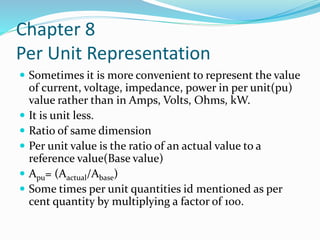
 Sometimes it is more convenient to represent the value
of current, voltage, impedance, power in per unit(pu)
value rather than in Amps, Volts, Ohms, kW.
 It is unit less.
 Ratio of same dimension
 Per unit value is the ratio of an actual value to a
reference value(Base value)
 Apu= (Aactual/Abase)
 Some times per unit quantities id mentioned as per
cent quantity by multiplying a factor of 100.
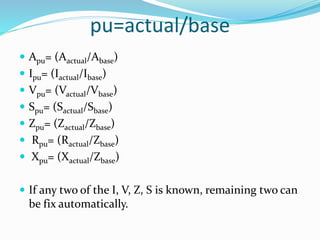
pu=actual/base
 Apu= (Aactual/Abase)
 Ipu= (Iactual/Ibase)
 Vpu= (Vactual/Vbase)
 Spu= (Sactual/Sbase)
 Zpu= (Zactual/Zbase)
 Rpu= (Ractual/Zbase)
 Xpu= (Xactual/Zbase)
 If any two of the I, V, Z, S is known, remaining two can
be fix automatically.
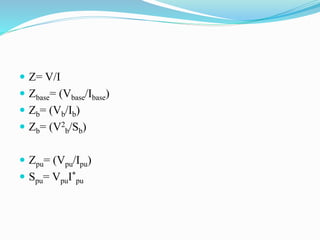
 Z= V/I
 Zbase= (Vbase/Ibase)
 Zb= (Vb/Ib)
 Zb= (V2
b/Sb)
 Zpu= (Vpu/Ipu)
 Spu= VpuI*
pu
Example 8.1
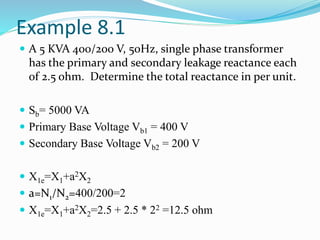
 A 5 KVA 400/200 V, 50Hz, single phase transformer
has the primary and secondary leakage reactance each
of 2.5 ohm. Determine the total reactance in per unit.
 Sb= 5000 VA
 Primary Base Voltage Vb1 = 400 V
 Secondary Base Voltage Vb2 = 200 V
 X1e=X1+a2X2
 a=N1/N2=400/200=2
 X1e=X1+a2X2=2.5 + 2.5 * 22 =12.5 ohm
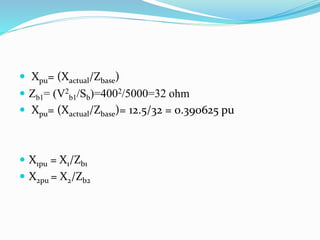
 Xpu= (Xactual/Zbase)
 Zb1= (V2
b1/Sb)=4002/5000=32 ohm
 Xpu= (Xactual/Zbase)= 12.5/32 = 0.390625 pu
 X1pu = X1/Zb1
 X2pu = X2/Zb2
Advantages of per unit representation
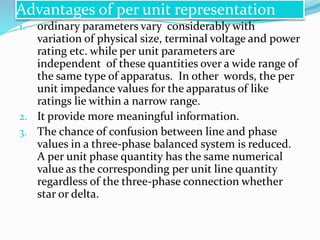
1. ordinary parameters vary considerably with
variation of physical size, terminal voltage and power
rating etc. while per unit parameters are
independent of these quantities over a wide range of
the same type of apparatus. In other words, the per
unit impedance values for the apparatus of like
ratings lie within a narrow range.
2. It provide more meaningful information.
3. The chance of confusion between line and phase
values in a three-phase balanced system is reduced.
A per unit phase quantity has the same numerical
value as the corresponding per unit line quantity
regardless of the three-phase connection whether
star or delta.
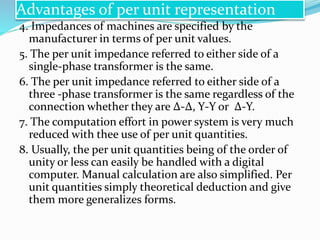
4. Impedances of machines are specified by the
manufacturer in terms of per unit values.
5. The per unit impedance referred to either side of a
single-phase transformer is the same.
6. The per unit impedance referred to either side of a
three -phase transformer is the same regardless of the
connection whether they are ∆-∆, Y-Y or ∆-Y.
7. The computation effort in power system is very much
reduced with thee use of per unit quantities.
8. Usually, the per unit quantities being of the order of
unity or less can easily be handled with a digital
computer. Manual calculation are also simplified. Per
unit quantities simply theoretical deduction and give
them more generalizes forms.
Advantages of per unit representation

Per unit representation

  • 2.
    Chapter 8 Per UnitRepresentation  Sometimes it is more convenient to represent the value of current, voltage, impedance, power in per unit(pu) value rather than in Amps, Volts, Ohms, kW.  It is unit less.  Ratio of same dimension  Per unit value is the ratio of an actual value to a reference value(Base value)  Apu= (Aactual/Abase)  Some times per unit quantities id mentioned as per cent quantity by multiplying a factor of 100.
  • 3.
    pu=actual/base  Apu= (Aactual/Abase) Ipu= (Iactual/Ibase)  Vpu= (Vactual/Vbase)  Spu= (Sactual/Sbase)  Zpu= (Zactual/Zbase)  Rpu= (Ractual/Zbase)  Xpu= (Xactual/Zbase)  If any two of the I, V, Z, S is known, remaining two can be fix automatically.
  • 4.
     Z= V/I Zbase= (Vbase/Ibase)  Zb= (Vb/Ib)  Zb= (V2 b/Sb)  Zpu= (Vpu/Ipu)  Spu= VpuI* pu
  • 5.
    Example 8.1  A5 KVA 400/200 V, 50Hz, single phase transformer has the primary and secondary leakage reactance each of 2.5 ohm. Determine the total reactance in per unit.  Sb= 5000 VA  Primary Base Voltage Vb1 = 400 V  Secondary Base Voltage Vb2 = 200 V  X1e=X1+a2X2  a=N1/N2=400/200=2  X1e=X1+a2X2=2.5 + 2.5 * 22 =12.5 ohm
  • 6.
     Xpu= (Xactual/Zbase) Zb1= (V2 b1/Sb)=4002/5000=32 ohm  Xpu= (Xactual/Zbase)= 12.5/32 = 0.390625 pu  X1pu = X1/Zb1  X2pu = X2/Zb2
  • 7.
    Advantages of perunit representation 1. ordinary parameters vary considerably with variation of physical size, terminal voltage and power rating etc. while per unit parameters are independent of these quantities over a wide range of the same type of apparatus. In other words, the per unit impedance values for the apparatus of like ratings lie within a narrow range. 2. It provide more meaningful information. 3. The chance of confusion between line and phase values in a three-phase balanced system is reduced. A per unit phase quantity has the same numerical value as the corresponding per unit line quantity regardless of the three-phase connection whether star or delta.
  • 8.
    4. Impedances ofmachines are specified by the manufacturer in terms of per unit values. 5. The per unit impedance referred to either side of a single-phase transformer is the same. 6. The per unit impedance referred to either side of a three -phase transformer is the same regardless of the connection whether they are ∆-∆, Y-Y or ∆-Y. 7. The computation effort in power system is very much reduced with thee use of per unit quantities. 8. Usually, the per unit quantities being of the order of unity or less can easily be handled with a digital computer. Manual calculation are also simplified. Per unit quantities simply theoretical deduction and give them more generalizes forms. Advantages of per unit representation