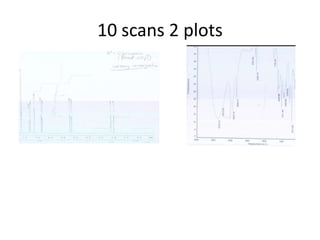
10 scans 2 plots
CARBON-COSY-HSQC
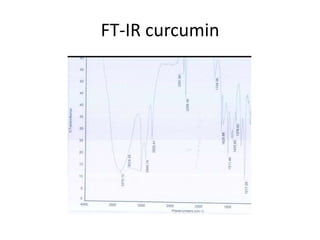
FT-IR curcumin
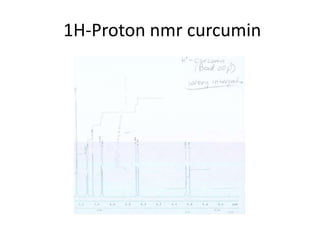
1H-Proton nmr curcumin
1H-Proton nmr curcumin SECOND
.
• For Curcumin, the proton (1H spectrum) shifts
  are as follows. 2 similar protons on the
  aromatic groups give rise to shifts at 5.55ppm
  (aromatic C-OH). The benzene CH of which
  there are 3, give rise to 7.16 ppm, 6.99 ppm
  and 6.79 ppm. On the hexadienone bridge,
  between the two benzene rings (aromatic
  rings) are 2 pairs of equvalent protons
.
• 2 protons are found at 7.60 ppm, that are
  attached to the aromatic Hydorgen and
  Carbons. The 2 protons attached to the
  carbonyl groups can be shown at 6.91 ppm.
  Lastly, there are two protons in between 2
  carbonyl groups at 4.69 ppm
.
• Our spectrum should be adjusted as such
13C CARBON nmr c C C. C.Curcumin
• .
2D 1H- COSY nmr curcumin
SECOND TRY
THIRD TRY
2D 1H-13C HSQC

Using information from 1H NMR data alone is not a
  new concept. However, applications that also use
  the 2D 1H-13C HSQC experiment are gaining
  more interest as a result of the growing feasibility
  of acquiring these spectra routinely. The 2D HSQC
  experiment contains additional information (i.e.
  13C chemical shift) as well as easier identification
  of labile and diastereotopic protons.
2D 1H-13C HSQC nmr of curcumin
• ,
2D 1H-13C HSQC nmr of curcumin
• ,
Positive Reduction in Automated NMR
         Structure Verification
• Sergey S. Golotvin1, Rostislav Pol1, Ryan R.
  Sasaki2, Asya Nikitina2, and Phil Keyes3
• 1Advanced Chemistry Development, Moscow,
  Russia;
• 2Advanced, Chemistry Development, Inc.,
  Toronto, Canada;
• 3Lexicon Pharmaceuticals, Princeton, NJ, USA
Proton nmr varying pH for Curcumin
Proton nmr varying solvents for
          Curcumin
1H-Proton nmr carboxylated curcumin
• For carboxylated curcumin, the proton
  spectrum differs from curcumin as follows.

• First, the carboxyllic chain gives rise to protons
  at 11.0 (C-O-O-H) group, and 3 carbons at 2.02
  ppm and 2 chemically equivalent at 2.30 ppm
• (CHa2 –CHb2-CHa2)
• As for the ring structure, it is primarily similar
  to curcumin of course.

• It shows an C-O-H proton at 5.35 ppm , and 3
  aromatic ring protons at 7.16 ppm, 6.99 ppm
  and 6.79 ppm.
• The aromatic protons next to the carboxyllic
  acid chain are now shifted to 7.30 ppm and
  7.26 ppm
.
• The are also 2 peaks at 3.83 ppm due to C-OH
  proton on both aromatic rings.
13C CARBON nmr carboxylated
         curcumin
2D 1H- COSY nmr carboxylated
         curcumin
2D 1H-13C HSQC nmr carboxylated
           curcumin
FT –IR curcumin
FT –IR carboxylated curcumin
COSY
• COSY is one of the simplest and most useful
  experiment. It is also one of the shortest 2D
  experiment. It needs a minimum of 4
  transients on conventional spectrometer (see
  phase cycling - vector model or coherence
  pathway). With the addition of gradients, only
  one transient is needed which means that on
  a modern spectrometer, the very precious
  COSY information can be obtained in 5 min!!!
COSY
• This 2D experiment is composed of a 90
  degree pulse that creates magnetization in the
  transverse plane. During the evolution time,
  the variable delay t1 is incremented
  systematically in order to sample the spectral
  width indirectly. Following this variable time
  period, a second pulse mixes the spin states,
  transferring magnetization between coupled
  spins
COSY
• The spectra is then acquired during t2
  (detection time). After double Fourier
  Transformation, a spectra like the one below is
  obtained showing a diagonal component (for
  magnetization that did not exchange
  magnetization) and cross peaks (off-diagonal)
  for nuclei exchanging magnetization through
  scalar coupling.
COSY
• The data is usually symmetrical respect to the
  diagonal and therefore the data can be
  symmetrized as part of the processing to improve
  the quality (care must be taken here to make sure
  that by getting rid of the non-symmetrical
  artefacts we are not also getting rid of precious
  information that might not be totally
  symmetrical). The data is usually acquired in a
  phase insensitive (magnitude mode) manner,
  avoiding the difficulty to phase a 2D data set
.

NMR

  • 1.
  • 2.
  • 3.
  • 4.
  • 5.
  • 6.
    . • For Curcumin,the proton (1H spectrum) shifts are as follows. 2 similar protons on the aromatic groups give rise to shifts at 5.55ppm (aromatic C-OH). The benzene CH of which there are 3, give rise to 7.16 ppm, 6.99 ppm and 6.79 ppm. On the hexadienone bridge, between the two benzene rings (aromatic rings) are 2 pairs of equvalent protons
  • 7.
    . • 2 protonsare found at 7.60 ppm, that are attached to the aromatic Hydorgen and Carbons. The 2 protons attached to the carbonyl groups can be shown at 6.91 ppm. Lastly, there are two protons in between 2 carbonyl groups at 4.69 ppm
  • 8.
    . • Our spectrumshould be adjusted as such
  • 9.
    13C CARBON nmrc C C. C.Curcumin • .
  • 10.
    2D 1H- COSYnmr curcumin
  • 11.
  • 12.
  • 13.
    2D 1H-13C HSQC Usinginformation from 1H NMR data alone is not a new concept. However, applications that also use the 2D 1H-13C HSQC experiment are gaining more interest as a result of the growing feasibility of acquiring these spectra routinely. The 2D HSQC experiment contains additional information (i.e. 13C chemical shift) as well as easier identification of labile and diastereotopic protons.
  • 14.
    2D 1H-13C HSQCnmr of curcumin • ,
  • 15.
    2D 1H-13C HSQCnmr of curcumin
  • 16.
    2D 1H-13C HSQCnmr of curcumin • ,
  • 17.
    Positive Reduction inAutomated NMR Structure Verification • Sergey S. Golotvin1, Rostislav Pol1, Ryan R. Sasaki2, Asya Nikitina2, and Phil Keyes3 • 1Advanced Chemistry Development, Moscow, Russia; • 2Advanced, Chemistry Development, Inc., Toronto, Canada; • 3Lexicon Pharmaceuticals, Princeton, NJ, USA
  • 18.
    Proton nmr varyingpH for Curcumin
  • 19.
    Proton nmr varyingsolvents for Curcumin
  • 20.
    1H-Proton nmr carboxylatedcurcumin • For carboxylated curcumin, the proton spectrum differs from curcumin as follows. • First, the carboxyllic chain gives rise to protons at 11.0 (C-O-O-H) group, and 3 carbons at 2.02 ppm and 2 chemically equivalent at 2.30 ppm • (CHa2 –CHb2-CHa2)
  • 21.
    • As forthe ring structure, it is primarily similar to curcumin of course. • It shows an C-O-H proton at 5.35 ppm , and 3 aromatic ring protons at 7.16 ppm, 6.99 ppm and 6.79 ppm. • The aromatic protons next to the carboxyllic acid chain are now shifted to 7.30 ppm and 7.26 ppm
  • 22.
    . • The arealso 2 peaks at 3.83 ppm due to C-OH proton on both aromatic rings.
  • 23.
    13C CARBON nmrcarboxylated curcumin
  • 24.
    2D 1H- COSYnmr carboxylated curcumin
  • 25.
    2D 1H-13C HSQCnmr carboxylated curcumin
  • 26.
  • 27.
  • 28.
    COSY • COSY isone of the simplest and most useful experiment. It is also one of the shortest 2D experiment. It needs a minimum of 4 transients on conventional spectrometer (see phase cycling - vector model or coherence pathway). With the addition of gradients, only one transient is needed which means that on a modern spectrometer, the very precious COSY information can be obtained in 5 min!!!
  • 29.
    COSY • This 2Dexperiment is composed of a 90 degree pulse that creates magnetization in the transverse plane. During the evolution time, the variable delay t1 is incremented systematically in order to sample the spectral width indirectly. Following this variable time period, a second pulse mixes the spin states, transferring magnetization between coupled spins
  • 30.
    COSY • The spectrais then acquired during t2 (detection time). After double Fourier Transformation, a spectra like the one below is obtained showing a diagonal component (for magnetization that did not exchange magnetization) and cross peaks (off-diagonal) for nuclei exchanging magnetization through scalar coupling.
  • 31.
    COSY • The datais usually symmetrical respect to the diagonal and therefore the data can be symmetrized as part of the processing to improve the quality (care must be taken here to make sure that by getting rid of the non-symmetrical artefacts we are not also getting rid of precious information that might not be totally symmetrical). The data is usually acquired in a phase insensitive (magnitude mode) manner, avoiding the difficulty to phase a 2D data set
  • 32.