Brian Lee, MD
Internal Medicine Resident
Advisor: Supparerk Disayabutr, MD
Division of Respiratory Disease andTuberculosis,
Department of Medicine,Siriraj Hospital
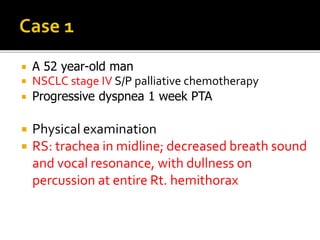
 A 52 year-old man
 NSCLC stage IV S/P palliative chemotherapy
 Progressive dyspnea 1 week PTA
 Physical examination
 RS: trachea in midline; decreased breath sound
and vocal resonance, with dullness on
percussion at entire Rt. hemithorax
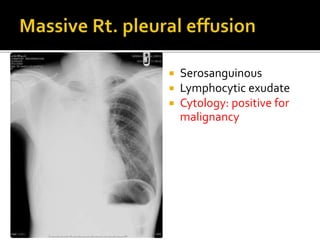
 Serosanguinous
 Lymphocytic exudate
 Cytology: positive for
malignancy
 Observation
 Repeat pleural aspiration
 Chest tube insertion, intrapleural sclerosant
 Thoracoscopy with talc poudrage
BTS guidelines for the management of malignant pleural effusions
Thorax 2003;58(Suppl II):ii29–ii38
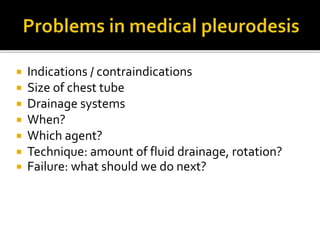
 Indications / contraindications
 Size of chest tube
 Drainage systems
 When?
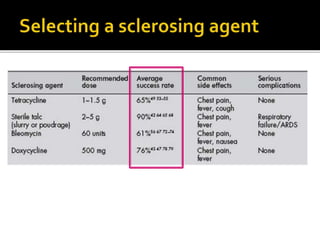
 Which agent?
 Technique: amount of fluid drainage, rotation?
 Failure: what should we do next?
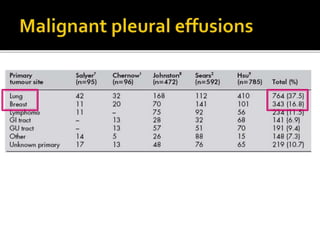
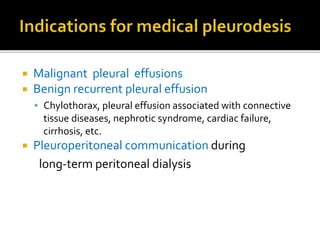
 Malignant pleural effusions
 Benign recurrent pleural effusion
 Chylothorax, pleural effusion associated with connective
tissue diseases, nephrotic syndrome, cardiac failure,
cirrhosis, etc.
 Pleuroperitoneal communication during
long-term peritoneal dialysis
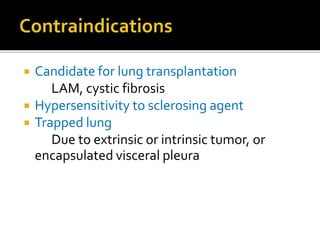
 Candidate for lung transplantation
LAM, cystic fibrosis
 Hypersensitivity to sclerosing agent
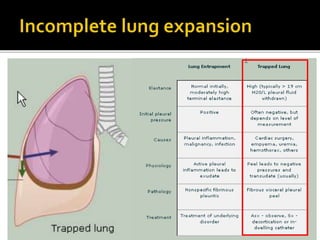
 Trapped lung
Due to extrinsic or intrinsic tumor, or
encapsulated visceral pleura
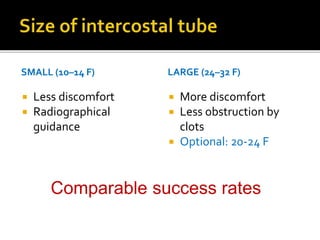
SMALL (10–14 F)
 Less discomfort
 Radiographical
guidance
LARGE (24–32 F)
 More discomfort
 Less obstruction by
clots
 Optional: 20-24 F
Comparable success rates
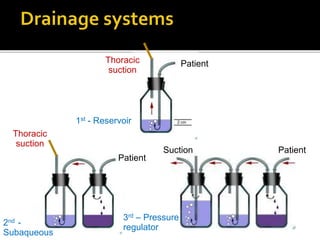
Patient
Patient
PatientSuction
Thoracic
suction
Thoracic
suction
1st - Reservoir
2nd -
Subaqueous
3rd – Pressure
regulator
 Thoracic suction or wall suction: pressure
regulator (3rd) bottle not needed
 Usual suction: check for bubbles in 3rd bottle
 Check drainage system regularly
 Release < 1-1.5 L at one time
 Instill agent when CXR shows complete lung
re-expansion
 Suction
 Usually unnecessary
 May be required for incomplete lung expansion,
persistent air leak
 Gradual increase to -20 cmH2O
 Risk
- Associated with pleural pressure (Ppl)
- Not necessarily with volume of fluid
removed
- Ppl dropped to < -20 cmH2O
 In common practice : 1,000-1,500 ml *
* Light RW, et al. Am Rev Respir Dis 1980; 121: 799-804.
 Instill lidocaine (3 mg/kg; maximum 250 mg)
 Oxytetracycline 10 ml / amp contains
lidocaine 200 mg
 Premedication for anxiety and pain
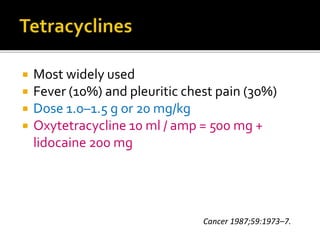
 Most widely used
 Fever (10%) and pleuritic chest pain (30%)
 Dose 1.0–1.5 g or 20 mg/kg
 Oxytetracycline 10 ml / amp = 500 mg +
lidocaine 200 mg
Cancer 1987;59:1973–7.
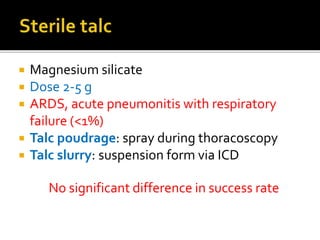
 Magnesium silicate
 Dose 2-5 g
 ARDS, acute pneumonitis with respiratory
failure (<1%)
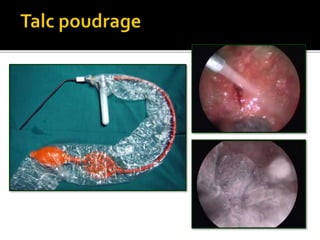
 Talc poudrage: spray during thoracoscopy
 Talc slurry: suspension form via ICD
No significant difference in success rate
 Clamping of ICD 1-2 h
 Rotation of patient
 Not necessary after instilling tetracyclines
 Required when using talc slurry
 Remove ICD when drain < 150-250 ml/day
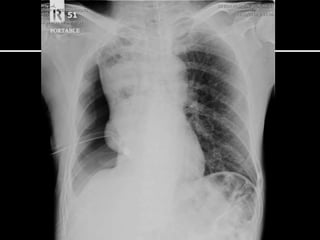
 Medical thoracoscopy with talc poudrage
 Findings
 Thickening of parietal and visceral pleura
 Plaque at medial & lateral part of parietal pleura
 Adhesion at diaphragmatic & upper parietal pleura
 Mostly due to incomplete lung expansion
 Causes of failure
 Trapped lung, lung entrapment
 Endobronchial obstruction
 Persistent air leak
 Suboptimal technique, drainage system
 Physical examination and CXR: no tracheal or
mediastinal shift, even with large effusions
 During thoracentesis
Symptom (cough, chest pain, -ve pressure)
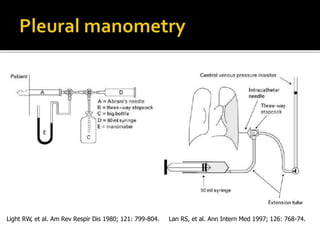
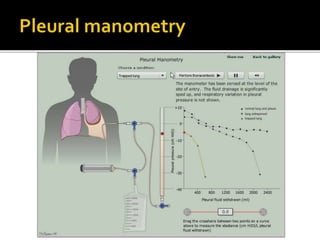
 Pleural pressure measurement
- Initial pleural pressure
- Pleural elastance
Lan RS, et al. Ann Intern Med 1997; 126: 768-74.Light RW, et al. Am Rev Respir Dis 1980; 121: 799-804.
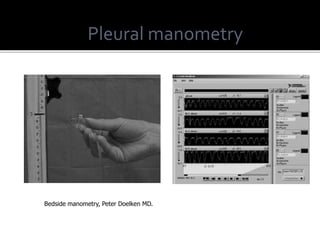
Bedside manometry, Peter Doelken MD.
Pleural manometry
 Repeat pleurodesis
 Repeat thoracentesis
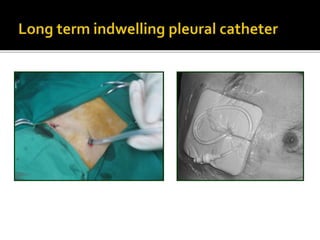
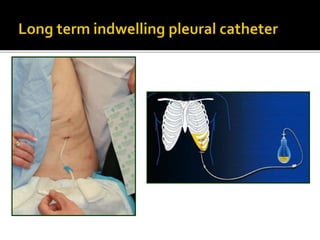
 Long term indwelling pleural catheter
 Intrapleural fibrinolytic drugs: loculations
 Pleuroperitoneal shunting
 Pleurectomy
What should we do?
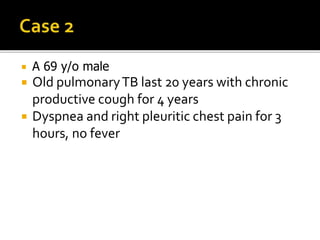
 A 69 y/o male
 Old pulmonaryTB last 20 years with chronic
productive cough for 4 years
 Dyspnea and right pleuritic chest pain for 3
hours, no fever
 V/S:T 37oc, PR 100/min, RR 26/min, BP 110/70
mmHg
 GA: AThai elderly age male, good
consciousness, not pale, no edema, mild
respiratory distress
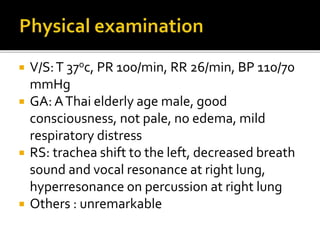
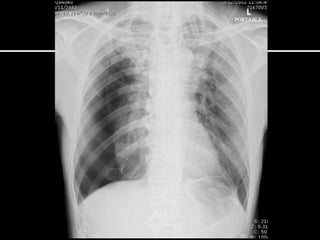
 RS: trachea shift to the left, decreased breath
sound and vocal resonance at right lung,
hyperresonance on percussion at right lung
 Others : unremarkable
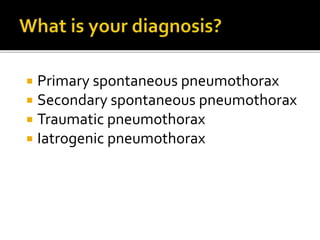
 Primary spontaneous pneumothorax
 Secondary spontaneous pneumothorax
 Traumatic pneumothorax
 Iatrogenic pneumothorax
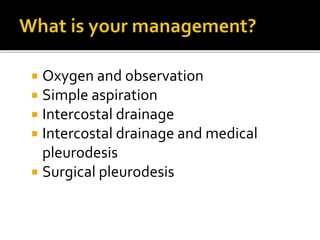
 Oxygen and observation
 Simple aspiration
 Intercostal drainage
 Intercostal drainage and medical
pleurodesis
 Surgical pleurodesis
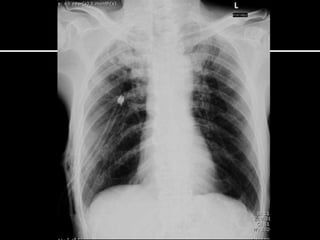
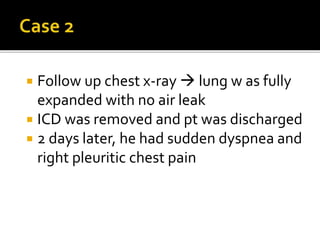
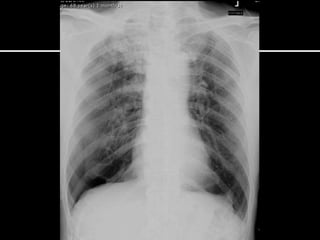
 Follow up chest x-ray  lung w as fully
expanded with no air leak
 ICD was removed and pt was discharged
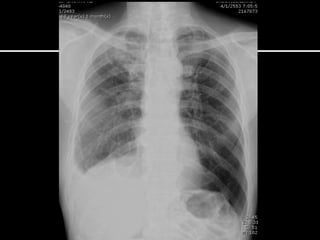
 2 days later, he had sudden dyspnea and
right pleuritic chest pain
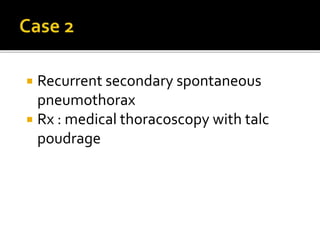
 Recurrent secondary spontaneous
pneumothorax
 Rx : medical thoracoscopy with talc
poudrage
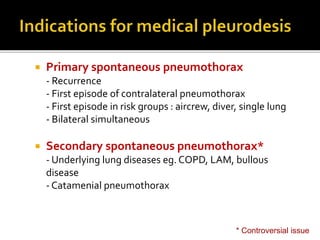
 Primary spontaneous pneumothorax
- Recurrence
- First episode of contralateral pneumothorax
- First episode in risk groups : aircrew, diver, single lung
- Bilateral simultaneous
 Secondary spontaneous pneumothorax*
- Underlying lung diseases eg. COPD, LAM, bullous
disease
- Catamenial pneumothorax
* Controversial issue
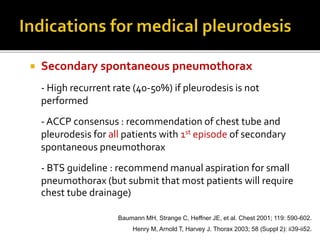
 Secondary spontaneous pneumothorax
- High recurrent rate (40-50%) if pleurodesis is not
performed
- ACCP consensus : recommendation of chest tube and
pleurodesis for all patients with 1st episode of secondary
spontaneous pneumothorax
- BTS guideline : recommend manual aspiration for small
pneumothorax (but submit that most patients will require
chest tube drainage)
Baumann MH, Strange C, Heffner JE, et al. Chest 2001; 119: 590-602.
Henry M, Arnold T, Harvey J. Thorax 2003; 58 (Suppl 2): ii39-ii52.
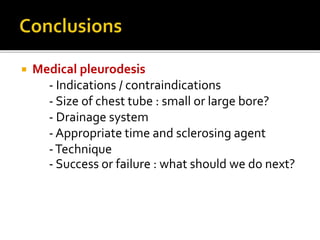
 Medical pleurodesis
- Indications / contraindications
- Size of chest tube : small or large bore?
- Drainage system
- Appropriate time and sclerosing agent
-Technique
- Success or failure : what should we do next?
Medical pleurodesis

Medical pleurodesis

  • 1.
    Brian Lee, MD InternalMedicine Resident Advisor: Supparerk Disayabutr, MD Division of Respiratory Disease andTuberculosis, Department of Medicine,Siriraj Hospital
  • 2.
     A 52year-old man  NSCLC stage IV S/P palliative chemotherapy  Progressive dyspnea 1 week PTA  Physical examination  RS: trachea in midline; decreased breath sound and vocal resonance, with dullness on percussion at entire Rt. hemithorax
  • 3.
     Serosanguinous  Lymphocyticexudate  Cytology: positive for malignancy
  • 4.
     Observation  Repeatpleural aspiration  Chest tube insertion, intrapleural sclerosant  Thoracoscopy with talc poudrage
  • 5.
    BTS guidelines forthe management of malignant pleural effusions Thorax 2003;58(Suppl II):ii29–ii38
  • 9.
     Indications /contraindications  Size of chest tube  Drainage systems  When?  Which agent?  Technique: amount of fluid drainage, rotation?  Failure: what should we do next?
  • 10.
     Malignant pleuraleffusions  Benign recurrent pleural effusion  Chylothorax, pleural effusion associated with connective tissue diseases, nephrotic syndrome, cardiac failure, cirrhosis, etc.  Pleuroperitoneal communication during long-term peritoneal dialysis
  • 11.
     Candidate forlung transplantation LAM, cystic fibrosis  Hypersensitivity to sclerosing agent  Trapped lung Due to extrinsic or intrinsic tumor, or encapsulated visceral pleura
  • 12.
    SMALL (10–14 F) Less discomfort  Radiographical guidance LARGE (24–32 F)  More discomfort  Less obstruction by clots  Optional: 20-24 F Comparable success rates
  • 13.
  • 14.
     Thoracic suctionor wall suction: pressure regulator (3rd) bottle not needed  Usual suction: check for bubbles in 3rd bottle  Check drainage system regularly
  • 15.
     Release <1-1.5 L at one time  Instill agent when CXR shows complete lung re-expansion  Suction  Usually unnecessary  May be required for incomplete lung expansion, persistent air leak  Gradual increase to -20 cmH2O
  • 16.
     Risk - Associatedwith pleural pressure (Ppl) - Not necessarily with volume of fluid removed - Ppl dropped to < -20 cmH2O  In common practice : 1,000-1,500 ml * * Light RW, et al. Am Rev Respir Dis 1980; 121: 799-804.
  • 17.
     Instill lidocaine(3 mg/kg; maximum 250 mg)  Oxytetracycline 10 ml / amp contains lidocaine 200 mg  Premedication for anxiety and pain
  • 19.
     Most widelyused  Fever (10%) and pleuritic chest pain (30%)  Dose 1.0–1.5 g or 20 mg/kg  Oxytetracycline 10 ml / amp = 500 mg + lidocaine 200 mg Cancer 1987;59:1973–7.
  • 20.
     Magnesium silicate Dose 2-5 g  ARDS, acute pneumonitis with respiratory failure (<1%)  Talc poudrage: spray during thoracoscopy  Talc slurry: suspension form via ICD No significant difference in success rate
  • 22.
     Clamping ofICD 1-2 h  Rotation of patient  Not necessary after instilling tetracyclines  Required when using talc slurry  Remove ICD when drain < 150-250 ml/day
  • 23.
     Medical thoracoscopywith talc poudrage  Findings  Thickening of parietal and visceral pleura  Plaque at medial & lateral part of parietal pleura  Adhesion at diaphragmatic & upper parietal pleura
  • 25.
     Mostly dueto incomplete lung expansion  Causes of failure  Trapped lung, lung entrapment  Endobronchial obstruction  Persistent air leak  Suboptimal technique, drainage system
  • 27.
     Physical examinationand CXR: no tracheal or mediastinal shift, even with large effusions  During thoracentesis Symptom (cough, chest pain, -ve pressure)  Pleural pressure measurement - Initial pleural pressure - Pleural elastance
  • 28.
    Lan RS, etal. Ann Intern Med 1997; 126: 768-74.Light RW, et al. Am Rev Respir Dis 1980; 121: 799-804.
  • 29.
    Bedside manometry, PeterDoelken MD. Pleural manometry
  • 31.
     Repeat pleurodesis Repeat thoracentesis  Long term indwelling pleural catheter  Intrapleural fibrinolytic drugs: loculations  Pleuroperitoneal shunting  Pleurectomy What should we do?
  • 34.
     A 69y/o male  Old pulmonaryTB last 20 years with chronic productive cough for 4 years  Dyspnea and right pleuritic chest pain for 3 hours, no fever
  • 35.
     V/S:T 37oc,PR 100/min, RR 26/min, BP 110/70 mmHg  GA: AThai elderly age male, good consciousness, not pale, no edema, mild respiratory distress  RS: trachea shift to the left, decreased breath sound and vocal resonance at right lung, hyperresonance on percussion at right lung  Others : unremarkable
  • 37.
     Primary spontaneouspneumothorax  Secondary spontaneous pneumothorax  Traumatic pneumothorax  Iatrogenic pneumothorax
  • 38.
     Oxygen andobservation  Simple aspiration  Intercostal drainage  Intercostal drainage and medical pleurodesis  Surgical pleurodesis
  • 40.
     Follow upchest x-ray  lung w as fully expanded with no air leak  ICD was removed and pt was discharged  2 days later, he had sudden dyspnea and right pleuritic chest pain
  • 42.
     Recurrent secondaryspontaneous pneumothorax  Rx : medical thoracoscopy with talc poudrage
  • 44.
     Primary spontaneouspneumothorax - Recurrence - First episode of contralateral pneumothorax - First episode in risk groups : aircrew, diver, single lung - Bilateral simultaneous  Secondary spontaneous pneumothorax* - Underlying lung diseases eg. COPD, LAM, bullous disease - Catamenial pneumothorax * Controversial issue
  • 45.
     Secondary spontaneouspneumothorax - High recurrent rate (40-50%) if pleurodesis is not performed - ACCP consensus : recommendation of chest tube and pleurodesis for all patients with 1st episode of secondary spontaneous pneumothorax - BTS guideline : recommend manual aspiration for small pneumothorax (but submit that most patients will require chest tube drainage) Baumann MH, Strange C, Heffner JE, et al. Chest 2001; 119: 590-602. Henry M, Arnold T, Harvey J. Thorax 2003; 58 (Suppl 2): ii39-ii52.
  • 46.
     Medical pleurodesis -Indications / contraindications - Size of chest tube : small or large bore? - Drainage system - Appropriate time and sclerosing agent -Technique - Success or failure : what should we do next?