INTEGRATED NUTRIENT
MANAGEMENT IN VEGETABLE CROPS
Integrated nutrient management means combined application of
different sources of plant nutrients like organic inorganic and
bio fertilisers for sustainable crop production without degrading
the natural resources on long term basis . The objective or aim to
integrate the use of natural and man made soil nutrients to
increase crop productivity and preserve soil productivity for future
generation .
▸ INM involves maintenance or adjustment of plant nutrient supply to an optimum level for
sustaining the desired crop productivity.
▸ It involves proper combination of chemical fertilizers, organic manures, crop residues,
nitrogen fixing crops and bio-fertilizers suitable to the system of land use and ecological, social
and economic conditions.
WHY INM?
•Unbalanced use of N:P:K have caused deleterious long term effects on soil fertility and productivity.
•In intensive cultivation, application of mere chemical fertilizers (N:P:K)
Not sufficient for sustaining the yields
Leads to deficiency in the soil for secondary nutrients and
Deficiency of micro-nutrients in the soil which limit crop productivity
•Use of organic manures, green manures, crop residue and biodegradable rural and urban waste
•Supplement the major nutrients.
•Increase the efficiency in other nutrients supply
•Leading to improvement in physical and biological properties of the soil
GOALS OF INM
 To maintain soil productivity To ensure productive and sustainable agriculture
 To reduce expenditure on cost of purchased inputs by using farm manure and crop
residues etc.
 To utilize the potential benefits of green manures, leguminous crops and bio-fertilizers
To prevent degradation of the environment
 To meet the social and economic aspirations of the farmers without harming the
natural resource base of the agricultural production
PRINCIPLES OF INM
 In the soil, replenishment of chemicals removed by the crop
 Maintenance of organic matter content in the soil
 Avoidance of weeds, pests and diseases occurrence
 Control of soil acidity and toxicity
 Control of soil erosion by improving soil physical properties
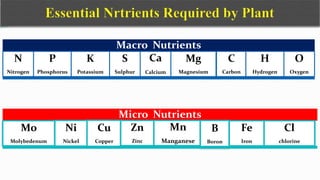
Macro Nutrients
N
Nitrogen
P
Phosphorus
K
Potassium
S
Sulphur
Ca
Calcium
Mg
Magnesium
C
Carbon
H
Hydrogen
O
Oxygen
Micro Nutrients
Mo
Molybedenum
Ni
Nickel
Cu
Copper
Zn
Zinc
Mn
Manganese
B
Boron
Fe
Iron
Cl
chlorine
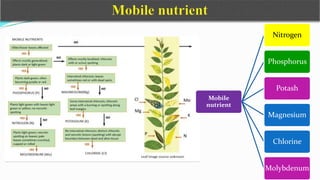
Mobile
nutrient
Nitrogen
Phosphorus
Potash
Magnesium
Chlorine
Molybdenum
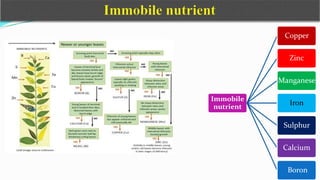
Immobile
nutrient
Copper
Zinc
Manganese
Iron
Sulphur
Calcium
Boron
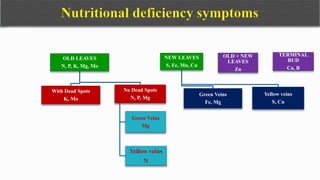
OLD LEAVES
N, P, K, Mg, Mo
With Dead Spots
K, Mo
No Dead Spots
N, P, Mg
Green Veins
Mg
Yellow veins
N
NEW LEAVES
S, Fe, Mn, Cu
Green Veins
Fe, Mg
Yellow veins
S, Cu
OLD + NEW
LEAVES
Zn
TERMINAL
BUD
Ca, B
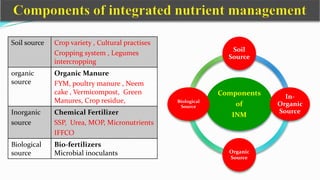
Soil source Crop variety , Cultural practises
Cropping system , Legumes
intercropping
organic
source
Organic Manure
FYM, poultry manure , Neem
cake , Vermicompost, Green
Manures, Crop residue,
Inorganic
source
Chemical Fertilizer
SSP, Urea, MOP, Micronutrients
IFFCO
Biological
source
Bio-fertilizers
Microbial inoculants
Components
of
INM
Soil
Source
In-
Organic
Source
Organic
Source
Biological
Source
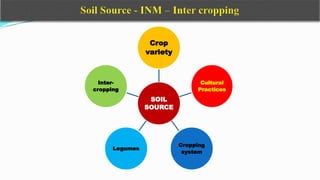
SOIL
SOURCE
Crop
variety
Cultural
Practices
Cropping
system
Legumes
Inter-
cropping
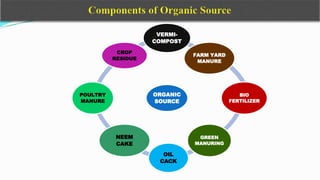
ORGANIC
SOURCE
VERMI-
COMPOST
FARM YARD
MANURE
BIO
FERTILIZER
GREEN
MANURING
OIL
CACK
NEEM
CAKE
POULTRY
MANURE
CROP
RESIDUE
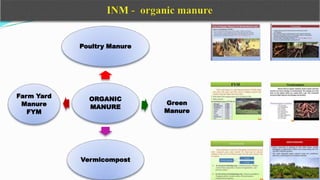
ORGANIC
MANURE
Poultry Manure
Green
Manure
Vermicompost
Farm Yard
Manure
FYM
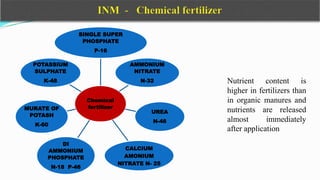
Chemical
fertilizer
SINGLE SUPER
PHOSPHATE
P-16
AMMONIUM
NITRATE
N-32
UREA
N-46
CALCIUM
AMONIUM
NITRATE N- 25
DI
AMMONIUM
PHOSPHATE
N-18 P-46
MURATE OF
POTASH
K-60
POTASSIUM
SULPHATE
K-48 Nutrient content is
higher in fertilizers than
in organic manures and
nutrients are released
almost immediately
after application
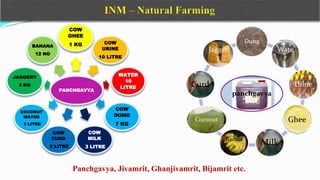
PANCHGAVYA
COW
GHEE
1 KG COW
URINE
10 LITRE
WATER
10
LITRE
COW
DUNG
7 KG
COW
MILK
3 LITRE
COW
CURD
2 LITRE
COCONUT
WATER
3 LITRE
JAGGERY
3 KG
BANANA
12 NO
panchgavya
Dung
Wate
r
Urine
Ghee
Milk
Banan
a
Coconut
Curd
Jagger
y
Panchgavya, Jivamrit, Ghanjivamrit, Bijamrit etc.
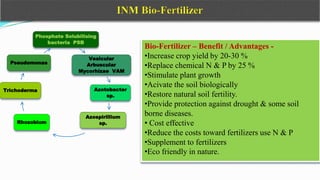
Phosphate Solubilising
bacteria PSB
Vesicular
Arbuscular
Mycorhizae VAM
Azotobactor
sp.
Azospirillium
sp.
Rhozobium
Trichoderma
Pseudomonas
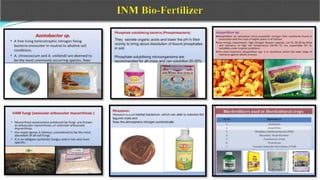
Bio-Fertilizer – Benefit / Advantages -
•Increase crop yield by 20-30 %
•Replace chemical N & P by 25 %
•Stimulate plant growth
•Acivate the soil biologically
•Restore natural soil fertility.
•Provide protection against drought & some soil
borne diseases.
• Cost effective
•Reduce the costs toward fertilizers use N & P
•Supplement to fertilizers
•Eco friendly in nature.
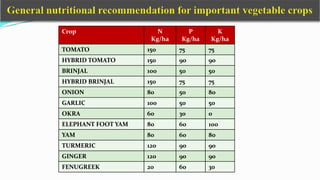
Crop N
Kg/ha
P
Kg/ha
K
Kg/ha
TOMATO 150 75 75
HYBRID TOMATO 150 90 90
BRINJAL 100 50 50
HYBRID BRINJAL 150 75 75
ONION 80 50 80
GARLIC 100 50 50
OKRA 60 30 0
ELEPHANT FOOT YAM 80 60 100
YAM 80 60 80
TURMERIC 120 90 90
GINGER 120 90 90
FENUGREEK 20 60 30
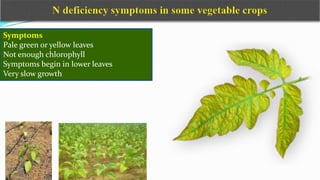
Symptoms
Pale green or yellow leaves
Not enough chlorophyll
Symptoms begin in lower leaves
Very slow growth
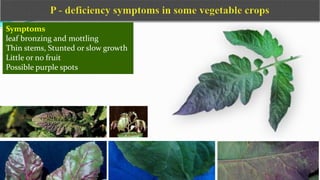
Symptoms
leaf bronzing and mottling
Thin stems, Stunted or slow growth
Little or no fruit
Possible purple spots
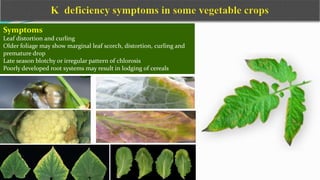
Symptoms
Leaf distortion and curling
Older foliage may show marginal leaf scorch, distortion, curling and
premature drop
Late season blotchy or irregular pattern of chlorosis
Poorly developed root systems may result in lodging of cereals
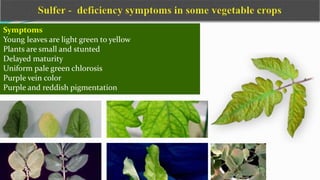
Symptoms
Young leaves are light green to yellow
Plants are small and stunted
Delayed maturity
Uniform pale green chlorosis
Purple vein color
Purple and reddish pigmentation
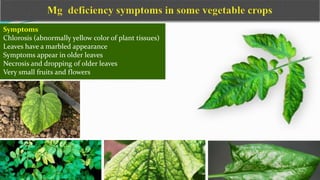
Symptoms
Chlorosis (abnormally yellow color of plant tissues)
Leaves have a marbled appearance
Symptoms appear in older leaves
Necrosis and dropping of older leaves
Very small fruits and flowers
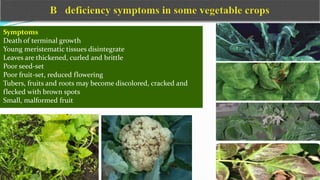
Symptoms
Death of terminal growth
Young meristematic tissues disintegrate
Leaves are thickened, curled and brittle
Poor seed-set
Poor fruit-set, reduced flowering
Tubers, fruits and roots may become discolored, cracked and
flecked with brown spots
Small, malformed fruit
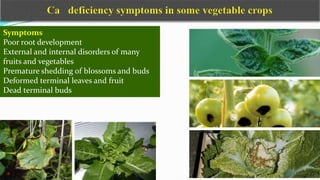
Symptoms
Poor root development
External and internal disorders of many
fruits and vegetables
Premature shedding of blossoms and buds
Deformed terminal leaves and fruit
Dead terminal buds
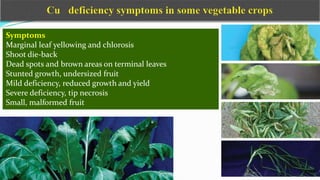
Symptoms
Marginal leaf yellowing and chlorosis
Shoot die-back
Dead spots and brown areas on terminal leaves
Stunted growth, undersized fruit
Mild deficiency, reduced growth and yield
Severe deficiency, tip necrosis
Small, malformed fruit
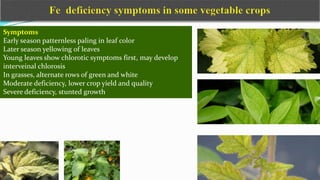
Symptoms
Early season patternless paling in leaf color
Later season yellowing of leaves
Young leaves show chlorotic symptoms first, may develop
interveinal chlorosis
In grasses, alternate rows of green and white
Moderate deficiency, lower crop yield and quality
Severe deficiency, stunted growth
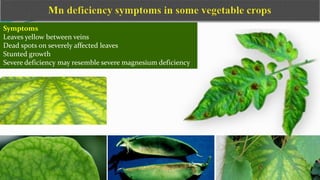
Symptoms
Leaves yellow between veins
Dead spots on severely affected leaves
Stunted growth
Severe deficiency may resemble severe magnesium deficiency
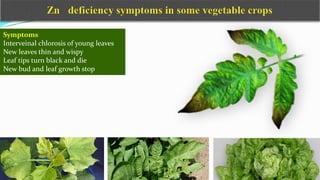
Symptoms
Interveinal chlorosis of young leaves
New leaves thin and wispy
Leaf tips turn black and die
New bud and leaf growth stop
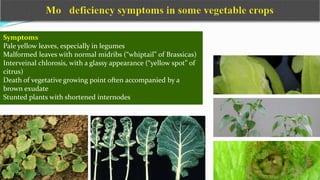
Symptoms
Pale yellow leaves, especially in legumes
Malformed leaves with normal midribs (“whiptail” of Brassicas)
Interveinal chlorosis, with a glassy appearance (“yellow spot” of
citrus)
Death of vegetative growing point often accompanied by a
brown exudate
Stunted plants with shortened internodes
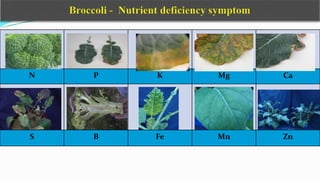
N P K Mg Ca
S B Fe Mn Zn
• Soil physical properties - Improvement in soil granulation, porosity, water holding and
drainage capacity, aeration etc.
• soil health - Prevent deterioration of better tolerance to biotic and abiotic stresses.
• Enrichment of soil with beneficial soil micro organisms. Improves & sustain Physical, Chemical and
biological functioning of soil.
• Balanced nutrition - Balanced nutrition to the crops, better nutritional uptake and hence better
plant growth and yield
• Nutrient demand - Enhance the availability of nutrient. Improvement in the organic matter content
in the soil - Inorganic sources insufficient for nutritional needs. -
• Multiple nutrient deficiency - Maintenance of soil nutrients reserve. Minimize antagonistic effects of
nutrient imbalance.
• Pollution. - Reduced use of chemical fertilizers , reduce nutrient losses , reduces pollution of ground
water and environment.
• Use of available nutrient sources for sustainable agriculture -
• Enhance crop yield & improve produce's quality appearance, taste and nutritional richness.
• Fruitful utilization of farm wastes, organic sources are cheaply available minimize production cost &
residual effect remains beneficial to succeeding crops.
INM in Vegetable crops .pptx

INM in Vegetable crops .pptx

  • 1.
  • 2.
    Integrated nutrient managementmeans combined application of different sources of plant nutrients like organic inorganic and bio fertilisers for sustainable crop production without degrading the natural resources on long term basis . The objective or aim to integrate the use of natural and man made soil nutrients to increase crop productivity and preserve soil productivity for future generation .
  • 3.
    ▸ INM involvesmaintenance or adjustment of plant nutrient supply to an optimum level for sustaining the desired crop productivity. ▸ It involves proper combination of chemical fertilizers, organic manures, crop residues, nitrogen fixing crops and bio-fertilizers suitable to the system of land use and ecological, social and economic conditions. WHY INM? •Unbalanced use of N:P:K have caused deleterious long term effects on soil fertility and productivity. •In intensive cultivation, application of mere chemical fertilizers (N:P:K) Not sufficient for sustaining the yields Leads to deficiency in the soil for secondary nutrients and Deficiency of micro-nutrients in the soil which limit crop productivity •Use of organic manures, green manures, crop residue and biodegradable rural and urban waste •Supplement the major nutrients. •Increase the efficiency in other nutrients supply •Leading to improvement in physical and biological properties of the soil
  • 4.
    GOALS OF INM To maintain soil productivity To ensure productive and sustainable agriculture  To reduce expenditure on cost of purchased inputs by using farm manure and crop residues etc.  To utilize the potential benefits of green manures, leguminous crops and bio-fertilizers To prevent degradation of the environment  To meet the social and economic aspirations of the farmers without harming the natural resource base of the agricultural production PRINCIPLES OF INM  In the soil, replenishment of chemicals removed by the crop  Maintenance of organic matter content in the soil  Avoidance of weeds, pests and diseases occurrence  Control of soil acidity and toxicity  Control of soil erosion by improving soil physical properties
  • 5.
  • 6.
  • 7.
  • 8.
    OLD LEAVES N, P,K, Mg, Mo With Dead Spots K, Mo No Dead Spots N, P, Mg Green Veins Mg Yellow veins N NEW LEAVES S, Fe, Mn, Cu Green Veins Fe, Mg Yellow veins S, Cu OLD + NEW LEAVES Zn TERMINAL BUD Ca, B
  • 9.
    Soil source Cropvariety , Cultural practises Cropping system , Legumes intercropping organic source Organic Manure FYM, poultry manure , Neem cake , Vermicompost, Green Manures, Crop residue, Inorganic source Chemical Fertilizer SSP, Urea, MOP, Micronutrients IFFCO Biological source Bio-fertilizers Microbial inoculants Components of INM Soil Source In- Organic Source Organic Source Biological Source
  • 10.
  • 11.
  • 12.
  • 13.
    Chemical fertilizer SINGLE SUPER PHOSPHATE P-16 AMMONIUM NITRATE N-32 UREA N-46 CALCIUM AMONIUM NITRATE N-25 DI AMMONIUM PHOSPHATE N-18 P-46 MURATE OF POTASH K-60 POTASSIUM SULPHATE K-48 Nutrient content is higher in fertilizers than in organic manures and nutrients are released almost immediately after application
  • 14.
    PANCHGAVYA COW GHEE 1 KG COW URINE 10LITRE WATER 10 LITRE COW DUNG 7 KG COW MILK 3 LITRE COW CURD 2 LITRE COCONUT WATER 3 LITRE JAGGERY 3 KG BANANA 12 NO panchgavya Dung Wate r Urine Ghee Milk Banan a Coconut Curd Jagger y Panchgavya, Jivamrit, Ghanjivamrit, Bijamrit etc.
  • 15.
    Phosphate Solubilising bacteria PSB Vesicular Arbuscular MycorhizaeVAM Azotobactor sp. Azospirillium sp. Rhozobium Trichoderma Pseudomonas Bio-Fertilizer – Benefit / Advantages - •Increase crop yield by 20-30 % •Replace chemical N & P by 25 % •Stimulate plant growth •Acivate the soil biologically •Restore natural soil fertility. •Provide protection against drought & some soil borne diseases. • Cost effective •Reduce the costs toward fertilizers use N & P •Supplement to fertilizers •Eco friendly in nature.
  • 17.
    Crop N Kg/ha P Kg/ha K Kg/ha TOMATO 15075 75 HYBRID TOMATO 150 90 90 BRINJAL 100 50 50 HYBRID BRINJAL 150 75 75 ONION 80 50 80 GARLIC 100 50 50 OKRA 60 30 0 ELEPHANT FOOT YAM 80 60 100 YAM 80 60 80 TURMERIC 120 90 90 GINGER 120 90 90 FENUGREEK 20 60 30
  • 18.
    Symptoms Pale green oryellow leaves Not enough chlorophyll Symptoms begin in lower leaves Very slow growth
  • 19.
    Symptoms leaf bronzing andmottling Thin stems, Stunted or slow growth Little or no fruit Possible purple spots
  • 20.
    Symptoms Leaf distortion andcurling Older foliage may show marginal leaf scorch, distortion, curling and premature drop Late season blotchy or irregular pattern of chlorosis Poorly developed root systems may result in lodging of cereals
  • 21.
    Symptoms Young leaves arelight green to yellow Plants are small and stunted Delayed maturity Uniform pale green chlorosis Purple vein color Purple and reddish pigmentation
  • 22.
    Symptoms Chlorosis (abnormally yellowcolor of plant tissues) Leaves have a marbled appearance Symptoms appear in older leaves Necrosis and dropping of older leaves Very small fruits and flowers
  • 23.
    Symptoms Death of terminalgrowth Young meristematic tissues disintegrate Leaves are thickened, curled and brittle Poor seed-set Poor fruit-set, reduced flowering Tubers, fruits and roots may become discolored, cracked and flecked with brown spots Small, malformed fruit
  • 24.
    Symptoms Poor root development Externaland internal disorders of many fruits and vegetables Premature shedding of blossoms and buds Deformed terminal leaves and fruit Dead terminal buds
  • 25.
    Symptoms Marginal leaf yellowingand chlorosis Shoot die-back Dead spots and brown areas on terminal leaves Stunted growth, undersized fruit Mild deficiency, reduced growth and yield Severe deficiency, tip necrosis Small, malformed fruit
  • 26.
    Symptoms Early season patternlesspaling in leaf color Later season yellowing of leaves Young leaves show chlorotic symptoms first, may develop interveinal chlorosis In grasses, alternate rows of green and white Moderate deficiency, lower crop yield and quality Severe deficiency, stunted growth
  • 27.
    Symptoms Leaves yellow betweenveins Dead spots on severely affected leaves Stunted growth Severe deficiency may resemble severe magnesium deficiency
  • 28.
    Symptoms Interveinal chlorosis ofyoung leaves New leaves thin and wispy Leaf tips turn black and die New bud and leaf growth stop
  • 29.
    Symptoms Pale yellow leaves,especially in legumes Malformed leaves with normal midribs (“whiptail” of Brassicas) Interveinal chlorosis, with a glassy appearance (“yellow spot” of citrus) Death of vegetative growing point often accompanied by a brown exudate Stunted plants with shortened internodes
  • 30.
    N P KMg Ca S B Fe Mn Zn
  • 32.
    • Soil physicalproperties - Improvement in soil granulation, porosity, water holding and drainage capacity, aeration etc. • soil health - Prevent deterioration of better tolerance to biotic and abiotic stresses. • Enrichment of soil with beneficial soil micro organisms. Improves & sustain Physical, Chemical and biological functioning of soil. • Balanced nutrition - Balanced nutrition to the crops, better nutritional uptake and hence better plant growth and yield • Nutrient demand - Enhance the availability of nutrient. Improvement in the organic matter content in the soil - Inorganic sources insufficient for nutritional needs. - • Multiple nutrient deficiency - Maintenance of soil nutrients reserve. Minimize antagonistic effects of nutrient imbalance. • Pollution. - Reduced use of chemical fertilizers , reduce nutrient losses , reduces pollution of ground water and environment. • Use of available nutrient sources for sustainable agriculture - • Enhance crop yield & improve produce's quality appearance, taste and nutritional richness. • Fruitful utilization of farm wastes, organic sources are cheaply available minimize production cost & residual effect remains beneficial to succeeding crops.