Integrated Nutrient Management for
Sustainable Crop Production
By
Prof. Dattijo Aminu
Department of Crop Production
University of Maiduguri
05th
August, 2024
Integrated Nutrient Management (INM)
INM is a practice where all sources of
nutrients are combined and applied to soils
for crop growth and yield enhancement.
INM keeps the soil in healthier condition.
INM is the most rewarding benefits that occur
when different technologies are combined.
INM is an integral part of any sustainable
agricultural system.
How INM differs from conventional farming
INM differs from conventional nutrient
management in that it considers nutrients from
different sources.
In conventional farming, higher yield is considered
through use of inorganic chemicals and improved
varieties along with irrigation facilities.
There is minimum nutrient losses.
Applying the combination organic simultaneously,
one hardly ever observes negative interactions.
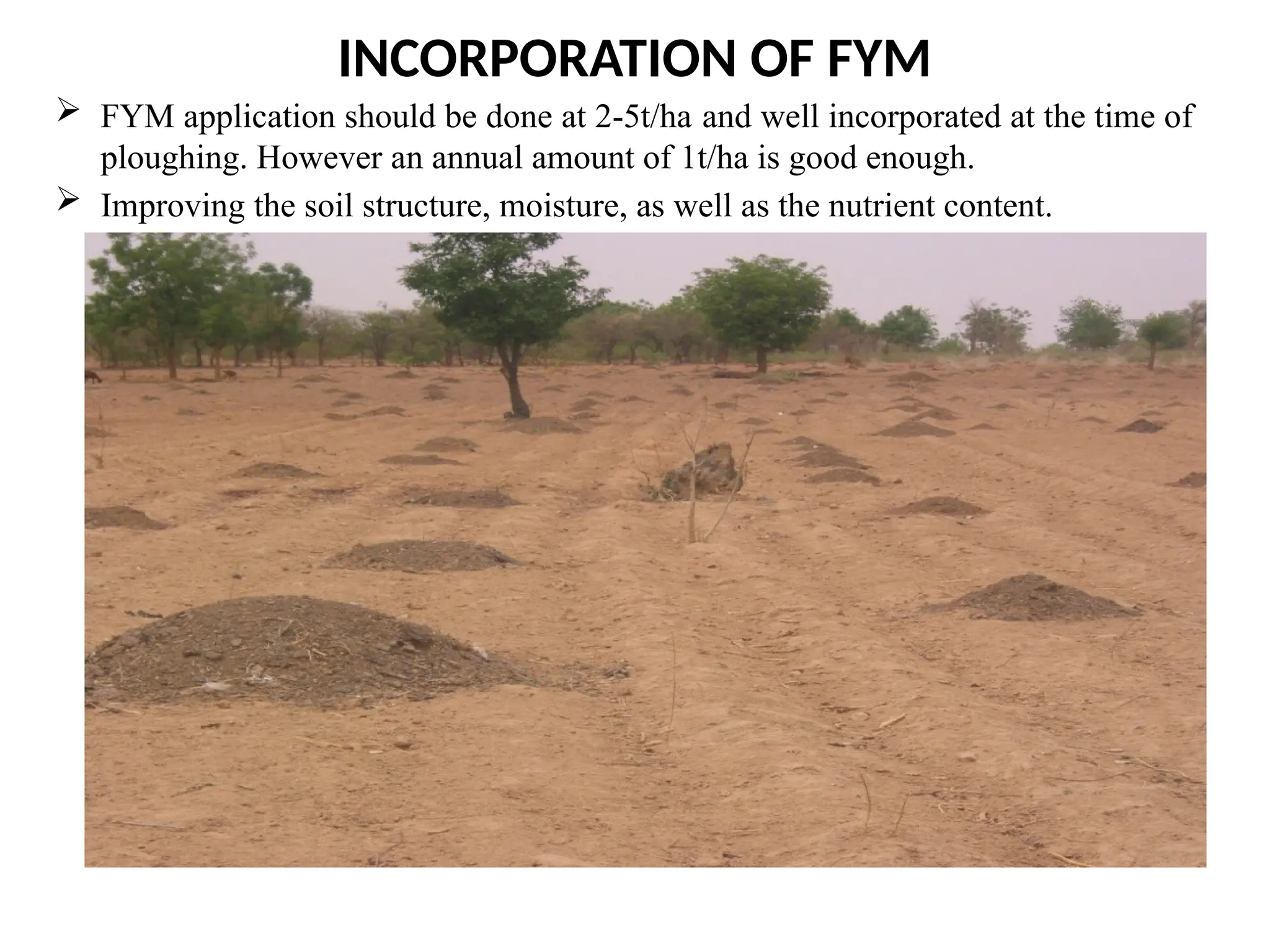
INCORPORATION OF FYM
 FYM application should be done at 2-5t/ha and well incorporated at the time of
ploughing. However an annual amount of 1t/ha is good enough.
 Improving the soil structure, moisture, as well as the nutrient content.
Application of INM Fertilizer
Development of an INM Programme
Three steps needed for the practical INM:
 Assess the nutrient status and needs of the system;
– soil nutrients.
– soil type and potential for proposed cropping.
– proposed cultivations.
 Establish an economic threshold;
– availability of inorganic amendments.
– cost of nutrient input (chemicals, manures, and labour).
– expected yield.
– potential financial return.
 Develop a nutrient management strategy;
– minimal inorganic chemical needs.
– nutrient supply from plant inputs.
– nutrient supply from animal inputs.
– nutrient inputs from other potential sources of nutrients.
INM vs IPNM
INM program
INM aims at improving and sustaining soil fertility and
Land productivity and reducing environmental
degradation.
Essential for the development of sustainable
agriculture and natural resource management.
IPNM Program
IPNM aims to optimize the condition of the soil, with
regard to its physical, chemical, biological and
hydrological properties,
 Enhancing productivity,
 Minimizing land degradation.
IPNM Include the Use of:
 Farmyard manures,
 Natural and mineral fertilizers,
 Soil amendments,
 Crop residues/farm wastes,
 Agroforestry and tillage practices,
 Green manures,
 Cover crops, legumes,
 Intercropping,
 Crop rotations,
 Fallows, irrigation, drainage,
 Vegetative measures designed to conserve both water and
soil.
Drip Irrigation
Integrated Plant Nutrient Management at Farm Level
Improved crop establishment at the beginning
of the rains,
 Increase protective ground cover thereby
reducing splash erosion,
Enhancing infiltration and biological activity;
Timely weeding to reduce crop yield losses
from competition for nutrients and soil
moisture;
Recycle farm wastes, so as to maintain and
enhance soil organic matter levels.
GAP for IPNM Nutrient Management
IPNM also contributes to pest management.
Stressed crops are more susceptible to disease and
to the effects of pest attacks.
Crops growing in poorly structured soil, under
unbalanced nutrient conditions with inadequate
water retention will be stressed.
Responding to disease and pest attacks by
improving the ecological conditions.
Agricultural products with less pesticides residues
are healthier to consume.
Healthy plants with a properly balanced nutrient
supply provide better quality feed and foodss.
Growing Vegetables on INM/IPNM Fertilizer in Sack/Bag
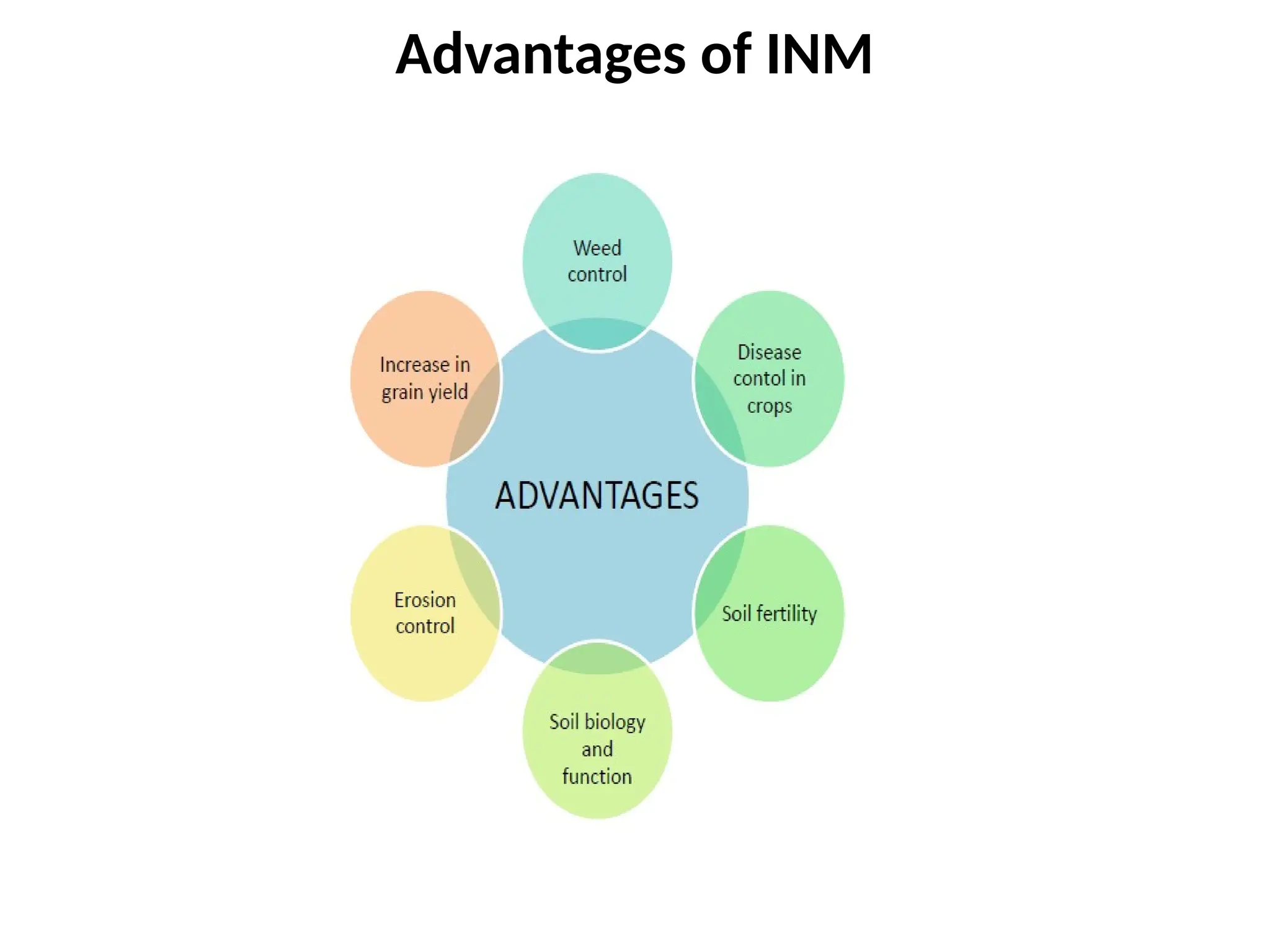
Advantages of INM
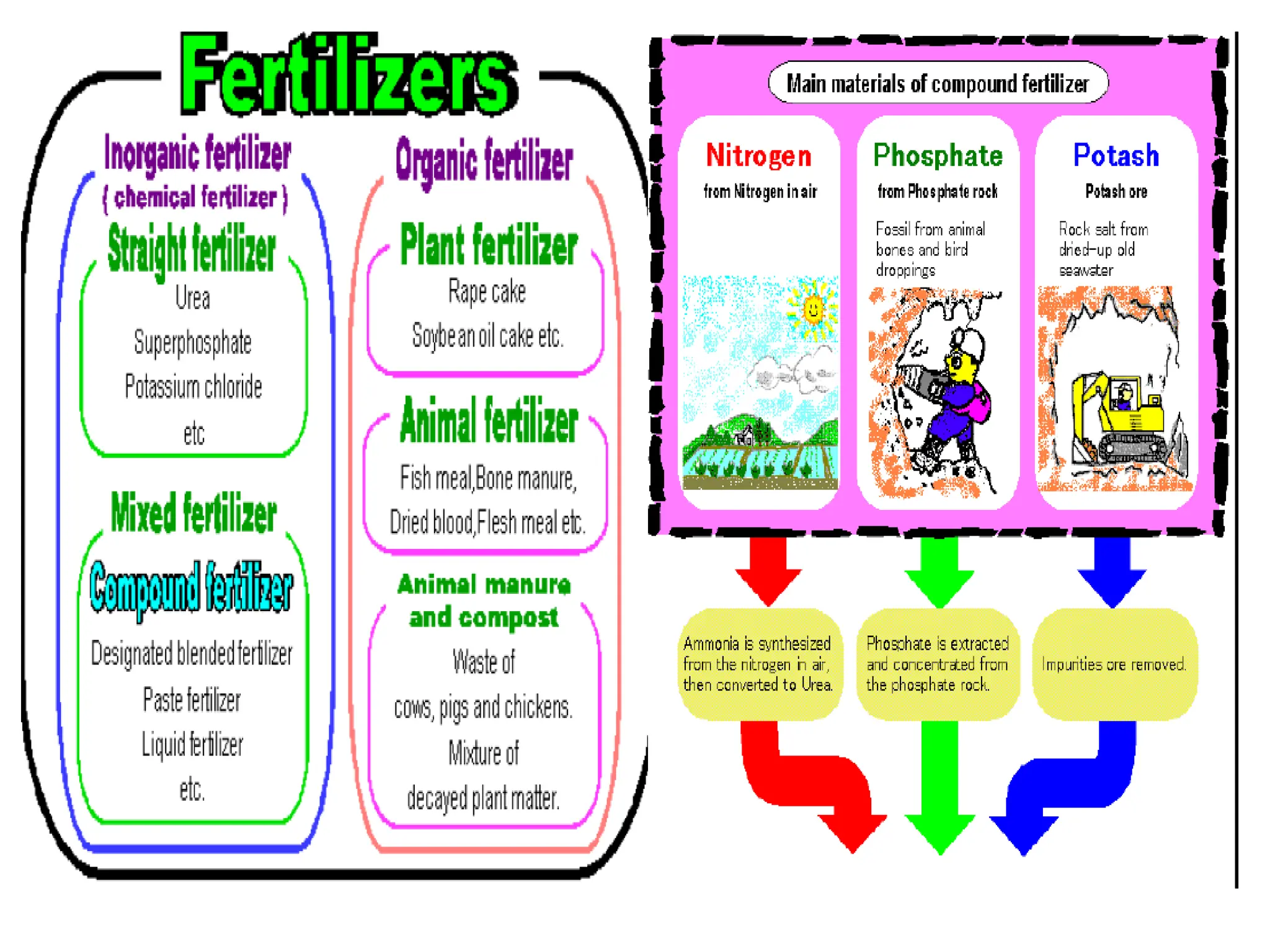
Form of INM Fertilizer
Components of Integrated Nutrient Management
Synthetic Fertilizers
Manures
Compost
Green Manures
Crop residues
Principles of Fertilizer Application
Once the choice of fertilizers has been made, The
selection of the best method of fertilizer application
depends on a number of factors
 The kind of soil.
Its moisture status.
 Its fixing power for the different nutrients.
Previous management.
The crop to be treated.
Its root development and the ability to extract
nutrients in the soil.
The kind and amount of fertilizer to be used.
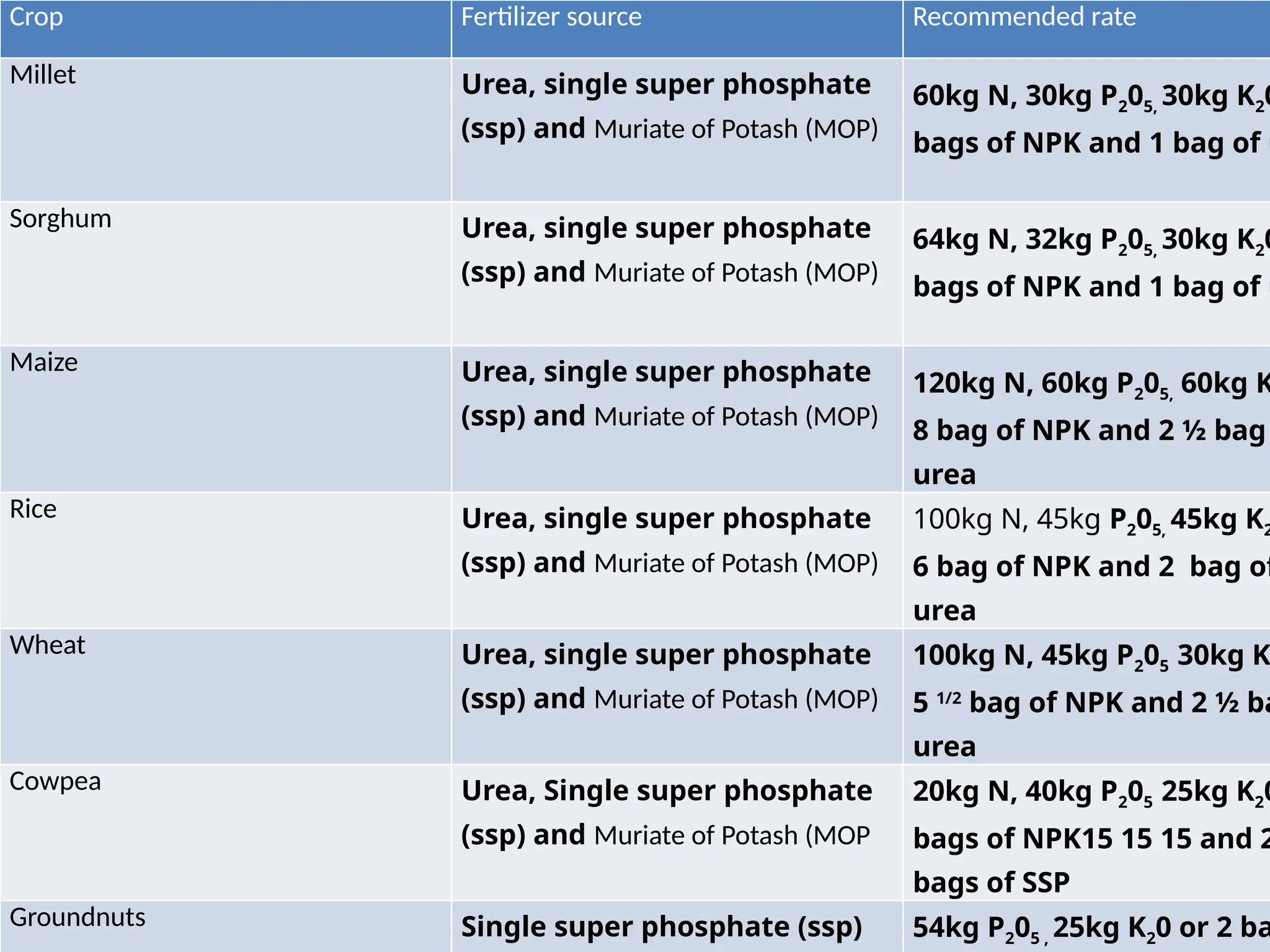
Crop Fertilizer source Recommended rate
Millet Urea, single super phosphate
(ssp) and Muriate of Potash (MOP)
60kg N, 30kg P205, 30kg K20
bags of NPK and 1 bag of u
Sorghum Urea, single super phosphate
(ssp) and Muriate of Potash (MOP)
64kg N, 32kg P205, 30kg K20
bags of NPK and 1 bag of u
Maize Urea, single super phosphate
(ssp) and Muriate of Potash (MOP)
120kg N, 60kg P205, 60kg K
8 bag of NPK and 2 ½ bag
urea
Rice Urea, single super phosphate
(ssp) and Muriate of Potash (MOP)
100kg N, 45kg P205, 45kg K2
6 bag of NPK and 2 bag of
urea
Wheat Urea, single super phosphate
(ssp) and Muriate of Potash (MOP)
100kg N, 45kg P205 30kg K
5 1/2
bag of NPK and 2 ½ ba
urea
Cowpea Urea, Single super phosphate
(ssp) and Muriate of Potash (MOP
20kg N, 40kg P205 25kg K20
bags of NPK15 15 15 and 2
bags of SSP
Groundnuts Single super phosphate (ssp) 54kg P205 , 25kg K20 or 2 ba
Conclusion
Production efficiencies are gained through the
integrated nutrient management practices;
promoting combined use of mineral, organic and
biological resources in a reasoned way to
balance efficient use of limited/finite resources
and ensure ecosystem sustainability against
nutrient mining and degradation of soil and
water resources.
Thank You for Your Attention

Integrated nutrient management for sustainable vegetable production

  • 1.
    Integrated Nutrient Managementfor Sustainable Crop Production By Prof. Dattijo Aminu Department of Crop Production University of Maiduguri 05th August, 2024
  • 2.
    Integrated Nutrient Management(INM) INM is a practice where all sources of nutrients are combined and applied to soils for crop growth and yield enhancement. INM keeps the soil in healthier condition. INM is the most rewarding benefits that occur when different technologies are combined. INM is an integral part of any sustainable agricultural system.
  • 3.
    How INM differsfrom conventional farming INM differs from conventional nutrient management in that it considers nutrients from different sources. In conventional farming, higher yield is considered through use of inorganic chemicals and improved varieties along with irrigation facilities. There is minimum nutrient losses. Applying the combination organic simultaneously, one hardly ever observes negative interactions.
  • 4.
    INCORPORATION OF FYM FYM application should be done at 2-5t/ha and well incorporated at the time of ploughing. However an annual amount of 1t/ha is good enough.  Improving the soil structure, moisture, as well as the nutrient content.
  • 5.
  • 6.
    Development of anINM Programme Three steps needed for the practical INM:  Assess the nutrient status and needs of the system; – soil nutrients. – soil type and potential for proposed cropping. – proposed cultivations.  Establish an economic threshold; – availability of inorganic amendments. – cost of nutrient input (chemicals, manures, and labour). – expected yield. – potential financial return.  Develop a nutrient management strategy; – minimal inorganic chemical needs. – nutrient supply from plant inputs. – nutrient supply from animal inputs. – nutrient inputs from other potential sources of nutrients.
  • 7.
    INM vs IPNM INMprogram INM aims at improving and sustaining soil fertility and Land productivity and reducing environmental degradation. Essential for the development of sustainable agriculture and natural resource management. IPNM Program IPNM aims to optimize the condition of the soil, with regard to its physical, chemical, biological and hydrological properties,  Enhancing productivity,  Minimizing land degradation.
  • 8.
    IPNM Include theUse of:  Farmyard manures,  Natural and mineral fertilizers,  Soil amendments,  Crop residues/farm wastes,  Agroforestry and tillage practices,  Green manures,  Cover crops, legumes,  Intercropping,  Crop rotations,  Fallows, irrigation, drainage,  Vegetative measures designed to conserve both water and soil.
  • 9.
  • 10.
    Integrated Plant NutrientManagement at Farm Level Improved crop establishment at the beginning of the rains,  Increase protective ground cover thereby reducing splash erosion, Enhancing infiltration and biological activity; Timely weeding to reduce crop yield losses from competition for nutrients and soil moisture; Recycle farm wastes, so as to maintain and enhance soil organic matter levels.
  • 11.
    GAP for IPNMNutrient Management IPNM also contributes to pest management. Stressed crops are more susceptible to disease and to the effects of pest attacks. Crops growing in poorly structured soil, under unbalanced nutrient conditions with inadequate water retention will be stressed. Responding to disease and pest attacks by improving the ecological conditions. Agricultural products with less pesticides residues are healthier to consume. Healthy plants with a properly balanced nutrient supply provide better quality feed and foodss.
  • 12.
    Growing Vegetables onINM/IPNM Fertilizer in Sack/Bag
  • 14.
  • 15.
    Form of INMFertilizer
  • 17.
    Components of IntegratedNutrient Management Synthetic Fertilizers Manures Compost Green Manures Crop residues
  • 30.
    Principles of FertilizerApplication Once the choice of fertilizers has been made, The selection of the best method of fertilizer application depends on a number of factors  The kind of soil. Its moisture status.  Its fixing power for the different nutrients. Previous management. The crop to be treated. Its root development and the ability to extract nutrients in the soil. The kind and amount of fertilizer to be used.
  • 31.
    Crop Fertilizer sourceRecommended rate Millet Urea, single super phosphate (ssp) and Muriate of Potash (MOP) 60kg N, 30kg P205, 30kg K20 bags of NPK and 1 bag of u Sorghum Urea, single super phosphate (ssp) and Muriate of Potash (MOP) 64kg N, 32kg P205, 30kg K20 bags of NPK and 1 bag of u Maize Urea, single super phosphate (ssp) and Muriate of Potash (MOP) 120kg N, 60kg P205, 60kg K 8 bag of NPK and 2 ½ bag urea Rice Urea, single super phosphate (ssp) and Muriate of Potash (MOP) 100kg N, 45kg P205, 45kg K2 6 bag of NPK and 2 bag of urea Wheat Urea, single super phosphate (ssp) and Muriate of Potash (MOP) 100kg N, 45kg P205 30kg K 5 1/2 bag of NPK and 2 ½ ba urea Cowpea Urea, Single super phosphate (ssp) and Muriate of Potash (MOP 20kg N, 40kg P205 25kg K20 bags of NPK15 15 15 and 2 bags of SSP Groundnuts Single super phosphate (ssp) 54kg P205 , 25kg K20 or 2 ba
  • 32.
    Conclusion Production efficiencies aregained through the integrated nutrient management practices; promoting combined use of mineral, organic and biological resources in a reasoned way to balance efficient use of limited/finite resources and ensure ecosystem sustainability against nutrient mining and degradation of soil and water resources.
  • 33.
    Thank You forYour Attention