
PHYSIOLOGICAL
DISORDERS OF
VEGETABLES
Presented By: Anshul Phaugat
181101049
Difference between Disease and disorder
■ DISEASE is the illness, having characteristics set of signs and
symptoms, caused by pathogens(virus, bacteria). Where changes in
biological functions occur. E.g.- Rust, Powdery Mildew etc.
■ DISORDER is the disturbance or disarrangement in the plant body
which affects the function of various physiological functions or body
these are due to internal factors like Genetically inherent or
deficiency of specific nutrient like .
Causes of Physiological Disorders
■ Caused by the lack or excess of something that supports life
or by the presence of something that interferes with life.
■ Occur with the absence of infectious agents therefore cannot
be transmitted.
■ Some important points:
– There is generally a clear line of demarcation from damaged
and undamaged tissue.
– Physiological disorders are serious in themselves but often
serve as the ‘open door’ for pathogens to enter
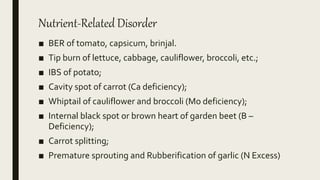
Nutrient-Related Disorder
■ BER of tomato, capsicum, brinjal.
■ Tip burn of lettuce, cabbage, cauliflower, broccoli, etc.;
■ IBS of potato;
■ Cavity spot of carrot (Ca deficiency);
■ Whiptail of cauliflower and broccoli (Mo deficiency);
■ Internal black spot or brown heart of garden beet (B –
Deficiency);
■ Carrot splitting;
■ Premature sprouting and Rubberification of garlic (N Excess)
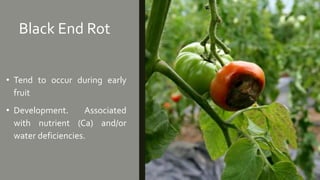
Black End Rot
• Tend to occur during early
fruit
• Development. Associated
with nutrient (Ca) and/or
water deficiencies.
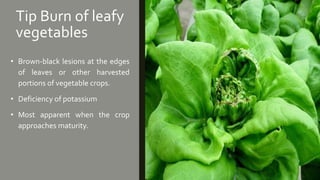
Tip Burn of leafy
vegetables
• Brown-black lesions at the edges
of leaves or other harvested
portions of vegetable crops.
• Deficiency of potassium
• Most apparent when the crop
approaches maturity.
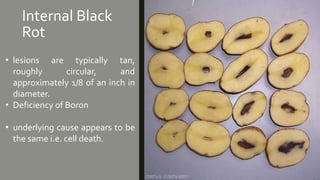
Internal Black
Rot
• lesions are typically tan,
roughly circular, and
approximately 1/8 of an inch in
diameter.
• Deficiency of Boron
• underlying cause appears to be
the same i.e. cell death.
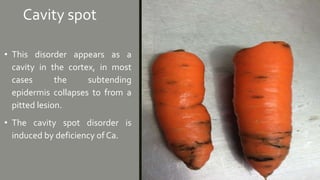
• This disorder appears as a
cavity in the cortex, in most
cases the subtending
epidermis collapses to from a
pitted lesion.
• The cavity spot disorder is
induced by deficiency of Ca.
Cavity spot
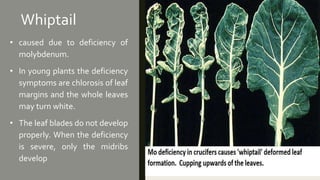
Whiptail
• caused due to deficiency of
molybdenum.
• In young plants the deficiency
symptoms are chlorosis of leaf
margins and the whole leaves
may turn white.
• The leaf blades do not develop
properly. When the deficiency
is severe, only the midribs
develop
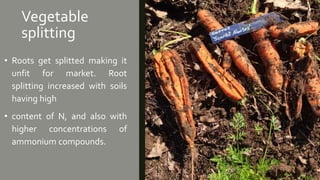
Vegetable
splitting
• Roots get splitted making it
unfit for market. Root
splitting increased with soils
having high
• content of N, and also with
higher concentrations of
ammonium compounds.
Storage-Related Disorders
■ Yellowing of cabbage;
■ Black leaf specks of cabbage,
■ Phenolic browning, bitterness and scaling or silvering of carrot;
■ Greening of potatoes and onions;
■ Sprouting of potatoes, onion and garlic;
■ Watery scales, translucent scales and freezing injury of garlic and onion;
■ Ammonia injury in onion;
■ Bitterness in pepper
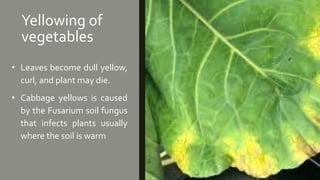
Yellowing of
vegetables
• Leaves become dull yellow,
curl, and plant may die.
• Cabbage yellows is caused
by the Fusarium soil fungus
that infects plants usually
where the soil is warm
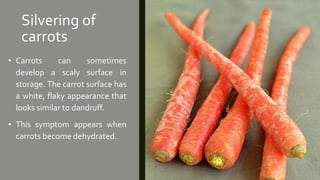
Silvering of
carrots
• Carrots can sometimes
develop a scaly surface in
storage. The carrot surface has
a white, flaky appearance that
looks similar to dandruff.
• This symptom appears when
carrots become dehydrated.
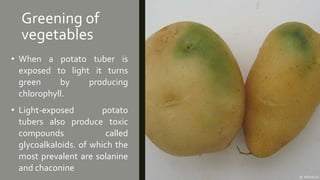
Greening of
vegetables
• When a potato tuber is
exposed to light it turns
green by producing
chlorophyll.
• Light-exposed potato
tubers also produce toxic
compounds called
glycoalkaloids. of which the
most prevalent are solanine
and chaconine
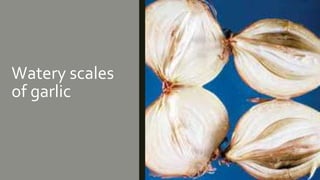
Watery scales
of garlic
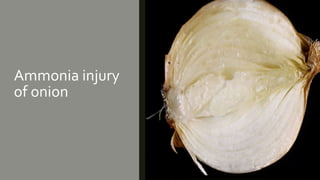
Ammonia injury
of onion
Growing Conditions and weather-Related Disorders
■ Root breakage and splitting of carrot;
■ Brown center and hollow heart of potato;
■ Growth cracking of potato and tomato;
■ Loose head of cabbage;
■ Elongated root or forking of radish and carrot;
■ Buttoning of broccoli and cauliflower;
■ Bolting of leafy and root vegetables;
■ Bracting of cauliflower;
■ Sunscald of tomatoes, capsicum, etc.(lycopene synthesis)
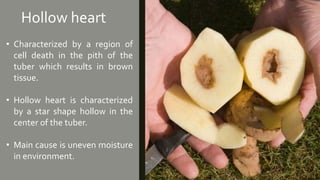
Hollow heart
• Characterized by a region of
cell death in the pith of the
tuber which results in brown
tissue.
• Hollow heart is characterized
by a star shape hollow in the
center of the tuber.
• Main cause is uneven moisture
in environment.
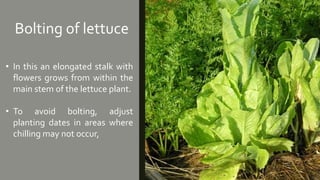
Bolting of lettuce
• In this an elongated stalk with
flowers grows from within the
main stem of the lettuce plant.
• To avoid bolting, adjust
planting dates in areas where
chilling may not occur,
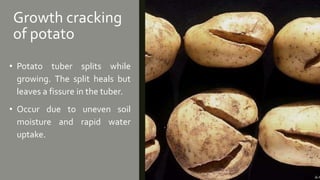
Growth cracking
of potato
• Potato tuber splits while
growing. The split heals but
leaves a fissure in the tuber.
• Occur due to uneven soil
moisture and rapid water
uptake.
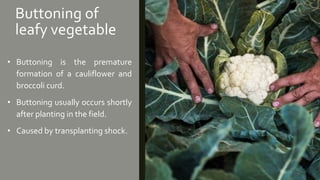
Buttoning of
leafy vegetable
• Buttoning is the premature
formation of a cauliflower and
broccoli curd.
• Buttoning usually occurs shortly
after planting in the field.
• Caused by transplanting shock.
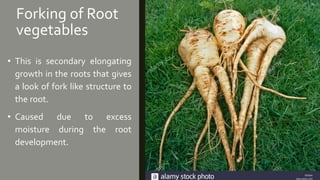
Forking of Root
vegetables
• This is secondary elongating
growth in the roots that gives
a look of fork like structure to
the root.
• Caused due to excess
moisture during the root
development.
Senescence-Related Disorders
■ Pore extent, pore development or pithiness of radish;
■ Cavity spot of carrot;
■ Premature sprouting of garlic bulbs
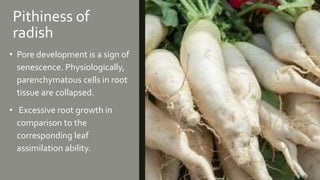
Pithiness of
radish
• Pore development is a sign of
senescence. Physiologically,
parenchymatous cells in root
tissue are collapsed.
• Excessive root growth in
comparison to the
corresponding leaf
assimilation ability.
THANK YOU

Physiological disorders of vegetables

  • 1.
  • 2.
    Difference between Diseaseand disorder ■ DISEASE is the illness, having characteristics set of signs and symptoms, caused by pathogens(virus, bacteria). Where changes in biological functions occur. E.g.- Rust, Powdery Mildew etc. ■ DISORDER is the disturbance or disarrangement in the plant body which affects the function of various physiological functions or body these are due to internal factors like Genetically inherent or deficiency of specific nutrient like .
  • 3.
    Causes of PhysiologicalDisorders ■ Caused by the lack or excess of something that supports life or by the presence of something that interferes with life. ■ Occur with the absence of infectious agents therefore cannot be transmitted. ■ Some important points: – There is generally a clear line of demarcation from damaged and undamaged tissue. – Physiological disorders are serious in themselves but often serve as the ‘open door’ for pathogens to enter
  • 4.
    Nutrient-Related Disorder ■ BERof tomato, capsicum, brinjal. ■ Tip burn of lettuce, cabbage, cauliflower, broccoli, etc.; ■ IBS of potato; ■ Cavity spot of carrot (Ca deficiency); ■ Whiptail of cauliflower and broccoli (Mo deficiency); ■ Internal black spot or brown heart of garden beet (B – Deficiency); ■ Carrot splitting; ■ Premature sprouting and Rubberification of garlic (N Excess)
  • 5.
    Black End Rot •Tend to occur during early fruit • Development. Associated with nutrient (Ca) and/or water deficiencies.
  • 6.
    Tip Burn ofleafy vegetables • Brown-black lesions at the edges of leaves or other harvested portions of vegetable crops. • Deficiency of potassium • Most apparent when the crop approaches maturity.
  • 7.
    Internal Black Rot • lesionsare typically tan, roughly circular, and approximately 1/8 of an inch in diameter. • Deficiency of Boron • underlying cause appears to be the same i.e. cell death.
  • 8.
    • This disorderappears as a cavity in the cortex, in most cases the subtending epidermis collapses to from a pitted lesion. • The cavity spot disorder is induced by deficiency of Ca. Cavity spot
  • 9.
    Whiptail • caused dueto deficiency of molybdenum. • In young plants the deficiency symptoms are chlorosis of leaf margins and the whole leaves may turn white. • The leaf blades do not develop properly. When the deficiency is severe, only the midribs develop
  • 10.
    Vegetable splitting • Roots getsplitted making it unfit for market. Root splitting increased with soils having high • content of N, and also with higher concentrations of ammonium compounds.
  • 11.
    Storage-Related Disorders ■ Yellowingof cabbage; ■ Black leaf specks of cabbage, ■ Phenolic browning, bitterness and scaling or silvering of carrot; ■ Greening of potatoes and onions; ■ Sprouting of potatoes, onion and garlic; ■ Watery scales, translucent scales and freezing injury of garlic and onion; ■ Ammonia injury in onion; ■ Bitterness in pepper
  • 12.
    Yellowing of vegetables • Leavesbecome dull yellow, curl, and plant may die. • Cabbage yellows is caused by the Fusarium soil fungus that infects plants usually where the soil is warm
  • 13.
    Silvering of carrots • Carrotscan sometimes develop a scaly surface in storage. The carrot surface has a white, flaky appearance that looks similar to dandruff. • This symptom appears when carrots become dehydrated.
  • 14.
    Greening of vegetables • Whena potato tuber is exposed to light it turns green by producing chlorophyll. • Light-exposed potato tubers also produce toxic compounds called glycoalkaloids. of which the most prevalent are solanine and chaconine
  • 15.
  • 16.
  • 17.
    Growing Conditions andweather-Related Disorders ■ Root breakage and splitting of carrot; ■ Brown center and hollow heart of potato; ■ Growth cracking of potato and tomato; ■ Loose head of cabbage; ■ Elongated root or forking of radish and carrot; ■ Buttoning of broccoli and cauliflower; ■ Bolting of leafy and root vegetables; ■ Bracting of cauliflower; ■ Sunscald of tomatoes, capsicum, etc.(lycopene synthesis)
  • 18.
    Hollow heart • Characterizedby a region of cell death in the pith of the tuber which results in brown tissue. • Hollow heart is characterized by a star shape hollow in the center of the tuber. • Main cause is uneven moisture in environment.
  • 19.
    Bolting of lettuce •In this an elongated stalk with flowers grows from within the main stem of the lettuce plant. • To avoid bolting, adjust planting dates in areas where chilling may not occur,
  • 20.
    Growth cracking of potato •Potato tuber splits while growing. The split heals but leaves a fissure in the tuber. • Occur due to uneven soil moisture and rapid water uptake.
  • 21.
    Buttoning of leafy vegetable •Buttoning is the premature formation of a cauliflower and broccoli curd. • Buttoning usually occurs shortly after planting in the field. • Caused by transplanting shock.
  • 22.
    Forking of Root vegetables •This is secondary elongating growth in the roots that gives a look of fork like structure to the root. • Caused due to excess moisture during the root development.
  • 23.
    Senescence-Related Disorders ■ Poreextent, pore development or pithiness of radish; ■ Cavity spot of carrot; ■ Premature sprouting of garlic bulbs
  • 24.
    Pithiness of radish • Poredevelopment is a sign of senescence. Physiologically, parenchymatous cells in root tissue are collapsed. • Excessive root growth in comparison to the corresponding leaf assimilation ability.
  • 25.