NCDEX
“ OPPORTUNITIES IN COMMODITIES
MARKET”
IARI – 8th January 2013
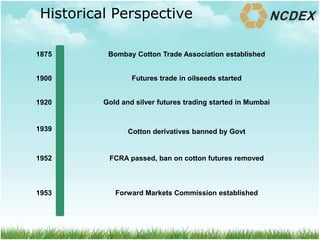
Historical Perspective
Forward Markets Commission established1953
FCRA passed, ban on cotton futures removed1952
Cotton derivatives banned by Govt1939
Gold and silver futures trading started in Mumbai1920
Futures trade in oilseeds started1900
Bombay Cotton Trade Association established1875
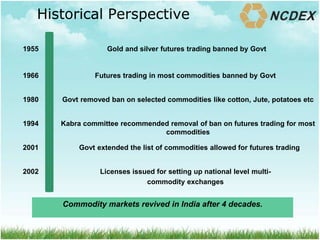
Historical Perspective
Govt extended the list of commodities allowed for futures trading2001
Kabra committee recommended removal of ban on futures trading for most
commodities
1994
Govt removed ban on selected commodities like cotton, Jute, potatoes etc1980
Futures trading in most commodities banned by Govt1966
Gold and silver futures trading banned by Govt1955
Commodity markets revived in India after 4 decades.
2002 Licenses issued for setting up national level multi-
commodity exchanges
4
Regulatory Structure in India
Banking /
NBFCs
RBI
Ministry of Finance
SEBI
Capital
Markets
NABARD
Co-operative Banks &
Regional Rural Banks
Ministry of Consumer
Affairs
FMC
Commodity
Exchanges
Insurance Regulatory
Development Authority
(IRDA)
Insurance
Pension
Funds
SIDBI
State Financial
Institutions
National
Housing Bank
Housing Finance
Companies
Company
Law Board
Corporates
Pension Funds Regulatory
Development Authority
(PFRDA)
Banking /
NBFCs
RBI
Ministry of Finance
SEBI
Capital
Markets
NABARD
Co-operative Banks &
Regional Rural Banks
Ministry of Consumer
Affairs
FMC
Commodity
Exchanges
Insurance Regulatory
Development Authority
(IRDA)
Insurance
Pension
Funds
SIDBI
State Financial
Institutions
National
Housing Bank
Housing Finance
Companies
Company
Law Board
Corporates
Pension Funds Regulatory
Development Authority
(PFRDA)
NCD
EX
5
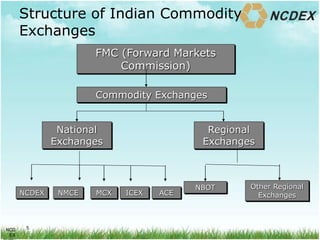
Structure of Indian Commodity
Exchanges
Other Regional
ExchangesNMCE
Commodity Exchanges
ICEX
National
Exchanges
Regional
Exchanges
FMC (Forward Markets
Commission)
NBOT
NCDEX MCX ACE
Objectives of an Exchange
 Platform for fair price discovery through: Wide
participation
 Real time information dissemination
 Platform for price risk management
 Exchange neutral to process of price discovery
 Ensure orderly functioning of markets through:
Various Checks & Controls
NCD
EX
7
Futures
 A futures contract is essentially an exchange-traded
version of a forward contract
 It is an agreement to buy or sell a specified quantity in
a designated future month at a price agreed upon by
the buyer and the seller
 Terms of each contract are “standardized” in a legal
document called the “contract specification”
 Types of futures contracts:
 Commodity futures
 Financial futures
 Index futures
8
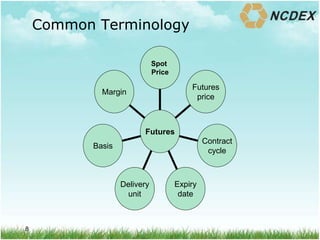
Common Terminology
Margin
Basis
Delivery
unit
Expiry
date
Contract
cycle
Futures
price
Spot
Price
Futures
How are commodities traded?
 Futures – Commodity futures are traded on an Exchange
platform
 National Commodity & Derivatives Exchange (NCDEX)
 Multi Commodity Exchange (MCX)
 National Multi Commodity Exchange (NMCE)
 Indian Commodity Exchange (ICEX)
 ACE Commodity Exchange
 Options – Lower risk for market participants, approval
awaited for the FCRA Amendment Bill
10
Indian Agriculture
 Commodities valued at 33% of GDP
 ~14% of GDP from Agriculture
 India ranks second worldwide in farm output
 Farm based economy, particularly in rural areas
 Agro-based industries – Textile, Paper, Starch, Poultry,
Food Processing, Oil Extraction, Beverages, Alcohols and
Spirits etc.
 Derivatives of above industries serve a wider range of
enterprises and industries
 Indian agriculture continues to provide livelihood to more
than 60% of population, directly and indirectly
 Consumption is one of the key drivers of Indian economy
About NCDEX
 Owned by distinguished national and global entities
 The shareholders bring with them expertise in areas of
agriculture, banking with focus on rural finance,
commodity and stock markets, physical markets,
investment banking and institution building
 Demutualised- the Exchange is professionally managed
and neither Directors nor management have any vested
interest in trading on the Exchange
Stake Holders
Sr. No. Name % of
total
1. Jaypee Capital 22.38
2. Shree Renuka Sugars 12.50
3. National Stock Exchange of India Limited (NSE) 11.1
4. Life Insurance Corporation of India (LIC) 11.1
5. National Bank for Agriculture and Rural Development
(NABARD)
11.1
6. Indian Farmers Fertiliser Cooperative Ltd (IFFCO) 8.88
7. Punjab National Bank (PNB) 7.29
8. Canara Bank 6.03
9. CRISIL Ltd 3.70
10. InterContinental Exchange (ICE) 2.96
11 Goldman Sachs Investments (Mauritius) I Limited 2.96
Total 100
NCDEX Profile
Exchange
architecture
is
vast
and dynamic
Products
Members
Terminals
Accredited
Warehouses
Clearing banks
57 (Included agri, bullion
polymers, energy, metals)
~20,000 in ~700 centers
569 with 2.0 MNT capacity
15
900 Members and
over 7 lack clients
NCDEX – Complete exchange
Agri, 39
Base Metal, 5
Precious
Metal, 6
Energy, 4
Ferrous Metal,
1
Market Share – Agri. Commodities
NCDEX
MCX
Other
Exchange Share (%)
NCDEX 83.0
MCX 12.0
Others 5.0
100
Commodities traded
Guar Seed &
Guar Gum
Other s
Bullion
Metal
Energy
Oil
& Oil Seed
Pulses
Spices
NCDEX
NCDEX Products
Spices Oil and Oilseeds Metals
Pepper Castor Seed Steel
Chilli RM Seed Copper
Jeera Cotton Seed Oilcake Zinc
Turmeric Soy Bean Aluminium
Coriander Refined Soy Oil Nickel
Cereals RBD Palmolein Lead
Wheat Plantation Products Energy
Barley Rubber Crude Oil
Maize (Feed/Industrial Grade) Fibres Heating Oil
Pulses Shankar Kapas Thermal Coal
Chana V -797 Kapas Brent Crude Oil
Others Others Natural Gas
Guar Seed Polyvinyl Chloride Gasoline
Potato CER Others
Mentha Oil Precious Metals Polyvinyl Chloride
Guar Gum Gold CER
Sugar Silver
Gur Platinum
Almond
NCD
EX
17
Annualized Returns: An Eye Opener
Returns were calculated on spot prices over a period of one year Aug11-Aug12
Stock position of commodities at NCDEX accredited warehouses as on 24 May 2012.
BARLEY - 41573 MT
CASTOR SEEDS - 23258 MT
CHANA - 77193 MT
CHILLI - 8130 MT
CORIANDER - 16784 MT
COTTON SEED OIL CAKE - 118300 MT
GOLD - 5 KGS
GOLD 100 GMS - 1200 GMS
GUAR - 43545MT
GUAR GUM - 8388 MT
JEERA - 11131 MT
MAIZE - 8497MT
PEPPER - 1327 MT
POTATO - 1160 MT
RAPESEED MUSTARD - 132702 MT
SILVER - 4979 KGS
STEEL LONG - 3013 MT
SUGAR - 6188 MT
TURMERIC - 6636 MT
WHEAT - 10367 MT
TOTAL DEPOSITS IN EXCESS OF 5 LAC MT
Strengths of NCDEX
 Credibility and respect in the market
 Have been the preferred exchange for trading in
agricultural commodities
 Have set benchmark prices for several commodities
 Have a strong, professionally managed board. Directors
have domain expertise in various fields
 Management team comprises a team of well qualified
and experienced members
 Neither the management nor employees have any
investment in commodity futures assuring neutrality
21
Physical Delivery Logic
 Intention Matching
 Compulsory Delivery
 Sellers option
 Staggered delivery
22
Intention Matching
 In case of Intention matching, request from both the buyers
and sellers are sought
 The Intentions should match for
 Quantity – only the minimum quantity of the request will
be matched &
 Warehouse Location
 If the intentions do not match both the
request are cash settled with the final
settlement price
23
Compulsory Delivery
 In case of compulsory delivery all the open position on the
expiry needs to be settled through physical delivery
 Sellers need to deliver
 Buyers need to accept the delivery
24
Sellers Option
 In case of sellers option the seller can opt to deliver at the
warehouse location of his choice
 Seller has the following options
 Warehouse Location
 Quantity
 The buyer can give the intention for preferential warehouse
 The buyer is not guaranteed of delivery at the warehouse
given as preference if there are no sellers available from that
particular location
25
Staggered delivery
 The tender period shall start on 5th of every month in which
the contract is due to expire.
 In case 5th happens to be a Saturday, Sunday or a holiday
then the tender period will start from the next working day.
 Seller shall have an option of marking an intention of delivery
on any day during tender period up to expiry of contract and
corresponding buyer matched by the allocation process put in
place by the exchange will have to take the delivery on T+2
day from the delivery centre where the seller has delivered
the commodity.
 The settlement price for any delivery allocation during the
staggered period( i.e. up to one day prior to expiry) would be
the last available spot price displayed by the exchange.
NCD
EX
26
Contract Specification - RMSEED
Parameters Details
Basis Ex-warehouse Jaipur(exclusive of VAT/sales tax)
Additional Delivery
centers
Alwar, Kota, Sri Ganganagar, Hapur, Bikaner & Agra
Unit of trading 10 MT
Delivery unit 10 MT
Quatation Rs per quintal
Tick size Re 1
Contract Specification - RMSEED
NCD
EX
27
Parameters Details
Quantity Variation +/- 2%
Delivery Logic Compulsory Delivery
Price Limit (+/-) 3% (+ / -) 1%
Position Limits Member-wise: 75,000 MT
Client-wise : 15,000 MT
For near month contracts :
Member: 21,000 MT
Client: 4,200 MT
Contract Specification - RMSEED
NCD
EX
28
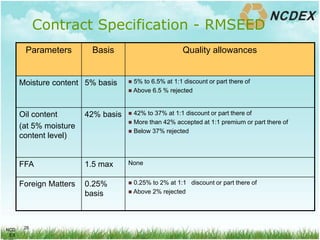
Parameters Basis Quality allowances
Moisture content 5% basis  5% to 6.5% at 1:1 discount or part there of
 Above 6.5 % rejected
Oil content
(at 5% moisture
content level)
42% basis  42% to 37% at 1:1 discount or part there of
 More than 42% accepted at 1:1 premium or part there of
 Below 37% rejected
FFA 1.5 max None
Foreign Matters 0.25%
basis
 0.25% to 2% at 1:1 discount or part there of
 Above 2% rejected
Precautions
 Trade through registered members only
 Learn the fundamentals of the commodity yourself,
before taking positions
 Study large research reports
 Thoroughly read contract specs and product note of the
commodity you trade in
 Use stop-losses to limit your losses and trailing stop-
losses to protect your profits
 Do not misuse margin leverage
Trading Strategies
Trading on NCDEX Platform
1. Hedging
2. Speculation/ Investors
3. Arbitrage
4. Spread trading
Market Participants
 Hedgers(Farmers,Processors)
 Face risk associated with the price of an asset
 Use futures market to reduce a particular risk they
face
 Lock in a price using derivatives
 Speculators
 Wish to bet on future movements in the price of an
asset
 Derivatives offer them leverage
 Arbitragers
 Take advantage of discrepancy between prices of the
same product across different markets
 Eg. Futures price and spot price
Hedgers
 Usually people related to physical markets
 They use it as a tool to hedge against price risk
 Sole objective is to “Lock-into” a price, which they
consider to be their “Optimum price”
Arbitragers
 Spot Price + Cost of Carry + Interest on Capital =
Futures Price
 Any deviation from this provides an opportunity for
Arbitrage
 Arbitragers take advantage of the price difference between
contracts of two different months of the same commodity,
or two different markets.
 Two types of Arbitrage:
 Cash and Carry
 Calendar Spread
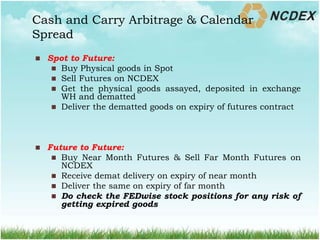
Cash and Carry Arbitrage & Calendar
Spread
 Spot to Future:
 Buy Physical goods in Spot
 Sell Futures on NCDEX
 Get the physical goods assayed, deposited in exchange
WH and dematted
 Deliver the dematted goods on expiry of futures contract
 Future to Future:
 Buy Near Month Futures & Sell Far Month Futures on
NCDEX
 Receive demat delivery on expiry of near month
 Deliver the same on expiry of far month
 Do check the FEDwise stock positions for any risk of
getting expired goods
Arbitrage
 Buying in spot, selling on futures and giving
deliveries
 Example:
 Spot price of soya bean = Rs.2500/quintal
 Cost of carry (1 month, incl. warehousing,
assaying, demat charges, interest cost etc.) =
Rs.60/qunital
 Near month soya bean price = Rs.2600/quintal
 Profit = 2600-(2500+60) = Rs.40/quintal
 Profit % = Rs.1.56% per month
36
Spreads
 Spread - Spread is the difference between
prices of two futures contracts of the same
underlying commodity.
 Calendar Spread - Buying a futures contract
in one month and selling in a different month
for the same commodity.
37
Why are Spreads
 Cost of Carry - The cost of carry of a
commodity is the sum of all the costs
including interest (financing costs), insurance,
storage costs and other miscellaneous costs.
Usually the price of a commodity future in the
exchange is the spot prices plus cost of carry.
 Future expectations - Expected
increase/decrease in prices due to reasons like
fresh arrivals, rainfall, government
interventions, prices of substitutes , short
term demand/supply.
38
Spread Margin
 It is half of the margin on the higher side of
the spread position.
 Spread margin does not include special
margin, cash margin or additional margin.
39
Type Of Spreads
 Bull Spread: Buying the near month
futures contract and simultaneously selling
the far month futures contract.
 Bear Spread: Selling the near month
futures and buying the far month contract
40
Things that an Investor/ Speculator should
study first
 Crop Cycle
 Domestic Production/ Consumption Scenario
 Export & Import Policies
 Trade Dynamics
 International Price Linkages
 Open Interest
 FED Stocks in Exchange WHs/ Info on website
N-charts
42
 Kanhaiya Jha 09350274983
 Gaurav Middha 09711159060
 Customer Care
askus@ncdex.com
022-6640 6609-13

Ncdex

  • 1.
    NCDEX “ OPPORTUNITIES INCOMMODITIES MARKET” IARI – 8th January 2013
  • 2.
    Historical Perspective Forward MarketsCommission established1953 FCRA passed, ban on cotton futures removed1952 Cotton derivatives banned by Govt1939 Gold and silver futures trading started in Mumbai1920 Futures trade in oilseeds started1900 Bombay Cotton Trade Association established1875
  • 3.
    Historical Perspective Govt extendedthe list of commodities allowed for futures trading2001 Kabra committee recommended removal of ban on futures trading for most commodities 1994 Govt removed ban on selected commodities like cotton, Jute, potatoes etc1980 Futures trading in most commodities banned by Govt1966 Gold and silver futures trading banned by Govt1955 Commodity markets revived in India after 4 decades. 2002 Licenses issued for setting up national level multi- commodity exchanges
  • 4.
    4 Regulatory Structure inIndia Banking / NBFCs RBI Ministry of Finance SEBI Capital Markets NABARD Co-operative Banks & Regional Rural Banks Ministry of Consumer Affairs FMC Commodity Exchanges Insurance Regulatory Development Authority (IRDA) Insurance Pension Funds SIDBI State Financial Institutions National Housing Bank Housing Finance Companies Company Law Board Corporates Pension Funds Regulatory Development Authority (PFRDA) Banking / NBFCs RBI Ministry of Finance SEBI Capital Markets NABARD Co-operative Banks & Regional Rural Banks Ministry of Consumer Affairs FMC Commodity Exchanges Insurance Regulatory Development Authority (IRDA) Insurance Pension Funds SIDBI State Financial Institutions National Housing Bank Housing Finance Companies Company Law Board Corporates Pension Funds Regulatory Development Authority (PFRDA)
  • 5.
    NCD EX 5 Structure of IndianCommodity Exchanges Other Regional ExchangesNMCE Commodity Exchanges ICEX National Exchanges Regional Exchanges FMC (Forward Markets Commission) NBOT NCDEX MCX ACE
  • 6.
    Objectives of anExchange  Platform for fair price discovery through: Wide participation  Real time information dissemination  Platform for price risk management  Exchange neutral to process of price discovery  Ensure orderly functioning of markets through: Various Checks & Controls
  • 7.
    NCD EX 7 Futures  A futurescontract is essentially an exchange-traded version of a forward contract  It is an agreement to buy or sell a specified quantity in a designated future month at a price agreed upon by the buyer and the seller  Terms of each contract are “standardized” in a legal document called the “contract specification”  Types of futures contracts:  Commodity futures  Financial futures  Index futures
  • 8.
  • 9.
    How are commoditiestraded?  Futures – Commodity futures are traded on an Exchange platform  National Commodity & Derivatives Exchange (NCDEX)  Multi Commodity Exchange (MCX)  National Multi Commodity Exchange (NMCE)  Indian Commodity Exchange (ICEX)  ACE Commodity Exchange  Options – Lower risk for market participants, approval awaited for the FCRA Amendment Bill
  • 10.
    10 Indian Agriculture  Commoditiesvalued at 33% of GDP  ~14% of GDP from Agriculture  India ranks second worldwide in farm output  Farm based economy, particularly in rural areas  Agro-based industries – Textile, Paper, Starch, Poultry, Food Processing, Oil Extraction, Beverages, Alcohols and Spirits etc.  Derivatives of above industries serve a wider range of enterprises and industries  Indian agriculture continues to provide livelihood to more than 60% of population, directly and indirectly  Consumption is one of the key drivers of Indian economy
  • 11.
    About NCDEX  Ownedby distinguished national and global entities  The shareholders bring with them expertise in areas of agriculture, banking with focus on rural finance, commodity and stock markets, physical markets, investment banking and institution building  Demutualised- the Exchange is professionally managed and neither Directors nor management have any vested interest in trading on the Exchange
  • 12.
    Stake Holders Sr. No.Name % of total 1. Jaypee Capital 22.38 2. Shree Renuka Sugars 12.50 3. National Stock Exchange of India Limited (NSE) 11.1 4. Life Insurance Corporation of India (LIC) 11.1 5. National Bank for Agriculture and Rural Development (NABARD) 11.1 6. Indian Farmers Fertiliser Cooperative Ltd (IFFCO) 8.88 7. Punjab National Bank (PNB) 7.29 8. Canara Bank 6.03 9. CRISIL Ltd 3.70 10. InterContinental Exchange (ICE) 2.96 11 Goldman Sachs Investments (Mauritius) I Limited 2.96 Total 100
  • 13.
    NCDEX Profile Exchange architecture is vast and dynamic Products Members Terminals Accredited Warehouses Clearingbanks 57 (Included agri, bullion polymers, energy, metals) ~20,000 in ~700 centers 569 with 2.0 MNT capacity 15 900 Members and over 7 lack clients
  • 14.
    NCDEX – Completeexchange Agri, 39 Base Metal, 5 Precious Metal, 6 Energy, 4 Ferrous Metal, 1
  • 15.
    Market Share –Agri. Commodities NCDEX MCX Other Exchange Share (%) NCDEX 83.0 MCX 12.0 Others 5.0 100
  • 16.
    Commodities traded Guar Seed& Guar Gum Other s Bullion Metal Energy Oil & Oil Seed Pulses Spices NCDEX
  • 17.
    NCDEX Products Spices Oiland Oilseeds Metals Pepper Castor Seed Steel Chilli RM Seed Copper Jeera Cotton Seed Oilcake Zinc Turmeric Soy Bean Aluminium Coriander Refined Soy Oil Nickel Cereals RBD Palmolein Lead Wheat Plantation Products Energy Barley Rubber Crude Oil Maize (Feed/Industrial Grade) Fibres Heating Oil Pulses Shankar Kapas Thermal Coal Chana V -797 Kapas Brent Crude Oil Others Others Natural Gas Guar Seed Polyvinyl Chloride Gasoline Potato CER Others Mentha Oil Precious Metals Polyvinyl Chloride Guar Gum Gold CER Sugar Silver Gur Platinum Almond NCD EX 17
  • 18.
    Annualized Returns: AnEye Opener Returns were calculated on spot prices over a period of one year Aug11-Aug12
  • 19.
    Stock position ofcommodities at NCDEX accredited warehouses as on 24 May 2012. BARLEY - 41573 MT CASTOR SEEDS - 23258 MT CHANA - 77193 MT CHILLI - 8130 MT CORIANDER - 16784 MT COTTON SEED OIL CAKE - 118300 MT GOLD - 5 KGS GOLD 100 GMS - 1200 GMS GUAR - 43545MT GUAR GUM - 8388 MT JEERA - 11131 MT MAIZE - 8497MT PEPPER - 1327 MT POTATO - 1160 MT RAPESEED MUSTARD - 132702 MT SILVER - 4979 KGS STEEL LONG - 3013 MT SUGAR - 6188 MT TURMERIC - 6636 MT WHEAT - 10367 MT TOTAL DEPOSITS IN EXCESS OF 5 LAC MT
  • 20.
    Strengths of NCDEX Credibility and respect in the market  Have been the preferred exchange for trading in agricultural commodities  Have set benchmark prices for several commodities  Have a strong, professionally managed board. Directors have domain expertise in various fields  Management team comprises a team of well qualified and experienced members  Neither the management nor employees have any investment in commodity futures assuring neutrality
  • 21.
    21 Physical Delivery Logic Intention Matching  Compulsory Delivery  Sellers option  Staggered delivery
  • 22.
    22 Intention Matching  Incase of Intention matching, request from both the buyers and sellers are sought  The Intentions should match for  Quantity – only the minimum quantity of the request will be matched &  Warehouse Location  If the intentions do not match both the request are cash settled with the final settlement price
  • 23.
    23 Compulsory Delivery  Incase of compulsory delivery all the open position on the expiry needs to be settled through physical delivery  Sellers need to deliver  Buyers need to accept the delivery
  • 24.
    24 Sellers Option  Incase of sellers option the seller can opt to deliver at the warehouse location of his choice  Seller has the following options  Warehouse Location  Quantity  The buyer can give the intention for preferential warehouse  The buyer is not guaranteed of delivery at the warehouse given as preference if there are no sellers available from that particular location
  • 25.
    25 Staggered delivery  Thetender period shall start on 5th of every month in which the contract is due to expire.  In case 5th happens to be a Saturday, Sunday or a holiday then the tender period will start from the next working day.  Seller shall have an option of marking an intention of delivery on any day during tender period up to expiry of contract and corresponding buyer matched by the allocation process put in place by the exchange will have to take the delivery on T+2 day from the delivery centre where the seller has delivered the commodity.  The settlement price for any delivery allocation during the staggered period( i.e. up to one day prior to expiry) would be the last available spot price displayed by the exchange.
  • 26.
    NCD EX 26 Contract Specification -RMSEED Parameters Details Basis Ex-warehouse Jaipur(exclusive of VAT/sales tax) Additional Delivery centers Alwar, Kota, Sri Ganganagar, Hapur, Bikaner & Agra Unit of trading 10 MT Delivery unit 10 MT Quatation Rs per quintal Tick size Re 1
  • 27.
    Contract Specification -RMSEED NCD EX 27 Parameters Details Quantity Variation +/- 2% Delivery Logic Compulsory Delivery Price Limit (+/-) 3% (+ / -) 1% Position Limits Member-wise: 75,000 MT Client-wise : 15,000 MT For near month contracts : Member: 21,000 MT Client: 4,200 MT
  • 28.
    Contract Specification -RMSEED NCD EX 28 Parameters Basis Quality allowances Moisture content 5% basis  5% to 6.5% at 1:1 discount or part there of  Above 6.5 % rejected Oil content (at 5% moisture content level) 42% basis  42% to 37% at 1:1 discount or part there of  More than 42% accepted at 1:1 premium or part there of  Below 37% rejected FFA 1.5 max None Foreign Matters 0.25% basis  0.25% to 2% at 1:1 discount or part there of  Above 2% rejected
  • 29.
    Precautions  Trade throughregistered members only  Learn the fundamentals of the commodity yourself, before taking positions  Study large research reports  Thoroughly read contract specs and product note of the commodity you trade in  Use stop-losses to limit your losses and trailing stop- losses to protect your profits  Do not misuse margin leverage
  • 30.
  • 31.
    Trading on NCDEXPlatform 1. Hedging 2. Speculation/ Investors 3. Arbitrage 4. Spread trading
  • 32.
    Market Participants  Hedgers(Farmers,Processors) Face risk associated with the price of an asset  Use futures market to reduce a particular risk they face  Lock in a price using derivatives  Speculators  Wish to bet on future movements in the price of an asset  Derivatives offer them leverage  Arbitragers  Take advantage of discrepancy between prices of the same product across different markets  Eg. Futures price and spot price
  • 33.
    Hedgers  Usually peoplerelated to physical markets  They use it as a tool to hedge against price risk  Sole objective is to “Lock-into” a price, which they consider to be their “Optimum price”
  • 34.
    Arbitragers  Spot Price+ Cost of Carry + Interest on Capital = Futures Price  Any deviation from this provides an opportunity for Arbitrage  Arbitragers take advantage of the price difference between contracts of two different months of the same commodity, or two different markets.  Two types of Arbitrage:  Cash and Carry  Calendar Spread
  • 35.
    Cash and CarryArbitrage & Calendar Spread  Spot to Future:  Buy Physical goods in Spot  Sell Futures on NCDEX  Get the physical goods assayed, deposited in exchange WH and dematted  Deliver the dematted goods on expiry of futures contract  Future to Future:  Buy Near Month Futures & Sell Far Month Futures on NCDEX  Receive demat delivery on expiry of near month  Deliver the same on expiry of far month  Do check the FEDwise stock positions for any risk of getting expired goods
  • 36.
    Arbitrage  Buying inspot, selling on futures and giving deliveries  Example:  Spot price of soya bean = Rs.2500/quintal  Cost of carry (1 month, incl. warehousing, assaying, demat charges, interest cost etc.) = Rs.60/qunital  Near month soya bean price = Rs.2600/quintal  Profit = 2600-(2500+60) = Rs.40/quintal  Profit % = Rs.1.56% per month 36
  • 37.
    Spreads  Spread -Spread is the difference between prices of two futures contracts of the same underlying commodity.  Calendar Spread - Buying a futures contract in one month and selling in a different month for the same commodity. 37
  • 38.
    Why are Spreads Cost of Carry - The cost of carry of a commodity is the sum of all the costs including interest (financing costs), insurance, storage costs and other miscellaneous costs. Usually the price of a commodity future in the exchange is the spot prices plus cost of carry.  Future expectations - Expected increase/decrease in prices due to reasons like fresh arrivals, rainfall, government interventions, prices of substitutes , short term demand/supply. 38
  • 39.
    Spread Margin  Itis half of the margin on the higher side of the spread position.  Spread margin does not include special margin, cash margin or additional margin. 39
  • 40.
    Type Of Spreads Bull Spread: Buying the near month futures contract and simultaneously selling the far month futures contract.  Bear Spread: Selling the near month futures and buying the far month contract 40
  • 41.
    Things that anInvestor/ Speculator should study first  Crop Cycle  Domestic Production/ Consumption Scenario  Export & Import Policies  Trade Dynamics  International Price Linkages  Open Interest  FED Stocks in Exchange WHs/ Info on website
  • 42.
  • 43.
     Kanhaiya Jha09350274983  Gaurav Middha 09711159060  Customer Care askus@ncdex.com 022-6640 6609-13