SES 874
ISSUES IN URBAN DESIGN PLANNING AND
MANAGEMENT
PRESENTER: Geofrey Yator
QUESTION:
Spatial and Local Theories of urban
Development
Introduction
Spatial is relating to space
Urbanization is the movement of population from rural to
urban areas
A theory is an organized system of accepted knowledge
that applies in a variety of circumstances to explain a
specific set of phenomena.
Urbanization is a relatively new global issue
In 1950 only 30% of the world’s population was urbanized
and 50% in 2009 lived in urban centres
The big question is how do towns come about to be?
Theories explaining the emergence of
towns
Central place theory
Examples. Polders of the Netherlands, the Fens of
East Anglia in the UK
Developed by the German geographer Walter
Christaller in 1933
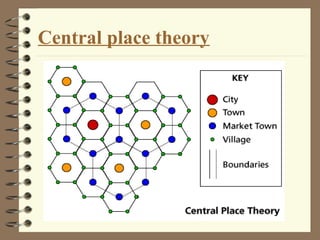
It explains the reasons behind the distribution
patterns, size, and number of cities and towns.
Tested in Southern Germany and came to the
conclusion that people gather together in cities to
share goods and ideas and that they
Central place theory
Assumptions
humans will always purchase goods from the
closest place
unbounded isotropic (all flat), homogeneous,
limitless surface
evenly distributed population
all settlements are equidistant and exist in a
triangular lattice pattern
evenly distributed resources
Central place theory
Public choice theory
Advanced by Paul Peterson in his 1981 book, City
Limits
States that urban politicians and governing
regimes are subordinate to the overall economic
principles that force cities to compete to capture
new investment and capital.
The competitive nature of cities encourages the
business elite and politicians to favour new
development
Theories explaining how towns
are arranged
Grid model/Hippodamian plan
Examples; The city of Priene
Proposed by Hippodamus of Miletus who is
considered the father of rational city planning
The center of the city contains the agora (Market
place), theaters, and temples. Private rooms
surround the city’s public arenas.
The plan can be laid out uniformly over any kind
of terrain since it’s based on angles and
measurements.
Grid model/Hippodamian plan
Hippodamian plan /Grid Model used in Priene city
Concentric Zone model
Also known as The Burgess Model, The Bull's Eye
Model
Developed in the 1920's by the urban sociologist
Ernest Burgess.
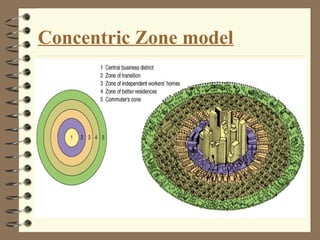
The model portrays how cities social groups are
spatially arranged in a series of rings.
The size of the rings may vary, but the order
always remains the same.
Concentric Zone model
1. Central Business District (CBD) - This area of
the city is a non-residential area and it’s where
businesses are. This area s called downtown ,a lot
of sky scrapers houses government institutions,
businesses, stadiums, and restaurants
2. Zone of Transition- the zone of transition
contains industry and has poorer-quality housing
available.Created by subdividing larger houses
into apartments
Concentric Zone model
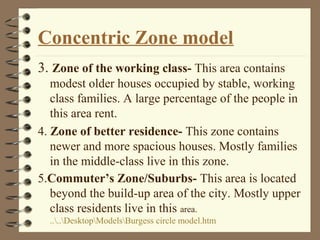
3. Zone of the working class- This area contains
modest older houses occupied by stable, working
class families. A large percentage of the people in
this area rent.
4. Zone of better residence- This zone contains
newer and more spacious houses. Mostly families
in the middle-class live in this zone.
5.Commuter’s Zone/Suburbs- This area is located
beyond the build-up area of the city. Mostly upper
class residents live in this area.
....DesktopModelsBurgess circle model.htm
Concentric Zone model
Shortcomings
It assumes an isotropic plain
land may restrict growth of certain sectors
The model does not fit polycentric cities
It describes the peculiar American
geography, where the inner city is poor
while suburbs are wealthy; the converse is
the norm elsewhere.
Sector model.
Chicago and Newcastle upon Tyne/Newcastle
Developed in 1939 by land economist Homer
Hoyt
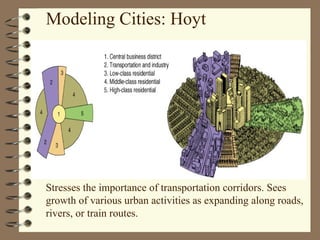
It is a model of the internal structure of cities.
Social groups are arranged around a series of
sectors, or wedges radiating out from the central
business district (CBD) and centred on major
transportation lines
low-income households to be near railroad lines,
and commercial establishments to be along
business thoroughfares
Stresses the importance of transportation corridors. Sees
growth of various urban activities as expanding along roads,
rivers, or train routes.
Modeling Cities: Hoyt
Sector model.
Shortcomings
Applies well to some towns only
Low cost housing is near industry and
transportation proving Hoyt’s model
Theory based on 20th century and does not take
into account cars which make commerce easier
With cars, people can live anywhere and further
from the city
Multiple Nuclei method
The Multiple Nuclei Model is an ecological model
created by Chauncy Harris and Edward Ullman in
the 1945
City grows from several independent points rather
than from one central business district.
As these expand, they merge to form a single
urban area.
Ports, universities, airports and parks also act as
nodes
Based on the idea that people have greater
movement due to increased car ownership.
Multiple nuclei model
The model has four geographic principles
– Certain activities require highly specialised facilities
• Accessible transportation for a factory
• Large areas of open land for a housing tract
– Certain activities cluster because they profit from
mutual association
– Certain activities repel each other and will not be found
in the same area
– Certain activities could not make a profit if they paid
the high rent of the most desirable locations
Stresses the importance of multiple nodes of activity, not a
single CBD. Ports, airports, universities attract certain uses
while repelling others.
Modeling Cities:
Harris-Ullman
Multiple nuclei model
Assumptions
Land is Flat
Even Distribution of
Resources
Even Distribution of
people in Residential
areas
Even Transportation
Costs
Criticisms
Each zone displays a
significant degree of internal
heterogeneity
and not homogeneity
No consideration of
influence of physical relief
and government policy.
Not applicable to oriental
cities with different cultural,
economic and political
backgrounds
Urban Realms Model
Francisco Bay area
Developed by James E. Vance Jr. in the 1960’s
Each realm is a separate economic, social and
political entity that is linked together to form a
larger metro framework
suburbs are within the sphere of influence of the
central city and its metropolitan CBD
Now urban realms have become, so large they even
have exurbs, not just suburbs
Urban realm depends on
Overall size of the
metropolitan region
Amount of economic
activity in each urban
realm
Topography and major
land features
Internal accessibility of
each realm
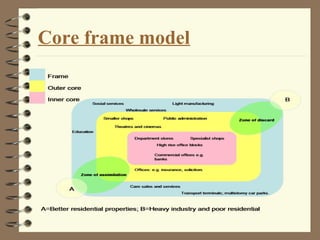
Core frame model
The Core frame model is a model showing
the urban structure of the Central Business
District of a town or city.
The model includes an inner core where
land is expensive and used intensively
The outer core and frame have lower land
values and are less intensively developed. T
various land uses are linked to the bid rent
theory
Core frame model
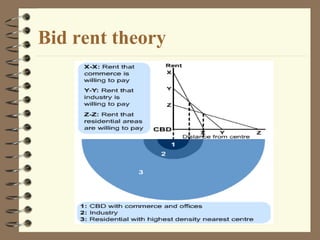
Bid rent theory
geographical economic theory that refers to how
the price and demand for real estate change as the
distance from the central business district (CBD)
This is based upon the idea that retail
establishments wish to maximize their
profitability, so they are much more willing to pay
more for land close to the CBD and less for land
further away from this area.
The amount they are willing to pay is called "bid
rent".
Bid rent theory
Irregular pattern model
Arrangement of Public space that
characterizes the stage of "Transition from
village to city" especially in Third World.
This urban model is due to lack of planning
or construction and illegal without a
specific order.
Includes blocks with no fixed order, or
permanent and temporary structures. S
structures are not related to an urban centres
near the place
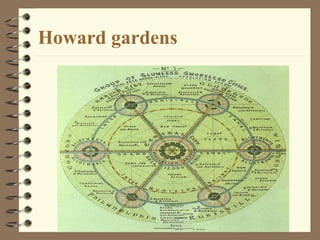
Howard gardens
Letchworth Garden City, Welwyn Garden city
Developed by Sir Ebenezer Howard (1898)
Inspired by the idea of ideal/Utopian cities
Inspired works on Model villages by Robert Owen
and Model industrial towns by Buckingham.
Comprised of Town, Country and Town-country
interactions
Howard gardens
THE END

Urban Planning theories and models

  • 1.
    SES 874 ISSUES INURBAN DESIGN PLANNING AND MANAGEMENT PRESENTER: Geofrey Yator QUESTION: Spatial and Local Theories of urban Development
  • 2.
    Introduction Spatial is relatingto space Urbanization is the movement of population from rural to urban areas A theory is an organized system of accepted knowledge that applies in a variety of circumstances to explain a specific set of phenomena. Urbanization is a relatively new global issue In 1950 only 30% of the world’s population was urbanized and 50% in 2009 lived in urban centres The big question is how do towns come about to be?
  • 3.
    Theories explaining theemergence of towns Central place theory Examples. Polders of the Netherlands, the Fens of East Anglia in the UK Developed by the German geographer Walter Christaller in 1933 It explains the reasons behind the distribution patterns, size, and number of cities and towns. Tested in Southern Germany and came to the conclusion that people gather together in cities to share goods and ideas and that they
  • 4.
    Central place theory Assumptions humanswill always purchase goods from the closest place unbounded isotropic (all flat), homogeneous, limitless surface evenly distributed population all settlements are equidistant and exist in a triangular lattice pattern evenly distributed resources
  • 5.
  • 6.
    Public choice theory Advancedby Paul Peterson in his 1981 book, City Limits States that urban politicians and governing regimes are subordinate to the overall economic principles that force cities to compete to capture new investment and capital. The competitive nature of cities encourages the business elite and politicians to favour new development
  • 7.
    Theories explaining howtowns are arranged Grid model/Hippodamian plan Examples; The city of Priene Proposed by Hippodamus of Miletus who is considered the father of rational city planning The center of the city contains the agora (Market place), theaters, and temples. Private rooms surround the city’s public arenas. The plan can be laid out uniformly over any kind of terrain since it’s based on angles and measurements.
  • 8.
    Grid model/Hippodamian plan Hippodamianplan /Grid Model used in Priene city
  • 9.
    Concentric Zone model Alsoknown as The Burgess Model, The Bull's Eye Model Developed in the 1920's by the urban sociologist Ernest Burgess. The model portrays how cities social groups are spatially arranged in a series of rings. The size of the rings may vary, but the order always remains the same.
  • 10.
  • 11.
    Concentric Zone model 1.Central Business District (CBD) - This area of the city is a non-residential area and it’s where businesses are. This area s called downtown ,a lot of sky scrapers houses government institutions, businesses, stadiums, and restaurants 2. Zone of Transition- the zone of transition contains industry and has poorer-quality housing available.Created by subdividing larger houses into apartments
  • 12.
    Concentric Zone model 3.Zone of the working class- This area contains modest older houses occupied by stable, working class families. A large percentage of the people in this area rent. 4. Zone of better residence- This zone contains newer and more spacious houses. Mostly families in the middle-class live in this zone. 5.Commuter’s Zone/Suburbs- This area is located beyond the build-up area of the city. Mostly upper class residents live in this area. ....DesktopModelsBurgess circle model.htm
  • 13.
    Concentric Zone model Shortcomings Itassumes an isotropic plain land may restrict growth of certain sectors The model does not fit polycentric cities It describes the peculiar American geography, where the inner city is poor while suburbs are wealthy; the converse is the norm elsewhere.
  • 14.
    Sector model. Chicago andNewcastle upon Tyne/Newcastle Developed in 1939 by land economist Homer Hoyt It is a model of the internal structure of cities. Social groups are arranged around a series of sectors, or wedges radiating out from the central business district (CBD) and centred on major transportation lines low-income households to be near railroad lines, and commercial establishments to be along business thoroughfares
  • 15.
    Stresses the importanceof transportation corridors. Sees growth of various urban activities as expanding along roads, rivers, or train routes. Modeling Cities: Hoyt
  • 16.
    Sector model. Shortcomings Applies wellto some towns only Low cost housing is near industry and transportation proving Hoyt’s model Theory based on 20th century and does not take into account cars which make commerce easier With cars, people can live anywhere and further from the city
  • 17.
    Multiple Nuclei method TheMultiple Nuclei Model is an ecological model created by Chauncy Harris and Edward Ullman in the 1945 City grows from several independent points rather than from one central business district. As these expand, they merge to form a single urban area. Ports, universities, airports and parks also act as nodes Based on the idea that people have greater movement due to increased car ownership.
  • 18.
    Multiple nuclei model Themodel has four geographic principles – Certain activities require highly specialised facilities • Accessible transportation for a factory • Large areas of open land for a housing tract – Certain activities cluster because they profit from mutual association – Certain activities repel each other and will not be found in the same area – Certain activities could not make a profit if they paid the high rent of the most desirable locations
  • 19.
    Stresses the importanceof multiple nodes of activity, not a single CBD. Ports, airports, universities attract certain uses while repelling others. Modeling Cities: Harris-Ullman
  • 20.
    Multiple nuclei model Assumptions Landis Flat Even Distribution of Resources Even Distribution of people in Residential areas Even Transportation Costs Criticisms Each zone displays a significant degree of internal heterogeneity and not homogeneity No consideration of influence of physical relief and government policy. Not applicable to oriental cities with different cultural, economic and political backgrounds
  • 21.
    Urban Realms Model FranciscoBay area Developed by James E. Vance Jr. in the 1960’s Each realm is a separate economic, social and political entity that is linked together to form a larger metro framework suburbs are within the sphere of influence of the central city and its metropolitan CBD Now urban realms have become, so large they even have exurbs, not just suburbs
  • 22.
    Urban realm dependson Overall size of the metropolitan region Amount of economic activity in each urban realm Topography and major land features Internal accessibility of each realm
  • 23.
    Core frame model TheCore frame model is a model showing the urban structure of the Central Business District of a town or city. The model includes an inner core where land is expensive and used intensively The outer core and frame have lower land values and are less intensively developed. T various land uses are linked to the bid rent theory
  • 24.
  • 25.
    Bid rent theory geographicaleconomic theory that refers to how the price and demand for real estate change as the distance from the central business district (CBD) This is based upon the idea that retail establishments wish to maximize their profitability, so they are much more willing to pay more for land close to the CBD and less for land further away from this area. The amount they are willing to pay is called "bid rent".
  • 26.
  • 27.
    Irregular pattern model Arrangementof Public space that characterizes the stage of "Transition from village to city" especially in Third World. This urban model is due to lack of planning or construction and illegal without a specific order. Includes blocks with no fixed order, or permanent and temporary structures. S structures are not related to an urban centres near the place
  • 28.
    Howard gardens Letchworth GardenCity, Welwyn Garden city Developed by Sir Ebenezer Howard (1898) Inspired by the idea of ideal/Utopian cities Inspired works on Model villages by Robert Owen and Model industrial towns by Buckingham. Comprised of Town, Country and Town-country interactions
  • 29.
  • 30.