Ceramics in Materials
Science:
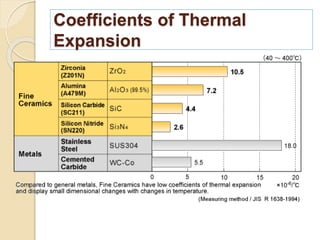
By
Prof. A. Balasubramanian
Centre for Advanced Studies in Earth Science
University of Mysore, India
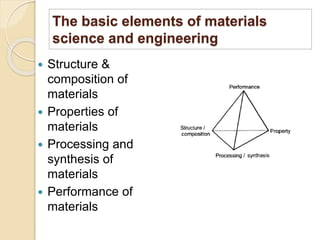
The basic elements of materials
science and engineering
 Structure &
composition of
materials
 Properties of
materials
 Processing and
synthesis of
materials
 Performance of
materials
Classification of Solids:
 Crystalline solids have regular ordered
arrays of components held together by
uniform intermolecular forces.
 The components of amorphous solids are
not arranged in regular arrays.
o Crystalline solids= atoms show short and
long range order
o amorphous (non-crystalline)= atoms show
short range order only
 Crystalline materials= - atoms(ions or
molecules) in repeating 3D pattern (called a
lattice)
 - long-range order; ex.: NaCl,
Properties of solids
 Properties are the way the material responds to the
environment and external forces.
 Mechanical properties – response to mechanical
forces, strength, etc.
 Electrical and magnetic properties - response
electrical and magnetic fields, conductivity, etc.
 Thermal properties are related to transmission of heat
and heat capacity.
 Optical properties include to absorption, transmission
and scattering of light.
 Chemical stability in contact with the environment -
corrosion resistance.
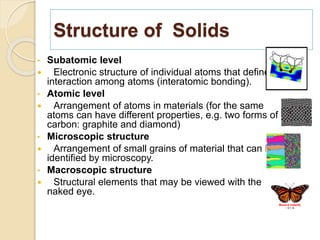
Structure of Solids
• Subatomic level
 Electronic structure of individual atoms that defines
interaction among atoms (interatomic bonding).
• Atomic level
 Arrangement of atoms in materials (for the same
atoms can have different properties, e.g. two forms of
carbon: graphite and diamond)
• Microscopic structure
 Arrangement of small grains of material that can be
identified by microscopy.
• Macroscopic structure
 Structural elements that may be viewed with the
naked eye.
Annealing of a polycrystalline grain structure
2D simulation using Monte Carlo Potts model.
2D simulations involve 40,000 sites and takes a day to run on a fast
workstation, 3D simulations involve 64 million sites, runs on 1000
processors of ASCI-Red.
Monarch butterfly
~ 0.1 m
Types of Materials
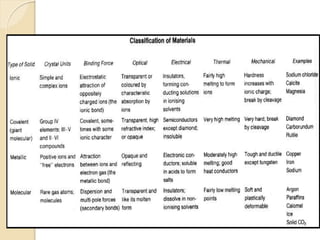
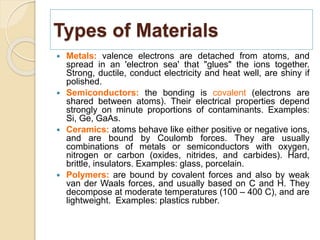
 Metals: valence electrons are detached from atoms, and
spread in an 'electron sea' that "glues" the ions together.
Strong, ductile, conduct electricity and heat well, are shiny if
polished.
 Semiconductors: the bonding is covalent (electrons are
shared between atoms). Their electrical properties depend
strongly on minute proportions of contaminants. Examples:
Si, Ge, GaAs.
 Ceramics: atoms behave like either positive or negative ions,
and are bound by Coulomb forces. They are usually
combinations of metals or semiconductors with oxygen,
nitrogen or carbon (oxides, nitrides, and carbides). Hard,
brittle, insulators. Examples: glass, porcelain.
 Polymers: are bound by covalent forces and also by weak
van der Waals forces, and usually based on C and H. They
decompose at moderate temperatures (100 – 400 C), and are
lightweight. Examples: plastics rubber.
Types of Materials
11
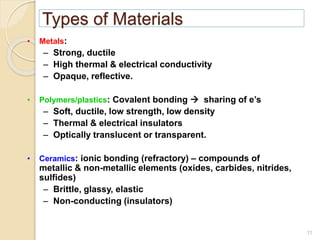
• Metals:
– Strong, ductile
– High thermal & electrical conductivity
– Opaque, reflective.
• Polymers/plastics: Covalent bonding  sharing of e’s
– Soft, ductile, low strength, low density
– Thermal & electrical insulators
– Optically translucent or transparent.
• Ceramics: ionic bonding (refractory) – compounds of
metallic & non-metallic elements (oxides, carbides, nitrides,
sulfides)
– Brittle, glassy, elastic
– Non-conducting (insulators)
12
The Materials Selection
Process
1. Pick Application Determine required Properties
Processing: changes structure and overall shape
ex: casting, sintering, vapor deposition, doping
forming, joining, annealing.
Properties: mechanical, electrical, thermal,
magnetic, optical, deteriorative.
Material: structure, composition.
2. Properties Identify candidate Material(s)
3. Material Identify required Processing
MINERALS
 3000 MINERALS
 METALLIC MINERALS
 NON-METALLIC MINERALS
 MINERAL FUELS
 PAINTS & PGMENT MINERALS
 INDUSTRIAL MINERALS
◦ Ceramics, abrasives, refractories,etc
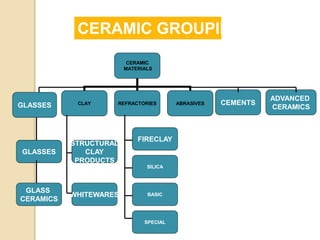
GLASSES
CERAMIC
MATERIALS
CLAY REFRACTORIES ABRASIVES CEMENTSGLASSES
ADVANCED
CERAMICS
GLASS
CERAMICS
STRUCTURAL
CLAY
PRODUCTS
WHITEWARES
FIRECLAY
SILICA
BASIC
SPECIAL
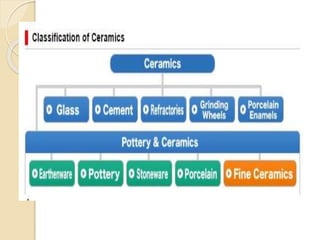
CERAMIC GROUPING
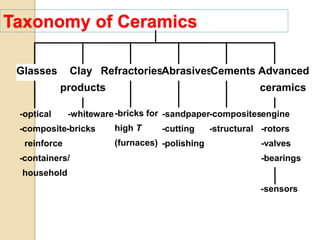
Glasses Clay
products
RefractoriesAbrasivesCements Advanced
ceramics
-optical
-composite
reinforce
-containers/
household
-whiteware
-bricks
-bricks for
high T
(furnaces)
-sandpaper
-cutting
-polishing
-composites
-structural
engine
-rotors
-valves
-bearings
-sensors
Taxonomy of Ceramics
USE OF CLAYS IN
POTTERY
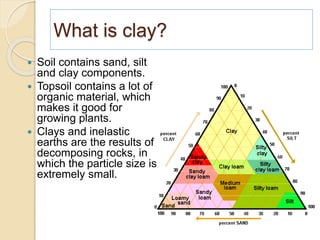
What is clay?
 Soil contains sand, silt
and clay components.
 Topsoil contains a lot of
organic material, which
makes it good for
growing plants.
 Clays and inelastic
earths are the results of
decomposing rocks, in
which the particle size is
extremely small.
Clay Is...
 Clay differs from the inelastic earths
and fine sand because of its ability,
when wet with the proper amount of
water, to form a cohesive mass and to
retain its shape when molded.
 This quality is known as clay’s
plasticity.
 When heated to high temperatures,
clay also partially melts, resulting in
the tight, hard rock-like substance
known as ceramic material.
Clay minerals
The clay minerals kaolin, smectite and palygorskite-
sepiolite are among the world's most important and
useful industrial minerals.
Clay minerals are important in a number of geological
applications such as stratigraphic correlations,
indicators of environments of deposition and
temperature for generation of hydrocarbons.
In agriculture, the clay minerals are a major component of
soils and determinant of soil properties.
The clay minerals are important in construction where they
are a major constituent in brick and tile.
The physical and chemical properties of the clay minerals
determine their utilization in the process industries.
Classes of Clay
 Clay can be divided into several
classes, based on characteristics and
at what temperature the clay must be
fired to in order for it to become
mature, or reach its optimum hardness
and durability.
Clays- important
characteristics
The important characteristics relating to the
applications of clay minerals are
a) particle size and shape,
b) surface chemistry,
c) surface area,
d) Surface charge, and
e) other properties specific to particular
applications, including viscosity, colour,
plasticity, green, dry and fired strength,
absorption and adsorption, abrasion and
pH.
In all applications, the clay minerals perform a
function and are not just inert components of
the system.
Three types of clays
 The three most commonly used clay
bodies are earthenware clay bodies,
mid-fire stoneware clay bodies, and
high-fire stoneware clay bodies.
 All three are available commercially in
moist and ready-to-use form.
 Clay bodies can also be produced by
mixing dry clays and additives with
water to create your own desired clay
body.
Physical stages of clay
 Clay ware takes on varying physical characteristics during the making
of pottery.
 Greenware: refers to unfired objects. At sufficient moisture content.
Most plastic in form. Soft and malleable. Easily deformed by handling.
 Leather-hard : refers to a clay body that has been dried partially. 15%
moisture content. Very firm and only slightly pliable. Trimming and
handle attachment possible.
 Bone-dry : clay body reaches a moisture content at or near 0%. It is
now ready to be bisque fired.
 Bisque : clay after the object is shaped to the desired form and fired in
the kiln for the first time. It is "bisque fired" or "biscuit fired". This
firing changes the clay body in several ways. Mineral components of the
clay body will undergo chemical changes that will change the colour of
the clay.
 Glaze fired : Final stage of pottery making. A glaze may be applied to
the bisque form and the object can be decorated in several ways. After
this the object is "glazed fired", which causes the glaze material to melt,
then adhere to the object. The glaze firing will also harden the body still
more as chemical processes can continue to occur in the body.
Stages with temperature rise
 Spinel = Further heating to 925–950 °C converts
metakaolin to an aluminium-silicon spinel which
is sometimes also referred to as a gamma-
alumina type structure: 2 Al2Si2O7 →
Si3Al4O12 + SiO2.
 Platelet mullite = Upon calcination above 1050
°C, the spinel phase nucleates and transforms to
platelet mullite and highly crystalline cristobalite:
3 Si3Al4O12 → 2(3 Al2O3 · 2 SiO2) + 5 SiO2.
 Needle mullite = Finally, at 1400 °C the "needle"
form of mullite appears, offering substantial
increases in structural strength and heat
resistance. This is a structural but not chemical
transformation.
CLAYS, POTTERY &
CERAMICS
Pottery and ceramics
 Pottery and ceramics are made by
forming and firing raw materials
including clay and pottery stones.
 They are divided into several
categories, such as earthenware and
porcelain, depending on such factors
as raw material composition, firing
temperatures and water absorption.
 Fine Ceramics are primarily composed
of unique minerals such as alumina
porcelain.
Pottery
 Pottery is the ceramic act of making
pottery wares, of which major types
include
 earthenware, stoneware and porcelain
.
 The place where such wares are
made is also called a pottery (plural
"potteries").
 Pottery also refers to the art or craft of
a potter or the manufacture of pottery.
Definition of pottery
 “all fired ceramic wares that contain
clay when formed, except technical,
structural, and refractory products.”
 Some archaeologists use a different
definition by excluding ceramic objects
such as figurines which are made by
similar processes and of similar
materials but are not vessels.
Origin of pottery
 Pottery originated during the Neolithic
period.
 Ceramic objects like the Gravettian
culture( Venus of Dolní Věstonice)
figurine discovered in the Czech
Republic date back to 29,000–25,000
BC.
 Pottery vessels discovered in Jiangxi,
China date back to 20,000 BP.
 Early Neolithic pottery has also been
found in Jomon Japan (10,500 BC)
 the Russian Far East (14,000 BC)& Sub-
Saharan Africa and South America.
HISTORY OF POTTERY AND
PORCELAIN
 The potter's wheel: 3000 BC
 Greek vases: 6th - 5th century BC
 Glazed ceramics: 9th - 1st century BC
 African terracotta figures: from the 5th century BC
 T'ang pottery: 7th - 9th century
 Islamic pottery: 9th-12th century
 Pottery of the Song dynasty: 10th - 13th century
 Japanese pottery and the Tea Ceremony: 13th - 16th c
 Raku:1588 Korean
 Kakiemon porcelain: 17th century – Japan
 Majolica, faience and delftware: 14th-17th century – Europe
 The European quest for porcelain: 16th-18th century
 The porcelain prisoner: 1700-1714
Pottery using clay body
 Pottery is made by forming a clay
body into objects of a required shape
and heating them to high
temperatures in a kiln which removes
all the water from the clay, which
induces reactions that lead to
permanent changes including
increasing their strength and
hardening and setting their shape.
Clay body can be decorated
 A clay body can be decorated before or after firing.
 Prior to some shaping processes, clay must be
prepared.
 Kneading helps to ensure presence of an even moisture
content throughout the clay body.
 Air trapped within the clay body needs to be removed.
 This is called de-airing and can be accomplished by a
machine called a vacuum pug or manually by wedging.
 Wedging can also help produce an even moisture
content.
 Once a clay body has been kneaded and de-aired or
wedged, it is shaped by a variety of techniques.
 After shaping it is dried and then fired.
Clays bodies and mineral
contents
 There are several materials that are
referred to as clay.
 The properties of the clays differ,
including:
 Plasticity,
 the malleability of the body;
 the extent to which they will absorb water
after firing; and
 shrinkage, the extent of reduction in size
of a body as water is removed.
Different clay bodies
 Different clay bodies also differ in the
way in which they respond when fired in
the kiln.
 A clay body can be decorated before or
after firing.
 Prior to some shaping processes, clay
must be prepared.
 Each of these different clays are
composed of different types and
amounts of minerals that determine the
characteristics of resulting pottery.
Mineral contents of clay
 It is common for clays and other
materials to be mixed to produce clay
bodies suited to specific purposes.
 A common component of clay bodies
is the mineral kaolinite.
 Other mineral compounds in the clay
may act as fluxes which lowers the
vitrification temperature of bodies.
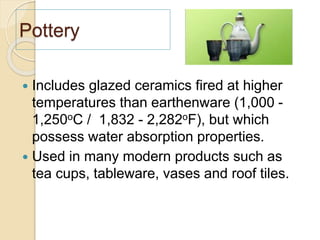
Pottery
 Includes glazed ceramics fired at higher
temperatures than earthenware (1,000 -
1,250oC / 1,832 - 2,282oF), but which
possess water absorption properties.
 Used in many modern products such as
tea cups, tableware, vases and roof tiles.
Different types of clays used for
pottery
 Earthernware clays
 Kaolin
 Ball clay
 Fire clay
 Stoneware clay
 Common red clay and Shale clay
 Bentonite clay
Earthenware Clays
 the earliest clays used by potters
 the most common type of clay found.
 highly plastic (easily worked) and can be sticky.
 contain iron and other mineral impurities which
cause the clay to reach its optimum hardness at
between 1745°F and 2012°F (950°C and 1100°C).
 Typical colors for under moist status -red,
orange, yellow, and light gray.
 Colors for fired earthenware includes brown, red,
orange, buff, medium grey, and white.
 Fired colors are determined by the mineral
impurities and the type of firing.
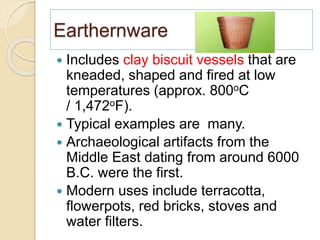
Earthernware
 Includes clay biscuit vessels that are
kneaded, shaped and fired at low
temperatures (approx. 800oC
/ 1,472oF).
 Typical examples are many.
 Archaeological artifacts from the
Middle East dating from around 6000
B.C. were the first.
 Modern uses include terracotta,
flowerpots, red bricks, stoves and
water filters.
Kaolin (Porcelain) Clays
 Due to their mineral purity, kaolins are used for
porcelain.
 They are all very light in color.
 While moist, they will be light grey and will fire in
the range between a very light grey or buff, to near-
white and white.
 Kaolin clays are not nearly as plastic as other clays.
 They are difficult to work with.
 Pure kaolin clays fire to maturity at about 3272°F
(1800°C).
 They are often mixed with other clays to both
increase workability and lower the firing
temperature.
 Many porcelain bodies are a mixture of kaolin and
ball clays.
Kaolin
 Another very large user of kaolins is
the ceramics industry, particularly in
 whiteware,
 sanitaryware,
 insulators,
 pottery and
 refractories.
 Both primary and secondary kaolins
can have excellent ceramic
properties.
Industrial uses of kaolin
 Paper coating , Cement, Food additives
 Paper filling , Pencil leads , Bleaching
 Extender in paint , Adhesives, Fertilizers
 Ceramic raw material , Tanning leather Plaster
 Filler in rubber , Pharmaceuticals , Filter aids
 Filler in plastics, Enamels , Cosmetics
 Extender in ink Pastes, and glues Crayons
 Cracking catalysts, Insecticide carriers,
Detergents
 Fibreglass, Medicines, Roofing granules
 Foundries, Sizing, Linoleum
 Desiccants, Textiles, Polishing compounds
Kaolin- China Clay
 Kaolin, is sometimes referred to as China
clay because it was first used in China.
 part of the group of industrial minerals,
with the chemical composition
Al2Si2O5(OH)4.
 It is a layered silicate mineral, with one
tetrahedral sheet linked through oxygen
atoms to one octahedral sheet of alumina
octahedra.
 Rocks that are rich in kaolinite are known
as kaolin or china clay.
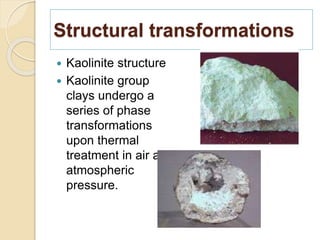
Structural transformations
 Kaolinite structure
 Kaolinite group
clays undergo a
series of phase
transformations
upon thermal
treatment in air at
atmospheric
pressure.
Drying kaolin
 Below 100 °C, exposure to dry air will slowly
remove liquid water from the kaolin.
 The end-state for this transformation is referred
to as "leather dry".
 Between 100 °C and about 550 °C, any
remaining liquid water is expelled from kaolinite.
The end state for this transformation is referred
to as "bone dry".
 Through this state, the expulsion of water is
reversible: if the kaolin is exposed to liquid water,
it will be reabsorbed and disintegrate into its fine
particulate form.
 Subsequent transformations are not reversible,
and represent permanent chemical changes.
Metakaolin
 Endothermic dehydration of kaolinite
begins at 550–600 °C producing
disordered metakaolin, but
continuous hydroxyl loss is observed
up to 900 °C.
 Comp: Al2Si2O5(OH)4 → Al2Si2O7 + 2
H2O.
Ball Clays
 Ball clays are highly plastic and
contain few mineral impurities.
 They fire to their mature hardness at
about 2336°F (1300°C).
 When moist , they are dark grey and
when fired they are either light grey or
light buff in color.
Common Dry Ball Clays Used
in Pottery
 Ball clays are light-colored,
highly plastic clays that are used to help
clay bodies become more workable.
They are also very prone to
excessive shrinkage (generally between
12% and 15%) and warping. Because of
these problems, they are not used by
themselves in a clay body.
 Champion Ball Clay
 Champion ball clay fires to white and is
known for excellent dry strength.
Problems of Ball clays
 Ball clays do have a serious
drawback.
 They cannot be used by themselves
due to their excessive shrinkage
during drying and firing.
 They are extremely useful, however,
when added to other clays to increase
workability and plasticity.
Ball clay
 Ball clay An extremely plastic, fine
grained sedimentary clay, which may
contain some organic matter. Small
amounts can be added to porcelain to
increase plasticity.
 Ball clays are kaolinitic sedimentary
clays.
 They consist of 20-80% kaolinite, 10-
25% mica, and 6-65% quartz.
 They are fine-grained and plastic in
nature.
Fire Clays
 Fire clays vary widely in their characteristics.
 The hallmark is their high firing range.
 They mature at about 2696°F (1500°C).
 Although relatively free from mineral
impurities, they tend to have spots of iron
which lend a speckled appearance once
fired.
 Often used in stoneware clay bodies to
increase their maturation temperature and to
give the fired clay a bit extra roughness, or
"tooth".
 Used in fuel-fired kilns to create cone packs
and to seal doors.
Fire clay
 Fire clay is a term applied to a range
of refractory clays used in the
manufacture of ceramics, especially fire
brick.
 This kind of clay has a slightly lower
percentage of fluxes than kaolin.
 It is usually quite plastic.
 It is a highly heat resistant form of clay.
 It can be combined with other clays to
increase the firing temperature and may
be used as an ingredient to make
stoneware type bodies.
Fire clay
 Fire clay has a "mineral aggregate composed of
hydrous silicates of aluminium
(Al2O3.2SiO2.2H2O) with or without free silica.
 A "fire clay“ material must withstand a minimum
temperature of 1,515 °C .
 High-grade fire clays can withstand temperatures
of 1775 °C (3227 °F).
 Fire clay is resistant to high temperatures,
having fusion points higher than 1,600 °C
(2,910 °F).
 It is suitable for lining furnaces, as fire brick.
 Suitable for the manufacture of utensils used in
the metalworking industries(crucibles &
glassware).
Porcelain Clay Bodies
 Porcelain clay bodies are known for their hardness,
their extremely tight density, their whiteness, and their
translucence when the pottery's walls are thin.
 Kaolin clays are the foundation of all porcelain clay
bodies.
 Kaolin is the purest form of clay.
 It is also so non-plastic as to be nearly unworkable if not
mixed with other clays.
 Another difficulty is that porcelain clay bodies are very
prone to warping during drying and in the kiln.
 The purest porcelain bodies are fired at the highest
temperatures used in pottery, usually between cone 11
and cone 14.
 However, many porcelain clay bodies are modified to
make the clay more workable and also to bring the firing
temperature down.
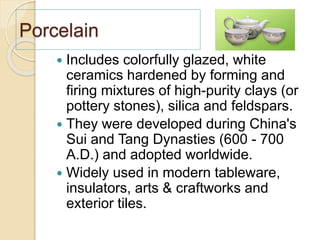
Porcelain
 Includes colorfully glazed, white
ceramics hardened by forming and
firing mixtures of high-purity clays (or
pottery stones), silica and feldspars.
 They were developed during China's
Sui and Tang Dynasties (600 - 700
A.D.) and adopted worldwide.
 Widely used in modern tableware,
insulators, arts & craftworks and
exterior tiles.
Stoneware Clays
 Stoneware clays are plastic and are
often grey in color when occur with
moisture.
 Their fired colors range through light
grey and buff, to medium grey and
brown.
 Fired colors are greatly affected by the
type of firing.
Stoneware clay
 Suitable for creating stoneware.
 has many of the characteristics
between fire clay and ball clay,
 It contains finer grains, like ball clay
 It is more heat resistant like fire clays.
Stoneware Clay Bodies
 Generally speaking, stoneware clay bodies fire to a gray, buff,
tan, or light brown color.
 Color will vary with the same clay, depending on the
kiln's atmosphere.
 Darker colors are possible with the addition of slips, such as
Alberta Slip, or of coloring oxides.
 Stoneware clays get their name from the dense, rock-like
nature of the clay body when it is fired to its maturation
temperature.
 There are some naturally occurring stoneware clays that
need little modification.
 Usually, however, a stoneware clay body adds other
ingredients for optimal performance.
 For example, ball clays may be added for plasticity, or fire
clays may be added to raise the maturation temperature of
the clay body.
Stoneware
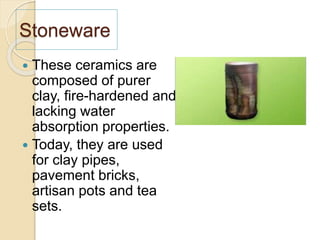
 These ceramics are
composed of purer
clay, fire-hardened and
lacking water
absorption properties.
 Today, they are used
for clay pipes,
pavement bricks,
artisan pots and tea
sets.
Dry Stoneware and Fire Clays
 There are several dry fire clays and
stoneware clays available to the studio
potter.
 These dry clays are used to create
custom clay bodies, using clay body
recipes.
Low-fire bodies
 Low-fire bodies are defined by when the
temperature at which the clay body matures,
generally considered to be between cones 09
and 02 (1700⁰ and 2000⁰ F or 927⁰ and 1093⁰
C).
 Low-fire clays tend to have good workability
and usually will not shrink, warp, or sag
excessively.
 However, they are softer which means that
they are less durable and will absorb liquids.
 Low-fire clays are divided into two types
according to their color after firing.
 Darker-colored bodies (most commonly red),
and the white and buff clay bodies.
Mid-Fire Stoneware Clay
Bodies
 Mid-Fire Stoneware Clay Bodies
 are formulated to fire to maturity
between 2150°F and 2260°F (1160°C
and 1225°C).
 High-Fire Stoneware Clay Bodies
 fire to their mature hardness between
2200°F and 2336°F (1200°C and
1300°C).
Differences Between Mid-
Range and High-Fire Clays
 the distinguishing factor is the temperature at
which the clay matures. (heating cones in
sequence)
 Mid-range clay bodies high to maturity between
cone 4 and cone 7.
 High-fire clay bodies are usually considered to be
those that mature between cone 8 and cone 11,
although some porcelains go all the way to cone
14.
 The ingredients used in mid-range and high-fire
clay bodies are very similar within their type.
 The main difference is that, in relation to high-fire
bodies, mid-range bodies will have either less
refractory elements, more fluxing agents, or a
combination of these two.
Red or Dark Earthenware
Clays
 can range from a orange-red to a dark brown,
with red being the most common.
 Their color derives from the iron-bearing clays
used their clay bodies.
 The iron already within the clay body acts as a
fluxing (melting) agent, which matures the clay
at relatively low temperatures.
 Earthenware clays melt at such low
temperatures that they seldom become fully
vitrified. Because of this, the fired ware will
continue to absorb liquids.
 For this reason, functional ware is almost
always glazed.
White or Buff Earthenware
Clays
 Because of an increased interest in low-temperature
firing, new varieties of low-fire clay bodies have been
developed.
 These clay bodies have also been given the label
“earthenware” due to the fact that they mature in the
earthenware temperature range.
 The idea of low-firing white clay bodies actually began
further back to Europe, when pottery factories began
trying to duplicate the porcelain ware that had become
available from the eastern Asia.
 These clay bodies required large quantities of fluxing
agents, in order to lower the melting temperature for the
relatively clean mixtures of kaolin and ball clays.
 The white bodies of today are still composed of about
half clay and half added fluxing agent, such as talc.
Common red clay and Shale
 Common red clay and Shale clay have
vegetable and ferric oxide impurities
which make them useful for bricks.
 Generally unsatisfactory for pottery
except under special conditions of a
particular deposit.
Bentonite
 An extremely plastic clay which can be
added in small quantities to short clay to
increase the plasticity.
 Bentonite is an absorbent aluminium
phyllosilicate,
 It is an impure clay consisting mostly of
montmorillonite.
 There are different types of bentonite,
each named after the respective
dominant element, such
as potassium (K), sodium (Na), calcium (
Ca), and aluminium (Al).
Smectite
Smectite is the mineral name given to a
group of
Na, Ca, Mg, Fe, and Li-A1 silicates.
The mineral names in the smectite
group which are most commonly used
are Na-montmorillonite, Ca-
montmorillonite, saponite (Mg),
nontronite (Fe), and hectorite (Li).
The rock in which these smectite
minerals are dominant is bentonite.
Methods of shaping in pottery
 Hand building
 The potter's wheel
 Granulate pressing
 Injection moulding
 Jiggering and jolleying
 Roller-head machine
 Pressure casting
 RAM pressing
 Slipcasting
Glaze
 Glaze is a glassy coating on pottery
 The primary purposes is for decoration and
protection.
 One important use of glaze is to render
porous pottery vessels impermeable to water
and other liquids.
 Glaze may be applied by dusting the unfired
composition over the ware or by spraying,
dipping, trailing or brushing on a
thin slurry composed of the unfired glaze and
water.
 The colour of a glaze after it has been fired
may be significantly different from before
firing.
Specialised glazing techniques;
Salt-glazing
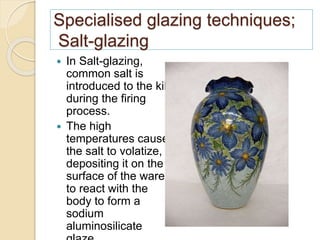
 In Salt-glazing,
common salt is
introduced to the kiln
during the firing
process.
 The high
temperatures cause
the salt to volatize,
depositing it on the
surface of the ware
to react with the
body to form a
sodium
aluminosilicate
Glazing Methods -Ash glazing
 Ash glazing - ash from the combustion of
plant matter has been used as the flux
component of glazes.
 The source of the ash was generally the
combustion waste from the fuelling of
kilns although the potential of ash
derived from arable crop wastes has
been investigated.
 They are now limited to small numbers of
studio potters who value the
unpredictability arising from the variable
nature of the raw material.
Glazing Methods
 Underglaze decoration (in the manner
of many blue and white wares).
 Underglaze may be applied by brush
strokes, air brush, or by pouring the
underglaze into the mold, covering the
inside, creating a swirling effect, then
the mold is filled with slip.
 In-glaze decoration
 On-glaze decoration
 Enamel
Firing
 Firing produces irreversible changes in the
body.
 It is only after firing that the article or material
is pottery.
 In lower-fired pottery, the changes include
sintering, the fusing together of coarser
particles in the body at their points of contact
with each other.
 In the case of porcelain, where different
materials and higher firing-temperatures are
used, the physical, chemical and
mineralogical properties of the constituents in
the body are greatly altered.
Object of firing
 In all cases, the object of firing is to
permanently harden the wares and the
firing regime must be appropriate to the
materials used to make them.
 As a rough guide, earthenwares are
normally fired at temperatures in the
range of about 1,000°C (1,830 °F) to
1,200 °C (2,190 °F); stonewares at
between about 1,100 °C (2,010 °F) to
1,300 °C (2,370 °F); and
 porcelains at between about 1,200 °C
(2,190 °F) to 1,400 °C (2,550 °F).
Kilns
 Kilns may be heated by
burning wood, coal and gas or by electricity.
 When used as fuels, coal and wood can
introduce smoke, soot and ash into the kiln
which can affect the appearance of
unprotected wares.
 For this reason, wares fired in wood- or coal-
fired kilns are often placed in the kiln
in saggars, lidded ceramic boxes, to protect
them.
 Modern kilns powered by gas or electricity
are cleaner and more easily controlled than
older wood- or coal-fired kilns and often allow
shorter firing times to be used.
Ceramics
 A wide-ranging group of materials whose
ingredients are clays, sand and feldspar.
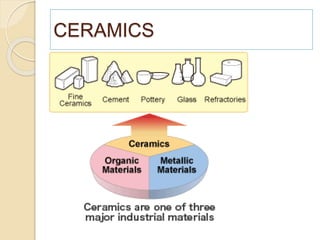
CERAMICS
Ceramics
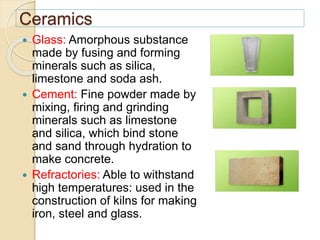
 Glass: Amorphous substance
made by fusing and forming
minerals such as silica,
limestone and soda ash.
 Cement: Fine powder made by
mixing, firing and grinding
minerals such as limestone
and silica, which bind stone
and sand through hydration to
make concrete.
 Refractories: Able to withstand
high temperatures: used in the
construction of kilns for making
iron, steel and glass.
Ceramics:
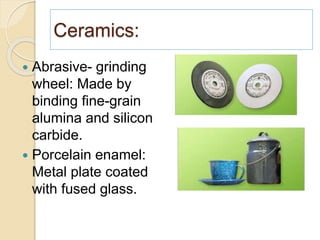
 Abrasive- grinding
wheel: Made by
binding fine-grain
alumina and silicon
carbide.
 Porcelain enamel:
Metal plate coated
with fused glass.
Ceramics
 keramikos - burnt stuff in Greek -properties
achieved through high-temperature heat treatment
(firing).
 Usually metallic + non-metallic elements
 Always composed of more than one element (e.g.,
Al2O3, NaCl, SiC, SiO2)
 Bonds are partially or totally ionic
 Hard and brittle
 Electrical and thermal insulators
 Optically opaque, semi-transparent, or transparent
 Traditionally based on clay (china, bricks, tiles,
porcelain) and glasses
 “New ceramics” for electronic, computer,
aerospace industries.
Ceramic structure
 Ceramics are predominantly ionic in
structure
 The overall structure is electronically
neutral
 The relative difference of anion and
cation determines the interstitial site in
crystal.
 The common ceramics are oxides and
chlorides.
 Cations fill in the hole of anion lattice.
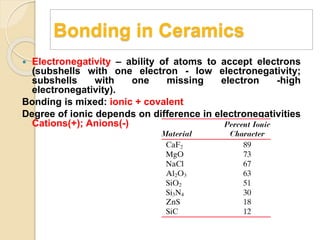
Bonding in Ceramics
 Electronegativity – ability of atoms to accept electrons
(subshells with one electron - low electronegativity;
subshells with one missing electron -high
electronegativity).
Bonding is mixed: ionic + covalent
Degree of ionic depends on difference in electronegativities
Cations(+); Anions(-)
Crystal Structures:
Predominantly Ionic in
ceramics
 Crystal structure is defined by
 Magnitude of electrical charge on
each ion Charge balance dictates
chemical formula (Ca2+ and F- form
CaF2).
 Relative sizes of cations and
anions
Cations want maximum possible
number of anion nearest neighbors
and vice-versa.
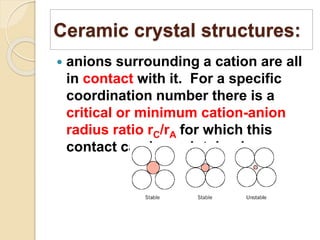
Ceramic crystal structures:
 anions surrounding a cation are all
in contact with it. For a specific
coordination number there is a
critical or minimum cation-anion
radius ratio rC/rA for which this
contact can be maintained
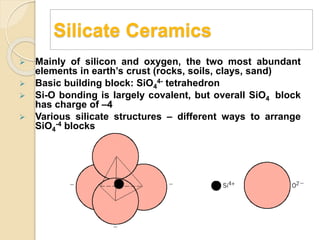
Silicate Ceramics
 Mainly of silicon and oxygen, the two most abundant
elements in earth’s crust (rocks, soils, clays, sand)
 Basic building block: SiO4
4- tetrahedron
 Si-O bonding is largely covalent, but overall SiO4 block
has charge of –4
 Various silicate structures – different ways to arrange
SiO4
-4 blocks
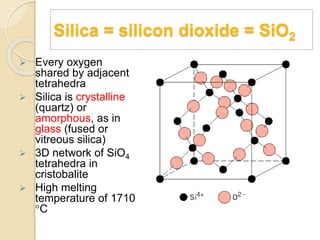
Silica = silicon dioxide = SiO2
 Every oxygen
shared by adjacent
tetrahedra
 Silica is crystalline
(quartz) or
amorphous, as in
glass (fused or
vitreous silica)
 3D network of SiO4
tetrahedra in
cristobalite
 High melting
temperature of 1710
C
Imperfections in Ceramics
 Point defects in ionic crystals are charged.
Coulomb forces are large. Any charge
imbalance has a strong tendency to balance
itself. To maintain charge neutrality several
point defects can be occur:
 Frenkel defect: a pair of cation (positive ion)
vacancies and a cation interstitial. Also be an
anion (negative ion) vacancy and anion
interstitial. Anions are larger than cations so
not easy for an anion interstitial to form
 Schottky defect is a pair of anion and cation
vacancies
Imperfections in Ceramics
• Frenkel and Schottky defects do not
change ratio of cations to anions 
compound is stoichiometric
• Non-stoichiometry (composition deviates
from the one predicted by chemical
formula) occurs when one ion type can
exist in two valence states, e.g. Fe2+, Fe3+
• In FeO, Fe valence state is 2+.
 Two Fe ions in 3+ state  an Fe vacancy
is required to maintain charge neutrality
  fewer Fe ions  non-stoichiometry
Properties of ceramics
 High hardness, electrical and thermal
insulating, chemical stability, and high
melting temperatures
 Brittle, virtually no ductility - can cause
problems in both processing and
performance of ceramic products
 Some ceramics are translucent,
window glass (based on silica) being
the clearest example
Mechanical Properties of
Ceramics
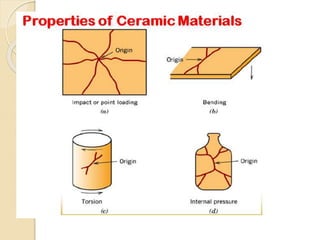
 Brittle Fracture stress concentrators are
very important. (Chap. 8: measured
fracture strengths are much smaller than
theoretical due to stress risers) Fracture
strength greatly enhanced by creating
compressive stresses in the surface
region (similar to shot peening, case
hardening in metals, Chap. 8)
 Compressive strength is typically ten
times the tensile strength Therefore
ceramics are good structural materials
under compression (e.g., bricks in
houses, stone blocks in the pyramids).
Plastic Deformation in
Ceramics
 Crystalline ceramics: Slip (dislocation
motion) is difficult because ions of like
charge have to be brought close together
 large barrier for dislocation motion In
ceramics with covalent bonding slip is not
easy (covalent bonds are strong)  ceramics
are brittle.
 Non-crystalline ceramic: no regular
crystalline structure  no dislocations or
slip. Materials deform by viscous flow
(breaking and reforming bonds, allowing
ions/atoms to slide past each other (like in a
liquid)
 Viscosity is a measure of glassy material’s
resistance to deformation.
Viscosity
 Viscosity: measure of non-crystalline
(glass or liquid) resistance to deformation.
High-viscosity fluids resist flow; low-
viscosity fluids flow easily.
 How readily a moving layer of molecules
drags adjacent layers of molecules along
determines its viscosity.
 Units are Pa-s, or Poises (P) 1 P = 0.1 Pa-s
 Viscosity of water at room temp is ~ 10-3 P
 Viscosity of typical glass at room temp >>
1016 P
Properties of Ceramic
Materials
Ceramic Products
 Clay construction products - bricks, clay
pipe, and building tile
 Refractory ceramics - ceramics capable
of high temperature applications such as
furnace walls, crucibles, and molds
 Cement used in concrete - used for
construction and roads
 Whiteware products - pottery, stoneware,
fine china, porcelain, and other
tableware, based on mixtures of clay and
other minerals
Ceramic Products
 Glass - bottles, glasses, lenses, window pane, and
light bulbs
 Glass fibers - thermal insulating wool, reinforced
plastics (fiberglass), and fiber optics
communications lines
 Abrasives - aluminum oxide and silicon carbide
 Cutting tool materials - tungsten carbide, aluminum
oxide, and cubic boron nitride
 Ceramic insulators - applications include electrical
transmission components, spark plugs, and
microelectronic chip substrates
 Magnetic ceramics – example: computer memories
 Nuclear fuels based on uranium oxide (UO2)
 Bioceramics - artificial teeth and bones
Three Basic Categories of
Ceramics
 Traditional ceramics - clay products such as
pottery and bricks, common abrasives, and
cement
 New ceramics - more recently developed
ceramics based on oxides, carbides, etc., and
generally possessing mechanical or physical
properties superior or unique compared to
traditional ceramics
 Glasses - based primarily on silica and
distinguished by their noncrystalline structure
◦ In addition, glass ceramics - glasses
transformed into a largely crystalline
structure by heat treatment
Physical Properties of
Ceramics
 Density – in general, ceramics are lighter
than metals and heavier than polymers
 Melting temperatures - higher than for most
metals
◦ Some ceramics decompose rather than
melt
 Electrical and thermal conductivities - lower
than for metals; but the range of values is
greater, so some ceramics are insulators
while others are conductors
 Thermal expansion - somewhat less than
for metals, but effects are more damaging
because of brittleness
Traditional Ceramics
Based on mineral silicates, silica, and
mineral oxides found in nature
 Primary products are fired clay (pottery,
tableware, brick, and tile), cement, and
natural abrasives such as alumina
 Products and the processes to make
them date back thousands of years
 Glass is also a silicate ceramic material
and is sometimes included among
traditional ceramics
Raw Materials for Traditional
Ceramics
 Mineral silicates, such as clays of
various compositions, and silica, such as
quartz, are among the most abundant
substances in nature and constitute the
principal raw materials for traditional
ceramics
 Another important raw material for
traditional ceramics is alumina
 These solid crystalline compounds have
been formed and mixed in the earth’s
crust over billions of years by complex
geological processes
New Ceramics
Ceramic materials developed synthetically over
the last several decades
 The term also refers to improvements in
processing techniques that provide greater
control over structures and properties of
ceramic materials
 New ceramics are based on compounds
other than variations of aluminum silicate,
which form most of the traditional ceramic
materials
 New ceramics are usually simpler chemically
than traditional ceramics; for example,
oxides, carbides, nitrides, and borides
Oxide Ceramics
 Most important oxide new ceramic is alumina
 Although also included as a traditional
ceramic, alumina is today produced from
bauxite, using an electric furnace method.
 Through control of particle size and
impurities, refinements in processing
methods, and blending with small amounts of
other ceramic ingredients, strength and
toughness of alumina are improved
substantially compared to its natural
counterpart
 Alumina also has good hardness, low thermal
conductivity, and good corrosion resistance.
Products of Oxide Ceramics
 Abrasives (grinding wheel grit)
 Bioceramics (artificial bones and
teeth)
 Electrical insulators and electronic
components
 Refractory brick
 Cutting tool inserts
 Spark plug barrels
 Engineering components
Carbides
 Silicon carbide (SiC), tungsten carbide (WC),
titanium carbide (TiC), tantalum carbide (TaC),
and chromium carbide (Cr3C2)
 Although SiC is a man-made ceramic, its
production methods were developed a century
ago, and it is generally included in traditional
ceramics group
 WC, TiC, and TaC are valued for their hardness
and wear resistance in cutting tools and other
applications requiring these properties
 WC, TiC, and TaC must be combined with a
metallic binder such as cobalt or nickel in order
to fabricate a useful solid product
Nitrides
 The important nitride ceramics are silicon
nitride (Si3N4), boron nitride (BN), and
titanium nitride (TiN)
 Properties: hard, brittle, high melting
temperatures, usually electrically
insulating, TiN being an exception
 Applications:
◦ Silicon nitride: components for gas turbines,
rocket engines, and melting crucibles
◦ Boron nitride and titanium nitride: cutting tool
material and coatings
Glass
 A state of matter as well as a type of
ceramic
 As a state of matter, it refers to an
amorphous (noncrystalline) structure of a
solid material.
◦ The glassy state occurs in a material
when insufficient time is allowed during
cooling from the molten state for the
crystalline structure to form.
 As a type of ceramic, glass is an inorganic,
nonmetallic compound (or mixture of
compounds) that cools to a rigid condition
without crystallizing
Why So Much SiO2 in Glass?
 Because SiO2 is the best glass
former
◦ Silica is the main component in glass
products, usually comprising 50% to
75% of total chemistry
◦ It naturally transforms into a glassy
state upon cooling from the liquid,
whereas most ceramics crystallize
upon solidification
Other Ingredients in Glass
 Sodium oxide (Na2O), calcium oxide (CaO), aluminum
oxide (Al2O3), magnesium oxide (MgO), potassium oxide
(K2O), lead oxide (PbO), and boron oxide (B2O3)
 Functions:
◦ Act as flux (promoting fusion) during heating
◦ Increase fluidity in molten glass for processing
◦ Improve chemical resistance against attack by
acids, basic substances, or water
◦ Add color to the glass
◦ Alter index of refraction for optical applications
Elements Related to Ceramics
 Carbon
◦ Two alternative forms of engineering and
commercial importance: graphite and
diamond
 Silicon
 Boron
 Carbon, silicon, and boron are not
ceramic materials, but they sometimes
◦ Compete for applications with ceramics
◦ Have important applications of their own
Graphite
 Form of carbon with a high content of
crystalline C in the form of layers
 Bonding between atoms in the layers is
covalent and therefore strong, but the parallel
layers are bonded to each other by weak van
der Waals forces
 This structure makes graphite anisotropic;
strength and other properties vary significantly
with direction
◦ As a powder it is a lubricant, but in traditional
solid form it is a refractory
◦ When formed into graphite fibers, it is a high
strength structural material.
Diamond
Carbon with a cubic crystalline structure with
covalent bonding between atoms
◦ This accounts for high hardness
 Industrial applications: cutting tools and
grinding wheels for machining hard, brittle
materials, or materials that are very
abrasive; also used in dressing tools to
sharpen grinding wheels that consist of
other abrasives
 Industrial or synthetic diamonds date back
to 1950s and are fabricated by heating
graphite to around 3000C (5400F) under
very high pressures
Silicon
Semi-metallic element in the same
periodic table group as carbon .
 One of the most abundant elements in
Earth's crust, comprising  26% by
weight
 Occurs naturally only as chemical
compound - in rocks, sand, clay, and
soil - either as silicon dioxide or as more
complex silicate compounds
 Properties: hard, brittle, lightweight,
chemically inactive at room temperature,
and classified as a semiconductor.
Applications and Importance
of Silicon
 Greatest amounts in manufacturing are
in ceramic compounds (SiO2 in glass
and silicates in clays) and alloying
elements in steel, aluminum, and copper.
 Also used as a reducing agent in certain
metallurgical processes .
 Pure silicon is used as the base material
in semiconductor manufacturing in
electronic industries.
 The vast majority of integrated circuits
produced today are made from silicon.
Boron
Semi-metallic element in same periodic group
as aluminum.
 Comprises only about 0.001% of Earth's crust
by weight, commonly occurring as minerals
borax (Na2B4O7- 10H2O) and kernite
(Na2B4O7-4H2O) .
 Properties: lightweight, semiconducting
properties, and very stiff (high modulus of
elasticity) in fiber form.
 Applications: B2O3 used in certain glasses, as
a nitride (cBN) for cutting tools, and in nearly
pure form as a fiber in polymer matrix
composites.
Temperature Ranges for Firing
Glazes
 Ceramic glazes each have a temperature range that
they should be fired to.
 If the glazes are fired at too low a temperature, the
glaze will not mature.
 If the temperature goes too high, the glaze will become
too melted and run off the surface of the pottery.
 For success, a potter must know their glazes'
temperature ranges at which they become mature.
 When potters talk about ceramic firing ranges, they are
usually referring to the three most common: low-fire,
mid-range, and high-fire ranges.
 In regards to glazes, we need to add two other ranges:
very low-fire, and lower mid-range firing ranges.
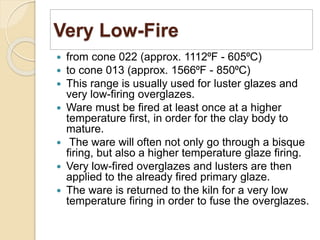
Very Low-Fire
 from cone 022 (approx. 1112⁰F - 605⁰C)
 to cone 013 (approx. 1566⁰F - 850⁰C)
 This range is usually used for luster glazes and
very low-firing overglazes.
 Ware must be fired at least once at a higher
temperature first, in order for the clay body to
mature.
 The ware will often not only go through a bisque
firing, but also a higher temperature glaze firing.
 Very low-fired overglazes and lusters are then
applied to the already fired primary glaze.
 The ware is returned to the kiln for a very low
temperature firing in order to fuse the overglazes.
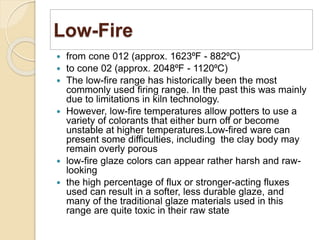
Low-Fire
 from cone 012 (approx. 1623⁰F - 882⁰C)
 to cone 02 (approx. 2048⁰F - 1120⁰C)
 The low-fire range has historically been the most
commonly used firing range. In the past this was mainly
due to limitations in kiln technology.
 However, low-fire temperatures allow potters to use a
variety of colorants that either burn off or become
unstable at higher temperatures.Low-fired ware can
present some difficulties, including the clay body may
remain overly porous
 low-fire glaze colors can appear rather harsh and raw-
looking
 the high percentage of flux or stronger-acting fluxes
used can result in a softer, less durable glaze, and
many of the traditional glaze materials used in this
range are quite toxic in their raw state
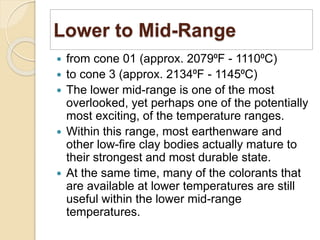
Lower to Mid-Range
 from cone 01 (approx. 2079⁰F - 1110⁰C)
 to cone 3 (approx. 2134⁰F - 1145⁰C)
 The lower mid-range is one of the most
overlooked, yet perhaps one of the potentially
most exciting, of the temperature ranges.
 Within this range, most earthenware and
other low-fire clay bodies actually mature to
their strongest and most durable state.
 At the same time, many of the colorants that
are available at lower temperatures are still
useful within the lower mid-range
temperatures.
Mid-Range
 from cone 4 (approx. 2167⁰F - 1165⁰C)
 to cone 7 (approx. 2264⁰F - 1210⁰C)
 This range is being used more and more as potters
become more concerned about energy and fuel usage.
 Another factor has been the availability of electric kilns
that can comfortably reach this range without severely
decreasing the kiln's and the kiln elements' lifespans.
 Other advantages to firing in the mid-range include
ability to adjust and use stoneware clay bodies to this
range in turn, mid-range stoneware bodies increase the
durability of the ware mid-range glazes are also more
durable than those fired at lower temperatures, and
there is still a fairly extensive color range available.
High Fire
 from cone 8 (approx. 2305⁰F - 1260⁰C)
 to cone 14 (approx. 2530⁰F - 1390⁰C)
 This range includes the stonewares and
porcelains.
 Glazes and clay bodies are dense and
durable; however, the color range is
limited.
 Because of the varying effects of
oxidation and reduction on glaze
colorants, the few coloring oxides that
are viable at this range can still produce
a rich, if much more limited, palette.
Ceramics v/s Fine Ceramics
 Ceramic materials exhibit hardness, excellent
heat and corrosion resistance, and electrical
insulation properties.
 Typical examples include china, firebricks,
cements and glass.
 In addition to these properties, Fine Ceramics
(also known as “advanced ceramics”) have many
advanced mechanical, electrical, electronic,
magnetic, optical, chemical and biochemical
characteristics.
 Today, Fine Ceramics have many roles in fields
such as semiconductors, automobiles,
telecommunications, industrial machinery and
healthcare.
Physical differences between
ceramics and Fine Ceramics
 The physical differences between
ceramics and Fine Ceramics mainly
arise from their raw materials and
manufacturing processes.
 Ceramics are manufactured by mixing,
shaping and firing natural minerals
including pottery stones, feldspar and
clay.
Fine Ceramics
 In contrast, Fine Ceramics are
manufactured using highly purified
natural raw materials, artificial raw
materials synthesized through chemical
processes and other non-naturally
occurring compounds.
 Through a series of precisely controlled,
complex processes such as forming,
machining, firing and grinding, these
compounded raw materials turn into
high-value-added products with excellent
dimensional accuracy and functional
characteristics.
Fine ceramics
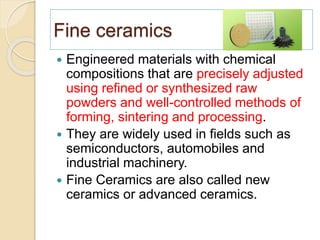
 Engineered materials with chemical
compositions that are precisely adjusted
using refined or synthesized raw
powders and well-controlled methods of
forming, sintering and processing.
 They are widely used in fields such as
semiconductors, automobiles and
industrial machinery.
 Fine Ceramics are also called new
ceramics or advanced ceramics.
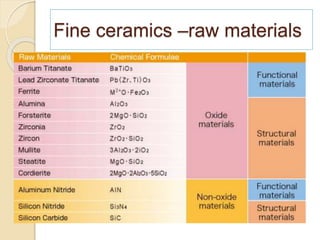
Fine ceramics –raw materials
Processing ceramic products
Fine Ceramic Production
Process
 The raw materials include inorganic solid
powders with precisely controlled purity,
particle size and distribution.
 These raw materials are formulated for specific
properties and functionality, then mixed with a
binding agent or binder.
 Afterward, they are shaped and cut to precise
requirements and fired at extreme heat in
temperature-controlled kilns.
 Firing removes the moisture and
binders.
 With additional firing, powder
particles are sintered together and
the products shrink due to reduced
porosity.
 This process results in products of
extreme density and hardness.
1. Raw materials
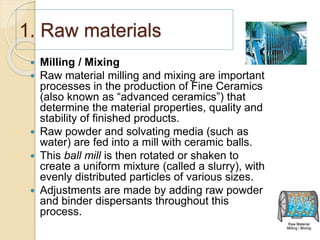
 Milling / Mixing
 Raw material milling and mixing are important
processes in the production of Fine Ceramics
(also known as “advanced ceramics”) that
determine the material properties, quality and
stability of finished products.
 Raw powder and solvating media (such as
water) are fed into a mill with ceramic balls.
 This ball mill is then rotated or shaken to
create a uniform mixture (called a slurry), with
evenly distributed particles of various sizes.
 Adjustments are made by adding raw powder
and binder dispersants throughout this
process.
Spraying / Drying
 A slurry adjusted through raw material
milling and mixing is sprayed and
dried in a hot-air spray dryer to form a
granulated powder of spherical
bodies.
 Enhancing the spherical composition
of the raw material helps facilitate the
next process: filling the forming dies.
2. Forming
1. Cold Isostatic Press (CIP)
2. Cutting
3. Dry pressing
4. Hot pressing
5. Extrusion
6. Tape casting
7. Injection/casting
Cold Isostatic press(CIP)
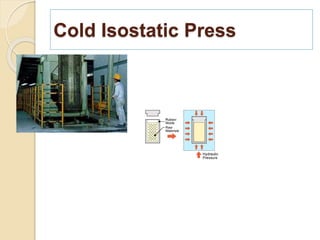
 This forming method involves pressing
dried and granulated raw materials into a
shape close to that of the finished
product.
 The granulated raw materials are poured
into a rubber mold.
 The mold is then put in a high-pressure
container, where hydraulic pressure is
applied evenly from all directions
(isostatic pressing) in order to provide
uniform, highly dense compaction.
 This method is ideal for forming products
with large dimensions.
Cold Isostatic Press
Cutting
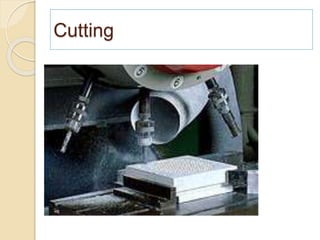
 Because ceramics are very hard, cutting
them after they have been sintered
requires considerable energy and
specialized tools such as diamond
wheels.
 Considering this, engineers strive to cut
or process ceramics into a shape as
close to the finished shape as
possible before sintering, which involves
estimating the degree of shrinkage that
will take place during the sintering
process.
 Super hard tools and drills are used in
this process.
Cutting
Dry pressing
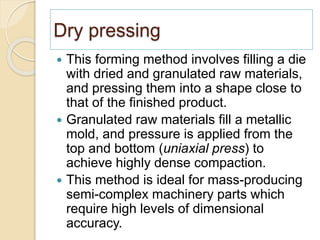
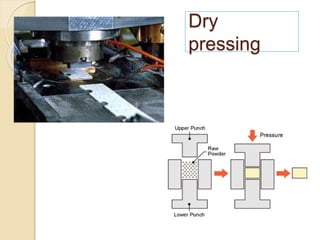
 This forming method involves filling a die
with dried and granulated raw materials,
and pressing them into a shape close to
that of the finished product.
 Granulated raw materials fill a metallic
mold, and pressure is applied from the
top and bottom (uniaxial press) to
achieve highly dense compaction.
 This method is ideal for mass-producing
semi-complex machinery parts which
require high levels of dimensional
accuracy.
Dry
pressing
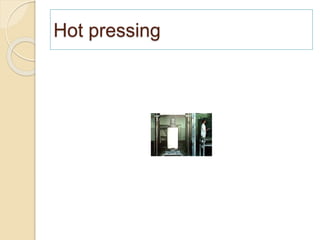
Hot pressing
 This forming method involves applying
pressure at high temperatures in order to
reduce porosity (voids) and produce
dense sintered bodies.
 A carbon mold is filled with raw powder,
which is then heated and pressurized
simultaneously from the top and bottom
to make a sintered body.
 This method yields ceramic bodies of
simple shapes.
Hot pressing
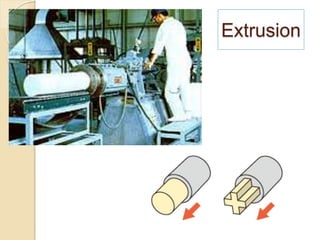
Extrusion
 This is a forming method in which
dried and granulated raw materials are
mixed with water, binder, a plasticizing
agent and a dispersing agent.
 The resulting clay-like, plastic body is
then extruded into the desired shape
under pressure.
 This method is ideal for long products
with continuous and unchanging
cross-sections.
Extrusion
Tape casting
 This method is used to produce
continuous thin compacts using slurries
composed of raw powder, binder and
solvating media.
 The tape casting process generally
employs a "doctor blade" to spread the
slurry into a thin film.
 This process is ideal for preparing the
"green" (unfired ceramic) tape used in
manufacturing multilayer ceramic
integrated circuit packages and ceramic
chip capacitors.
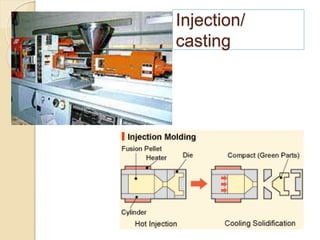
Injection/casting
 This is a forming method in which
dried and granulated raw materials are
mixed with additives to provide a
degree of fluidity.
 The raw material is then pressure-
filled into a forming die that gives it a
shape close to that of the finished
product.
Injection Molding Process
 In the injection molding process, raw
materials are mixed with resin in order
to provide the necessary degree of
fluidity, and then injected into the
molding die.
 The mold is then cooled to harden the
binder and produce a "green" compact
part (also known as an unsintered
powder compact).
Casting Process
 In the casting process, mixed raw
materials are combined with solvating
media and a dispersant, and then fed
into an absorbent die.
 The materials are then dehydrated
and solidified to make a compact.
 Both methods are suitable for
complex, three-dimensionally shaped
products requiring high levels of
dimensional accuracy.
Injection/
casting
Firing
Sintering
Hot isostatic pressing
Hot pressing
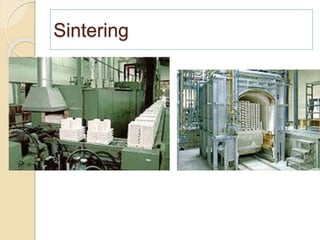
Sintering
 In the firing process, raw materials that are
compression-molded (volumetric filling rate:
approx. 60%) are heated at temperatures
below their melting points to sinter powder
and create density.
 Ceramic powder particles induce mass
transfer at high temperatures through contact
points between particles, combining in a
manner similar to water droplets.
 Depending on the intended application, a
variety of sintering methods may be used —
such as vacuum sintering, atmosphere
sintering and sintering in non-oxidizing
atmospheres.
Sintering
Hot Isostatic Press (HIP)
 In this process, gas pressure is applied
isostatically at high temperatures to
enhance sintering and produce dense
bodies.
 After materials are pre-sintered, and their
density is increased to almost 95 percent
of the theoretical density, they are placed
in a pressure container equipped with a
furnace.
 Gas pressure is then applied isostatically
at 1,000 to 2,000 atmospheres while
being heated.
Hot Isostatic Press
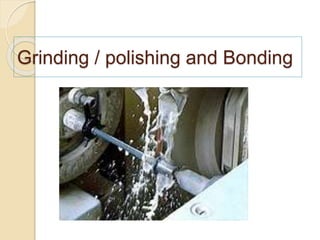
Grinding / polishing and Bonding
Grinding / Polishing
 This important process is designed to
fabricate products with high levels of
dimensional accuracy and mirror-
finished surfaces. It is generally
performed using a diamond wheel.
 Because ceramics are extremely hard,
it is necessary to use diamond — the
hardest material in the world — for the
grinding and polishing process.
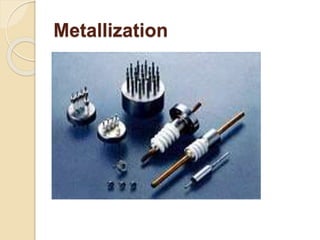
Metallization
 Metallization refers to the process of
affixing a metallic layer to the surface of
a sintered body to form conductive
patterns or provide hermetic sealing.
 One method involves coating the
ceramic surface with a paste containing
metallic powder, and then applying high
temperatures to burn this metallic layer
onto the surface of the ceramic.
 A related method involves applying
metallic layers through an electroplating
process.
Metallization
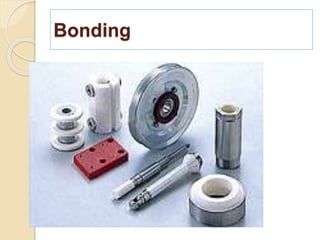
Bonding
 This is an important and value-adding
process for joining multiple ceramic
products, or joining ceramic products
to metallic or resin materials.
 Several methods may be employed to
combine these items, including
mechanical joining or other processes
using adhesives, glass or wax.
Bonding
Quality control
 Inspection
 Products are delivered after rigorous
inspection. This inspection ensures
that all products are tested to perform
at the highest level and allows
customers to use them with
confidence.
ELECTRICAL PROPS
 Insulation
 Dielectricity
 Conductivity
 Piezoelectricity
 Magnetism
 Superconductivity
Electrical Insulation
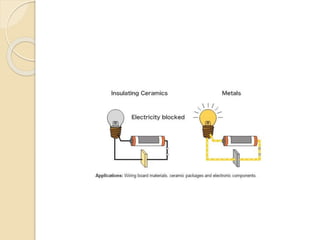
 Fine Ceramics (also known as “advanced
ceramics”) are insulating materials that do not
conduct electricity.
 A few examples of products - include packages
for surface-mounted electronic components,
such as quartz crystal oscillators and surface
acoustic wave (SAW) filters.
 These products are widely used in mobile
phones, automotive navigation systems and
portable music players.
 Ceramic packages provide advanced hermetic
sealing and electrical insulation between
electric circuit lines to maintain the high
reliability of these electronic components.
Electrical Insulation
 A material that is unable to conduct electricity due to its
high level of electrical resistance is an insulator. In
contrast, a conductor is a material that offers low
resistance to electric conductivity. An atom, the smallest
unit of matter, is composed of a nucleus and electrons
which orbit that nucleus.
 Whether a substance is an insulator or a conductor
generally depends on the number of free electrons it
possesses, which can be used to carry electric current.
A substance with higher insulation properties is less
conductive because it possesses fewer free electrons.
 In addition to Fine Ceramics, other insulators include
paraffin, rubber, plastic, paper and marble. Because
ceramics are fired in a kiln, they can be fashioned into a
wide variety of shapes with excellent heat resistance
and durability. For these reasons, ceramics have long
been used as insulators.
Accumulation of Electricity
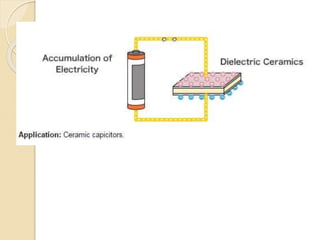
 When voltage is applied to electrodes attached to
opposite sides of an insulating ceramic, they exhibit
electricity-accumulating properties. These insulators are
said to be dielectric.
 An insulator that can accumulate a volume of electricity
exceptionally well is called ferroelectric.
 Consequently, ceramic has become an indispensable
material for producing capacitors and electronic
components that are widely used in products such as
computers, televisions and mobile phones.
 Capacitors serve as "traffic controllers" within an
electronic circuit by conducting electricity to certain
parts, temporarily blocking electricity, or blocking only
certain types of electrical signals.
Dielectricity
 Electricity, by definition, is the movement
of electrons within the molecules of a
material.
 Although electrons can move freely
within conductors, they cannot do so
within insulators.
 When a direct current voltage is applied
to an insulator, electrons do not separate
from molecules, and are divided by an
electrical charge (positive or negative)
induced at both ends of the material.
 In addition, ions themselves may move.
 Materials in which electrical charges
appear at both ends are called dielectric
substances.
 Dielectricity is measured by the relative
dielectric constant, a value representing
the ratio of the dielectric constant of the
material in question and that of a
vacuum.
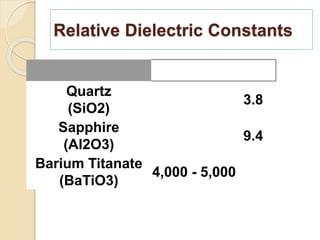
 The dielectric constant of quartz is 3.8,
while that of sapphire (main component:
oxidized aluminum) is 9.4.
 The dielectric constant of barium
titanate, a ferroelectric material, is as
high as 4,000 to 5,000.
Relative Dielectric Constants
Quartz
(SiO2)
3.8
Sapphire
(Al2O3)
9.4
Barium Titanate
(BaTiO3)
4,000 - 5,000
Electrical Conduction
 Though Fine Ceramics (also known as
“advanced ceramics”) are generally
insulating materials that block
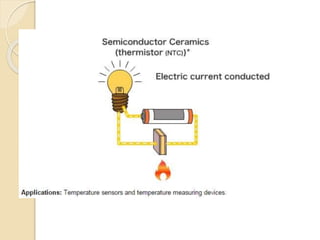
electricity, semiconductor ceramics
can be created to conduct electricity
depending on their temperature and
the level of voltage applied.
Conductivity
 Conductivity is a property that allows
electricity to flow through a material.
 Fine Ceramics are insulating materials
in general, but some varieties exhibit
electrical conductivity according to
changes in temperature.
PIEZOELECTRICITY
 Converting Mechanical Vibration
into Electricity
 Some Fine Ceramics (also known as
“advanced ceramics”) possess a
unique property allowing them to
convert mechanical shock or vibration
into electrical signals, and vice versa.
 These materials,
called piezoelectric ceramics, are built
into a wide variety of products.
Piezoelectricity
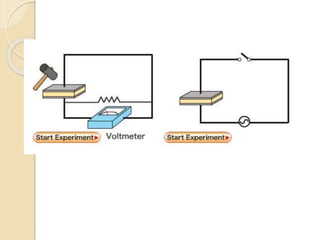
 Piezoelectric materials exhibit both a
direct and a reverse piezoelectric
effect.
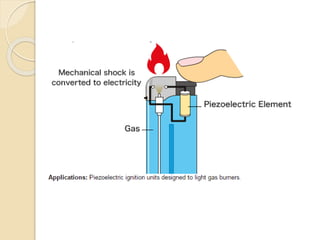
 The direct effect produces an
electrical charge when a mechanical
vibration or shock is applied to the
material, while the reverse effect
creates a mechanical vibration or
shock when electricity is applied.
Piezoelectric substances
 Piezoelectric substances are
polycrystalline materials consisting of
lead zirconate titanate, or PZT. Lead
(Pb), zirconium (Zr) and titanium (Ti) are
combined with additives to achieve
desired levels of performance.
 A PZT component possesses the unique
ability to generate vibrations based on its
shape when electricity is applied, and to
generate electricity upon exposure to
mechanical vibration or shock.
Magnetic Ceramics
 Magnets possess north and south
poles and generate magnetic fields.
 Most ceramics are nonmagnetic, with
ferrite being one notable exception.
Applications: Magnets and coils.
Magnetic Properties
 Ferrite is well known among Fine
Ceramic materials for its magnetic
properties.
 Ferrites are made by mixing and
sintering iron oxide, manganese oxide
and nickel oxide powders.
 Their primary uses include serving as
magnets and magnetic coils in a wide
variety of electronic circuits, and in
electronic devices, such as transformers
and loudspeakers.
Superconductivity and Fine
Ceramics
 All metals possess some level of electrical
resistance — even those that exhibit a high degree
of electrical conductivity, such as iron and copper.
 If this resistance can be eliminated, a single charge
of electricity in a conducting loop will keep flowing
indefinitely.
 This state is called superconductivity.
 Researchers are now working on ways to harness
this phenomenon in exciting new applications,
including superconductor powered high-speed
trains, energy storage systems with
superconductive coils, electricity-generating
superconductive motors, and computers with
Superconductivity
 In order to attain superconductivity,
most materials must be cooled to near
absolute zero (-273oC / -459oF), a
state which cannot easily be achieved.
 Fine Ceramics have been observed
to exhibit superconductivity at
significantly higher temperatures, up
to about -140oC (-220oF).
Optical Properties of Fine
Ceramics
 Multicrystalline Fine Ceramics possess a
microstructure of crystal grain boundaries
and microscopic pores which diffuses light
and makes it difficult to pass through.
 In contrast, single-crystal sapphire contains
no grain boundaries or pores, making it as
clear as glass.
 It also exhibits far superior strength and
thermal conductivity than glass.
 As a result, single-crystal sapphire is an
excellent material for making windows for
high power LCD projectors, among other
things.
 Additionally, semiconductive and
dielectric crystals are employed in
products that make use of the tonal
and refractive changes in light which
result from interactions between
crystals and magnetic fields.
 Applications: Windows for high
power LCD projectors, fluorescent
lights, light sensors and other related
products.
Classifying Fine Ceramics by
Optical Properties
 Fine Ceramics are sintered materials
consisting of microscopic crystal
particles separated by boundary
elements.
 Fine Ceramics can be made
translucent by minimizing pores and
boundary elements after sintering, and
by increasing crystal size in order to
reduce boundary interfaces.
 Fine Ceramic crystals have
semiconductive, ferrodielectric and
ferromagnetic properties. These
exhibit changes in fluorescence,
phosphorescence, color tone and
 birefringence due to interactions with
light and electric / magnetic fields.
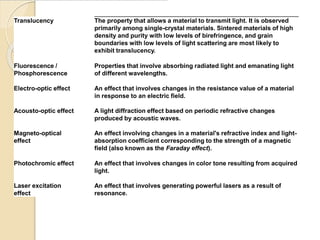
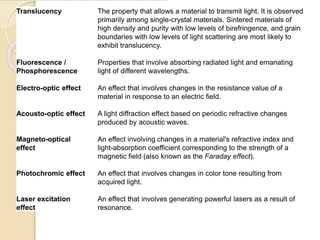
Translucency The property that allows a material to transmit light. It is observed
primarily among single-crystal materials. Sintered materials of high
density and purity with low levels of birefringence, and grain
boundaries with low levels of light scattering are most likely to
exhibit translucency.
Fluorescence /
Phosphorescence
Properties that involve absorbing radiated light and emanating light
of different wavelengths.
Electro-optic effect An effect that involves changes in the resistance value of a material
in response to an electric field.
Acousto-optic effect A light diffraction effect based on periodic refractive changes
produced by acoustic waves.
Magneto-optical
effect
An effect involving changes in a material's refractive index and light-
absorption coefficient corresponding to the strength of a magnetic
field (also known as the Faraday effect).
Photochromic effect An effect that involves changes in color tone resulting from acquired
light.
Laser excitation
effect
An effect that involves generating powerful lasers as a result of
resonance.
Fine Ceramics:
Harder Than Stainless Steel
 The signature feature of Fine is their
extreme hardness; as a result, they
have valuable use in high-
performance applications, such as
industrial cutting tools for milling and
grinding metals.
A material's hardness
 A material's hardness is determined by
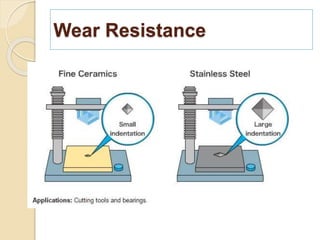
measuring the size of an indentation
made by a sharp diamond pressed
strongly onto a material specimen.
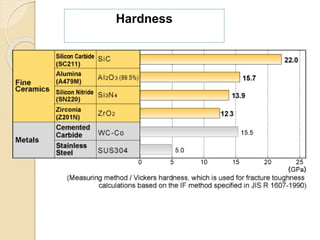
 The hardness of alumina ceramics is
nearly three times that of stainless steel;
silicon carbide is more than four times
harder than stainless steel.
 This extreme hardness is one of many
unique properties that makes Fine
Ceramics "super materials" for modern
technology.
Hardness
 The hardness of Fine Ceramics is generally
indicated using a Vickers hardness number.
 Hardness is a resistance value obtained by
pressing a diamond indenter onto a test
specimen.
 Extreme hardness is the primary feature that
endows Fine Ceramics with their superior
wear resistance.
 This has led to the use of Fine Ceramics in a
wide range of applications, including pump
components, cutting tools, seal rings,
bearings and a multitude of wear-resistant
components for industrial equipment.
Hardness
Strength of Fine Ceramics
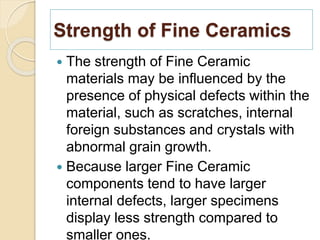
 The strength of Fine Ceramic
materials may be influenced by the
presence of physical defects within the
material, such as scratches, internal
foreign substances and crystals with
abnormal grain growth.
 Because larger Fine Ceramic
components tend to have larger
internal defects, larger specimens
display less strength compared to
smaller ones.
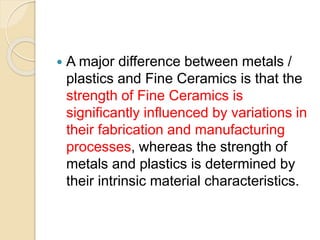
 A major difference between metals /
plastics and Fine Ceramics is that the
strength of Fine Ceramics is
significantly influenced by variations in
their fabrication and manufacturing
processes, whereas the strength of
metals and plastics is determined by
their intrinsic material characteristics.
Wear Resistance
 Fine Ceramics that exhibit excellent
hardness also greatly surpass most
metals in wear resistance.
 During wear resistance tests, small
glass beads were continously sprayed
at high speeds onto Fine Ceramics
and metals for extended periods of
time.
 The Fine Ceramics displayed only about
10 percent of the abrasion observed in the
stainless steel samples.
 Additionally, during a test in which disks
with Fine Ceramics and metals attached
were continously rotated in wet sand for
eight hours, the Fine Ceramics displayed
considerably less abrasion.
Wear Resistance
HARDNESS
 RIGIDITY
 TOUGHNESS
 SPECIFIC GRAVITY
Rigidity
 Fine Ceramics (also known as
“advanced ceramics”) possess high
rigidity, which is measured by
inspecting the elasticity of a specimen
after applying a load.
 Materials that display less elastic
deformation under load possess
higher levels of rigidity.
 The coefficient of extension with
respect to a load is called Young's
Using Young's modulus to
measure rigidity
 Using Young's modulus to measure rigidity,
alumina and silicon carbide display nearly
double the values of stainless steel. Why is
high rigidity advantageous?
 It allows ceramic components to be
manufactured to much higher levels of
precision with regard to size and shape.
 In some cases, large mechanical stresses
are generated on a material while it is being
ground to final specifications.
 The less deformation that occurs during this
process, the more precisely the parts can be
processed.
Rigidity
 Rigidity, also known as "stiffness," is
generally measured using Young's
modulus.
 It can be defined as the "force necessary
to bend a material to a given degree."
 As shown in the graph below, Fine
Ceramics are highly rigid materials,
according to Young's modulus.
 This makes their machining accuracy
high enough to enable them to be used
for high-precision parts.
Young's Moduluses
Why High Rigidity Yields High
Machining Accuracy
TOUGHNESS:
Overcoming Fragility
 Zirconia Ceramics
 Typically, ceramics are characterized by
hardness as well as a lack of toughness.
 The toughness of a material is measured by
its resistance to fracturing. Among Fine
Ceramics , zirconia possesses relatively high
levels of toughness.
 As a result, it is used for products such as
blades, scissors and knives.
 Applications: Knives, scissors and other
related products.
Toughness
 Fracture toughness measures a fissured
material's resistance to fracturing (whether
the fissures exist throughout the material or
only on its surface).
 The fracture toughness of Fine Ceramics is
measured using the critical stress intensity
factor KIC at crack terminations where
fracturing generally occurs.
 Though Fine Ceramics generally possess low
fracture toughness, partially-stabilized
zirconia, used for products such as scissors
and knives, offers significant fracture-
toughness improvements.
Fracture Toughness
SPECIFIC GRAVITY
 Fine Ceramics: Strong but Light
 Fine Ceramics are lighter than high-
strength metals.
 Within the same volume, many Fine
Ceramic materials weigh only half as
much as metal counterparts.
Specific Gravity
 Density refers to a material's mass per
cubic centimeter, while specific
gravity refers to the density ratio
between a given material and water,
where water is assigned a value of 1.
 Many Fine Ceramic materials have
specific gravities less than half those
of ferrous metals.
Specific Gravities
CERAMICS:
THERMAL PROPERTIES
 HEAT RESISTANCE
 THERMAL EXPANSION
 THERMAL CONDUCTIVITY
HEAT RESISTANCE
 Conventional ceramics, including bricks
and tiles, are well known for their ability
to withstand high temperatures.
 Nonetheless, Fine Ceramics are more
heat resistant than these materials by
far.
 While aluminum begins to melt at
approximately 660oC (approx. 1,220oF),
alumina Fine Ceramics only begin to
melt or decompose at temperatures
above 2,000oC (approx. 3,632oF).
Heat and Thermal Shock
Resistance
 The heat resistant properties of Fine
Ceramics are measured by the
temperatures at which they begin to
melt, and by their levels of thermal
shock resistance. Thermal shock
resistance refers to a material's ability
to withstand rapid changes in
temperature.
 Silicon nitride, a particularly heat tolerant
material, displays superior resistance to
thermal shock, as tested by heating the
material to 550oC (1,022oF) and then
rapidly cooling it by dropping it into
water.
 Silicon nitride is thus suitable for
applications involving extreme
temperature variations, and in high-
temperature industries such as metal
manufacturing and energy generation.
Thermal Shock Resistance
(Water Immersion Test)
Testing Thermal Shock
Resistance
 A material's thermal shock resistance is
determined by the difference between
the peak temperature of the Fine
Ceramic which was heated, rapidly
cooled, and then fractured, and that of
the cooling media.
 Stresses are generated by temperature
differences between the interior and
surface of a test piece, which occur
during rapid cooling.
 When these stresses exceed the
strength of the Fine Ceramic, fracturing
 These temperature differences are
determined by the thermal conductivity of
ceramics, as well as the coefficient of
heat transfer between the Fine Ceramic
and the cooling media.
 In addition, the stresses generated are
determined by multiplying Young's
modulus, the coefficient of thermal
expansion, and the temperature
differences between the interior and
surface of the Fine Ceramic.
Low Thermal Expansion
 When materials are heated, their size
and volume increase in small
increments, in a phenomenon known
as thermal expansion.
 Expansion values vary depending on the
material being heated.
 The coefficient ratio of thermal
expansion indicates how much a
material expands per 1oC (2.2oF) rise in
temperature.
 Fine Ceramics have low coefficients of
thermal expansion — less than half
those of stainless steels.
Coefficient of Thermal
Expansion
 The ratio that a material expands in
accordance with changes in temperature
is called the coefficient of thermal
expansion.
 Because Fine Ceramics possess low
coefficients of thermal expansion, their
distortion values, with respect to
changes in temperature, are low.
 The coefficients of thermal expansion
depend on the bond strength between
the atoms that make up the materials.
 Covalent materials such as diamond,
silicon carbide and silicon nitride have
strong bonds between atoms,
resulting in low coeficients of thermal
expansion.
 In contrast, materials such as
stainless steel possess weaker bonds
between atoms, resulting in much
higher coefficients of thermal
expansion in comparison with Fine
Ceramics.
Coefficients of Thermal
Expansion
Fine Ceramics Offer a Wide
Range of Thermal
Conductivity
 The property that measures how well
heat is transmitted through a material
is called thermal conductivity.
 Among Fine Ceramics, some
materials possess high levels of
conductivity and transfer heat well,
while others possess low levels of
conductivity and transfer less heat.
 Aluminum nitride and silicon carbide
transfer heat particularly well.
 Aluminum nitride is used in packages for
semiconductors that emit high volumes
of heat, but must avoid accumulating
heat internally.
 Zirconia blocks heat effectively and its
coefficient of thermal conductivity is low
— 1/10 that of stainless steel.
 It is used for kiln walls, which are
exposed to high temperatures.
Thermal Conductivity
 The property that measures how easily
heat is transmitted through a material is
calledthermal conductivity.
 For ceramics, factors such as internal
porosity, grain boundaries and impurities
can affect this property.
 Higher or lower levels of thermal
conductivity can be attained in Fine
Ceramic materials by controlling these
factors.
Thermal Conductivity of
Ceramics
 Thermal conduction is generated by
the movement of electrons and the
transfer of lattice vibrations.
 Metals with low electrical resistance
and crystals in which lattice vibrations
are transferred easily (for example,
crystals with atoms or ions of similar
masses at lattice points and covalent
crystals with strong bonds) display
high thermal conductivity.
Thermal Conductivity at Room
Temperature
Chemical properties of fine
ceramics
 Chemical resistance
 Biocompatibility
Chemical resistance
 Fine ceramics are Highly Resistant
to Chemicals
 Fine Ceramics possess high levels of
chemical stability.
 As a result, Fine Ceramic materials
are highly resistant to chemical
corrosion.
Chemical Resistance
 Even the strongest materials may have a
limited range of applications if they are
chemically soluble.
 Harsh chemicals are frequently used in
factories; even water is corrosive to many
common metals.
 In order to measure chemical resistance,
several tests were conducted with Fine
Ceramics and iron that had been soaked in
chemicals — including hydrochloric acid,
sulfuric acid, nitric acid, sodium hydroxide
and hydrofluoric acid.
 The results were analyzed, and materials that
dissolved in relatively large quantities were
 Stainless steel dissolved in hydrochloric
acid, and, similarly, stainless steel,
zirconia and silicon nitride dissolved in
hydrofluoric acid, all exhibit high levels of
solubility.
 Alumina and silicon carbide displayed
resistance to all of the chemicals in the
tests. Alumina and silicon carbide are
substances which possess particularly
high levels of resistance to chemicals
(low chemical solubility).
Chemical Resistance
Biocompatibility
 Biocompatible Fine Ceramics
 The human body contains a wide
variety of chemical substances.
 Fine Ceramics (also known as
“advanced ceramics”) possess a high
degree of chemical resistance to acids
and alkalis.
 The artificial joints shown below are
made of materials that are compatible
with the internal chemistry of the
human body.
Biocompatibility
 Fine Ceramics are light, strong and
chemically stable.
 Due to these characteristics, Fine
Ceramics have helped advance the
field of medical science, and Fine
Ceramic materials and process
technologies have become crucial to
the development of contemporary
medicine.
Optical Properties of Fine
Ceramics
 Multicrystalline Fine Ceramics possess a
microstructure of crystal grain boundaries
and microscopic pores which diffuses light
and makes it difficult to pass through.
 In contrast, single-crystal sapphire contains
no grain boundaries or pores, making it as
clear as glass.
 It also exhibits far superior strength and
thermal conductivity than glass.
 As a result, single-crystal sapphire is an
excellent material for making windows for
high power LCD projectors, among other
things.
 Additionally, semiconductive and
dielectric crystals are employed in
products that make use of the tonal
and refractive changes in light which
result from interactions between
crystals and magnetic fields.
 Applications: Windows for high
power LCD projectors, fluorescent
lights, light sensors and other related
products.
Classifying Fine Ceramics by
Optical Properties
 Fine Ceramics are sintered materials
consisting of microscopic crystal
particles separated by boundary
elements.
 Fine Ceramics can be made
translucent by minimizing pores and
boundary elements after sintering, and
by increasing crystal size in order to
reduce boundary interfaces.
 In addition, some varieties of Fine
Ceramic crystals have
semiconductive, ferrodielectric and
ferromagnetic properties.
 These exhibit changes
in fluorescence,
phosphorescence, color
tone and birefringence due to
interactions with light and electric /
magnetic fields.
Translucency The property that allows a material to transmit light. It is observed
primarily among single-crystal materials. Sintered materials of
high density and purity with low levels of birefringence, and grain
boundaries with low levels of light scattering are most likely to
exhibit translucency.
Fluorescence /
Phosphorescence
Properties that involve absorbing radiated light and emanating
light of different wavelengths.
Electro-optic effect An effect that involves changes in the resistance value of a
material in response to an electric field.
Acousto-optic effect A light diffraction effect based on periodic refractive changes
produced by acoustic waves.
Magneto-optical
effect
An effect involving changes in a material's refractive index and
light-absorption coefficient corresponding to the strength of a
magnetic field (also known as the Faraday effect).
Photochromic effect An effect that involves changes in color tone resulting from
acquired light.
Laser excitation
effect
An effect that involves generating powerful lasers as a result of
resonance.
Fine Ceramic Materials at Work in the
Heart of Residential-use Fuel Cells
 Solid oxide fuel cell (SOFC) system
for residential use
Understanding the Features of
Fine Ceramics
 Various types of fuel cells are made by using
different materials for the cells at the heart of
the system. Polymer electrolyte fuel cells
(PEFC) using polymer electrolyte membranes
are already available for residential use.
However, one company has proceeded with
the development of solid oxide fuel cells
(SOFCs), which generate electricity even
more efficiently than PEFCs. For the cell
materials Kyocera uses Fine Ceramics, with
their superior heat resistance and durability,
and they have achieved one of the highest
levels of generating efficiency in the world.
Types of fuel cells for
residential use
Polymer electrolyte
fuel cells (PEFCs)
Solid oxide fuel cells
(SOFCs)
Cell (electrolyte) Polymer Fine Ceramics
Operating
temperature
Room temperature -
90°C
700°C and above
Generating efficiency 35 - 40% 45% and above
Main uses
· Cogeneration for
residential use
· Automotive use
· Cogeneration for
residential use
· Cogeneration for
business use
Fine Ceramics at Work in
Space
 Fine Ceramic Materials Play an Important
Role in Space DevelopmentThe Japanese
asteroid probe "Hayabusa" was the first in the
world to successfully bring back a sample of
material from an asteroid. Fine Ceramic
components (alumina) -- which have superior
strength, corrosion resistance, heat
resistance and insulating properties -- and
advanced metallizing technology (brazing
technology) -- which can join different
materials in a way which makes them
extremely airtight, even in space -- were used
on the terminals of the lithium-ion battery
mounted on the Hayabusa as an emergency
power source.
 Understanding Fine Ceramics and
Related Technologies
 On lithium-ion batteries, an insulating
material (which does not conduct
electricity) is needed between the
electrolytic solution inside and the
metal case that it is enclosed in, and
between the metal terminals used to
conduct the electricity and the lid.
 Highly reliable Fine Ceramics -- with their
superior strength, corrosion resistance,
heat resistance and insulating properties
-- are more suitable as a material than
resin or glass in order to maintain battery
performance over a long period of time in
the harsh environment of space, where
temperature variations are extreme and
there is exposure to cosmic rays
(radiation), and also to withstand the
impact when being launched into space
from earth.
 Furthermore, in order to prevent liquid
leaks from the battery, it is essential that
high levels of hermeticity (airtight
structure) are maintained, even in space.
 By using advanced metallizing
technology to join the different materials
of metal and Fine Ceramic used on the
battery, it was possible to achieve a seal
that remained highly reliable over a long
period of time and thus contributed to the
stable operation of the battery.
Fine Ceramics at Work in the
Deep Sea
 Fine Ceramic Materials Play an Important
Role in Submarine Earthquake Observation
 Silicon nitride, a Fine Ceramic material, exhibits
characteristic features of high compressive
strength, corrosion resistance and low specific
density in its use for submarine pressure-
resistant containers.
Conventionally, pressure-resistant containers
have been made of glass -- which cannot
withstand the same depth as containers made of
silicon nitride. Using Fine Ceramics (also known
as "advanced ceramics") has allowed the
installation of a seismograph at a sea depth of
11,000 meters (36,089 feet) in the Mariana
Trench, which is believed to be the world's
deepest.
 Self-Surfacing Ocean Bottom
Seismograph
 The self-surfacing ocean bottom
seismograph records seismic movement on
the bottom of the sea. Once measurements
are taken the main body separates from the
weight device and floats to the surface where
it is collected so the data can be analyzed.
Some ocean bottom seismographs have their
seismic data recorders placed in high-
pressure-resistant glass containers.
Measurement of seismic data in a deeper
sea, requires higher resistance to pressure,
thus an increase in use of ceramic containers
for this application is expected in the future.
Window glasses
Common window glass is produced by
adding oxides (e.g. CaO, Na2O) whose
cations are incorporated within SiO4
network. The cations break the
tetrahedral network. Glasses melt at
lower temperature than pure
amorphous SiO2.
Lower melting T makes it easier to form
objects (e.g, bottles). Some other
oxides (TiO2, Al2O3) substitute for
silicon and become part of the
network
Ceramics has a world of its
own
 Thank you

Ceramics in Materials Science

  • 1.
    Ceramics in Materials Science: By Prof.A. Balasubramanian Centre for Advanced Studies in Earth Science University of Mysore, India
  • 2.
    The basic elementsof materials science and engineering  Structure & composition of materials  Properties of materials  Processing and synthesis of materials  Performance of materials
  • 3.
    Classification of Solids: Crystalline solids have regular ordered arrays of components held together by uniform intermolecular forces.  The components of amorphous solids are not arranged in regular arrays. o Crystalline solids= atoms show short and long range order o amorphous (non-crystalline)= atoms show short range order only  Crystalline materials= - atoms(ions or molecules) in repeating 3D pattern (called a lattice)  - long-range order; ex.: NaCl,
  • 4.
    Properties of solids Properties are the way the material responds to the environment and external forces.  Mechanical properties – response to mechanical forces, strength, etc.  Electrical and magnetic properties - response electrical and magnetic fields, conductivity, etc.  Thermal properties are related to transmission of heat and heat capacity.  Optical properties include to absorption, transmission and scattering of light.  Chemical stability in contact with the environment - corrosion resistance.
  • 5.
    Structure of Solids •Subatomic level  Electronic structure of individual atoms that defines interaction among atoms (interatomic bonding). • Atomic level  Arrangement of atoms in materials (for the same atoms can have different properties, e.g. two forms of carbon: graphite and diamond) • Microscopic structure  Arrangement of small grains of material that can be identified by microscopy. • Macroscopic structure  Structural elements that may be viewed with the naked eye. Annealing of a polycrystalline grain structure 2D simulation using Monte Carlo Potts model. 2D simulations involve 40,000 sites and takes a day to run on a fast workstation, 3D simulations involve 64 million sites, runs on 1000 processors of ASCI-Red. Monarch butterfly ~ 0.1 m
  • 10.
    Types of Materials Metals: valence electrons are detached from atoms, and spread in an 'electron sea' that "glues" the ions together. Strong, ductile, conduct electricity and heat well, are shiny if polished.  Semiconductors: the bonding is covalent (electrons are shared between atoms). Their electrical properties depend strongly on minute proportions of contaminants. Examples: Si, Ge, GaAs.  Ceramics: atoms behave like either positive or negative ions, and are bound by Coulomb forces. They are usually combinations of metals or semiconductors with oxygen, nitrogen or carbon (oxides, nitrides, and carbides). Hard, brittle, insulators. Examples: glass, porcelain.  Polymers: are bound by covalent forces and also by weak van der Waals forces, and usually based on C and H. They decompose at moderate temperatures (100 – 400 C), and are lightweight. Examples: plastics rubber.
  • 11.
    Types of Materials 11 •Metals: – Strong, ductile – High thermal & electrical conductivity – Opaque, reflective. • Polymers/plastics: Covalent bonding  sharing of e’s – Soft, ductile, low strength, low density – Thermal & electrical insulators – Optically translucent or transparent. • Ceramics: ionic bonding (refractory) – compounds of metallic & non-metallic elements (oxides, carbides, nitrides, sulfides) – Brittle, glassy, elastic – Non-conducting (insulators)
  • 12.
    12 The Materials Selection Process 1.Pick Application Determine required Properties Processing: changes structure and overall shape ex: casting, sintering, vapor deposition, doping forming, joining, annealing. Properties: mechanical, electrical, thermal, magnetic, optical, deteriorative. Material: structure, composition. 2. Properties Identify candidate Material(s) 3. Material Identify required Processing
  • 13.
    MINERALS  3000 MINERALS METALLIC MINERALS  NON-METALLIC MINERALS  MINERAL FUELS  PAINTS & PGMENT MINERALS  INDUSTRIAL MINERALS ◦ Ceramics, abrasives, refractories,etc
  • 14.
    GLASSES CERAMIC MATERIALS CLAY REFRACTORIES ABRASIVESCEMENTSGLASSES ADVANCED CERAMICS GLASS CERAMICS STRUCTURAL CLAY PRODUCTS WHITEWARES FIRECLAY SILICA BASIC SPECIAL CERAMIC GROUPING
  • 15.
    Glasses Clay products RefractoriesAbrasivesCements Advanced ceramics -optical -composite reinforce -containers/ household -whiteware -bricks -bricksfor high T (furnaces) -sandpaper -cutting -polishing -composites -structural engine -rotors -valves -bearings -sensors Taxonomy of Ceramics
  • 16.
    USE OF CLAYSIN POTTERY
  • 17.
    What is clay? Soil contains sand, silt and clay components.  Topsoil contains a lot of organic material, which makes it good for growing plants.  Clays and inelastic earths are the results of decomposing rocks, in which the particle size is extremely small.
  • 18.
    Clay Is...  Claydiffers from the inelastic earths and fine sand because of its ability, when wet with the proper amount of water, to form a cohesive mass and to retain its shape when molded.  This quality is known as clay’s plasticity.  When heated to high temperatures, clay also partially melts, resulting in the tight, hard rock-like substance known as ceramic material.
  • 19.
    Clay minerals The clayminerals kaolin, smectite and palygorskite- sepiolite are among the world's most important and useful industrial minerals. Clay minerals are important in a number of geological applications such as stratigraphic correlations, indicators of environments of deposition and temperature for generation of hydrocarbons. In agriculture, the clay minerals are a major component of soils and determinant of soil properties. The clay minerals are important in construction where they are a major constituent in brick and tile. The physical and chemical properties of the clay minerals determine their utilization in the process industries.
  • 20.
    Classes of Clay Clay can be divided into several classes, based on characteristics and at what temperature the clay must be fired to in order for it to become mature, or reach its optimum hardness and durability.
  • 21.
    Clays- important characteristics The importantcharacteristics relating to the applications of clay minerals are a) particle size and shape, b) surface chemistry, c) surface area, d) Surface charge, and e) other properties specific to particular applications, including viscosity, colour, plasticity, green, dry and fired strength, absorption and adsorption, abrasion and pH. In all applications, the clay minerals perform a function and are not just inert components of the system.
  • 22.
    Three types ofclays  The three most commonly used clay bodies are earthenware clay bodies, mid-fire stoneware clay bodies, and high-fire stoneware clay bodies.  All three are available commercially in moist and ready-to-use form.  Clay bodies can also be produced by mixing dry clays and additives with water to create your own desired clay body.
  • 23.
    Physical stages ofclay  Clay ware takes on varying physical characteristics during the making of pottery.  Greenware: refers to unfired objects. At sufficient moisture content. Most plastic in form. Soft and malleable. Easily deformed by handling.  Leather-hard : refers to a clay body that has been dried partially. 15% moisture content. Very firm and only slightly pliable. Trimming and handle attachment possible.  Bone-dry : clay body reaches a moisture content at or near 0%. It is now ready to be bisque fired.  Bisque : clay after the object is shaped to the desired form and fired in the kiln for the first time. It is "bisque fired" or "biscuit fired". This firing changes the clay body in several ways. Mineral components of the clay body will undergo chemical changes that will change the colour of the clay.  Glaze fired : Final stage of pottery making. A glaze may be applied to the bisque form and the object can be decorated in several ways. After this the object is "glazed fired", which causes the glaze material to melt, then adhere to the object. The glaze firing will also harden the body still more as chemical processes can continue to occur in the body.
  • 24.
    Stages with temperaturerise  Spinel = Further heating to 925–950 °C converts metakaolin to an aluminium-silicon spinel which is sometimes also referred to as a gamma- alumina type structure: 2 Al2Si2O7 → Si3Al4O12 + SiO2.  Platelet mullite = Upon calcination above 1050 °C, the spinel phase nucleates and transforms to platelet mullite and highly crystalline cristobalite: 3 Si3Al4O12 → 2(3 Al2O3 · 2 SiO2) + 5 SiO2.  Needle mullite = Finally, at 1400 °C the "needle" form of mullite appears, offering substantial increases in structural strength and heat resistance. This is a structural but not chemical transformation.
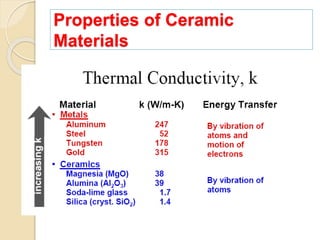
  • 25.
  • 26.
    Pottery and ceramics Pottery and ceramics are made by forming and firing raw materials including clay and pottery stones.  They are divided into several categories, such as earthenware and porcelain, depending on such factors as raw material composition, firing temperatures and water absorption.  Fine Ceramics are primarily composed of unique minerals such as alumina porcelain.
  • 27.
    Pottery  Pottery isthe ceramic act of making pottery wares, of which major types include  earthenware, stoneware and porcelain .  The place where such wares are made is also called a pottery (plural "potteries").  Pottery also refers to the art or craft of a potter or the manufacture of pottery.
  • 28.
    Definition of pottery “all fired ceramic wares that contain clay when formed, except technical, structural, and refractory products.”  Some archaeologists use a different definition by excluding ceramic objects such as figurines which are made by similar processes and of similar materials but are not vessels.
  • 29.
    Origin of pottery Pottery originated during the Neolithic period.  Ceramic objects like the Gravettian culture( Venus of Dolní Věstonice) figurine discovered in the Czech Republic date back to 29,000–25,000 BC.  Pottery vessels discovered in Jiangxi, China date back to 20,000 BP.  Early Neolithic pottery has also been found in Jomon Japan (10,500 BC)  the Russian Far East (14,000 BC)& Sub- Saharan Africa and South America.
  • 30.
    HISTORY OF POTTERYAND PORCELAIN  The potter's wheel: 3000 BC  Greek vases: 6th - 5th century BC  Glazed ceramics: 9th - 1st century BC  African terracotta figures: from the 5th century BC  T'ang pottery: 7th - 9th century  Islamic pottery: 9th-12th century  Pottery of the Song dynasty: 10th - 13th century  Japanese pottery and the Tea Ceremony: 13th - 16th c  Raku:1588 Korean  Kakiemon porcelain: 17th century – Japan  Majolica, faience and delftware: 14th-17th century – Europe  The European quest for porcelain: 16th-18th century  The porcelain prisoner: 1700-1714
  • 31.
    Pottery using claybody  Pottery is made by forming a clay body into objects of a required shape and heating them to high temperatures in a kiln which removes all the water from the clay, which induces reactions that lead to permanent changes including increasing their strength and hardening and setting their shape.
  • 32.
    Clay body canbe decorated  A clay body can be decorated before or after firing.  Prior to some shaping processes, clay must be prepared.  Kneading helps to ensure presence of an even moisture content throughout the clay body.  Air trapped within the clay body needs to be removed.  This is called de-airing and can be accomplished by a machine called a vacuum pug or manually by wedging.  Wedging can also help produce an even moisture content.  Once a clay body has been kneaded and de-aired or wedged, it is shaped by a variety of techniques.  After shaping it is dried and then fired.
  • 33.
    Clays bodies andmineral contents  There are several materials that are referred to as clay.  The properties of the clays differ, including:  Plasticity,  the malleability of the body;  the extent to which they will absorb water after firing; and  shrinkage, the extent of reduction in size of a body as water is removed.
  • 34.
    Different clay bodies Different clay bodies also differ in the way in which they respond when fired in the kiln.  A clay body can be decorated before or after firing.  Prior to some shaping processes, clay must be prepared.  Each of these different clays are composed of different types and amounts of minerals that determine the characteristics of resulting pottery.
  • 35.
    Mineral contents ofclay  It is common for clays and other materials to be mixed to produce clay bodies suited to specific purposes.  A common component of clay bodies is the mineral kaolinite.  Other mineral compounds in the clay may act as fluxes which lowers the vitrification temperature of bodies.
  • 36.
    Pottery  Includes glazedceramics fired at higher temperatures than earthenware (1,000 - 1,250oC / 1,832 - 2,282oF), but which possess water absorption properties.  Used in many modern products such as tea cups, tableware, vases and roof tiles.
  • 37.
    Different types ofclays used for pottery  Earthernware clays  Kaolin  Ball clay  Fire clay  Stoneware clay  Common red clay and Shale clay  Bentonite clay
  • 38.
    Earthenware Clays  theearliest clays used by potters  the most common type of clay found.  highly plastic (easily worked) and can be sticky.  contain iron and other mineral impurities which cause the clay to reach its optimum hardness at between 1745°F and 2012°F (950°C and 1100°C).  Typical colors for under moist status -red, orange, yellow, and light gray.  Colors for fired earthenware includes brown, red, orange, buff, medium grey, and white.  Fired colors are determined by the mineral impurities and the type of firing.
  • 39.
    Earthernware  Includes claybiscuit vessels that are kneaded, shaped and fired at low temperatures (approx. 800oC / 1,472oF).  Typical examples are many.  Archaeological artifacts from the Middle East dating from around 6000 B.C. were the first.  Modern uses include terracotta, flowerpots, red bricks, stoves and water filters.
  • 40.
    Kaolin (Porcelain) Clays Due to their mineral purity, kaolins are used for porcelain.  They are all very light in color.  While moist, they will be light grey and will fire in the range between a very light grey or buff, to near- white and white.  Kaolin clays are not nearly as plastic as other clays.  They are difficult to work with.  Pure kaolin clays fire to maturity at about 3272°F (1800°C).  They are often mixed with other clays to both increase workability and lower the firing temperature.  Many porcelain bodies are a mixture of kaolin and ball clays.
  • 41.
    Kaolin  Another verylarge user of kaolins is the ceramics industry, particularly in  whiteware,  sanitaryware,  insulators,  pottery and  refractories.  Both primary and secondary kaolins can have excellent ceramic properties.
  • 42.
    Industrial uses ofkaolin  Paper coating , Cement, Food additives  Paper filling , Pencil leads , Bleaching  Extender in paint , Adhesives, Fertilizers  Ceramic raw material , Tanning leather Plaster  Filler in rubber , Pharmaceuticals , Filter aids  Filler in plastics, Enamels , Cosmetics  Extender in ink Pastes, and glues Crayons  Cracking catalysts, Insecticide carriers, Detergents  Fibreglass, Medicines, Roofing granules  Foundries, Sizing, Linoleum  Desiccants, Textiles, Polishing compounds
  • 43.
    Kaolin- China Clay Kaolin, is sometimes referred to as China clay because it was first used in China.  part of the group of industrial minerals, with the chemical composition Al2Si2O5(OH)4.  It is a layered silicate mineral, with one tetrahedral sheet linked through oxygen atoms to one octahedral sheet of alumina octahedra.  Rocks that are rich in kaolinite are known as kaolin or china clay.
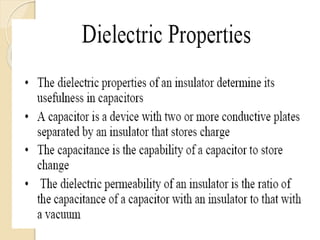
  • 44.
    Structural transformations  Kaolinitestructure  Kaolinite group clays undergo a series of phase transformations upon thermal treatment in air at atmospheric pressure.
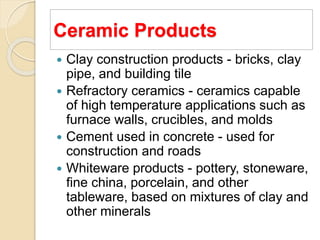
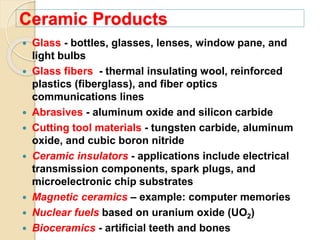
  • 45.
    Drying kaolin  Below100 °C, exposure to dry air will slowly remove liquid water from the kaolin.  The end-state for this transformation is referred to as "leather dry".  Between 100 °C and about 550 °C, any remaining liquid water is expelled from kaolinite. The end state for this transformation is referred to as "bone dry".  Through this state, the expulsion of water is reversible: if the kaolin is exposed to liquid water, it will be reabsorbed and disintegrate into its fine particulate form.  Subsequent transformations are not reversible, and represent permanent chemical changes.
  • 46.
    Metakaolin  Endothermic dehydrationof kaolinite begins at 550–600 °C producing disordered metakaolin, but continuous hydroxyl loss is observed up to 900 °C.  Comp: Al2Si2O5(OH)4 → Al2Si2O7 + 2 H2O.
  • 47.
    Ball Clays  Ballclays are highly plastic and contain few mineral impurities.  They fire to their mature hardness at about 2336°F (1300°C).  When moist , they are dark grey and when fired they are either light grey or light buff in color.
  • 48.
    Common Dry BallClays Used in Pottery  Ball clays are light-colored, highly plastic clays that are used to help clay bodies become more workable. They are also very prone to excessive shrinkage (generally between 12% and 15%) and warping. Because of these problems, they are not used by themselves in a clay body.  Champion Ball Clay  Champion ball clay fires to white and is known for excellent dry strength.
  • 49.
    Problems of Ballclays  Ball clays do have a serious drawback.  They cannot be used by themselves due to their excessive shrinkage during drying and firing.  They are extremely useful, however, when added to other clays to increase workability and plasticity.
  • 50.
    Ball clay  Ballclay An extremely plastic, fine grained sedimentary clay, which may contain some organic matter. Small amounts can be added to porcelain to increase plasticity.  Ball clays are kaolinitic sedimentary clays.  They consist of 20-80% kaolinite, 10- 25% mica, and 6-65% quartz.  They are fine-grained and plastic in nature.
  • 51.
    Fire Clays  Fireclays vary widely in their characteristics.  The hallmark is their high firing range.  They mature at about 2696°F (1500°C).  Although relatively free from mineral impurities, they tend to have spots of iron which lend a speckled appearance once fired.  Often used in stoneware clay bodies to increase their maturation temperature and to give the fired clay a bit extra roughness, or "tooth".  Used in fuel-fired kilns to create cone packs and to seal doors.
  • 52.
    Fire clay  Fireclay is a term applied to a range of refractory clays used in the manufacture of ceramics, especially fire brick.  This kind of clay has a slightly lower percentage of fluxes than kaolin.  It is usually quite plastic.  It is a highly heat resistant form of clay.  It can be combined with other clays to increase the firing temperature and may be used as an ingredient to make stoneware type bodies.
  • 53.
    Fire clay  Fireclay has a "mineral aggregate composed of hydrous silicates of aluminium (Al2O3.2SiO2.2H2O) with or without free silica.  A "fire clay“ material must withstand a minimum temperature of 1,515 °C .  High-grade fire clays can withstand temperatures of 1775 °C (3227 °F).  Fire clay is resistant to high temperatures, having fusion points higher than 1,600 °C (2,910 °F).  It is suitable for lining furnaces, as fire brick.  Suitable for the manufacture of utensils used in the metalworking industries(crucibles & glassware).
  • 54.
    Porcelain Clay Bodies Porcelain clay bodies are known for their hardness, their extremely tight density, their whiteness, and their translucence when the pottery's walls are thin.  Kaolin clays are the foundation of all porcelain clay bodies.  Kaolin is the purest form of clay.  It is also so non-plastic as to be nearly unworkable if not mixed with other clays.  Another difficulty is that porcelain clay bodies are very prone to warping during drying and in the kiln.  The purest porcelain bodies are fired at the highest temperatures used in pottery, usually between cone 11 and cone 14.  However, many porcelain clay bodies are modified to make the clay more workable and also to bring the firing temperature down.
  • 55.
    Porcelain  Includes colorfullyglazed, white ceramics hardened by forming and firing mixtures of high-purity clays (or pottery stones), silica and feldspars.  They were developed during China's Sui and Tang Dynasties (600 - 700 A.D.) and adopted worldwide.  Widely used in modern tableware, insulators, arts & craftworks and exterior tiles.
  • 56.
    Stoneware Clays  Stonewareclays are plastic and are often grey in color when occur with moisture.  Their fired colors range through light grey and buff, to medium grey and brown.  Fired colors are greatly affected by the type of firing.
  • 57.
    Stoneware clay  Suitablefor creating stoneware.  has many of the characteristics between fire clay and ball clay,  It contains finer grains, like ball clay  It is more heat resistant like fire clays.
  • 58.
    Stoneware Clay Bodies Generally speaking, stoneware clay bodies fire to a gray, buff, tan, or light brown color.  Color will vary with the same clay, depending on the kiln's atmosphere.  Darker colors are possible with the addition of slips, such as Alberta Slip, or of coloring oxides.  Stoneware clays get their name from the dense, rock-like nature of the clay body when it is fired to its maturation temperature.  There are some naturally occurring stoneware clays that need little modification.  Usually, however, a stoneware clay body adds other ingredients for optimal performance.  For example, ball clays may be added for plasticity, or fire clays may be added to raise the maturation temperature of the clay body.
  • 59.
    Stoneware  These ceramicsare composed of purer clay, fire-hardened and lacking water absorption properties.  Today, they are used for clay pipes, pavement bricks, artisan pots and tea sets.
  • 60.
    Dry Stoneware andFire Clays  There are several dry fire clays and stoneware clays available to the studio potter.  These dry clays are used to create custom clay bodies, using clay body recipes.
  • 61.
    Low-fire bodies  Low-firebodies are defined by when the temperature at which the clay body matures, generally considered to be between cones 09 and 02 (1700⁰ and 2000⁰ F or 927⁰ and 1093⁰ C).  Low-fire clays tend to have good workability and usually will not shrink, warp, or sag excessively.  However, they are softer which means that they are less durable and will absorb liquids.  Low-fire clays are divided into two types according to their color after firing.  Darker-colored bodies (most commonly red), and the white and buff clay bodies.
  • 62.
    Mid-Fire Stoneware Clay Bodies Mid-Fire Stoneware Clay Bodies  are formulated to fire to maturity between 2150°F and 2260°F (1160°C and 1225°C).  High-Fire Stoneware Clay Bodies  fire to their mature hardness between 2200°F and 2336°F (1200°C and 1300°C).
  • 63.
    Differences Between Mid- Rangeand High-Fire Clays  the distinguishing factor is the temperature at which the clay matures. (heating cones in sequence)  Mid-range clay bodies high to maturity between cone 4 and cone 7.  High-fire clay bodies are usually considered to be those that mature between cone 8 and cone 11, although some porcelains go all the way to cone 14.  The ingredients used in mid-range and high-fire clay bodies are very similar within their type.  The main difference is that, in relation to high-fire bodies, mid-range bodies will have either less refractory elements, more fluxing agents, or a combination of these two.
  • 64.
    Red or DarkEarthenware Clays  can range from a orange-red to a dark brown, with red being the most common.  Their color derives from the iron-bearing clays used their clay bodies.  The iron already within the clay body acts as a fluxing (melting) agent, which matures the clay at relatively low temperatures.  Earthenware clays melt at such low temperatures that they seldom become fully vitrified. Because of this, the fired ware will continue to absorb liquids.  For this reason, functional ware is almost always glazed.
  • 65.
    White or BuffEarthenware Clays  Because of an increased interest in low-temperature firing, new varieties of low-fire clay bodies have been developed.  These clay bodies have also been given the label “earthenware” due to the fact that they mature in the earthenware temperature range.  The idea of low-firing white clay bodies actually began further back to Europe, when pottery factories began trying to duplicate the porcelain ware that had become available from the eastern Asia.  These clay bodies required large quantities of fluxing agents, in order to lower the melting temperature for the relatively clean mixtures of kaolin and ball clays.  The white bodies of today are still composed of about half clay and half added fluxing agent, such as talc.
  • 66.
    Common red clayand Shale  Common red clay and Shale clay have vegetable and ferric oxide impurities which make them useful for bricks.  Generally unsatisfactory for pottery except under special conditions of a particular deposit.
  • 67.
    Bentonite  An extremelyplastic clay which can be added in small quantities to short clay to increase the plasticity.  Bentonite is an absorbent aluminium phyllosilicate,  It is an impure clay consisting mostly of montmorillonite.  There are different types of bentonite, each named after the respective dominant element, such as potassium (K), sodium (Na), calcium ( Ca), and aluminium (Al).
  • 68.
    Smectite Smectite is themineral name given to a group of Na, Ca, Mg, Fe, and Li-A1 silicates. The mineral names in the smectite group which are most commonly used are Na-montmorillonite, Ca- montmorillonite, saponite (Mg), nontronite (Fe), and hectorite (Li). The rock in which these smectite minerals are dominant is bentonite.
  • 69.
    Methods of shapingin pottery  Hand building  The potter's wheel  Granulate pressing  Injection moulding  Jiggering and jolleying  Roller-head machine  Pressure casting  RAM pressing  Slipcasting
  • 70.
    Glaze  Glaze isa glassy coating on pottery  The primary purposes is for decoration and protection.  One important use of glaze is to render porous pottery vessels impermeable to water and other liquids.  Glaze may be applied by dusting the unfired composition over the ware or by spraying, dipping, trailing or brushing on a thin slurry composed of the unfired glaze and water.  The colour of a glaze after it has been fired may be significantly different from before firing.
  • 71.
    Specialised glazing techniques; Salt-glazing In Salt-glazing, common salt is introduced to the kiln during the firing process.  The high temperatures cause the salt to volatize, depositing it on the surface of the ware to react with the body to form a sodium aluminosilicate
  • 72.
    Glazing Methods -Ashglazing  Ash glazing - ash from the combustion of plant matter has been used as the flux component of glazes.  The source of the ash was generally the combustion waste from the fuelling of kilns although the potential of ash derived from arable crop wastes has been investigated.  They are now limited to small numbers of studio potters who value the unpredictability arising from the variable nature of the raw material.
  • 73.
    Glazing Methods  Underglazedecoration (in the manner of many blue and white wares).  Underglaze may be applied by brush strokes, air brush, or by pouring the underglaze into the mold, covering the inside, creating a swirling effect, then the mold is filled with slip.  In-glaze decoration  On-glaze decoration  Enamel
  • 74.
    Firing  Firing producesirreversible changes in the body.  It is only after firing that the article or material is pottery.  In lower-fired pottery, the changes include sintering, the fusing together of coarser particles in the body at their points of contact with each other.  In the case of porcelain, where different materials and higher firing-temperatures are used, the physical, chemical and mineralogical properties of the constituents in the body are greatly altered.
  • 75.
    Object of firing In all cases, the object of firing is to permanently harden the wares and the firing regime must be appropriate to the materials used to make them.  As a rough guide, earthenwares are normally fired at temperatures in the range of about 1,000°C (1,830 °F) to 1,200 °C (2,190 °F); stonewares at between about 1,100 °C (2,010 °F) to 1,300 °C (2,370 °F); and  porcelains at between about 1,200 °C (2,190 °F) to 1,400 °C (2,550 °F).
  • 76.
    Kilns  Kilns maybe heated by burning wood, coal and gas or by electricity.  When used as fuels, coal and wood can introduce smoke, soot and ash into the kiln which can affect the appearance of unprotected wares.  For this reason, wares fired in wood- or coal- fired kilns are often placed in the kiln in saggars, lidded ceramic boxes, to protect them.  Modern kilns powered by gas or electricity are cleaner and more easily controlled than older wood- or coal-fired kilns and often allow shorter firing times to be used.
  • 77.
    Ceramics  A wide-ranginggroup of materials whose ingredients are clays, sand and feldspar.
  • 78.
  • 80.
    Ceramics  Glass: Amorphoussubstance made by fusing and forming minerals such as silica, limestone and soda ash.  Cement: Fine powder made by mixing, firing and grinding minerals such as limestone and silica, which bind stone and sand through hydration to make concrete.  Refractories: Able to withstand high temperatures: used in the construction of kilns for making iron, steel and glass.
  • 81.
    Ceramics:  Abrasive- grinding wheel:Made by binding fine-grain alumina and silicon carbide.  Porcelain enamel: Metal plate coated with fused glass.
  • 82.
    Ceramics  keramikos -burnt stuff in Greek -properties achieved through high-temperature heat treatment (firing).  Usually metallic + non-metallic elements  Always composed of more than one element (e.g., Al2O3, NaCl, SiC, SiO2)  Bonds are partially or totally ionic  Hard and brittle  Electrical and thermal insulators  Optically opaque, semi-transparent, or transparent  Traditionally based on clay (china, bricks, tiles, porcelain) and glasses  “New ceramics” for electronic, computer, aerospace industries.
  • 83.
    Ceramic structure  Ceramicsare predominantly ionic in structure  The overall structure is electronically neutral  The relative difference of anion and cation determines the interstitial site in crystal.  The common ceramics are oxides and chlorides.  Cations fill in the hole of anion lattice.
  • 84.
    Bonding in Ceramics Electronegativity – ability of atoms to accept electrons (subshells with one electron - low electronegativity; subshells with one missing electron -high electronegativity). Bonding is mixed: ionic + covalent Degree of ionic depends on difference in electronegativities Cations(+); Anions(-)
  • 85.
    Crystal Structures: Predominantly Ionicin ceramics  Crystal structure is defined by  Magnitude of electrical charge on each ion Charge balance dictates chemical formula (Ca2+ and F- form CaF2).  Relative sizes of cations and anions Cations want maximum possible number of anion nearest neighbors and vice-versa.
  • 86.
    Ceramic crystal structures: anions surrounding a cation are all in contact with it. For a specific coordination number there is a critical or minimum cation-anion radius ratio rC/rA for which this contact can be maintained
  • 87.
    Silicate Ceramics  Mainlyof silicon and oxygen, the two most abundant elements in earth’s crust (rocks, soils, clays, sand)  Basic building block: SiO4 4- tetrahedron  Si-O bonding is largely covalent, but overall SiO4 block has charge of –4  Various silicate structures – different ways to arrange SiO4 -4 blocks
  • 88.
    Silica = silicondioxide = SiO2  Every oxygen shared by adjacent tetrahedra  Silica is crystalline (quartz) or amorphous, as in glass (fused or vitreous silica)  3D network of SiO4 tetrahedra in cristobalite  High melting temperature of 1710 C
  • 89.
    Imperfections in Ceramics Point defects in ionic crystals are charged. Coulomb forces are large. Any charge imbalance has a strong tendency to balance itself. To maintain charge neutrality several point defects can be occur:  Frenkel defect: a pair of cation (positive ion) vacancies and a cation interstitial. Also be an anion (negative ion) vacancy and anion interstitial. Anions are larger than cations so not easy for an anion interstitial to form  Schottky defect is a pair of anion and cation vacancies
  • 90.
    Imperfections in Ceramics •Frenkel and Schottky defects do not change ratio of cations to anions  compound is stoichiometric • Non-stoichiometry (composition deviates from the one predicted by chemical formula) occurs when one ion type can exist in two valence states, e.g. Fe2+, Fe3+ • In FeO, Fe valence state is 2+.  Two Fe ions in 3+ state  an Fe vacancy is required to maintain charge neutrality   fewer Fe ions  non-stoichiometry
  • 91.
    Properties of ceramics High hardness, electrical and thermal insulating, chemical stability, and high melting temperatures  Brittle, virtually no ductility - can cause problems in both processing and performance of ceramic products  Some ceramics are translucent, window glass (based on silica) being the clearest example
  • 92.
    Mechanical Properties of Ceramics Brittle Fracture stress concentrators are very important. (Chap. 8: measured fracture strengths are much smaller than theoretical due to stress risers) Fracture strength greatly enhanced by creating compressive stresses in the surface region (similar to shot peening, case hardening in metals, Chap. 8)  Compressive strength is typically ten times the tensile strength Therefore ceramics are good structural materials under compression (e.g., bricks in houses, stone blocks in the pyramids).
  • 93.
    Plastic Deformation in Ceramics Crystalline ceramics: Slip (dislocation motion) is difficult because ions of like charge have to be brought close together  large barrier for dislocation motion In ceramics with covalent bonding slip is not easy (covalent bonds are strong)  ceramics are brittle.  Non-crystalline ceramic: no regular crystalline structure  no dislocations or slip. Materials deform by viscous flow (breaking and reforming bonds, allowing ions/atoms to slide past each other (like in a liquid)  Viscosity is a measure of glassy material’s resistance to deformation.
  • 94.
    Viscosity  Viscosity: measureof non-crystalline (glass or liquid) resistance to deformation. High-viscosity fluids resist flow; low- viscosity fluids flow easily.  How readily a moving layer of molecules drags adjacent layers of molecules along determines its viscosity.  Units are Pa-s, or Poises (P) 1 P = 0.1 Pa-s  Viscosity of water at room temp is ~ 10-3 P  Viscosity of typical glass at room temp >> 1016 P
  • 96.
  • 98.
    Ceramic Products  Clayconstruction products - bricks, clay pipe, and building tile  Refractory ceramics - ceramics capable of high temperature applications such as furnace walls, crucibles, and molds  Cement used in concrete - used for construction and roads  Whiteware products - pottery, stoneware, fine china, porcelain, and other tableware, based on mixtures of clay and other minerals
  • 99.
    Ceramic Products  Glass- bottles, glasses, lenses, window pane, and light bulbs  Glass fibers - thermal insulating wool, reinforced plastics (fiberglass), and fiber optics communications lines  Abrasives - aluminum oxide and silicon carbide  Cutting tool materials - tungsten carbide, aluminum oxide, and cubic boron nitride  Ceramic insulators - applications include electrical transmission components, spark plugs, and microelectronic chip substrates  Magnetic ceramics – example: computer memories  Nuclear fuels based on uranium oxide (UO2)  Bioceramics - artificial teeth and bones
  • 100.
    Three Basic Categoriesof Ceramics  Traditional ceramics - clay products such as pottery and bricks, common abrasives, and cement  New ceramics - more recently developed ceramics based on oxides, carbides, etc., and generally possessing mechanical or physical properties superior or unique compared to traditional ceramics  Glasses - based primarily on silica and distinguished by their noncrystalline structure ◦ In addition, glass ceramics - glasses transformed into a largely crystalline structure by heat treatment
  • 101.
    Physical Properties of Ceramics Density – in general, ceramics are lighter than metals and heavier than polymers  Melting temperatures - higher than for most metals ◦ Some ceramics decompose rather than melt  Electrical and thermal conductivities - lower than for metals; but the range of values is greater, so some ceramics are insulators while others are conductors  Thermal expansion - somewhat less than for metals, but effects are more damaging because of brittleness
  • 102.
    Traditional Ceramics Based onmineral silicates, silica, and mineral oxides found in nature  Primary products are fired clay (pottery, tableware, brick, and tile), cement, and natural abrasives such as alumina  Products and the processes to make them date back thousands of years  Glass is also a silicate ceramic material and is sometimes included among traditional ceramics
  • 103.
    Raw Materials forTraditional Ceramics  Mineral silicates, such as clays of various compositions, and silica, such as quartz, are among the most abundant substances in nature and constitute the principal raw materials for traditional ceramics  Another important raw material for traditional ceramics is alumina  These solid crystalline compounds have been formed and mixed in the earth’s crust over billions of years by complex geological processes
  • 104.
    New Ceramics Ceramic materialsdeveloped synthetically over the last several decades  The term also refers to improvements in processing techniques that provide greater control over structures and properties of ceramic materials  New ceramics are based on compounds other than variations of aluminum silicate, which form most of the traditional ceramic materials  New ceramics are usually simpler chemically than traditional ceramics; for example, oxides, carbides, nitrides, and borides
  • 105.
    Oxide Ceramics  Mostimportant oxide new ceramic is alumina  Although also included as a traditional ceramic, alumina is today produced from bauxite, using an electric furnace method.  Through control of particle size and impurities, refinements in processing methods, and blending with small amounts of other ceramic ingredients, strength and toughness of alumina are improved substantially compared to its natural counterpart  Alumina also has good hardness, low thermal conductivity, and good corrosion resistance.
  • 106.
    Products of OxideCeramics  Abrasives (grinding wheel grit)  Bioceramics (artificial bones and teeth)  Electrical insulators and electronic components  Refractory brick  Cutting tool inserts  Spark plug barrels  Engineering components
  • 107.
    Carbides  Silicon carbide(SiC), tungsten carbide (WC), titanium carbide (TiC), tantalum carbide (TaC), and chromium carbide (Cr3C2)  Although SiC is a man-made ceramic, its production methods were developed a century ago, and it is generally included in traditional ceramics group  WC, TiC, and TaC are valued for their hardness and wear resistance in cutting tools and other applications requiring these properties  WC, TiC, and TaC must be combined with a metallic binder such as cobalt or nickel in order to fabricate a useful solid product
  • 108.
    Nitrides  The importantnitride ceramics are silicon nitride (Si3N4), boron nitride (BN), and titanium nitride (TiN)  Properties: hard, brittle, high melting temperatures, usually electrically insulating, TiN being an exception  Applications: ◦ Silicon nitride: components for gas turbines, rocket engines, and melting crucibles ◦ Boron nitride and titanium nitride: cutting tool material and coatings
  • 109.
    Glass  A stateof matter as well as a type of ceramic  As a state of matter, it refers to an amorphous (noncrystalline) structure of a solid material. ◦ The glassy state occurs in a material when insufficient time is allowed during cooling from the molten state for the crystalline structure to form.  As a type of ceramic, glass is an inorganic, nonmetallic compound (or mixture of compounds) that cools to a rigid condition without crystallizing
  • 110.
    Why So MuchSiO2 in Glass?  Because SiO2 is the best glass former ◦ Silica is the main component in glass products, usually comprising 50% to 75% of total chemistry ◦ It naturally transforms into a glassy state upon cooling from the liquid, whereas most ceramics crystallize upon solidification
  • 111.
    Other Ingredients inGlass  Sodium oxide (Na2O), calcium oxide (CaO), aluminum oxide (Al2O3), magnesium oxide (MgO), potassium oxide (K2O), lead oxide (PbO), and boron oxide (B2O3)  Functions: ◦ Act as flux (promoting fusion) during heating ◦ Increase fluidity in molten glass for processing ◦ Improve chemical resistance against attack by acids, basic substances, or water ◦ Add color to the glass ◦ Alter index of refraction for optical applications
  • 112.
    Elements Related toCeramics  Carbon ◦ Two alternative forms of engineering and commercial importance: graphite and diamond  Silicon  Boron  Carbon, silicon, and boron are not ceramic materials, but they sometimes ◦ Compete for applications with ceramics ◦ Have important applications of their own
  • 113.
    Graphite  Form ofcarbon with a high content of crystalline C in the form of layers  Bonding between atoms in the layers is covalent and therefore strong, but the parallel layers are bonded to each other by weak van der Waals forces  This structure makes graphite anisotropic; strength and other properties vary significantly with direction ◦ As a powder it is a lubricant, but in traditional solid form it is a refractory ◦ When formed into graphite fibers, it is a high strength structural material.
  • 114.
    Diamond Carbon with acubic crystalline structure with covalent bonding between atoms ◦ This accounts for high hardness  Industrial applications: cutting tools and grinding wheels for machining hard, brittle materials, or materials that are very abrasive; also used in dressing tools to sharpen grinding wheels that consist of other abrasives  Industrial or synthetic diamonds date back to 1950s and are fabricated by heating graphite to around 3000C (5400F) under very high pressures
  • 115.
    Silicon Semi-metallic element inthe same periodic table group as carbon .  One of the most abundant elements in Earth's crust, comprising  26% by weight  Occurs naturally only as chemical compound - in rocks, sand, clay, and soil - either as silicon dioxide or as more complex silicate compounds  Properties: hard, brittle, lightweight, chemically inactive at room temperature, and classified as a semiconductor.
  • 116.
    Applications and Importance ofSilicon  Greatest amounts in manufacturing are in ceramic compounds (SiO2 in glass and silicates in clays) and alloying elements in steel, aluminum, and copper.  Also used as a reducing agent in certain metallurgical processes .  Pure silicon is used as the base material in semiconductor manufacturing in electronic industries.  The vast majority of integrated circuits produced today are made from silicon.
  • 117.
    Boron Semi-metallic element insame periodic group as aluminum.  Comprises only about 0.001% of Earth's crust by weight, commonly occurring as minerals borax (Na2B4O7- 10H2O) and kernite (Na2B4O7-4H2O) .  Properties: lightweight, semiconducting properties, and very stiff (high modulus of elasticity) in fiber form.  Applications: B2O3 used in certain glasses, as a nitride (cBN) for cutting tools, and in nearly pure form as a fiber in polymer matrix composites.
  • 118.
    Temperature Ranges forFiring Glazes  Ceramic glazes each have a temperature range that they should be fired to.  If the glazes are fired at too low a temperature, the glaze will not mature.  If the temperature goes too high, the glaze will become too melted and run off the surface of the pottery.  For success, a potter must know their glazes' temperature ranges at which they become mature.  When potters talk about ceramic firing ranges, they are usually referring to the three most common: low-fire, mid-range, and high-fire ranges.  In regards to glazes, we need to add two other ranges: very low-fire, and lower mid-range firing ranges.
  • 119.
    Very Low-Fire  fromcone 022 (approx. 1112⁰F - 605⁰C)  to cone 013 (approx. 1566⁰F - 850⁰C)  This range is usually used for luster glazes and very low-firing overglazes.  Ware must be fired at least once at a higher temperature first, in order for the clay body to mature.  The ware will often not only go through a bisque firing, but also a higher temperature glaze firing.  Very low-fired overglazes and lusters are then applied to the already fired primary glaze.  The ware is returned to the kiln for a very low temperature firing in order to fuse the overglazes.
  • 120.
    Low-Fire  from cone012 (approx. 1623⁰F - 882⁰C)  to cone 02 (approx. 2048⁰F - 1120⁰C)  The low-fire range has historically been the most commonly used firing range. In the past this was mainly due to limitations in kiln technology.  However, low-fire temperatures allow potters to use a variety of colorants that either burn off or become unstable at higher temperatures.Low-fired ware can present some difficulties, including the clay body may remain overly porous  low-fire glaze colors can appear rather harsh and raw- looking  the high percentage of flux or stronger-acting fluxes used can result in a softer, less durable glaze, and many of the traditional glaze materials used in this range are quite toxic in their raw state
  • 121.
    Lower to Mid-Range from cone 01 (approx. 2079⁰F - 1110⁰C)  to cone 3 (approx. 2134⁰F - 1145⁰C)  The lower mid-range is one of the most overlooked, yet perhaps one of the potentially most exciting, of the temperature ranges.  Within this range, most earthenware and other low-fire clay bodies actually mature to their strongest and most durable state.  At the same time, many of the colorants that are available at lower temperatures are still useful within the lower mid-range temperatures.
  • 122.
    Mid-Range  from cone4 (approx. 2167⁰F - 1165⁰C)  to cone 7 (approx. 2264⁰F - 1210⁰C)  This range is being used more and more as potters become more concerned about energy and fuel usage.  Another factor has been the availability of electric kilns that can comfortably reach this range without severely decreasing the kiln's and the kiln elements' lifespans.  Other advantages to firing in the mid-range include ability to adjust and use stoneware clay bodies to this range in turn, mid-range stoneware bodies increase the durability of the ware mid-range glazes are also more durable than those fired at lower temperatures, and there is still a fairly extensive color range available.
  • 123.
    High Fire  fromcone 8 (approx. 2305⁰F - 1260⁰C)  to cone 14 (approx. 2530⁰F - 1390⁰C)  This range includes the stonewares and porcelains.  Glazes and clay bodies are dense and durable; however, the color range is limited.  Because of the varying effects of oxidation and reduction on glaze colorants, the few coloring oxides that are viable at this range can still produce a rich, if much more limited, palette.
  • 124.
    Ceramics v/s FineCeramics  Ceramic materials exhibit hardness, excellent heat and corrosion resistance, and electrical insulation properties.  Typical examples include china, firebricks, cements and glass.  In addition to these properties, Fine Ceramics (also known as “advanced ceramics”) have many advanced mechanical, electrical, electronic, magnetic, optical, chemical and biochemical characteristics.  Today, Fine Ceramics have many roles in fields such as semiconductors, automobiles, telecommunications, industrial machinery and healthcare.
  • 125.
    Physical differences between ceramicsand Fine Ceramics  The physical differences between ceramics and Fine Ceramics mainly arise from their raw materials and manufacturing processes.  Ceramics are manufactured by mixing, shaping and firing natural minerals including pottery stones, feldspar and clay.
  • 126.
    Fine Ceramics  Incontrast, Fine Ceramics are manufactured using highly purified natural raw materials, artificial raw materials synthesized through chemical processes and other non-naturally occurring compounds.  Through a series of precisely controlled, complex processes such as forming, machining, firing and grinding, these compounded raw materials turn into high-value-added products with excellent dimensional accuracy and functional characteristics.
  • 127.
    Fine ceramics  Engineeredmaterials with chemical compositions that are precisely adjusted using refined or synthesized raw powders and well-controlled methods of forming, sintering and processing.  They are widely used in fields such as semiconductors, automobiles and industrial machinery.  Fine Ceramics are also called new ceramics or advanced ceramics.
  • 128.
  • 129.
  • 130.
    Fine Ceramic Production Process The raw materials include inorganic solid powders with precisely controlled purity, particle size and distribution.  These raw materials are formulated for specific properties and functionality, then mixed with a binding agent or binder.  Afterward, they are shaped and cut to precise requirements and fired at extreme heat in temperature-controlled kilns.
  • 131.
     Firing removesthe moisture and binders.  With additional firing, powder particles are sintered together and the products shrink due to reduced porosity.  This process results in products of extreme density and hardness.
  • 132.
    1. Raw materials Milling / Mixing  Raw material milling and mixing are important processes in the production of Fine Ceramics (also known as “advanced ceramics”) that determine the material properties, quality and stability of finished products.  Raw powder and solvating media (such as water) are fed into a mill with ceramic balls.  This ball mill is then rotated or shaken to create a uniform mixture (called a slurry), with evenly distributed particles of various sizes.  Adjustments are made by adding raw powder and binder dispersants throughout this process.
  • 133.
    Spraying / Drying A slurry adjusted through raw material milling and mixing is sprayed and dried in a hot-air spray dryer to form a granulated powder of spherical bodies.  Enhancing the spherical composition of the raw material helps facilitate the next process: filling the forming dies.
  • 134.
    2. Forming 1. ColdIsostatic Press (CIP) 2. Cutting 3. Dry pressing 4. Hot pressing 5. Extrusion 6. Tape casting 7. Injection/casting
  • 135.
    Cold Isostatic press(CIP) This forming method involves pressing dried and granulated raw materials into a shape close to that of the finished product.  The granulated raw materials are poured into a rubber mold.  The mold is then put in a high-pressure container, where hydraulic pressure is applied evenly from all directions (isostatic pressing) in order to provide uniform, highly dense compaction.  This method is ideal for forming products with large dimensions.
  • 136.
  • 137.
    Cutting  Because ceramicsare very hard, cutting them after they have been sintered requires considerable energy and specialized tools such as diamond wheels.  Considering this, engineers strive to cut or process ceramics into a shape as close to the finished shape as possible before sintering, which involves estimating the degree of shrinkage that will take place during the sintering process.  Super hard tools and drills are used in this process.
  • 138.
  • 139.
    Dry pressing  Thisforming method involves filling a die with dried and granulated raw materials, and pressing them into a shape close to that of the finished product.  Granulated raw materials fill a metallic mold, and pressure is applied from the top and bottom (uniaxial press) to achieve highly dense compaction.  This method is ideal for mass-producing semi-complex machinery parts which require high levels of dimensional accuracy.
  • 140.
  • 141.
    Hot pressing  Thisforming method involves applying pressure at high temperatures in order to reduce porosity (voids) and produce dense sintered bodies.  A carbon mold is filled with raw powder, which is then heated and pressurized simultaneously from the top and bottom to make a sintered body.  This method yields ceramic bodies of simple shapes.
  • 142.
  • 143.
    Extrusion  This isa forming method in which dried and granulated raw materials are mixed with water, binder, a plasticizing agent and a dispersing agent.  The resulting clay-like, plastic body is then extruded into the desired shape under pressure.  This method is ideal for long products with continuous and unchanging cross-sections.
  • 144.
  • 145.
    Tape casting  Thismethod is used to produce continuous thin compacts using slurries composed of raw powder, binder and solvating media.  The tape casting process generally employs a "doctor blade" to spread the slurry into a thin film.  This process is ideal for preparing the "green" (unfired ceramic) tape used in manufacturing multilayer ceramic integrated circuit packages and ceramic chip capacitors.
  • 146.
    Injection/casting  This isa forming method in which dried and granulated raw materials are mixed with additives to provide a degree of fluidity.  The raw material is then pressure- filled into a forming die that gives it a shape close to that of the finished product.
  • 147.
    Injection Molding Process In the injection molding process, raw materials are mixed with resin in order to provide the necessary degree of fluidity, and then injected into the molding die.  The mold is then cooled to harden the binder and produce a "green" compact part (also known as an unsintered powder compact).
  • 148.
    Casting Process  Inthe casting process, mixed raw materials are combined with solvating media and a dispersant, and then fed into an absorbent die.  The materials are then dehydrated and solidified to make a compact.  Both methods are suitable for complex, three-dimensionally shaped products requiring high levels of dimensional accuracy.
  • 149.
  • 150.
  • 151.
    Sintering  In thefiring process, raw materials that are compression-molded (volumetric filling rate: approx. 60%) are heated at temperatures below their melting points to sinter powder and create density.  Ceramic powder particles induce mass transfer at high temperatures through contact points between particles, combining in a manner similar to water droplets.  Depending on the intended application, a variety of sintering methods may be used — such as vacuum sintering, atmosphere sintering and sintering in non-oxidizing atmospheres.
  • 152.
  • 153.
    Hot Isostatic Press(HIP)  In this process, gas pressure is applied isostatically at high temperatures to enhance sintering and produce dense bodies.  After materials are pre-sintered, and their density is increased to almost 95 percent of the theoretical density, they are placed in a pressure container equipped with a furnace.  Gas pressure is then applied isostatically at 1,000 to 2,000 atmospheres while being heated.
  • 154.
  • 155.
  • 156.
    Grinding / Polishing This important process is designed to fabricate products with high levels of dimensional accuracy and mirror- finished surfaces. It is generally performed using a diamond wheel.  Because ceramics are extremely hard, it is necessary to use diamond — the hardest material in the world — for the grinding and polishing process.
  • 157.
    Metallization  Metallization refersto the process of affixing a metallic layer to the surface of a sintered body to form conductive patterns or provide hermetic sealing.  One method involves coating the ceramic surface with a paste containing metallic powder, and then applying high temperatures to burn this metallic layer onto the surface of the ceramic.  A related method involves applying metallic layers through an electroplating process.
  • 158.
  • 159.
    Bonding  This isan important and value-adding process for joining multiple ceramic products, or joining ceramic products to metallic or resin materials.  Several methods may be employed to combine these items, including mechanical joining or other processes using adhesives, glass or wax.
  • 160.
  • 161.
    Quality control  Inspection Products are delivered after rigorous inspection. This inspection ensures that all products are tested to perform at the highest level and allows customers to use them with confidence.
  • 162.
    ELECTRICAL PROPS  Insulation Dielectricity  Conductivity  Piezoelectricity  Magnetism  Superconductivity
  • 163.
    Electrical Insulation  FineCeramics (also known as “advanced ceramics”) are insulating materials that do not conduct electricity.  A few examples of products - include packages for surface-mounted electronic components, such as quartz crystal oscillators and surface acoustic wave (SAW) filters.  These products are widely used in mobile phones, automotive navigation systems and portable music players.  Ceramic packages provide advanced hermetic sealing and electrical insulation between electric circuit lines to maintain the high reliability of these electronic components.
  • 164.
    Electrical Insulation  Amaterial that is unable to conduct electricity due to its high level of electrical resistance is an insulator. In contrast, a conductor is a material that offers low resistance to electric conductivity. An atom, the smallest unit of matter, is composed of a nucleus and electrons which orbit that nucleus.  Whether a substance is an insulator or a conductor generally depends on the number of free electrons it possesses, which can be used to carry electric current. A substance with higher insulation properties is less conductive because it possesses fewer free electrons.  In addition to Fine Ceramics, other insulators include paraffin, rubber, plastic, paper and marble. Because ceramics are fired in a kiln, they can be fashioned into a wide variety of shapes with excellent heat resistance and durability. For these reasons, ceramics have long been used as insulators.
  • 166.
    Accumulation of Electricity When voltage is applied to electrodes attached to opposite sides of an insulating ceramic, they exhibit electricity-accumulating properties. These insulators are said to be dielectric.  An insulator that can accumulate a volume of electricity exceptionally well is called ferroelectric.  Consequently, ceramic has become an indispensable material for producing capacitors and electronic components that are widely used in products such as computers, televisions and mobile phones.  Capacitors serve as "traffic controllers" within an electronic circuit by conducting electricity to certain parts, temporarily blocking electricity, or blocking only certain types of electrical signals.
  • 167.
    Dielectricity  Electricity, bydefinition, is the movement of electrons within the molecules of a material.  Although electrons can move freely within conductors, they cannot do so within insulators.  When a direct current voltage is applied to an insulator, electrons do not separate from molecules, and are divided by an electrical charge (positive or negative) induced at both ends of the material.  In addition, ions themselves may move.
  • 168.
     Materials inwhich electrical charges appear at both ends are called dielectric substances.  Dielectricity is measured by the relative dielectric constant, a value representing the ratio of the dielectric constant of the material in question and that of a vacuum.  The dielectric constant of quartz is 3.8, while that of sapphire (main component: oxidized aluminum) is 9.4.  The dielectric constant of barium titanate, a ferroelectric material, is as high as 4,000 to 5,000.
  • 169.
  • 171.
    Electrical Conduction  ThoughFine Ceramics (also known as “advanced ceramics”) are generally insulating materials that block electricity, semiconductor ceramics can be created to conduct electricity depending on their temperature and the level of voltage applied.
  • 172.
    Conductivity  Conductivity isa property that allows electricity to flow through a material.  Fine Ceramics are insulating materials in general, but some varieties exhibit electrical conductivity according to changes in temperature.
  • 174.
    PIEZOELECTRICITY  Converting MechanicalVibration into Electricity  Some Fine Ceramics (also known as “advanced ceramics”) possess a unique property allowing them to convert mechanical shock or vibration into electrical signals, and vice versa.  These materials, called piezoelectric ceramics, are built into a wide variety of products.
  • 175.
    Piezoelectricity  Piezoelectric materialsexhibit both a direct and a reverse piezoelectric effect.  The direct effect produces an electrical charge when a mechanical vibration or shock is applied to the material, while the reverse effect creates a mechanical vibration or shock when electricity is applied.
  • 176.
    Piezoelectric substances  Piezoelectricsubstances are polycrystalline materials consisting of lead zirconate titanate, or PZT. Lead (Pb), zirconium (Zr) and titanium (Ti) are combined with additives to achieve desired levels of performance.  A PZT component possesses the unique ability to generate vibrations based on its shape when electricity is applied, and to generate electricity upon exposure to mechanical vibration or shock.
  • 179.
    Magnetic Ceramics  Magnetspossess north and south poles and generate magnetic fields.  Most ceramics are nonmagnetic, with ferrite being one notable exception. Applications: Magnets and coils.
  • 180.
    Magnetic Properties  Ferriteis well known among Fine Ceramic materials for its magnetic properties.  Ferrites are made by mixing and sintering iron oxide, manganese oxide and nickel oxide powders.  Their primary uses include serving as magnets and magnetic coils in a wide variety of electronic circuits, and in electronic devices, such as transformers and loudspeakers.
  • 181.
    Superconductivity and Fine Ceramics All metals possess some level of electrical resistance — even those that exhibit a high degree of electrical conductivity, such as iron and copper.  If this resistance can be eliminated, a single charge of electricity in a conducting loop will keep flowing indefinitely.  This state is called superconductivity.  Researchers are now working on ways to harness this phenomenon in exciting new applications, including superconductor powered high-speed trains, energy storage systems with superconductive coils, electricity-generating superconductive motors, and computers with
  • 182.
    Superconductivity  In orderto attain superconductivity, most materials must be cooled to near absolute zero (-273oC / -459oF), a state which cannot easily be achieved.  Fine Ceramics have been observed to exhibit superconductivity at significantly higher temperatures, up to about -140oC (-220oF).
  • 183.
    Optical Properties ofFine Ceramics  Multicrystalline Fine Ceramics possess a microstructure of crystal grain boundaries and microscopic pores which diffuses light and makes it difficult to pass through.  In contrast, single-crystal sapphire contains no grain boundaries or pores, making it as clear as glass.  It also exhibits far superior strength and thermal conductivity than glass.  As a result, single-crystal sapphire is an excellent material for making windows for high power LCD projectors, among other things.
  • 184.
     Additionally, semiconductiveand dielectric crystals are employed in products that make use of the tonal and refractive changes in light which result from interactions between crystals and magnetic fields.  Applications: Windows for high power LCD projectors, fluorescent lights, light sensors and other related products.
  • 185.
    Classifying Fine Ceramicsby Optical Properties  Fine Ceramics are sintered materials consisting of microscopic crystal particles separated by boundary elements.  Fine Ceramics can be made translucent by minimizing pores and boundary elements after sintering, and by increasing crystal size in order to reduce boundary interfaces.
  • 186.
     Fine Ceramiccrystals have semiconductive, ferrodielectric and ferromagnetic properties. These exhibit changes in fluorescence, phosphorescence, color tone and  birefringence due to interactions with light and electric / magnetic fields.
  • 187.
    Translucency The propertythat allows a material to transmit light. It is observed primarily among single-crystal materials. Sintered materials of high density and purity with low levels of birefringence, and grain boundaries with low levels of light scattering are most likely to exhibit translucency. Fluorescence / Phosphorescence Properties that involve absorbing radiated light and emanating light of different wavelengths. Electro-optic effect An effect that involves changes in the resistance value of a material in response to an electric field. Acousto-optic effect A light diffraction effect based on periodic refractive changes produced by acoustic waves. Magneto-optical effect An effect involving changes in a material's refractive index and light- absorption coefficient corresponding to the strength of a magnetic field (also known as the Faraday effect). Photochromic effect An effect that involves changes in color tone resulting from acquired light. Laser excitation effect An effect that involves generating powerful lasers as a result of resonance.
  • 188.
    Fine Ceramics: Harder ThanStainless Steel  The signature feature of Fine is their extreme hardness; as a result, they have valuable use in high- performance applications, such as industrial cutting tools for milling and grinding metals.
  • 189.
    A material's hardness A material's hardness is determined by measuring the size of an indentation made by a sharp diamond pressed strongly onto a material specimen.  The hardness of alumina ceramics is nearly three times that of stainless steel; silicon carbide is more than four times harder than stainless steel.  This extreme hardness is one of many unique properties that makes Fine Ceramics "super materials" for modern technology.
  • 190.
    Hardness  The hardnessof Fine Ceramics is generally indicated using a Vickers hardness number.  Hardness is a resistance value obtained by pressing a diamond indenter onto a test specimen.  Extreme hardness is the primary feature that endows Fine Ceramics with their superior wear resistance.  This has led to the use of Fine Ceramics in a wide range of applications, including pump components, cutting tools, seal rings, bearings and a multitude of wear-resistant components for industrial equipment.
  • 191.
  • 192.
    Strength of FineCeramics  The strength of Fine Ceramic materials may be influenced by the presence of physical defects within the material, such as scratches, internal foreign substances and crystals with abnormal grain growth.  Because larger Fine Ceramic components tend to have larger internal defects, larger specimens display less strength compared to smaller ones.
  • 193.
     A majordifference between metals / plastics and Fine Ceramics is that the strength of Fine Ceramics is significantly influenced by variations in their fabrication and manufacturing processes, whereas the strength of metals and plastics is determined by their intrinsic material characteristics.
  • 194.
    Wear Resistance  FineCeramics that exhibit excellent hardness also greatly surpass most metals in wear resistance.  During wear resistance tests, small glass beads were continously sprayed at high speeds onto Fine Ceramics and metals for extended periods of time.
  • 195.
     The FineCeramics displayed only about 10 percent of the abrasion observed in the stainless steel samples.  Additionally, during a test in which disks with Fine Ceramics and metals attached were continously rotated in wet sand for eight hours, the Fine Ceramics displayed considerably less abrasion.
  • 196.
  • 197.
  • 198.
    Rigidity  Fine Ceramics(also known as “advanced ceramics”) possess high rigidity, which is measured by inspecting the elasticity of a specimen after applying a load.  Materials that display less elastic deformation under load possess higher levels of rigidity.  The coefficient of extension with respect to a load is called Young's
  • 199.
    Using Young's modulusto measure rigidity  Using Young's modulus to measure rigidity, alumina and silicon carbide display nearly double the values of stainless steel. Why is high rigidity advantageous?  It allows ceramic components to be manufactured to much higher levels of precision with regard to size and shape.  In some cases, large mechanical stresses are generated on a material while it is being ground to final specifications.  The less deformation that occurs during this process, the more precisely the parts can be processed.
  • 200.
    Rigidity  Rigidity, alsoknown as "stiffness," is generally measured using Young's modulus.  It can be defined as the "force necessary to bend a material to a given degree."  As shown in the graph below, Fine Ceramics are highly rigid materials, according to Young's modulus.  This makes their machining accuracy high enough to enable them to be used for high-precision parts.
  • 201.
  • 202.
    Why High RigidityYields High Machining Accuracy
  • 203.
    TOUGHNESS: Overcoming Fragility  ZirconiaCeramics  Typically, ceramics are characterized by hardness as well as a lack of toughness.  The toughness of a material is measured by its resistance to fracturing. Among Fine Ceramics , zirconia possesses relatively high levels of toughness.  As a result, it is used for products such as blades, scissors and knives.  Applications: Knives, scissors and other related products.
  • 204.
    Toughness  Fracture toughnessmeasures a fissured material's resistance to fracturing (whether the fissures exist throughout the material or only on its surface).  The fracture toughness of Fine Ceramics is measured using the critical stress intensity factor KIC at crack terminations where fracturing generally occurs.  Though Fine Ceramics generally possess low fracture toughness, partially-stabilized zirconia, used for products such as scissors and knives, offers significant fracture- toughness improvements.
  • 205.
  • 206.
    SPECIFIC GRAVITY  FineCeramics: Strong but Light  Fine Ceramics are lighter than high- strength metals.  Within the same volume, many Fine Ceramic materials weigh only half as much as metal counterparts.
  • 207.
    Specific Gravity  Densityrefers to a material's mass per cubic centimeter, while specific gravity refers to the density ratio between a given material and water, where water is assigned a value of 1.  Many Fine Ceramic materials have specific gravities less than half those of ferrous metals.
  • 208.
  • 209.
    CERAMICS: THERMAL PROPERTIES  HEATRESISTANCE  THERMAL EXPANSION  THERMAL CONDUCTIVITY
  • 210.
    HEAT RESISTANCE  Conventionalceramics, including bricks and tiles, are well known for their ability to withstand high temperatures.  Nonetheless, Fine Ceramics are more heat resistant than these materials by far.  While aluminum begins to melt at approximately 660oC (approx. 1,220oF), alumina Fine Ceramics only begin to melt or decompose at temperatures above 2,000oC (approx. 3,632oF).
  • 211.
    Heat and ThermalShock Resistance  The heat resistant properties of Fine Ceramics are measured by the temperatures at which they begin to melt, and by their levels of thermal shock resistance. Thermal shock resistance refers to a material's ability to withstand rapid changes in temperature.
  • 212.
     Silicon nitride,a particularly heat tolerant material, displays superior resistance to thermal shock, as tested by heating the material to 550oC (1,022oF) and then rapidly cooling it by dropping it into water.  Silicon nitride is thus suitable for applications involving extreme temperature variations, and in high- temperature industries such as metal manufacturing and energy generation.
  • 213.
  • 214.
    Testing Thermal Shock Resistance A material's thermal shock resistance is determined by the difference between the peak temperature of the Fine Ceramic which was heated, rapidly cooled, and then fractured, and that of the cooling media.  Stresses are generated by temperature differences between the interior and surface of a test piece, which occur during rapid cooling.  When these stresses exceed the strength of the Fine Ceramic, fracturing
  • 215.
     These temperaturedifferences are determined by the thermal conductivity of ceramics, as well as the coefficient of heat transfer between the Fine Ceramic and the cooling media.  In addition, the stresses generated are determined by multiplying Young's modulus, the coefficient of thermal expansion, and the temperature differences between the interior and surface of the Fine Ceramic.
  • 217.
    Low Thermal Expansion When materials are heated, their size and volume increase in small increments, in a phenomenon known as thermal expansion.  Expansion values vary depending on the material being heated.  The coefficient ratio of thermal expansion indicates how much a material expands per 1oC (2.2oF) rise in temperature.  Fine Ceramics have low coefficients of thermal expansion — less than half those of stainless steels.
  • 218.
    Coefficient of Thermal Expansion The ratio that a material expands in accordance with changes in temperature is called the coefficient of thermal expansion.  Because Fine Ceramics possess low coefficients of thermal expansion, their distortion values, with respect to changes in temperature, are low.  The coefficients of thermal expansion depend on the bond strength between the atoms that make up the materials.
  • 219.
     Covalent materialssuch as diamond, silicon carbide and silicon nitride have strong bonds between atoms, resulting in low coeficients of thermal expansion.  In contrast, materials such as stainless steel possess weaker bonds between atoms, resulting in much higher coefficients of thermal expansion in comparison with Fine Ceramics.
  • 220.
  • 221.
    Fine Ceramics Offera Wide Range of Thermal Conductivity  The property that measures how well heat is transmitted through a material is called thermal conductivity.  Among Fine Ceramics, some materials possess high levels of conductivity and transfer heat well, while others possess low levels of conductivity and transfer less heat.
  • 222.
     Aluminum nitrideand silicon carbide transfer heat particularly well.  Aluminum nitride is used in packages for semiconductors that emit high volumes of heat, but must avoid accumulating heat internally.  Zirconia blocks heat effectively and its coefficient of thermal conductivity is low — 1/10 that of stainless steel.  It is used for kiln walls, which are exposed to high temperatures.
  • 223.
    Thermal Conductivity  Theproperty that measures how easily heat is transmitted through a material is calledthermal conductivity.  For ceramics, factors such as internal porosity, grain boundaries and impurities can affect this property.  Higher or lower levels of thermal conductivity can be attained in Fine Ceramic materials by controlling these factors.
  • 224.
    Thermal Conductivity of Ceramics Thermal conduction is generated by the movement of electrons and the transfer of lattice vibrations.  Metals with low electrical resistance and crystals in which lattice vibrations are transferred easily (for example, crystals with atoms or ions of similar masses at lattice points and covalent crystals with strong bonds) display high thermal conductivity.
  • 225.
    Thermal Conductivity atRoom Temperature
  • 226.
    Chemical properties offine ceramics  Chemical resistance  Biocompatibility
  • 227.
    Chemical resistance  Fineceramics are Highly Resistant to Chemicals  Fine Ceramics possess high levels of chemical stability.  As a result, Fine Ceramic materials are highly resistant to chemical corrosion.
  • 228.
    Chemical Resistance  Eventhe strongest materials may have a limited range of applications if they are chemically soluble.  Harsh chemicals are frequently used in factories; even water is corrosive to many common metals.  In order to measure chemical resistance, several tests were conducted with Fine Ceramics and iron that had been soaked in chemicals — including hydrochloric acid, sulfuric acid, nitric acid, sodium hydroxide and hydrofluoric acid.  The results were analyzed, and materials that dissolved in relatively large quantities were
  • 229.
     Stainless steeldissolved in hydrochloric acid, and, similarly, stainless steel, zirconia and silicon nitride dissolved in hydrofluoric acid, all exhibit high levels of solubility.  Alumina and silicon carbide displayed resistance to all of the chemicals in the tests. Alumina and silicon carbide are substances which possess particularly high levels of resistance to chemicals (low chemical solubility).
  • 230.
  • 231.
    Biocompatibility  Biocompatible FineCeramics  The human body contains a wide variety of chemical substances.  Fine Ceramics (also known as “advanced ceramics”) possess a high degree of chemical resistance to acids and alkalis.  The artificial joints shown below are made of materials that are compatible with the internal chemistry of the human body.
  • 232.
    Biocompatibility  Fine Ceramicsare light, strong and chemically stable.  Due to these characteristics, Fine Ceramics have helped advance the field of medical science, and Fine Ceramic materials and process technologies have become crucial to the development of contemporary medicine.
  • 234.
    Optical Properties ofFine Ceramics  Multicrystalline Fine Ceramics possess a microstructure of crystal grain boundaries and microscopic pores which diffuses light and makes it difficult to pass through.  In contrast, single-crystal sapphire contains no grain boundaries or pores, making it as clear as glass.  It also exhibits far superior strength and thermal conductivity than glass.  As a result, single-crystal sapphire is an excellent material for making windows for high power LCD projectors, among other things.
  • 235.
     Additionally, semiconductiveand dielectric crystals are employed in products that make use of the tonal and refractive changes in light which result from interactions between crystals and magnetic fields.  Applications: Windows for high power LCD projectors, fluorescent lights, light sensors and other related products.
  • 236.
    Classifying Fine Ceramicsby Optical Properties  Fine Ceramics are sintered materials consisting of microscopic crystal particles separated by boundary elements.  Fine Ceramics can be made translucent by minimizing pores and boundary elements after sintering, and by increasing crystal size in order to reduce boundary interfaces.
  • 237.
     In addition,some varieties of Fine Ceramic crystals have semiconductive, ferrodielectric and ferromagnetic properties.  These exhibit changes in fluorescence, phosphorescence, color tone and birefringence due to interactions with light and electric / magnetic fields.
  • 238.
    Translucency The propertythat allows a material to transmit light. It is observed primarily among single-crystal materials. Sintered materials of high density and purity with low levels of birefringence, and grain boundaries with low levels of light scattering are most likely to exhibit translucency. Fluorescence / Phosphorescence Properties that involve absorbing radiated light and emanating light of different wavelengths. Electro-optic effect An effect that involves changes in the resistance value of a material in response to an electric field. Acousto-optic effect A light diffraction effect based on periodic refractive changes produced by acoustic waves. Magneto-optical effect An effect involving changes in a material's refractive index and light-absorption coefficient corresponding to the strength of a magnetic field (also known as the Faraday effect). Photochromic effect An effect that involves changes in color tone resulting from acquired light. Laser excitation effect An effect that involves generating powerful lasers as a result of resonance.
  • 239.
    Fine Ceramic Materialsat Work in the Heart of Residential-use Fuel Cells  Solid oxide fuel cell (SOFC) system for residential use
  • 240.
    Understanding the Featuresof Fine Ceramics  Various types of fuel cells are made by using different materials for the cells at the heart of the system. Polymer electrolyte fuel cells (PEFC) using polymer electrolyte membranes are already available for residential use. However, one company has proceeded with the development of solid oxide fuel cells (SOFCs), which generate electricity even more efficiently than PEFCs. For the cell materials Kyocera uses Fine Ceramics, with their superior heat resistance and durability, and they have achieved one of the highest levels of generating efficiency in the world.
  • 241.
    Types of fuelcells for residential use Polymer electrolyte fuel cells (PEFCs) Solid oxide fuel cells (SOFCs) Cell (electrolyte) Polymer Fine Ceramics Operating temperature Room temperature - 90°C 700°C and above Generating efficiency 35 - 40% 45% and above Main uses · Cogeneration for residential use · Automotive use · Cogeneration for residential use · Cogeneration for business use
  • 242.
    Fine Ceramics atWork in Space  Fine Ceramic Materials Play an Important Role in Space DevelopmentThe Japanese asteroid probe "Hayabusa" was the first in the world to successfully bring back a sample of material from an asteroid. Fine Ceramic components (alumina) -- which have superior strength, corrosion resistance, heat resistance and insulating properties -- and advanced metallizing technology (brazing technology) -- which can join different materials in a way which makes them extremely airtight, even in space -- were used on the terminals of the lithium-ion battery mounted on the Hayabusa as an emergency power source.
  • 243.
     Understanding FineCeramics and Related Technologies  On lithium-ion batteries, an insulating material (which does not conduct electricity) is needed between the electrolytic solution inside and the metal case that it is enclosed in, and between the metal terminals used to conduct the electricity and the lid.
  • 244.
     Highly reliableFine Ceramics -- with their superior strength, corrosion resistance, heat resistance and insulating properties -- are more suitable as a material than resin or glass in order to maintain battery performance over a long period of time in the harsh environment of space, where temperature variations are extreme and there is exposure to cosmic rays (radiation), and also to withstand the impact when being launched into space from earth.
  • 245.
     Furthermore, inorder to prevent liquid leaks from the battery, it is essential that high levels of hermeticity (airtight structure) are maintained, even in space.  By using advanced metallizing technology to join the different materials of metal and Fine Ceramic used on the battery, it was possible to achieve a seal that remained highly reliable over a long period of time and thus contributed to the stable operation of the battery.
  • 247.
    Fine Ceramics atWork in the Deep Sea  Fine Ceramic Materials Play an Important Role in Submarine Earthquake Observation  Silicon nitride, a Fine Ceramic material, exhibits characteristic features of high compressive strength, corrosion resistance and low specific density in its use for submarine pressure- resistant containers. Conventionally, pressure-resistant containers have been made of glass -- which cannot withstand the same depth as containers made of silicon nitride. Using Fine Ceramics (also known as "advanced ceramics") has allowed the installation of a seismograph at a sea depth of 11,000 meters (36,089 feet) in the Mariana Trench, which is believed to be the world's deepest.
  • 248.
     Self-Surfacing OceanBottom Seismograph  The self-surfacing ocean bottom seismograph records seismic movement on the bottom of the sea. Once measurements are taken the main body separates from the weight device and floats to the surface where it is collected so the data can be analyzed. Some ocean bottom seismographs have their seismic data recorders placed in high- pressure-resistant glass containers. Measurement of seismic data in a deeper sea, requires higher resistance to pressure, thus an increase in use of ceramic containers for this application is expected in the future.
  • 249.
    Window glasses Common windowglass is produced by adding oxides (e.g. CaO, Na2O) whose cations are incorporated within SiO4 network. The cations break the tetrahedral network. Glasses melt at lower temperature than pure amorphous SiO2. Lower melting T makes it easier to form objects (e.g, bottles). Some other oxides (TiO2, Al2O3) substitute for silicon and become part of the network
  • 250.
    Ceramics has aworld of its own  Thank you