Refractories
Dr. Jawahar
Role of refractory
Refractory materials have a crucial impact on the cost and quality of steel
products. The diversification on steel products and their cleanliness
requirement in recent years have increased the demand for high quality
refractory. Steelmaking requires high temperatures of the order of 1600
degree centigrade. In addition steelmaking handles high temperature
phases like molten steel, slag and hot gases. These phases are
chemically reactive; refractory materials are required to produces steels.
High quality refractory at a cheaper cost is the main requirement because
cost of refractory adds into the cost of product.
3
Materials that
– Withstand high temperatures and
sudden changes
– Withstand action of molten slag, glass,
hot gases etc.
– Withstand load at service conditions
– Withstand abrasive forces
– Conserve heat
– Have low coefficient of thermal
expansion
– Will not contaminate the load
What are Refractories:
4
Refractories
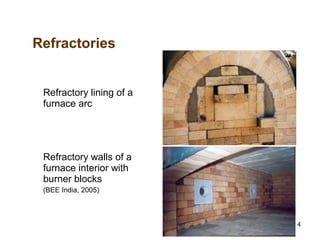
Refractory lining of a
furnace arc
Refractory walls of a
furnace interior with
burner blocks
(BEE India, 2005)
What is a Refractory?
Refractories are inorganic nonmetallic material which can
withstand high temperature without undergoing physico –
chemical changes while remaining in contact with molten slag,
metal and gases. It is necessary to produce range of refractory
materials with different properties to meet range of processing
conditions.
The refractory range incorporates fired, chemically and carbon
bonded materials that are made in different combinations and
shapes for diversified applications.
Why required?
• To minimize heat losses from the reaction chamber
• To allow thermal energy dependent conversion of chemically
reactive reactants into products because metallic vessels are not
suitable.
Refractory requirements:
The refractory materials should be able to withstand
• High temperature
• Sudden changes of temperature
• Load at service conditions
• Chemical and abrasive action of phases
The refractory material should not contaminate the material with
which it is in contact.
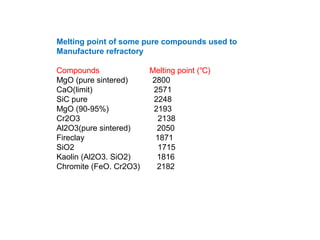
Melting point of some pure compounds used to
Manufacture refractory
Compounds Melting point ( )℃
MgO (pure sintered) 2800
CaO(limit) 2571
SiC pure 2248
MgO (90-95%) 2193
Cr2O3 2138
Al2O3(pure sintered) 2050
Fireclay 1871
SiO2 1715
Kaolin (Al2O3. SiO2) 1816
Chromite (FeO. Cr2O3) 2182
8
• Melting point
– Temperature at which a ‘test pyramid’
(cone) fails to support its own weight
• Size
– Affects stability of furnace structure
• Bulk density
– Amount of refractory material within a
volume (kg/m3)
– High bulk density = high volume
stability, heat capacity and resistance
Properties of Refractories
9
• Porosity
– Volume of open pores as % of total
refractory volume
– Low porosity = less penetration of
molten material
• Cold crushing strength
– Resistance of refractory to crushing
• Creep at high temperature
– Deformation of refractory material
under stress at given time and
temperature
Properties of Refractories
10
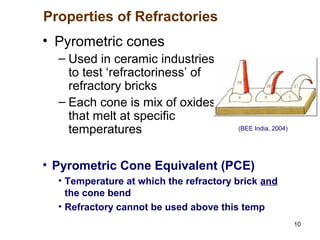
• Pyrometric cones
– Used in ceramic industries
to test ‘refractoriness’ of
refractory bricks
– Each cone is mix of oxides
that melt at specific
temperatures
Properties of Refractories
• Pyrometric Cone Equivalent (PCE)
• Temperature at which the refractory brick and
the cone bend
• Refractory cannot be used above this temp
(BEE India, 2004)
11
• Volume stability, expansion &
shrinkage
– Permanent changes during refractory
service life
– Occurs at high temperatures
• Reversible thermal expansion
– Phase transformations during heating
and cooling
Properties of Refractories
12
• Thermal conductivity
– Depends on composition and silica
content
– Increases with rising temperature
• High thermal conductivity:
– Heat transfer through brickwork
required
– E.g. recuperators, regenerators
• Low thermal conductivity:
– Heat conservation required
(insulating refractories)
– E.g. heat treatment furnaces
Properties of Refractories
13
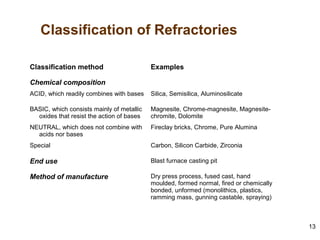
Classification of Refractories
Classification method Examples
Chemical composition
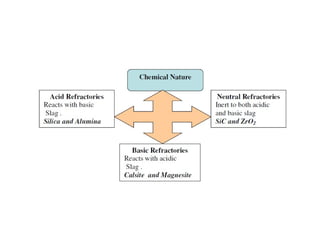
ACID, which readily combines with bases Silica, Semisilica, Aluminosilicate
BASIC, which consists mainly of metallic
oxides that resist the action of bases
Magnesite, Chrome-magnesite, Magnesite-
chromite, Dolomite
NEUTRAL, which does not combine with
acids nor bases
Fireclay bricks, Chrome, Pure Alumina
Special Carbon, Silicon Carbide, Zirconia
End use Blast furnace casting pit
Method of manufacture Dry press process, fused cast, hand
moulded, formed normal, fired or chemically
bonded, unformed (monolithics, plastics,
ramming mass, gunning castable, spraying)
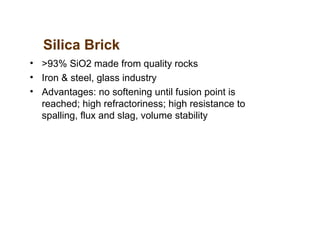
Silica Brick
• >93% SiO2 made from quality rocks
• Iron & steel, glass industry
• Advantages: no softening until fusion point is
reached; high refractoriness; high resistance to
spalling, flux and slag, volume stability
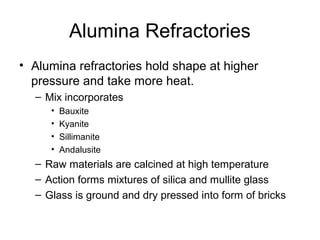
Alumina Refractories
• Alumina refractories hold shape at higher
pressure and take more heat.
– Mix incorporates
• Bauxite
• Kyanite
• Sillimanite
• Andalusite
– Raw materials are calcined at high temperature
– Action forms mixtures of silica and mullite glass
– Glass is ground and dry pressed into form of bricks
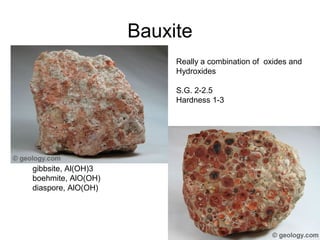
Bauxite
gibbsite, Al(OH)3
boehmite, AlO(OH)
diaspore, AlO(OH)
Really a combination of oxides and
Hydroxides
S.G. 2-2.5
Hardness 1-3
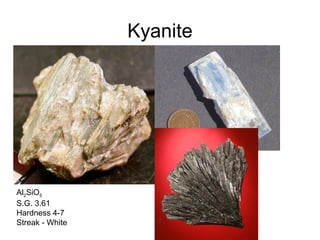
Kyanite
Al2SiO5
S.G. 3.61
Hardness 4-7
Streak - White
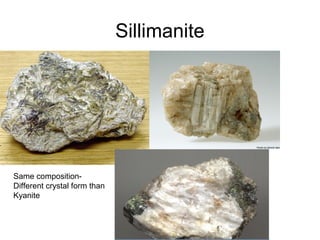
Sillimanite
Same composition-
Different crystal form than
Kyanite
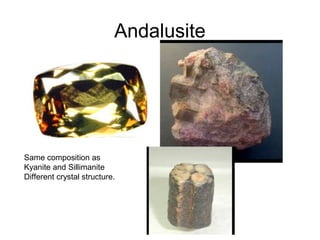
Andalusite
Same composition as
Kyanite and Sillimanite
Different crystal structure.
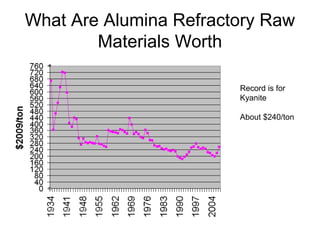
What Are Alumina Refractory Raw
Materials Worth
Record is for
Kyanite
About $240/ton
22
• Chemically basic: >85% magnesium oxide
• Properties depend on silicate bond concentration
• High slag resistance, especially lime and iron
Magnesite
Magnesia Refractories
• They are not easily eaten by molten slags
• Raw materials
– Magnesite
– Brucite
– Dolomite
– Olivine
– Serpentine (with extra step)
• Calcine them to make MgO magnesia
– Can be used as a chemical but
– Fired to Perclase makes a very resistant refractory
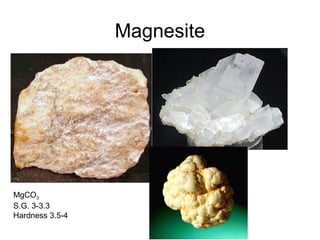
Magnesite
MgCO3
S.G. 3-3.3
Hardness 3.5-4
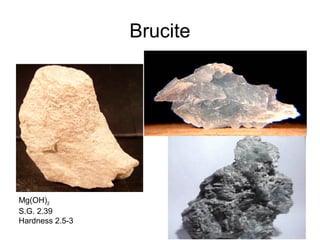
Brucite
Mg(OH)2
S.G. 2.39
Hardness 2.5-3
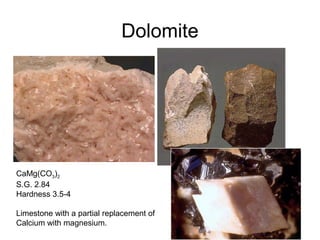
Dolomite
CaMg(CO3)2
S.G. 2.84
Hardness 3.5-4
Limestone with a partial replacement of
Calcium with magnesium.
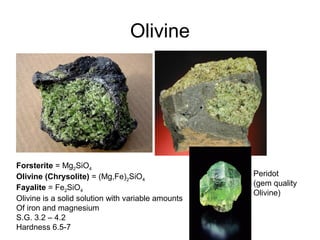
Olivine
Peridot
(gem quality
Olivine)
Forsterite = Mg2SiO4
Olivine (Chrysolite) = (Mg,Fe)2SiO4
Fayalite = Fe2SiO4
Olivine is a solid solution with variable amounts
Of iron and magnesium
S.G. 3.2 – 4.2
Hardness 6.5-7
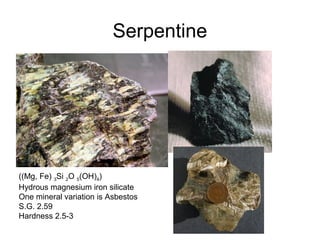
Serpentine
((Mg, Fe) 3Si 2O 5(OH)4)
Hydrous magnesium iron silicate
One mineral variation is Asbestos
S.G. 2.59
Hardness 2.5-3
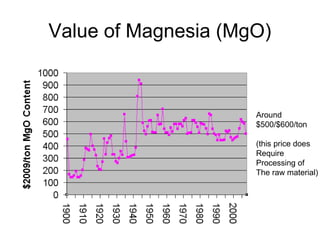
Value of Magnesia (MgO)
Around
$500/$600/ton
(this price does
Require
Processing of
The raw material)
30
• Common in industry: materials available and
inexpensive
• Consist of aluminium silicates
• Decreasing melting point (PCE) with increasing
impurity and decreasing AL2O3
Fireclay Refractories
• 45 - 100% alumina
• High alumina % = high refractoriness
• Applications: hearth and shaft of blast furnaces,
ceramic kilns, cement kilns, glass tanks
High Alumina Refractories
31
• Chrome-magnesite
– 15-35% Cr2O3 and 42-50% MgO
– Used for critical parts of high temp
furnaces
– Withstand corrosive slags
– High refractories
• Magnesite-chromite
– >60% MgO and 8-18% Cr2O3
– High temp resistance
– Basic slags in steel melting
– Better spalling resistance
Chromite Refractories
32
• Zirconium dioxide ZrO2
• Stabilized with calcium, magnesium, etc.
• High strength, low thermal conductivity, not
reactive, low thermal loss
• Used in glass furnaces, insulating refractory
Zirconia Refractories
• Aluminium oxide + alumina impurities
• Chemically stable, strong, insoluble, high
resistance in oxidizing and reducing atmosphere
• Used in heat processing industry, crucible shaping
Oxide Refractories (Alumina)
33
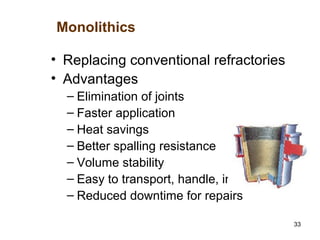
• Replacing conventional refractories
• Advantages
– Elimination of joints
– Faster application
– Heat savings
– Better spalling resistance
– Volume stability
– Easy to transport, handle, install
– Reduced downtime for repairs
Monolithics
34
• Material with low heat conductivity:
keeps furnace surface temperature
low
• Classification into five groups
– Insulating bricks
– Insulating castables and concrete
– Ceramic fiber
– Calcium silicate
– Ceramic coatings (high emissivity
coatings)
Insulating Materials Classification
35
• Consist of
– Insulation materials used for making
piece refractories
– Concretes contain Portland or high-
alumina cement
• Application
– Monolithic linings of furnace sections
– Bases of tunnel kiln cars in ceramics
industry
Castables and Concretes
36
• Thermal mass insulation materials
• Manufactured by blending alumina
and silica
• Bulk wool to make insulation
products
– Blankets, strips, paper, ropes, wet felt
etc
• Produced in two temperature
grades
Ceramic Fibers
37
• Low thermal conductivity
• Light weight
• Lower heat storage
• Thermal shock resistant
• Chemical resistance
• Mechanical resilience
• Low installation costs
• Ease of maintenance
• Ease of handling
• Thermal efficiency
Ceramic Fibers
Remarkable properties and benefits
• Lightweight furnace
• Simple steel fabrication
work
• Low down time
• Increased productivity
• Additional capacity
• Low maintenance costs
• Longer service life
• High thermal efficiency
• Faster response
38
• Emissivity: ability to absorb and
radiate heat
• Coatings applied to interior furnace
surface:
– emissivity stays constant
– Increase emissivity from 0.3 to 0.8
– Uniform heating and extended
refractory life
– Fuel reduction by up to 25-45%
High Emissivity Coatings
Other Refractories
• Zircon based
– Fine ground pressed into bricks often used in
borosilicate glass manufacture
• Zirconia
– Ultra high melting point 2710 C
• Artificial minerals – Silicon Carbide (also an
abrasive)
– Made from coke (a carbon source) and sand (a silicon
source) with sawdust and salt
– Cook the mix at about 2200 C
– Refractory very good at resisting oxidation

Refractories dr. jawahar

  • 1.
  • 2.
    Role of refractory Refractorymaterials have a crucial impact on the cost and quality of steel products. The diversification on steel products and their cleanliness requirement in recent years have increased the demand for high quality refractory. Steelmaking requires high temperatures of the order of 1600 degree centigrade. In addition steelmaking handles high temperature phases like molten steel, slag and hot gases. These phases are chemically reactive; refractory materials are required to produces steels. High quality refractory at a cheaper cost is the main requirement because cost of refractory adds into the cost of product.
  • 3.
    3 Materials that – Withstandhigh temperatures and sudden changes – Withstand action of molten slag, glass, hot gases etc. – Withstand load at service conditions – Withstand abrasive forces – Conserve heat – Have low coefficient of thermal expansion – Will not contaminate the load What are Refractories:
  • 4.
    4 Refractories Refractory lining ofa furnace arc Refractory walls of a furnace interior with burner blocks (BEE India, 2005)
  • 5.
    What is aRefractory? Refractories are inorganic nonmetallic material which can withstand high temperature without undergoing physico – chemical changes while remaining in contact with molten slag, metal and gases. It is necessary to produce range of refractory materials with different properties to meet range of processing conditions. The refractory range incorporates fired, chemically and carbon bonded materials that are made in different combinations and shapes for diversified applications.
  • 6.
    Why required? • Tominimize heat losses from the reaction chamber • To allow thermal energy dependent conversion of chemically reactive reactants into products because metallic vessels are not suitable. Refractory requirements: The refractory materials should be able to withstand • High temperature • Sudden changes of temperature • Load at service conditions • Chemical and abrasive action of phases The refractory material should not contaminate the material with which it is in contact.
  • 7.
    Melting point ofsome pure compounds used to Manufacture refractory Compounds Melting point ( )℃ MgO (pure sintered) 2800 CaO(limit) 2571 SiC pure 2248 MgO (90-95%) 2193 Cr2O3 2138 Al2O3(pure sintered) 2050 Fireclay 1871 SiO2 1715 Kaolin (Al2O3. SiO2) 1816 Chromite (FeO. Cr2O3) 2182
  • 8.
    8 • Melting point –Temperature at which a ‘test pyramid’ (cone) fails to support its own weight • Size – Affects stability of furnace structure • Bulk density – Amount of refractory material within a volume (kg/m3) – High bulk density = high volume stability, heat capacity and resistance Properties of Refractories
  • 9.
    9 • Porosity – Volumeof open pores as % of total refractory volume – Low porosity = less penetration of molten material • Cold crushing strength – Resistance of refractory to crushing • Creep at high temperature – Deformation of refractory material under stress at given time and temperature Properties of Refractories
  • 10.
    10 • Pyrometric cones –Used in ceramic industries to test ‘refractoriness’ of refractory bricks – Each cone is mix of oxides that melt at specific temperatures Properties of Refractories • Pyrometric Cone Equivalent (PCE) • Temperature at which the refractory brick and the cone bend • Refractory cannot be used above this temp (BEE India, 2004)
  • 11.
    11 • Volume stability,expansion & shrinkage – Permanent changes during refractory service life – Occurs at high temperatures • Reversible thermal expansion – Phase transformations during heating and cooling Properties of Refractories
  • 12.
    12 • Thermal conductivity –Depends on composition and silica content – Increases with rising temperature • High thermal conductivity: – Heat transfer through brickwork required – E.g. recuperators, regenerators • Low thermal conductivity: – Heat conservation required (insulating refractories) – E.g. heat treatment furnaces Properties of Refractories
  • 13.
    13 Classification of Refractories Classificationmethod Examples Chemical composition ACID, which readily combines with bases Silica, Semisilica, Aluminosilicate BASIC, which consists mainly of metallic oxides that resist the action of bases Magnesite, Chrome-magnesite, Magnesite- chromite, Dolomite NEUTRAL, which does not combine with acids nor bases Fireclay bricks, Chrome, Pure Alumina Special Carbon, Silicon Carbide, Zirconia End use Blast furnace casting pit Method of manufacture Dry press process, fused cast, hand moulded, formed normal, fired or chemically bonded, unformed (monolithics, plastics, ramming mass, gunning castable, spraying)
  • 15.
    Silica Brick • >93%SiO2 made from quality rocks • Iron & steel, glass industry • Advantages: no softening until fusion point is reached; high refractoriness; high resistance to spalling, flux and slag, volume stability
  • 16.
    Alumina Refractories • Aluminarefractories hold shape at higher pressure and take more heat. – Mix incorporates • Bauxite • Kyanite • Sillimanite • Andalusite – Raw materials are calcined at high temperature – Action forms mixtures of silica and mullite glass – Glass is ground and dry pressed into form of bricks
  • 17.
    Bauxite gibbsite, Al(OH)3 boehmite, AlO(OH) diaspore,AlO(OH) Really a combination of oxides and Hydroxides S.G. 2-2.5 Hardness 1-3
  • 18.
  • 19.
  • 20.
    Andalusite Same composition as Kyaniteand Sillimanite Different crystal structure.
  • 21.
    What Are AluminaRefractory Raw Materials Worth Record is for Kyanite About $240/ton
  • 22.
    22 • Chemically basic:>85% magnesium oxide • Properties depend on silicate bond concentration • High slag resistance, especially lime and iron Magnesite
  • 23.
    Magnesia Refractories • Theyare not easily eaten by molten slags • Raw materials – Magnesite – Brucite – Dolomite – Olivine – Serpentine (with extra step) • Calcine them to make MgO magnesia – Can be used as a chemical but – Fired to Perclase makes a very resistant refractory
  • 24.
  • 25.
  • 26.
    Dolomite CaMg(CO3)2 S.G. 2.84 Hardness 3.5-4 Limestonewith a partial replacement of Calcium with magnesium.
  • 27.
    Olivine Peridot (gem quality Olivine) Forsterite =Mg2SiO4 Olivine (Chrysolite) = (Mg,Fe)2SiO4 Fayalite = Fe2SiO4 Olivine is a solid solution with variable amounts Of iron and magnesium S.G. 3.2 – 4.2 Hardness 6.5-7
  • 28.
    Serpentine ((Mg, Fe) 3Si2O 5(OH)4) Hydrous magnesium iron silicate One mineral variation is Asbestos S.G. 2.59 Hardness 2.5-3
  • 29.
    Value of Magnesia(MgO) Around $500/$600/ton (this price does Require Processing of The raw material)
  • 30.
    30 • Common inindustry: materials available and inexpensive • Consist of aluminium silicates • Decreasing melting point (PCE) with increasing impurity and decreasing AL2O3 Fireclay Refractories • 45 - 100% alumina • High alumina % = high refractoriness • Applications: hearth and shaft of blast furnaces, ceramic kilns, cement kilns, glass tanks High Alumina Refractories
  • 31.
    31 • Chrome-magnesite – 15-35%Cr2O3 and 42-50% MgO – Used for critical parts of high temp furnaces – Withstand corrosive slags – High refractories • Magnesite-chromite – >60% MgO and 8-18% Cr2O3 – High temp resistance – Basic slags in steel melting – Better spalling resistance Chromite Refractories
  • 32.
    32 • Zirconium dioxideZrO2 • Stabilized with calcium, magnesium, etc. • High strength, low thermal conductivity, not reactive, low thermal loss • Used in glass furnaces, insulating refractory Zirconia Refractories • Aluminium oxide + alumina impurities • Chemically stable, strong, insoluble, high resistance in oxidizing and reducing atmosphere • Used in heat processing industry, crucible shaping Oxide Refractories (Alumina)
  • 33.
    33 • Replacing conventionalrefractories • Advantages – Elimination of joints – Faster application – Heat savings – Better spalling resistance – Volume stability – Easy to transport, handle, install – Reduced downtime for repairs Monolithics
  • 34.
    34 • Material withlow heat conductivity: keeps furnace surface temperature low • Classification into five groups – Insulating bricks – Insulating castables and concrete – Ceramic fiber – Calcium silicate – Ceramic coatings (high emissivity coatings) Insulating Materials Classification
  • 35.
    35 • Consist of –Insulation materials used for making piece refractories – Concretes contain Portland or high- alumina cement • Application – Monolithic linings of furnace sections – Bases of tunnel kiln cars in ceramics industry Castables and Concretes
  • 36.
    36 • Thermal massinsulation materials • Manufactured by blending alumina and silica • Bulk wool to make insulation products – Blankets, strips, paper, ropes, wet felt etc • Produced in two temperature grades Ceramic Fibers
  • 37.
    37 • Low thermalconductivity • Light weight • Lower heat storage • Thermal shock resistant • Chemical resistance • Mechanical resilience • Low installation costs • Ease of maintenance • Ease of handling • Thermal efficiency Ceramic Fibers Remarkable properties and benefits • Lightweight furnace • Simple steel fabrication work • Low down time • Increased productivity • Additional capacity • Low maintenance costs • Longer service life • High thermal efficiency • Faster response
  • 38.
    38 • Emissivity: abilityto absorb and radiate heat • Coatings applied to interior furnace surface: – emissivity stays constant – Increase emissivity from 0.3 to 0.8 – Uniform heating and extended refractory life – Fuel reduction by up to 25-45% High Emissivity Coatings
  • 39.
    Other Refractories • Zirconbased – Fine ground pressed into bricks often used in borosilicate glass manufacture • Zirconia – Ultra high melting point 2710 C • Artificial minerals – Silicon Carbide (also an abrasive) – Made from coke (a carbon source) and sand (a silicon source) with sawdust and salt – Cook the mix at about 2200 C – Refractory very good at resisting oxidation

Editor's Notes

  • #4 Any material can be described as a ‘refractory,’ if it can withstand the action of abrasive or corrosive solids, liquids or gases at high temperatures. The various combinations of operating conditions in which refractories are used, make it necessary to manufacture a range of refractory materials with different properties. Refractory materials are made in varying combinations and shapes depending on their applications. General requirements of a refractory material are: Withstand high temperatures Withstand sudden changes of temperatures Withstand action of molten metal slag, glass, hot gases, etc Withstand load at service conditions Withstand load and abrasive forces Conserve heat Have low coefficient of thermal expansion Should not contaminate the material with which it comes into contact
  • #9 Melting point: Pure substances melt instantly at a specific temperature. Most refractory materials consist of particles bonded together that have high melting temperatures. At high temperatures, these particles melt and form slag. The melting point of the refractory is the temperature at which a test pyramid (cone) fails to support its own weight. Size: The size and shape of the refractories is a part of the design of the furnace, since it affects the stability of the furnace structure. Accurate size is extremely important to properly fit the refractory shape inside the furnace and to minimize space between construction joints. Bulk density: The bulk density is useful property of refractories, which is the amount of refractory material within a volume (kg/m3). An increase in bulk density of a given refractory increases its volume stability, heat capacity and resistance to slag penetration.
  • #10 Porosity: The apparent porosity is the volume of the open pores, into which a liquid can penetrate, as a percentage of the total volume of the refractory. This property is important when the refractory is in contact with molten charge and slag. A low apparent porosity prevents molten material from penetrating into the refractory. A large number of small pores is generally preferred to a small number of large pores. (Click once) Cold crushing strength: The cold crushing strength is the resistance of the refractory to crushing, which mostly happens during transport. It only has an indirect relevance to refractory performance, and is used as one of the indicators of abrasion resistance. Other indicators used are bulk density and porosity. (Click once) Creep at high temperature: Creep is a time dependent property, which determines the deformation in a given time and at a given temperature by a refractory material under stress.
  • #11 Pyrometric cones and Pyrometric cones equivalent (PCE): The ‘refractoriness’ of (refractory) bricks is the temperature at which the refractory bends because it can no longer support its own weight. Pyrometric cones are used in ceramic industries to test the refractoriness of the (refractory) bricks and thus determine what refractory bricks they should use. They consist of a mixture of oxides that are known to melt at a specific narrow temperature range. Cones with different oxide composition are placed in sequence of their melting temperature alongside a row of refractory bricks in a furnace. The furnace is fired and the temperature rises. One cone will bends together with the refractory brick as shown in the figure. This is the temperature range in oC above which the refractory cannot be used. This is known as Pyrometric Cone Equivalent temperatures.
  • #12 Volume stability, expansion, and shrinkage at high temperatures: The contraction or expansion of the refractories can take place during service life. Such permanent changes in dimensions may be due to, for example, a chemical reaction, which produces a new material of altered specific gravity. (Click once) Reversible thermal expansion: Any material expands when heated, and contracts when cooled. The reversible thermal expansion is a reflection on the phase transformations that occur during heating and cooling.
  • #13 Thermal conductivity: Thermal conductivity depends on the chemical and mineralogical composition and silica content of the refractory and on the application temperature. The conductivity usually changes with rising temperature. High thermal conductivity of a refractory is desirable when heat transfer though brickwork is required, for example in recuperators, regenerators, muffles, etc. Low thermal conductivity is desirable for conservation of heat, as the refractory acts as an insulator. Additional insulation conserves heat but at the same time increases the hot face temperature and hence a better quality refractory is required. Because of this, the outside roofs of open-hearth furnaces are normally not insulated, as this could cause the roof to collapse. Lightweight refractories of low thermal conductivity find wider applications in low temperature heat treatment furnaces, for example in batch type furnaces where the low heat capacity of the refractory structure minimizes the heat stored during the intermittent heating and cooling cycles. Insulating refractories have very low thermal conductivity.
  • #14 Refractories can be classified on the basis of chemical composition, end use and methods of manufacture as shown in the table
  • #23 Silica brick Silica brick (or Dinas) is a refractory that contains at least 93 percent SiO2. The raw material is quality rocks. Various grades of silica brick have found extensive use in the iron and steel melting furnaces and the glass industry. Advantages are The outstanding property of silica brick is that it does not begin to soften under high loads until its fusion point is approached. This behavior contrasts with that of many other refractories, for example alumina silicate materials, which begin to fuse and creep at temperatures considerably lower than their fusion points. High resistance to thermal shock (spalling) High refractoriness. Flux and slag resistance Volume stability (Click once) Magnesite Magnesite refractories are chemically basic materials, containing at least 85 percent magnesium oxide. They are made from naturally occurring magnesite (MgCO3). The properties of magnesite refractories depend on the concentration of silicate bond at the operating temperatures. Good quality magnesite usually results from a CaO-SiO2 ratio of less than two with a minimum ferrite concentration, particularly if the furnaces lined with the refractory operate in oxidizing and reducing conditions. The slag resistance is very high particularly to lime and iron rich slags.
  • #31 Fireclay Refractories Firebrick is the most common form of refractory material. It is used extensively in the iron and steel industry, nonferrous metallurgy, glass industry, pottery kilns, cement industry, and many others. Fireclay refractories, such as firebricks, siliceous fireclays and aluminous clay refractories consist of aluminum silicates with varying silica (SiO2) content of up to 78 percent and Al2O3 content of up to 44 percent. The table shows that the melting point (PCE) of fireclay brick decreases with increasing impurity and decreasing Al2O3. This material is often used in furnaces, kilns and stoves because the materials are widely available and relatively inexpensive. (Click once) High alumina refractories Alumina silicate refractories containing more than 45 percent alumina are generally termed as high alumina materials. The alumina concentration ranges from 45 to 100 percent. The refractoriness of high alumina refractories increases with increase in alumina percentage. The applications of high alumina refractories include the hearth and shaft of blast furnaces, ceramic kilns, cement kilns, glass tanks and crucibles for melting a wide range of metals.
  • #32 Chromite refractories Two types of chromite refractories are distinguished: Chrome-magnesite refractories, which usually contain 15-35 percent Cr2O3 and 42-50 percent MgO. They are made in a wide range of qualities and are used for building the critical parts of high temperature furnaces. These materials can withstand corrosive slags and gases and have high refractoriness. Magnesite-chromite refractories, which contain at least 60 percent MgO and 8-18 percent Cr2O3. They are suitable for service at the highest temperatures and for contact with the most basic slags used in steel melting. Magnesite-chromite usually has a better spalling resistance than chrome-magnesite.
  • #33 Zirconia refractories Zirconium dioxide (ZrO2) is a polymorphic material. It is essential to stabilize it before application as a refractory, which is achieved by incorporating small quantities of calcium, magnesium and cerium oxide, etc. Its properties depend mainly on the degree of stabilization, quantity of stabilizer and quality of the original raw material. Zirconia refractories have a very high strength at room temperature, which is maintained up to temperatures as high as 1500 oC. They are therefore useful as high temperature construction materials in furnaces and kilns. The thermal conductivity of zirconium dioxide is much lower than that of most other refractories and the material is therefore used as a high temperature insulating refractory. Zirconia exhibits very low thermal losses and does not react readily with liquid metals, and is particularly useful for making refractory crucibles and other vessels for metallurgical purposes. Glass furnaces use zirconia because it is not easily wetted by molten glasses and does not react easily with glass. (Click once) Oxide refractories (Alumina) Alumina refractory materials that consist of aluminium oxide with little traces of impurities are known as pure alumina. Alumina is one of the most chemically stable oxides known. It is mechanically very strong, insoluble in water, super heated steam, and most inorganic acids and alkalies. Its properties make it suitable for the shaping of crucibles for fusing sodium carbonate, sodium hydroxide and sodium peroxide. It has a high resistance in oxidizing and reducing atmosphere. Alumina is extensively used in heat processing industries. Highly porous alumina is used for lining furnaces operating up to 1850oC
  • #34 Monolithics Monolithic refractories are single piece casts in the shape of equipment, such as a ladle as shown in the figure. They are rapidly replacing the conventional type fired refractories in many applications including industrial furnaces. The main advantages of monolithics are: Elimination of joints which is an inherent weakness Faster application method Special skill for installation not required Ease of transportation and handling Better scope to reduce downtime for repairs Considerable scope to reduce inventory and eliminate special shapes Heat savings Better spalling resistance Greater volume stability Monolithics are put into place using various methods, such as ramming, casting, gunniting, spraying, and sand slinging.
  • #35 Insulating materials greatly reduce the heat losses through walls. Insulation is achieved by providing a layer of material with low heat conductivity between the internal hot surface of a furnace and the external surface, thus keeping the temperature of the external surface low. (Click once) Insulating materials may be classified into the following groups: Insulating bricks Insulating castables Ceramic fiber Calcium silicate Ceramic coating We will explain three insulating materials
  • #36 Castables and concretes The ingredients are similar to those insulation materials used for making piece refractories, except that concretes contain either Portland or high-alumina cement. Monolithic linings of furnace sections can be constructed by casting refractory insulating concretes, and stamping lightweight aggregates into place that are suitably bonded. Other applications include the bases of tunnel kiln cars used in the ceramic industry.
  • #37 Ceramic fiber is a low thermal mass insulation material, which has revolutionized furnace design lining systems. Ceramic fiber is manufactured by blending and melting alumina and silica at a temperature of 1800 – 2000oC, and breaking the molten stream by blowing compressed air or dropping the molten stream on a spinning disc to form loose or bulk ceramic fiber. The bulk fiber is used to produce various insulation products including blankets, strips, veneering and anchored modules, paper, vacuum formed boards and shapes, ropes, wet felt, mastic cement etc. Fibers are usually produced in two temperature grades based on Al2O3 content. A new product is ZrO2 added alumino-silicate fiber, which helps to reduce shrinkage levels and thereby making the fiber suitable for higher temperatures.
  • #38 The characteristics of ceramic fibers are a remarkable combination of the properties of refractories and traditional insulation material. (No need to read all of them out, the idea is to make trainees aware that ceramic fibers has so many favorable properties and benefits. This can be mentioned while the individual lines “fly in” and then move on to the next slide) a) Lower thermal conductivity b) Light weight c) Lower heat storage d) Thermal shock resistant e) Chemical resistance f) Mechanical resilience g) Low installation cost h) Ease of maintenance i) Ease of handling j) Thermal efficiency Other advantages offered by ceramic fiber are: Lightweight furnace Simple steel fabrication work Low down time Increased productivity Additional capacity Low maintenance cost Longer service life Higher thermal efficiency Faster response
  • #39 Emissivity (i.e. the measure of a material’s ability to both absorb and radiate heat) is often considered as an inherent physical property that does not normally change (other examples are density, specific heat and thermal conductivity). However, the development of high emissivity coatings allows the surface emissivity of materials to be increased. High emissivity coatings are applied on the interior surface of furnaces. The advantage of high emissivity coatings is that the emissivity remains more or less constant. The emissivity of furnaces that operate at high temperatures is 0.3. By using high emissivity coatings this can go up to 0.8, resulting in an increase of heat transfer through radiation. Other benefits of high emissivity coatings in furnace chambers are uniform heating and extended life of refractories and metallic components such as radiant tubes and heating elements. For intermittent furnaces or where rapid heating is required, use of such coatings was found to reduce fuel or power by 25 - 45 percent.