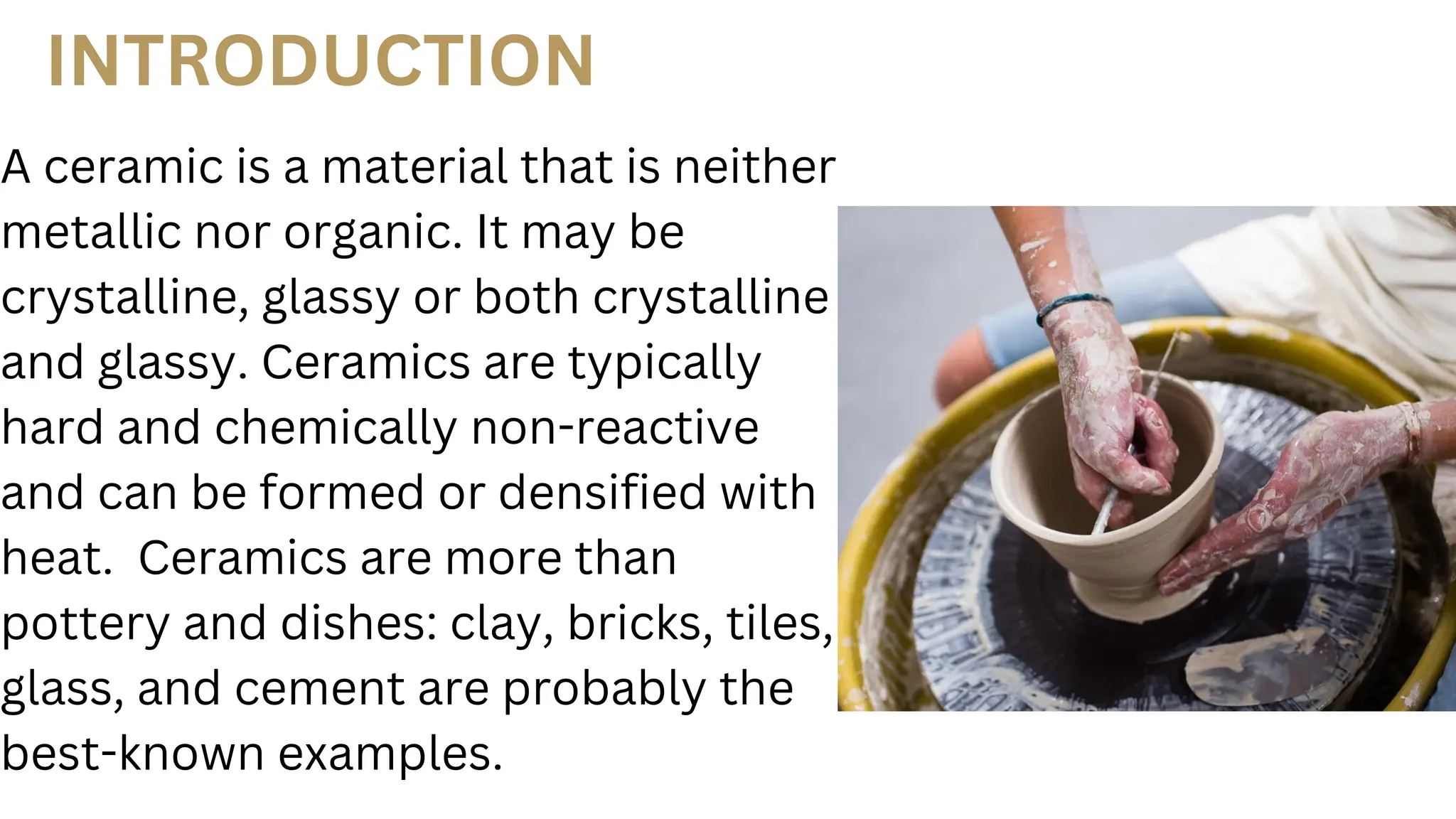
A ceramic isa material that is neither
metallic nor organic. It may be
crystalline, glassy or both crystalline
and glassy. Ceramics are typically
hard and chemically non-reactive
and can be formed or densified with
heat. Ceramics are more than
pottery and dishes: clay, bricks, tiles,
glass, and cement are probably the
best-known examples.
INTRODUCTION
3.
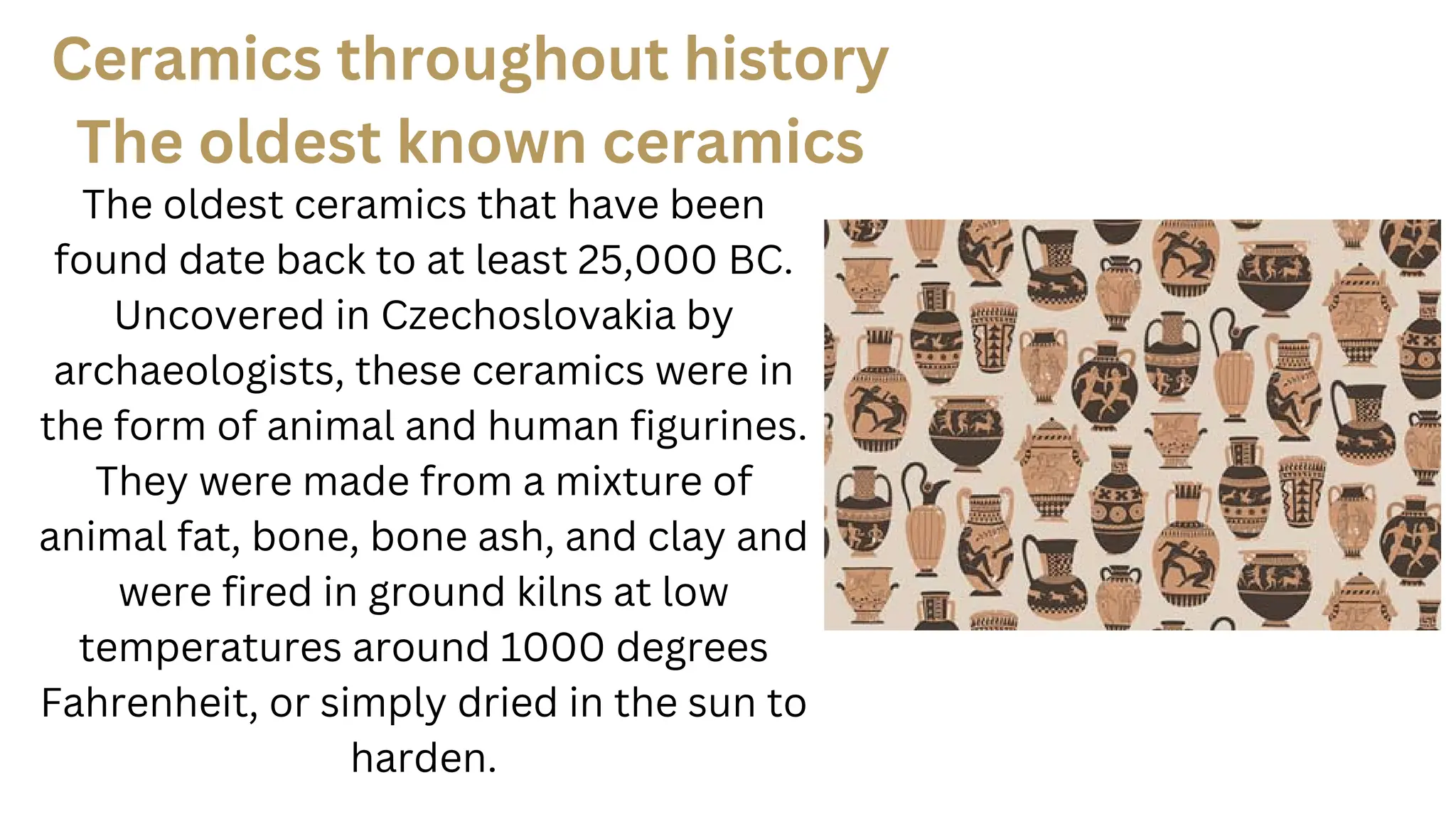
The oldest ceramicsthat have been
found date back to at least 25,000 BC.
Uncovered in Czechoslovakia by
archaeologists, these ceramics were in
the form of animal and human figurines.
They were made from a mixture of
animal fat, bone, bone ash, and clay and
were fired in ground kilns at low
temperatures around 1000 degrees
Fahrenheit, or simply dried in the sun to
harden.
Ceramics throughout history
The oldest known ceramics
4.
What Are CeramicsMade Of?
Ceramics are made of clay,
earthen elements, powders,
and water. These components
are combined, molded into the
desired shape, and then fired
or otherwise heated to finish
the fabrication.
5.
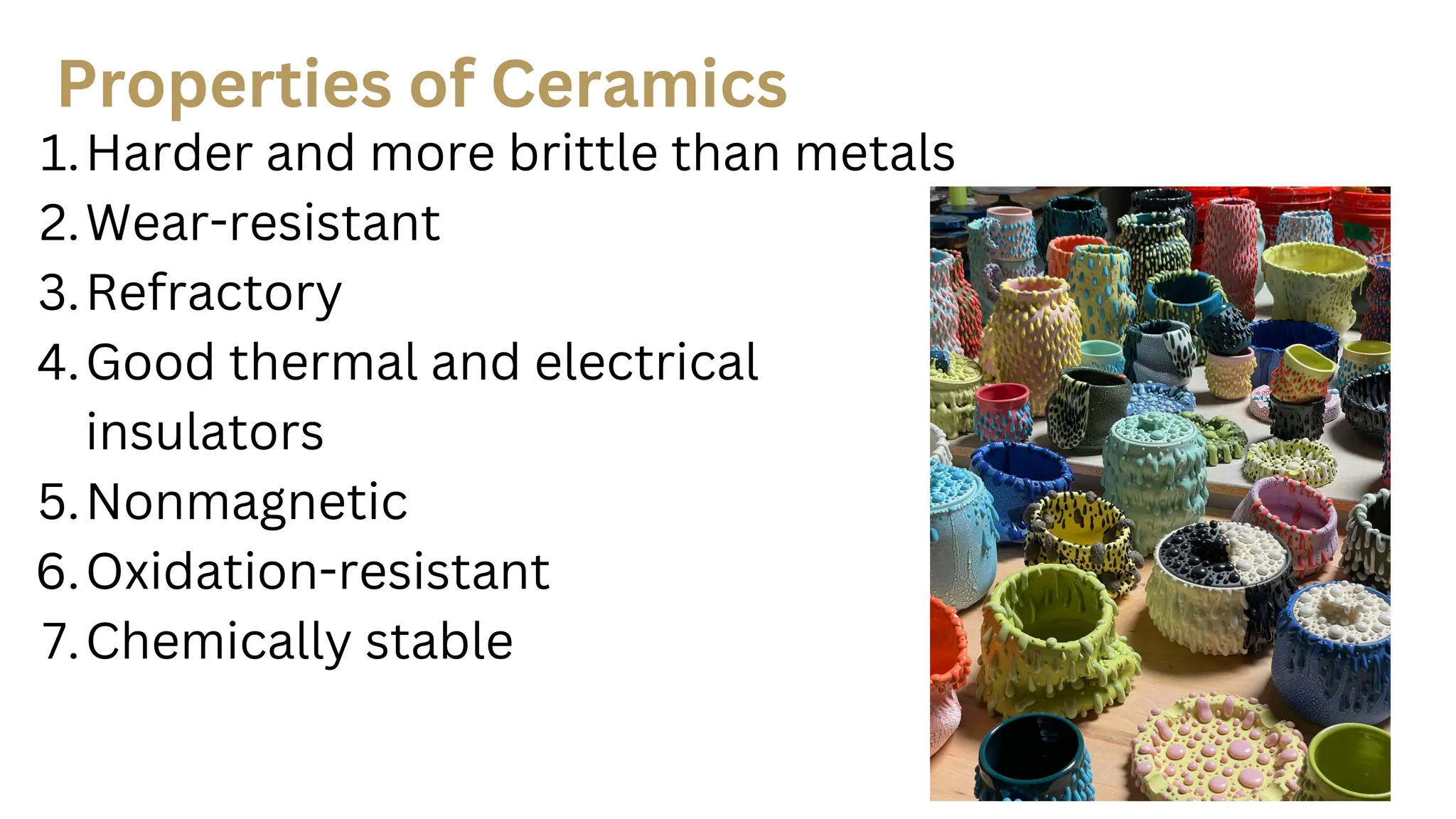
Harder and morebrittle than metals
1.
Wear-resistant
2.
Refractory
3.
Good thermal and electrical
insulators
4.
Nonmagnetic
5.
Oxidation-resistant
6.
Chemically stable
7.
Properties of Ceramics
6.
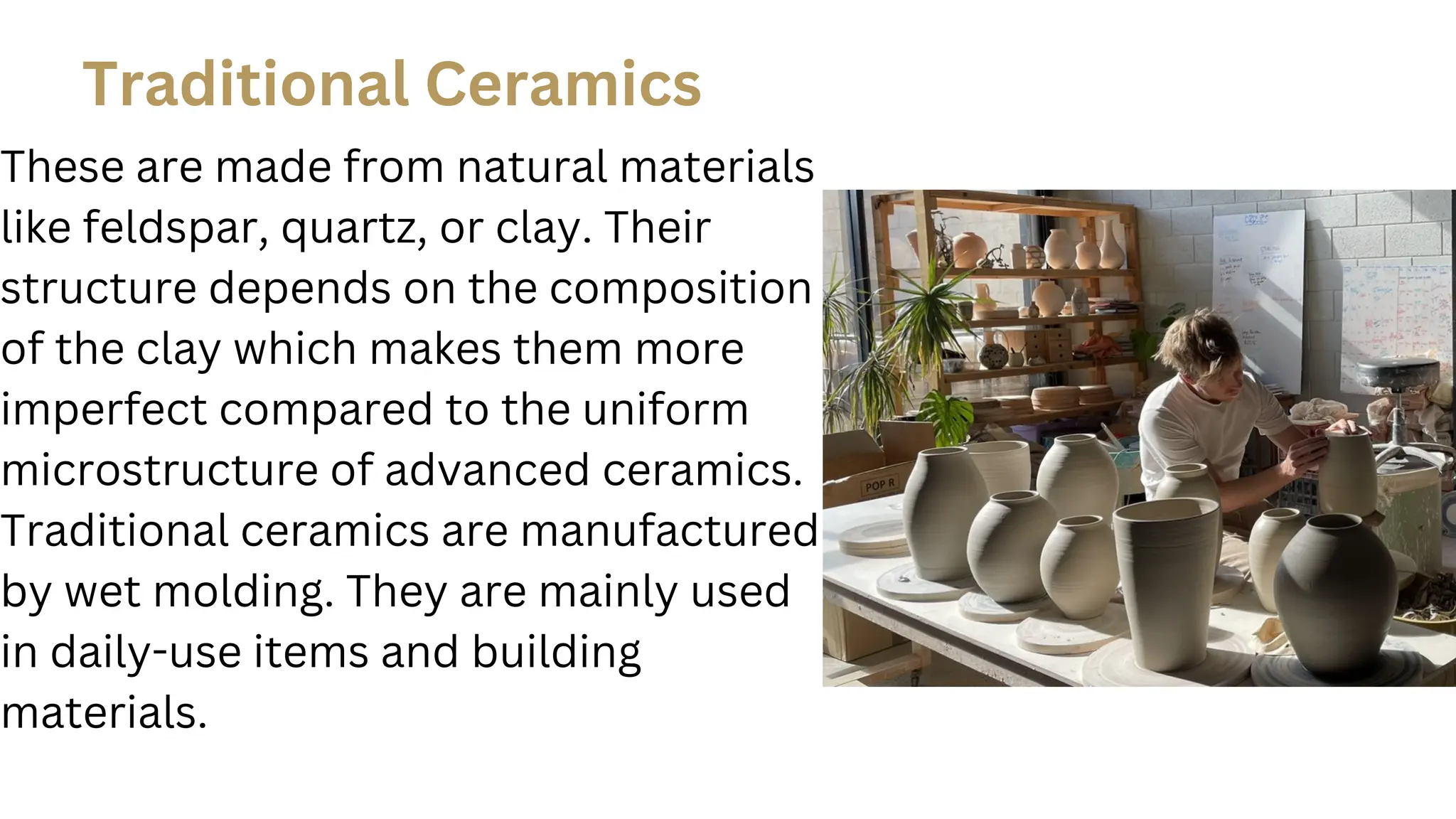
Traditional Ceramics
These aremade from natural materials
like feldspar, quartz, or clay. Their
structure depends on the composition
of the clay which makes them more
imperfect compared to the uniform
microstructure of advanced ceramics.
Traditional ceramics are manufactured
by wet molding. They are mainly used
in daily-use items and building
materials.
7.
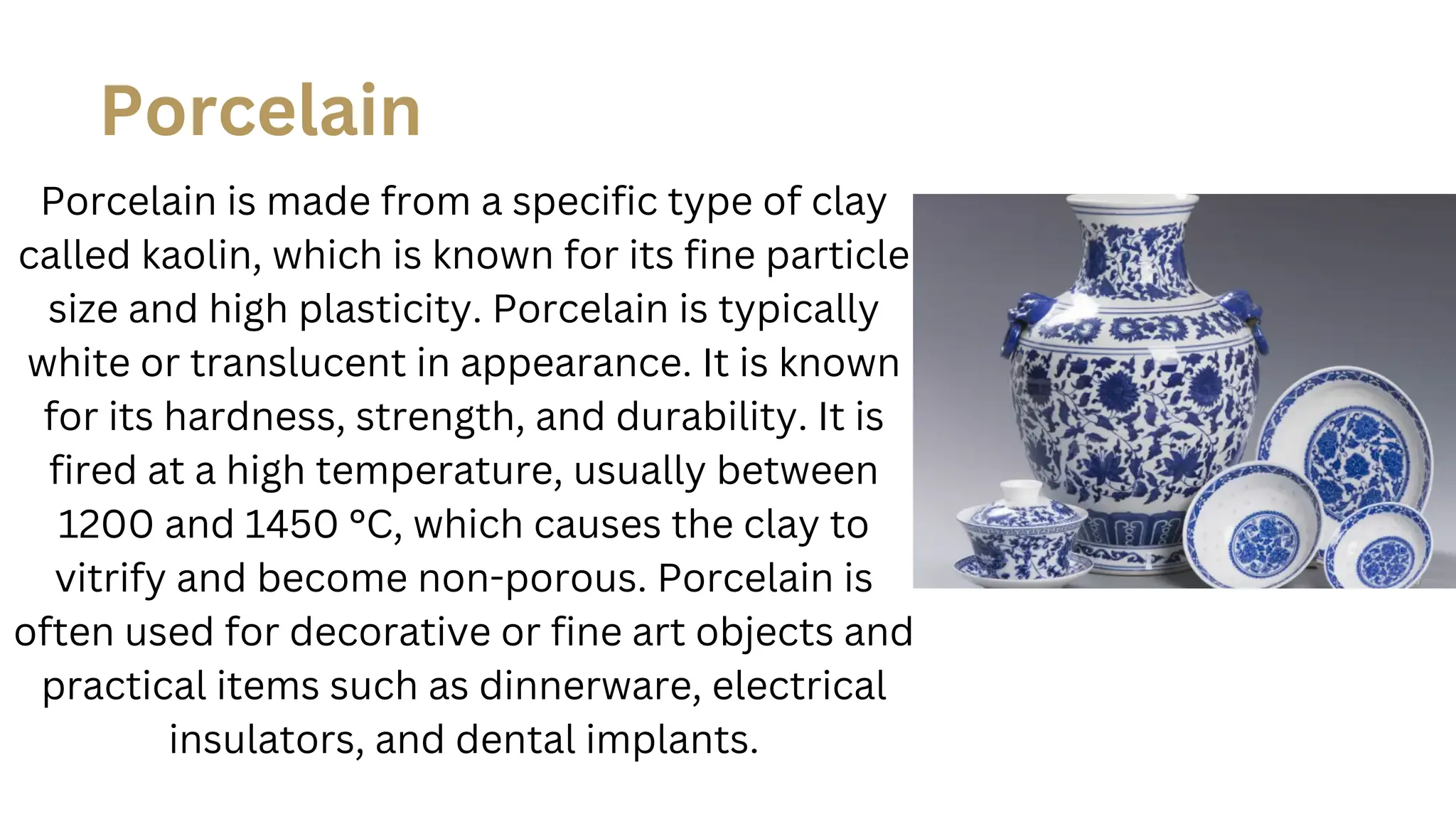
Porcelain is madefrom a specific type of clay
called kaolin, which is known for its fine particle
size and high plasticity. Porcelain is typically
white or translucent in appearance. It is known
for its hardness, strength, and durability. It is
fired at a high temperature, usually between
1200 and 1450 °C, which causes the clay to
vitrify and become non-porous. Porcelain is
often used for decorative or fine art objects and
practical items such as dinnerware, electrical
insulators, and dental implants.
Porcelain
8.
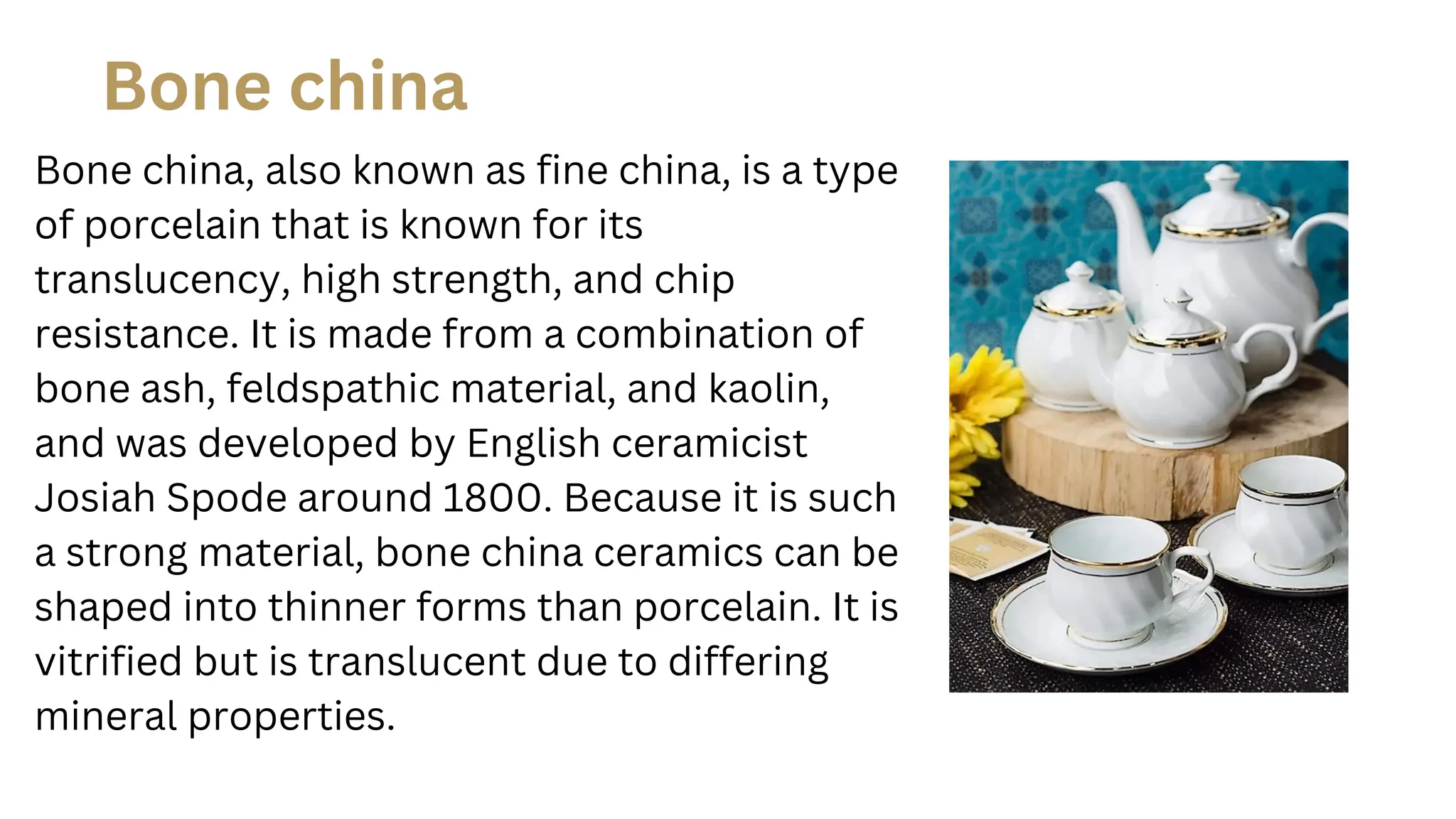
Bone china, alsoknown as fine china, is a type
of porcelain that is known for its
translucency, high strength, and chip
resistance. It is made from a combination of
bone ash, feldspathic material, and kaolin,
and was developed by English ceramicist
Josiah Spode around 1800. Because it is such
a strong material, bone china ceramics can be
shaped into thinner forms than porcelain. It is
vitrified but is translucent due to differing
mineral properties.
Bone china
9.
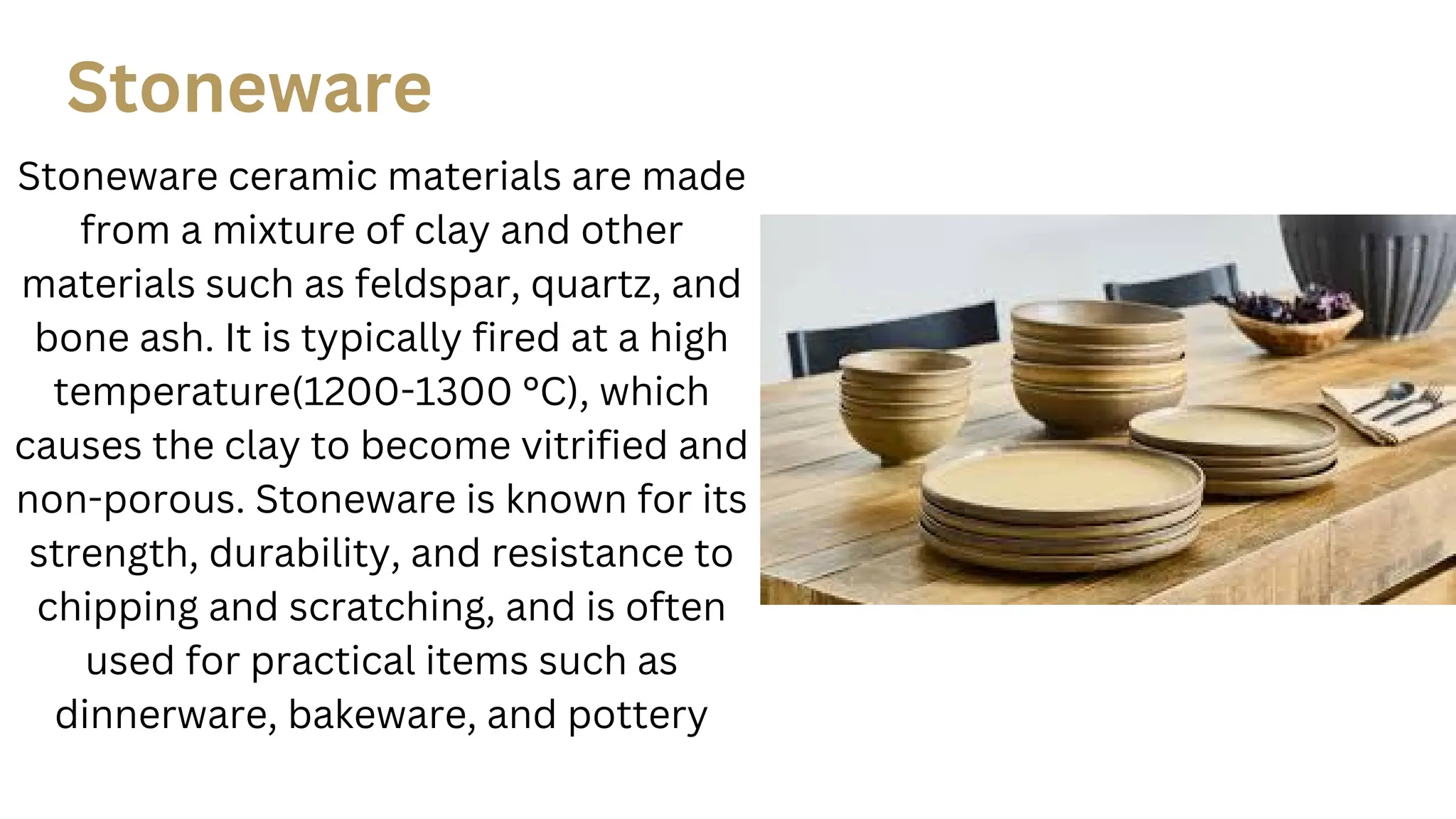
Stoneware
Stoneware ceramic materialsare made
from a mixture of clay and other
materials such as feldspar, quartz, and
bone ash. It is typically fired at a high
temperature(1200-1300 °C), which
causes the clay to become vitrified and
non-porous. Stoneware is known for its
strength, durability, and resistance to
chipping and scratching, and is often
used for practical items such as
dinnerware, bakeware, and pottery
10.
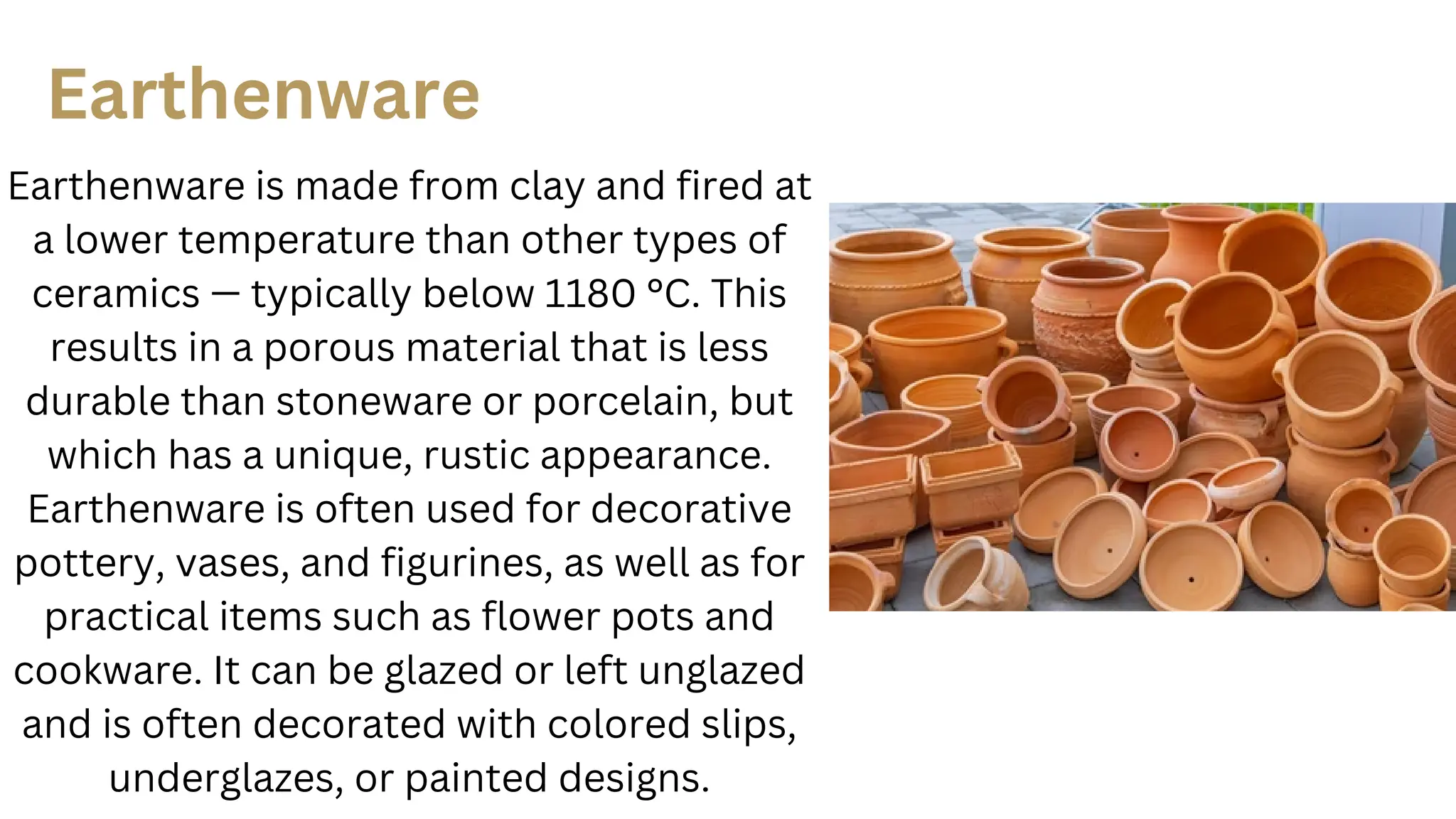
Earthenware
Earthenware is madefrom clay and fired at
a lower temperature than other types of
ceramics — typically below 1180 °C. This
results in a porous material that is less
durable than stoneware or porcelain, but
which has a unique, rustic appearance.
Earthenware is often used for decorative
pottery, vases, and figurines, as well as for
practical items such as flower pots and
cookware. It can be glazed or left unglazed
and is often decorated with colored slips,
underglazes, or painted designs.
11.
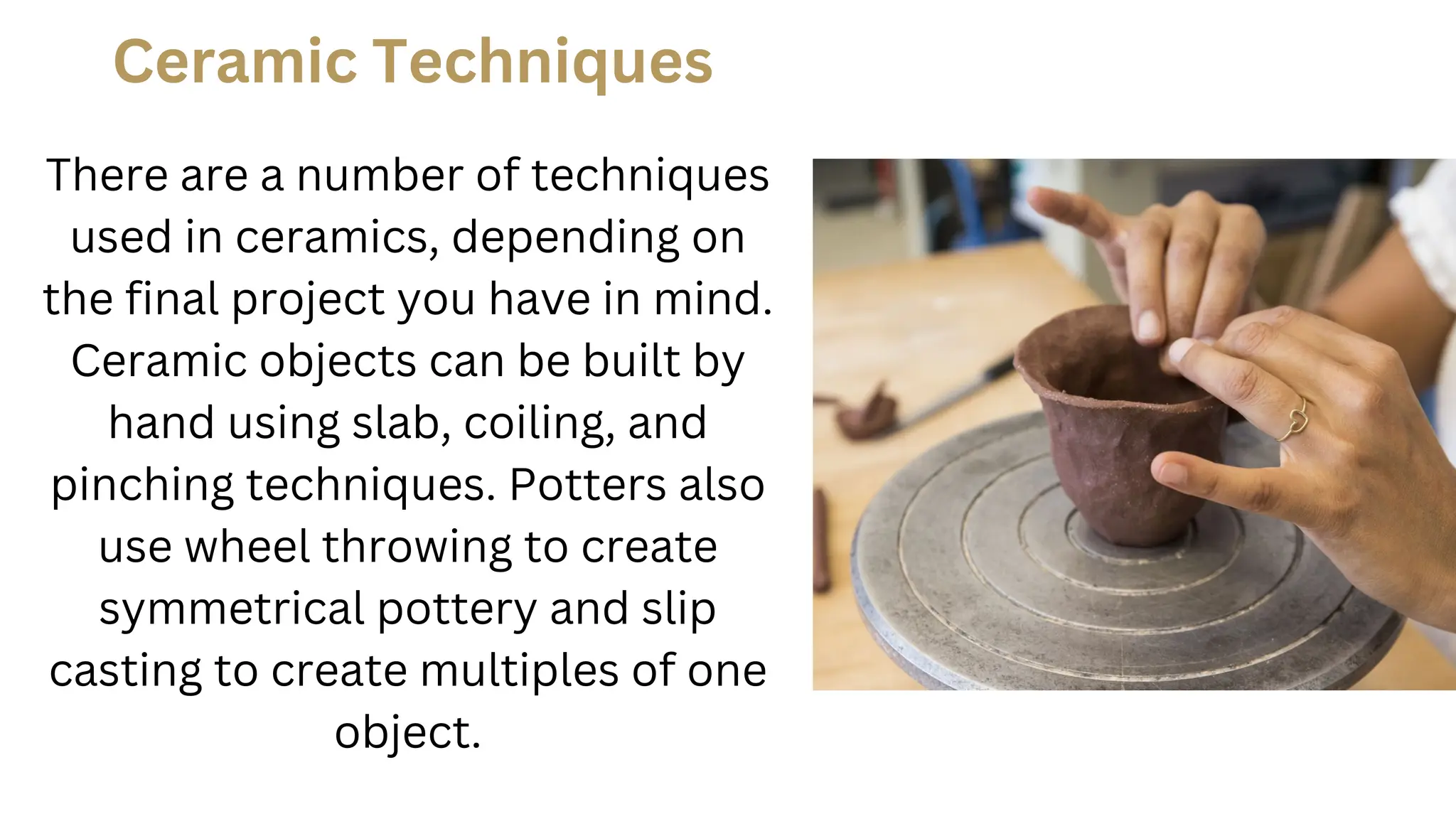
Ceramic Techniques
There area number of techniques
used in ceramics, depending on
the final project you have in mind.
Ceramic objects can be built by
hand using slab, coiling, and
pinching techniques. Potters also
use wheel throwing to create
symmetrical pottery and slip
casting to create multiples of one
object.
12.
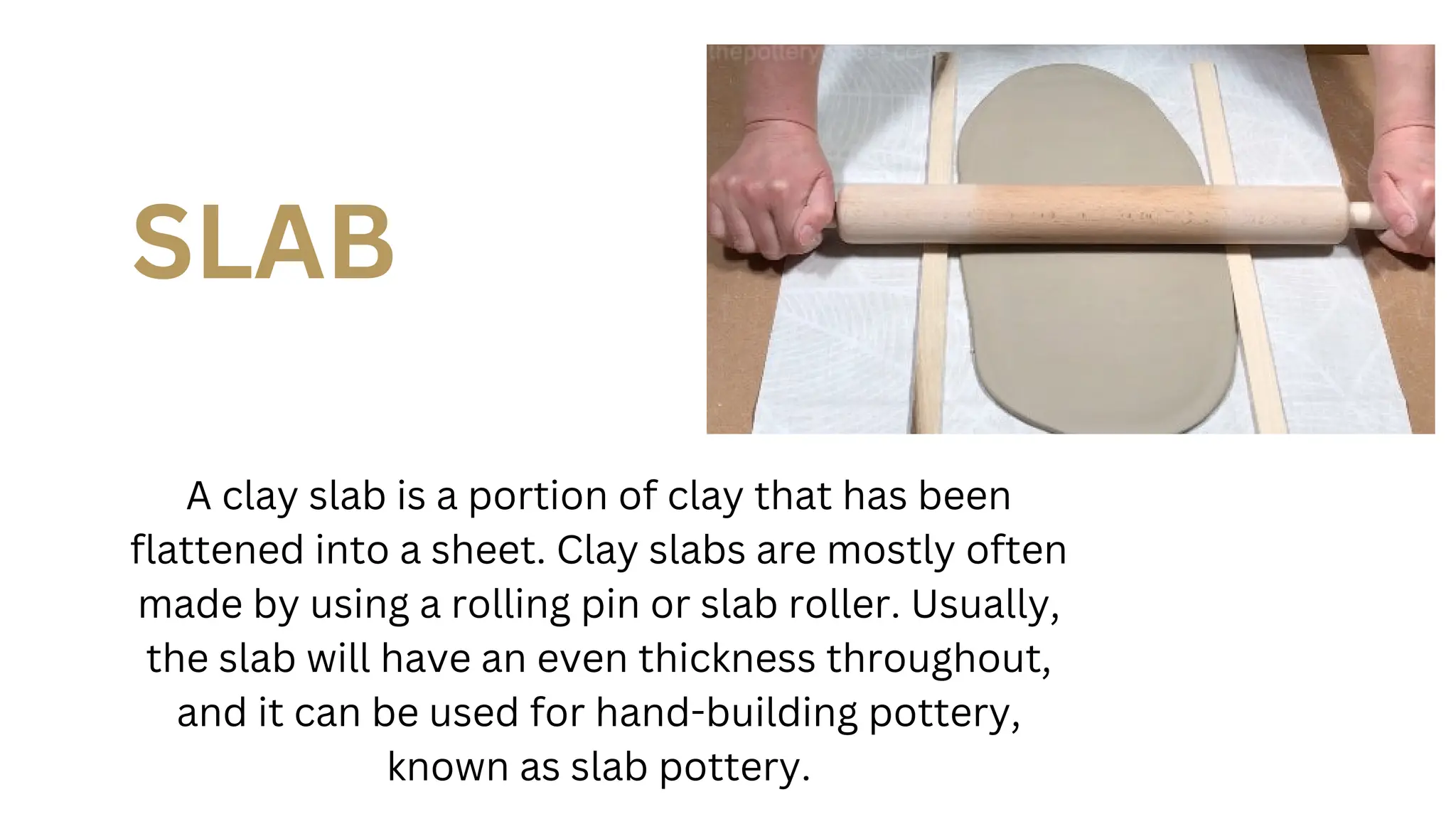
SLAB
A clay slabis a portion of clay that has been
flattened into a sheet. Clay slabs are mostly often
made by using a rolling pin or slab roller. Usually,
the slab will have an even thickness throughout,
and it can be used for hand-building pottery,
known as slab pottery.
13.
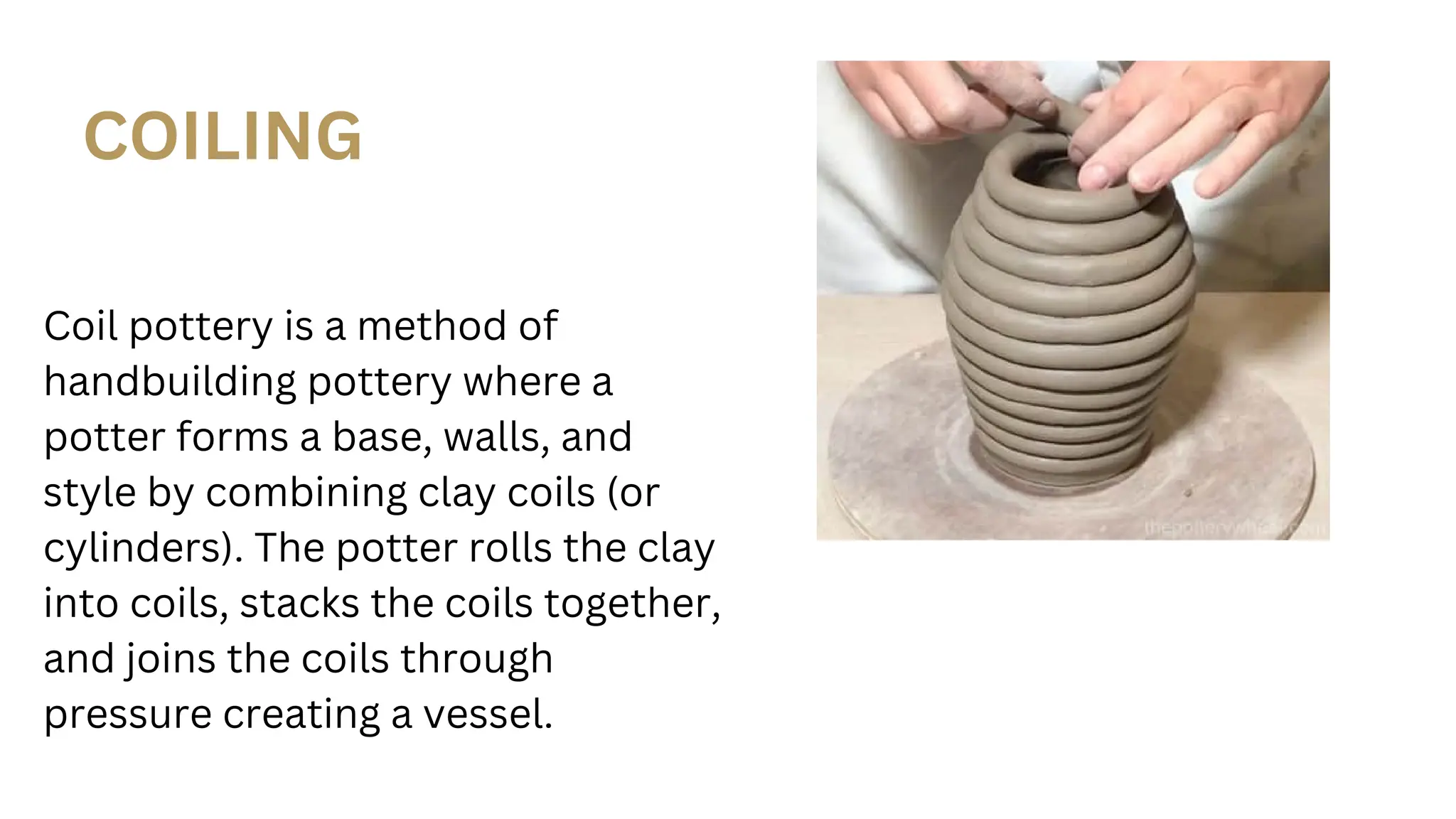
COILING
Coil pottery isa method of
handbuilding pottery where a
potter forms a base, walls, and
style by combining clay coils (or
cylinders). The potter rolls the clay
into coils, stacks the coils together,
and joins the coils through
pressure creating a vessel.
14.
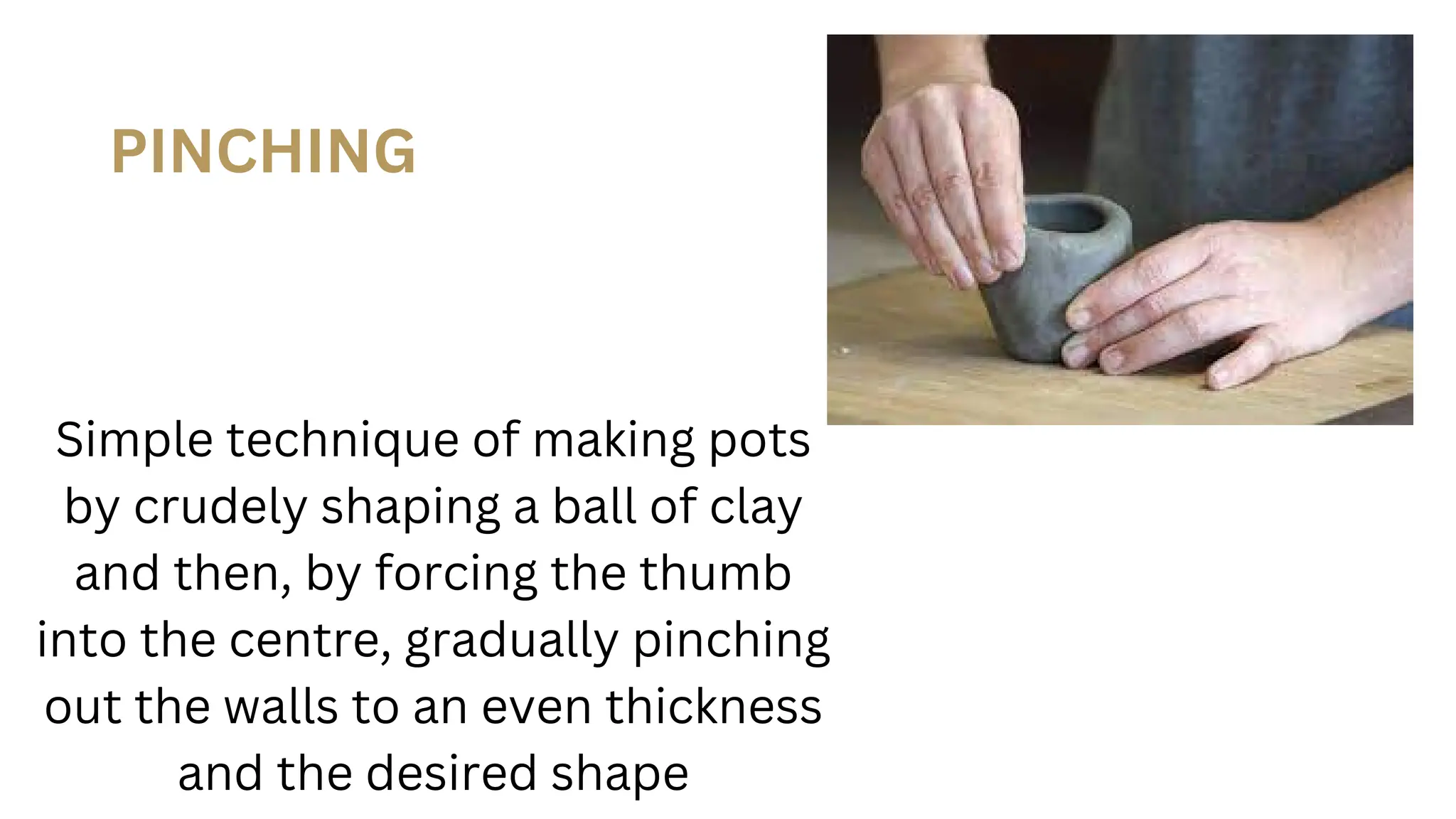
PINCHING
Simple technique ofmaking pots
by crudely shaping a ball of clay
and then, by forcing the thumb
into the centre, gradually pinching
out the walls to an even thickness
and the desired shape
15.
TILES
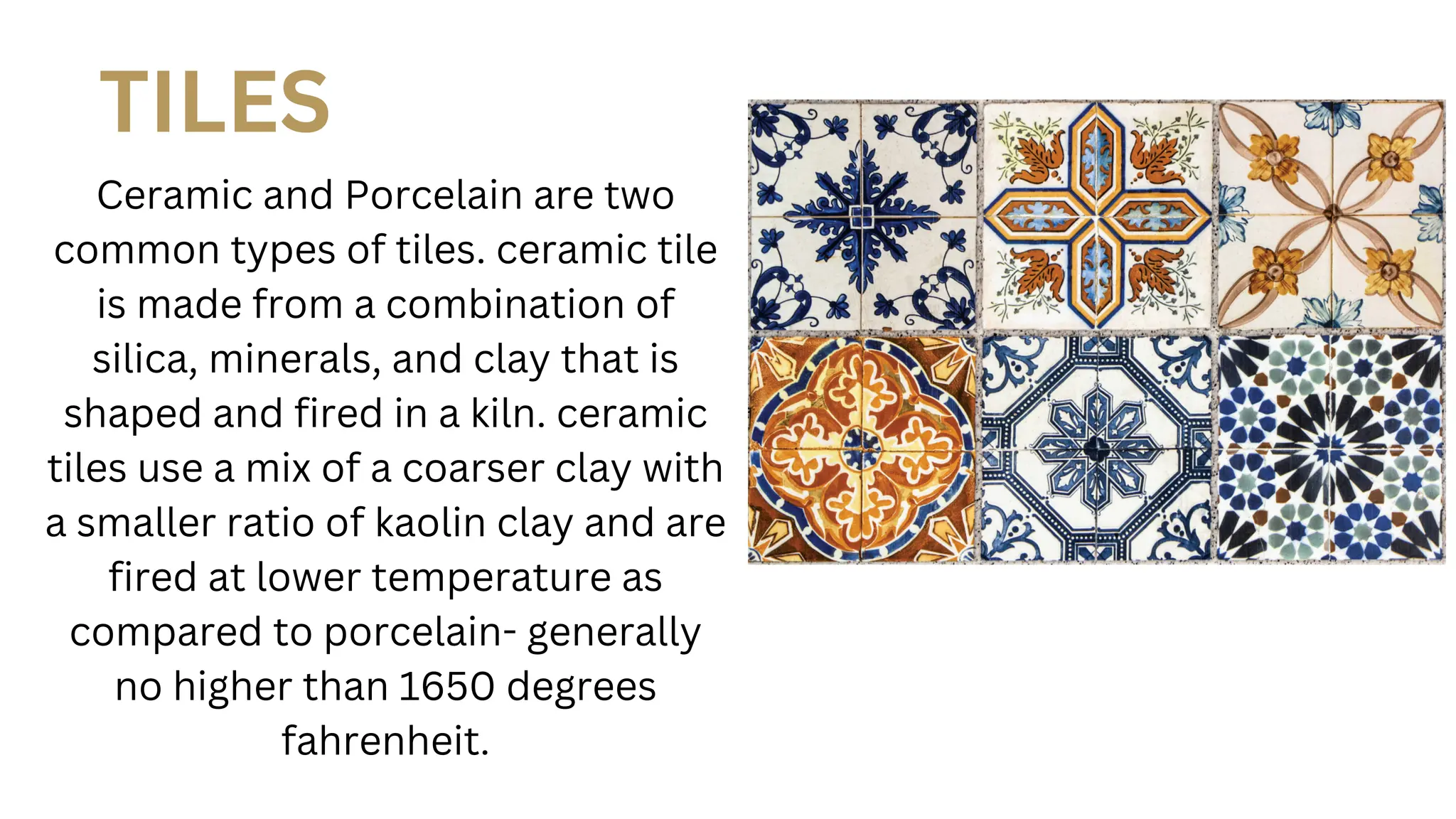
Ceramic and Porcelainare two
common types of tiles. ceramic tile
is made from a combination of
silica, minerals, and clay that is
shaped and fired in a kiln. ceramic
tiles use a mix of a coarser clay with
a smaller ratio of kaolin clay and are
fired at lower temperature as
compared to porcelain- generally
no higher than 1650 degrees
fahrenheit.
16.
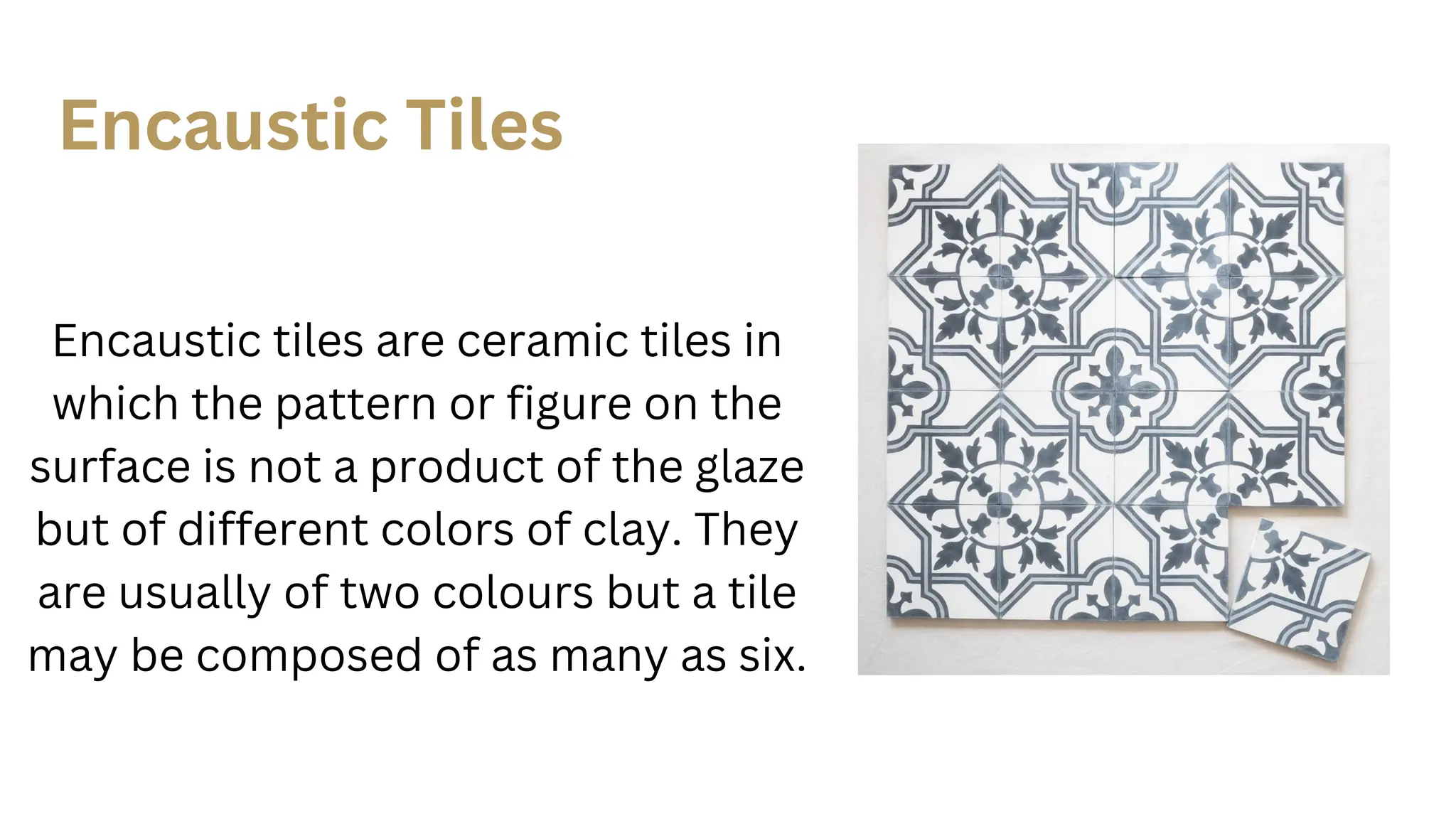
Encaustic tiles areceramic tiles in
which the pattern or figure on the
surface is not a product of the glaze
but of different colors of clay. They
are usually of two colours but a tile
may be composed of as many as six.
Encaustic Tiles




![Chapter4_Initiation_of_Sediment_Motion_v2[1].pptx](https://cdn.slidesharecdn.com/ss_thumbnails/chapter4initiationofsedimentmotionv21-251208223747-f94ef163-thumbnail.jpg?width=640&height=640&fit=bounds)
![CleanMyMac X v5.2.8 Crack for MacOS Full Version [Latest] pptx](https://cdn.slidesharecdn.com/ss_thumbnails/softwareoverview-251207194121-a81f0142-thumbnail.jpg?width=640&height=640&fit=bounds)
![AnyTrans for iOS 8.9.14.20251127 With Crack for MacOS [Latest] pptx](https://cdn.slidesharecdn.com/ss_thumbnails/softwareoverview-251207190907-2316965f-thumbnail.jpg?width=640&height=640&fit=bounds)
![Wondershare Filmora 15.0.11 Crack for Mac Key Full Download [Latest] pptx](https://cdn.slidesharecdn.com/ss_thumbnails/software-251207184836-1d16ba16-thumbnail.jpg?width=640&height=640&fit=bounds)

![iStat Menus 7.20 Crack for MacOS 2026 Full Version [Latest] pptx](https://cdn.slidesharecdn.com/ss_thumbnails/softwareoverview-251207191544-22b737dc-thumbnail.jpg?width=640&height=640&fit=bounds)


![Driver Easy Pro Key 7.1.0.2641 Full Mac Crack Free Activated Download [2026]....](https://cdn.slidesharecdn.com/ss_thumbnails/software-251207185324-b2fb71b4-thumbnail.jpg?width=640&height=640&fit=bounds)

![PowerISO 9.2 Mac Crack + Serial Key Free Download 2026 [Latest] Software.pptx](https://cdn.slidesharecdn.com/ss_thumbnails/software-251207185653-5d5700e6-thumbnail.jpg?width=640&height=640&fit=bounds)


