Wireless Body Area Network (WBAN)
Ashish patil
GUIDE : Prof. S.P.Bhosale
AISSMS COE , PUNE
March 1,2016
1 / 16
Wireless Body Area Network (WBAN)
Outline
1 Introduction
2 Literature Survey
3 Architecture Of WBAN
4 Layers of WBANS
5 Hardware required for WBAN
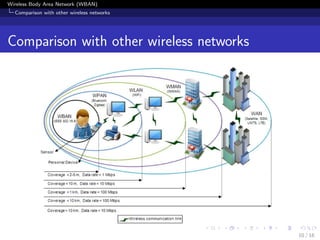
6 Comparison with other wireless networks
7 Advantages and Disadvantages
8 Applications
9 Conclusion
10 References
2 / 16
Wireless Body Area Network (WBAN)
Introduction
Intoduction
DEFINITION BY IEEE: A communication standard
Optimized for low power device for their operation On , in
and around the human body to serve a variety of
applications including medical , consumer electronics or
personal entertainment and other.[4]
Standardization of WBAN : IEEE 802.15.6[7][4]
3 / 16
Wireless Body Area Network (WBAN)
Introduction
Wireless Body Area Network
WBAN is a network around the human body.
It allows the integration of intelligent, miniaturized, low
power sensor node in, on or around a human body to
monitoring body function.[1]
It senses biological, physical, chemical changes of our
body and alarms the person who wears it.[4]
It helps in auto medication in case of emergency
4 / 16
Wireless Body Area Network (WBAN)
Literature Survey
Literature Survey
Wireless Personal Area Network : Interconnect
information devices[4]
Wireless Body Area network : Short range, Low Power,
Low cost [4][7]
Jan 2006 : Working group established for examination of
new topics and direction
May 2008 : Task group compiled all submitted
application into single document
April 2010: First draft of 802.15.6
Feb 2012 : Approved version of 802.15.6
5 / 16
Wireless Body Area Network (WBAN)
Literature Survey
Figure: Evolution of IEEE 802.15 standard[7]
6 / 16
Wireless Body Area Network (WBAN)
Architecture Of WBAN
Tier-1: Intra-WBAN communication
Tier-2: Inter-WBAN communication
Tier-3: Beyond-WBAN communication[3][4]
Figure: Communication Tiers in a Wireless Body Area Network 7 / 16
Wireless Body Area Network (WBAN)
Layers of WBANS
Layers of WBANS
Physical Layer : The PHY layer of IEEE 802.15.6 is
responsible for the following tasks[4][3];
1 Activation and deactivation of the radio transceiver
2 Clear channel assessment (CCA) within the current
channel
3 Data transmission and reception.
MAC Layer : The IEEE 802.15.6 working group defines to
control channel access[4][3].
The hub (or coordinator) divides the entire channel (or
time axis) into a chain of superframes for time
referenced resource allocations. The hub also chooses
beacon periods of equal length to bound the
superframes.
8 / 16
Wireless Body Area Network (WBAN)
Hardware required for WBAN
There are two types of hardware devices required of BAN[4].
Wearable devices are used on the body surface of human.
Medical Implanted devices are inserted inside human
body.
9 / 16
Wireless Body Area Network (WBAN)
Comparison with other wireless networks
10 / 16
Wireless Body Area Network (WBAN)
Advantages and Disadvantages
Advantages
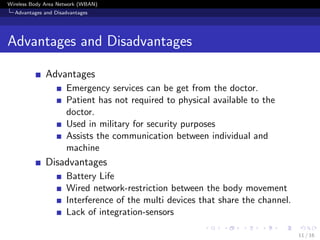
Emergency services can be get from the doctor.
Patient has not required to physical available to the
doctor.
Used in military for security purposes
Assists the communication between individual and
machine
Disadvantages
Battery Life
Wired network-restriction between the body movement
Interference of the multi devices that share the channel.
Lack of integration-sensors
11 / 16
Wireless Body Area Network (WBAN)
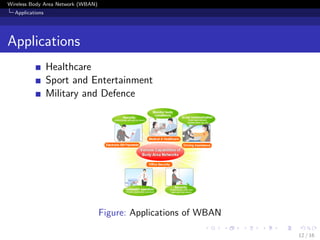
Applications
Applications
Healthcare
Sport and Entertainment
Military and Defence
Figure: Applications of WBAN
12 / 16
Wireless Body Area Network (WBAN)
Conclusion
Conclusion
WBAN plays a very important role in ubiquitous
healthcare applications and enjoys a huge potential
market in the area of consumer electronics
While WBAN technologies provide a promising platform
to enable ubiquitous communications, several open issues
still need to be addressed
13 / 16
Wireless Body Area Network (WBAN)
References
References I
[1] Gabriel E. Arrobo and Richard D. Gitlin, “ New approaches to
reliable wireless body area networks”, IEEE International
Conference on , vol., no., pp.1-6, 7-9 Nov. 2011.
[2] Jocelyne Elias and Ahmed Mehaoua,“ Energy-aware topology
design for wireless body area networks”, IEEE International
Conference on , vol., no., pp.3409-3410, 10-15 June 2012.
[3] Riccardo Cavallari,Flavia Martelli, Ramona Rosini, Chiara
Buratti and Roberto Verdone “ A Survey on Wireless Body
Area Networks: Technologies and Design Challenges”,IEEE
Communications Surveys and Tutorials , vol.16, no.3,
pp.1635-1657, Third Quarter 2014.
14 / 16
Wireless Body Area Network (WBAN)
References
References II
[4] Samaneh Movassaghi, Mehran Abolhasan,Justin Lipman,
David Smith and Abbas Jamalipour,“Wireless Body Area
Networks: A Survey”, IEEE Communications Surveys and
Tutorials , vol.16, no.3, pp.1658-1686, Third Quarter 2014.
[5] Peter Van Daele, Ingrid Moerman, and Piet
Demeester“Wireless body area networks: Status and
opportunities”, IEEE General Assembly and Scientific
Symposium (URSI GASS), vol., no., pp.1-4, 16-23 Aug. 2014.
15 / 16
Wireless Body Area Network (WBAN)
References
References III
[6] Sang-Hun Han and Sang Kyu Park“Performance Analysis of
Wireless Body Area Network in Indoor Off-body
Communication”,IEEE Transactions on Consumer Electronics,
Vol. 57, No. 2, May 2011.
[7] “IEEE Standard for Local and metropolitan area networks -
Part 15.6: Wireless Body Area Networks”,in IEEE Std
802.15.6-2012 , vol., no., pp.1-271, Feb. 29 2012
[8] https://en.wikipedia.org/wiki/IEEE_802.15.6
16 / 16

Wireless body area network

  • 1.
    Wireless Body AreaNetwork (WBAN) Wireless Body Area Network (WBAN) Ashish patil GUIDE : Prof. S.P.Bhosale AISSMS COE , PUNE March 1,2016 1 / 16
  • 2.
    Wireless Body AreaNetwork (WBAN) Outline 1 Introduction 2 Literature Survey 3 Architecture Of WBAN 4 Layers of WBANS 5 Hardware required for WBAN 6 Comparison with other wireless networks 7 Advantages and Disadvantages 8 Applications 9 Conclusion 10 References 2 / 16
  • 3.
    Wireless Body AreaNetwork (WBAN) Introduction Intoduction DEFINITION BY IEEE: A communication standard Optimized for low power device for their operation On , in and around the human body to serve a variety of applications including medical , consumer electronics or personal entertainment and other.[4] Standardization of WBAN : IEEE 802.15.6[7][4] 3 / 16
  • 4.
    Wireless Body AreaNetwork (WBAN) Introduction Wireless Body Area Network WBAN is a network around the human body. It allows the integration of intelligent, miniaturized, low power sensor node in, on or around a human body to monitoring body function.[1] It senses biological, physical, chemical changes of our body and alarms the person who wears it.[4] It helps in auto medication in case of emergency 4 / 16
  • 5.
    Wireless Body AreaNetwork (WBAN) Literature Survey Literature Survey Wireless Personal Area Network : Interconnect information devices[4] Wireless Body Area network : Short range, Low Power, Low cost [4][7] Jan 2006 : Working group established for examination of new topics and direction May 2008 : Task group compiled all submitted application into single document April 2010: First draft of 802.15.6 Feb 2012 : Approved version of 802.15.6 5 / 16
  • 6.
    Wireless Body AreaNetwork (WBAN) Literature Survey Figure: Evolution of IEEE 802.15 standard[7] 6 / 16
  • 7.
    Wireless Body AreaNetwork (WBAN) Architecture Of WBAN Architecture Of WBAN Tier-1: Intra-WBAN communication Tier-2: Inter-WBAN communication Tier-3: Beyond-WBAN communication[3][4] Figure: Communication Tiers in a Wireless Body Area Network 7 / 16
  • 8.
    Wireless Body AreaNetwork (WBAN) Layers of WBANS Layers of WBANS Physical Layer : The PHY layer of IEEE 802.15.6 is responsible for the following tasks[4][3]; 1 Activation and deactivation of the radio transceiver 2 Clear channel assessment (CCA) within the current channel 3 Data transmission and reception. MAC Layer : The IEEE 802.15.6 working group defines to control channel access[4][3]. The hub (or coordinator) divides the entire channel (or time axis) into a chain of superframes for time referenced resource allocations. The hub also chooses beacon periods of equal length to bound the superframes. 8 / 16
  • 9.
    Wireless Body AreaNetwork (WBAN) Hardware required for WBAN Hardware required for WBAN There are two types of hardware devices required of BAN[4]. Wearable devices are used on the body surface of human. Medical Implanted devices are inserted inside human body. 9 / 16
  • 10.
    Wireless Body AreaNetwork (WBAN) Comparison with other wireless networks Comparison with other wireless networks 10 / 16
  • 11.
    Wireless Body AreaNetwork (WBAN) Advantages and Disadvantages Advantages and Disadvantages Advantages Emergency services can be get from the doctor. Patient has not required to physical available to the doctor. Used in military for security purposes Assists the communication between individual and machine Disadvantages Battery Life Wired network-restriction between the body movement Interference of the multi devices that share the channel. Lack of integration-sensors 11 / 16
  • 12.
    Wireless Body AreaNetwork (WBAN) Applications Applications Healthcare Sport and Entertainment Military and Defence Figure: Applications of WBAN 12 / 16
  • 13.
    Wireless Body AreaNetwork (WBAN) Conclusion Conclusion WBAN plays a very important role in ubiquitous healthcare applications and enjoys a huge potential market in the area of consumer electronics While WBAN technologies provide a promising platform to enable ubiquitous communications, several open issues still need to be addressed 13 / 16
  • 14.
    Wireless Body AreaNetwork (WBAN) References References I [1] Gabriel E. Arrobo and Richard D. Gitlin, “ New approaches to reliable wireless body area networks”, IEEE International Conference on , vol., no., pp.1-6, 7-9 Nov. 2011. [2] Jocelyne Elias and Ahmed Mehaoua,“ Energy-aware topology design for wireless body area networks”, IEEE International Conference on , vol., no., pp.3409-3410, 10-15 June 2012. [3] Riccardo Cavallari,Flavia Martelli, Ramona Rosini, Chiara Buratti and Roberto Verdone “ A Survey on Wireless Body Area Networks: Technologies and Design Challenges”,IEEE Communications Surveys and Tutorials , vol.16, no.3, pp.1635-1657, Third Quarter 2014. 14 / 16
  • 15.
    Wireless Body AreaNetwork (WBAN) References References II [4] Samaneh Movassaghi, Mehran Abolhasan,Justin Lipman, David Smith and Abbas Jamalipour,“Wireless Body Area Networks: A Survey”, IEEE Communications Surveys and Tutorials , vol.16, no.3, pp.1658-1686, Third Quarter 2014. [5] Peter Van Daele, Ingrid Moerman, and Piet Demeester“Wireless body area networks: Status and opportunities”, IEEE General Assembly and Scientific Symposium (URSI GASS), vol., no., pp.1-4, 16-23 Aug. 2014. 15 / 16
  • 16.
    Wireless Body AreaNetwork (WBAN) References References III [6] Sang-Hun Han and Sang Kyu Park“Performance Analysis of Wireless Body Area Network in Indoor Off-body Communication”,IEEE Transactions on Consumer Electronics, Vol. 57, No. 2, May 2011. [7] “IEEE Standard for Local and metropolitan area networks - Part 15.6: Wireless Body Area Networks”,in IEEE Std 802.15.6-2012 , vol., no., pp.1-271, Feb. 29 2012 [8] https://en.wikipedia.org/wiki/IEEE_802.15.6 16 / 16