Report By:
Mohit Goyal
M Satyam
Recent decline in oil prices of crude
oil: Causes and Global Impact
Overview
 Introduction
 Reasons for decline in oil prices
 Financial Implications
 Macroeconomic effects - Oil exporting countries
- Oil importing countries
 Effects on India
 Conclusion
 References
Introduction
Crude Oil, often called “black gold” is naturally occurring, unrefined petroleum product
composed of hydrocarbon deposits.
Trade of crude oil across the globe is one the major factors in determining the G.D.P
and financial policies of various countries across the globe
Recent overview of crude oil
 Oil prices fell sharply in the second half of 2014.
 Four-year period of stability around $105 per barrel.
 From June 2014, the global oil prices started a trend of downward shift.
 From $115 per barrel it touched a low of $45 per barrel in Jan 2015.
 This decline being the largest since the 2008 decline when prices fell from a whooping
$145.85 per barrel to $32 per barrel.
West Texas Intermediate
(WTI) crude oil is of very
high quality and is at refining a
larger portion of gasoline. Its
API gravity is 39.6 degrees,
which makes it a "light" crude
oil, and it contains only about
0.24 percent of sulfur (making
a "sweet" crude oil).
Brent Blend is actually a
combination of crude oil from
fifteen different oil fields
located in the North Sea. It is
still a "light" crude oil, but not
quite as "light" as WTI, and it
contains about 0.37 percent of
sulfur (making it a "sweet"
crude oil, but again slightly
less "sweet" than WTI).
Reasons for decline in oil prices
Supply and demand Role of OPEC
Strengthening US Dollar
Middle East countries are
back
Declining
crude oil prices
Supply And Demand
 Technological shift from vertical to horizontal drilling in US led to it becoming a
producer from a consumer.
 Major boom in shale gas production causes the production increase by 0.9 million
barrel per day.
 Between July and Dec 2014 alone, the projected oil demand for 2015 is
downwards by 0.8 million barrel per day.
 The US is producing record amounts of oils plenty of supply out of OPEC and Russia.
But there’s not enough demand from developing economies
like China and India to consume all the oil that’s being supplied.
 A global recession has left Asian demand weaker than expected, and
governments are slashing fuel subsidies across Asia.
 It’s not just Asia, though. Austerity measures and decreased consumption
across Europe are curbing oil demand throughout that continent, too.
Role of OPEC
 OPEC coordinates and unifies the petroleum policies of its members.
 In 2014 OPEC comprised 12 members: Algeria, Angola, Ecuador, Iran, Iraq,
Kuwait, Libya, Nigeria, Qatar, Saudi Arabia, the United Arab Emirates and Venezuela.
 OPEC member countries produce about 40 percent of the world's crude oil.
 Equally important to global prices, OPEC's oil exports represent about 60 percent of the
total petroleum traded internationally
On November 27, a big meeting was held by the Cartel, and countries, like
Venezuela and Iran, proposed that the Cartel (mainly Saudi Arabia)
decreases oil production in order to maintain stability in the oil prices.
1
Just to ensure it maintains its market share, Saudi Arabia, the world's largest
oil producer, did not agree to reducing oil production and was willing to let
prices plummet.
2
OPEC's surprising response: Let prices keep falling
 Oil prices continued to slip onwards of September 2014.(remove it)
 During the November 27, 2014 Vienna meeting of OPEC countries the major oil producing
members like Saudi Arabia and Iran, did nothing to arrest the falling price.
 Some countries, like Venezuela and Iran, wanted the cartel (mainly Saudi Arabia) to cut
back on production in order to prop up the price. These countries need high prices in
order to "break even" on their budgets and pay for all the government spending.
 On the other side Saudi Arabia, the world's second-largest crude oil producer, which was
opposed to cutting production and seemed willing to let prices keep dropping.
 In the 1980s, when prices fell and the country tried to cut back on production to prop
them up. The result was that prices kept declining anyway and Saudi Arabia simply lost
market share.
"We will produce 30 million barrels a day for the next 6 months, and we will watch to
see how the market behaves," said OPEC Secretary-General Abdalla El-Badri.
 That caused the price of oil to start crashing even further.
 The price of Brent crude went from $80 per barrel to $70 per barrel in just a few days. And
it kept tumbling to down below $60 per barrel by mid-December and $50 by January.
 OPEC is now engaged in a "price war" with the US.
 It's relatively cheap to pump oil out of places like Saudi Arabia and Kuwait. But it's
more expensive to extract oil from shale formations in places like Texas and North Dakota.
 So as the price of oil keeps falling, some US producers may become unprofitable and
go out of business. And the price of oil will stabilize. At least that's what OPEC members
hope.
Strengthening Dollar
 Across the globe the crude oil is bought and sold in dollars.
 Dollar getting stronger makes oil more expensive to buy in countries outside the US. That, in
turn, weakens worldwide demand and further puts downward pressure on oil prices.
 high estimates suggest that a 10 percent appreciation is associated with a decline of about 10
percent in the oil price, whereas the low estimates suggest 3 percent or less.
 Even though global oil prices are falling, they’re falling less for countries with currencies that are
weaker than the US dollar.
Financial Implications
Input Costs
Real Income
Shifts
Monetary and
Fiscal Policies
Global Growth
Reduced
investment in
new
development
Input Costs
 Lower oil prices reduce energy costs generally, as prices of competing energy
materials are forced down too.
 Oil is feedstock for various sectors, including petrochemicals, paper, and
aluminium, the decline in price directly impacts a wide range of processed or
semi-processed inputs.
 The transportation, petrochemicals, and agricultural sectors, and some
manufacturing industries, would be major beneficiaries from lower prices.
Real Income Shifts
 Oil price declines generate changes in real income benefiting oil-importers and
losses hurting oil-exporters.
 The shift in income from oil exporting economies with higher average saving
rates to net importers with a higher propensity to spend should generally result in
stronger global demand over the medium-term.
Monetary and Fiscal Policy
Oil importing countries:
declining oil prices may
reduce medium-term
inflation expectations below
target
central banks could
respond with additional
monetary policy which can
support growth
Oil-exporting countries:
lower oil prices might trigger
contractionary fiscal policy
measures.
.
Developing countries:
may benefit more from a
decline in energy input
costs.
Household inflation
expectations in developing
economies may also be
more responsive to changes
in fuel prices than in
developed countries
 Reduced investment in new exploration or development.
Lower oil prices would especially put at risk oil investment projects in low-income
countries (e.g., Mozambique, Uganda)
also unconventional sources such as shale oil, tar sands, deep sea oil fields (especially in
Brazil, Mexico, Canada and the United States), and oil in the Arctic zone.
Macroeconomic Effect
 In 2014-15 the price of crude oil has fallen more than 50%. This fall in the price
of oil has a significant impact in reducing transport and other business costs.
Falling oil prices is good news for oil importers, such as Western Europe, China,
India and Japan; however, it is bad news for oil exporters, such as Russia,
Venezuela, Kuwait, Iraq and Nigeria.
Oil Exporting Countries
 Many oil exporting countries rely on tax revenue from oil production to fund
government spending.
 For example, Russia gains 70% of all tax revenues from oil and gas. Falling oil
prices will lead to a government budget deficit, social problems and will require
either higher taxes or government spending cuts.
 Some oil-exporting countries in the Middle East and North Africa, could contract
by 0.8–2.5 percentage points in the year following a 10 percent decline in the
annual average oil price.
 Further we discuss in detail about oil exporting countries.
Oil Exporting Countries:
RUSSIA
SAUDI ARAB
IRAN
UNITED STATES OF AMERICA
VENEZUELA
Russian budget heavily relies
on its oil income
More than half of its budget
revenues come from selling
Oil and Gas
The Russian economy may
go into Recession if oil
prices keep falling
Effect of falling oil prices on Russia
Image Courtesy: http://www.kp24.fi/data/attachments/6488fd17-c93a-453c-b788-eedd292063d9_389541.jpg
 Russia is the world’s largest crude oil producer.
 Russia gains 70% of all tax revenues from oil and gas.
 Oil revenues makes up 45% of the government budget and falling oil prices will lead to a
government budget deficit, and will require either higher taxes or government spending.
 Russia’s economy is expected to shrink 4.5% next year if oil stays at $60 per barrel.
 The plunging price of oil has also caused the ruble's value to collapse.
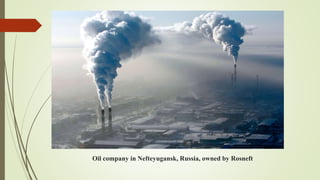
Oil company in Nefteyugansk, Russia, owned by Rosneft
2. Saudi Arabia
 Saudi Arabia is the world's second-largest crude producer after Russia.
 It produces 10 million barrel per day.
 It will suffer financially from cheap oil.
 It oil stays at around $60 per barrel next year, the government will run a deficit
equal to 14% of GDP.
 It can afford temporary falls in oil prices because they have substantial reserves. It
has build up a stockpile of foreign currency worth some $740 billion, which it will
use to finance its deficits.
 This is why Saudi Arabia has so far not responded by cutting output.
 Still, if low oil prices persist, Saudi Arabia may have to cut back on some of the
social programs.
Petrochemical plant, Jubail, Saudi Arabia
3. Venezuela
 It is another major oil producer.
 In Venezuela oil sales provide both 47% of government revenues and the main
source of foreign currency.
 Venezuela are relying on oil revenues to fund generous social spending.
 A fall in oil prices could lead to a significant budget deficit and social problems.
 The nation's economy is set to shrink some 3% this year and inflation is rampant.
This will translate into
accelerated economic growth
to a forecasted 3.5% next year.
Falling oil prices will cause
gas prices to go down, which
will result in increased
consumer spending.
Effect of falling oil prices on US
Image Courtesy: http://www.ulkeajans.com/images/haberler/obama_uluslararasi_toplum_gazzede_ateskes_icin_calismali_h56636.jpg
 In the US a fall in crude prices would have more varied impacts.
 For many people, it will offer a nice economic boost: cheaper oil means lower
gasoline prices which have fallen to $2.47 per gallon.
 However oil-producing states like Texas and North Dakota are likely to see a drop in
revenues and economic activity.
 The falling price of oil is also putting severe pressure on Alaska’s state budget.
 All told, oil prices are likely to be good for 42 states and bad for the other 8.
High oil prices are one of the major factors affecting the Iranian economy.
Severe economic problems may result if oil prices keep falling.
Iran may decide to reach a nuclear deal with the US to ease economic sanctions.
Image Courtesy - http://www.timesofisrael.com/irans-supreme-leader-undergoes-prostate-surgery//
Effect of falling oil prices on Iran
5. Iran
 One big problem for Iran is that it needs oil prices well north of $100 per barrel to
balance its budget, especially since Western sanctions have made it much harder
to export crude.
 If oil prices keep falling, the Iranian government may need to make up revenues
elsewhere say, by paring back domestic fuel subsidies (always an unpopular
move, at least in the short term).
Oil Importing Countries
 There are three main channels through which a decrease in the price of oil affects
oil importers.
 The first is the effect of the increase in real income on consumption.
 The second is the decrease in the cost of production of final goods, and in turn on
profit and investment.
 The third is the effect on the rate of inflation.
 A 10 percent decrease in oil prices would raise growth in oil-importing economies by some
0.1– 0.5 percentage points, depending on the share of oil imports in GDP.
 In China, for example, the impact of lower oil prices on growth is expected to boost
activity by 0.1-0.2 percent because oil accounts for only 18 percent of energy
consumption, whereas 68 percent is accounted for by coal.
 Japan is also a major importer of oil and oil-related products with imports valued at $210
billion in 2014, roughly equivalent to 4% of the country’s GDP.
Japan’s manufacturing sector is set to experience. a significant upside from lower raw
material and electricity costs. This includes companies in the steel, tyres, glass and
paper sectors.
 Several other large oil-importing emerging market economies also stand to benefit from
lower oil prices.
 In Brazil, India, Indonesia, South Africa and Turkey, the fall in oil prices will help
lower inflation and reduce current account deficits a major source of vulnerability for
many of these countries.
 Some oil importers would also be affected by a slowdown in oil-exporting countries.
 A sharp recession in Russia would dampen growth in Central Asia, while weakening
external accounts in Venezuela or the Gulf Cooperation Council (GCC) countries may put
at risk external financing support they provide to neighbouring countries.
How does the fall in oil prices affect India?
 India, which is the fourth largest consumer of oil, is a big beneficiary of falling oil
prices.
 India imports nearly two-thirds of crude oil requirements.
 The reduced prices will not only lower the import bill but also help save foreign
exchange.
 And It will also enable oil marketing companies to reduce retail prices of petrol and
diesel.
 As per rough estimates, a $10 fall in crude could reduce the current account deficit by
approximately 0.5% of GDP and the fiscal deficit by around 0.1% of GDP.
 Lower oil prices have also aided government's efforts to keep inflation low and stable
besides curtailing fuel subsidies.
 A lower subsidy bill will help contain the country's fiscal deficit — a measure of the
amount the government borrows to fund its expenses — at the budgeted level of 4.1% of
GDP in 2014-15.
 With every dollar decrease in oil prices, the government's oil import bill comes down by
Rs. 4,000 crore.
Conclusion
 Following four years of stability at around $105 per barrel, oil prices fell sharply in the
second half of 2014.
 The decline in oil prices was quite significant compared with the previous episodes of
oil price drops during the past three decades.
 There have been a number of long-terms and short-term drivers behind the recent
plunge in oil prices: several years of large upward surprises in oil supply; some
downward surprises in demand; unwinding of some geopolitical risks that had
threatened production; change in OPEC policy objectives; and appreciation of U.S.
dollar.
 Supply related factors have clearly played a dominant role.
 The decline in oil prices has significant macroeconomic, financial implications.
 If sustained, it will support activity and reduce inflationary, external, and fiscal
pressures in oil-importing countries.
 On the other hand, it would affect oil-exporting countries adversely by weakening
fiscal and external positions and reducing economic activity.
 However, declining oil prices also present a significant window of opportunity to
reform energy taxes and fuel subsidies, which are substantial in several developing
countries, and reinvigorate reforms to diversify oil-reliant economies.
 http://www.bangkokpost.com/business/news/464181/impact-of-lower-oil-
prices-on-asian-economies
 http://blog-imfdirect.imf.org/2014/12/22/seven-questions-about-the-recent-
oil-price-slump/
 http://www.bbc.com/news/business-29643612

declining crude oil pricing:causes and global impact

  • 1.
  • 2.
    Recent decline inoil prices of crude oil: Causes and Global Impact
  • 3.
    Overview  Introduction  Reasonsfor decline in oil prices  Financial Implications  Macroeconomic effects - Oil exporting countries - Oil importing countries  Effects on India  Conclusion  References
  • 4.
    Introduction Crude Oil, oftencalled “black gold” is naturally occurring, unrefined petroleum product composed of hydrocarbon deposits. Trade of crude oil across the globe is one the major factors in determining the G.D.P and financial policies of various countries across the globe
  • 5.
    Recent overview ofcrude oil  Oil prices fell sharply in the second half of 2014.  Four-year period of stability around $105 per barrel.  From June 2014, the global oil prices started a trend of downward shift.  From $115 per barrel it touched a low of $45 per barrel in Jan 2015.  This decline being the largest since the 2008 decline when prices fell from a whooping $145.85 per barrel to $32 per barrel.
  • 6.
    West Texas Intermediate (WTI)crude oil is of very high quality and is at refining a larger portion of gasoline. Its API gravity is 39.6 degrees, which makes it a "light" crude oil, and it contains only about 0.24 percent of sulfur (making a "sweet" crude oil). Brent Blend is actually a combination of crude oil from fifteen different oil fields located in the North Sea. It is still a "light" crude oil, but not quite as "light" as WTI, and it contains about 0.37 percent of sulfur (making it a "sweet" crude oil, but again slightly less "sweet" than WTI).
  • 8.
    Reasons for declinein oil prices
  • 9.
    Supply and demandRole of OPEC Strengthening US Dollar Middle East countries are back Declining crude oil prices
  • 10.
    Supply And Demand Technological shift from vertical to horizontal drilling in US led to it becoming a producer from a consumer.  Major boom in shale gas production causes the production increase by 0.9 million barrel per day.  Between July and Dec 2014 alone, the projected oil demand for 2015 is downwards by 0.8 million barrel per day.  The US is producing record amounts of oils plenty of supply out of OPEC and Russia. But there’s not enough demand from developing economies like China and India to consume all the oil that’s being supplied.
  • 11.
     A globalrecession has left Asian demand weaker than expected, and governments are slashing fuel subsidies across Asia.  It’s not just Asia, though. Austerity measures and decreased consumption across Europe are curbing oil demand throughout that continent, too.
  • 12.
  • 13.
     OPEC coordinatesand unifies the petroleum policies of its members.  In 2014 OPEC comprised 12 members: Algeria, Angola, Ecuador, Iran, Iraq, Kuwait, Libya, Nigeria, Qatar, Saudi Arabia, the United Arab Emirates and Venezuela.  OPEC member countries produce about 40 percent of the world's crude oil.  Equally important to global prices, OPEC's oil exports represent about 60 percent of the total petroleum traded internationally
  • 14.
    On November 27,a big meeting was held by the Cartel, and countries, like Venezuela and Iran, proposed that the Cartel (mainly Saudi Arabia) decreases oil production in order to maintain stability in the oil prices. 1 Just to ensure it maintains its market share, Saudi Arabia, the world's largest oil producer, did not agree to reducing oil production and was willing to let prices plummet. 2 OPEC's surprising response: Let prices keep falling
  • 15.
     Oil pricescontinued to slip onwards of September 2014.(remove it)  During the November 27, 2014 Vienna meeting of OPEC countries the major oil producing members like Saudi Arabia and Iran, did nothing to arrest the falling price.  Some countries, like Venezuela and Iran, wanted the cartel (mainly Saudi Arabia) to cut back on production in order to prop up the price. These countries need high prices in order to "break even" on their budgets and pay for all the government spending.  On the other side Saudi Arabia, the world's second-largest crude oil producer, which was opposed to cutting production and seemed willing to let prices keep dropping.  In the 1980s, when prices fell and the country tried to cut back on production to prop them up. The result was that prices kept declining anyway and Saudi Arabia simply lost market share.
  • 17.
    "We will produce30 million barrels a day for the next 6 months, and we will watch to see how the market behaves," said OPEC Secretary-General Abdalla El-Badri.
  • 18.
     That causedthe price of oil to start crashing even further.  The price of Brent crude went from $80 per barrel to $70 per barrel in just a few days. And it kept tumbling to down below $60 per barrel by mid-December and $50 by January.  OPEC is now engaged in a "price war" with the US.  It's relatively cheap to pump oil out of places like Saudi Arabia and Kuwait. But it's more expensive to extract oil from shale formations in places like Texas and North Dakota.  So as the price of oil keeps falling, some US producers may become unprofitable and go out of business. And the price of oil will stabilize. At least that's what OPEC members hope.
  • 19.
    Strengthening Dollar  Acrossthe globe the crude oil is bought and sold in dollars.  Dollar getting stronger makes oil more expensive to buy in countries outside the US. That, in turn, weakens worldwide demand and further puts downward pressure on oil prices.  high estimates suggest that a 10 percent appreciation is associated with a decline of about 10 percent in the oil price, whereas the low estimates suggest 3 percent or less.  Even though global oil prices are falling, they’re falling less for countries with currencies that are weaker than the US dollar.
  • 21.
  • 22.
    Input Costs Real Income Shifts Monetaryand Fiscal Policies Global Growth Reduced investment in new development
  • 23.
    Input Costs  Loweroil prices reduce energy costs generally, as prices of competing energy materials are forced down too.  Oil is feedstock for various sectors, including petrochemicals, paper, and aluminium, the decline in price directly impacts a wide range of processed or semi-processed inputs.  The transportation, petrochemicals, and agricultural sectors, and some manufacturing industries, would be major beneficiaries from lower prices.
  • 24.
    Real Income Shifts Oil price declines generate changes in real income benefiting oil-importers and losses hurting oil-exporters.  The shift in income from oil exporting economies with higher average saving rates to net importers with a higher propensity to spend should generally result in stronger global demand over the medium-term.
  • 25.
    Monetary and FiscalPolicy Oil importing countries: declining oil prices may reduce medium-term inflation expectations below target central banks could respond with additional monetary policy which can support growth Oil-exporting countries: lower oil prices might trigger contractionary fiscal policy measures. . Developing countries: may benefit more from a decline in energy input costs. Household inflation expectations in developing economies may also be more responsive to changes in fuel prices than in developed countries
  • 26.
     Reduced investmentin new exploration or development. Lower oil prices would especially put at risk oil investment projects in low-income countries (e.g., Mozambique, Uganda) also unconventional sources such as shale oil, tar sands, deep sea oil fields (especially in Brazil, Mexico, Canada and the United States), and oil in the Arctic zone.
  • 27.
    Macroeconomic Effect  In2014-15 the price of crude oil has fallen more than 50%. This fall in the price of oil has a significant impact in reducing transport and other business costs. Falling oil prices is good news for oil importers, such as Western Europe, China, India and Japan; however, it is bad news for oil exporters, such as Russia, Venezuela, Kuwait, Iraq and Nigeria.
  • 29.
    Oil Exporting Countries Many oil exporting countries rely on tax revenue from oil production to fund government spending.  For example, Russia gains 70% of all tax revenues from oil and gas. Falling oil prices will lead to a government budget deficit, social problems and will require either higher taxes or government spending cuts.  Some oil-exporting countries in the Middle East and North Africa, could contract by 0.8–2.5 percentage points in the year following a 10 percent decline in the annual average oil price.  Further we discuss in detail about oil exporting countries.
  • 30.
    Oil Exporting Countries: RUSSIA SAUDIARAB IRAN UNITED STATES OF AMERICA VENEZUELA
  • 31.
    Russian budget heavilyrelies on its oil income More than half of its budget revenues come from selling Oil and Gas The Russian economy may go into Recession if oil prices keep falling Effect of falling oil prices on Russia Image Courtesy: http://www.kp24.fi/data/attachments/6488fd17-c93a-453c-b788-eedd292063d9_389541.jpg
  • 32.
     Russia isthe world’s largest crude oil producer.  Russia gains 70% of all tax revenues from oil and gas.  Oil revenues makes up 45% of the government budget and falling oil prices will lead to a government budget deficit, and will require either higher taxes or government spending.  Russia’s economy is expected to shrink 4.5% next year if oil stays at $60 per barrel.  The plunging price of oil has also caused the ruble's value to collapse.
  • 33.
    Oil company inNefteyugansk, Russia, owned by Rosneft
  • 34.
    2. Saudi Arabia Saudi Arabia is the world's second-largest crude producer after Russia.  It produces 10 million barrel per day.  It will suffer financially from cheap oil.  It oil stays at around $60 per barrel next year, the government will run a deficit equal to 14% of GDP.  It can afford temporary falls in oil prices because they have substantial reserves. It has build up a stockpile of foreign currency worth some $740 billion, which it will use to finance its deficits.  This is why Saudi Arabia has so far not responded by cutting output.  Still, if low oil prices persist, Saudi Arabia may have to cut back on some of the social programs.
  • 35.
  • 36.
    3. Venezuela  Itis another major oil producer.  In Venezuela oil sales provide both 47% of government revenues and the main source of foreign currency.  Venezuela are relying on oil revenues to fund generous social spending.  A fall in oil prices could lead to a significant budget deficit and social problems.  The nation's economy is set to shrink some 3% this year and inflation is rampant.
  • 37.
    This will translateinto accelerated economic growth to a forecasted 3.5% next year. Falling oil prices will cause gas prices to go down, which will result in increased consumer spending. Effect of falling oil prices on US Image Courtesy: http://www.ulkeajans.com/images/haberler/obama_uluslararasi_toplum_gazzede_ateskes_icin_calismali_h56636.jpg
  • 38.
     In theUS a fall in crude prices would have more varied impacts.  For many people, it will offer a nice economic boost: cheaper oil means lower gasoline prices which have fallen to $2.47 per gallon.  However oil-producing states like Texas and North Dakota are likely to see a drop in revenues and economic activity.  The falling price of oil is also putting severe pressure on Alaska’s state budget.  All told, oil prices are likely to be good for 42 states and bad for the other 8.
  • 39.
    High oil pricesare one of the major factors affecting the Iranian economy. Severe economic problems may result if oil prices keep falling. Iran may decide to reach a nuclear deal with the US to ease economic sanctions. Image Courtesy - http://www.timesofisrael.com/irans-supreme-leader-undergoes-prostate-surgery// Effect of falling oil prices on Iran
  • 40.
    5. Iran  Onebig problem for Iran is that it needs oil prices well north of $100 per barrel to balance its budget, especially since Western sanctions have made it much harder to export crude.  If oil prices keep falling, the Iranian government may need to make up revenues elsewhere say, by paring back domestic fuel subsidies (always an unpopular move, at least in the short term).
  • 41.
    Oil Importing Countries There are three main channels through which a decrease in the price of oil affects oil importers.  The first is the effect of the increase in real income on consumption.  The second is the decrease in the cost of production of final goods, and in turn on profit and investment.  The third is the effect on the rate of inflation.
  • 42.
     A 10percent decrease in oil prices would raise growth in oil-importing economies by some 0.1– 0.5 percentage points, depending on the share of oil imports in GDP.  In China, for example, the impact of lower oil prices on growth is expected to boost activity by 0.1-0.2 percent because oil accounts for only 18 percent of energy consumption, whereas 68 percent is accounted for by coal.  Japan is also a major importer of oil and oil-related products with imports valued at $210 billion in 2014, roughly equivalent to 4% of the country’s GDP. Japan’s manufacturing sector is set to experience. a significant upside from lower raw material and electricity costs. This includes companies in the steel, tyres, glass and paper sectors.
  • 43.
     Several otherlarge oil-importing emerging market economies also stand to benefit from lower oil prices.  In Brazil, India, Indonesia, South Africa and Turkey, the fall in oil prices will help lower inflation and reduce current account deficits a major source of vulnerability for many of these countries.  Some oil importers would also be affected by a slowdown in oil-exporting countries.  A sharp recession in Russia would dampen growth in Central Asia, while weakening external accounts in Venezuela or the Gulf Cooperation Council (GCC) countries may put at risk external financing support they provide to neighbouring countries.
  • 44.
    How does thefall in oil prices affect India?  India, which is the fourth largest consumer of oil, is a big beneficiary of falling oil prices.  India imports nearly two-thirds of crude oil requirements.  The reduced prices will not only lower the import bill but also help save foreign exchange.  And It will also enable oil marketing companies to reduce retail prices of petrol and diesel.  As per rough estimates, a $10 fall in crude could reduce the current account deficit by approximately 0.5% of GDP and the fiscal deficit by around 0.1% of GDP.
  • 45.
     Lower oilprices have also aided government's efforts to keep inflation low and stable besides curtailing fuel subsidies.  A lower subsidy bill will help contain the country's fiscal deficit — a measure of the amount the government borrows to fund its expenses — at the budgeted level of 4.1% of GDP in 2014-15.  With every dollar decrease in oil prices, the government's oil import bill comes down by Rs. 4,000 crore.
  • 46.
    Conclusion  Following fouryears of stability at around $105 per barrel, oil prices fell sharply in the second half of 2014.  The decline in oil prices was quite significant compared with the previous episodes of oil price drops during the past three decades.  There have been a number of long-terms and short-term drivers behind the recent plunge in oil prices: several years of large upward surprises in oil supply; some downward surprises in demand; unwinding of some geopolitical risks that had threatened production; change in OPEC policy objectives; and appreciation of U.S. dollar.  Supply related factors have clearly played a dominant role.
  • 47.
     The declinein oil prices has significant macroeconomic, financial implications.  If sustained, it will support activity and reduce inflationary, external, and fiscal pressures in oil-importing countries.  On the other hand, it would affect oil-exporting countries adversely by weakening fiscal and external positions and reducing economic activity.  However, declining oil prices also present a significant window of opportunity to reform energy taxes and fuel subsidies, which are substantial in several developing countries, and reinvigorate reforms to diversify oil-reliant economies.
  • 48.

Editor's Notes

  • #33 Inflation- The rate at which the general level of prices for goods and services is rising and purchasing power is falling. The ruble or rouble is a unit of currency of various countries in Eastern Europe and is closely associated with the economy of Russia
  • #35 Deficit essentially refers to the difference between cash inflows and outflows.
  • #37 Rampant means wild, out of control, to be up on your hind legs roaring at the world.