

1 I NAME OF PRESENTER
FP Algorithm
Ashis Kumar Chanda
Department of Computer Science and Engineering
University of Dhaka
2 I NAME OF PRESENTERCSE, DU2
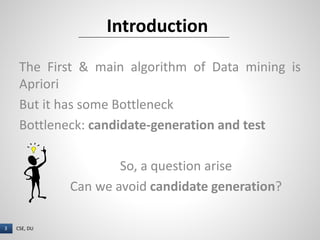
Key concepts
oIntroduction
o Idea of FP
o FP-construction
o Analysis of FP
3 I NAME OF PRESENTERCSE, DU3
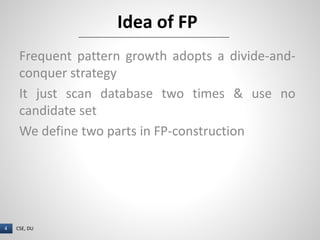
Introduction
The First & main algorithm of Data mining is
Apriori
But it has some Bottleneck
Bottleneck: candidate-generation and test
So, a question arise
Can we avoid candidate generation?
4 I NAME OF PRESENTERCSE, DU4
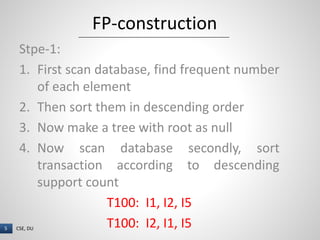
Idea of FP
Frequent pattern growth adopts a divide-and-
conquer strategy
It just scan database two times & use no
candidate set
We define two parts in FP-construction
5 I NAME OF PRESENTERCSE, DU5
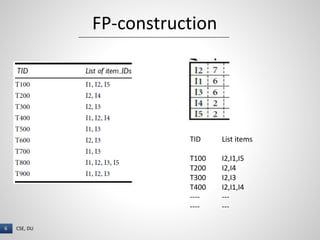
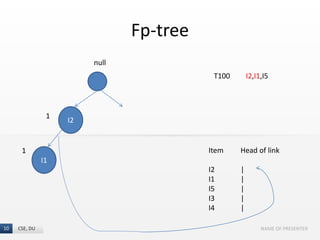
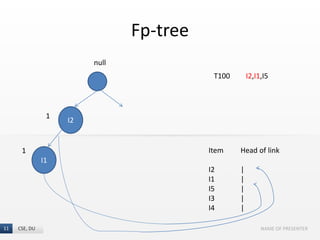
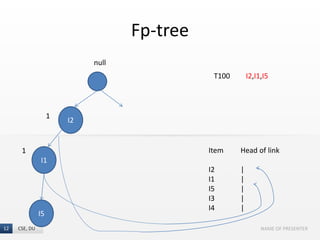
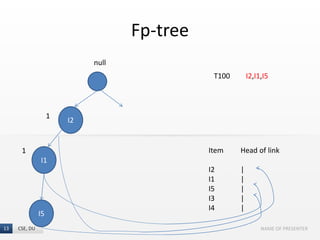
FP-construction
Stpe-1:
1. First scan database, find frequent number
of each element
2. Then sort them in descending order
3. Now make a tree with root as null
4. Now scan database secondly, sort
transaction according to descending
support count
T100: I1, I2, I5
T100: I2, I1, I5
6 I NAME OF PRESENTERCSE, DU6
FP-construction
TID List items
T100 I2,I1,I5
T200 I2,I4
T300 I2,I3
T400 I2,I1,I4
---- ---
---- ---
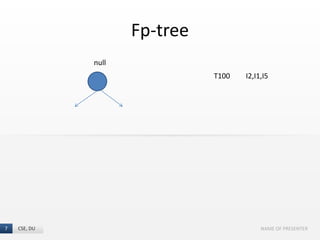
7 I NAME OF PRESENTER
Fp-tree
7
null
T100 I2,I1,I5
CSE, DU
8 I NAME OF PRESENTER
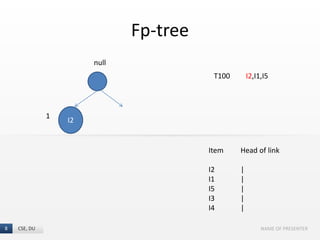
Fp-tree
8
null
T100 I2,I1,I5
I2
1
Item Head of link
I2 |
I1 |
I5 |
I3 |
I4 |
CSE, DU
9 I NAME OF PRESENTER
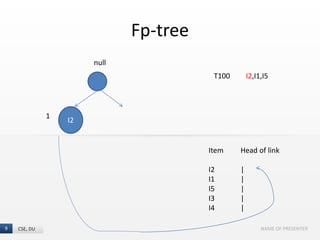
Fp-tree
9
null
T100 I2,I1,I5
I2
1
Item Head of link
I2 |
I1 |
I5 |
I3 |
I4 |
CSE, DU
10 I NAME OF PRESENTER
Fp-tree
10
null
T100 I2,I1,I5
I2
I1
1
1 Item Head of link
I2 |
I1 |
I5 |
I3 |
I4 |
CSE, DU
11 I NAME OF PRESENTER
Fp-tree
11
null
T100 I2,I1,I5
I2
I1
1
1 Item Head of link
I2 |
I1 |
I5 |
I3 |
I4 |
CSE, DU
12 I NAME OF PRESENTER
Fp-tree
12
null
T100 I2,I1,I5
I2
I1
I5
1
1 Item Head of link
I2 |
I1 |
I5 |
I3 |
I4 |
CSE, DU
13 I NAME OF PRESENTER
Fp-tree
13
null
T100 I2,I1,I5
I2
I1
I5
1
1 Item Head of link
I2 |
I1 |
I5 |
I3 |
I4 |
CSE, DU
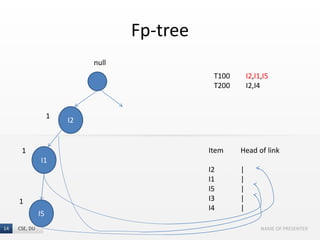
14 I NAME OF PRESENTER
Fp-tree
14
null
T100 I2,I1,I5
T200 I2,I4
I2
I1
I5
1
1
1
Item Head of link
I2 |
I1 |
I5 |
I3 |
I4 |
CSE, DU
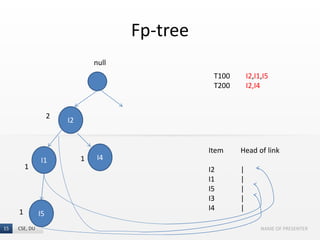
15 I NAME OF PRESENTER
Fp-tree
15
null
T100 I2,I1,I5
T200 I2,I4
I2
I1
I5
I4
2
1
1
1
Item Head of link
I2 |
I1 |
I5 |
I3 |
I4 |
CSE, DU
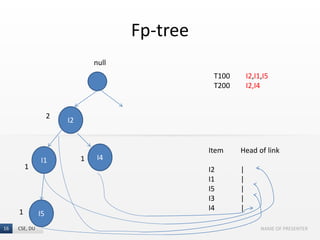
16 I NAME OF PRESENTER
Fp-tree
16
null
T100 I2,I1,I5
T200 I2,I4
I2
I1
I5
I4
2
1
1
1
Item Head of link
I2 |
I1 |
I5 |
I3 |
I4 |
CSE, DU
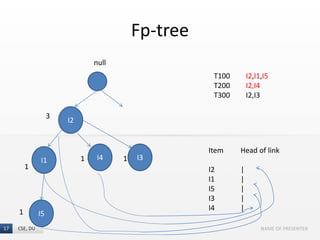
17 I NAME OF PRESENTER
Fp-tree
17
null
T100 I2,I1,I5
T200 I2,I4
T300 I2,I3
I2
I1
I5
I4 I3
3
1
1
1 1
Item Head of link
I2 |
I1 |
I5 |
I3 |
I4 |
CSE, DU
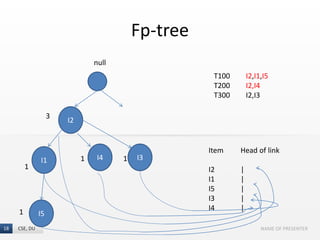
18 I NAME OF PRESENTER
Fp-tree
18
null
T100 I2,I1,I5
T200 I2,I4
T300 I2,I3
I2
I1
I5
I4 I3
3
1
1
1 1
Item Head of link
I2 |
I1 |
I5 |
I3 |
I4 |
CSE, DU
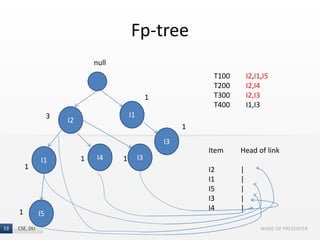
19 I NAME OF PRESENTER
Fp-tree
19
null
T100 I2,I1,I5
T200 I2,I4
T300 I2,I3
T400 I1,I3
I2
I1
I5
I4 I3
3
1
1
1 1
I1
1
I3
1
Item Head of link
I2 |
I1 |
I5 |
I3 |
I4 |
CSE, DU
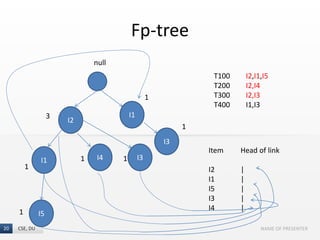
20 I NAME OF PRESENTER
Fp-tree
20
null
T100 I2,I1,I5
T200 I2,I4
T300 I2,I3
T400 I1,I3
I2
I1
I5
I4 I3
3
1
1
1 1
I1
1
I3
1
Item Head of link
I2 |
I1 |
I5 |
I3 |
I4 |
CSE, DU
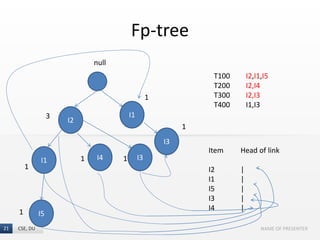
21 I NAME OF PRESENTER
Fp-tree
21
null
T100 I2,I1,I5
T200 I2,I4
T300 I2,I3
T400 I1,I3
I2
I1
I5
I4 I3
3
1
1
1 1
I1
1
I3
1
Item Head of link
I2 |
I1 |
I5 |
I3 |
I4 |
CSE, DU
22 I NAME OF PRESENTER
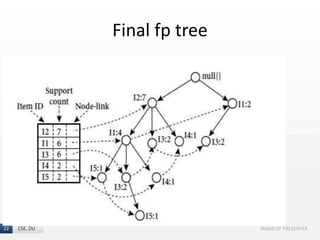
Final fp tree
22 CSE, DU
23 I NAME OF PRESENTER
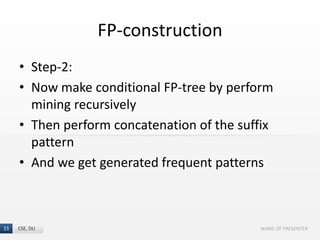
FP-construction
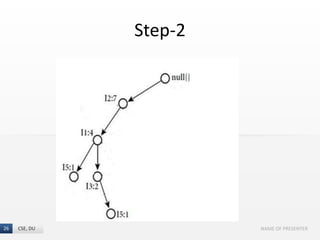
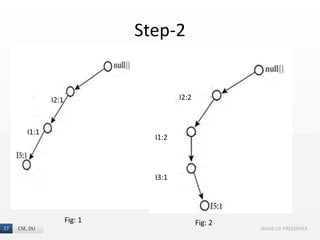
• Step-2:
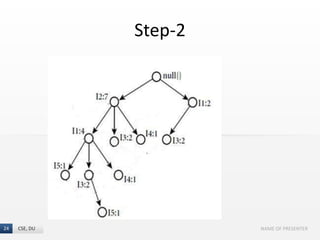
• Now make conditional FP-tree by perform
mining recursively
• Then perform concatenation of the suffix
pattern
• And we get generated frequent patterns
23 CSE, DU
24 I NAME OF PRESENTER
Step-2
24 CSE, DU
25 I NAME OF PRESENTER
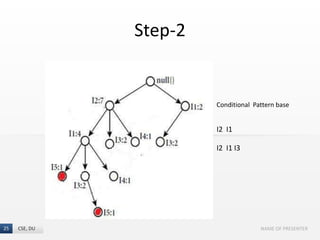
Step-2
25
I2 I1
I2 I1 I3
Conditional Pattern base
CSE, DU
26 I NAME OF PRESENTER
Step-2
26 CSE, DU
27 I NAME OF PRESENTER
Step-2
27
I2:1
I1:1
I2:2
I1:2
I3:1
Fig: 1 Fig: 2
CSE, DU
28 I NAME OF PRESENTER
Step-2
28
dd
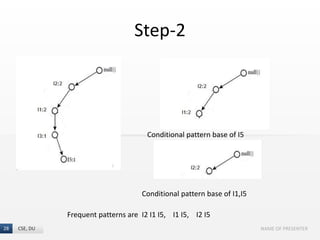
Conditional pattern base of I5
Conditional pattern base of I1,I5
Frequent patterns are I2 I1 I5, I1 I5, I2 I5
CSE, DU
29 I NAME OF PRESENTERCSE, DU29
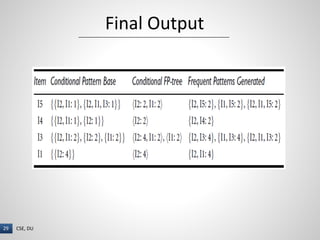
Final Output
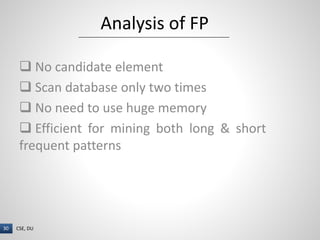
30 I NAME OF PRESENTERCSE, DU30
Analysis of FP
 No candidate element
 Scan database only two times
 No need to use huge memory
 Efficient for mining both long & short
frequent patterns
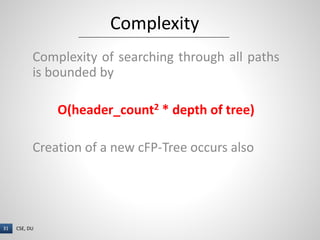
31 I NAME OF PRESENTERCSE, DU31
Complexity
Complexity of searching through all paths
is bounded by
O(header_count2 * depth of tree)
Creation of a new cFP-Tree occurs also
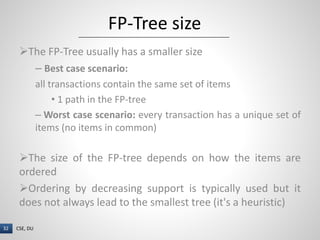
32 I NAME OF PRESENTERCSE, DU32
FP-Tree size
The FP-Tree usually has a smaller size
– Best case scenario:
all transactions contain the same set of items
• 1 path in the FP-tree
– Worst case scenario: every transaction has a unique set of
items (no items in common)
The size of the FP-tree depends on how the items are
ordered
Ordering by decreasing support is typically used but it
does not always lead to the smallest tree (it's a heuristic)
33 I NAME OF PRESENTERCSE, DU33
References
- Data Mining Concepts & Techniques
by J. Han & M. Kamber
- Database system Concept
by Abraham Sillberschatz, Korth, Sudarshan
- Lecture of Dr. S. Srinath
Institute of Technology at Madras, India

Frequent Pattern Growth Algorithm (FP growth method)

  • 1.
    1 I NAMEOF PRESENTER FP Algorithm Ashis Kumar Chanda Department of Computer Science and Engineering University of Dhaka
  • 2.
    2 I NAMEOF PRESENTERCSE, DU2 Key concepts oIntroduction o Idea of FP o FP-construction o Analysis of FP
  • 3.
    3 I NAMEOF PRESENTERCSE, DU3 Introduction The First & main algorithm of Data mining is Apriori But it has some Bottleneck Bottleneck: candidate-generation and test So, a question arise Can we avoid candidate generation?
  • 4.
    4 I NAMEOF PRESENTERCSE, DU4 Idea of FP Frequent pattern growth adopts a divide-and- conquer strategy It just scan database two times & use no candidate set We define two parts in FP-construction
  • 5.
    5 I NAMEOF PRESENTERCSE, DU5 FP-construction Stpe-1: 1. First scan database, find frequent number of each element 2. Then sort them in descending order 3. Now make a tree with root as null 4. Now scan database secondly, sort transaction according to descending support count T100: I1, I2, I5 T100: I2, I1, I5
  • 6.
    6 I NAMEOF PRESENTERCSE, DU6 FP-construction TID List items T100 I2,I1,I5 T200 I2,I4 T300 I2,I3 T400 I2,I1,I4 ---- --- ---- ---
  • 7.
    7 I NAMEOF PRESENTER Fp-tree 7 null T100 I2,I1,I5 CSE, DU
  • 8.
    8 I NAMEOF PRESENTER Fp-tree 8 null T100 I2,I1,I5 I2 1 Item Head of link I2 | I1 | I5 | I3 | I4 | CSE, DU
  • 9.
    9 I NAMEOF PRESENTER Fp-tree 9 null T100 I2,I1,I5 I2 1 Item Head of link I2 | I1 | I5 | I3 | I4 | CSE, DU
  • 10.
    10 I NAMEOF PRESENTER Fp-tree 10 null T100 I2,I1,I5 I2 I1 1 1 Item Head of link I2 | I1 | I5 | I3 | I4 | CSE, DU
  • 11.
    11 I NAMEOF PRESENTER Fp-tree 11 null T100 I2,I1,I5 I2 I1 1 1 Item Head of link I2 | I1 | I5 | I3 | I4 | CSE, DU
  • 12.
    12 I NAMEOF PRESENTER Fp-tree 12 null T100 I2,I1,I5 I2 I1 I5 1 1 Item Head of link I2 | I1 | I5 | I3 | I4 | CSE, DU
  • 13.
    13 I NAMEOF PRESENTER Fp-tree 13 null T100 I2,I1,I5 I2 I1 I5 1 1 Item Head of link I2 | I1 | I5 | I3 | I4 | CSE, DU
  • 14.
    14 I NAMEOF PRESENTER Fp-tree 14 null T100 I2,I1,I5 T200 I2,I4 I2 I1 I5 1 1 1 Item Head of link I2 | I1 | I5 | I3 | I4 | CSE, DU
  • 15.
    15 I NAMEOF PRESENTER Fp-tree 15 null T100 I2,I1,I5 T200 I2,I4 I2 I1 I5 I4 2 1 1 1 Item Head of link I2 | I1 | I5 | I3 | I4 | CSE, DU
  • 16.
    16 I NAMEOF PRESENTER Fp-tree 16 null T100 I2,I1,I5 T200 I2,I4 I2 I1 I5 I4 2 1 1 1 Item Head of link I2 | I1 | I5 | I3 | I4 | CSE, DU
  • 17.
    17 I NAMEOF PRESENTER Fp-tree 17 null T100 I2,I1,I5 T200 I2,I4 T300 I2,I3 I2 I1 I5 I4 I3 3 1 1 1 1 Item Head of link I2 | I1 | I5 | I3 | I4 | CSE, DU
  • 18.
    18 I NAMEOF PRESENTER Fp-tree 18 null T100 I2,I1,I5 T200 I2,I4 T300 I2,I3 I2 I1 I5 I4 I3 3 1 1 1 1 Item Head of link I2 | I1 | I5 | I3 | I4 | CSE, DU
  • 19.
    19 I NAMEOF PRESENTER Fp-tree 19 null T100 I2,I1,I5 T200 I2,I4 T300 I2,I3 T400 I1,I3 I2 I1 I5 I4 I3 3 1 1 1 1 I1 1 I3 1 Item Head of link I2 | I1 | I5 | I3 | I4 | CSE, DU
  • 20.
    20 I NAMEOF PRESENTER Fp-tree 20 null T100 I2,I1,I5 T200 I2,I4 T300 I2,I3 T400 I1,I3 I2 I1 I5 I4 I3 3 1 1 1 1 I1 1 I3 1 Item Head of link I2 | I1 | I5 | I3 | I4 | CSE, DU
  • 21.
    21 I NAMEOF PRESENTER Fp-tree 21 null T100 I2,I1,I5 T200 I2,I4 T300 I2,I3 T400 I1,I3 I2 I1 I5 I4 I3 3 1 1 1 1 I1 1 I3 1 Item Head of link I2 | I1 | I5 | I3 | I4 | CSE, DU
  • 22.
    22 I NAMEOF PRESENTER Final fp tree 22 CSE, DU
  • 23.
    23 I NAMEOF PRESENTER FP-construction • Step-2: • Now make conditional FP-tree by perform mining recursively • Then perform concatenation of the suffix pattern • And we get generated frequent patterns 23 CSE, DU
  • 24.
    24 I NAMEOF PRESENTER Step-2 24 CSE, DU
  • 25.
    25 I NAMEOF PRESENTER Step-2 25 I2 I1 I2 I1 I3 Conditional Pattern base CSE, DU
  • 26.
    26 I NAMEOF PRESENTER Step-2 26 CSE, DU
  • 27.
    27 I NAMEOF PRESENTER Step-2 27 I2:1 I1:1 I2:2 I1:2 I3:1 Fig: 1 Fig: 2 CSE, DU
  • 28.
    28 I NAMEOF PRESENTER Step-2 28 dd Conditional pattern base of I5 Conditional pattern base of I1,I5 Frequent patterns are I2 I1 I5, I1 I5, I2 I5 CSE, DU
  • 29.
    29 I NAMEOF PRESENTERCSE, DU29 Final Output
  • 30.
    30 I NAMEOF PRESENTERCSE, DU30 Analysis of FP  No candidate element  Scan database only two times  No need to use huge memory  Efficient for mining both long & short frequent patterns
  • 31.
    31 I NAMEOF PRESENTERCSE, DU31 Complexity Complexity of searching through all paths is bounded by O(header_count2 * depth of tree) Creation of a new cFP-Tree occurs also
  • 32.
    32 I NAMEOF PRESENTERCSE, DU32 FP-Tree size The FP-Tree usually has a smaller size – Best case scenario: all transactions contain the same set of items • 1 path in the FP-tree – Worst case scenario: every transaction has a unique set of items (no items in common) The size of the FP-tree depends on how the items are ordered Ordering by decreasing support is typically used but it does not always lead to the smallest tree (it's a heuristic)
  • 33.
    33 I NAMEOF PRESENTERCSE, DU33 References - Data Mining Concepts & Techniques by J. Han & M. Kamber - Database system Concept by Abraham Sillberschatz, Korth, Sudarshan - Lecture of Dr. S. Srinath Institute of Technology at Madras, India