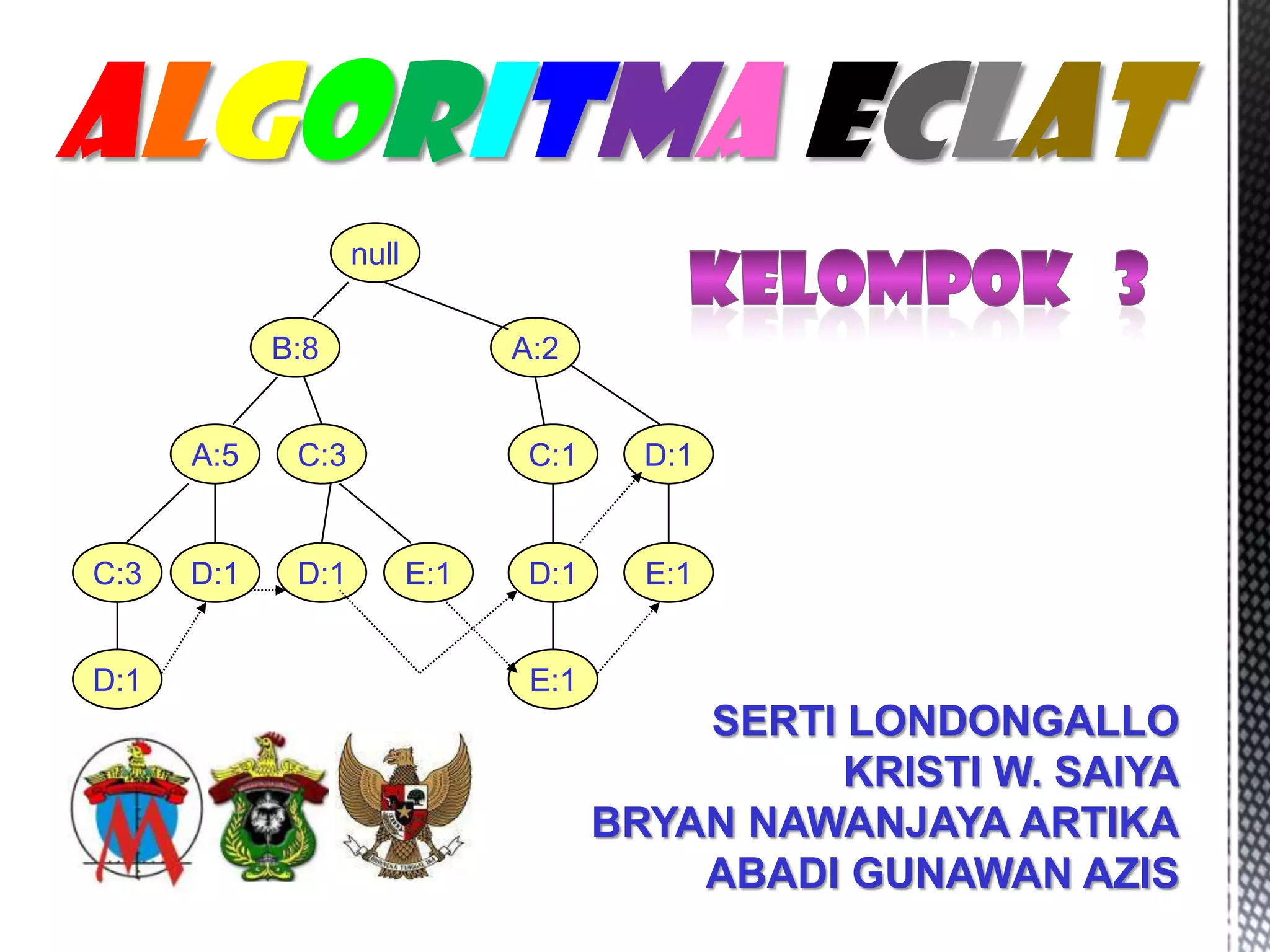
ALGORITMA ECLAT
SERTI LONDONGALLO
KRISTI W. SAIYA
BRYAN NAWANJAYA ARTIKA
ABADI GUNAWAN AZIS
B:8
A:5
null
C:3
D:1
A:2
C:1
D:1
E:1
D:1
E:1C:3
D:1
D:1 E:1
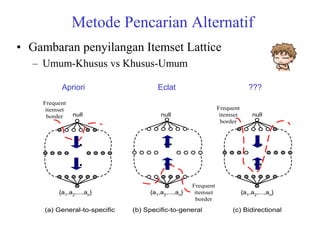
Metode Pencarian Alternatif
• Gambaran penyilangan Itemset Lattice
– Umum-Khusus vs Khusus-Umum
Frequent
itemset
border null
{a1,a2,...,an}
(a) General-to-specific
null
{a1,a2,...,an}
Frequent
itemset
border
(b) Specific-to-general
..
..
..
..
Frequent
itemset
border
null
{a1,a2,...,an}
(c) Bidirectional
..
..
Apriori Eclat ???
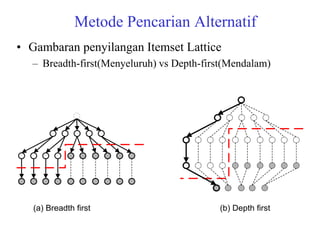
• Gambaran penyilangan Itemset Lattice
– Breadth-first(Menyeluruh) vs Depth-first(Mendalam)
(a) Breadth first (b) Depth first
Metode Pencarian Alternatif
ECLAT: Metode Pembentukan Itemset
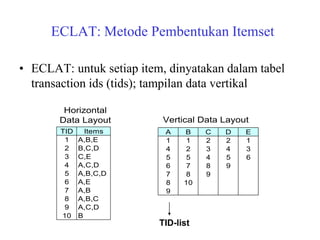
• ECLAT: untuk setiap item, dinyatakan dalam tabel
transaction ids (tids); tampilan data vertikal
TID Items
1 A,B,E
2 B,C,D
3 C,E
4 A,C,D
5 A,B,C,D
6 A,E
7 A,B
8 A,B,C
9 A,C,D
10 B
Horizontal
Data Layout
A B C D E
1 1 2 2 1
4 2 3 4 3
5 5 4 5 6
6 7 8 9
7 8 9
8 10
9
Vertical Data Layout
TID-list
ECLAT: Metode Pembentukan Itemset
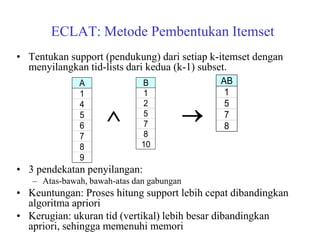
• Tentukan support (pendukung) dari setiap k-itemset dengan
menyilangkan tid-lists dari kedua (k-1) subset.
• 3 pendekatan penyilangan:
– Atas-bawah, bawah-atas dan gabungan
• Keuntungan: Proses hitung support lebih cepat dibandingkan
algoritma apriori
• Kerugian: ukuran tid (vertikal) lebih besar dibandingkan
apriori, sehingga memenuhi memori
A
1
4
5
6
7
8
9
B
1
2
5
7
8
10
 
AB
1
5
7
8
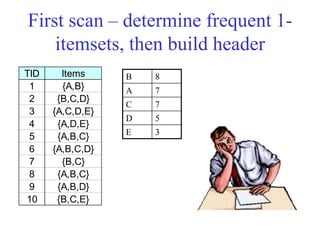
First scan – determine frequent 1-
itemsets, then build header
TID Items
1 {A,B}
2 {B,C,D}
3 {A,C,D,E}
4 {A,D,E}
5 {A,B,C}
6 {A,B,C,D}
7 {B,C}
8 {A,B,C}
9 {A,B,D}
10 {B,C,E}
B 8
A 7
C 7
D 5
E 3
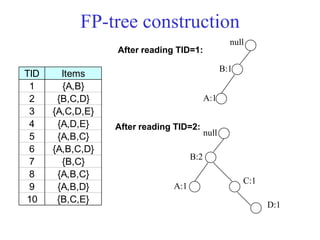
FP-tree construction
TID Items
1 {A,B}
2 {B,C,D}
3 {A,C,D,E}
4 {A,D,E}
5 {A,B,C}
6 {A,B,C,D}
7 {B,C}
8 {A,B,C}
9 {A,B,D}
10 {B,C,E}
null
B:1
A:1
After reading TID=1:
After reading TID=2:
null
B:2
A:1
C:1
D:1
FP-Tree Construction
TID Items
1 {A,B}
2 {B,C,D}
3 {A,C,D,E}
4 {A,D,E}
5 {A,B,C}
6 {A,B,C,D}
7 {B,C}
8 {A,B,C}
9 {A,B,D}
10 {B,C,E}
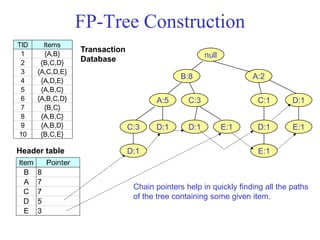
Transaction
Database
Item Pointer
B 8
A 7
C 7
D 5
E 3
Header table
B:8
A:5
null
C:3
D:1
A:2
C:1
D:1
E:1
D:1
E:1C:3
D:1
D:1 E:1
Chain pointers help in quickly finding all the paths
of the tree containing some given item.
FP-Growth (I)
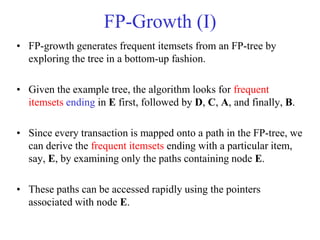
• FP-growth generates frequent itemsets from an FP-tree by
exploring the tree in a bottom-up fashion.
• Given the example tree, the algorithm looks for frequent
itemsets ending in E first, followed by D, C, A, and finally, B.
• Since every transaction is mapped onto a path in the FP-tree, we
can derive the frequent itemsets ending with a particular item,
say, E, by examining only the paths containing node E.
• These paths can be accessed rapidly using the pointers
associated with node E.
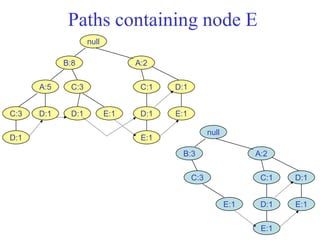
Paths containing node E
B:3
null
C:3
A:2
C:1
D:1
E:1
D:1
E:1E:1
B:8
A:5
null
C:3
D:1
A:2
C:1
D:1
E:1
D:1
E:1C:3
D:1
D:1 E:1
Conditional FP-Tree for E
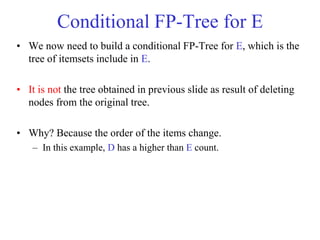
• We now need to build a conditional FP-Tree for E, which is the
tree of itemsets include in E.
• It is not the tree obtained in previous slide as result of deleting
nodes from the original tree.
• Why? Because the order of the items change.
– In this example, D has a higher than E count.
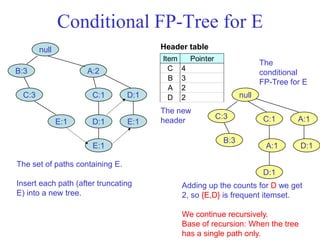
Conditional FP-Tree for E
Adding up the counts for D we get
2, so {E,D} is frequent itemset.
We continue recursively.
Base of recursion: When the tree
has a single path only.
B:3
null
C:3
A:2
C:1
D:1
E:1
D:1
E:1E:1
The set of paths containing E.
Insert each path (after truncating
E) into a new tree.
Item Pointer
C 4
B 3
A 2
D 2
Header table
The new
header
C:3
null
B:3
C:1
A:1
D:1
A:1
D:1
The
conditional
FP-Tree for E
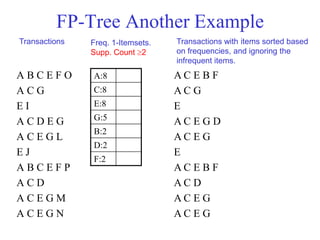
FP-Tree Another Example
A B C E F O
A C G
E I
A C D E G
A C E G L
E J
A B C E F P
A C D
A C E G M
A C E G N
A:8
C:8
E:8
G:5
B:2
D:2
F:2
A C E B F
A C G
E
A C E G D
A C E G
E
A C E B F
A C D
A C E G
A C E G
Freq. 1-Itemsets.
Supp. Count 2
Transactions Transactions with items sorted based
on frequencies, and ignoring the
infrequent items.
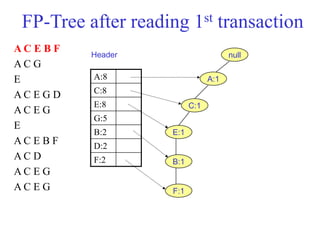
FP-Tree after reading 1st transaction
A:8
C:8
E:8
G:5
B:2
D:2
F:2
A C E B F
A C G
E
A C E G D
A C E G
E
A C E B F
A C D
A C E G
A C E G
null
A:1
C:1
E:1
B:1
F:1
Header
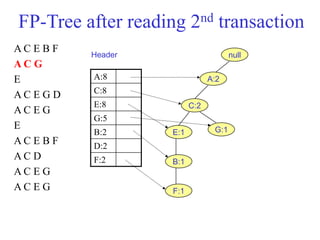
FP-Tree after reading 2nd transaction
A C E B F
A C G
E
A C E G D
A C E G
E
A C E B F
A C D
A C E G
A C E G
G:1
A:8
C:8
E:8
G:5
B:2
D:2
F:2
null
A:2
C:2
E:1
B:1
F:1
Header
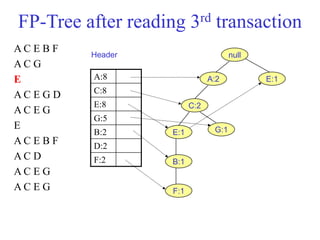
FP-Tree after reading 3rd transaction
A C E B F
A C G
E
A C E G D
A C E G
E
A C E B F
A C D
A C E G
A C E G
G:1
A:8
C:8
E:8
G:5
B:2
D:2
F:2
null
A:2
C:2
E:1
B:1
F:1
Header
E:1
A C E B F
A C G
E
A C E G D
A C E G
E
A C E B F
A C D
A C E G
A C E G
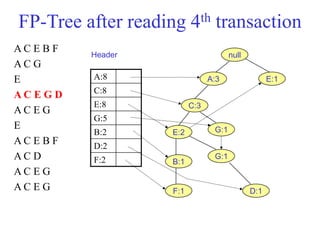
FP-Tree after reading 4th transaction
G:1
A:8
C:8
E:8
G:5
B:2
D:2
F:2
null
A:3
C:3
E:2
B:1
F:1
Header
E:1
G:1
D:1
A C E B F
A C G
E
A C E G D
A C E G
E
A C E B F
A C D
A C E G
A C E G
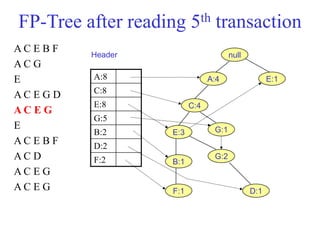
FP-Tree after reading 5th transaction
G:1
A:8
C:8
E:8
G:5
B:2
D:2
F:2
null
A:4
C:4
E:3
B:1
F:1
Header
E:1
G:2
D:1
A C E B F
A C G
E
A C E G D
A C E G
E
A C E B F
A C D
A C E G
A C E G
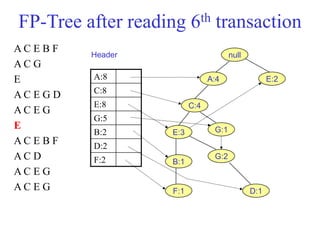
FP-Tree after reading 6th transaction
G:1
A:8
C:8
E:8
G:5
B:2
D:2
F:2
null
A:4
C:4
E:3
B:1
F:1
Header
E:2
G:2
D:1
A C E B F
A C G
E
A C E G D
A C E G
E
A C E B F
A C D
A C E G
A C E G
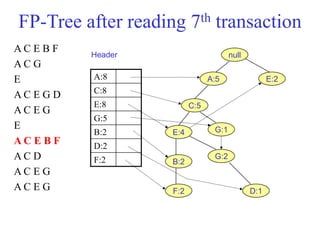
FP-Tree after reading 7th transaction
G:1
A:8
C:8
E:8
G:5
B:2
D:2
F:2
null
A:5
C:5
E:4
B:2
F:2
Header
E:2
G:2
D:1
A C E B F
A C G
E
A C E G D
A C E G
E
A C E B F
A C D
A C E G
A C E G
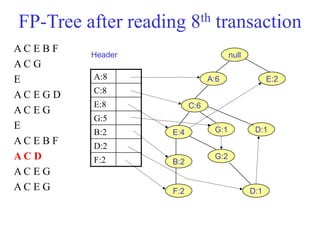
FP-Tree after reading 8th transaction
G:1
A:8
C:8
E:8
G:5
B:2
D:2
F:2
null
A:6
C:6
E:4
B:2
F:2
Header
E:2
G:2
D:1
D:1
A C E B F
A C G
E
A C E G D
A C E G
E
A C E B F
A C D
A C E G
A C E G
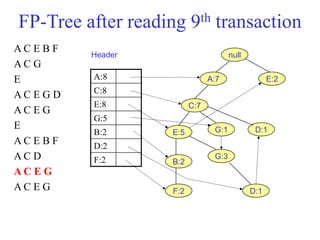
FP-Tree after reading 9th transaction
G:1
A:8
C:8
E:8
G:5
B:2
D:2
F:2
null
A:7
C:7
E:5
B:2
F:2
Header
E:2
G:3
D:1
D:1
A C E B F
A C G
E
A C E G D
A C E G
E
A C E B F
A C D
A C E G
A C E G
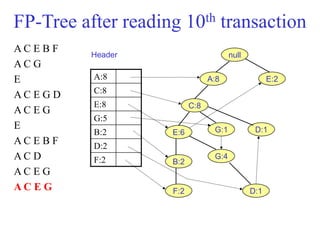
FP-Tree after reading 10th transaction
G:1
A:8
C:8
E:8
G:5
B:2
D:2
F:2
null
A:8
C:8
E:6
B:2
F:2
Header
E:2
G:4
D:1
D:1
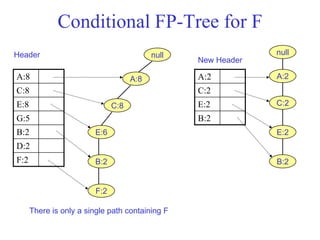
Conditional FP-Tree for F
A:8
C:8
E:8
G:5
B:2
D:2
F:2
null
A:8
C:8
E:6
B:2
F:2
Header
There is only a single path containing F
A:2
C:2
E:2
B:2
null
A:2
C:2
E:2
B:2
New Header
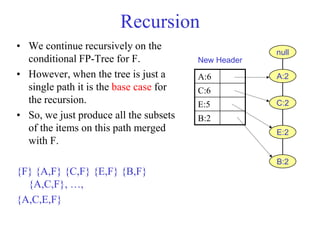
Recursion
• We continue recursively on the
conditional FP-Tree for F.
• However, when the tree is just a
single path it is the base case for
the recursion.
• So, we just produce all the subsets
of the items on this path merged
with F.
{F} {A,F} {C,F} {E,F} {B,F}
{A,C,F}, …,
{A,C,E,F}
A:6
C:6
E:5
B:2
null
A:2
C:2
E:2
B:2
New Header
Conditional FP-Tree for D
A:2
C:2
null
A:2
C:2
New Headernull
A:8
C:8
E:6
G:4
D:1
D:1
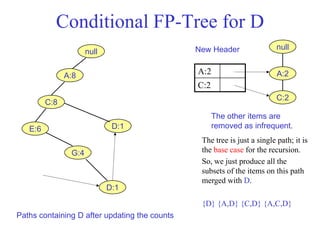
Paths containing D after updating the counts
The other items are
removed as infrequent.
The tree is just a single path; it is
the base case for the recursion.
So, we just produce all the
subsets of the items on this path
merged with D.
{D} {A,D} {C,D} {A,C,D}

Presentasi Eclat

  • 1.
    ALGORITMA ECLAT SERTI LONDONGALLO KRISTIW. SAIYA BRYAN NAWANJAYA ARTIKA ABADI GUNAWAN AZIS B:8 A:5 null C:3 D:1 A:2 C:1 D:1 E:1 D:1 E:1C:3 D:1 D:1 E:1
  • 2.
    Metode Pencarian Alternatif •Gambaran penyilangan Itemset Lattice – Umum-Khusus vs Khusus-Umum Frequent itemset border null {a1,a2,...,an} (a) General-to-specific null {a1,a2,...,an} Frequent itemset border (b) Specific-to-general .. .. .. .. Frequent itemset border null {a1,a2,...,an} (c) Bidirectional .. .. Apriori Eclat ???
  • 3.
    • Gambaran penyilanganItemset Lattice – Breadth-first(Menyeluruh) vs Depth-first(Mendalam) (a) Breadth first (b) Depth first Metode Pencarian Alternatif
  • 4.
    ECLAT: Metode PembentukanItemset • ECLAT: untuk setiap item, dinyatakan dalam tabel transaction ids (tids); tampilan data vertikal TID Items 1 A,B,E 2 B,C,D 3 C,E 4 A,C,D 5 A,B,C,D 6 A,E 7 A,B 8 A,B,C 9 A,C,D 10 B Horizontal Data Layout A B C D E 1 1 2 2 1 4 2 3 4 3 5 5 4 5 6 6 7 8 9 7 8 9 8 10 9 Vertical Data Layout TID-list
  • 5.
    ECLAT: Metode PembentukanItemset • Tentukan support (pendukung) dari setiap k-itemset dengan menyilangkan tid-lists dari kedua (k-1) subset. • 3 pendekatan penyilangan: – Atas-bawah, bawah-atas dan gabungan • Keuntungan: Proses hitung support lebih cepat dibandingkan algoritma apriori • Kerugian: ukuran tid (vertikal) lebih besar dibandingkan apriori, sehingga memenuhi memori A 1 4 5 6 7 8 9 B 1 2 5 7 8 10   AB 1 5 7 8
  • 6.
    First scan –determine frequent 1- itemsets, then build header TID Items 1 {A,B} 2 {B,C,D} 3 {A,C,D,E} 4 {A,D,E} 5 {A,B,C} 6 {A,B,C,D} 7 {B,C} 8 {A,B,C} 9 {A,B,D} 10 {B,C,E} B 8 A 7 C 7 D 5 E 3
  • 7.
    FP-tree construction TID Items 1{A,B} 2 {B,C,D} 3 {A,C,D,E} 4 {A,D,E} 5 {A,B,C} 6 {A,B,C,D} 7 {B,C} 8 {A,B,C} 9 {A,B,D} 10 {B,C,E} null B:1 A:1 After reading TID=1: After reading TID=2: null B:2 A:1 C:1 D:1
  • 8.
    FP-Tree Construction TID Items 1{A,B} 2 {B,C,D} 3 {A,C,D,E} 4 {A,D,E} 5 {A,B,C} 6 {A,B,C,D} 7 {B,C} 8 {A,B,C} 9 {A,B,D} 10 {B,C,E} Transaction Database Item Pointer B 8 A 7 C 7 D 5 E 3 Header table B:8 A:5 null C:3 D:1 A:2 C:1 D:1 E:1 D:1 E:1C:3 D:1 D:1 E:1 Chain pointers help in quickly finding all the paths of the tree containing some given item.
  • 9.
    FP-Growth (I) • FP-growthgenerates frequent itemsets from an FP-tree by exploring the tree in a bottom-up fashion. • Given the example tree, the algorithm looks for frequent itemsets ending in E first, followed by D, C, A, and finally, B. • Since every transaction is mapped onto a path in the FP-tree, we can derive the frequent itemsets ending with a particular item, say, E, by examining only the paths containing node E. • These paths can be accessed rapidly using the pointers associated with node E.
  • 10.
    Paths containing nodeE B:3 null C:3 A:2 C:1 D:1 E:1 D:1 E:1E:1 B:8 A:5 null C:3 D:1 A:2 C:1 D:1 E:1 D:1 E:1C:3 D:1 D:1 E:1
  • 11.
    Conditional FP-Tree forE • We now need to build a conditional FP-Tree for E, which is the tree of itemsets include in E. • It is not the tree obtained in previous slide as result of deleting nodes from the original tree. • Why? Because the order of the items change. – In this example, D has a higher than E count.
  • 12.
    Conditional FP-Tree forE Adding up the counts for D we get 2, so {E,D} is frequent itemset. We continue recursively. Base of recursion: When the tree has a single path only. B:3 null C:3 A:2 C:1 D:1 E:1 D:1 E:1E:1 The set of paths containing E. Insert each path (after truncating E) into a new tree. Item Pointer C 4 B 3 A 2 D 2 Header table The new header C:3 null B:3 C:1 A:1 D:1 A:1 D:1 The conditional FP-Tree for E
  • 13.
    FP-Tree Another Example AB C E F O A C G E I A C D E G A C E G L E J A B C E F P A C D A C E G M A C E G N A:8 C:8 E:8 G:5 B:2 D:2 F:2 A C E B F A C G E A C E G D A C E G E A C E B F A C D A C E G A C E G Freq. 1-Itemsets. Supp. Count 2 Transactions Transactions with items sorted based on frequencies, and ignoring the infrequent items.
  • 14.
    FP-Tree after reading1st transaction A:8 C:8 E:8 G:5 B:2 D:2 F:2 A C E B F A C G E A C E G D A C E G E A C E B F A C D A C E G A C E G null A:1 C:1 E:1 B:1 F:1 Header
  • 15.
    FP-Tree after reading2nd transaction A C E B F A C G E A C E G D A C E G E A C E B F A C D A C E G A C E G G:1 A:8 C:8 E:8 G:5 B:2 D:2 F:2 null A:2 C:2 E:1 B:1 F:1 Header
  • 16.
    FP-Tree after reading3rd transaction A C E B F A C G E A C E G D A C E G E A C E B F A C D A C E G A C E G G:1 A:8 C:8 E:8 G:5 B:2 D:2 F:2 null A:2 C:2 E:1 B:1 F:1 Header E:1
  • 17.
    A C EB F A C G E A C E G D A C E G E A C E B F A C D A C E G A C E G FP-Tree after reading 4th transaction G:1 A:8 C:8 E:8 G:5 B:2 D:2 F:2 null A:3 C:3 E:2 B:1 F:1 Header E:1 G:1 D:1
  • 18.
    A C EB F A C G E A C E G D A C E G E A C E B F A C D A C E G A C E G FP-Tree after reading 5th transaction G:1 A:8 C:8 E:8 G:5 B:2 D:2 F:2 null A:4 C:4 E:3 B:1 F:1 Header E:1 G:2 D:1
  • 19.
    A C EB F A C G E A C E G D A C E G E A C E B F A C D A C E G A C E G FP-Tree after reading 6th transaction G:1 A:8 C:8 E:8 G:5 B:2 D:2 F:2 null A:4 C:4 E:3 B:1 F:1 Header E:2 G:2 D:1
  • 20.
    A C EB F A C G E A C E G D A C E G E A C E B F A C D A C E G A C E G FP-Tree after reading 7th transaction G:1 A:8 C:8 E:8 G:5 B:2 D:2 F:2 null A:5 C:5 E:4 B:2 F:2 Header E:2 G:2 D:1
  • 21.
    A C EB F A C G E A C E G D A C E G E A C E B F A C D A C E G A C E G FP-Tree after reading 8th transaction G:1 A:8 C:8 E:8 G:5 B:2 D:2 F:2 null A:6 C:6 E:4 B:2 F:2 Header E:2 G:2 D:1 D:1
  • 22.
    A C EB F A C G E A C E G D A C E G E A C E B F A C D A C E G A C E G FP-Tree after reading 9th transaction G:1 A:8 C:8 E:8 G:5 B:2 D:2 F:2 null A:7 C:7 E:5 B:2 F:2 Header E:2 G:3 D:1 D:1
  • 23.
    A C EB F A C G E A C E G D A C E G E A C E B F A C D A C E G A C E G FP-Tree after reading 10th transaction G:1 A:8 C:8 E:8 G:5 B:2 D:2 F:2 null A:8 C:8 E:6 B:2 F:2 Header E:2 G:4 D:1 D:1
  • 24.
    Conditional FP-Tree forF A:8 C:8 E:8 G:5 B:2 D:2 F:2 null A:8 C:8 E:6 B:2 F:2 Header There is only a single path containing F A:2 C:2 E:2 B:2 null A:2 C:2 E:2 B:2 New Header
  • 25.
    Recursion • We continuerecursively on the conditional FP-Tree for F. • However, when the tree is just a single path it is the base case for the recursion. • So, we just produce all the subsets of the items on this path merged with F. {F} {A,F} {C,F} {E,F} {B,F} {A,C,F}, …, {A,C,E,F} A:6 C:6 E:5 B:2 null A:2 C:2 E:2 B:2 New Header
  • 26.
    Conditional FP-Tree forD A:2 C:2 null A:2 C:2 New Headernull A:8 C:8 E:6 G:4 D:1 D:1 Paths containing D after updating the counts The other items are removed as infrequent. The tree is just a single path; it is the base case for the recursion. So, we just produce all the subsets of the items on this path merged with D. {D} {A,D} {C,D} {A,C,D}