Multi-class Image Classification using
Deep Convolutional Networks on
extremely large dataset
Marija Stanojevic
Ashis Chanda
CIS Department, Temple University
5th December 2017
Problem Definition
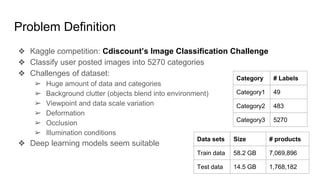
❖ Kaggle competition: Cdiscount’s Image Classification Challenge
❖ Classify user posted images into 5270 categories
❖ Challenges of dataset:
➢ Huge amount of data and categories
➢ Background clutter (objects blend into environment)
➢ Viewpoint and data scale variation
➢ Deformation
➢ Occlusion
➢ Illumination conditions
❖ Deep learning models seem suitable
Data sets Size # products
Train data 58.2 GB 7,069,896
Test data 14.5 GB 1,768,182
Category # Labels
Category1 49
Category2 483
Category3 5270
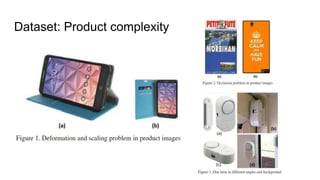
Dataset: Product complexity
Dataset: Categories
A sample list of product categories:
Our used models
● CNN
● DenseNet
● ResNet
● ResNext
● Wide-res Net
Models: CNN
❖ Our CNN
➢ 3 Conv, 2 FC layers, 3 Pool layers
➢ thinner layers
➢ downsampling three times
❖ Tried to use for three types of categories
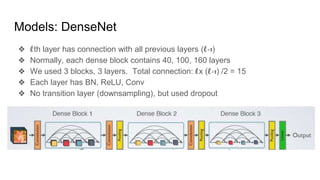
❖ l th layer has connection with all previous layers (l -1)
❖ Normally, each dense block contains 40, 100, 160 layers
❖ We used 3 blocks, 3 layers. Total connection: l x (l -1) /2 = 15
❖ Each layer has BN, ReLU, Conv
❖ No transition layer (downsampling), but used dropout
Models: DenseNet
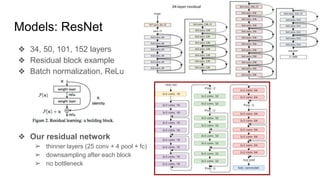
Models: ResNet
❖ 34, 50, 101, 152 layers
❖ Residual block example
❖ Batch normalization, ReLu
❖ Our residual network
➢ thinner layers (25 conv + 4 pool + fc)
➢ downsampling after each block
➢ no bottleneck
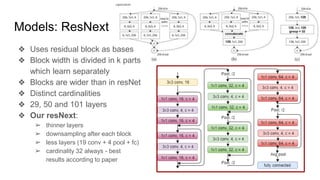
❖ Uses residual block as bases
❖ Block width is divided in k parts
which learn separately
❖ Blocks are wider than in resNet
❖ Distinct cardinalities
❖ 29, 50 and 101 layers
❖ Our resNext:
➢ thinner layers
➢ downsampling after each block
➢ less layers (19 conv + 4 pool + fc)
➢ cardinality 32 always - best
results according to paper
Models: ResNext
❖ Uses residual block as bases
❖ Block is k times wider (k=1, 2, 4, 8, 10, 12)
❖ Dropout beside batch normalization
❖ 16, 22, 28, 40 layers
❖ Our wideResNet:
➢ k = 2 - doesn’t increase much number
of parameters, but shows biggest
improvement in original results
➢ dropout keep = 0.7 - best in original results
➢ less layers (13 conv + 4 pool + fc)
Models: WideResNet
Challenges in dataset
❖ 5.6 TB after splitting data
❖ Train data (707 Batches) & Test data (177 Batches)
❖ Smaller batch: more reads and writes
❖ Bigger batch: memory error
❖ Each batch has 10,000 products ~ 20,000 images
❖ Cross-validation data: 707 products ~ 1500 images
Challenges in implementation
❖ Used owlsnesttwo high performance computing system
❖ GPU: NVIDIA Tesla P100 PCIe 12GB
❖ Only two jobs allowed in parallel
❖ Implemented with tensorflow and tflearn in python
❖ Network
➢ Complexity in debugging
➢ Bigger network: memory error => tuning network
➢ Thinner and less layers
➢ Small number of epoch
Baseline (CNN) Result
❖ CNN: (10 Epochs, 10 Batches)
❖ CNN: (50 Epochs, 50 Batches) (in progress)
Label # class Accuracy Error Time
Category 1 49 52% 10.7 4 hours
Category 2 483 47% 11.68 5 hours
Category 3 5270 32% 4.89 11 hours
Category 1 49 12%
(1 epoch)
3.42 20 hours
Experimental Result (category 3)
Model # Batch # Epoch Accuracy Error Time
DenseNet 50/707 1 (running) 4% 9.83 10 days
ResNet 50/707 10 34% 3.94489 5.69 hours
ResNext 50/707 10 28.9% 4.51031 16.8 hours
WideResNext 50/707 10 41.93% 3.53318 6.11 hours
ResNet 707/707 3 (running) 36.69% 3.84427 3.35 days
ResNext 707/707 1 (running) 28.47% 4.50394 9.90 days
WideResNext 707/707 2 (running) 40.51% 3.49804 3.60 days
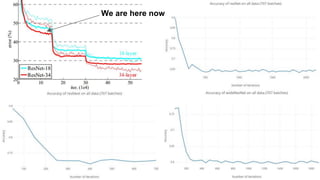
We are here now
Experimental results: Error in classifying
Mobile cover bag Mobile Case Mobile
Laptop cover bag Mobile film protector Mobile Case
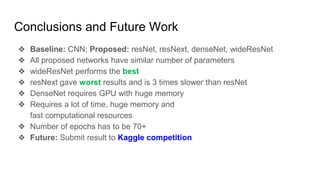
Conclusions and Future Work
❖ Baseline: CNN; Proposed: resNet, resNext, denseNet, wideResNet
❖ All proposed networks have similar number of parameters
❖ wideResNet performs the best
❖ resNext gave worst results and is 3 times slower than resNet
❖ DenseNet requires GPU with huge memory
❖ Requires a lot of time, huge memory and
fast computational resources
❖ Number of epochs has to be 70+
❖ Future: Submit result to Kaggle competition
Thank you
Questions?

Multi-class Image Classification using Deep Convolutional Networks on extremely large dataset

  • 1.
    Multi-class Image Classificationusing Deep Convolutional Networks on extremely large dataset Marija Stanojevic Ashis Chanda CIS Department, Temple University 5th December 2017
  • 2.
    Problem Definition ❖ Kagglecompetition: Cdiscount’s Image Classification Challenge ❖ Classify user posted images into 5270 categories ❖ Challenges of dataset: ➢ Huge amount of data and categories ➢ Background clutter (objects blend into environment) ➢ Viewpoint and data scale variation ➢ Deformation ➢ Occlusion ➢ Illumination conditions ❖ Deep learning models seem suitable Data sets Size # products Train data 58.2 GB 7,069,896 Test data 14.5 GB 1,768,182 Category # Labels Category1 49 Category2 483 Category3 5270
  • 3.
  • 4.
    Dataset: Categories A samplelist of product categories:
  • 5.
    Our used models ●CNN ● DenseNet ● ResNet ● ResNext ● Wide-res Net
  • 6.
    Models: CNN ❖ OurCNN ➢ 3 Conv, 2 FC layers, 3 Pool layers ➢ thinner layers ➢ downsampling three times ❖ Tried to use for three types of categories
  • 7.
    ❖ l thlayer has connection with all previous layers (l -1) ❖ Normally, each dense block contains 40, 100, 160 layers ❖ We used 3 blocks, 3 layers. Total connection: l x (l -1) /2 = 15 ❖ Each layer has BN, ReLU, Conv ❖ No transition layer (downsampling), but used dropout Models: DenseNet
  • 8.
    Models: ResNet ❖ 34,50, 101, 152 layers ❖ Residual block example ❖ Batch normalization, ReLu ❖ Our residual network ➢ thinner layers (25 conv + 4 pool + fc) ➢ downsampling after each block ➢ no bottleneck
  • 9.
    ❖ Uses residualblock as bases ❖ Block width is divided in k parts which learn separately ❖ Blocks are wider than in resNet ❖ Distinct cardinalities ❖ 29, 50 and 101 layers ❖ Our resNext: ➢ thinner layers ➢ downsampling after each block ➢ less layers (19 conv + 4 pool + fc) ➢ cardinality 32 always - best results according to paper Models: ResNext
  • 10.
    ❖ Uses residualblock as bases ❖ Block is k times wider (k=1, 2, 4, 8, 10, 12) ❖ Dropout beside batch normalization ❖ 16, 22, 28, 40 layers ❖ Our wideResNet: ➢ k = 2 - doesn’t increase much number of parameters, but shows biggest improvement in original results ➢ dropout keep = 0.7 - best in original results ➢ less layers (13 conv + 4 pool + fc) Models: WideResNet
  • 11.
    Challenges in dataset ❖5.6 TB after splitting data ❖ Train data (707 Batches) & Test data (177 Batches) ❖ Smaller batch: more reads and writes ❖ Bigger batch: memory error ❖ Each batch has 10,000 products ~ 20,000 images ❖ Cross-validation data: 707 products ~ 1500 images
  • 12.
    Challenges in implementation ❖Used owlsnesttwo high performance computing system ❖ GPU: NVIDIA Tesla P100 PCIe 12GB ❖ Only two jobs allowed in parallel ❖ Implemented with tensorflow and tflearn in python ❖ Network ➢ Complexity in debugging ➢ Bigger network: memory error => tuning network ➢ Thinner and less layers ➢ Small number of epoch
  • 13.
    Baseline (CNN) Result ❖CNN: (10 Epochs, 10 Batches) ❖ CNN: (50 Epochs, 50 Batches) (in progress) Label # class Accuracy Error Time Category 1 49 52% 10.7 4 hours Category 2 483 47% 11.68 5 hours Category 3 5270 32% 4.89 11 hours Category 1 49 12% (1 epoch) 3.42 20 hours
  • 14.
    Experimental Result (category3) Model # Batch # Epoch Accuracy Error Time DenseNet 50/707 1 (running) 4% 9.83 10 days ResNet 50/707 10 34% 3.94489 5.69 hours ResNext 50/707 10 28.9% 4.51031 16.8 hours WideResNext 50/707 10 41.93% 3.53318 6.11 hours ResNet 707/707 3 (running) 36.69% 3.84427 3.35 days ResNext 707/707 1 (running) 28.47% 4.50394 9.90 days WideResNext 707/707 2 (running) 40.51% 3.49804 3.60 days
  • 15.
  • 16.
    Experimental results: Errorin classifying Mobile cover bag Mobile Case Mobile Laptop cover bag Mobile film protector Mobile Case
  • 17.
    Conclusions and FutureWork ❖ Baseline: CNN; Proposed: resNet, resNext, denseNet, wideResNet ❖ All proposed networks have similar number of parameters ❖ wideResNet performs the best ❖ resNext gave worst results and is 3 times slower than resNet ❖ DenseNet requires GPU with huge memory ❖ Requires a lot of time, huge memory and fast computational resources ❖ Number of epochs has to be 70+ ❖ Future: Submit result to Kaggle competition
  • 18.