STANDING WAVES
ON
VIOLIN STRINGS
STANDING WAVES
• Are stationary (as opposed to travelling waves)
• Vs
STANDING WAVE TRAVELLING WAVE
STANDING WAVES
• Are the superposition of two
harmonic waves with equal
amplitude, frequency and
wavelengths but moving in
opposite direction
v
v
Resulting Standing Wave
from adding the two
harmonic waves
STANDING WAVES
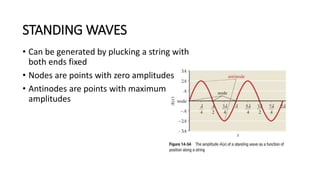
• Can be generated by plucking a string with
both ends fixed
• Nodes are points with zero amplitudes
• Antinodes are points with maximum
amplitudes
STANDING WAVES ON STRINGS
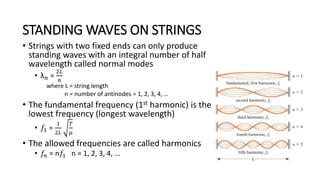
• Strings with two fixed ends can only produce
standing waves with an integral number of half
wavelength called normal modes
• λ 𝑛 =
2𝐿
𝑛
where L = string length
n = number of antinodes = 1, 2, 3, 4, …
• The fundamental frequency (1st harmonic) is the
lowest frequency (longest wavelength)
• 𝑓1 =
1
2𝐿
𝑇
𝜇
where T = tension in the string
𝜇 = linear mass density of the string =
𝑚𝑎𝑠𝑠 𝑜𝑓 𝑠𝑡𝑟𝑖𝑛𝑔
𝑙𝑒𝑛𝑔𝑡ℎ 𝑜𝑓 𝑠𝑡𝑟𝑖𝑛𝑔
• The allowed frequencies are called harmonics
• 𝑓𝑛 = n𝑓1 n = 1, 2, 3, 4, …
QUESTION PART 1
Tom wants to make a violin for his sister as a birthday present.
Violins usually make sound frequencies ranging from
200~3000Hz. He has a few 30 cm long strings with linear mass
densities:
A 2.8 × 10⁻⁴
kg/m
B 4.0 × 10⁻⁴
kg/m
C 0.62 g/m
Which string should he use to make the violin in order to get a
fundamental frequency of 700Hz if the tension in the string is
kept at 70 N?
Hints
• What variables are given in the question?
• The fundamental frequency (𝑓1), tension (T), and string length (L)
Hints
• What variables are given in the question?
• The fundamental frequency (𝑓1), tension (T), and string length (L)
• Which equation to use when solving for linear mass density?
• 𝑓1 =
1
2𝐿
𝑇
𝜇
where T = tension in the string
𝜇 = linear mass density of the string =
𝑚𝑎𝑠𝑠 𝑜𝑓 𝑠𝑡𝑟𝑖𝑛𝑔
𝑙𝑒𝑛𝑔𝑡ℎ 𝑜𝑓 𝑠𝑡𝑟𝑖𝑛𝑔
Solution — Tom should use string B
𝑓1 = 700 Hz T = 70 N L = 30 cm = 0.30 m
𝑓1 =
1
2𝐿
𝑇
𝜇
Solve for 𝜇
𝑓1 × 2𝐿 =
𝑇
𝜇
(𝑓1 × 2𝐿) 2
=
𝑇
𝜇
𝜇 =
𝑇
( 𝑓1×2𝐿)
2 =
70 𝑁
(700 𝐻𝑧×2×0.30𝑚)
2 = 3.97× 10⁻⁴ kg/ m
≈ 4.0 × 10⁻⁴
kg/m
QUESTION PART 2
The violin string broke after a few weeks, but Tom
doesn’t have anymore of the same string. If he
uses a string with linear mass density of 4.7 ×
10−4
kg/m, what should the tension be in the
string in order to produce the same sound
frequency (700 Hz)?
Hints
• What variables are given in the question?
• The fundamental frequency (𝑓1), linear mass density (𝜇),
and string length (L)
Hints
• What variables are given in the question?
• The fundamental frequency (𝑓1), linear mass density (𝜇),
and string length (L)
• Which equation to use when solving for tension?
• 𝑓1 =
1
2𝐿
𝑇
𝜇
where T = tension in the string
𝜇 = linear mass density of the string =
𝑚𝑎𝑠𝑠 𝑜𝑓 𝑠𝑡𝑟𝑖𝑛𝑔
𝑙𝑒𝑛𝑔𝑡ℎ 𝑜𝑓 𝑠𝑡𝑟𝑖𝑛𝑔
Solution
𝑓1 = 700 Hz 𝜇 = 4.7 × 10⁻⁴
kg/m L = 30 cm = 0.30 m
𝑓1 =
1
2𝐿
𝑇
𝜇
Solve for T
𝑓1 × 2𝐿 =
𝑇
𝜇
(𝑓1 × 2𝐿) 2
=
𝑇
𝜇
T = (𝑓1 × 2𝐿) 2
× 𝜇 = (700𝐻𝑧 × 2 × 0.30𝑚) 2
× 4.7 × 10−4
kg/m
= 82.9 N
≈ 83 N
THANK YOU FOR WATCHING

Standing waves

  • 1.
  • 2.
    STANDING WAVES • Arestationary (as opposed to travelling waves) • Vs STANDING WAVE TRAVELLING WAVE
  • 3.
    STANDING WAVES • Arethe superposition of two harmonic waves with equal amplitude, frequency and wavelengths but moving in opposite direction v v Resulting Standing Wave from adding the two harmonic waves
  • 4.
    STANDING WAVES • Canbe generated by plucking a string with both ends fixed • Nodes are points with zero amplitudes • Antinodes are points with maximum amplitudes
  • 5.
    STANDING WAVES ONSTRINGS • Strings with two fixed ends can only produce standing waves with an integral number of half wavelength called normal modes • λ 𝑛 = 2𝐿 𝑛 where L = string length n = number of antinodes = 1, 2, 3, 4, … • The fundamental frequency (1st harmonic) is the lowest frequency (longest wavelength) • 𝑓1 = 1 2𝐿 𝑇 𝜇 where T = tension in the string 𝜇 = linear mass density of the string = 𝑚𝑎𝑠𝑠 𝑜𝑓 𝑠𝑡𝑟𝑖𝑛𝑔 𝑙𝑒𝑛𝑔𝑡ℎ 𝑜𝑓 𝑠𝑡𝑟𝑖𝑛𝑔 • The allowed frequencies are called harmonics • 𝑓𝑛 = n𝑓1 n = 1, 2, 3, 4, …
  • 6.
    QUESTION PART 1 Tomwants to make a violin for his sister as a birthday present. Violins usually make sound frequencies ranging from 200~3000Hz. He has a few 30 cm long strings with linear mass densities: A 2.8 × 10⁻⁴ kg/m B 4.0 × 10⁻⁴ kg/m C 0.62 g/m Which string should he use to make the violin in order to get a fundamental frequency of 700Hz if the tension in the string is kept at 70 N?
  • 7.
    Hints • What variablesare given in the question? • The fundamental frequency (𝑓1), tension (T), and string length (L)
  • 8.
    Hints • What variablesare given in the question? • The fundamental frequency (𝑓1), tension (T), and string length (L) • Which equation to use when solving for linear mass density? • 𝑓1 = 1 2𝐿 𝑇 𝜇 where T = tension in the string 𝜇 = linear mass density of the string = 𝑚𝑎𝑠𝑠 𝑜𝑓 𝑠𝑡𝑟𝑖𝑛𝑔 𝑙𝑒𝑛𝑔𝑡ℎ 𝑜𝑓 𝑠𝑡𝑟𝑖𝑛𝑔
  • 9.
    Solution — Tomshould use string B 𝑓1 = 700 Hz T = 70 N L = 30 cm = 0.30 m 𝑓1 = 1 2𝐿 𝑇 𝜇 Solve for 𝜇 𝑓1 × 2𝐿 = 𝑇 𝜇 (𝑓1 × 2𝐿) 2 = 𝑇 𝜇 𝜇 = 𝑇 ( 𝑓1×2𝐿) 2 = 70 𝑁 (700 𝐻𝑧×2×0.30𝑚) 2 = 3.97× 10⁻⁴ kg/ m ≈ 4.0 × 10⁻⁴ kg/m
  • 10.
    QUESTION PART 2 Theviolin string broke after a few weeks, but Tom doesn’t have anymore of the same string. If he uses a string with linear mass density of 4.7 × 10⁻⁴ kg/m, what should the tension be in the string in order to produce the same sound frequency (700 Hz)?
  • 11.
    Hints • What variablesare given in the question? • The fundamental frequency (𝑓1), linear mass density (𝜇), and string length (L)
  • 12.
    Hints • What variablesare given in the question? • The fundamental frequency (𝑓1), linear mass density (𝜇), and string length (L) • Which equation to use when solving for tension? • 𝑓1 = 1 2𝐿 𝑇 𝜇 where T = tension in the string 𝜇 = linear mass density of the string = 𝑚𝑎𝑠𝑠 𝑜𝑓 𝑠𝑡𝑟𝑖𝑛𝑔 𝑙𝑒𝑛𝑔𝑡ℎ 𝑜𝑓 𝑠𝑡𝑟𝑖𝑛𝑔
  • 13.
    Solution 𝑓1 = 700Hz 𝜇 = 4.7 × 10⁻⁴ kg/m L = 30 cm = 0.30 m 𝑓1 = 1 2𝐿 𝑇 𝜇 Solve for T 𝑓1 × 2𝐿 = 𝑇 𝜇 (𝑓1 × 2𝐿) 2 = 𝑇 𝜇 T = (𝑓1 × 2𝐿) 2 × 𝜇 = (700𝐻𝑧 × 2 × 0.30𝑚) 2 × 4.7 × 10−4 kg/m = 82.9 N ≈ 83 N
  • 14.
    THANK YOU FORWATCHING