STANDING WAVES AND MUSIC
Featuring a Guitar Sample Question
BIBLIOGRAPHY
• Hawkes, R., Iqbal, J., Mansour, Firas., & Milner-Bolotin, M. (2014).
Physics for Scientists and Engineers: An Interactive Approach. Vancouver,
B.C., Nelson Education.
STANDING WAVES ON STRINGS
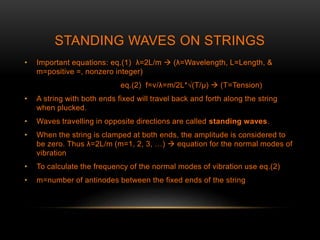
• Important equations: eq.(1) λ=2L/m  (λ=Wavelength, L=Length, &
m=positive =, nonzero integer)
eq.(2) f=ν/λ=m/2L*√(Τ/μ)  (T=Tension)
• A string with both ends fixed will travel back and forth along the string
when plucked.
• Waves travelling in opposite directions are called standing waves.
• When the string is clamped at both ends, the amplitude is considered to
be zero. Thus λ=2L/m (m=1, 2, 3, …)  equation for the normal modes of
vibration
• To calculate the frequency of the normal modes of vibration use eq.(2)
• m=number of antinodes between the fixed ends of the string
CONTINUED…
• The lowest frequency corresponds to the longest wavelength, λ, where
m=1
• The fundamental frequency/first harmonic is the longest wavelength, λ=2L
• Harmonics are the allowed frequencies
• Increasing to the second or third harmonic, you multiple the fundamental
frequency by the harmonic number. (ie: fourth harmonic 
4[(1/2L)*√(T/μ)])
HOW DO STANDING WAVES RELATE TO
MUSIC?
• When the string on an instrument such as, a banjo or guitar, is plucked, a
standing wave generates as the string vibrates.
• The sound of the string is based on the frequency of the wave that is
generated when the string is plucked.
• Both ends of a guitar string are fixed.
• Using these hints, let’s see if you can apply your accumulated knowledge
to the practice question on the next slide.
SAMPLE QUESTION
a.) A guitar has six strings. The strings are the same length and
approximately under the same tension. However, when you push down on a
guitar string and you strum, each string produces a different sound. Explain
this phenomenon. (Assume the strings have the same linear mass density)
b.) If I want to tune my guitar, I have to loosen/tighten the strings. How does
this change the sounds that are produced by my guitar? If I tighten the strings
on my guitar will I produce a high or low-pitched sound?
SOLUTIONS
a.) Although the guitar strings may have the same length and tension,
pushing down at a specific position along the guitar string changes the
frequency of the standing wave. This shortens the length of vibration when
you strum the guitar. Thus, the wave only travels between the guitarist’s
finger and the bridge of the guitar, instead of down the entire length of the
string. This can be explained by the following equation: f=(1/2L)√T/μ 
shortening the length of the string by pressing down closer to the bridge of
the guitar results in a higher frequency.
b.) Using the equation from the above explanation, loosening and tightening
the strings changes the tension of the string. Thus, producing a different
frequency which, in turn, produces a different sound. Increasing the tension
of a guitar string results in a higher frequency. f=(1/2L)√T/μ

Standing waves (music)

  • 1.
    STANDING WAVES ANDMUSIC Featuring a Guitar Sample Question
  • 2.
    BIBLIOGRAPHY • Hawkes, R.,Iqbal, J., Mansour, Firas., & Milner-Bolotin, M. (2014). Physics for Scientists and Engineers: An Interactive Approach. Vancouver, B.C., Nelson Education.
  • 3.
    STANDING WAVES ONSTRINGS • Important equations: eq.(1) λ=2L/m  (λ=Wavelength, L=Length, & m=positive =, nonzero integer) eq.(2) f=ν/λ=m/2L*√(Τ/μ)  (T=Tension) • A string with both ends fixed will travel back and forth along the string when plucked. • Waves travelling in opposite directions are called standing waves. • When the string is clamped at both ends, the amplitude is considered to be zero. Thus λ=2L/m (m=1, 2, 3, …)  equation for the normal modes of vibration • To calculate the frequency of the normal modes of vibration use eq.(2) • m=number of antinodes between the fixed ends of the string
  • 4.
    CONTINUED… • The lowestfrequency corresponds to the longest wavelength, λ, where m=1 • The fundamental frequency/first harmonic is the longest wavelength, λ=2L • Harmonics are the allowed frequencies • Increasing to the second or third harmonic, you multiple the fundamental frequency by the harmonic number. (ie: fourth harmonic  4[(1/2L)*√(T/μ)])
  • 5.
    HOW DO STANDINGWAVES RELATE TO MUSIC? • When the string on an instrument such as, a banjo or guitar, is plucked, a standing wave generates as the string vibrates. • The sound of the string is based on the frequency of the wave that is generated when the string is plucked. • Both ends of a guitar string are fixed. • Using these hints, let’s see if you can apply your accumulated knowledge to the practice question on the next slide.
  • 6.
    SAMPLE QUESTION a.) Aguitar has six strings. The strings are the same length and approximately under the same tension. However, when you push down on a guitar string and you strum, each string produces a different sound. Explain this phenomenon. (Assume the strings have the same linear mass density) b.) If I want to tune my guitar, I have to loosen/tighten the strings. How does this change the sounds that are produced by my guitar? If I tighten the strings on my guitar will I produce a high or low-pitched sound?
  • 7.
    SOLUTIONS a.) Although theguitar strings may have the same length and tension, pushing down at a specific position along the guitar string changes the frequency of the standing wave. This shortens the length of vibration when you strum the guitar. Thus, the wave only travels between the guitarist’s finger and the bridge of the guitar, instead of down the entire length of the string. This can be explained by the following equation: f=(1/2L)√T/μ  shortening the length of the string by pressing down closer to the bridge of the guitar results in a higher frequency. b.) Using the equation from the above explanation, loosening and tightening the strings changes the tension of the string. Thus, producing a different frequency which, in turn, produces a different sound. Increasing the tension of a guitar string results in a higher frequency. f=(1/2L)√T/μ