Standing	
  waves	
  on	
  a	
  string	


Key	
  concepts:	
  
-­‐ a	
  string	
  that	
  is	
  plucked	
  with	
  both	
  ends	
  fixed	
  results	
  in	
  standing	
  waves	
  on	
  the	
  
string	
  (aka	
  normal	
  modes)	
  
o amplitudes	
  are	
  0	
  at	
  x=0	
  and	
  x=L	
  (L	
  =	
  length)	
  
-­‐ fundamental	
  frequency	
  aka	
  first	
  harmonic:	
  the	
  lowest	
  frequency	
  
corresponding	
  to	
  the	
  longest	
  wavelength	
  (λ = 2L)	
  
-­‐ wavelength:	
  	
   𝜆! = 2𝐿/𝑚	
  where	
  m	
  is	
  a	
  positive,	
  nonzero	
  integer	
  
-­‐ fundamental	
  frequency:	
   𝑓! =  
!
!
=  
!
!!
𝑣 =  
!
!!
!
!
,	
  where	
  v	
  =	
  wavespeed,	
  T	
  =	
  
tension,	


   𝜇	
  =	
  linear	
  mass	
  density	
  
-­‐ frequency:	
  fm	
  =	
  mf1	


Example:	
  
A	
  guitar	
  string	
  is	
  0.61m	
  long,	
  has	
  a	
  fundamental	
  frequency	
  of	
  500Hz,	
  and	
  a	
  tension	
  
kept	
  at	
  80.0N	
  
a) Find	
  the	
  wave	
  speed	
  of	
  the	
  string	
  (hint:	
  find	
  linear	
  mass	
  density)	
  
b) Find	
  the	
  wavelengths	
  and	
  frequencies	
  for	
  the	
  2nd,	
  3rd,	
  and	
  4th	
  normal	
  modes	
  
of	
  vibration	


ANSWER	
  
a) 𝑣 =  
!
!


𝑓! =
!
!!
!
!
→ 500 =  
!
!(!.!"!)
∗  
!".!
!


𝜇 =  0.0013kg/m	
  
𝑣 =  
𝑇
𝜇
=  
80.0
0.013
= 245m/s	


b) for	
  the	
  2nd	
  harmonic:	
  
wavelength:	
   𝜆! = 2𝐿/𝑚	
  à	
   𝜆! =
!!
!
=
!(!.!")
!
= 0.61𝑚	
  
frequency:	
  fm	
  =	
  mf1	
  à	
   𝑓! = 2 500 = 1000Hz	


For	
  the	
  3rd	
  harmonic:	
  
wavelength:	
   𝜆! = 2𝐿/𝑚	
  à	
   𝜆! =
!!
!
=
!(!.!")
!
= 0.41𝑚	
  
frequency:	
  fm	
  =	
  mf1	
  à	
   𝑓! = 3 500 = 1500Hz	


For	
  the	
  4th	
  harmonic:	
  
wavelength:	
   𝜆! = 2𝐿/𝑚	
  à	
   𝜆! =
!!
!
=
!(!.!")
!
= 0.31𝑚	
  
frequency:	
  fm	
  =	
  mf1	
  à	
   𝑓! = 4 500 = 2000Hz	


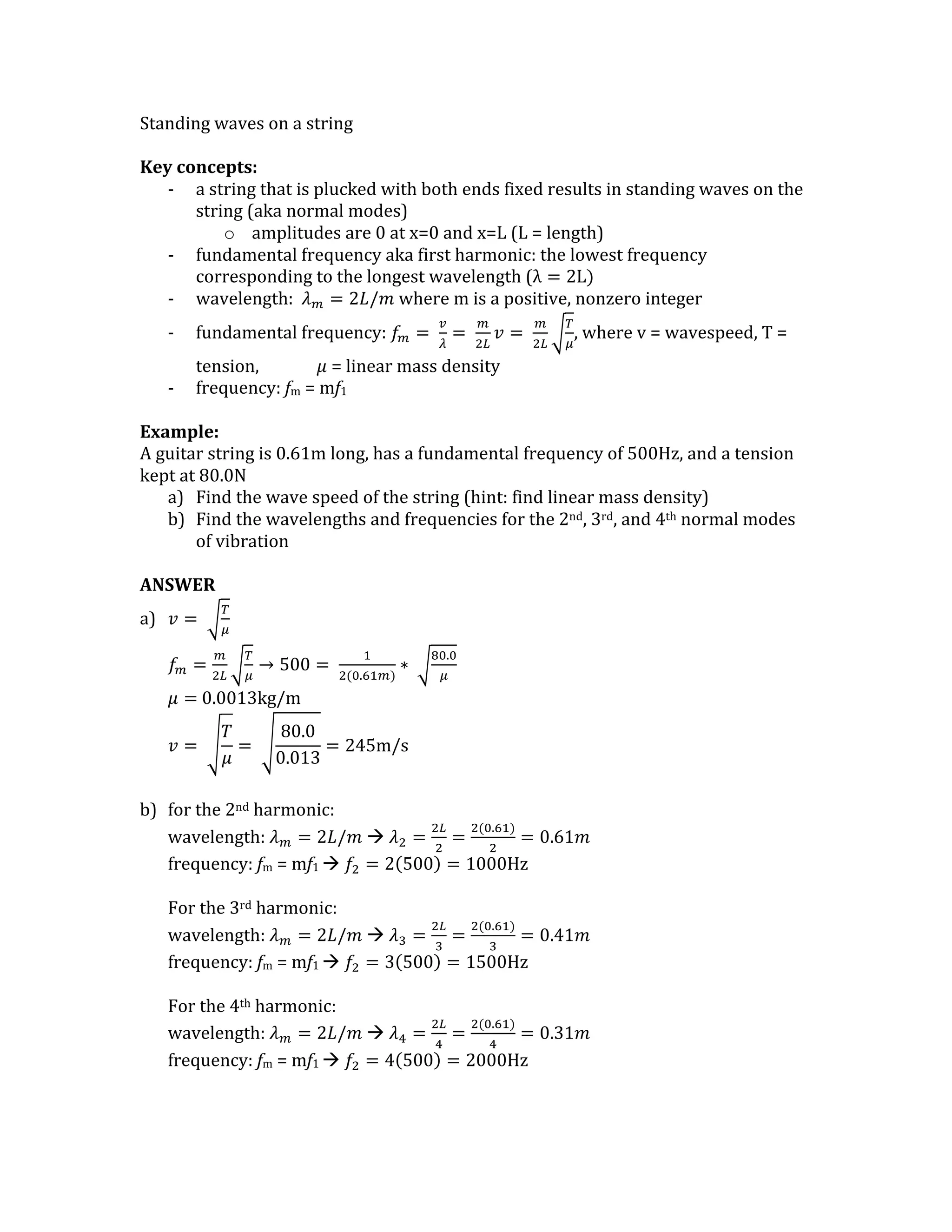
Standing waves on a string

  • 1.
    Standing  waves  on  a  string     Key  concepts:   -­‐ a  string  that  is  plucked  with  both  ends  fixed  results  in  standing  waves  on  the   string  (aka  normal  modes)   o amplitudes  are  0  at  x=0  and  x=L  (L  =  length)   -­‐ fundamental  frequency  aka  first  harmonic:  the  lowest  frequency   corresponding  to  the  longest  wavelength  (λ = 2L)   -­‐ wavelength:     𝜆! = 2𝐿/𝑚  where  m  is  a  positive,  nonzero  integer   -­‐ fundamental  frequency:   𝑓! =   ! ! =   ! !! 𝑣 =   ! !! ! ! ,  where  v  =  wavespeed,  T  =   tension,                             𝜇  =  linear  mass  density   -­‐ frequency:  fm  =  mf1       Example:   A  guitar  string  is  0.61m  long,  has  a  fundamental  frequency  of  500Hz,  and  a  tension   kept  at  80.0N   a) Find  the  wave  speed  of  the  string  (hint:  find  linear  mass  density)   b) Find  the  wavelengths  and  frequencies  for  the  2nd,  3rd,  and  4th  normal  modes   of  vibration     ANSWER   a) 𝑣 =   ! !     𝑓! = ! !! ! ! → 500 =   ! !(!.!"!) ∗   !".! !     𝜇 =  0.0013kg/m   𝑣 =   𝑇 𝜇 =   80.0 0.013 = 245m/s     b) for  the  2nd  harmonic:   wavelength:   𝜆! = 2𝐿/𝑚  à   𝜆! = !! ! = !(!.!") ! = 0.61𝑚   frequency:  fm  =  mf1  à   𝑓! = 2 500 = 1000Hz     For  the  3rd  harmonic:   wavelength:   𝜆! = 2𝐿/𝑚  à   𝜆! = !! ! = !(!.!") ! = 0.41𝑚   frequency:  fm  =  mf1  à   𝑓! = 3 500 = 1500Hz     For  the  4th  harmonic:   wavelength:   𝜆! = 2𝐿/𝑚  à   𝜆! = !! ! = !(!.!") ! = 0.31𝑚   frequency:  fm  =  mf1  à   𝑓! = 4 500 = 2000Hz