GONIOMETRY
By: DR. AMMARA FAZAL
VALIDITY AND RELIABILITY
 VALIDITY:
Validity refers to how well a test measures what it is purposed to measure.
Types of Validity:
The types of validity are:
 Face Validity
 Construct Validity
 Criterion-based Validity
 Formative Validity
 Sampling Validity
 Face Validity:
It ascertains that the measure appears to be assessing the
intended construct under study. The stakeholders can easily
assess face validity. Although this is not a very “scientific” type of
validity, it may be an essential component in enlisting motivation
of stakeholders. If the stakeholders do not believe the measure is
an accurate assessment of the ability, they may become
disengaged with the task.
Example: If a measure of art appreciation is created all of the items
should be related to the different components and types of art. If the
questions are regarding historical time periods, with no reference to
any artistic movement, stakeholders may not be motivated to give their
best effort or invest in this measure because they do not believe it is a
true assessment of art appreciation.
 Construct Validity:
It is used to ensure that the measure is actually measure what it is
intended to measure (i.e. the construct) and not other variables.
Using a panel of “experts” familiar with the construct is a way in
which this type of validity can be assessed. The experts can
examine the items and decide what that specific item is intended
to measure. Students can be involved in this process to obtain
their feedback.
Example:A women’s studies program may design a cumulative
assessment of learning throughout the major. The questions are
written with complicated wording and phrasing. This can cause the test
inadvertently becoming a test of reading comprehension, rather than a
test of women’s studies. It is important that the measure is actually
assessing the intended construct, rather than an extraneous factor.
 Criterion-Related Validity:
It is used to predict future or current performance - it correlates
test results with another criterion of interest.
Example:If a physics program designed a measure to assess
cumulative student learning throughout the major. The new measure
could be correlated with a standardized measure of ability in this
discipline, such as an ETS field test or the GRE subject test. The higher
the correlation between the established measure and new measure,
the more faith stakeholders can have in the new assessment tool.
 Formative Validity:
When applied to outcomes assessment it is used to assess how well a
measure is able to provide information to help improve the program
under study.
Example: When designing a rubric for history one could assess
student’s knowledge across the discipline. If the measure can provide
information that students are lacking knowledge in a certain area, for
instance the Civil Rights Movement, then that assessment tool is
providing meaningful information that can be used to improve the
course or program requirements.
 Sampling Validity:
It (similar to content validity) ensures that the measure covers the
broad range of areas within the concept under study. Not everything
can be covered, so items need to be sampled from all of the
domains. This may need to be completed using a panel of “experts” to
ensure that the content area is adequately sampled. Additionally, a
panel can help limit “expert” bias (i.e. a test reflecting what an
individual personally feels are the most important or relevant areas).
Example:When designing an assessment of learning in the theatre
department, it would not be sufficient to only cover issues related to
acting. Other areas of theatre such as lighting, sound, functions of
stage managers should all be included. The assessment should reflect
the content area in its entirely.
 RELIABILITY:
Reliability is the degree to which an assessment tool produces stable
and consistent results.
Types of Reliability:
The types of reliability are:
 Test-retest reliability:
It is a measure of reliability obtained by administering the same
test twice over a period of time to a group of individuals. The
scores from Time 1 and Time 2 can then be correlated in order to
evaluate the test for stability over time.
Example: A test designed to assess student learning in psychology
could be given to a group of students twice, with the second
administration perhaps coming a week after the first. The obtained
correlation coefficient would indicate the stability of the scores.
 Parallel forms reliability:
It is a measure of reliability obtained by administering different
versions of an assessment tool (both versions must contain items
that probe the same construct, skill, knowledge base, etc.) to the
same group of individuals. The scores from the two versions can
then be correlated in order to evaluate the consistency of results
across alternate versions.
Example: If you wanted to evaluate the reliability of a critical
thinking assessment, you might create a large set of items that all
pertain to critical thinking and then randomly split the questions up
into two sets, which would represent the parallel forms.
 Inter-rater reliability:
It is a measure of reliability used to assess the degree to which
different judges or raters agree in their assessment
decisions. Inter-rater reliability is useful because human
observers will not necessarily interpret answers the same way;
raters may disagree as to how well certain responses or material
demonstrate knowledge of the construct or skill being assessed.
Example: Inter-rater reliability might be employed when different
judges are evaluating the degree to which art portfolios meet certain
standards. Inter-rater reliability is especially useful when judgments
can be considered relatively subjective. Thus, the use of this type of
reliability would probably be more likely when evaluating artwork as
opposed to math problems.
 Internal consistency reliability:
It is a measure of reliability used to evaluate the degree to which
different test items that probe the same construct produce similar
results.
 Average inter-item correlation:
It is a subtype of internal consistency reliability. It is
obtained by taking all of the items on a test that probe the
same construct (e.g., reading comprehension), determining
the correlation coefficient for each pair of items, and finally
taking the average of all of these correlation
coefficients. This final step yields the average inter-item
correlation.
 Split-half reliability:
It is another subtype of internal consistency reliability. The
process of obtaining split-half reliability is begun by
“splitting in half” all items of a test that are intended to
probe the same area of knowledge (e.g., World War II) in
order to form two “sets” of items. The entire test is
administered to a group of individuals, the total score for
each “set” is computed, and finally the split-half reliability is
obtained by determining the correlation between the two
total “set” scores.
GONIOMETRY AND ITS INTRODUCTION
Goniometer:
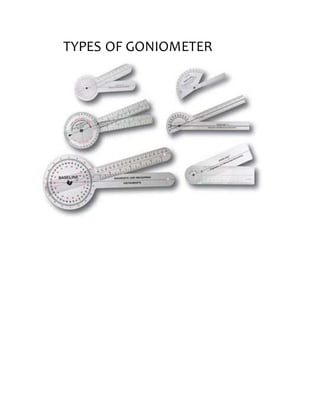
A goniometer is an instrument that either measures an
angle or allows an object to be rotated to a precise angular position.
A goniometer is a device used in physical therapy to
measure the range of motion around a joint in the body.
Goniometry:
Goniometry is an evaluating tool to make a record at
ground level and to access the patient functioning.
It is a measurement of JROM (Joint range of motion)
which is evaluative and which we can use to progn0se or anticipate
treatment protocol.
It is an accurate record of joint motion which provides
information that is necessary for determining the extent of disability.
Effective rehabilitation program:
Effective rehabilitation program includes:
 MMT
 ROM Assessment
 Cognition Assessment
Patient permanent record:
The recording of patient’s JROM according to muscle
power is termed permanent record. It involves assessment of patient’s
performance and then re-assessment to assure quality of treatment and
recovery.
PARTS OF A GONIOMETER
A Goniometer consists of three parts:
oFulcrum
oMobile Arm
oImmobile Arm
TYPES OF GONIOMETER
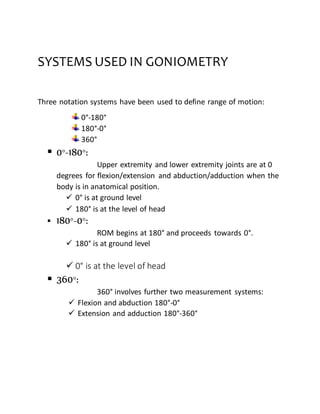
SYSTEMS USED IN GONIOMETRY
Three notation systems have been used to define range of motion:
0°-180°
180°-0°
360°
 0°-180°:
Upper extremity and lower extremity joints are at 0
degrees for flexion/extension and abduction/adduction when the
body is in anatomical position.
 0° is at ground level
 180° is at the level of head
 180°-0°:
ROM begins at 180° and proceeds towards 0°.
 180° is at ground level
 0° is at the level of head
 360°:
360° involves further two measurement systems:
 Flexion and abduction 180°-0°
 Extension and adduction 180°-360°
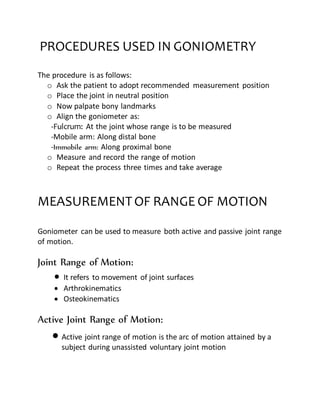
PROCEDURES USED IN GONIOMETRY
The procedure is as follows:
o Ask the patient to adopt recommended measurement position
o Place the joint in neutral position
o Now palpate bony landmarks
o Align the goniometer as:
-Fulcrum: At the joint whose range is to be measured
-Mobile arm: Along distal bone
-Immobile arm: Along proximal bone
o Measure and record the range of motion
o Repeat the process three times and take average
MEASUREMENTOF RANGE OF MOTION
Goniometer can be used to measure both active and passive joint range
of motion.
Joint Range of Motion:
 It refers to movement of joint surfaces
 Arthrokinematics
 Osteokinematics
Active Joint Range of Motion:
 Active joint range of motion is the arc of motion attained by a
subject during unassisted voluntary joint motion
 It is the performance of measurement by the patient voluntarily
and actively
 It provides the therapist with information about the subject’s
willingness to move, coordinate, muscle strength and joint range
of motion.
Passive Joint Range of Motion:
 PROM is the arc of motion attained by an examiner without
assistance from the subject
 Normally PROM is slightly greater than AROM
 This provides the examiner with information about the integrity
of the articular surfaces and extensibility of soft tissues around
the joint
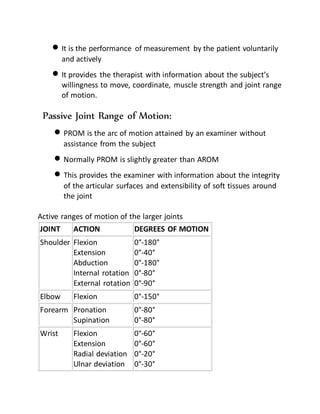
Active ranges of motion of the larger joints
JOINT ACTION DEGREES OF MOTION
Shoulder Flexion
Extension
Abduction
Internal rotation
External rotation
0°-180°
0°-40°
0°-180°
0°-80°
0°-90°
Elbow Flexion 0°-150°
Forearm Pronation
Supination
0°-80°
0°-80°
Wrist Flexion
Extension
Radial deviation
Ulnar deviation
0°-60°
0°-60°
0°-20°
0°-30°
Hip Flexion
Extension
Abduction
Adduction
Internal rotation
External rotation
0°-100°
0°-30°
0°-40°
0°-20°
0°-40°
0°-50°
Knee Flexion 0°-150°
Ankle Plantarflexion
Dorsiflexion
0°-40°
0°-20°
Foot Inversion
Eversion
0°-30°
0°-20°
Active range of motion norms for the hand and fingers
Motion Degrees
Finger flexion MCP:85°-90°; PIP: 100°-115°; DIP: 80°-90°
Finger extension MCP:30°-45°; PIP: 0°; DIP: 20°
Finger abduction 20°-30°
Finger adduction 0°
Thumb flexion CMC: 45°-50°; MCP: 50°-55°; IP: 85°-90°
Thumb extension MCP: 0°; IP: 0°-5°
Thumb adduction 30°
Thumb abduction 60°-70°
Normal ranges of motion, and end feels, for the toes[2, 3]
Motion Normal Range (Degrees)
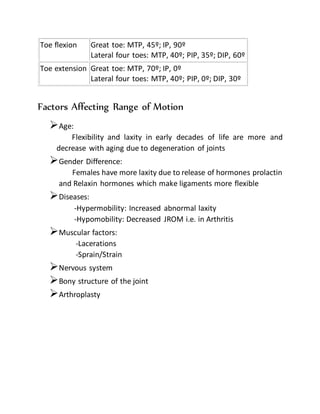
Toe flexion Great toe: MTP, 45º; IP, 90º
Lateral four toes: MTP, 40º; PIP, 35º; DIP, 60º
Toe extension Great toe: MTP, 70º; IP, 0º
Lateral four toes: MTP, 40º; PIP, 0º; DIP, 30º
Factors Affecting Range of Motion
Age:
Flexibility and laxity in early decades of life are more and
decrease with aging due to degeneration of joints
Gender Difference:
Females have more laxity due to release of hormones prolactin
and Relaxin hormones which make ligaments more flexible
Diseases:
-Hypermobility: Increased abnormal laxity
-Hypomobility: Decreased JROM i.e. in Arthritis
Muscular factors:
-Lacerations
-Sprain/Strain
Nervous system
Bony structure of the joint
Arthroplasty
RECORDINGS
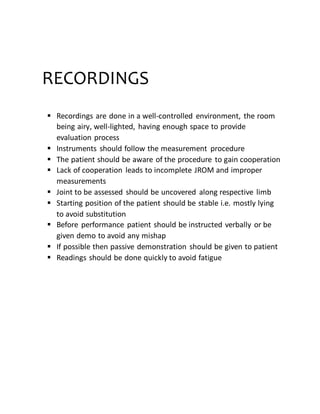
 Recordings are done in a well-controlled environment, the room
being airy, well-lighted, having enough space to provide
evaluation process
 Instruments should follow the measurement procedure
 The patient should be aware of the procedure to gain cooperation
 Lack of cooperation leads to incomplete JROM and improper
measurements
 Joint to be assessed should be uncovered along respective limb
 Starting position of the patient should be stable i.e. mostly lying
to avoid substitution
 Before performance patient should be instructed verbally or be
given demo to avoid any mishap
 If possible then passive demonstration should be given to patient
 Readings should be done quickly to avoid fatigue
CAPSULAR PATTERNS OF JROM
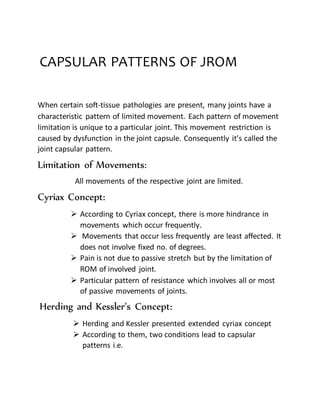
When certain soft-tissue pathologies are present, many joints have a
characteristic pattern of limited movement. Each pattern of movement
limitation is unique to a particular joint. This movement restriction is
caused by dysfunction in the joint capsule. Consequently it’s called the
joint capsular pattern.
Limitation of Movements:
All movements of the respective joint are limited.
Cyriax Concept:
 According to Cyriax concept, there is more hindrance in
movements which occur frequently.
 Movements that occur less frequently are least affected. It
does not involve fixed no. of degrees.
 Pain is not due to passive stretch but by the limitation of
ROM of involved joint.
 Particular pattern of resistance which involves all or most
of passive movements of joints.
Herding and Kessler’s Concept:
 Herding and Kessler presented extended cyriax concept
 According to them, two conditions lead to capsular
patterns i.e.
 Joint Effusion and Synovial Inflammation:
 Traumatic Arthritis
 Infectious Arthritis
 Rheumatoid Arthritis
 Gout
Relative Capsular Fibrosis:
 Chronic low grade capsular inflammation
 Immobilization of joint and resolution
 Capsular fibrosis
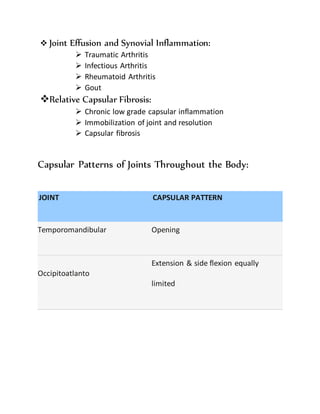
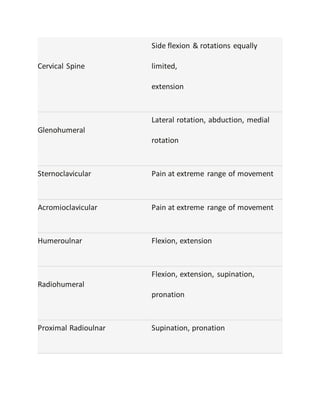
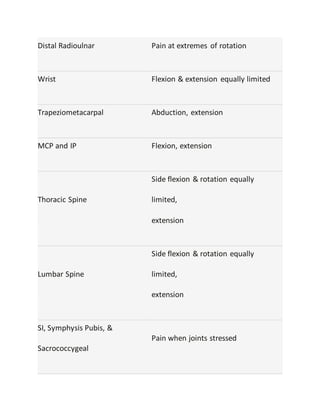
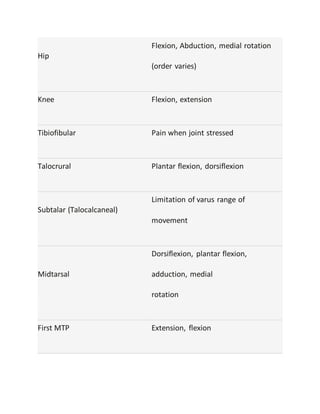
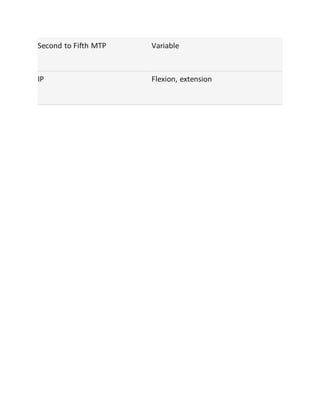
Capsular Patterns of Joints Throughout the Body:
JOINT CAPSULAR PATTERN
Temporomandibular Opening
Occipitoatlanto
Extension & side flexion equally
limited
Cervical Spine
Side flexion & rotations equally
limited,
extension
Glenohumeral
Lateral rotation, abduction, medial
rotation
Sternoclavicular Pain at extreme range of movement
Acromioclavicular Pain at extreme range of movement
Humeroulnar Flexion, extension
Radiohumeral
Flexion, extension, supination,
pronation
Proximal Radioulnar Supination, pronation
Distal Radioulnar Pain at extremes of rotation
Wrist Flexion & extension equally limited
Trapeziometacarpal Abduction, extension
MCP and IP Flexion, extension
Thoracic Spine
Side flexion & rotation equally
limited,
extension
Lumbar Spine
Side flexion & rotation equally
limited,
extension
SI, Symphysis Pubis, &
Sacrococcygeal
Pain when joints stressed
Hip
Flexion, Abduction, medial rotation
(order varies)
Knee Flexion, extension
Tibiofibular Pain when joint stressed
Talocrural Plantar flexion, dorsiflexion
Subtalar (Talocalcaneal)
Limitation of varus range of
movement
Midtarsal
Dorsiflexion, plantar flexion,
adduction, medial
rotation
First MTP Extension, flexion
Second to Fifth MTP Variable
IP Flexion, extension
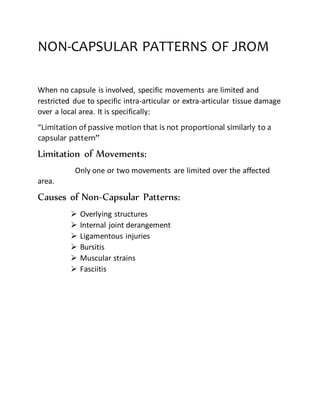
NON-CAPSULAR PATTERNS OF JROM
When no capsule is involved, specific movements are limited and
restricted due to specific intra-articular or extra-articular tissue damage
over a local area. It is specifically:
“Limitation of passive motion that is not proportional similarly to a
capsular pattern”
Limitation of Movements:
Only one or two movements are limited over the affected
area.
Causes of Non-Capsular Patterns:
 Overlying structures
 Internal joint derangement
 Ligamentous injuries
 Bursitis
 Muscular strains
 Fasciitis
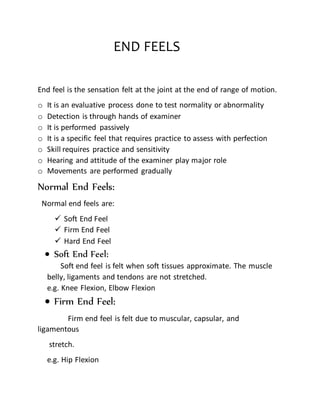
END FEELS
End feel is the sensation felt at the joint at the end of range of motion.
o It is an evaluative process done to test normality or abnormality
o Detection is through hands of examiner
o It is performed passively
o It is a specific feel that requires practice to assess with perfection
o Skill requires practice and sensitivity
o Hearing and attitude of the examiner play major role
o Movements are performed gradually
Normal End Feels:
Normal end feels are:
 Soft End Feel
 Firm End Feel
 Hard End Feel
 Soft End Feel:
Soft end feel is felt when soft tissues approximate. The muscle
belly, ligaments and tendons are not stretched.
e.g. Knee Flexion, Elbow Flexion
 Firm End Feel:
Firm end feel is felt due to muscular, capsular, and
ligamentous
stretch.
e.g. Hip Flexion
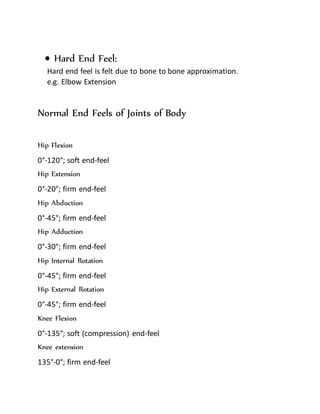
 Hard End Feel:
Hard end feel is felt due to bone to bone approximation.
e.g. Elbow Extension
Normal End Feels of Joints of Body
Hip Flexion
0°-120°; soft end-feel
Hip Extension
0°-20°; firm end-feel
Hip Abduction
0°-45°; firm end-feel
Hip Adduction
0°-30°; firm end-feel
Hip Internal Rotation
0°-45°; firm end-feel
Hip External Rotation
0°-45°; firm end-feel
Knee Flexion
0°-135°; soft (compression) end-feel
Knee extension
135°-0°; firm end-feel
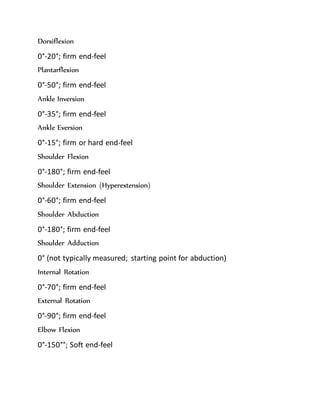
Dorsiflexion
0°-20°; firm end-feel
Plantarflexion
0°-50°; firm end-feel
Ankle Inversion
0°-35°; firm end-feel
Ankle Eversion
0°-15°; firm or hard end-feel
Shoulder Flexion
0°-180°; firm end-feel
Shoulder Extension (Hyperextension)
0°-60°; firm end-feel
Shoulder Abduction
0°-180°; firm end-feel
Shoulder Adduction
0° (not typically measured; starting point for abduction)
Internal Rotation
0°-70°; firm end-feel
External Rotation
0°-90°; firm end-feel
Elbow Flexion
0°-150°°; Soft end-feel
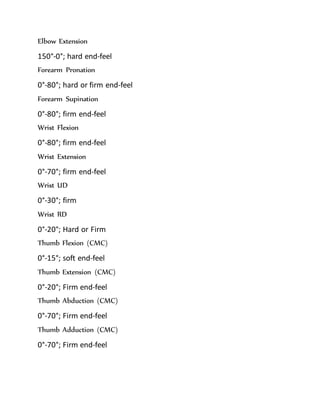
Elbow Extension
150°-0°; hard end-feel
Forearm Pronation
0°-80°; hard or firm end-feel
Forearm Supination
0°-80°; firm end-feel
Wrist Flexion
0°-80°; firm end-feel
Wrist Extension
0°-70°; firm end-feel
Wrist UD
0°-30°; firm
Wrist RD
0°-20°; Hard or Firm
Thumb Flexion (CMC)
0°-15°; soft end-feel
Thumb Extension (CMC)
0°-20°; Firm end-feel
Thumb Abduction (CMC)
0°-70°; Firm end-feel
Thumb Adduction (CMC)
0°-70°; Firm end-feel
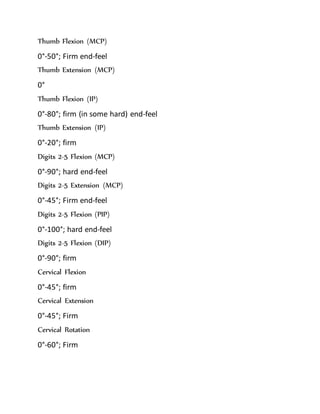
Thumb Flexion (MCP)
0°-50°; Firm end-feel
Thumb Extension (MCP)
0°
Thumb Flexion (IP)
0°-80°; firm (in some hard) end-feel
Thumb Extension (IP)
0°-20°; firm
Digits 2-5 Flexion (MCP)
0°-90°; hard end-feel
Digits 2-5 Extension (MCP)
0°-45°; Firm end-feel
Digits 2-5 Flexion (PIP)
0°-100°; hard end-feel
Digits 2-5 Flexion (DIP)
0°-90°; firm
Cervical Flexion
0°-45°; firm
Cervical Extension
0°-45°; Firm
Cervical Rotation
0°-60°; Firm
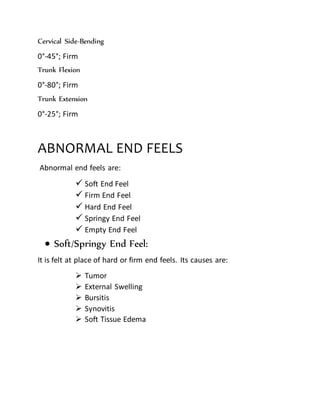
Cervical Side-Bending
0°-45°; Firm
Trunk Flexion
0°-80°; Firm
Trunk Extension
0°-25°; Firm
ABNORMAL END FEELS
Abnormal end feels are:
 Soft End Feel
 Firm End Feel
 Hard End Feel
 Springy End Feel
 Empty End Feel
 Soft/Springy End Feel:
It is felt at place of hard or firm end feels. Its causes are:
 Tumor
 External Swelling
 Bursitis
 Synovitis
 Soft Tissue Edema
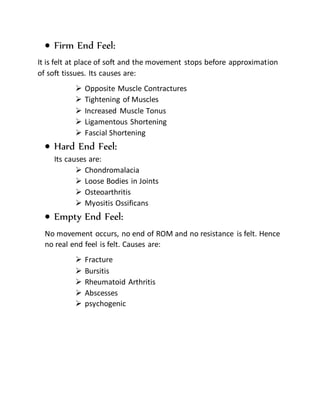
 Firm End Feel:
It is felt at place of soft and the movement stops before approximation
of soft tissues. Its causes are:
 Opposite Muscle Contractures
 Tightening of Muscles
 Increased Muscle Tonus
 Ligamentous Shortening
 Fascial Shortening
 Hard End Feel:
Its causes are:
 Chondromalacia
 Loose Bodies in Joints
 Osteoarthritis
 Myositis Ossificans
 Empty End Feel:
No movement occurs, no end of ROM and no resistance is felt. Hence
no real end feel is felt. Causes are:
 Fracture
 Bursitis
 Rheumatoid Arthritis
 Abscesses
 psychogenic

Goniometry

  • 1.
  • 2.
    VALIDITY AND RELIABILITY VALIDITY: Validity refers to how well a test measures what it is purposed to measure. Types of Validity: The types of validity are:  Face Validity  Construct Validity  Criterion-based Validity  Formative Validity  Sampling Validity  Face Validity: It ascertains that the measure appears to be assessing the intended construct under study. The stakeholders can easily assess face validity. Although this is not a very “scientific” type of validity, it may be an essential component in enlisting motivation of stakeholders. If the stakeholders do not believe the measure is an accurate assessment of the ability, they may become disengaged with the task. Example: If a measure of art appreciation is created all of the items should be related to the different components and types of art. If the
  • 3.
    questions are regardinghistorical time periods, with no reference to any artistic movement, stakeholders may not be motivated to give their best effort or invest in this measure because they do not believe it is a true assessment of art appreciation.  Construct Validity: It is used to ensure that the measure is actually measure what it is intended to measure (i.e. the construct) and not other variables. Using a panel of “experts” familiar with the construct is a way in which this type of validity can be assessed. The experts can examine the items and decide what that specific item is intended to measure. Students can be involved in this process to obtain their feedback. Example:A women’s studies program may design a cumulative assessment of learning throughout the major. The questions are written with complicated wording and phrasing. This can cause the test inadvertently becoming a test of reading comprehension, rather than a test of women’s studies. It is important that the measure is actually assessing the intended construct, rather than an extraneous factor.  Criterion-Related Validity: It is used to predict future or current performance - it correlates test results with another criterion of interest. Example:If a physics program designed a measure to assess cumulative student learning throughout the major. The new measure
  • 4.
    could be correlatedwith a standardized measure of ability in this discipline, such as an ETS field test or the GRE subject test. The higher the correlation between the established measure and new measure, the more faith stakeholders can have in the new assessment tool.  Formative Validity: When applied to outcomes assessment it is used to assess how well a measure is able to provide information to help improve the program under study. Example: When designing a rubric for history one could assess student’s knowledge across the discipline. If the measure can provide information that students are lacking knowledge in a certain area, for instance the Civil Rights Movement, then that assessment tool is providing meaningful information that can be used to improve the course or program requirements.  Sampling Validity: It (similar to content validity) ensures that the measure covers the broad range of areas within the concept under study. Not everything can be covered, so items need to be sampled from all of the domains. This may need to be completed using a panel of “experts” to ensure that the content area is adequately sampled. Additionally, a panel can help limit “expert” bias (i.e. a test reflecting what an individual personally feels are the most important or relevant areas).
  • 5.
    Example:When designing anassessment of learning in the theatre department, it would not be sufficient to only cover issues related to acting. Other areas of theatre such as lighting, sound, functions of stage managers should all be included. The assessment should reflect the content area in its entirely.  RELIABILITY: Reliability is the degree to which an assessment tool produces stable and consistent results. Types of Reliability: The types of reliability are:  Test-retest reliability: It is a measure of reliability obtained by administering the same test twice over a period of time to a group of individuals. The scores from Time 1 and Time 2 can then be correlated in order to evaluate the test for stability over time. Example: A test designed to assess student learning in psychology could be given to a group of students twice, with the second administration perhaps coming a week after the first. The obtained correlation coefficient would indicate the stability of the scores.  Parallel forms reliability: It is a measure of reliability obtained by administering different versions of an assessment tool (both versions must contain items that probe the same construct, skill, knowledge base, etc.) to the same group of individuals. The scores from the two versions can then be correlated in order to evaluate the consistency of results across alternate versions.
  • 6.
    Example: If youwanted to evaluate the reliability of a critical thinking assessment, you might create a large set of items that all pertain to critical thinking and then randomly split the questions up into two sets, which would represent the parallel forms.  Inter-rater reliability: It is a measure of reliability used to assess the degree to which different judges or raters agree in their assessment decisions. Inter-rater reliability is useful because human observers will not necessarily interpret answers the same way; raters may disagree as to how well certain responses or material demonstrate knowledge of the construct or skill being assessed. Example: Inter-rater reliability might be employed when different judges are evaluating the degree to which art portfolios meet certain standards. Inter-rater reliability is especially useful when judgments can be considered relatively subjective. Thus, the use of this type of reliability would probably be more likely when evaluating artwork as opposed to math problems.  Internal consistency reliability: It is a measure of reliability used to evaluate the degree to which different test items that probe the same construct produce similar results.  Average inter-item correlation: It is a subtype of internal consistency reliability. It is obtained by taking all of the items on a test that probe the same construct (e.g., reading comprehension), determining the correlation coefficient for each pair of items, and finally taking the average of all of these correlation coefficients. This final step yields the average inter-item correlation.  Split-half reliability:
  • 7.
    It is anothersubtype of internal consistency reliability. The process of obtaining split-half reliability is begun by “splitting in half” all items of a test that are intended to probe the same area of knowledge (e.g., World War II) in order to form two “sets” of items. The entire test is administered to a group of individuals, the total score for each “set” is computed, and finally the split-half reliability is obtained by determining the correlation between the two total “set” scores. GONIOMETRY AND ITS INTRODUCTION Goniometer: A goniometer is an instrument that either measures an angle or allows an object to be rotated to a precise angular position. A goniometer is a device used in physical therapy to measure the range of motion around a joint in the body. Goniometry:
  • 8.
    Goniometry is anevaluating tool to make a record at ground level and to access the patient functioning. It is a measurement of JROM (Joint range of motion) which is evaluative and which we can use to progn0se or anticipate treatment protocol. It is an accurate record of joint motion which provides information that is necessary for determining the extent of disability. Effective rehabilitation program: Effective rehabilitation program includes:  MMT  ROM Assessment  Cognition Assessment Patient permanent record: The recording of patient’s JROM according to muscle power is termed permanent record. It involves assessment of patient’s performance and then re-assessment to assure quality of treatment and recovery. PARTS OF A GONIOMETER A Goniometer consists of three parts: oFulcrum oMobile Arm oImmobile Arm
  • 9.
  • 10.
    SYSTEMS USED INGONIOMETRY Three notation systems have been used to define range of motion: 0°-180° 180°-0° 360°  0°-180°: Upper extremity and lower extremity joints are at 0 degrees for flexion/extension and abduction/adduction when the body is in anatomical position.  0° is at ground level  180° is at the level of head  180°-0°: ROM begins at 180° and proceeds towards 0°.  180° is at ground level  0° is at the level of head  360°: 360° involves further two measurement systems:  Flexion and abduction 180°-0°  Extension and adduction 180°-360°
  • 11.
    PROCEDURES USED INGONIOMETRY The procedure is as follows: o Ask the patient to adopt recommended measurement position o Place the joint in neutral position o Now palpate bony landmarks o Align the goniometer as: -Fulcrum: At the joint whose range is to be measured -Mobile arm: Along distal bone -Immobile arm: Along proximal bone o Measure and record the range of motion o Repeat the process three times and take average MEASUREMENTOF RANGE OF MOTION Goniometer can be used to measure both active and passive joint range of motion. Joint Range of Motion:  It refers to movement of joint surfaces  Arthrokinematics  Osteokinematics Active Joint Range of Motion:  Active joint range of motion is the arc of motion attained by a subject during unassisted voluntary joint motion
  • 12.
     It isthe performance of measurement by the patient voluntarily and actively  It provides the therapist with information about the subject’s willingness to move, coordinate, muscle strength and joint range of motion. Passive Joint Range of Motion:  PROM is the arc of motion attained by an examiner without assistance from the subject  Normally PROM is slightly greater than AROM  This provides the examiner with information about the integrity of the articular surfaces and extensibility of soft tissues around the joint Active ranges of motion of the larger joints JOINT ACTION DEGREES OF MOTION Shoulder Flexion Extension Abduction Internal rotation External rotation 0°-180° 0°-40° 0°-180° 0°-80° 0°-90° Elbow Flexion 0°-150° Forearm Pronation Supination 0°-80° 0°-80° Wrist Flexion Extension Radial deviation Ulnar deviation 0°-60° 0°-60° 0°-20° 0°-30°
  • 13.
    Hip Flexion Extension Abduction Adduction Internal rotation Externalrotation 0°-100° 0°-30° 0°-40° 0°-20° 0°-40° 0°-50° Knee Flexion 0°-150° Ankle Plantarflexion Dorsiflexion 0°-40° 0°-20° Foot Inversion Eversion 0°-30° 0°-20° Active range of motion norms for the hand and fingers Motion Degrees Finger flexion MCP:85°-90°; PIP: 100°-115°; DIP: 80°-90° Finger extension MCP:30°-45°; PIP: 0°; DIP: 20° Finger abduction 20°-30° Finger adduction 0° Thumb flexion CMC: 45°-50°; MCP: 50°-55°; IP: 85°-90° Thumb extension MCP: 0°; IP: 0°-5° Thumb adduction 30° Thumb abduction 60°-70° Normal ranges of motion, and end feels, for the toes[2, 3] Motion Normal Range (Degrees)
  • 14.
    Toe flexion Greattoe: MTP, 45º; IP, 90º Lateral four toes: MTP, 40º; PIP, 35º; DIP, 60º Toe extension Great toe: MTP, 70º; IP, 0º Lateral four toes: MTP, 40º; PIP, 0º; DIP, 30º Factors Affecting Range of Motion Age: Flexibility and laxity in early decades of life are more and decrease with aging due to degeneration of joints Gender Difference: Females have more laxity due to release of hormones prolactin and Relaxin hormones which make ligaments more flexible Diseases: -Hypermobility: Increased abnormal laxity -Hypomobility: Decreased JROM i.e. in Arthritis Muscular factors: -Lacerations -Sprain/Strain Nervous system Bony structure of the joint Arthroplasty
  • 15.
    RECORDINGS  Recordings aredone in a well-controlled environment, the room being airy, well-lighted, having enough space to provide evaluation process  Instruments should follow the measurement procedure  The patient should be aware of the procedure to gain cooperation  Lack of cooperation leads to incomplete JROM and improper measurements  Joint to be assessed should be uncovered along respective limb  Starting position of the patient should be stable i.e. mostly lying to avoid substitution  Before performance patient should be instructed verbally or be given demo to avoid any mishap  If possible then passive demonstration should be given to patient  Readings should be done quickly to avoid fatigue
  • 16.
    CAPSULAR PATTERNS OFJROM When certain soft-tissue pathologies are present, many joints have a characteristic pattern of limited movement. Each pattern of movement limitation is unique to a particular joint. This movement restriction is caused by dysfunction in the joint capsule. Consequently it’s called the joint capsular pattern. Limitation of Movements: All movements of the respective joint are limited. Cyriax Concept:  According to Cyriax concept, there is more hindrance in movements which occur frequently.  Movements that occur less frequently are least affected. It does not involve fixed no. of degrees.  Pain is not due to passive stretch but by the limitation of ROM of involved joint.  Particular pattern of resistance which involves all or most of passive movements of joints. Herding and Kessler’s Concept:  Herding and Kessler presented extended cyriax concept  According to them, two conditions lead to capsular patterns i.e.
  • 17.
     Joint Effusionand Synovial Inflammation:  Traumatic Arthritis  Infectious Arthritis  Rheumatoid Arthritis  Gout Relative Capsular Fibrosis:  Chronic low grade capsular inflammation  Immobilization of joint and resolution  Capsular fibrosis Capsular Patterns of Joints Throughout the Body: JOINT CAPSULAR PATTERN Temporomandibular Opening Occipitoatlanto Extension & side flexion equally limited
  • 18.
    Cervical Spine Side flexion& rotations equally limited, extension Glenohumeral Lateral rotation, abduction, medial rotation Sternoclavicular Pain at extreme range of movement Acromioclavicular Pain at extreme range of movement Humeroulnar Flexion, extension Radiohumeral Flexion, extension, supination, pronation Proximal Radioulnar Supination, pronation
  • 19.
    Distal Radioulnar Painat extremes of rotation Wrist Flexion & extension equally limited Trapeziometacarpal Abduction, extension MCP and IP Flexion, extension Thoracic Spine Side flexion & rotation equally limited, extension Lumbar Spine Side flexion & rotation equally limited, extension SI, Symphysis Pubis, & Sacrococcygeal Pain when joints stressed
  • 20.
    Hip Flexion, Abduction, medialrotation (order varies) Knee Flexion, extension Tibiofibular Pain when joint stressed Talocrural Plantar flexion, dorsiflexion Subtalar (Talocalcaneal) Limitation of varus range of movement Midtarsal Dorsiflexion, plantar flexion, adduction, medial rotation First MTP Extension, flexion
  • 21.
    Second to FifthMTP Variable IP Flexion, extension
  • 22.
    NON-CAPSULAR PATTERNS OFJROM When no capsule is involved, specific movements are limited and restricted due to specific intra-articular or extra-articular tissue damage over a local area. It is specifically: “Limitation of passive motion that is not proportional similarly to a capsular pattern” Limitation of Movements: Only one or two movements are limited over the affected area. Causes of Non-Capsular Patterns:  Overlying structures  Internal joint derangement  Ligamentous injuries  Bursitis  Muscular strains  Fasciitis
  • 23.
    END FEELS End feelis the sensation felt at the joint at the end of range of motion. o It is an evaluative process done to test normality or abnormality o Detection is through hands of examiner o It is performed passively o It is a specific feel that requires practice to assess with perfection o Skill requires practice and sensitivity o Hearing and attitude of the examiner play major role o Movements are performed gradually Normal End Feels: Normal end feels are:  Soft End Feel  Firm End Feel  Hard End Feel  Soft End Feel: Soft end feel is felt when soft tissues approximate. The muscle belly, ligaments and tendons are not stretched. e.g. Knee Flexion, Elbow Flexion  Firm End Feel: Firm end feel is felt due to muscular, capsular, and ligamentous stretch. e.g. Hip Flexion
  • 24.
     Hard EndFeel: Hard end feel is felt due to bone to bone approximation. e.g. Elbow Extension Normal End Feels of Joints of Body Hip Flexion 0°-120°; soft end-feel Hip Extension 0°-20°; firm end-feel Hip Abduction 0°-45°; firm end-feel Hip Adduction 0°-30°; firm end-feel Hip Internal Rotation 0°-45°; firm end-feel Hip External Rotation 0°-45°; firm end-feel Knee Flexion 0°-135°; soft (compression) end-feel Knee extension 135°-0°; firm end-feel
  • 25.
    Dorsiflexion 0°-20°; firm end-feel Plantarflexion 0°-50°;firm end-feel Ankle Inversion 0°-35°; firm end-feel Ankle Eversion 0°-15°; firm or hard end-feel Shoulder Flexion 0°-180°; firm end-feel Shoulder Extension (Hyperextension) 0°-60°; firm end-feel Shoulder Abduction 0°-180°; firm end-feel Shoulder Adduction 0° (not typically measured; starting point for abduction) Internal Rotation 0°-70°; firm end-feel External Rotation 0°-90°; firm end-feel Elbow Flexion 0°-150°°; Soft end-feel
  • 26.
    Elbow Extension 150°-0°; hardend-feel Forearm Pronation 0°-80°; hard or firm end-feel Forearm Supination 0°-80°; firm end-feel Wrist Flexion 0°-80°; firm end-feel Wrist Extension 0°-70°; firm end-feel Wrist UD 0°-30°; firm Wrist RD 0°-20°; Hard or Firm Thumb Flexion (CMC) 0°-15°; soft end-feel Thumb Extension (CMC) 0°-20°; Firm end-feel Thumb Abduction (CMC) 0°-70°; Firm end-feel Thumb Adduction (CMC) 0°-70°; Firm end-feel
  • 27.
    Thumb Flexion (MCP) 0°-50°;Firm end-feel Thumb Extension (MCP) 0° Thumb Flexion (IP) 0°-80°; firm (in some hard) end-feel Thumb Extension (IP) 0°-20°; firm Digits 2-5 Flexion (MCP) 0°-90°; hard end-feel Digits 2-5 Extension (MCP) 0°-45°; Firm end-feel Digits 2-5 Flexion (PIP) 0°-100°; hard end-feel Digits 2-5 Flexion (DIP) 0°-90°; firm Cervical Flexion 0°-45°; firm Cervical Extension 0°-45°; Firm Cervical Rotation 0°-60°; Firm
  • 28.
    Cervical Side-Bending 0°-45°; Firm TrunkFlexion 0°-80°; Firm Trunk Extension 0°-25°; Firm ABNORMAL END FEELS Abnormal end feels are:  Soft End Feel  Firm End Feel  Hard End Feel  Springy End Feel  Empty End Feel  Soft/Springy End Feel: It is felt at place of hard or firm end feels. Its causes are:  Tumor  External Swelling  Bursitis  Synovitis  Soft Tissue Edema
  • 29.
     Firm EndFeel: It is felt at place of soft and the movement stops before approximation of soft tissues. Its causes are:  Opposite Muscle Contractures  Tightening of Muscles  Increased Muscle Tonus  Ligamentous Shortening  Fascial Shortening  Hard End Feel: Its causes are:  Chondromalacia  Loose Bodies in Joints  Osteoarthritis  Myositis Ossificans  Empty End Feel: No movement occurs, no end of ROM and no resistance is felt. Hence no real end feel is felt. Causes are:  Fracture  Bursitis  Rheumatoid Arthritis  Abscesses  psychogenic