Upper Motor
Neuron Lesion
BY:
NUR ADILIA
NUR ATIKAH
SITI HAJAR
FATHIRAH AINA
Neuroanatomy UMN
• motor neurons originate in the motor
region of the cerebral cortex or the brain
stem and carry motor info to the final
common pathway.
• Betz cell large pyramidal cells
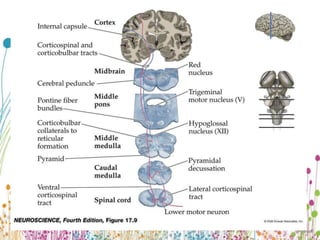
• UMN lesions result from damage of
– Corticospinal tract
– Cortico bulbar tract
Pyramidal Tract
Lesion
Upper Motor Neuron Weakness
• If lesion is above pyramidal decussation (
level of lower medulla) weakness at
contralateral to site of lesion
• If lesion occurs lower than the level
weakness at ipsilateral to lesion
Upper Motor Neuron Weakness
• Increased tone ( spasticity)
– Spastic catch: mild spasticity during flexion
– “Clasp-knife “phenomenonrelaxation following
resistance to passive flexion of elbow or knee
– Clonus rythmic involuntary muscle contractions
abruptly applied n sustained strtch stimulus
• Brisk tendon reflex – KPR, biceps reflex,
triceps reflex
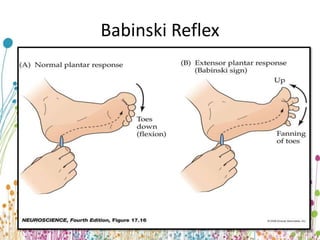
• Extensor Plantar Response positive Babinski
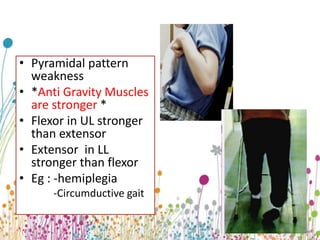
• Pyramidal pattern
weakness
• *Anti Gravity Muscles
are stronger *
• Flexor in UL stronger
than extensor
• Extensor in LL
stronger than flexor
• Eg : -hemiplegia
-Circumductive gait
Babinski Reflex
Upper motor neuron

Upper motor neuron

  • 1.
    Upper Motor Neuron Lesion BY: NURADILIA NUR ATIKAH SITI HAJAR FATHIRAH AINA
  • 2.
    Neuroanatomy UMN • motorneurons originate in the motor region of the cerebral cortex or the brain stem and carry motor info to the final common pathway. • Betz cell large pyramidal cells • UMN lesions result from damage of – Corticospinal tract – Cortico bulbar tract Pyramidal Tract Lesion
  • 4.
    Upper Motor NeuronWeakness • If lesion is above pyramidal decussation ( level of lower medulla) weakness at contralateral to site of lesion • If lesion occurs lower than the level weakness at ipsilateral to lesion
  • 5.
    Upper Motor NeuronWeakness • Increased tone ( spasticity) – Spastic catch: mild spasticity during flexion – “Clasp-knife “phenomenonrelaxation following resistance to passive flexion of elbow or knee – Clonus rythmic involuntary muscle contractions abruptly applied n sustained strtch stimulus • Brisk tendon reflex – KPR, biceps reflex, triceps reflex • Extensor Plantar Response positive Babinski
  • 6.
    • Pyramidal pattern weakness •*Anti Gravity Muscles are stronger * • Flexor in UL stronger than extensor • Extensor in LL stronger than flexor • Eg : -hemiplegia -Circumductive gait
  • 7.