





This document provides an overview of mixed methods research, including definitions, characteristics, strengths/weaknesses of quantitative and qualitative methods, reasons for using mixed methods, and major mixed methods designs. It discusses the convergent parallel design, which collects and analyzes quantitative and qualitative data concurrently and equally. It also covers the explanatory sequential design, in which qualitative data is used to help explain initial quantitative results. Examples of published studies using each design are provided.
Overview of mixed methods research, contact information, and key reference material.
Mixed methods research collects and analyzes both quantitative and qualitative data in various ways.
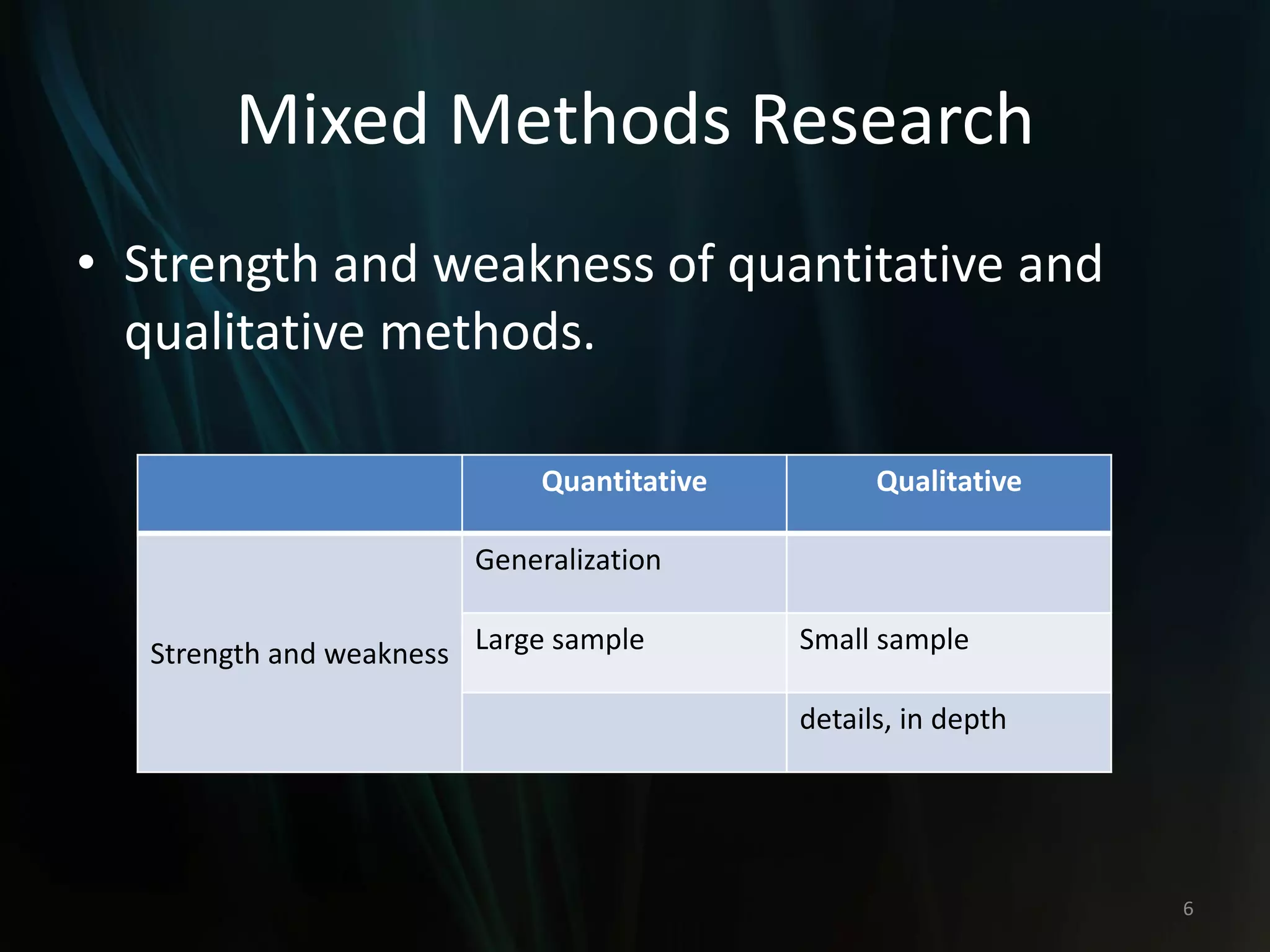
Comparison of strengths and weaknesses of quantitative and qualitative methods regarding sample size and detail.
Mixed methods are preferred when one data source is insufficient to explain outcomes or when a project has multiple phases.
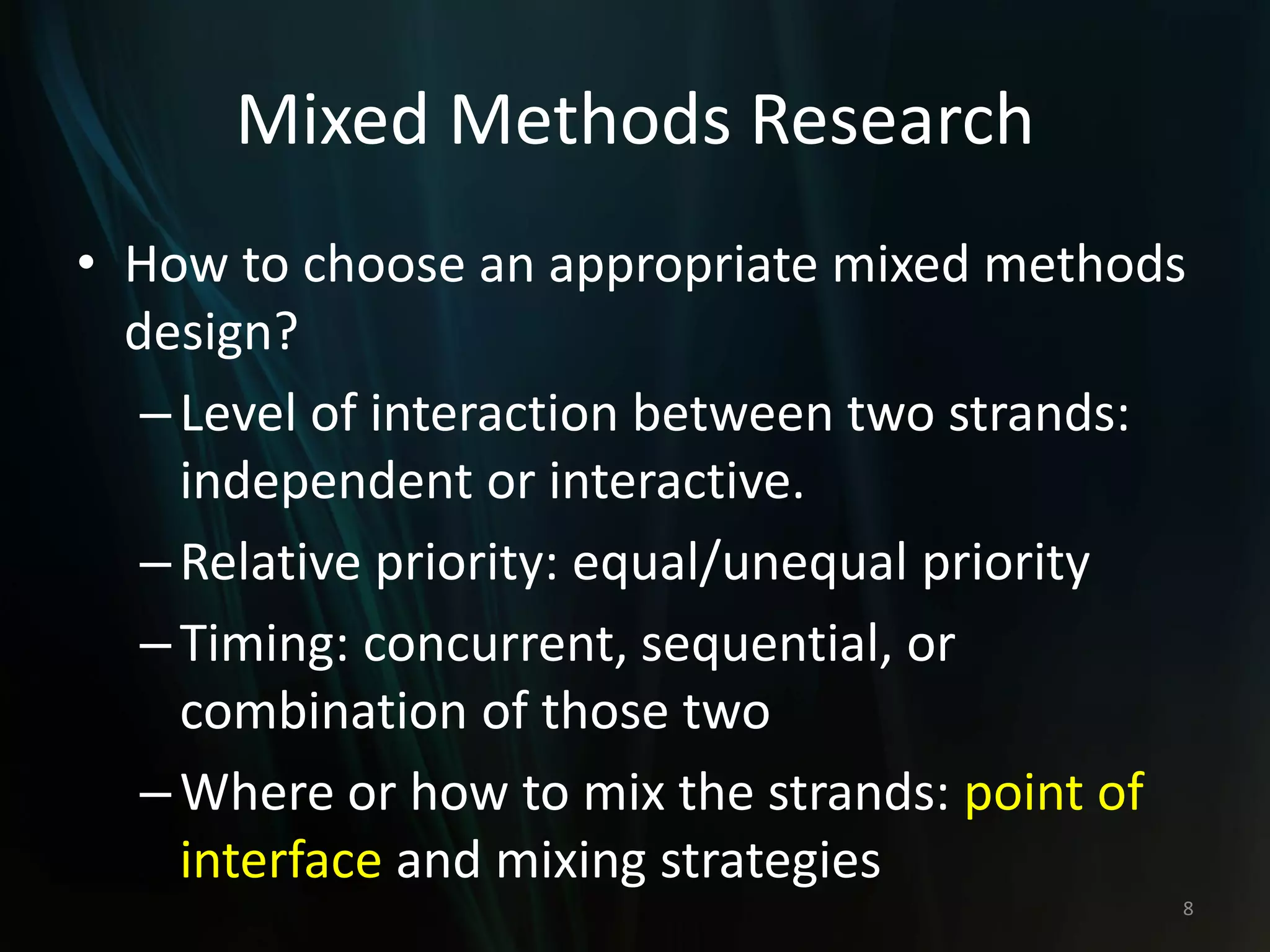
Guidelines for selecting mixed methods designs based on interaction levels, priorities, and timing.
Discussion on points of interface where quantitative and qualitative data are mixed, analyzed, and interpreted.
Practical examples illustrating the use of mixed methods to gather and explain data.
Details about convergent parallel design, including design purpose, examples, and data merging strategies.
Challenges faced when merging quantitative and qualitative data in convergent parallel design.
Different variants of convergent parallel design including parallel-databases and data-validation variant.
Explanatory sequential design utilizes qualitative data to explain quantitative results and its challenges.
Exploratory sequential design focuses on generalizing qualitative findings to larger samples for instrument development.Embedded designs answer various questions requiring different data types within a single study.
Transformative design aims at addressing social justice issues through qualitative and quantitative methods.
Discusses multiphase mixed methods that blend sequential and concurrent approaches in extensive projects.
Resources for researching mixed methods, including conferences, journals, and research offices.
Mixed Methods Research
•My contact information
–Office: 1001 Joyner library (room 1006)
–bianh@ecu.edu
–Phone: 252-328-5428
–Website:
http://core.ecu.edu/StatisticsResearch
2
3.
Mixed Methods Research
Reference
Creswell,J. W., & Plano Clark, V. L. (2011).
Designing and conducting mixed methods
research (2nd ed.). Thousand Oaks, CA: Sage
Publications, Inc.
3
4.
Mixed Methods Research
•Definition
– “as a method, it focuses on collecting, analyzing,
and mixing both quantitative and qualitative data
in a single study or series of studies. Its central
premise is that the use of quantitative and
qualitative approaches, in combination, provides a
better understanding of research problems than
either approach alone.”
4
5.
Mixed Methods Research
•Characteristics of mixed methods research
– Collect and analyze both quantitative and
qualitative data.
– Mix two forms of data in different ways.
– Give priority to one or both forms of data.
– Can be in a single study or in multiple phases of a
study.
5
6.
Mixed Methods Research
•Strength and weakness of quantitative and
qualitative methods.
6
Quantitative Qualitative
Strength and weakness
Generalization
Large sample Small sample
details, in depth
7.
Mixed Methods Research
•Why use mixed methods
–One data resource may not be enough;
–Initial results need to be further
explained;
–A second method is needed to
enhance a primary method;
–The project has multi-phases.
7
8.
Mixed Methods Research
•How to choose an appropriate mixed methods
design?
–Level of interaction between two strands:
independent or interactive.
–Relative priority: equal/unequal priority
–Timing: concurrent, sequential, or
combination of those two
–Where or how to mix the strands: point of
interface and mixing strategies
8
9.
Mixed Methods Research
•Point of interface: is a point where the two
strands are mixed: possible point of interfaces
– Data collection: quan or qual results build to the
subsequent collection of qual or quan data.
– Data analysis: transform one type of data into
other type of data and analyze combined data.
– Interpretation: comparing or combining results
from both methods.
9
10.
Mixed Methods Research
•Examples
–Similar results from different perspectives:
collect data on quantitative instrument and
on qualitative data based on focus groups.
–Collect quantitative data first and follow up
with interviews to help explain their
outcomes from quantitative data.
10
11.
Mixed Methods Research
•Examples
–Use interviews to explores how
individuals describe a topic and use the
findings to develop quantitative data
collection instrument.
11
12.
Mixed Methods Research
•Major designs
–(1). Convergent parallel design:
purpose of this design
– to best understand or develop more
complete understanding of the research
problem by obtaining different but
complementary data.
– Validation purpose
12
13.
Mixed Methods Research
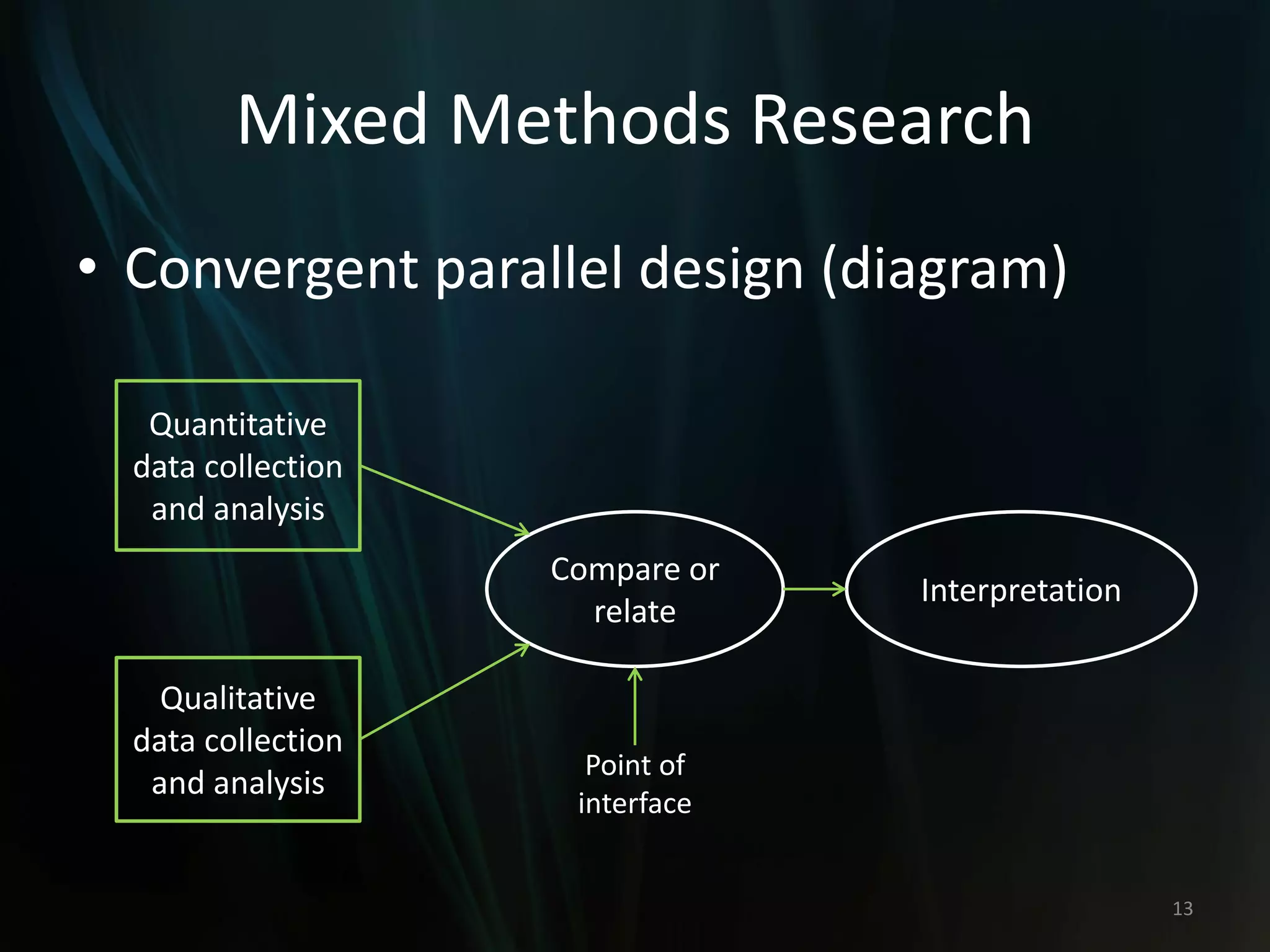
•Convergent parallel design (diagram)
13
Quantitative
data collection
and analysis
Qualitative
data collection
and analysis
Compare or
relate
Interpretation
Point of
interface
14.
Convergent Parallel Design
•Three published papers
– Sherrilene Classen, Ellen DS Lopez, Sandra Winter,
Kezia D Awadzi, Nita Ferree, et al.
Population-based health promotion perspective
for older driver safety: Conceptual framework to
intervention plan. Clinical Interventions in Aging
2007, 2:677-693 03 January 2007
http://www.dovepress.com/population-based-
health-promotion-perspective-for-older-driver-
safety--peer-reviewed-article-CIA
14
15.
Convergent Parallel Design
•Three published papers
– David F. Feldon and Yasmin B. Kafai. Mixed
methods for mixed reality: understanding users’
avatar activities in virtual worlds. Educational
Technology Research and Development 2008
56:575-593
http://www.springerlink.com/content/g66m160n
75444mx7/fulltext.pdf
15
16.
Convergent Parallel Design
•Three published papers
– Marsha N. Wittink, Frances K. Barg, and Joseph J.
Gallo. Unwritten Rules of Talking to Doctors
About Depression: Integrating Qualitative and
Quantitative Methods. Ann Fam Med 2006 4:302-
309; doi:10.1370/afm.558 .
http://www.annfammed.org/content/4/4/302.full
.pdf+html
16
17.
Convergent Parallel Design
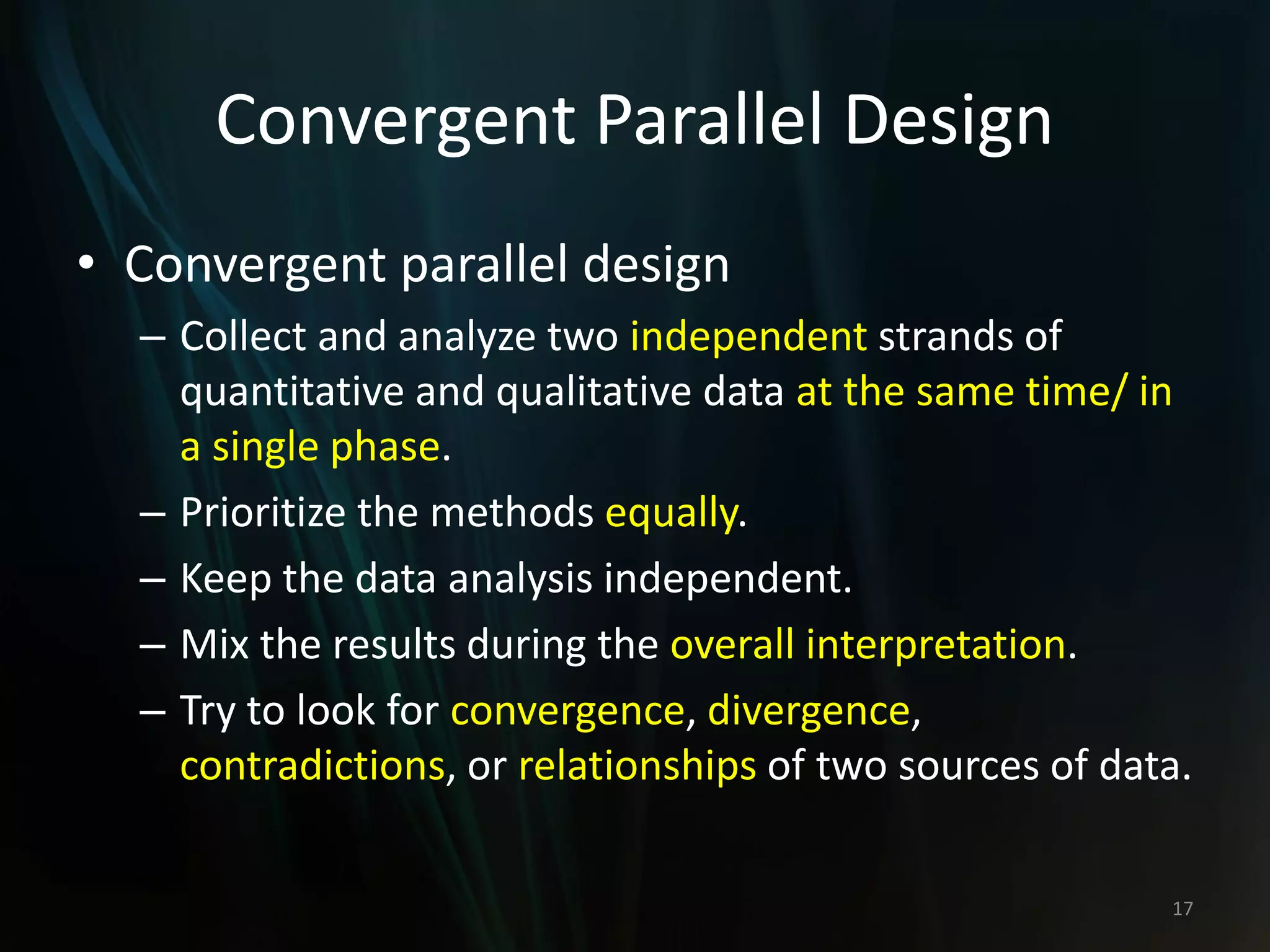
•Convergent parallel design
– Collect and analyze two independent strands of
quantitative and qualitative data at the same time/ in
a single phase.
– Prioritize the methods equally.
– Keep the data analysis independent.
– Mix the results during the overall interpretation.
– Try to look for convergence, divergence,
contradictions, or relationships of two sources of data.
17
18.
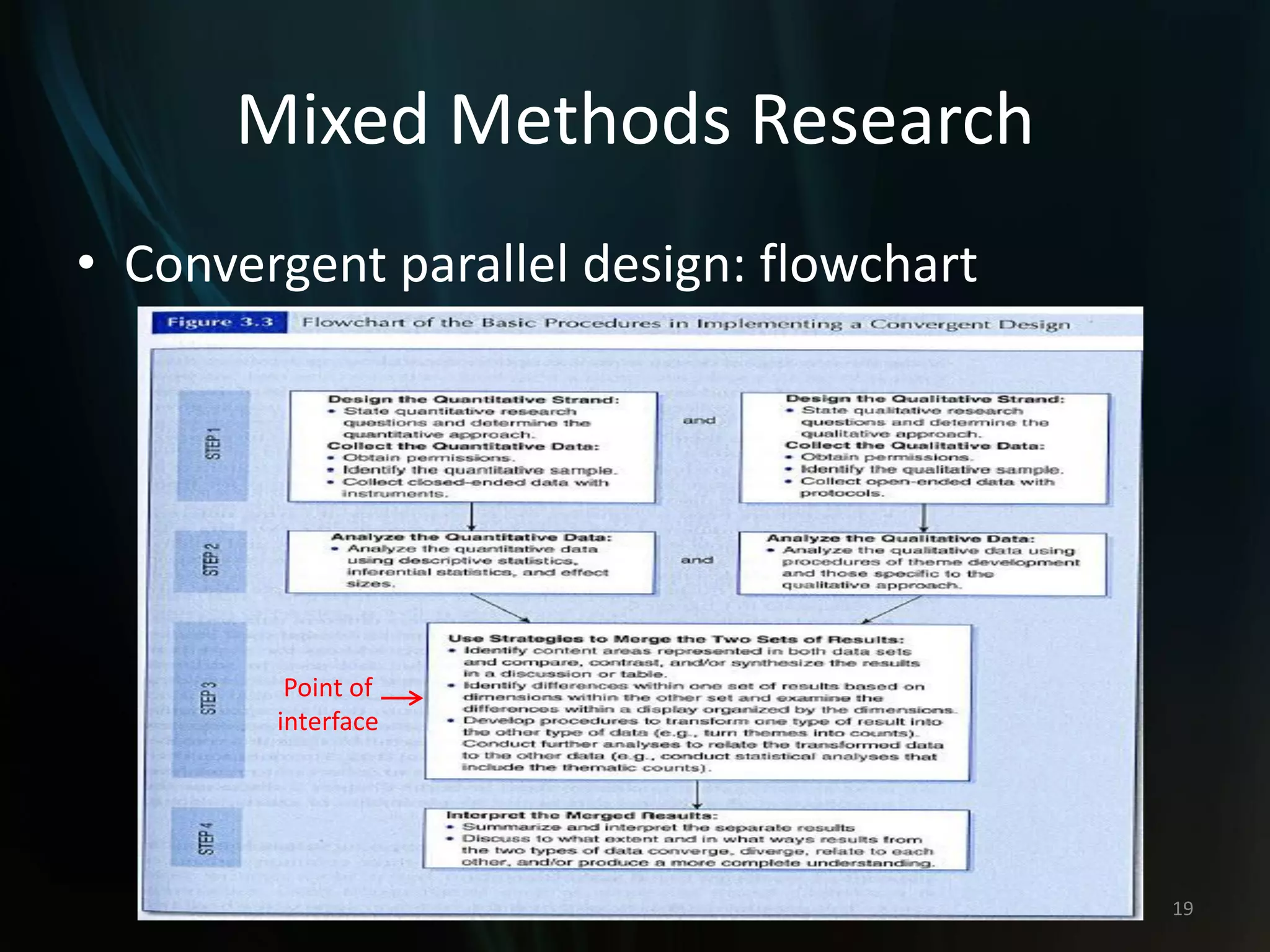
Convergent Parallel Design
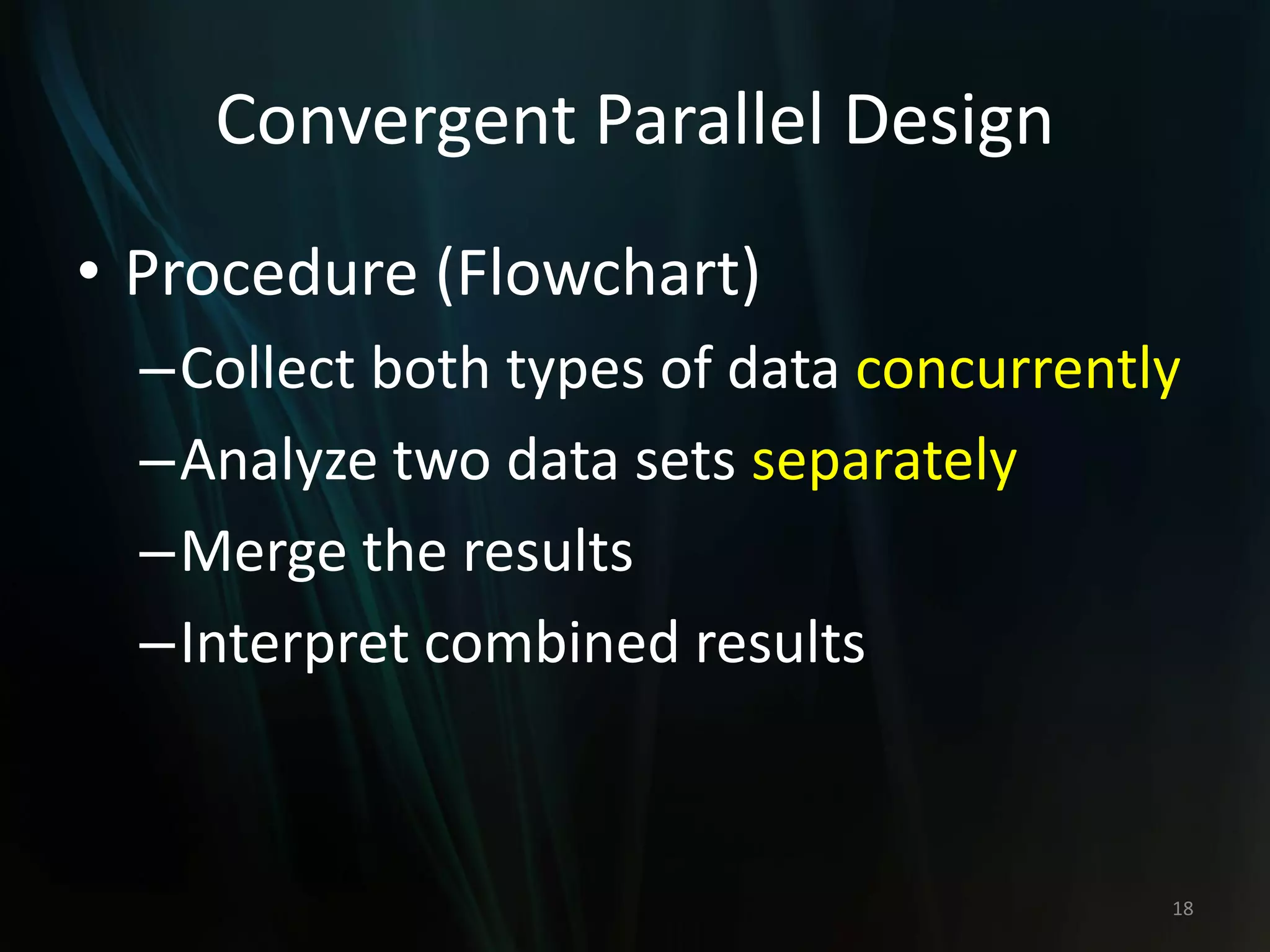
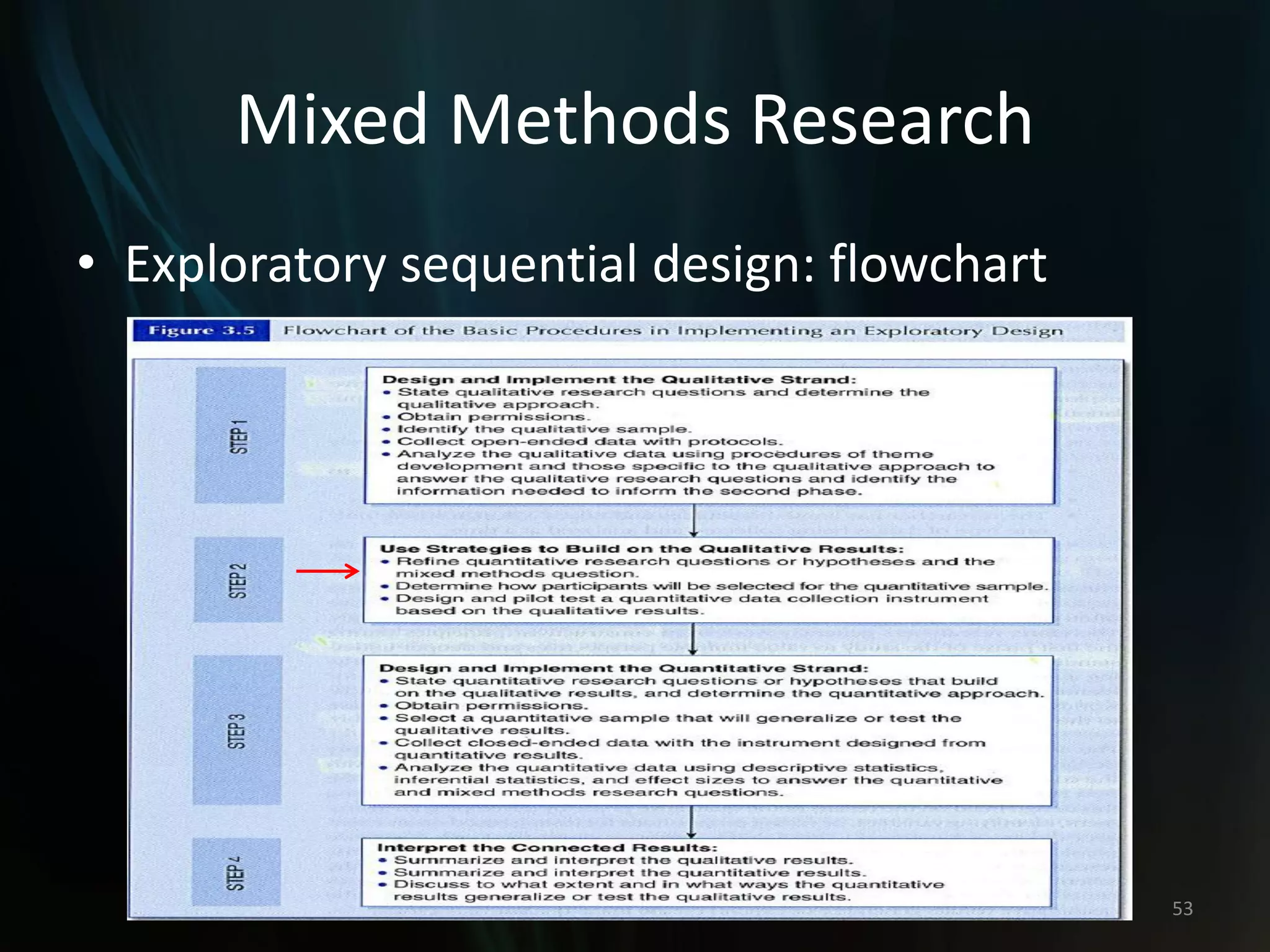
•Procedure (Flowchart)
–Collect both types of data concurrently
–Analyze two data sets separately
–Merge the results
–Interpret combined results
18
Convergent Parallel Design
•Design
–Research questions: create parallel
questions for the qual and quan
studies.
–Samples: different or same group of
people in quantitative and qualitative
studies?
–Sample sizes: equal or unequal
20
21.
Convergent Parallel Design
•Design:
• Data will be collected from one source or
different sources: survey/interview or only
use survey.
• Order of two types of data collections:
survey first then focus group or one-on-one
interview.
21
22.
Convergent Parallel Design
•Merged data analysis strategies
–Side-by-side comparison (in a results or
discussion section or a summary table).
• Present quantitative or qualitative results
• Followed by qualitative or quantitative results
• Followed by comments describe how
qual/quan confirm or disconfirm quan/qual
results.
22
23.
Convergent Parallel Design
•Merged data analysis strategies
–Joint display: using table or figure to show
both quan and qual results
– Data transformation merged analysis: transform
one type of data (qual) into the other type of data
(quan).
• Create a new variable based on presence of a
theme
• Create a new variable based on number of
times a theme appears.
23
24.
Convergent Parallel Design
•Interpreting merged results
–Look for similarity and convergence
–How to handle discrepancy?
•State the limitations of the study
•Revisit two types of data
•Could collect additional data
24
25.
Convergent Parallel Design
•Challenges
– Needs both quantitative and qualitative expertise
– Consequences of having different samples and
different sample size when merging two data sets.
– How to merge two types of data.
– How to deal with the situation in which
quantitative and qualitative results contradict
each other.
25
26.
Mixed Methods Research
•Convergent parallel design variants
–Parallel-databases variants: two sets of data
merge at the final step.
–Data-transformation variant
–Data-validation variant: such as open-ended
questions on a questionnaire.
26
27.
Mixed Methods Research
•Major designs
–(2). Explanatory sequential design:
purpose of this design is to use
qualitative approach to explain
quantitative results (significant, non-
significant, outliers or surprising
results) or to guide to form groups
based on quantitative results
27
28.
Mixed Methods Research
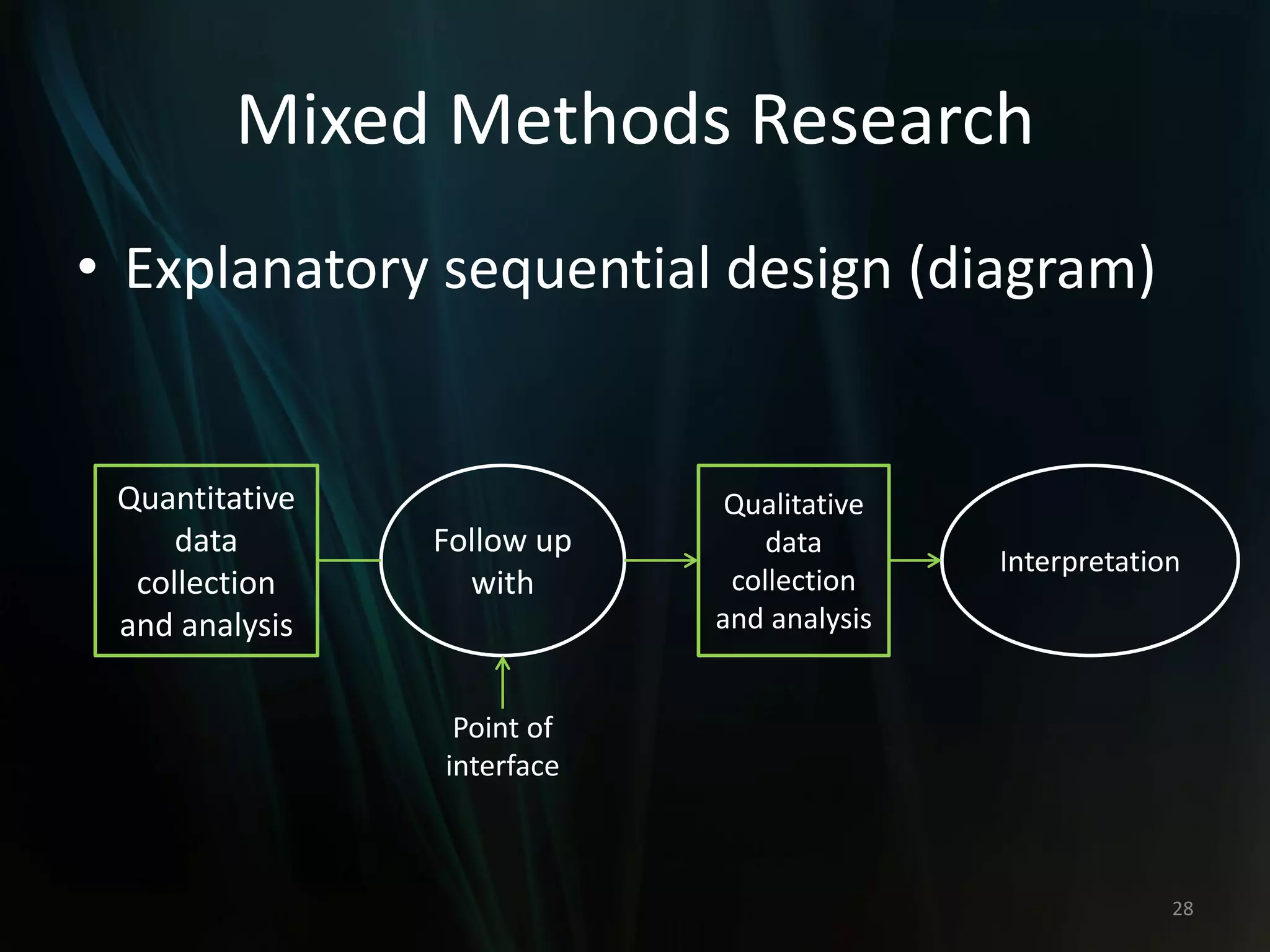
•Explanatory sequential design (diagram)
28
Quantitative
data
collection
and analysis
Follow up
with
Qualitative
data
collection
and analysis
Interpretation
Point of
interface
29.
Explanatory Sequential Design
•Published paper
– Nataliya V. Ivankova and Sheldon L. Stick (2007).
Students' persistence in a distributed doctoral
program in educational leadership in higher
education: A mixed methods study. Research in
Higher Education, 48(1):93-135
http://www.jstor.org/stable/25704494
29
30.
Explanatory Sequential Design
•Published paper
– Niobe Way, Helena Y. Stauber, Michael J. Nakkula and Perry
London (1994). Depression and substance use in two
divergent high school cultures: A quantitative and
qualitative analysis. Journal of Youth and Adolescence,
23(3): 331-357
http://www.springerlink.com/content/l367l0l77r213712/fullt
ext.pdf
30
31.
Explanatory Sequential Design
•Mixed methods question
“In what ways do the qualitative data
help explain the quantitative results?”
31
32.
Explanatory Sequential Design
•Key points
–Typically it is a two-phase design.
–Collect quantitative and qualitative data at
different time.
–Qualitative study depends on quantitative
results.
–Usually quantitative data collection is the
priority.
32
33.
Explanatory Sequential Design
•Procedure
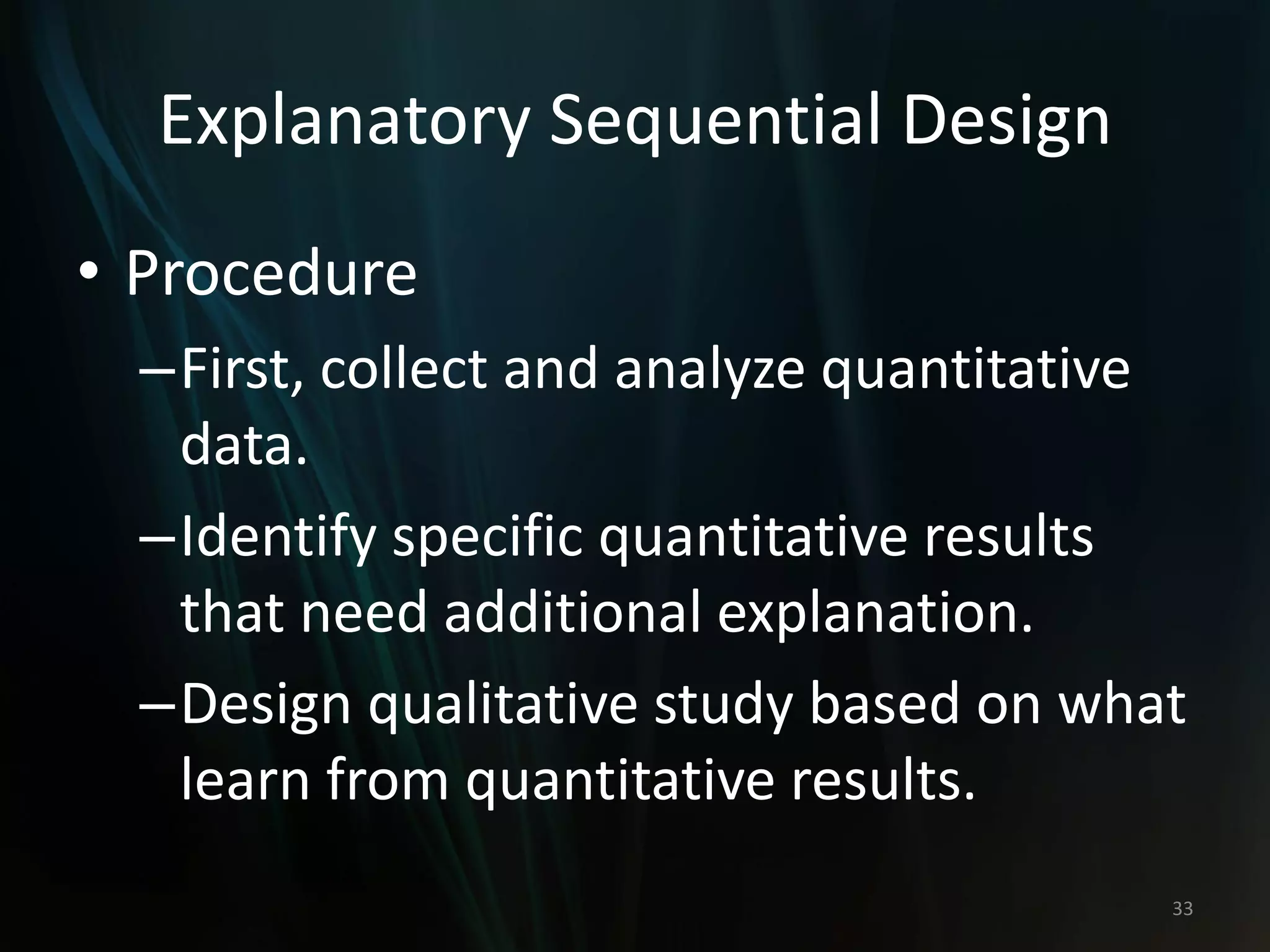
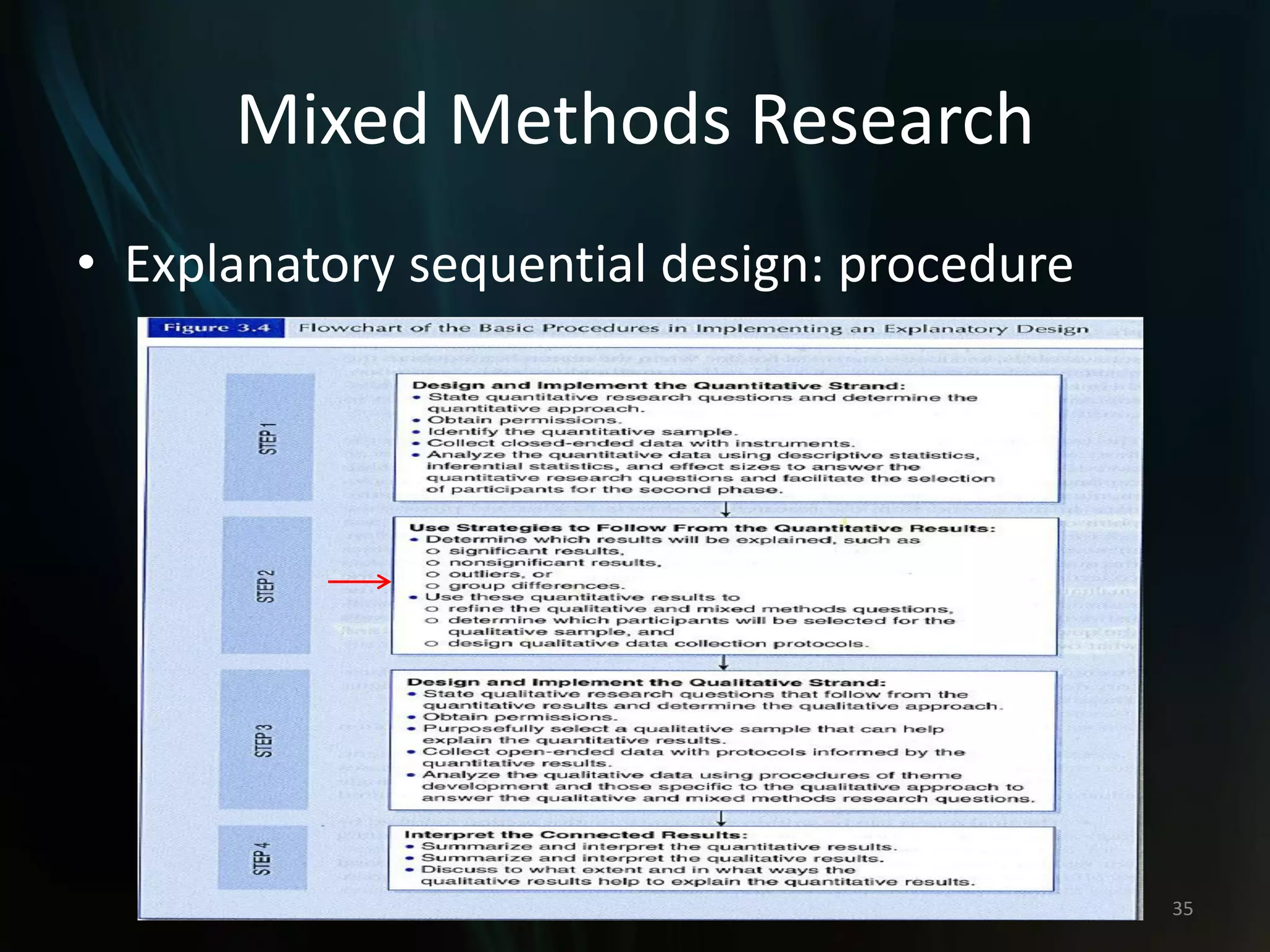
–First, collect and analyze quantitative
data.
–Identify specific quantitative results
that need additional explanation.
–Design qualitative study based on what
learn from quantitative results.
33
Explanatory Sequential Design
•Design
–Samples: different or same group of people
in both studies?
• The participants in the qualitative study should
be those who participated in the quantitative
study.
–Sample sizes: equal or unequal
• Qualitative study uses smaller sample.
36
37.
Explanatory Sequential Design
•Design
–Decide what quantitative results to follow
up.
• Unclear
• Unexpected
• Significant/non-significant results
• Outliers or extreme cases
37
38.
Explanatory Sequential Design
•Design
–How to select participants for qualitative
study
• Individuals who volunteer to participate in
interviews (weaker connection between two
phases).
• Systematic approach: based on quantitative
results and select participants best able to fit in
qualitative study (IRB issue).
38
39.
Explanatory Sequential Design
•Design
–IRB issues: suggestions
• Separate IRB for each phase.
• One IRB, state the follow up phase as
tentative.
• From the start, inform participants the
possibility of second data collection.
39
40.
Explanatory Sequential Design
•Select qualitative sample
–Participants who are representative of
different groups.
–Participants with extreme scores.
–Participants differed in their scores on
significant predictors.
40
41.
Explanatory Sequential Design
•Interpreting connected results
–Conclusion is about whether the follow
up qualitative data provide a better
understanding of the research problem
than simply the quantitative results.
41
42.
Explanatory Sequential Design
•Explanatory sequential design variants
–Follow-up explanation variant
–Participation-selection variant: it needs
quantitative results to help select best
participants. It places priority on the
second, qualitative phase.
42
43.
Explanatory Sequential Design
•Challenges
– Time consuming
– IRB issue
– Decisions about which quantitative results need
further explanation.
– Decisions about who to sample and what criteria
used for sample selection for qualitative study.
43
44.
Mixed Methods Research
•Major designs
–(3). Exploratory sequential design: also
referred to as instrument development
design. The purpose of this design is to
generalize qualitative findings to a
larger sample.
44
45.
Exploratory Sequential Design
Referencefor instrument design
DeVellis, R. F. (2003). Scale development: theory and application (2nd ed.).
Thousand Oaks, CA: Sage Publications, Inc.
Downing, S. M. & Haladyna, T. M. (2006). Handbook of test development.
Mahwah, NJ: Lawrence Erlbaum Associates, Inc.
Fishman, J. A. & Galguera, T. (2003). Introduction to test construction in the
social and behavioral sciences: a practical guide. Lanham, MD: Rowman &
Littlefield Publishers, Inc.
Pett, M. A., Lackey, N. R.,& Sullivan, J. J. (2003). Making sense of factor
analysis: the use of factor analysis for instrument development in health
care research. Thousand Oaks, CA: Sage Publications, Inc.
45
46.
Exploratory Sequential Design
•Published paper
– Myers, Karen Kroman; Oetzel, John G. (2003).
Communication Quarterly, 51(4), 438-457.
http://ehis.ebscohost.com/ehost/pdfviewer/pdfviewer?vid=
3&hid=2&sid=2339ee9b-08f8-45b1-babf-
b7e2c0d193ef%40sessionmgr12
46
47.
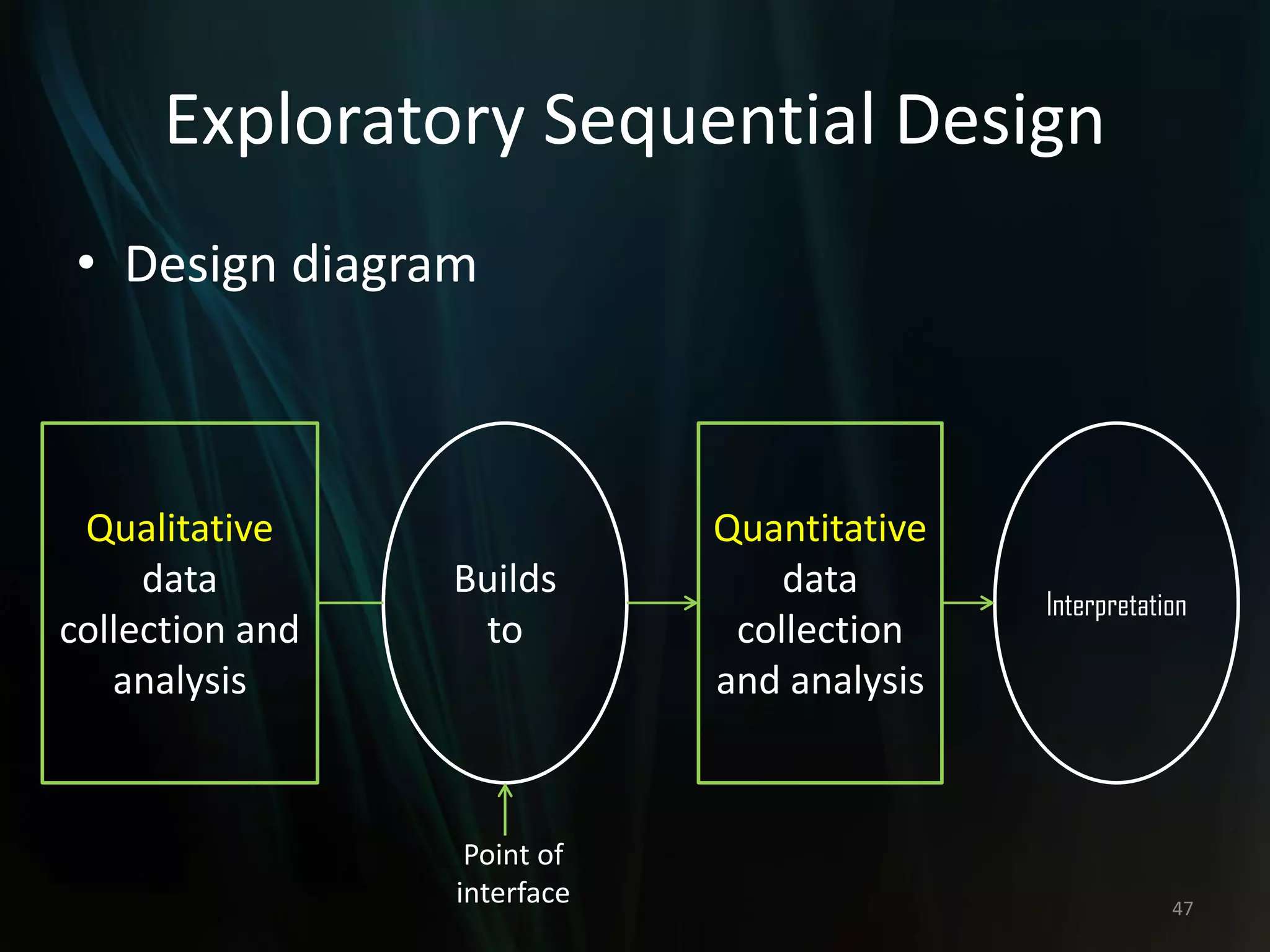
Exploratory Sequential Design
•Design diagram
47
Qualitative
data
collection and
analysis
Builds
to
Quantitative
data
collection
and analysis
Interpretation
Point of
interface
48.
Exploratory Sequential Design
•Purpose of this design:
• The qualitative phase is used to help
develop or inform the quantitative
study.
– Instrument design (explore)
– Grounded theory (generalize qualitative
results)
48
49.
Exploratory Sequential Design
•Reasons for using this design
• Instruments are not available
• The variables are not known
• There is no theory or model as a guide
49
50.
Exploratory Sequential Design
•Key points
–Typically it is a two-phase design.
• Three phases for instrument development (instrument
development phase, a phase testing, and apply the
instrument).
–Collect quantitative and qualitative data at
different time.
–Qualitative results can help and inform the
second quantitative method.
50
51.
Exploratory Sequential Design
•Mixed design research question
–In what ways do the quantitative
results generalize the qualitative
findings?
51
52.
Exploratory Sequential Design
•Procedure
–First, collect and analyze qualitative
data.
–Develop quantitative study based on
what you learn from qualitative results.
–Collect and analyze quantitative data.
52
Exploratory Sequential Design
•Design
–Samples: different or same group of people
in both studies?
• The participants in the quantitative study are
NOT same individuals who provided qualitative
data.
–Sample sizes: equal or unequal
• Quantitative study uses larger sample.
54
55.
Exploratory Sequential Design
•Design
–IRB issues for emerging follow-up
phase:
• Separate IRB for each phase.
• One IRB, state the follow up phase as
tentative.
55
Exploratory Sequential Design
•Design
–How to develop a good instrument:
scale development.
•Steps for instrument development
57
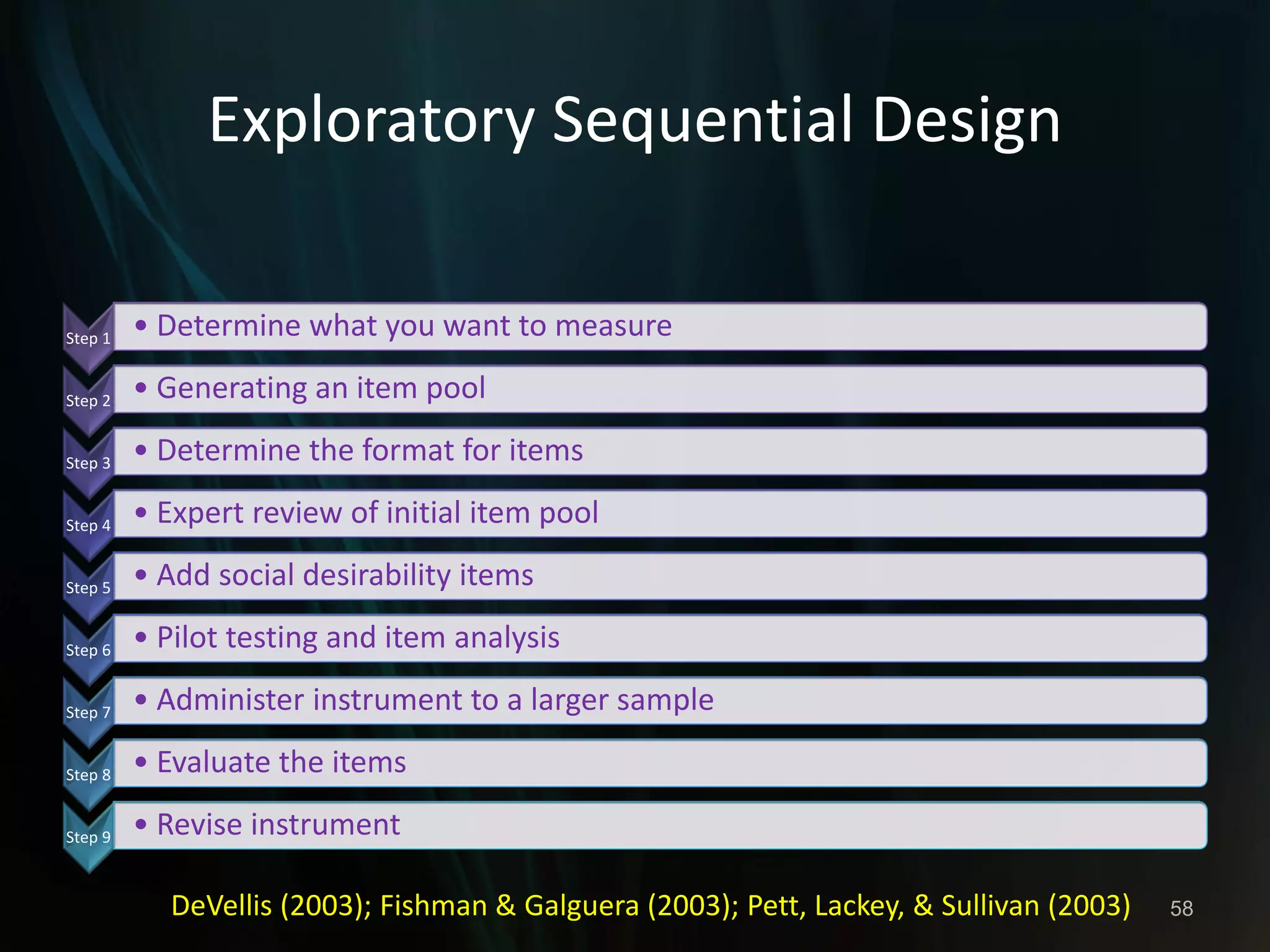
58.
Exploratory Sequential Design
Step1 • Determine what you want to measure
Step 2 • Generating an item pool
Step 3 • Determine the format for items
Step 4 • Expert review of initial item pool
Step 5 • Add social desirability items
Step 6 • Pilot testing and item analysis
Step 7 • Administer instrument to a larger sample
Step 8 • Evaluate the items
Step 9 • Revise instrument
58DeVellis (2003); Fishman & Galguera (2003); Pett, Lackey, & Sullivan (2003)
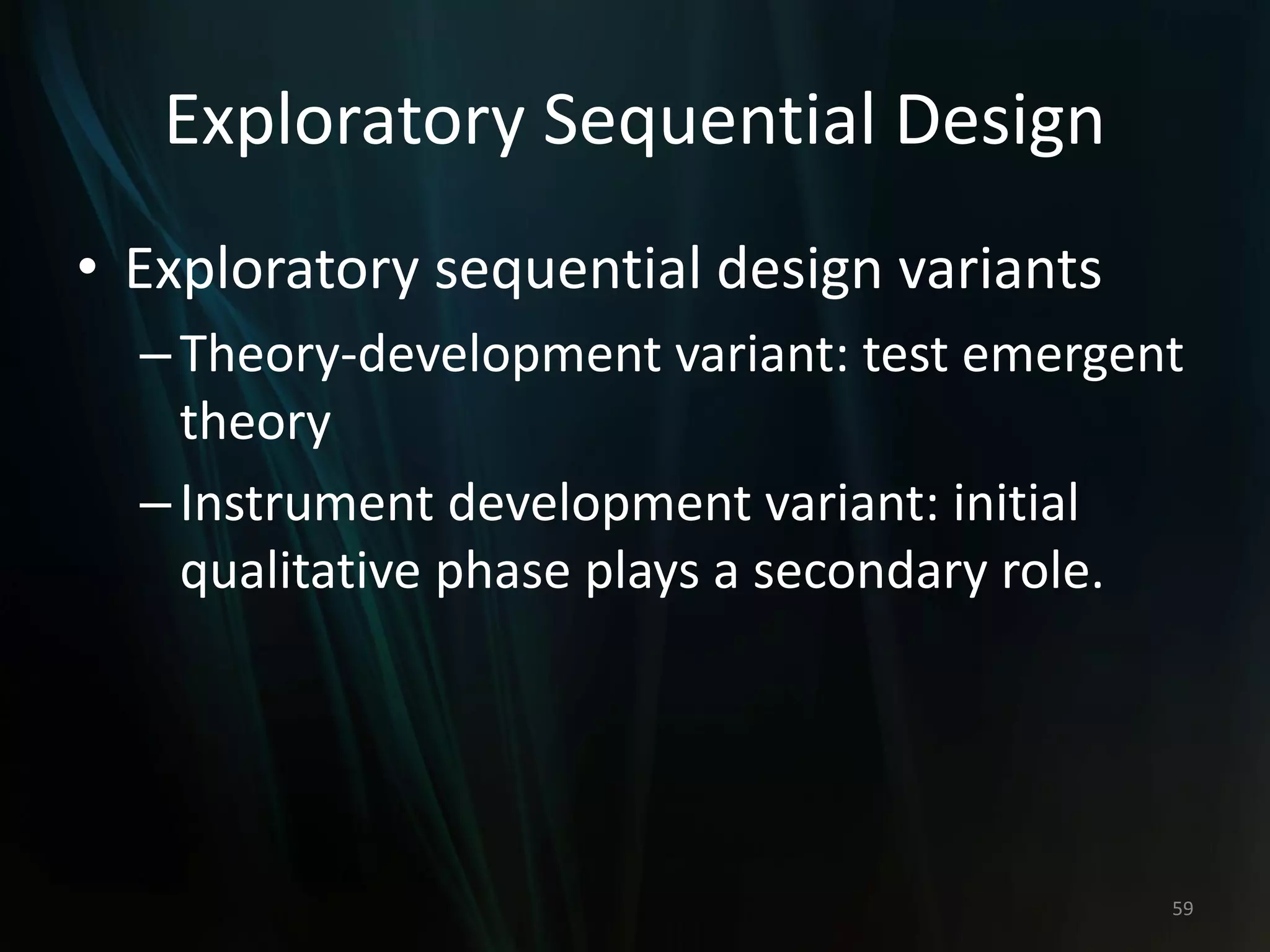
59.
Exploratory Sequential Design
•Exploratory sequential design variants
–Theory-development variant: test emergent
theory
–Instrument development variant: initial
qualitative phase plays a secondary role.
59
60.
Mixed Methods Research
•Major designs
–(4). Embedded design: purpose of this
design is to answer different questions
that requires different types of data.
60
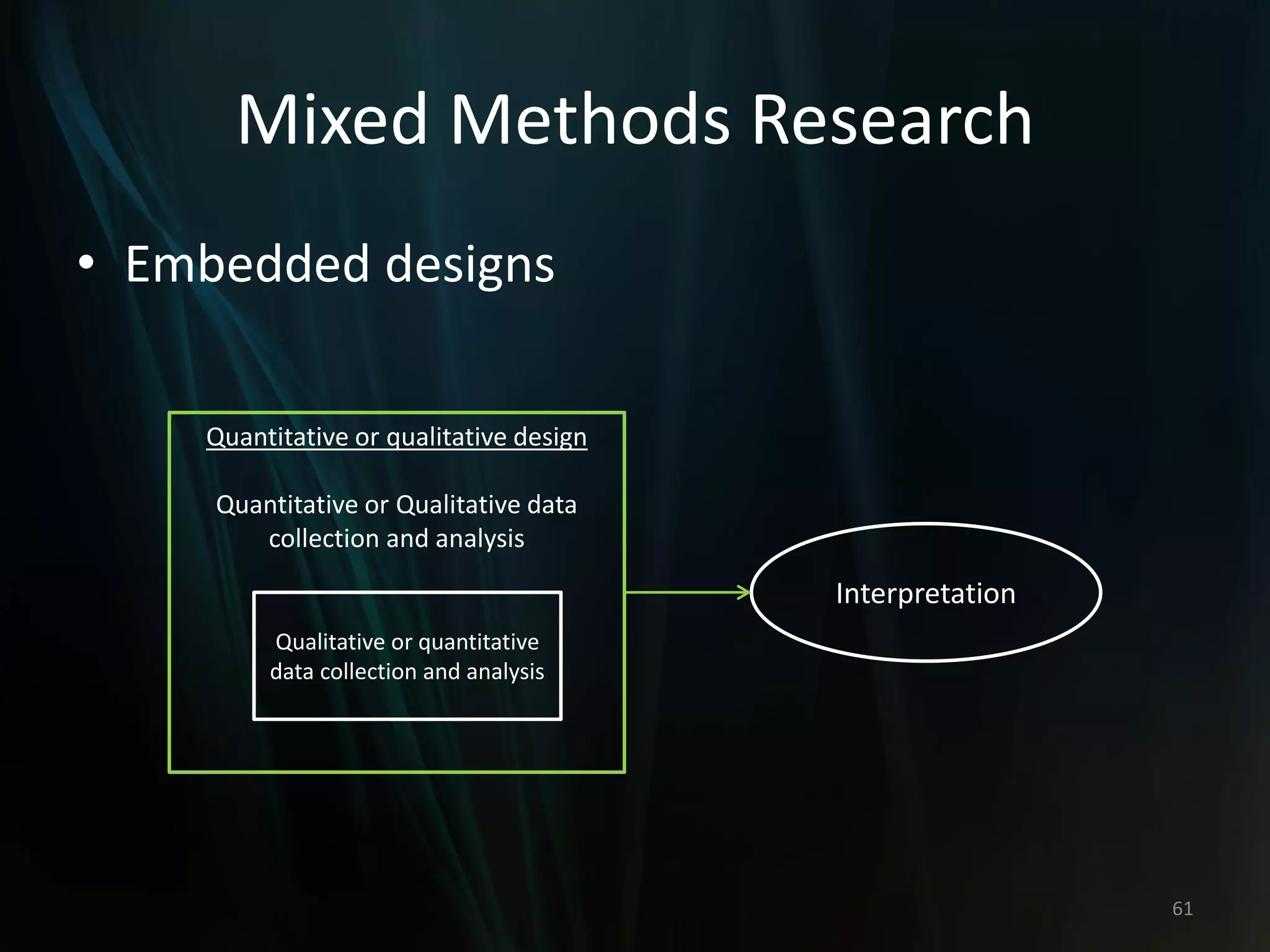
61.
Mixed Methods Research
•Embedded designs
61
Quantitative or qualitative design
Quantitative or Qualitative data
collection and analysis
Qualitative or quantitative
data collection and analysis
Interpretation
62.
Mixed Methods Research
•Embedded design
– A quantitative or qualitative data collection is
within a quantitative or qualitative procedure.
– A single data set is not enough.
– Two types of data answer different research
questions.
– The collection and analysis of the second data set
may occur before, during, and/or after the first
data collection.
62
63.
Mixed Methods Research
•Examples of embedded design: Qualitative
data in quantitative study:
– Develop an instrument in an intervention trial.
– Try to understand the impact of the intervention
on participants.
– Test long term effects of an intervention after a
trial.
63
Mixed Methods Research
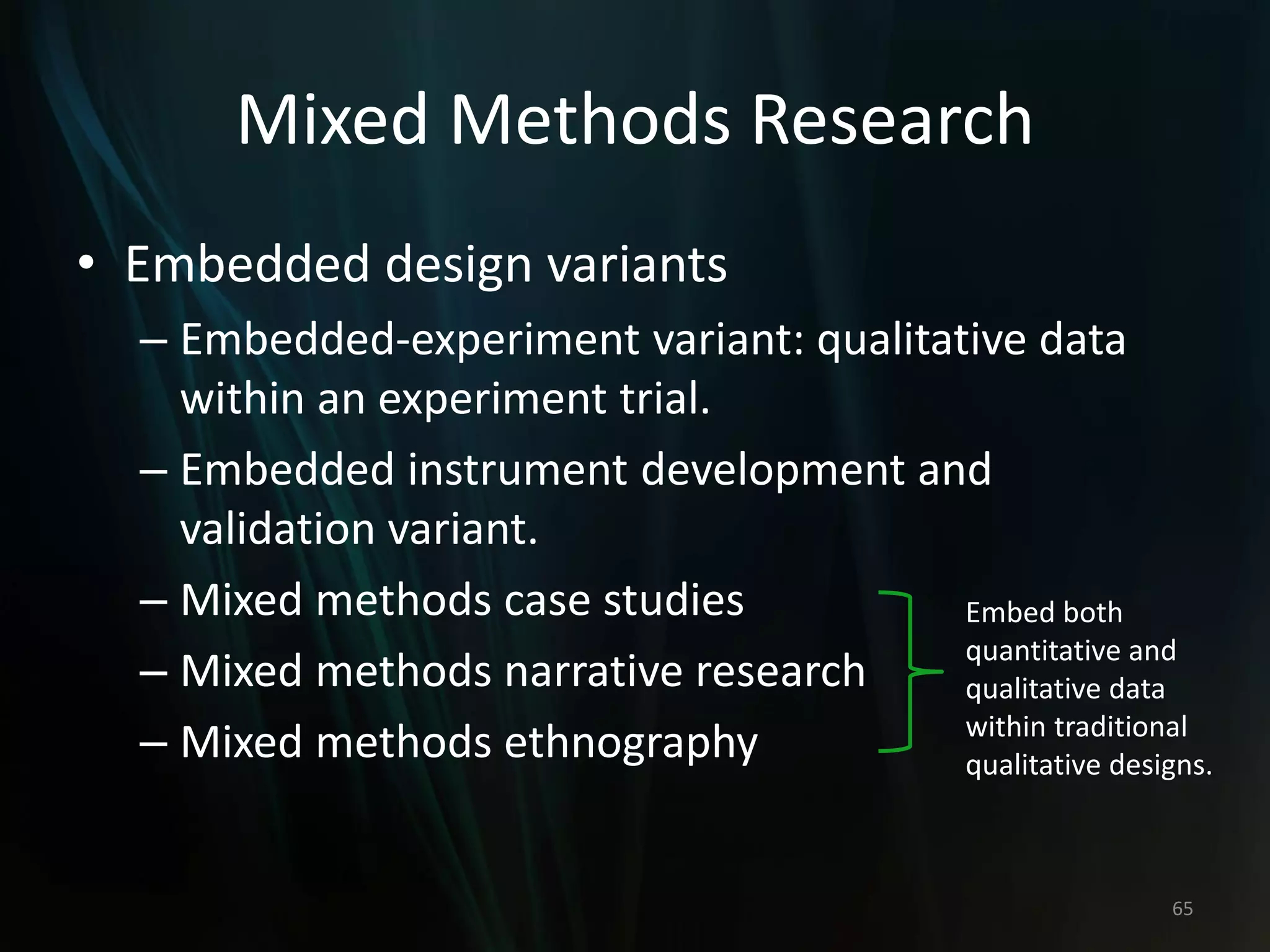
•Embedded design variants
– Embedded-experiment variant: qualitative data
within an experiment trial.
– Embedded instrument development and
validation variant.
– Mixed methods case studies
– Mixed methods narrative research
– Mixed methods ethnography
65
Embed both
quantitative and
qualitative data
within traditional
qualitative designs.
66.
Mixed Methods Research
•Published paper
– Victor, C. R., Ross, F., & Axford, J. (2004). Capturing
lay perspectives in a randomized control trial of a
health promotion intervention for people with
osteoarthritis of the knee. Journal of Evaluation in
Clinical Practice, 10(1), 63-70.
66
67.
Mixed Methods Research
•Major designs
– (5). Transformative design: the purpose of this
design is to address issues of social justice and call
for change for underrepresented or marginalized
populations.
• This design more relates to the content than to
the methodology.
• Is beyond first four basic mixed methods
designs mentioned before.
67
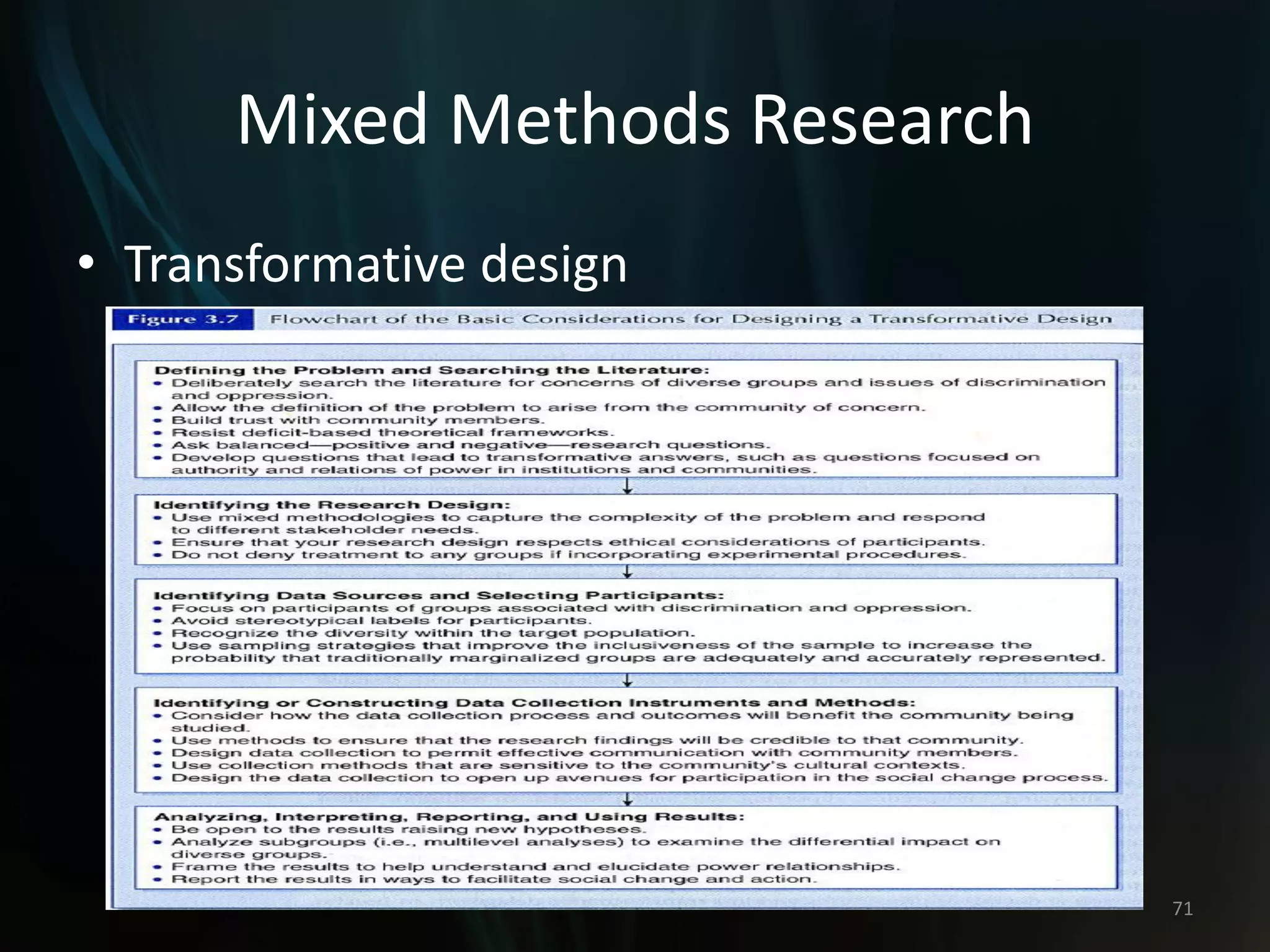
68.
Mixed Methods Research
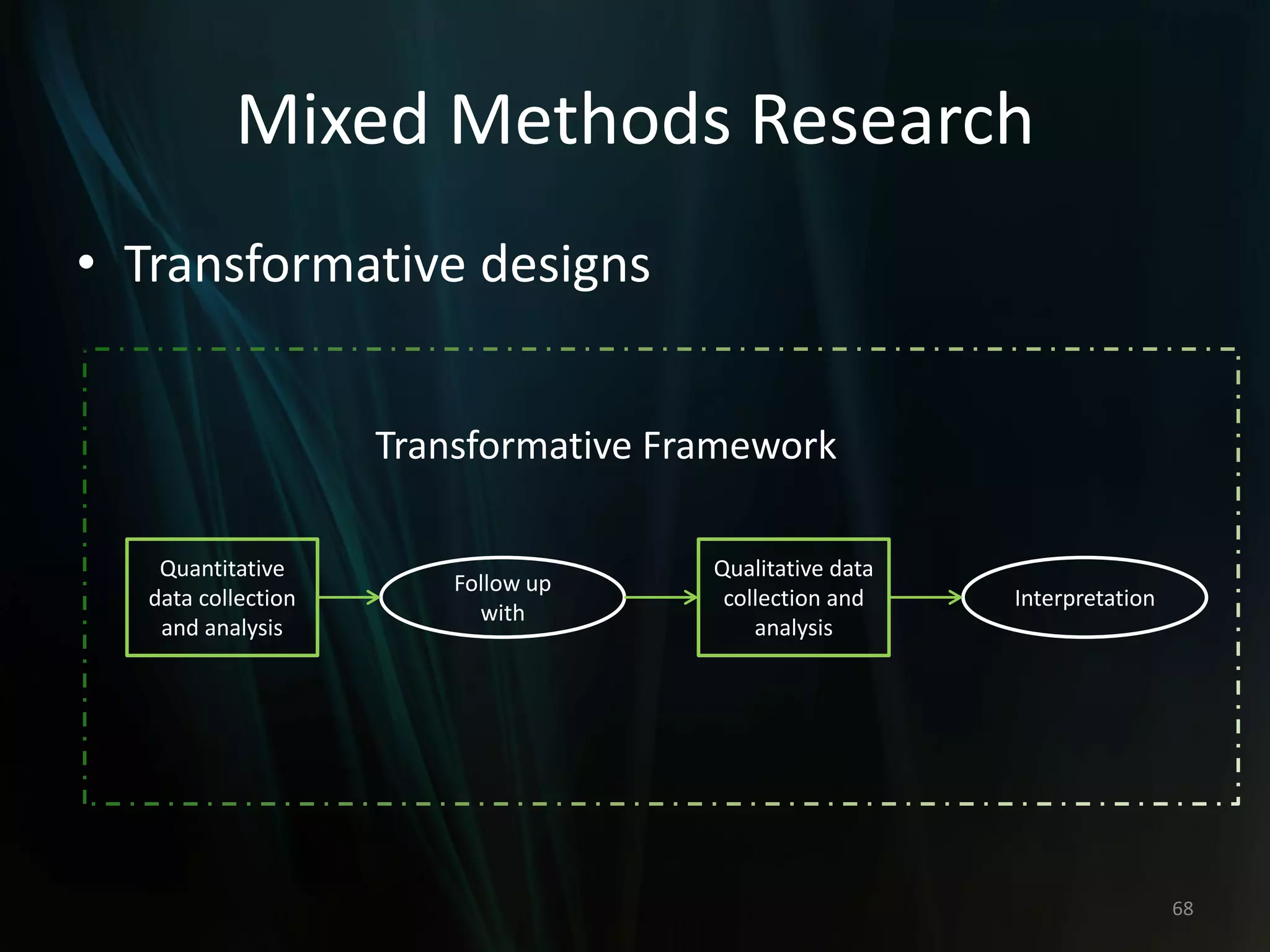
•Transformative designs
68
Quantitative
data collection
and analysis
Follow up
with
Qualitative data
collection and
analysis
Interpretation
Transformative Framework
69.
Mixed Methods Research
•Transformative Framework
–Is a framework for advancing the needs
of underrepresented or marginalized
populations.
–Such as: Feminist theory, racial or
ethnic theory, sexual orientation
theory, and disability theory.
69
70.
Mixed Methods Research
•Transformative design
– All decisions about interaction, priority, timing,
and mixing are made within the context of the
transformative framework.
– Researchers can implement any of four basic
mixed methods designs within the transformative
framework.
70
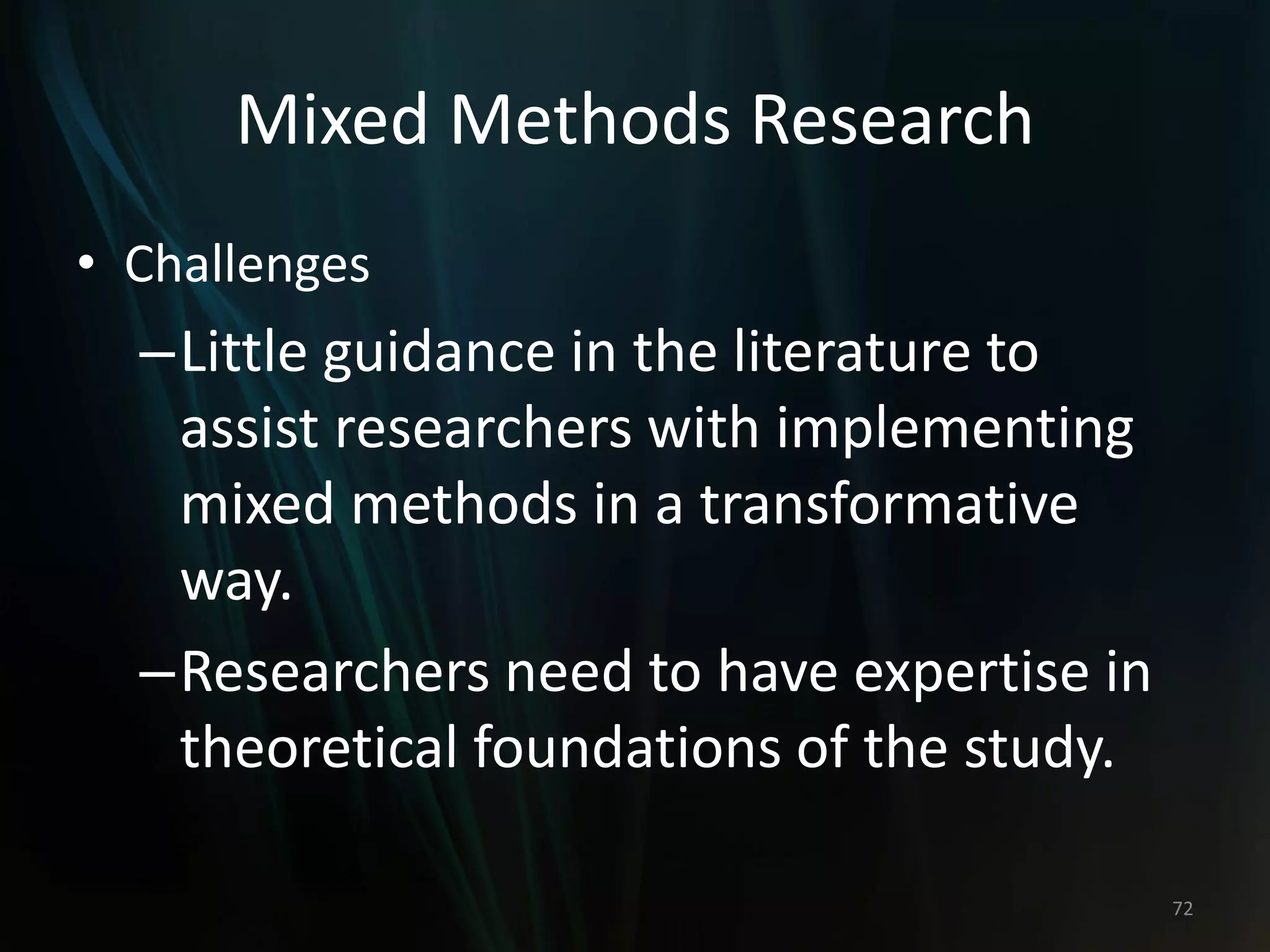
Mixed Methods Research
•Challenges
–Little guidance in the literature to
assist researchers with implementing
mixed methods in a transformative
way.
–Researchers need to have expertise in
theoretical foundations of the study.
72
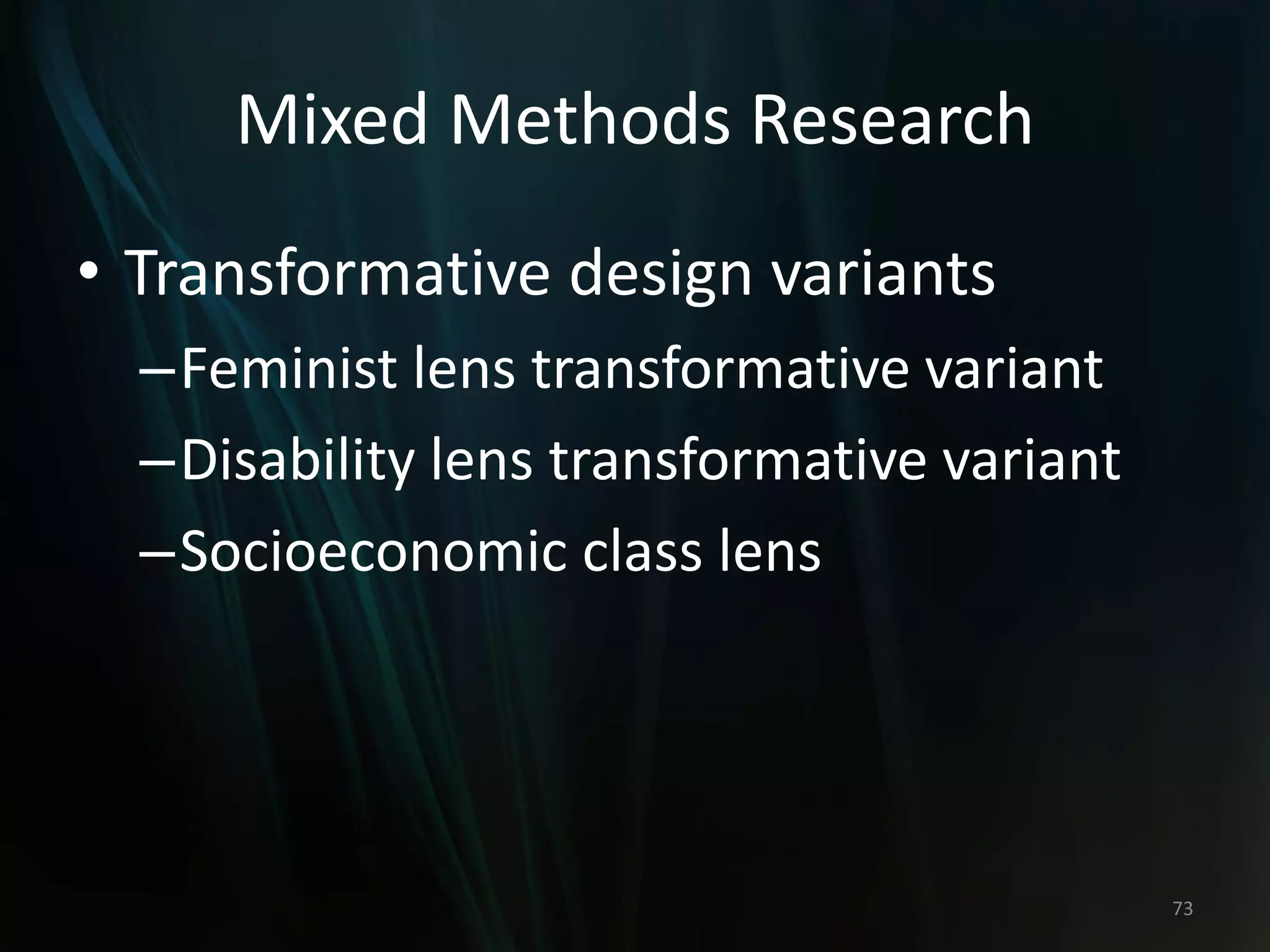
73.
Mixed Methods Research
•Transformative design variants
–Feminist lens transformative variant
–Disability lens transformative variant
–Socioeconomic class lens
73
74.
Mixed Methods Research
•Major designs
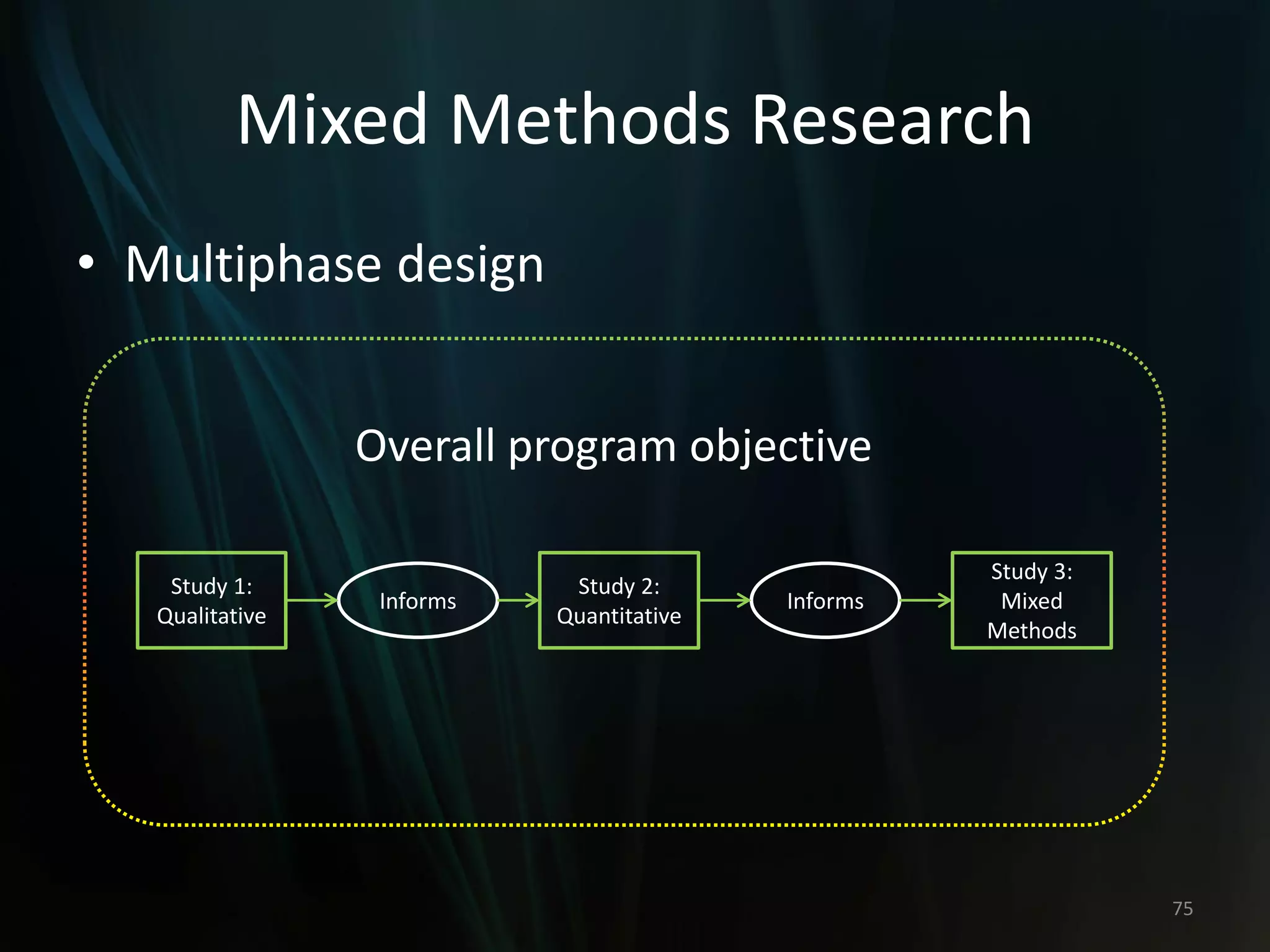
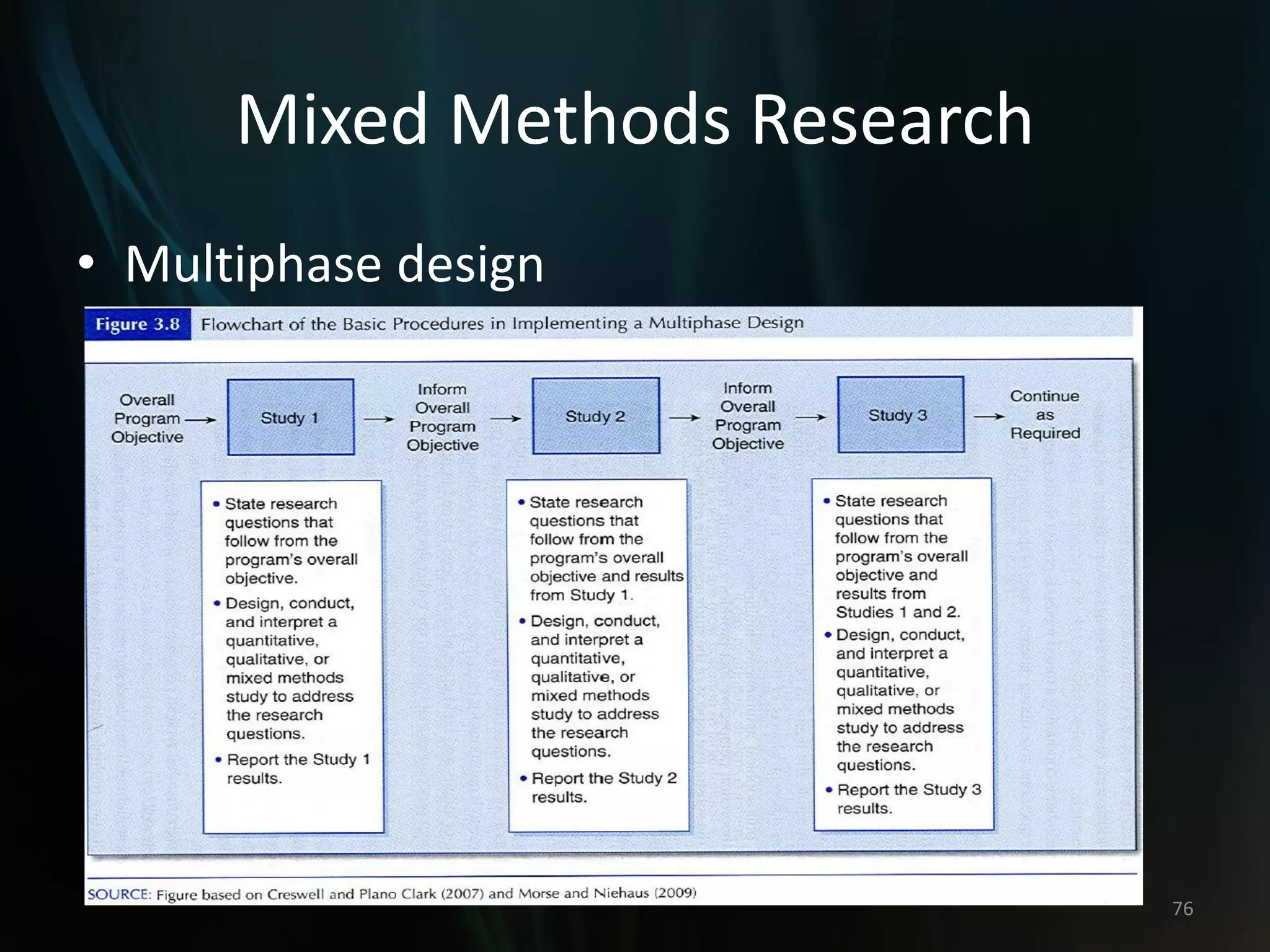
– (6). Multiphase: is an another example of a
mixed methods design that goes beyond
four basic designs.
• It is a combination of sequential and
concurrent aspects.
• Most common in large funded or
multiyear projects.
74
75.
Mixed Methods Research
•Multiphase design
75
Study 1:
Qualitative
Study 2:
Quantitative
Study 3:
Mixed
Methods
Informs Informs
Overall program objective
Mixed Methods Research
•Challenges
–Challenges associated with individual
concurrent and sequential designs.
–Needs sufficient resources, time, and effort.
–May need a research team to implement
research.
77
78.
Mixed Methods Research
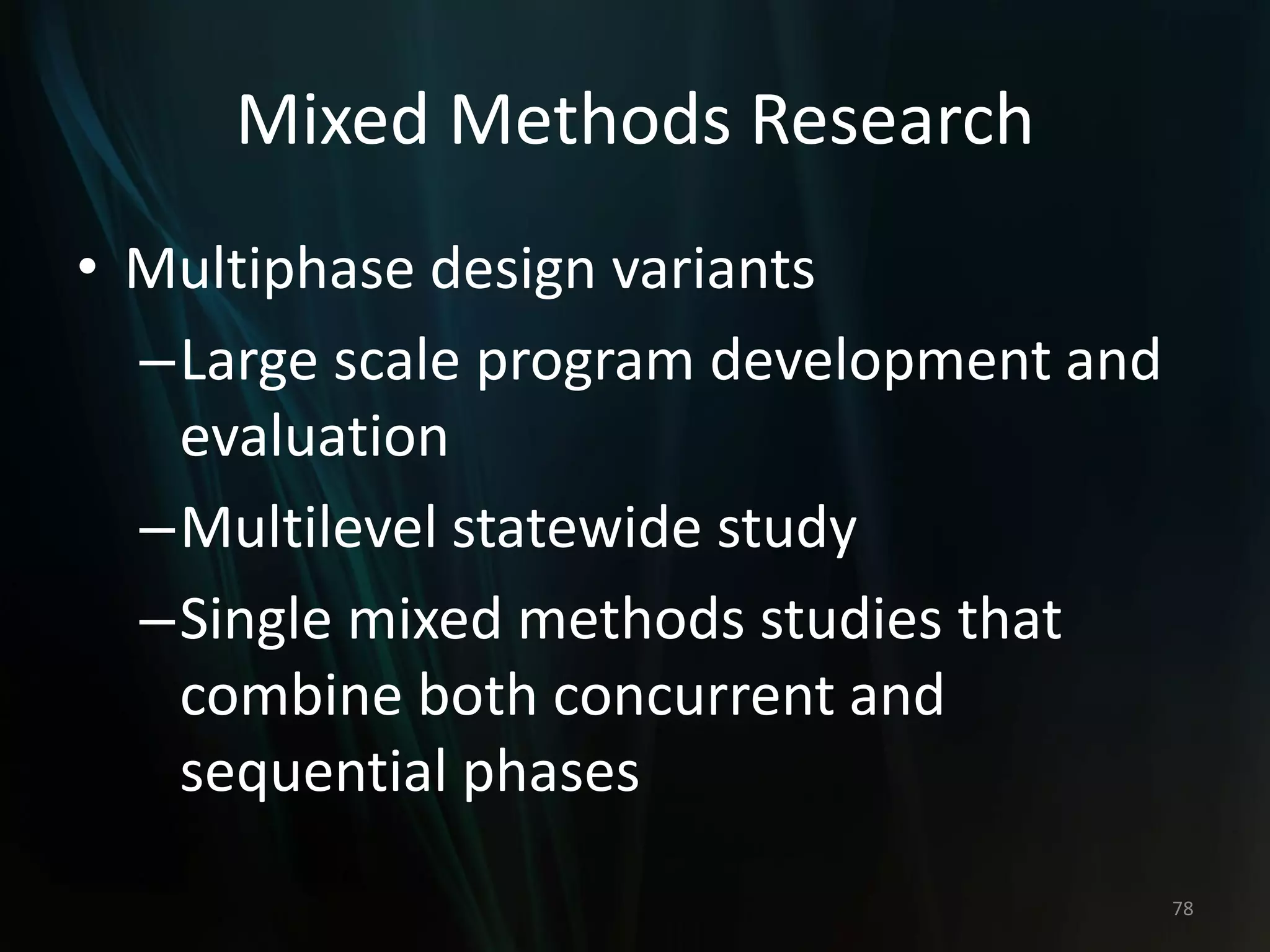
•Multiphase design variants
–Large scale program development and
evaluation
–Multilevel statewide study
–Single mixed methods studies that
combine both concurrent and
sequential phases
78
79.
Mixed Methods Research
•Resources
– International Congress for Qualitative Inquiry
Conference
– Mixed methods international conference
– Journal of Mixed Methods Research
– OBSSR (Office of Behavioral and Social Sciences
Research) from NIH : Scientific areas >
Methodology > Mixed Methods Research
79