Group Presentation: Starbucks
Presentation By:
Ng Yee Jie
Damian Lim Kwi Hoong
Chin Siow Lyn
Dr. Abdul Razak Rahman Hamzah
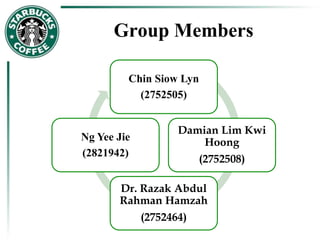
Group Members
Chin Siow Lyn
(2752505)
Damian Lim Kwi
Hoong
(2752508)
Dr. Razak Abdul
Rahman Hamzah
(2752464)
Ng Yee Jie
(2821942)
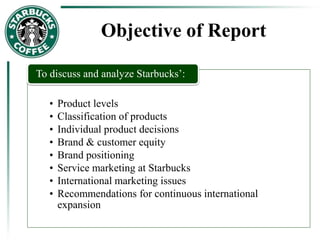
Objective of Report
• Product levels
• Classification of products
• Individual product decisions
• Brand & customer equity
• Brand positioning
• Service marketing at Starbucks
• International marketing issues
• Recommendations for continuous international
expansion
To discuss and analyze Starbucks’:
Starbucks…
Growth of an Empire
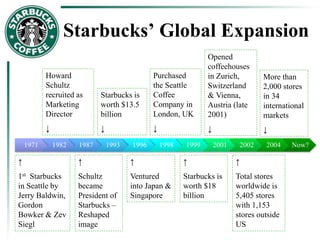
Starbucks’ Global Expansion
1971 1982 1987 1993 1996 1998 1999 2001 2002 2004 Now?
↑
1st Starbucks
in Seattle by
Jerry Baldwin,
Gordon
Bowker & Zev
Siegl
Howard
Schultz
recruited as
Marketing
Director
↓
↑
Schultz
became
President of
Starbucks –
Reshaped
image
Starbucks is
worth $13.5
billion
↓
↑
Ventured
into Japan &
Singapore
Purchased
the Seattle
Coffee
Company in
London, UK
↓
↑
Starbucks is
worth $18
billion
Opened
coffeehouses
in Zurich,
Switzerland
& Vienna,
Austria (late
2001)
↓
↑
Total stores
worldwide is
5,405 stores
with 1,153
stores outside
US
More than
2,000 stores
in 34
international
markets
↓
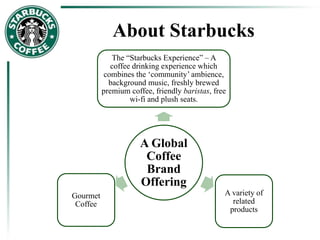
About Starbucks
A Global
Coffee
Brand
Offering
The “Starbucks Experience” – A
coffee drinking experience which
combines the ‘community’ ambience,
background music, freshly brewed
premium coffee, friendly baristas, free
wi-fi and plush seats.
A variety of
related
products
Gourmet
Coffee
Product Levels
Starbucks’ Product Levels
Questions to ponder…
 What is Starbucks’ core product?
 What are the actual and augmented levels of
that product?
Starbucks’ Product Levels
(Cont.)
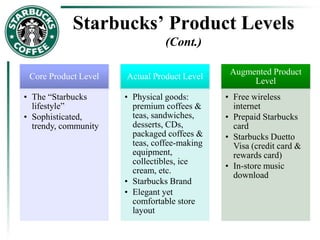
Core Product Level
• The “Starbucks
lifestyle”
• Sophisticated,
trendy, community
Actual Product Level
• Physical goods:
premium coffees &
teas, sandwiches,
desserts, CDs,
packaged coffees &
teas, coffee-making
equipment,
collectibles, ice
cream, etc.
• Starbucks Brand
• Elegant yet
comfortable store
layout
Augmented Product
Level
• Free wireless
internet
• Prepaid Starbucks
card
• Starbucks Duetto
Visa (credit card &
rewards card)
• In-store music
download
Starbucks’ Product Levels
(Cont.)
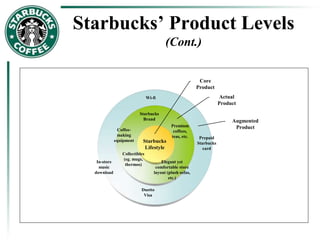
Augmented
Product
Actual
Product
Core
Product
Starbucks
Lifestyle
Wi-fi
Prepaid
Starbucks
card
Duetto
Visa
Starbucks
Brand
Premium
coffees,
teas, etc.
Coffee-
making
equipment
Collectibles
(eg. mugs,
thermos)
Elegant yet
comfortable store
layout (plush sofas,
etc.)
In-store
music
download
Product Classification
Starbucks’ Product
Classification
Question to ponder…
 What is the classification of Starbucks’
product, based on consumer marketing
concepts?
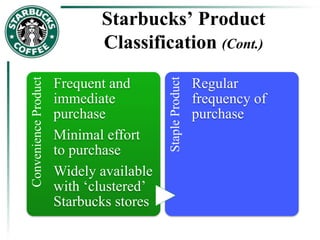
Starbucks’ Product
Classification (Cont.)
ConvenienceProduct
Frequent and
immediate
purchase
Minimal effort
to purchase
Widely available
with ‘clustered’
Starbucks stores
StapleProduct
Regular
frequency of
purchase
Individual Product Decisions
Question to ponder…
 What individual product decisions has
Starbucks made?
Individual Product
Decisions (Cont.)
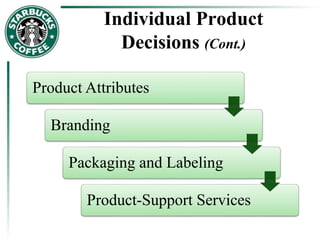
Product Attributes
Branding
Packaging and Labeling
Product-Support Services
Product Attributes
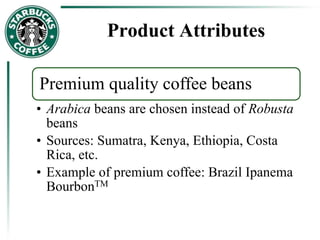
Premium quality coffee beans
• Arabica beans are chosen instead of Robusta
beans
• Sources: Sumatra, Kenya, Ethiopia, Costa
Rica, etc.
• Example of premium coffee: Brazil Ipanema
BourbonTM
Product Attributes (Cont.)
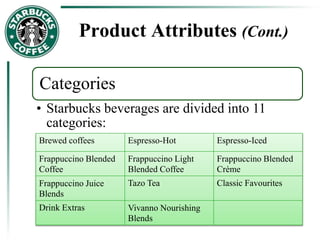
Categories
• Starbucks beverages are divided into 11
categories:
Brewed coffees Espresso-Hot Espresso-Iced
Frappuccino Blended
Coffee
Frappuccino Light
Blended Coffee
Frappuccino Blended
Crème
Frappuccino Juice
Blends
Tazo Tea Classic Favourites
Drink Extras Vivanno Nourishing
Blends
Product Attributes (Cont.)
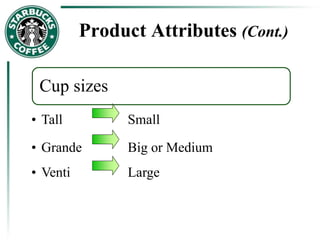
Cup sizes
• Tall Small
• Grande Big or Medium
• Venti Large
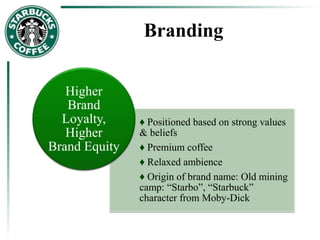
Branding
♦ Positioned based on strong values
& beliefs
♦ Premium coffee
♦ Relaxed ambience
♦ Origin of brand name: Old mining
camp: “Starbo”, “Starbuck”
character from Moby-Dick
Higher
Brand
Loyalty,
Higher
Brand Equity
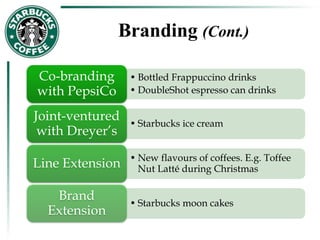
Branding (Cont.)
• Bottled Frappuccino drinks
• DoubleShot espresso can drinks
Co-branding
with PepsiCo
• Starbucks ice cream
Joint-ventured
with Dreyer’s
• New flavours of coffees. E.g. Toffee
Nut Latté during ChristmasLine Extension
• Starbucks moon cakes
Brand
Extension
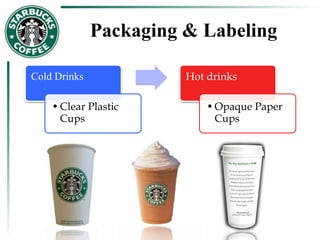
Packaging & Labeling
Cold Drinks
•Clear Plastic
Cups
Hot drinks
•Opaque Paper
Cups
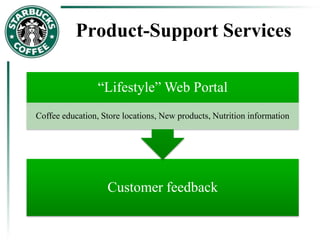
Product-Support Services
Customer feedback
“Lifestyle” Web Portal
Coffee education, Store locations, New products, Nutrition information
Brand Equity,
Customer Equity &
Brand Positioning
Brand Equity, Customer
Equity & Brand Positioning
Question to ponder…
 How does Starbucks deal with:
– Brand equity?
– Customer equity?
– Brand positioning?
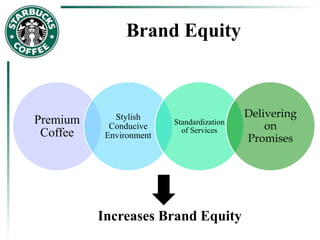
Brand Equity
Premium
Coffee
Stylish
Conducive
Environment
Standardization
of Services
Delivering
on
Promises
Increases Brand Equity
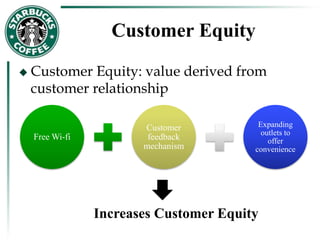
Customer Equity
 Customer Equity: value derived from
customer relationship
Free Wi-fi
Customer
feedback
mechanism
Expanding
outlets to
offer
convenience
Increases Customer Equity
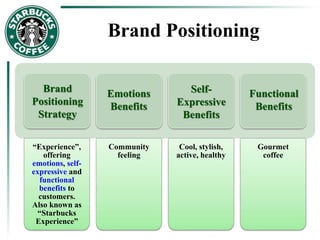
Brand Positioning
“Experience”,
offering
emotions, self-
expressive and
functional
benefits to
customers.
Also known as
“Starbucks
Experience”
Community
feeling
Cool, stylish,
active, healthy
Gourmet
coffee
Brand
Positioning
Strategy
Emotions
Benefits
Self-
Expressive
Benefits
Functional
Benefits
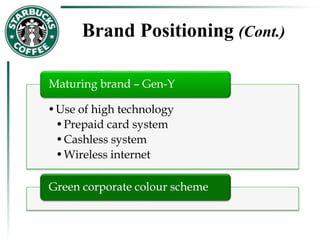
Brand Positioning (Cont.)
•Use of high technology
•Prepaid card system
•Cashless system
•Wireless internet
Maturing brand – Gen-Y
Green corporate colour scheme
Services Marketing
at Starbucks
Services Marketing at
Starbucks
Questions to ponder…
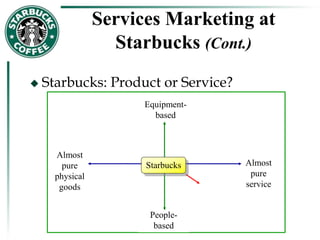
 Is Starbucks a product or a service?
 How are services marketing concepts
important to Starbucks?
Services Marketing at
Starbucks (Cont.)
 Starbucks: Product or Service?
Equipment-
based
People-
based
Almost
pure
service
Almost
pure
physical
goods
Starbucks
Services Marketing at
Starbucks (Cont.)
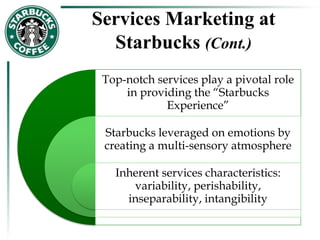
Top-notch services play a pivotal role
in providing the “Starbucks
Experience”
Starbucks leveraged on emotions by
creating a multi-sensory atmosphere
Inherent services characteristics:
variability, perishability,
inseparability, intangibility
Services Marketing Mix at
Starbucks
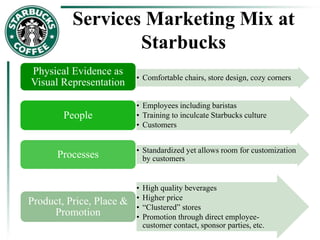
• Comfortable chairs, store design, cozy corners
Physical Evidence as
Visual Representation
• Employees including baristas
• Training to inculcate Starbucks culture
• Customers
People
• Standardized yet allows room for customization
by customersProcesses
• High quality beverages
• Higher price
• “Clustered” stores
• Promotion through direct employee-
customer contact, sponsor parties, etc.
Product, Price, Place &
Promotion
International
Marketing Issues
International Marketing
Issues
Question to ponder…
 How has Starbucks dealt with international
marketing issues?
International Marketing
Issues (Cont.)
Standardizing
the marketing
mix
International
supply chain
management
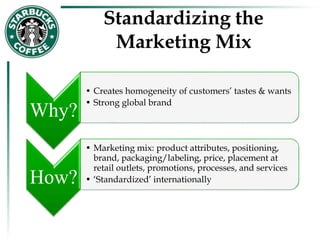
Standardizing the
Marketing Mix
Why?
• Creates homogeneity of customers’ tastes & wants
• Strong global brand
How?
• Marketing mix: product attributes, positioning,
brand, packaging/labeling, price, placement at
retail outlets, promotions, processes, and services
• ‘Standardized’ internationally
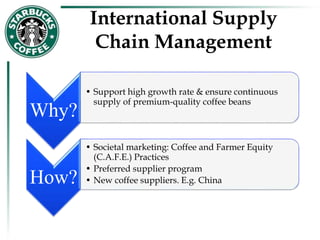
International Supply
Chain Management
Why?
• Support high growth rate & ensure continuous
supply of premium-quality coffee beans
How?
• Societal marketing: Coffee and Farmer Equity
(C.A.F.E.) Practices
• Preferred supplier program
• New coffee suppliers. E.g. China
Recommendations for
Continuous Global Expansion
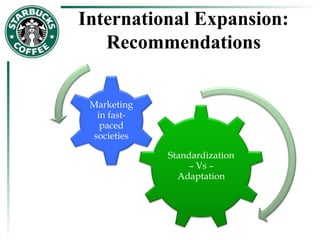
International Expansion:
Recommendations
Standardization
– Vs –
Adaptation
Marketing
in fast-
paced
societies
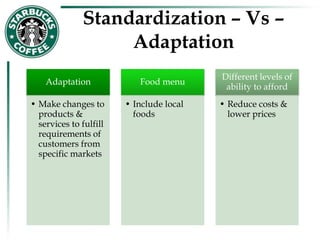
Standardization – Vs –
Adaptation
Adaptation
• Make changes to
products &
services to fulfill
requirements of
customers from
specific markets
Food menu
• Include local
foods
Different levels of
ability to afford
• Reduce costs &
lower prices
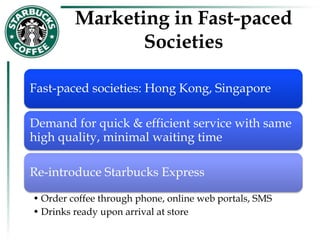
Marketing in Fast-paced
Societies
Fast-paced societies: Hong Kong, Singapore
Demand for quick & efficient service with same
high quality, minimal waiting time
Re-introduce Starbucks Express
• Order coffee through phone, online web portals, SMS
• Drinks ready upon arrival at store
Conclusion
Conclusion
 Reviewing branding and positioning
strategy to ensure relevance to current
markets
 Corporate social responsibility
 Staying relevant to the current generation:
Generation –Y
Thank You…
Q&A

Strategic Marketing: A Case Study of Starbucks