PHARMACEUTICAL INDUSTRY
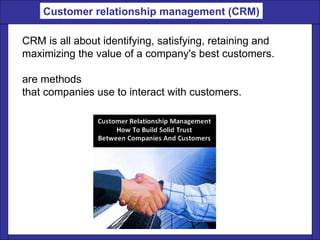
CRM is all about identifying, satisfying, retaining and  maximizing the value of a company's best customers. are methods that companies use to interact with customers. Customer relationship management (CRM)
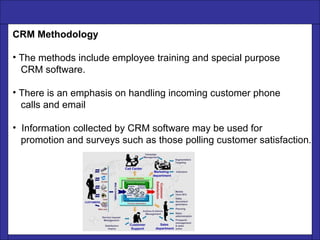
CRM Methodology  The methods include employee training and special purpose  CRM software.  There is an emphasis on handling incoming customer phone  calls and email Information collected by CRM software may be used for  promotion and surveys such as those polling customer satisfaction.
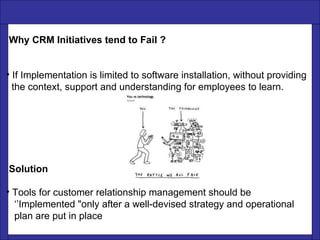
Why CRM Initiatives tend to Fail ? If Implementation is limited to software installation, without providing the context, support and understanding for employees to learn. Solution  Tools for customer relationship management should be ‘’ Implemented "only after a well-devised strategy and operational  plan are put in place
Types/variations of CRM  Operational CRM Operational CRM provides support to "front office’’ business  processes, e.g. to sales, marketing and service staff.  Interactions with customers are generally stored in customers'  contact histories, and staff can retrieve customer information as  necessary. Operational CRM processes customer data for : Managing campaigns Enterprise Marketing Automation Sales Force Automation Sales Management System
Analytical CRM Analytical CRM analyzes customer data for a variety of purposes: Designing and executing targeted marketing campaigns  Designing and executing campaigns, e.g. customer acquisition, cross-selling, up-selling, add-on-selling etc. Analyzing customer behavior in order to make decisions relating to products and services (e.g. pricing, product development)  Management information system (e.g. financial forecasting and customer profitability analysis) Types/variations of CRM
Sales Intelligence CRM Sales Intelligence CRM is similar to Analytical CRM, but is intended  as a more direct sales tool. Features include alerts sent to sales  staff regarding: Cross-selling/Up-selling/Switch-selling opportunities  Sales performance  Customer trends  Customer margins  Customer alignment Types/variations of CRM
Campaign Management Campaign management combines elements of Operational and  Analytical CRM.  Campaign management functions include: - Target groups formed from the client base according to selected  criteria.  Sending campaign-related material (e.g. on special offers) to  selected recipients using various channels (e.g. e-mail, telephone,  SMS, post)  -Tracking, storing, and analyzing campaign statistics, including  tracking responses and analyzing trends Types/variations of CRM
Collaborative CRM Collaborative CRM covers aspects of a company's dealings  with customers that are handled by various departments within a  company, such as sales, technical support and marketing.  Staff members from different departments can share information  collected when interacting with customers.  Eg.: Feedback received by customer support agents can  provide other staff members with information on the services  and features requested by customers.  Collaborative CRM's ultimate goal is to use information collected by  all departments to improve the quality of services provided by  the company Types/variations of CRM
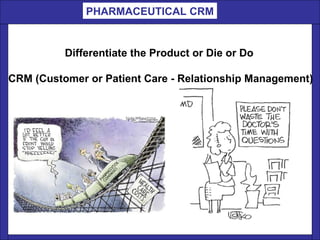
Differentiate the Product or Die or Do  CRM (Customer or Patient Care - Relationship Management)   PHARMACEUTICAL CRM
On the average, Pharmaceutical product development reaching  consumers after Phase III is a billion dollar investment,  takes 13 years and the product uniqueness patent expires in  15 years – Therefore difficult to create a product. Takes lot of money and time to take the product to consumers,  and ownership of the product expires sooner than any product  created for its uniqueness. CRM thus helps to get the most revenue from shelf life by reaching  more new prescribers (doctors) & patients (consumers), keeping them loyal by increasing their well being  Has the potential to innovate new products there by providing  competitive advantage to continue to thrive in the market and grow. Why is CRM Important for Pharmaceuticals ?
Customer Perspective : Fulfillment of product or service needs  New enhancements to products and services Quality of communication  Reward for better relationship The principles of  Pharmaceutical CRM
Operations perspective  Quality of interactive media and interactive  communications Right message, Right offer  Data capture and data utilization Customer intelligence  The principles of  Pharmaceutical CRM
Management perspective  Relationship level metrics  Products & services level intelligence  Revenue  Profitability  New Product development and penetration into the market  The principles of  Pharmaceutical CRM
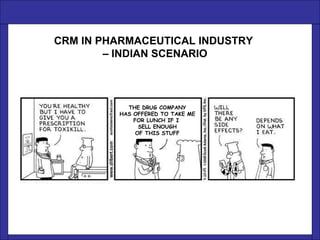
CRM IN PHARMACEUTICAL INDUSTRY  –  INDIAN SCENARIO THE DRUG COMPANY HAS OFFERED TO TAKE ME  FOR LUNCH IF I  SELL ENOUGH OF THIS STUFF
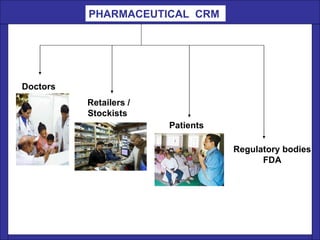
PHARMACEUTICAL  CRM  Doctors  Retailers / Stockists  Patients  Regulatory bodies FDA
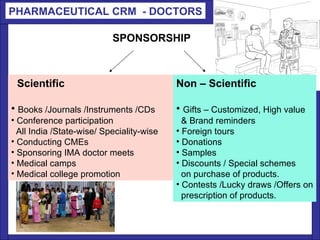
PHARMACEUTICAL CRM  - DOCTORS SPONSORSHIP  Scientific  Books /Journals /Instruments /CDs Conference participation All India /State-wise/ Speciality-wise Conducting CMEs Sponsoring IMA doctor meets Medical camps Medical college promotion Non – Scientific Gifts – Customized, High value & Brand reminders Foreign tours Donations Samples  Discounts / Special schemes on purchase of products. Contests /Lucky draws /Offers on prescription of products.
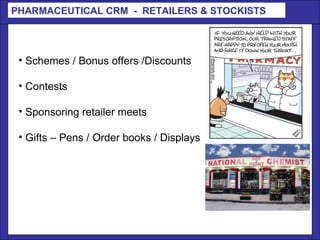
PHARMACEUTICAL CRM  -  RETAILERS & STOCKISTS Schemes / Bonus offers /Discounts Contests  Sponsoring retailer meets Gifts – Pens / Order books / Displays
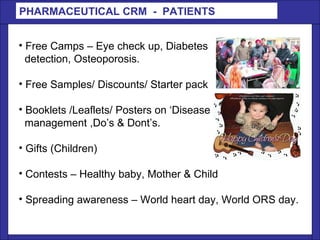
PHARMACEUTICAL CRM  -  PATIENTS  Free Camps – Eye check up, Diabetes detection, Osteoporosis. Free Samples/ Discounts/ Starter pack  Booklets /Leaflets/ Posters on ‘Disease management ,Do’s & Dont’s. Gifts (Children) Contests – Healthy baby, Mother & Child  Spreading awareness – World heart day, World ORS day.
Need to increase the profit potential from a strong  customer relationship. Deliver a superior customer service.  Improve customer retention rates.  Reduce time to market of new propositions.  Increase market share and revenue per customer.  Improve workforce productivity.  To establish a low cost communication link between the company  and its regular customers. Reasons driving Pharma Companies to adopt CRM :
Ability to provide faster response to customer inquires.  Having a deeper knowledge about the customers.  Reduced costs of sales and increased sales representative  productivity.  Receiving customer feedback that leads to new and improved product/s or services.  Doing more one-to-one marketing.  Benefits from CRM :
Provide best possible products and services to the customers. Be competitive. Be innovative in creating new products and services to suit  the dynamics of demographics and market conditions with assured  availability of continuity of products and services. Sell and service more with utmost details to the customer input and  customer relevance. The End results of CRM in pharmaceutical industry
An evolving e-physician community is resulting in effortless  communication and interaction with pharmaceutical companies.  Advantage of online physicians and patients; information gathering,  storing and retrieving, analyzing and reporting will become relatively easier.  Demand for tools to perform these tasks will emerge as the next spending priority for pharmaceutical companies in the  World Pharmaceutical CRM Market  Pharmaceutical Industry CRM – FUTURE Trend
  The CRM communications have to be fully approved by FDA  and the fulfillment requirements have to be strictly followed, implying the following:   - No over selling of the benefits, services, efficacy, or under selling  of toxicity due to the products. - There are no differences between the patient information that is  part of the medication package and the communications that come out in every little bit that are part of CRM implementation. 2. Privacy and confidentiality are foremost business rules the  companies have to uphold in terms of whatever the data companies  collect, however they use the data and share the data with any one for any legitimate purposes.      The critical factors for success that are unique to pharmaceutical CRM :
  3. Managing data, sharing data or letting a third party have the  data for analytical purposes, or for tele-services and  fulfillment purposes is very common in pharmaceutical industry as with any other industry. A careful solution need to be and  could be brought out where the confidentiality of patient information is not compromised. 4. Any reward or points mechanism and resulting CRM  communications strategy, content, relevance, and frequency  can not discriminate any sub population because their ROI  metrics are not favorable to the company. It becomes more  important and absolute necessity because it affects the  health needs of an individual. The critical factors for success that are unique to pharmaceutical CRM :
Thank You…

Pharma CRM

  • 1.
  • 2.
    CRM is allabout identifying, satisfying, retaining and maximizing the value of a company's best customers. are methods that companies use to interact with customers. Customer relationship management (CRM)
  • 3.
    CRM Methodology The methods include employee training and special purpose CRM software. There is an emphasis on handling incoming customer phone calls and email Information collected by CRM software may be used for promotion and surveys such as those polling customer satisfaction.
  • 4.
    Why CRM Initiativestend to Fail ? If Implementation is limited to software installation, without providing the context, support and understanding for employees to learn. Solution Tools for customer relationship management should be ‘’ Implemented "only after a well-devised strategy and operational plan are put in place
  • 5.
    Types/variations of CRM Operational CRM Operational CRM provides support to "front office’’ business processes, e.g. to sales, marketing and service staff. Interactions with customers are generally stored in customers' contact histories, and staff can retrieve customer information as necessary. Operational CRM processes customer data for : Managing campaigns Enterprise Marketing Automation Sales Force Automation Sales Management System
  • 6.
    Analytical CRM AnalyticalCRM analyzes customer data for a variety of purposes: Designing and executing targeted marketing campaigns Designing and executing campaigns, e.g. customer acquisition, cross-selling, up-selling, add-on-selling etc. Analyzing customer behavior in order to make decisions relating to products and services (e.g. pricing, product development) Management information system (e.g. financial forecasting and customer profitability analysis) Types/variations of CRM
  • 7.
    Sales Intelligence CRMSales Intelligence CRM is similar to Analytical CRM, but is intended as a more direct sales tool. Features include alerts sent to sales staff regarding: Cross-selling/Up-selling/Switch-selling opportunities Sales performance Customer trends Customer margins Customer alignment Types/variations of CRM
  • 8.
    Campaign Management Campaignmanagement combines elements of Operational and Analytical CRM. Campaign management functions include: - Target groups formed from the client base according to selected criteria. Sending campaign-related material (e.g. on special offers) to selected recipients using various channels (e.g. e-mail, telephone, SMS, post) -Tracking, storing, and analyzing campaign statistics, including tracking responses and analyzing trends Types/variations of CRM
  • 9.
    Collaborative CRM CollaborativeCRM covers aspects of a company's dealings with customers that are handled by various departments within a company, such as sales, technical support and marketing. Staff members from different departments can share information collected when interacting with customers. Eg.: Feedback received by customer support agents can provide other staff members with information on the services and features requested by customers. Collaborative CRM's ultimate goal is to use information collected by all departments to improve the quality of services provided by the company Types/variations of CRM
  • 10.
    Differentiate the Productor Die or Do CRM (Customer or Patient Care - Relationship Management)   PHARMACEUTICAL CRM
  • 11.
    On the average,Pharmaceutical product development reaching consumers after Phase III is a billion dollar investment, takes 13 years and the product uniqueness patent expires in 15 years – Therefore difficult to create a product. Takes lot of money and time to take the product to consumers, and ownership of the product expires sooner than any product created for its uniqueness. CRM thus helps to get the most revenue from shelf life by reaching more new prescribers (doctors) & patients (consumers), keeping them loyal by increasing their well being Has the potential to innovate new products there by providing competitive advantage to continue to thrive in the market and grow. Why is CRM Important for Pharmaceuticals ?
  • 12.
    Customer Perspective :Fulfillment of product or service needs New enhancements to products and services Quality of communication Reward for better relationship The principles of Pharmaceutical CRM
  • 13.
    Operations perspective Quality of interactive media and interactive communications Right message, Right offer Data capture and data utilization Customer intelligence The principles of Pharmaceutical CRM
  • 14.
    Management perspective Relationship level metrics Products & services level intelligence Revenue Profitability New Product development and penetration into the market The principles of Pharmaceutical CRM
  • 15.
    CRM IN PHARMACEUTICALINDUSTRY – INDIAN SCENARIO THE DRUG COMPANY HAS OFFERED TO TAKE ME FOR LUNCH IF I SELL ENOUGH OF THIS STUFF
  • 16.
    PHARMACEUTICAL CRM Doctors Retailers / Stockists Patients Regulatory bodies FDA
  • 17.
    PHARMACEUTICAL CRM - DOCTORS SPONSORSHIP Scientific Books /Journals /Instruments /CDs Conference participation All India /State-wise/ Speciality-wise Conducting CMEs Sponsoring IMA doctor meets Medical camps Medical college promotion Non – Scientific Gifts – Customized, High value & Brand reminders Foreign tours Donations Samples Discounts / Special schemes on purchase of products. Contests /Lucky draws /Offers on prescription of products.
  • 18.
    PHARMACEUTICAL CRM - RETAILERS & STOCKISTS Schemes / Bonus offers /Discounts Contests Sponsoring retailer meets Gifts – Pens / Order books / Displays
  • 19.
    PHARMACEUTICAL CRM - PATIENTS Free Camps – Eye check up, Diabetes detection, Osteoporosis. Free Samples/ Discounts/ Starter pack Booklets /Leaflets/ Posters on ‘Disease management ,Do’s & Dont’s. Gifts (Children) Contests – Healthy baby, Mother & Child Spreading awareness – World heart day, World ORS day.
  • 20.
    Need to increasethe profit potential from a strong customer relationship. Deliver a superior customer service. Improve customer retention rates. Reduce time to market of new propositions. Increase market share and revenue per customer. Improve workforce productivity. To establish a low cost communication link between the company and its regular customers. Reasons driving Pharma Companies to adopt CRM :
  • 21.
    Ability to providefaster response to customer inquires. Having a deeper knowledge about the customers. Reduced costs of sales and increased sales representative productivity. Receiving customer feedback that leads to new and improved product/s or services. Doing more one-to-one marketing. Benefits from CRM :
  • 22.
    Provide best possibleproducts and services to the customers. Be competitive. Be innovative in creating new products and services to suit the dynamics of demographics and market conditions with assured availability of continuity of products and services. Sell and service more with utmost details to the customer input and customer relevance. The End results of CRM in pharmaceutical industry
  • 23.
    An evolving e-physiciancommunity is resulting in effortless communication and interaction with pharmaceutical companies. Advantage of online physicians and patients; information gathering, storing and retrieving, analyzing and reporting will become relatively easier. Demand for tools to perform these tasks will emerge as the next spending priority for pharmaceutical companies in the World Pharmaceutical CRM Market Pharmaceutical Industry CRM – FUTURE Trend
  • 24.
      The CRMcommunications have to be fully approved by FDA and the fulfillment requirements have to be strictly followed, implying the following:  - No over selling of the benefits, services, efficacy, or under selling of toxicity due to the products. - There are no differences between the patient information that is part of the medication package and the communications that come out in every little bit that are part of CRM implementation. 2. Privacy and confidentiality are foremost business rules the companies have to uphold in terms of whatever the data companies collect, however they use the data and share the data with any one for any legitimate purposes.      The critical factors for success that are unique to pharmaceutical CRM :
  • 25.
      3. Managingdata, sharing data or letting a third party have the data for analytical purposes, or for tele-services and fulfillment purposes is very common in pharmaceutical industry as with any other industry. A careful solution need to be and could be brought out where the confidentiality of patient information is not compromised. 4. Any reward or points mechanism and resulting CRM communications strategy, content, relevance, and frequency can not discriminate any sub population because their ROI metrics are not favorable to the company. It becomes more important and absolute necessity because it affects the health needs of an individual. The critical factors for success that are unique to pharmaceutical CRM :
  • 26.