Starbucks: Delivering
Customer Service

Section G: Group 4
Executive Summary
•
•
•
•
•
•
•

Established in 1971, made public in 1992
Operates 5886 stores all over the world as of FY2002
11th consecutive year of 5% or higher sales growth
Continuously into retail expansion, product and service
expansion
Controlled supply chain to maintain coffee standards
Product Variety – Customized drinks
Specific target audience
•
•
•

Affluent
Well educated
White‐collar people
STARBUCKS - 1992
• Establishment of Brand
• Company became
public
• 140 stores in US
• Major sales from
Whole Bean Coffee
• Less number of Drink
Combinations
• Small customer base
(Affluent , Mid &
Upper class Prof.)
• Third Place, where Best
Quality coffee is served

STARBUCKS - 2002
• 4500 stores in US and
Internationally
• 77% of Sales from
beverages
• Product variety
• Slow and complex
process
• Customer Base (
Younger, Less-educated
and lower income
group)
• Image has changed to
‘Convenient Place’
Executive summary (Continued)
• Branding strategy
– Coffee
– Service
– Atmosphere
• Employee relationship
– Lowest employee turnover in the industry.
– Ranked 47th in the list of best places to work by Fortune
• Customer relationship
– Aim to become America’s “Third place”
– “Just say yes”
Executive summary (Continued)
Value Proposition
• To create an experience around the consumption of coffee, an
experience that people would weave into their lives
• To create an o uplifting experience in “Customer Intimacy”
• To create an ambience based on human spirit and need to get
people together.

Brand Image
•
•
•
•
•

Present Everywhere
Good Coffee on the run
Place to meet and move on
Convenience oriented
Accessible and consistent
Current issue
• Data Research: Changing customer perception
• Goal: Tie customer satisfaction to bottom line
• Is it correct that Starbucks diverted from customer
service to retail expansion and product
diversification ?
• Whether to invest $40 million in 4500 stores?
• Can it be believed what customers are telling about
what constitutes ‘ excellent’ customer service ?
• Heaviest users are most demanding. Customization
lead to slow down of service ?
The Mystery Shopper
•
•
•
•

Service
Cleanliness
Product Quality
Speed of Service

Over the time, snapshot method is showing
increased positive results.
Competition
• Each competitor differentiated in atleast
one factor
• Special attention to the Dunkin Donuts chain

Retail Expansion
The company considered itself a growth company due
to following reasons:
• No presence in 8 states
• Increasing coffee consumption
• Saturation level not yet reached.
A look into the issues
• New Customer Baseline
• Values of starbucks was not efficiently visible to
customers
• Direct link between customer satisfaction and
customer loyalty
• Most frequent feedback found to be “increase in
service speed”
Declining Customer Satisfaction

• Customer satisfaction gap could primarily be attributed
to a service gap between Starbucks scores on key
attributes and customer expectations
• Premium Starbuck Experience was gone, as now it was
the product for everybody
• High waiting time due to customized drinks
• Increased Competition from Small Specialty stores
• Customer intimacy did not exist anymore
Despite minute flaws in the research methods, customer satisfaction
has declined due to changing expectations of the new customer base
and actual service decline.
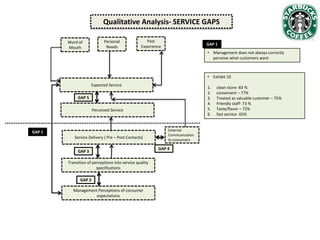
Qualitative Analysis- SERVICE GAPS
Personal
Needs

Word of
Mouth

Past
Experience

GAP 1
• Management does not always correctly
perceive what customers want

• Exhibit 10
Expected Service

1.
2.
3.
4.
5.
6.

GAP 5
Perceived Service

GAP 1
Service Delivery ( Pre – Post Contacts)
GAP 3
Transition of perceptions into service quality
specifications
GAP 2
Management Perceptions of consumer
expectations

External
Communication
to consumers

GAP 4

clean store- 83 %
convenient – 77%
Treated as valuable customer – 75%
Friendly staff- 73 %
Taste/flavor – 72%
fast service- 65%
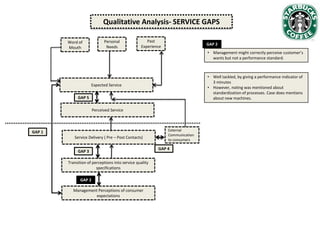
Qualitative Analysis- SERVICE GAPS
Personal
Needs

Word of
Mouth

Past
Experience

GAP 2
• Management might correctly perceive customer’s
wants but not a performance standard.

• Well tackled, by giving a performance indicator of
3 minutes
• However, noting was mentioned about
standardization of processes. Case does mentions
about new machines.

Expected Service
GAP 5
Perceived Service

GAP 1
Service Delivery ( Pre – Post Contacts)
GAP 3
Transition of perceptions into service quality
specifications
GAP 2
Management Perceptions of consumer
expectations

External
Communication
to consumers

GAP 4
Qualitative Analysis- SERVICE GAPS
Personal
Needs

Word of
Mouth

Past
Experience

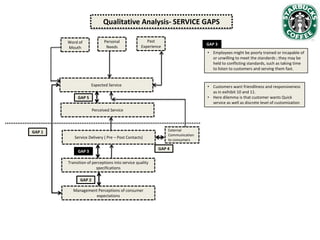
GAP 3
• Employees might be poorly trained or incapable of
or unwilling to meet the standards ; they may be
held to conflicting standards, such as taking time
to listen to customers and serving them fast.

Expected Service

• Customers want friendliness and responsiveness
as in exihibit 10 and 11.
• Here dilemma is that customer wants Quick
service as well as discrete level of customization

GAP 5
Perceived Service

GAP 1
Service Delivery ( Pre – Post Contacts)
GAP 3
Transition of perceptions into service quality
specifications
GAP 2
Management Perceptions of consumer
expectations

External
Communication
to consumers

GAP 4
Qualitative Analysis- SERVICE GAPS
Personal
Needs

Word of
Mouth

Past
Experience

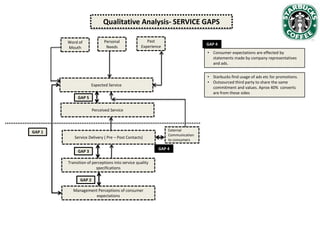
GAP 4
• Consumer expectations are effected by
statements made by company representatives
and ads.
• Starbucks find usage of ads etc for promotions.
• Outsourced third party to share the same
commitment and values. Aprox 40% converts
are from these sides

Expected Service
GAP 5
Perceived Service

GAP 1
Service Delivery ( Pre – Post Contacts)
GAP 3
Transition of perceptions into service quality
specifications
GAP 2
Management Perceptions of consumer
expectations

External
Communication
to consumers

GAP 4
Qualitative Analysis- SERVICE GAPS
Personal
Needs

Word of
Mouth

Past
Experience

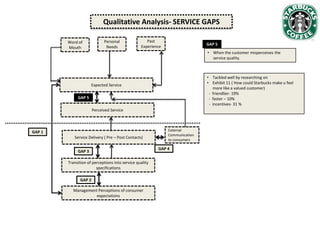
GAP 5
• When the customer misperceives the
service quality.

• Tackled well by researching on
• Exhibit 11 ( How could Starbucks make u feel
more like a valued customer)
- friendlier- 19%
- faster – 10%
- incentives- 31 %

Expected Service
GAP 5
Perceived Service

GAP 1
Service Delivery ( Pre – Post Contacts)
GAP 3
Transition of perceptions into service quality
specifications
GAP 2
Management Perceptions of consumer
expectations

External
Communication
to consumers

GAP 4
Quantitative analysis
• Opportunity Cost
PRIMARY DATA (Present)
–
–
–
–
–

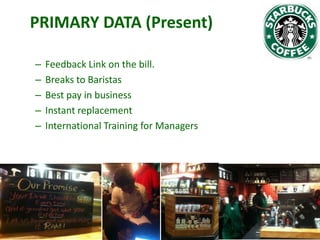
Feedback Link on the bill.
Breaks to Baristas
Best pay in business
Instant replacement
International Training for Managers
Primary Survey
• All employees trained for 1 month before joining: Managers go to
Malaysia
• Other employees trained in Gurgaon
• Loyalty Cards will be introduced soon.
• Customer feedback taken in store through Random Sampling, online.
• Weekly internal and Monthly external Audits
• STARBUCKS PHILOSOPHY: "PRESERVE AND NURTURE THE HUMAN
SPIRIT, ONE PERSON, ONE CUP, ONE NEIGHBORHOOD AT A TIME".
• Customer voice survey (customer feebdack program) started 2.5 months
ago.
• Attrition rate is 7%
• Structure of Outlet: Shift Mgr>Asst. Store Mgr>Store Mgr>Area
Mrg>District Mgr
• Staff Rotation is very common (All over Delhi)
CSS
Sheet
Thank You

Starbucks: Brand offering and Positioning

  • 1.
  • 2.
    Executive Summary • • • • • • • Established in1971, made public in 1992 Operates 5886 stores all over the world as of FY2002 11th consecutive year of 5% or higher sales growth Continuously into retail expansion, product and service expansion Controlled supply chain to maintain coffee standards Product Variety – Customized drinks Specific target audience • • • Affluent Well educated White‐collar people
  • 3.
    STARBUCKS - 1992 •Establishment of Brand • Company became public • 140 stores in US • Major sales from Whole Bean Coffee • Less number of Drink Combinations • Small customer base (Affluent , Mid & Upper class Prof.) • Third Place, where Best Quality coffee is served STARBUCKS - 2002 • 4500 stores in US and Internationally • 77% of Sales from beverages • Product variety • Slow and complex process • Customer Base ( Younger, Less-educated and lower income group) • Image has changed to ‘Convenient Place’
  • 4.
    Executive summary (Continued) •Branding strategy – Coffee – Service – Atmosphere • Employee relationship – Lowest employee turnover in the industry. – Ranked 47th in the list of best places to work by Fortune • Customer relationship – Aim to become America’s “Third place” – “Just say yes”
  • 5.
    Executive summary (Continued) ValueProposition • To create an experience around the consumption of coffee, an experience that people would weave into their lives • To create an o uplifting experience in “Customer Intimacy” • To create an ambience based on human spirit and need to get people together. Brand Image • • • • • Present Everywhere Good Coffee on the run Place to meet and move on Convenience oriented Accessible and consistent
  • 6.
    Current issue • DataResearch: Changing customer perception • Goal: Tie customer satisfaction to bottom line • Is it correct that Starbucks diverted from customer service to retail expansion and product diversification ? • Whether to invest $40 million in 4500 stores? • Can it be believed what customers are telling about what constitutes ‘ excellent’ customer service ? • Heaviest users are most demanding. Customization lead to slow down of service ?
  • 7.
    The Mystery Shopper • • • • Service Cleanliness ProductQuality Speed of Service Over the time, snapshot method is showing increased positive results.
  • 8.
    Competition • Each competitordifferentiated in atleast one factor • Special attention to the Dunkin Donuts chain Retail Expansion The company considered itself a growth company due to following reasons: • No presence in 8 states • Increasing coffee consumption • Saturation level not yet reached.
  • 9.
    A look intothe issues • New Customer Baseline • Values of starbucks was not efficiently visible to customers • Direct link between customer satisfaction and customer loyalty • Most frequent feedback found to be “increase in service speed”
  • 10.
    Declining Customer Satisfaction •Customer satisfaction gap could primarily be attributed to a service gap between Starbucks scores on key attributes and customer expectations • Premium Starbuck Experience was gone, as now it was the product for everybody • High waiting time due to customized drinks • Increased Competition from Small Specialty stores • Customer intimacy did not exist anymore Despite minute flaws in the research methods, customer satisfaction has declined due to changing expectations of the new customer base and actual service decline.
  • 11.
    Qualitative Analysis- SERVICEGAPS Personal Needs Word of Mouth Past Experience GAP 1 • Management does not always correctly perceive what customers want • Exhibit 10 Expected Service 1. 2. 3. 4. 5. 6. GAP 5 Perceived Service GAP 1 Service Delivery ( Pre – Post Contacts) GAP 3 Transition of perceptions into service quality specifications GAP 2 Management Perceptions of consumer expectations External Communication to consumers GAP 4 clean store- 83 % convenient – 77% Treated as valuable customer – 75% Friendly staff- 73 % Taste/flavor – 72% fast service- 65%
  • 12.
    Qualitative Analysis- SERVICEGAPS Personal Needs Word of Mouth Past Experience GAP 2 • Management might correctly perceive customer’s wants but not a performance standard. • Well tackled, by giving a performance indicator of 3 minutes • However, noting was mentioned about standardization of processes. Case does mentions about new machines. Expected Service GAP 5 Perceived Service GAP 1 Service Delivery ( Pre – Post Contacts) GAP 3 Transition of perceptions into service quality specifications GAP 2 Management Perceptions of consumer expectations External Communication to consumers GAP 4
  • 13.
    Qualitative Analysis- SERVICEGAPS Personal Needs Word of Mouth Past Experience GAP 3 • Employees might be poorly trained or incapable of or unwilling to meet the standards ; they may be held to conflicting standards, such as taking time to listen to customers and serving them fast. Expected Service • Customers want friendliness and responsiveness as in exihibit 10 and 11. • Here dilemma is that customer wants Quick service as well as discrete level of customization GAP 5 Perceived Service GAP 1 Service Delivery ( Pre – Post Contacts) GAP 3 Transition of perceptions into service quality specifications GAP 2 Management Perceptions of consumer expectations External Communication to consumers GAP 4
  • 14.
    Qualitative Analysis- SERVICEGAPS Personal Needs Word of Mouth Past Experience GAP 4 • Consumer expectations are effected by statements made by company representatives and ads. • Starbucks find usage of ads etc for promotions. • Outsourced third party to share the same commitment and values. Aprox 40% converts are from these sides Expected Service GAP 5 Perceived Service GAP 1 Service Delivery ( Pre – Post Contacts) GAP 3 Transition of perceptions into service quality specifications GAP 2 Management Perceptions of consumer expectations External Communication to consumers GAP 4
  • 15.
    Qualitative Analysis- SERVICEGAPS Personal Needs Word of Mouth Past Experience GAP 5 • When the customer misperceives the service quality. • Tackled well by researching on • Exhibit 11 ( How could Starbucks make u feel more like a valued customer) - friendlier- 19% - faster – 10% - incentives- 31 % Expected Service GAP 5 Perceived Service GAP 1 Service Delivery ( Pre – Post Contacts) GAP 3 Transition of perceptions into service quality specifications GAP 2 Management Perceptions of consumer expectations External Communication to consumers GAP 4
  • 16.
  • 17.
    PRIMARY DATA (Present) – – – – – FeedbackLink on the bill. Breaks to Baristas Best pay in business Instant replacement International Training for Managers
  • 18.
    Primary Survey • Allemployees trained for 1 month before joining: Managers go to Malaysia • Other employees trained in Gurgaon • Loyalty Cards will be introduced soon. • Customer feedback taken in store through Random Sampling, online. • Weekly internal and Monthly external Audits • STARBUCKS PHILOSOPHY: "PRESERVE AND NURTURE THE HUMAN SPIRIT, ONE PERSON, ONE CUP, ONE NEIGHBORHOOD AT A TIME". • Customer voice survey (customer feebdack program) started 2.5 months ago. • Attrition rate is 7% • Structure of Outlet: Shift Mgr>Asst. Store Mgr>Store Mgr>Area Mrg>District Mgr • Staff Rotation is very common (All over Delhi) CSS Sheet
  • 19.